Get in touch with Guangzhou Toplay amusement equipment co. Company

Trampoline Park Equipment for Commercial Indoor Parks and Family Entertainment Centers
- Floor-plan-led court design
- Attraction mix set against clear height and column grid
- Commercial scope fixed in a written quotation
- Every product we build is customizable
Trampoline park equipment is bought from a floor plan, not from a catalogue page. Send us your dimensions and what comes back is a court layout built on your column grid and your clear height. We manufacture the steel, the beds, the padding and the netting on our own line.
Send the site drawing and measured dimensions you have. The first review identifies the missing inputs before a court layout is prepared.
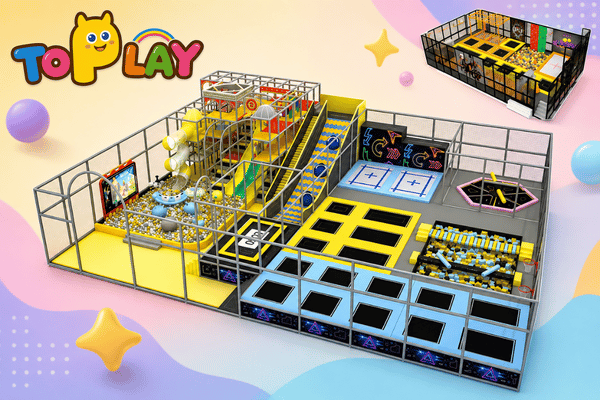
Trampoline Park Equipment We Manufacture
A commercial trampoline park is a set of attractions sharing one welded steel structure, not a room full of separate products. Fix the attraction mix first and the structure follows; fix the structure first and you pay to redesign it.
Attractions we build, and what each one asks of the building
Attraction
What it is
What it demands from the site
Free jump court
Grid of connected beds with padded bedrails between them
Largest single clear-height footprint on the floor
Slam dunk lanes
Angled approach beds facing adjustable basketball hoops
Height above the hoop, plus run-off behind the landing
Trampoline dodgeball court
Enclosed court with netted or padded end walls
Perimeter containment on all four sides
Foam pit
Loose foam cubes over a fail-safe sub-bed
Excavated or framed depth below the jump surface
Airbag landing
Inflated landing surface fed by a continuous blower
Power supply, blower housing, service access
Ninja course
Obstacle line over matting or water
Long narrow runs, often along a wall
Climbing wall
Auto-belay or low-height climbing panels
Anchorage into the building, or a free-standing frame
Drop slide
Vertical or near-vertical descent onto matting
Elevated platform and its access stair
Zip line
Overhead line with a braked landing
Uninterrupted length and two anchor points
Performance trampoline
Higher-response beds for skilled users
Greatest overhead clearance of any attraction
Interactive and AR games
Projection or sensor games mapped onto beds and walls
Lighting control, network, projector mounting
Toddler zone
Low-rebound beds and soft play separated from the main court
Sightlines from a seating area for parents
Soft play structures
Multi-level padded play frames
Vertical volume rather than floor area
Adventure park add-ons
Ropes, balance and agility elements
Usually the leftover volume other attractions cannot use
Custom Trampoline Park Design and Manufacture
Every product we build is customizable, and on a trampoline park that is not a slogan about colour. Your court perimeter follows your column grid, your bed count follows your target simultaneous capacity, and your attraction mix follows your catchment.
- Court outline and bed grid drawn to your measured plan
- Attraction mix and adjacency selected against your target age profile
- Padding, netting and bed colours matched to your theme
- Graphics, signage panels and branded surfaces produced with the structure
- Staged build-outs, where phase two attaches to phase one without rebuilding the frame
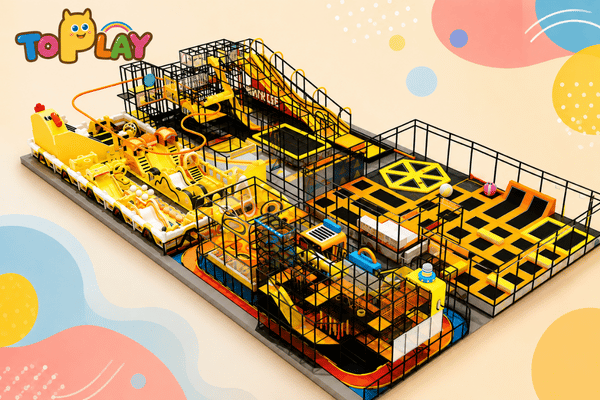
Trampoline Park Equipment by Venue Size
Most supplier pages organise this list by product, and buyers do not shop that way. Your building is the first constraint, so the same catalogue is grouped here by what a floor area carries.
- Compact indoor park inside an existing tenancy – free jump court, toddler zone, one signature attraction. Adding a fourth usually shrinks the free jump court below the size that carries your queue.
- Mid-size indoor trampoline park as a standalone destination – once dodgeball, slam dunk and a foam pit or airbag join the free jump court and toddler zone, circulation between attractions costs more floor area than any single attraction does, so size this format from a dimensioned plan rather than from a total area figure.
- Full adventure park or family entertainment center anchor – all of the above plus ninja course, climbing wall, drop slide and interactive games, with soft play structures for the sibling who will not jump.
- Mixed-tenant sites – malls, hotels, restaurants and community spaces, where your court shares its clear height with a mezzanine or a services run, and the ceiling void decides your attraction mix for you.
Our In-House Fabrication Line
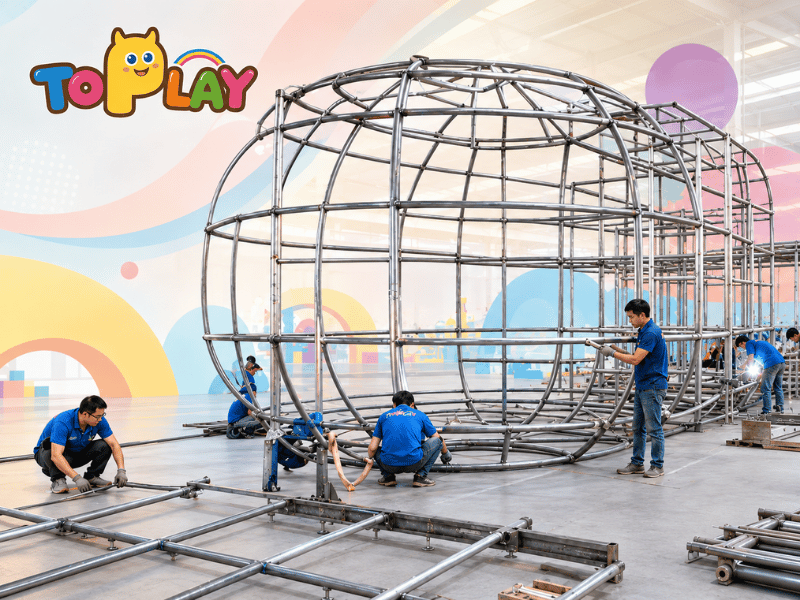
Court frames fail at joints before they fail anywhere else, which makes welding and finishing the part of manufacturing worth asking about. Our in-house fabrication line runs nine processes end to end.
Cutting and forming
- Laser tube cutting
- Tube sawing
- Punching
- Drilling
- Shaping
- Tube bending
- Press braking
Joining and finishing
- MIG, TIG and CO2 welding
- Robotic welding
- Grinding and polishing
Laser tube cutting matters here for one specific reason. Court frames are built from many short members meeting at repeated angles, and a cut profile that seats correctly gives a welder a consistent joint instead of a gap to fill.
“We get asked least about what happens to a frame at the joints after two years of impact loading, and it is the question that should be asked most. Anyone can quote you a steel section. Whether your court is still square in year five is decided by whether the cuts seated properly before anyone struck an arc.” — Guangzhou Toplay Engineering Team
Court construction is a documented engineering field rather than folklore. Published designs describe the frame, the bed attachment and the padded bedrail as one connected assembly, which is how a published trampoline court patent sets it out, and why ASTM F2970 treats a court as a system rather than a list of parts.
Trampoline Park Equipment Materials and Structural Components
Five component families carry a trampoline court, and they age at completely different rates. Reading this table by its last two columns is more useful than reading it by the first.
Component families, why each material is chosen, and how each one tells you it is finished
| Component | Material family | Why it is chosen | Effect on maintenance | Replacement signal |
|---|---|---|---|---|
| Court frame | Welded steel tube, protected surface | Carries repeated dynamic loading and holds geometry across a whole court | Lowest-touch item on the floor; inspected rather than serviced | Deformation at joints, movement under load, surface breakdown at contact points |
| Springs | Coiled spring steel | Converts and returns jump energy at a consistent rate across every bed | Replaced individually; a court is never re-sprung all at once | Loss of tension, permanent set, hooks opening, uneven response between adjacent beds |
| Jump beds | Woven performance textile | Survives abrasion and UV while holding tension across a large span | Re-tensioned during inspection; replaced as a unit | Fibre breakdown, weave distortion, edging or attachment point wear |
| Padding | Foam core in a coated cover | Covers frame, springs and bedrail, and is the only soft surface between a user and steel | Highest-touch item; covers fail long before cores do | Compression that does not recover, cover splitting, pads no longer sitting where they were fitted |
| Netting and containment | Knotless or knotted synthetic net, with fixings | Keeps users inside a court and separates attractions from circulation | Serviced at the fixings more often than in the net field | Stitching wear, opened mesh, fixings loosening at the frame |
Trampoline Equipment Safety Padding, Netting and Replacement Parts
Steel is not what wears out on a trampoline park. Padding, netting and beds do, and those three decide your reorder cycle, your inspection outcome and your liability position. Most equipment pages skip this section entirely.
How Long Wear Parts Last, and Why Nobody Can Give You One Number
A service-life figure of roughly two to five years circulates in this trade for wear components. We looked for a primary source behind it and there is not one. Regulators refuse to set a universal number and point at your manufacturer instead.
What the inspection regime actually requires, using Queensland as a named example
Requirement
What the regulation says
Requirement: Detailed inspection
Regulation: At least once every 12 months, by a competent person
Requirement: Major inspection interval
Regulation: As recommended by the device manufacturer, or a shorter period if a competent person who has previously inspected the device recommends one
Requirement: Where no manufacturer interval exists
Regulation: No later than every 10 years
Requirement: Maintenance basis
Regulation: In accordance with the recommendations of the designer or manufacturer, or a maintenance manual prepared by a competent person
That chain of authority inverts the usual buying question. Your legally operative maintenance interval is the one your manufacturer states, and the ten-year ceiling only applies where your manufacturer never stated one. Whether a supplier publishes replacement criteria at all is therefore a procurement criterion, not a nicety.
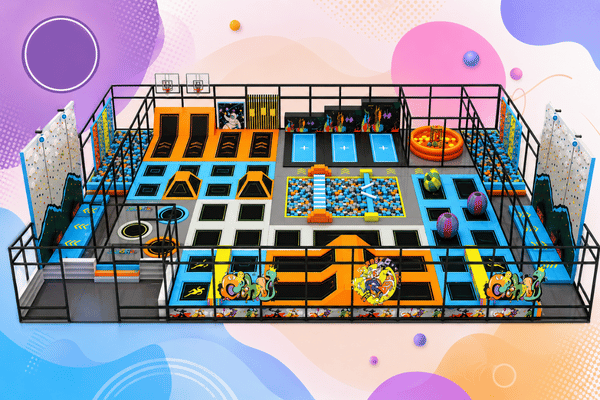
Points to verify with any supplier
- Recommended replacement interval for beds, springs, padding and netting, in writing
- Stated major inspection interval for the equipment being quoted
- Whether wear parts are stocked as spares, and for how many years after your build
- Whether replacement pads and nets are made to the original pattern, or refitted
Source: WorkSafe Queensland, amusement device regulation. Requirements differ by jurisdiction, and this one governs amusement devices registrable under AS 3533.1.
Replacement Signals an Inspector Actually Looks For
Regulators describe wear in observable terms rather than in years, and those descriptions serve an operator better than any interval. A South Australian regulator sets out a daily pre-opening routine that reads like a condition checklist.
- Trampoline framework is stable and secure
- Padding, netting and matting are correctly fitted and well maintained
- Matting does not appear worn or compressed
- Foam pits are adequately edge padded and filled to the top of the pit
- Obstructions are not located within the trampoline clearance area
Two of those are equipment specification problems disguised as housekeeping. Matting that compresses and does not recover was the wrong material for the impact it receives, and a foam pit that will not stay filled to the top was specified with too little volume for its throughput.
What We Supply as Replacement Parts
- Jump beds, matched to the original bed size and attachment pattern
- Springs, in counts that suit partial replacement rather than whole-court re-springing
- Bedrail padding, frame padding and impact mats, including the landing mats around drop slides and ninja lines
- Netting panels and the fixings that attach them
- Graphics and surface panels, reproduced from the original artwork
Because every product we build is customizable, replacement parts are made to your original drawing rather than pulled from a generic size range. Record your build specification at handover, because that is what makes a like-for-like replacement possible in year four.
Court Specifications and Site Requirements
What stops most trampoline park projects before a quotation is ever requested is whether the building works at all.
Measure to the Lowest Obstruction, Not to the Ceiling
Clear height is the single most misread number in this category. Operators measure to the deck or the underside of the roof, then discover that sprinkler heads, ductwork, lighting and signage all sit below it. What is regulated is the clearance area above your court, and it has to be free of exactly those things.
The measurement that matters
Stand on your intended court footprint and measure to the lowest thing above you anywhere within it. That figure, not your ceiling height, is what a court layout has to work with. A South Australian regulator states it plainly: obstructions including roofing or sprinkler systems, signage and lighting are not to be located within the trampoline clearance area.
A services drawing is therefore worth more to us than a photograph. Two buildings with identical stated ceiling heights routinely produce different attraction mixes, because one of them has a duct run crossing the middle of the floor.
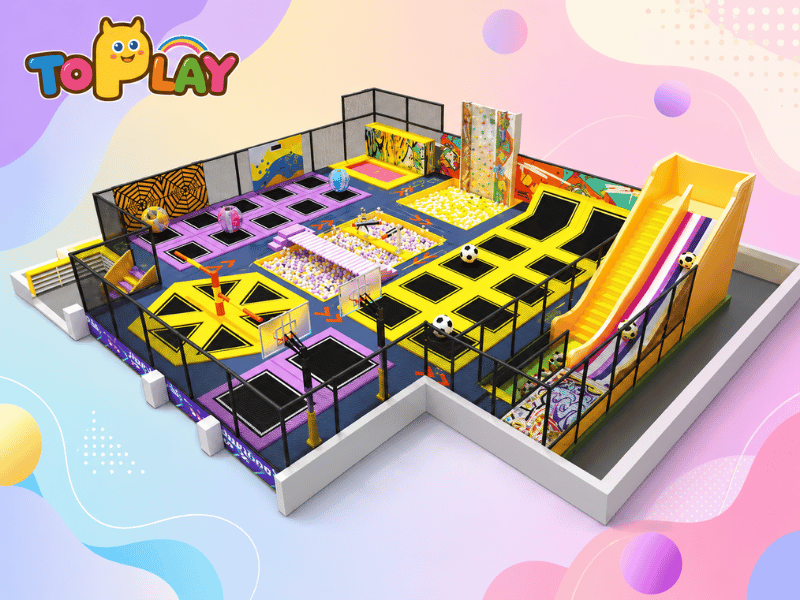
Design and compliance parameters we build to, and where each one comes from
Parameter
Value
Where it comes from
Parameter: Foam pit depth, minimum
Value: 60 in (1.524 m)
Source: ASTM F2970-20, as quoted in peer-reviewed impact testing
Parameter: Foam pit plan length, minimum
Value: Specified by the standard; read the value off the edition your project is built to
Source: Same standard; that clause exists and its figure is edition-dependent
Parameter: Overhead clearance area
Value: Measured from court surface to lowest obstruction, kept free of roofing, sprinklers, signage and lighting
Source: SafeWork SA guidance for trampoline centres
Parameter: Detailed inspection interval
Value: At least every 12 months, by a competent person
Source: WorkSafe Queensland amusement device regulation
Parameter: Major inspection ceiling
Value: No later than 10 years where no manufacturer interval is stated
Source: WorkSafe Queensland amusement device regulation
Parameter: Reported injury rate benchmark
Value: 1.14 injuries per 1,000 jumper hours
Source: Study of 18 parks in Australia and the Middle East, 2017-2019, published in Pediatrics 2024
Parameter: Example of state operator duties
Value: Arizona A.R.S. § 37-1424 sets 6 standing obligations, including $1,000,000 minimum bodily injury cover, 2-year record retention and a 10-day service-call reporting rule
Source: Arizona Revised Statutes; other states differ
Parameter: Emergency-response record example
Value: Retain service-call records for 2 years and submit a copy within 10 days of each call
Source: Arizona A.R.S. § 37-1424.A.6; confirm the rule in your own jurisdiction
Why a Deeper Foam Pit Is Not Automatically a Safer One
Foam pit depth gets treated as a simple more-is-better number, but the three configurations in one instrumented test series did not behave as a simple depth progression. Researchers dropped an instrumented test dummy head-first into three pit constructions and compared neck loads against published injury references.
- A foam-only pit filled to 1.8 m produced 2.33 kN peak compressive neck force from a 1.15 m drop.
- Pits with a trampoline bed or a net bed beneath the foam, at 1.5 m working depth, produced 1.36 kN and 1.41 kN from a higher 1.5 m drop.
- At least one injury reference was exceeded in every pit condition tested at 1.5 m.
Within this test series, the two pits with sub-beds produced lower peak compression than the deeper foam-only configuration under different drop heights. That comparison does not establish a universal depth trade-off or a standalone risk model, but it makes sub-bed architecture a specification item alongside foam depth. Your pit specification should therefore describe both.
Confirm Accessibility Before Layout Sign-off
Requirements for play and recreation facilities, including accessible routes and turning space, may apply depending on how your venue is classified. Confirm that with your local authority before your layout is fixed.
Attraction footprints are sized against your measured plan because column positions, circulation and building services change the usable footprint. Each selected attraction is dimensioned on your layout. Zoning across a whole floor is a separate discipline, covered in our indoor playground layout design work.
Send your plan and get a court layout
Calculate the lowest-obstruction heightIf your clear height turns out not to work for trampolines, we will tell you that rather than sell you a shorter court.
Trampoline Park Equipment Pricing, Payment Terms and Lead Times
Price follows your attraction mix, floor area, depth of custom theming, grade of netting and padding, and shipping arrangement, rather than a fixed price list. Two parks of identical square metres quote differently when one is three attractions and the other is eight. Site conditions move the figure too, because a pit framed above your slab is not the same build as one dropped into an excavation.
Terms Your Written Quotation Must Fix
Layout deliverables
The quotation names the drawing set, attraction list and equipment schedule included in the design scope.
Production trigger
The schedule states which signed document starts the production clock and which later changes reset it.
Payment milestones
Deposit and balance points belong in the quotation before order placement, alongside the production and shipping milestones they release.
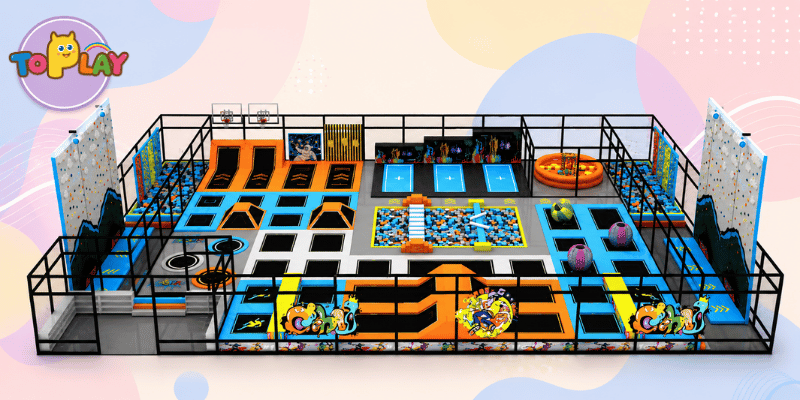
What We Need From You to Quote Accurately
These six inputs turn an enquiry into a project quotation. Collecting them before you contact a supplier lets procurement compare scope instead of comparing two numbers built from different assumptions.
- Floor plan with length, width and clear height to the lowest obstruction
- Column grid positions, and any services crossing the floor
- Floor loading capacity, and whether your slab can be excavated
- Target age profile, including whether a toddler zone is required
- Target simultaneous capacity at peak
- Intended opening date, used to test whether the quoted production and shipping schedule fits
Bring those and your conversation moves straight to configuration. A quotation built on all six is comparable against another supplier quotation; one built on a photograph is not.
Quality Control and the Evidence Pack You Should Request
Our own control points are ordinary and we will name them: in-process checks at each fabrication stage, trial assembly of court sections before packing, and a piece count against the packing list before a container is sealed. None of that is worth anything to you unless it arrives as documents you can check. A high-quality claim becomes verifiable only when those records name the order, component list and inspection stage.
Supplier Evidence Pack — What Each Document Proves
Use this list against any trampoline park supplier, including us. Match every document to your order number, and verify external report and certificate numbers with the issuing body.
Part A — What should arrive with the equipment
Documents to request from the supplier, and what each one actually proves
Document
What it proves
How to check it
Document: Installation manual
Proves: Build sequence and fixings are documented, so an installer is not improvising
Check: Confirm it covers your actual attraction list, not a generic court. It is not a substitute for a competent installer
Document: Conformance declaration against a named standard edition
Proves: Which edition of the trampoline court standard the equipment was designed to
Check: Check the edition suffix. ASTM F2970-25 is current, and documents citing F2970-17 or F2970-20 quote superseded editions
Document: Test or inspection reports from an accredited body
Proves: That someone outside the supplier examined the product
Check: Look up the report number with the issuing body directly
Document: Material and component list
Proves: What is actually in your build, by component family
Check: Match it line by line against the specification on your quotation
Document: Assembly and pre-shipment count records
Proves: Your court was trial-assembled and counted before it shipped
Check: Ask for the record against your order number
Document: Stated maintenance and replacement intervals
Proves: Manufacturer interval your inspection regime will be measured against
Check: Confirm it is specific to the equipment quoted
Document: Recognised system and product references
Proves: Wider framework this category is governed by, such as ISO 23659 for trampoline park facilities, EN 1176 for playground equipment, and ISO 9001 for quality management
Check: Ask which of these the supplier holds, and for the certificate number and issuing body
Part B — What you must hold and maintain yourself
These are operator obligations. No equipment supplier can hold them for you, and any supplier implying otherwise is describing something they cannot deliver.
- Annual inspection certificate, held for the life of the installation
- Liability insurance appropriate to your jurisdiction
- Equipment registration where your state or country requires it
- Incident records, kept for the retention period your jurisdiction sets
- Staff training records for operators and court monitors
- Periodic condition checks against defined replacement criteria
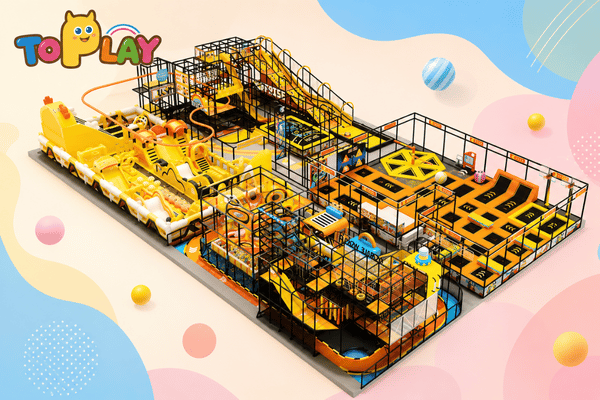
From Site Drawing to Opening Day
STEP 01
You send measured site information
Floor dimensions, column positions, the lowest obstruction and floor-loading data expose any critical gap before layout work begins.
STEP 02
We prepare the project layout
The court layout and equipment list follow your measured dimensions. If the site does not suit trampolines, this is where the attraction mix changes.
STEP 03
You confirm the configuration
Attraction mix, colours, theming and capacity. Changes here cost drawing time; changes after this cost production time.
STEP 04
The quotation fixes commercial terms
Scope, production window, payment milestones and shipping responsibilities are agreed in writing before production begins.
STEP 05
We manufacture and trial-assemble
Fabrication, welding, finishing, assembly check and a piece count against the packing list.
STEP 06
Handover follows the written scope
Packing, documents, installation support and the shipment-release milestone follow the final quotation rather than an unstated turnkey label.
Turnkey Scope and What Each Party Handles
Turnkey is used loosely in this trade and it hides expensive gaps. Below is the version we will put in writing, including the parts that are not ours.
Scope split from design through ongoing operation
| Stage | What we handle | What you arrange |
|---|---|---|
| Design and layout | 2D court layout, equipment list, attraction mix against your dimensions | Measured drawing, services positions, floor loading confirmation |
| Manufacture | Fabrication, welding, finishing, beds, padding, netting, graphics | Sign-off on the layout and the configuration |
| Documentation | Documents named in the quotation and evidence-pack schedule | Approving the list and filing it where your inspector can find it |
| Shipping | Packing and export-document scope stated in the quotation | Freight booking, destination customs, duties and inland delivery unless the quotation says otherwise |
| Installation | Installation-support scope stated in the quotation | Local installation labour unless it is expressly included |
| Commissioning | Commissioning scope stated in the quotation | Local sign-off, first inspection and insurance activation |
| Ongoing operation | Replacement-part scope recorded at handover | Staff training records, periodic condition checks, replacement decisions, emergency procedures and incident reporting |
We publish that last row because a scope table that stops before it leaves you to discover the gap after handover. Operating a trampoline park is a safety management responsibility that stays with the operator regardless of who built the court.
Guangzhou Toplay Manufacturing and Export Capability
Guangzhou Toplay Amusement Equipment Co., Ltd. is an indoor playground equipment maker and trampoline park manufacturer supplying operators overseas. Here is what is checkable about us, stated plainly.
Established in 2014
Our own line in Guangzhou ever since, not resale from another factory.
Exported to 40+ countries
Including France, India, Sri Lanka, South Africa, Mexico, Malaysia and Poland.
Over 90% sold globally
Export is our main business, not a sideline to a domestic operation.
Annual growth > 20%
Sustained average across the entire period since founding.
Active in international fairs
Where equipment can be inspected in person rather than in photographs.
9 fabrication processes
From laser tube cutting through robotic welding to grinding and polishing.
Venues We Build For
- Shopping malls and mixed-use complexes — fit-out access is shared and short, so structures are welded and trial-assembled in our factory rather than built inside the tenancy.
- Indoor playgrounds, children’s play centres and family entertainment centers — here trampolines share a floor with soft play, so both fall zones belong on one drawing and not on two separate equipment plans.
- Kindergartens and early childhood education centres — the mix shifts to toddler equipment and lower fall heights and a free jump court is generally an unsuitable anchor for this audience.
- Family-friendly restaurants and hotels — play areas compete with services runs and mezzanines for clear height, so we specify against the void that is actually left rather than against the floor plate.
- Community recreational spaces — budgets arrive in stages, so equipment is specified to be extended later rather than replaced at the next round of funding.
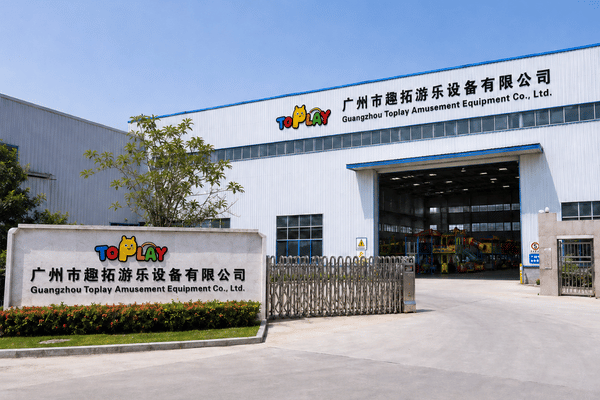
To inspect finished equipment before you commit, two routes work better than photographs: an international fair, where the welds and the padding can be handled in person, or a reference contact arranged directly on request.
Send a photo of your space and ask one questionUse it to identify which site measurement will decide the attraction mix.
Project Resources
Trampoline Park Project Planning Tools
Lowest-Obstruction Clear-Height Calculator
Calculate your usable overhead clearance to determine which attractions safely fit your building footprint.
Launch Tool
Trampoline Supplier Evidence-Pack Checker
Verify your supplier’s documentation against mandatory safety, manufacturing, and legal compliance standards.
Launch Tool
Trampoline Park Quote-Scope Comparator
Compare multiple quotations side-by-side to identify hidden gaps in shipping, installation, and materials.
Launch Tool
FAQ on Trampoline Park Equipment, Site Requirements and Cost
Measure to the lowest obstruction over your court footprint, not to the ceiling. Sprinkler heads, ductwork, lighting and signage all reduce usable clearance, and regulators require that area to be kept free of them.
- Performance trampolines and slam dunk lanes need the most clearance of anything on a floor.
- Free jump courts and toddler zones need the least.
- Send us the height to your lowest obstruction and we will tell you which attractions fit.
Floor area sets your attraction mix, and that mix sets how long a visitor stays. What matters is whether your space carries a free jump court plus enough supporting attractions to fill a full session.
- Column positions and circulation routes change this answer more than total area does.
- We size attractions against your measured plan, not against a table of averages.
Measure your building, confirm floor loading, check local regulatory requirements, then fix your attraction mix against your catchment. Equipment selection comes after those four, not before.
It depends on how your venue is classified locally, and classification is not uniform. Confirm it with your local authority before your layout is fixed, because accessible routes are cheap to draw and expensive to retrofit.
Equipment is priced against the attraction list, floor area, site structure, theming, netting and padding grades, and shipping scope. A layout-backed quotation is comparable; an unscoped price band is not.
- Bring the six quotation inputs listed above and you get a number instead of a range.
- Ask every supplier to separate equipment, freight, installation labour and destination charges before you compare totals.
Equipment is one line in a build. Fit-out, flooring, services, freight, duties, inland delivery, installation labour, insurance and pre-opening staffing all sit alongside it.
- Comparing only equipment quotations between an offshore and a local supplier compares different scopes.
- Ask every supplier which of those lines their number includes.
That depends on catchment, pricing, dwell time and repeat rate, and no equipment supplier can honestly answer it for your site. What equipment choice controls is how long visitors stay and how wide your age range is.
Your largest single swing is usually the attraction mix, because each attraction brings its own structure rather than sharing the free jump court frame.
- Attraction count and type
- Total court area
- Depth of custom theming
- Grade of netting and padding
- Structural work, such as a framed rather than excavated pit
- Shipping arrangement
A recurring pattern is a thin attraction mix producing short visits and weak repeat business, combined with maintenance costs nobody budgeted. Padding, netting and beds are consumables on a commercial court, and a business plan without a replacement line gets surprised in year two.
Liability sits with the operator in the general case, which is why jurisdictions impose inspection, insurance, registration and record-keeping duties on operators rather than on manufacturers.
- Your equipment supplier contributes documentation: conformance to a named standard edition, stated maintenance intervals and replacement criteria.
- Confirm liability allocation with counsel in the jurisdiction where the park will operate.
ASTM F2970 is the trampoline court standard usually referenced, currently in its 2025 edition, with ISO 23659 covering trampoline park facilities internationally. Several US states adopt ASTM standards by reference rather than writing their own dimensional rules.
- On top of those sit state or national operator duties covering annual inspection, certificates, liability insurance, registration and record retention.
- Those duties differ substantially between jurisdictions, so check yours rather than assuming a single national rule applies.
- Ask any supplier which edition their conformance documents cite, because superseded editions still circulate.
Used is legitimate when complete maintenance records, spare parts availability and a workable fit to your column grid all come with it. Without records you are buying an unknown remaining service life on exactly the parts that wear.
Replace the component when wear changes its protective or load-bearing function: padding no longer recovers, stitching opens, mesh separates, a spring takes a permanent set, or a bed loses tension unevenly. Repairs belong in the maintenance record, and the next inspection should verify the repaired area against the manufacturer’s stated criteria.
Turnkey is defined differently by every supplier, and the gaps are typically in installation labour, destination customs and duties, and anything operational.
- Our scope split is published in full in the table above, including rows that are yours rather than ours.
- Ask any supplier for the same split in writing before comparing two turnkey numbers, because across the industry that word covers very different scopes.



