Get in touch with Guangzhou Toplay amusement equipment co. Company

+
+
Commercial Indoor Playground Equipment for Venue Operators
Commercial indoor playground equipment is a made-to-order steel and soft-play structure engineered for continuous public use inside a building, sized to one room’s clear height and floor area rather than sold from a catalogue. We build six lines of it, cut and welded on our own equipment, and we start from your dimensions.
Drawings back in 3 working days
Production 15 to 30 working days
Six equipment lines, one set of drawings
Exported to more than 40 countries since 2014
Send Us the Dimensions, Get the Drawing
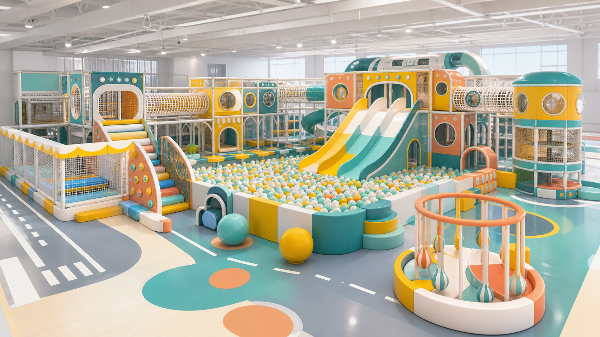
Commercial Play Equipment at a Glance
These are the terms we work to, not a range we hope to hit. Each one is fixed in your written quotation before any deposit changes hands.
Six Equipment Lines, One Set of Drawings
A venue is rarely one attraction. These six lines are drawn together against a single floor plan so that clearances, circulation and supervision sightlines resolve once rather than six times.
They go into a family entertainment center, a mall unit or a standalone play center.
They also go into a kindergarten or early-education centre, a daycare, a family restaurant or a hotel.
The venue changes the supervision model and the licensing path, so explore the six lines against your own room rather than against a catalogue photograph.
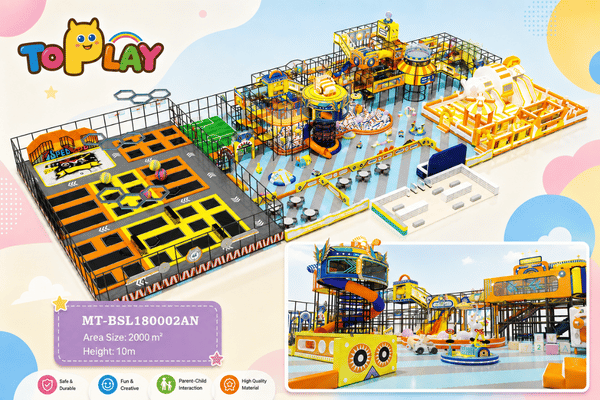
Soft Play Equipment
Foam-and-vinyl components, ball pools, tunnels, indoor playground slides and toddler zones inside a netted envelope. This is soft play equipment in the sense the standards use: a fully enclosed environment built from pliable material.
Governing document in the United States: ASTM F1918-21
In Europe: EN 1176-1:2017+A1:2023 with EN 1176-10:2023
The ball pool is a scheduled consumable, not a fit-and-forget item
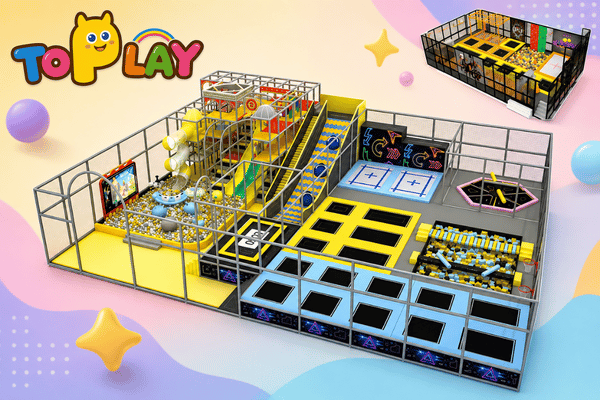
Trampoline Park Equipment
Court beds, pads, framing and enclosure. This line sits under a different standard family and a different ASTM committee from everything else on this page, which is the most common scoping error in a mixed venue.
Governing document: ASTM F2970-25, Subcommittee F24.61 under Committee F24 on Amusement Rides and Devices
In Europe: EN ISO 23659:2022 for trampoline parks
Both documents reach operation, maintenance and inspection, not only manufacture
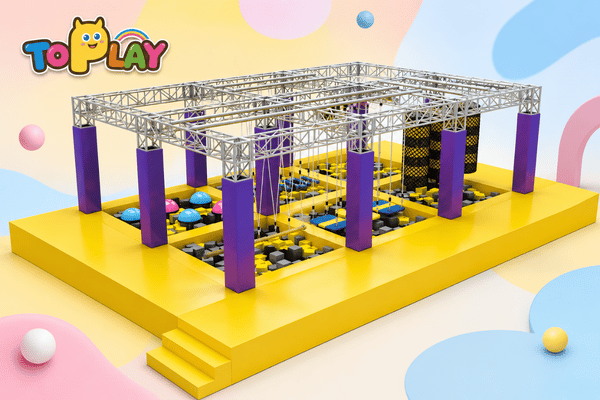
Ninja & Obstacle Courses
Timed obstacle courses, warped walls, hanging traverses and landing zones. Fall height sets the surfacing spec here more sharply than anywhere else in the venue, so the drawing decides the flooring budget.
Fall height is measured from the highest designated play surface, not from the top of the frame
Landing zones drive floor area as much as the obstacle line does
Steel frames cut, bent and welded on our own equipment
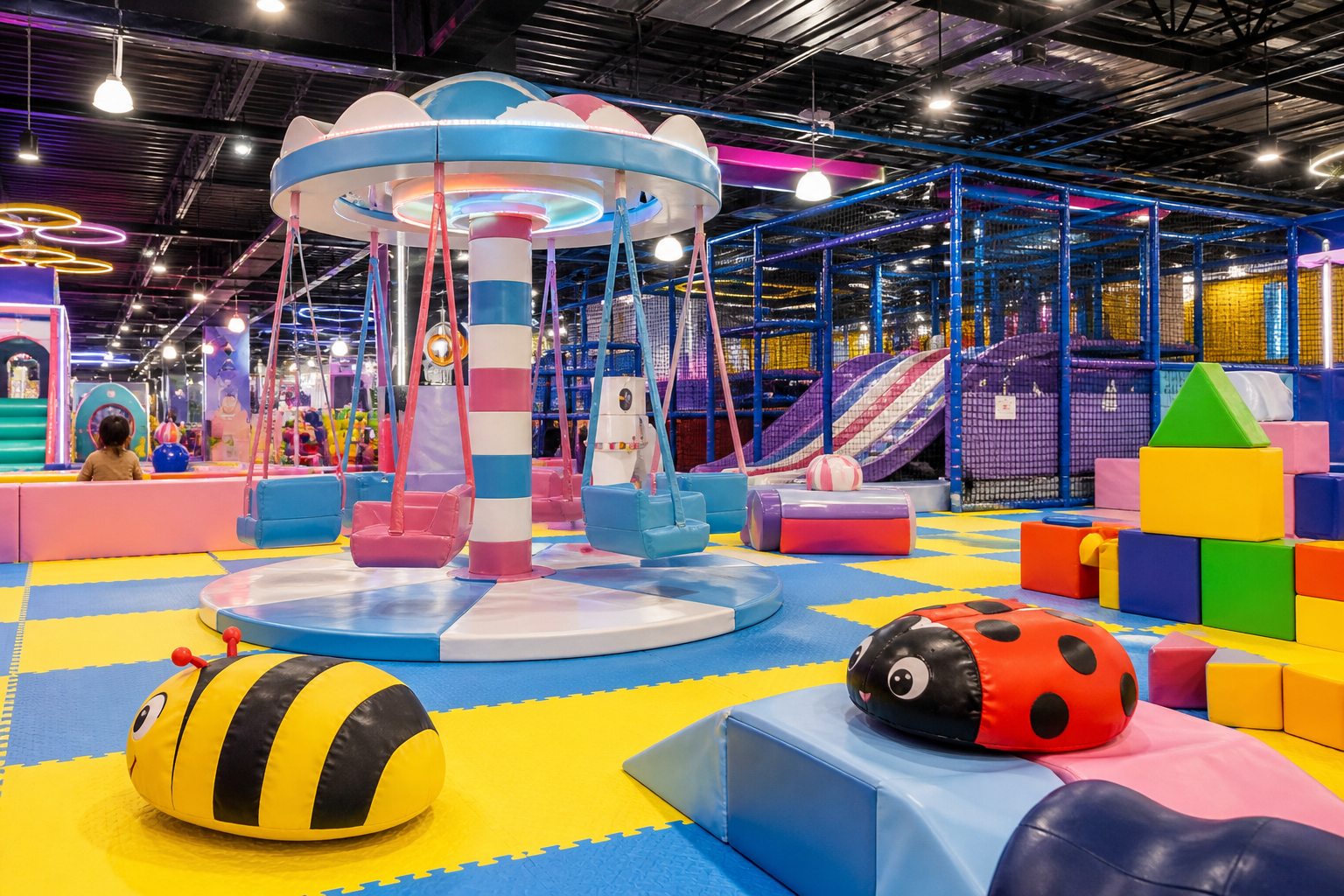
Indoor Play Structures
Multi-level decks, link tubes, ramps and access towers. A commercial indoor jungle gym at this scale is a construction item in most jurisdictions once it passes a height or area threshold, which is covered further down this page.
Deck level count drives clear-height demand and cost together
Accessible entry points are counted, not estimated
Open, non-contained components in the same room answer to ASTM F1487-25, which is where the certificate coverage gap usually opens in a mixed venue
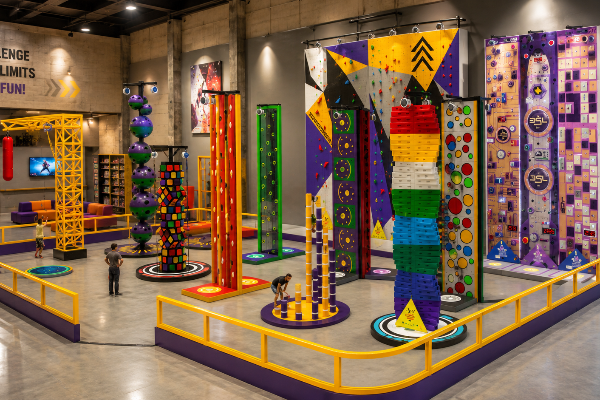
Climbing & Adventure Equipment
Climbing walls, net climbs, rope elements and adventure towers. Anchoring on an indoor slab has to be coordinated with the landlord and the floor build-up before the drawing is frozen.
A freestanding climber outside the netted envelope is a separate compliance object from the envelope itself
Anchoring is performed to the manufacturer’s written specification
Net and rope elements are inspected on a documented cadence, not on sight
Entrapment clearances are a design constraint on every net climb
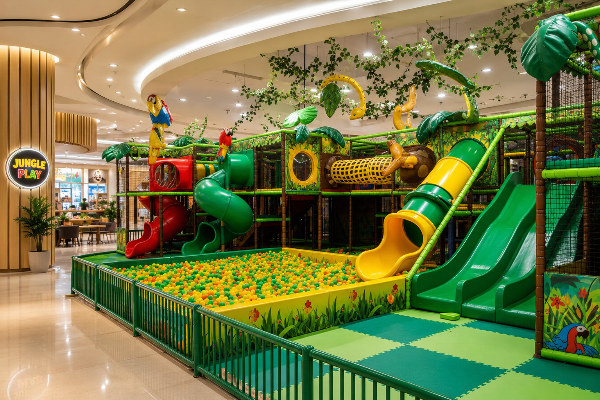
Themed Play Environments
Theming, custom design and scenic treatment applied across any of the five lines above. Theming changes cure time and off-gassing, which changes your opening date rather than only your invoice.
Themed playgrounds are drawn to your brand, not picked from a catalogue, and imaginative play is what the theming is for
Every product we make is customisable
Cure and ventilation time is scheduled, not assumed
Parts We Cut, Bend and Weld Ourselves
Every indoor playground equipment manufacturer says its frames are high-quality, and no buyer can check that word. So here is the process list instead of the adjective, scoped to exactly what runs on our own floor.
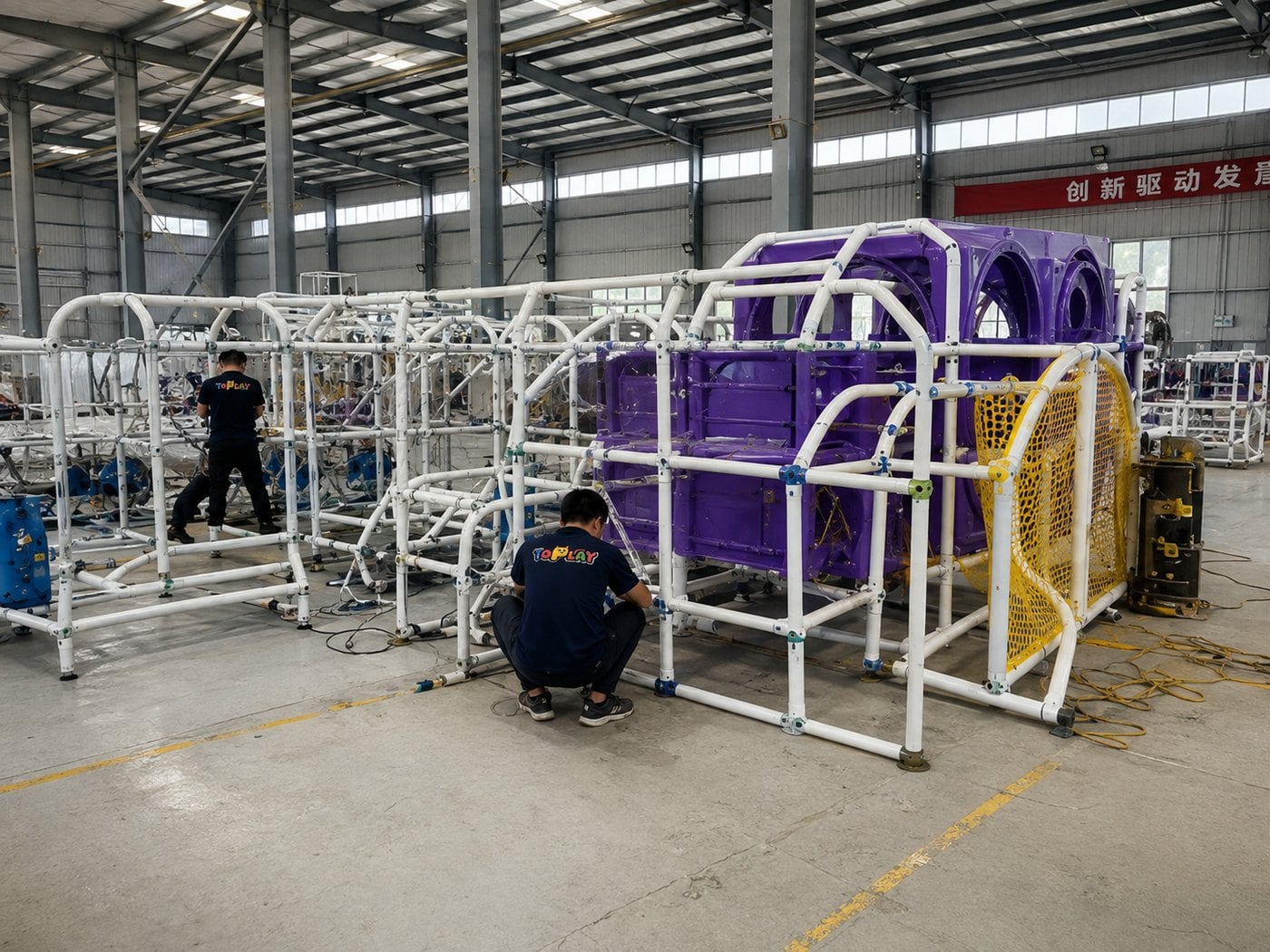
Metal fabrication on our own equipment
Laser tube cutting and tube sawing
— frame members are cut to the drawing rather than to stock length
Punching and drilling
— connection holes are placed from the same file that produced the cut list
Tube bending and press braking
— curved members and brackets are formed in house
MIG, TIG and CO2 welding
— joint process is selected per member, not per shop convenience
Robotic welding
— repeat joints on load-bearing members are made by machine, so the hundredth joint matches the first
Grinding and polishing
— weld dressing before coating, on the same line
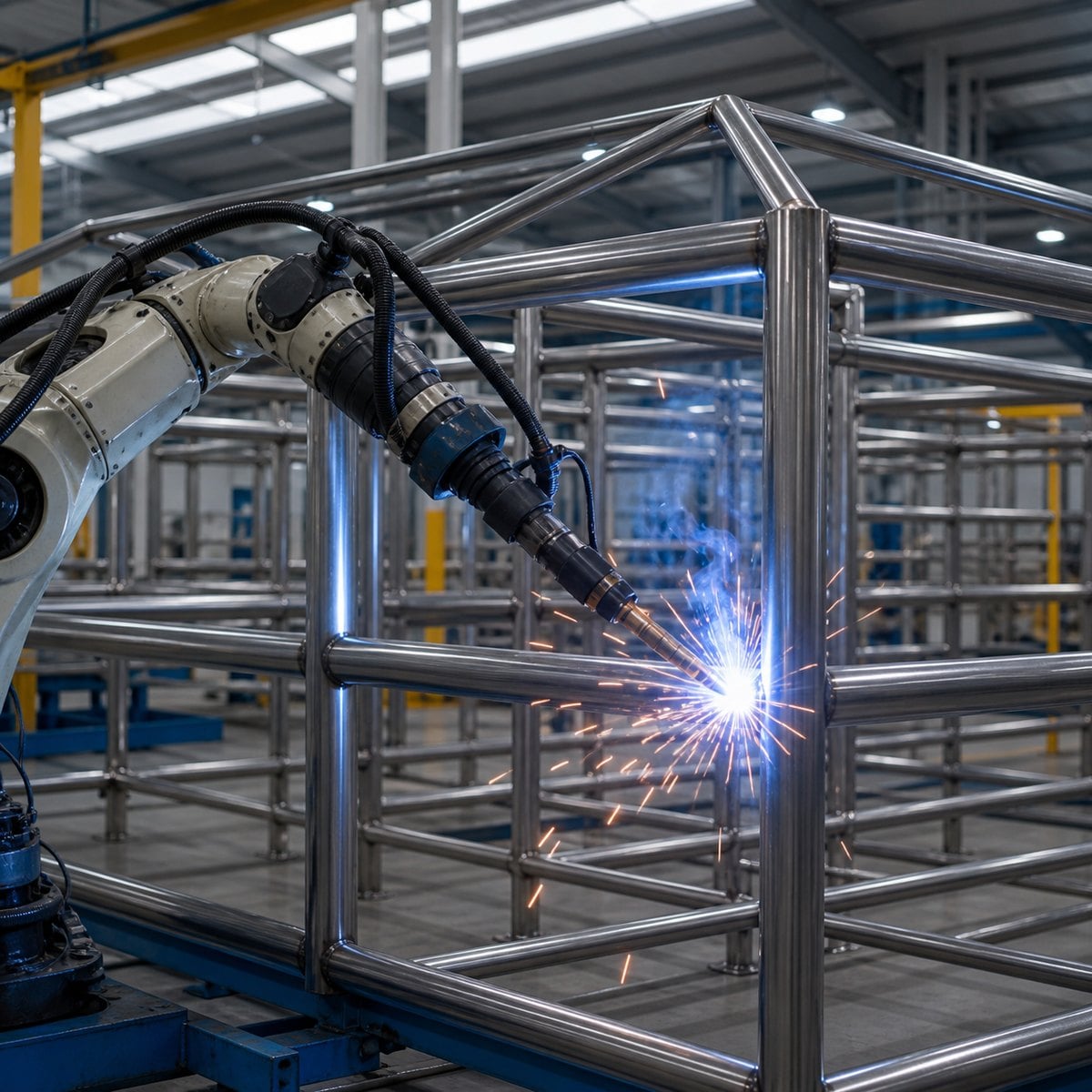
Why robotic welding matters on a play structure.
A multi-level deck repeats the same load-bearing joint dozens of times. Machine repeatability is the difference between a frame that ages evenly and one where a handful of hand-made joints become the inspection findings in year three.
The boundary of that list
The list above is what we own equipment for. We are not going to tell you that nothing at all is bought in, because foam, vinyl, netting, fabric and electronics are normal supply items in this trade and pretending otherwise would be the first thing an experienced buyer tested.
The Certificate Coverage Gap
Ask any supplier in this category for a safety certificate and you will get one.
The problem is that a commercial indoor venue is not one compliance object, so a single certificate cannot cover the room you are building. We call the distance between what a certificate covers and what your room contains the certificate coverage gap, and the table below maps it zone by zone.
Chosen per zone, not per supplier
Play Zone Coverage Map
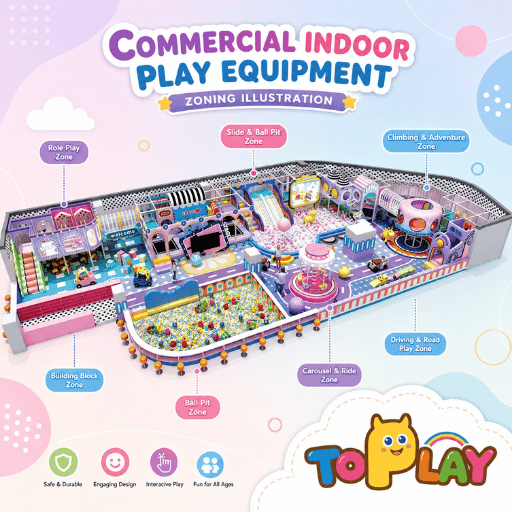
Compliance Guidelines & Scopes
ASTM F1918-21 Scope
ASTM F1918-21 says so in its own scope, which excludes:
- Public playground equipment and home playground equipment
- Sports equipment and fitness equipment not part of the play system
- Amusement rides
- Water-related attractions and devices
- Toys and juvenile products
Google & CPSC Guidelines
Google’s own generative answer for this category currently tells buyers to look for equipment meeting ASTM F1487 or EN safety certifications. The European half of that is right. The ASTM half points at a standard that excludes this equipment class in its own scope clause.
“These guidelines are not intended for amusement park equipment, sports or fitness equipment normally intended for users over the age of 12 years, soft contained play equipment, constant air inflatable play devices, art and museum sculptures …, equipment found in water play facilities, or home playground equipment.”
CPSC Public Playground Safety Handbook, Publication 325, July 2025 edition, section 1.3
That is the structural reason a certificate request in this category so often names the wrong document. What buyers get wrong is not the diligence, it is which family of documents the diligence should point at.
Which document governs which part of your venue
| Zone in your venue | United States | Age envelope | Europe | Certification mark |
|---|---|---|---|---|
| Fully enclosed soft-contained envelope | ASTM F1918-21 | 5th percentile 2-year-old to 95th percentile 12-year-old | EN 1176-1:2017+A1:2023 with EN 1176-10:2023 | No IPEMA program covers it |
| Open, non-contained play components | ASTM F1487-25 | Same band; excludes 6 to 24 months | EN 1176-1:2017+A1:2023 and the relevant parts | IPEMA certifies to F1487-25 |
| Impact-attenuating surfacing | ASTM F1292-22, a performance specification | Set by fall height, not by age | EN 1177:2018+A1:2023, whose title is Methods of test for determination of impact attenuation | IPEMA certifies to F1292-22 |
| Trampoline attraction | ASTM F2970-25, Subcommittee F24.61 | Set by the attraction, not by age band | EN ISO 23659:2022 | Not an IPEMA program |
| Separate play area for 6 to 23 months | ASTM F2373-24, which excludes soft contained play equipment | 5th percentile 6-month-old to 95th percentile 23-month-old | No equivalent standard exists | Not an IPEMA program |
| Under-two child inside the contained envelope | Outside F1918-21 and outside F2373-24 | Below 2 years | Inside EN 1176-10:2023, which has no lower age bound | None |
The trade-off the table hides
A mark is easier to show a landlord than a test report, which is why buyers ask for one. The catch is that the only mark available in this category covers a standard that excludes this equipment, so an IPEMA seal is not a substitute for evidence about the structure you are buying.
Beyond the Table Details
Three things the table does not say on its own
These scopes overlap. Different parts of one room can sit under two documents at once, which is why suppliers advertise units passing both F1487-25 and F1918-21.
ASTM F2970-25 reaches past delivery. Its title covers operation, maintenance, inspection and major modification, so a trampoline attraction carries duties no supplier’s shipping documents discharge.
The destination market decides. This table is the United States and Europe. We ship to more than 40 countries and confirm the applicable set per destination rather than assuming this pair travels.
The widest certificate coverage gap, and where to raise it
In the United States a child under two playing inside the contained envelope is outside ASTM F1918-21, which begins at the 5th percentile two-year-old, and outside ASTM F2373-24, which names soft contained play equipment in its own exclusion list. No published document in that pair is written for that position.
In Europe the same child is inside EN 1176-10:2023, which applies to fully enclosed play equipment with an upper bound of 14 years and no lower bound.
- The gap is a feature of how the two American documents divide the work, not a property of the equipment.
- It is cheap to resolve at drawing stage and expensive to resolve after a structure is standing.
- That is why we draw a toddler zone as a separate object with its own access, rather than as a corner of the main envelope.
What an IPEMA mark actually covers.
IPEMA’s published certification program validates conformance to ASTM F1487-25, CSA Z614:20 Update No. 1, ASTM F1292-22, ASTM F3351-19e1, ASTM F2075-26 and ASTM F3012-22. ASTM F1918 is not on that list, so an IPEMA mark is not evidence of F1918 conformance for anyone, from any factory, anywhere.
Where to look instead: a test report from an accredited laboratory against the standard that does cover your zone. And the inspection record that shows the structure still meets it.
Why We Published the Coverage Table
We published this table because a certificate request in this category so often names the wrong document family, and no page in this market sets the documents side by side. It is checked line by line against CPSC Publication 325 of July 2025, the published ASTM scopes for F1918-21, F1487-25, F2373-24, F1292-22 and F2970-25, the IPEMA certification program page, and the BSI and Estonian national-body records for EN 1176-10:2023 and EN 1177:2018+A1:2023.
Quotation.
Drawings and a written quotation come back within 3 working days of receiving your dimensions.
Production.
Orders are produced in 15 to 30 working days, counted from deposit receipt and drawing sign-off.
Payment.
30% deposit, with the balance due before loading.
Shipping.
We ship FOB. Other Incoterms are quoted on request rather than promised in advance.
With the goods.
An installation manual with dimensioned assembly drawings and installation video guidance ships with your order.
Ordering, From Your Dimensions to Opening Day
The structure is rarely the hard part. Operators consistently report that installing the play structure was straightforward and the surrounding build-out was not, in one case because the design had not accounted for the mini-split units it had to share a ceiling with.
A play center opens on the day its licence, its inspection and its ventilation window allow, and the equipment is only one of those three.
“So the solution we quote is a drawing plus a schedule, not a crate.”
The thresholds that turn a purchase into a permit
Adopted building and fire codes treat a play structure past a certain size as construction rather than as furniture. The figures below are as adopted and published by named jurisdictions; confirm the edition your building official actually enforces.
Height / Area Trigger
Over 10 ft high,
or over 150 sq ft
or over 150 sq ft
Inside an existing building. Additional code provisions apply; expect drawings and a building official.
Single-Structure Cap
600 sq ft max
Unless a special investigation demonstrates adequate fire safety. Larger structures split or require engineering.
Separation in Mall
Not less than 20 ft
Between play structures, kiosks and similar structures. Shows on the leasing plan before it shows on ours.
Sprinkler Clearance
Min 18 in vertical
Between sprinklers and material below. Usable structure height is clear ceiling height, minus sprinkler drop, minus 18 in.
Under Obstructions
Over 4 ft wide
Wide solid decks can pull sprinkler piping inside the structure; open mesh decking avoids it.
Platform Use Zone
Min 6 ft beyond
Floor area is the footprint plus a protected perimeter, not just the footprint itself.
NOTE: Your legal occupancy is a separate calculation again. It comes from floor area under the adopted occupant-load table, not from how many children a structure can physically hold.
The schedule cost nobody quotes
Insurance is the surprise line operators name most often, and it moves with structure height and attraction mix rather than with purchase price. A taller build and a trampoline attraction are both premium events, so they are worth deciding at drawing stage.
- A structure delayed at port for over 30 days has already forced at least one venue to open without it.
- The build-out, not the equipment, is where budgets break: drawings, fire-safety provision and the trades around the structure.
- An air-quality test failed on off-gassing has delayed a licensed preschool launch by two months.
What we need from your site
To ensure precise engineering and a smooth workflow, please supply the following site specifics upfront:
- Clear ceiling height, and lowest obstruction (sprinklers, ducts, beams, lighting)
- Usable floor area, and whether the structure anchors to slab or stands free
- Door and corridor widths on the delivery path, for crate access
- Destination market and the standard set your jurisdiction or insurer names
- Age bands you intend to serve, and whether any of them is under two
- Your opening date, and whether a licence sits between installation and opening
How an order runs
Dimensions in.
You send the six items above. No drawing is required to start.
Drawing & quote.
Both come back to you within 3 working days.
Design freeze.
Levels, entry points, fall heights and theming are settled together.
Deposit & prod.
30% deposit; 15 to 30 working days from official sign-off.
Shipment.
Balance before loading, FOB. Manuals and video ship with goods.
Install & inspect.
Anchoring performed to written spec; independent inspection arranged by you.
Build the cure time into the schedule.
One venue failed its required air-quality test because new equipment was still off-gassing, which delayed a licensed preschool launch by two months. If your opening depends on a licence, tell us at step one and the ventilation window goes into the programme rather than into the apology.
Where an Overseas Build Is the Wrong Call
There are projects this route serves badly. Saying so is cheaper for both of us than discovering it after a deposit.
01
You need it in six weeks
Production runs 15 to 30 working days and ocean freight sits on top of that. One venue has already opened without its structure after a delay at port.
Instead
a domestic stock system, with the custom build ordered as phase two.
02
Your bid demands an IPEMA certificate
Municipal park bids routinely make IPEMA certification a pass-or-fail supply condition and a scoring preference. No manufacturer of soft contained play equipment can meet that ask, because IPEMA runs no program covering ASTM F1918.
Instead
if the bid genuinely covers open public playground equipment, buy that from an IPEMA participant. If it covers a contained indoor structure, the specification needs correcting before anyone can bid it honestly.
03
A single small spare will decide your year
Cross-border replacement parts carry paperwork and handling that dwarf the part. One European operator reported a €15 component landing at close to €100 once the process was done.
Instead
order consumables and wear parts with the structure and hold them on site.
04
Nobody on your side owns the fit-out
Operators report their general contractor had never built a venue of this type, leaving the owners to direct the design. Our drawings cover the structure, not your building.
Instead
appoint someone accountable for the fit-out before ordering equipment, and give them our drawings early.
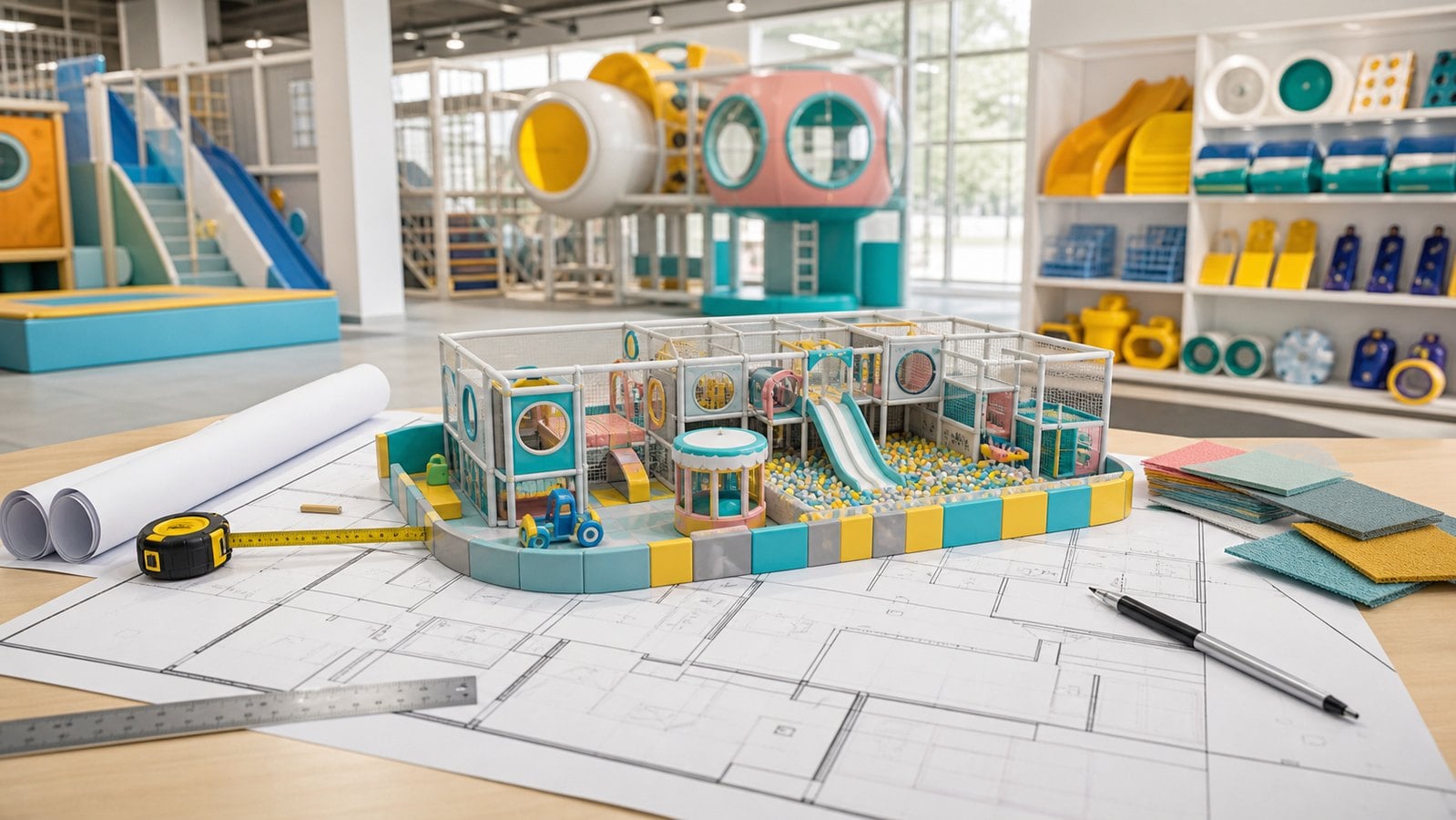
Commercial Play Equipment Planning Tools
Certificate Coverage Router
Tick the zones your venue will actually contain and choose the destination market. The router returns the published document that governs each zone, and tells you where no single certificate can cover you.
Access RouterAccessible Entry Calculator
The 2010 ADA Standards set countable minimums for a soft contained play structure. Enter what your layout currently proposes and the calculator returns the minimum that has to be on an accessible route, plus the shortfall if there is one.
Open CalculatorClear Height and Code Trigger Checker
Two measurements decide most of what a structure can be. This works out the height actually available for the build, the floor area a use zone consumes, and which adopted-code thresholds your plan crosses.
Check Dimensions


