Indoor Playground Manufacturer:
Steel Frame and Soft Play, Both Built In-House

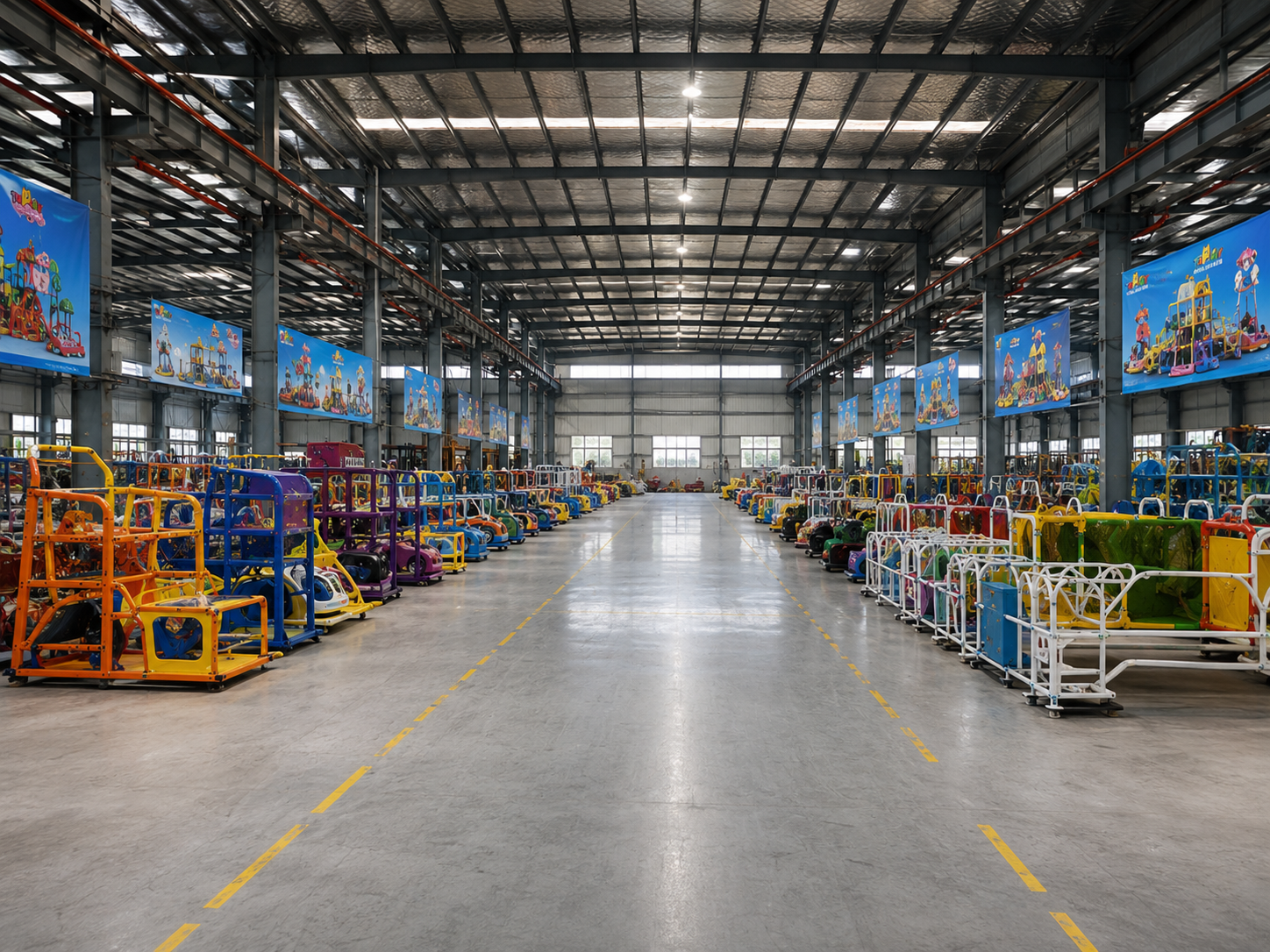
Guangzhou Toplay is an indoor playground manufacturer in Guangzhou, China, building custom soft contained play structures for venue operators worldwide.

Two build stages run on our own premises: the welded steel frame, and the sewn soft play that wraps it. Every project starts from your floor plan. Since 2014. Over 90% of output is exported, to 40+ countries. Your drawings and site photographs are confidential project material, used solely to prepare your layout and quotation, and an NDA is signed on request before detailed project information is exchanged.

Select Scene:
Scene 1
Scene 2

Quotation

3 working days from usable project inputs

Layout

Free 2D layout and 3D render in 3–4 working days

Production

45–75 days from design approval and deposit

Minimum order

One complete playground system

Payment

30% T/T deposit, 70% before shipment

Trade terms

EXW, FOB, CFR and CIF; DAP and DDP on request

Two Build Stages Under One Roof

A soft contained play structure is two products fused together. One is a welded steel skeleton; the other is sewn PVC-covered padding that wraps it. Most supply chains split at that seam.

The Seam Question

Ask any indoor playground equipment supplier which side of the seam they sit on. The answer decides who you talk to when a padded panel arrives wrong, and whether that conversation gets forwarded to a company you have never dealt with.

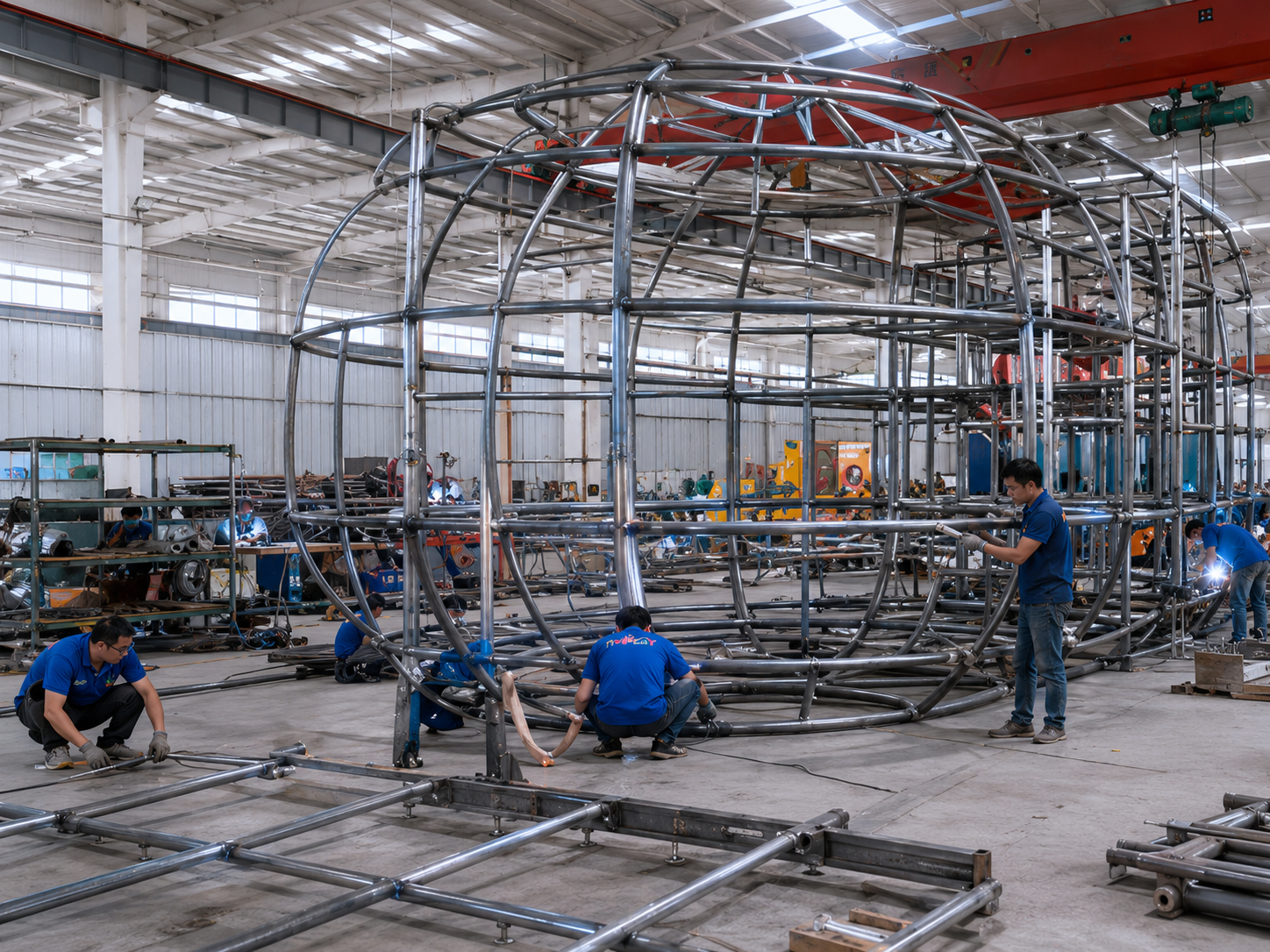
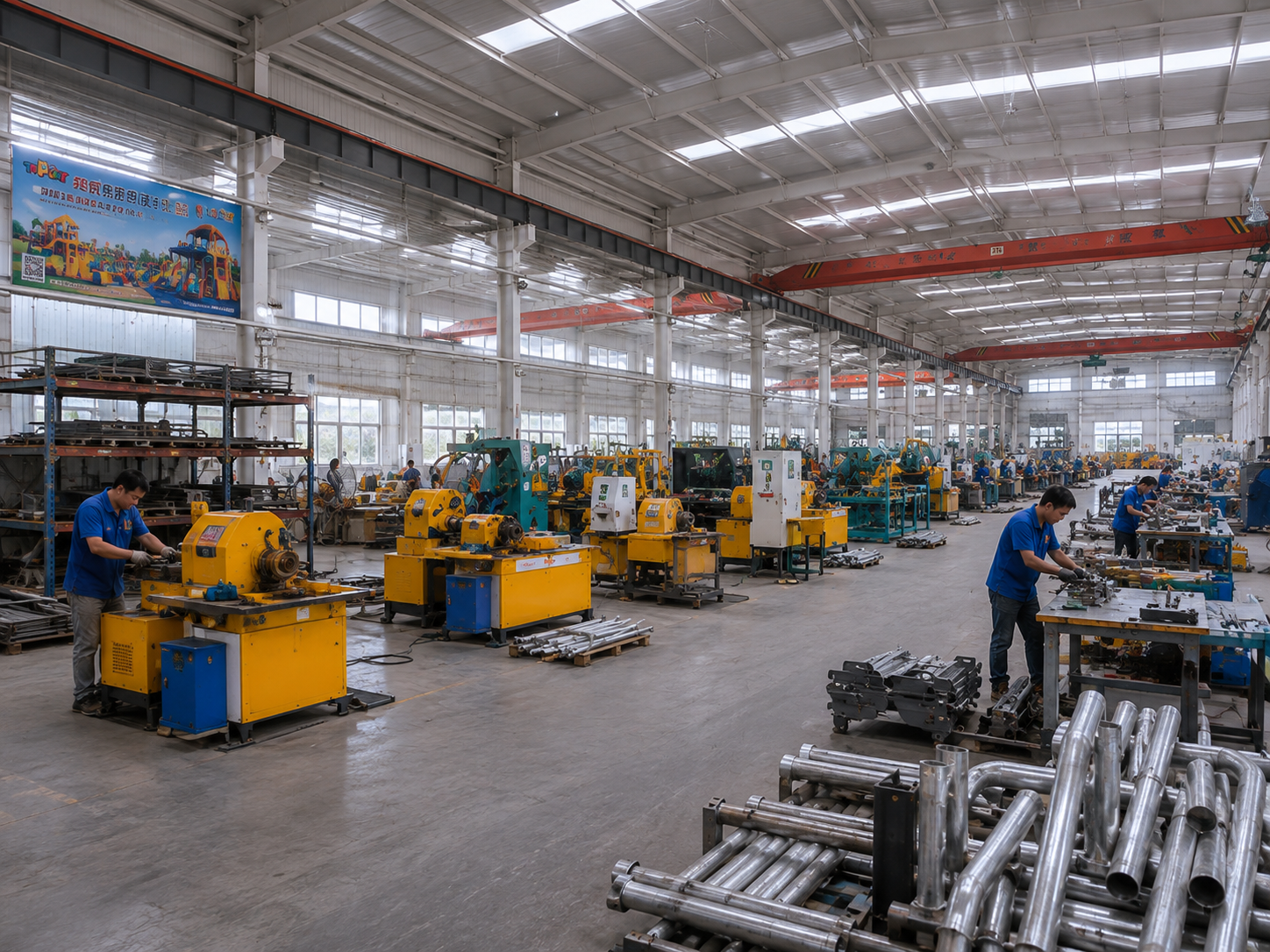
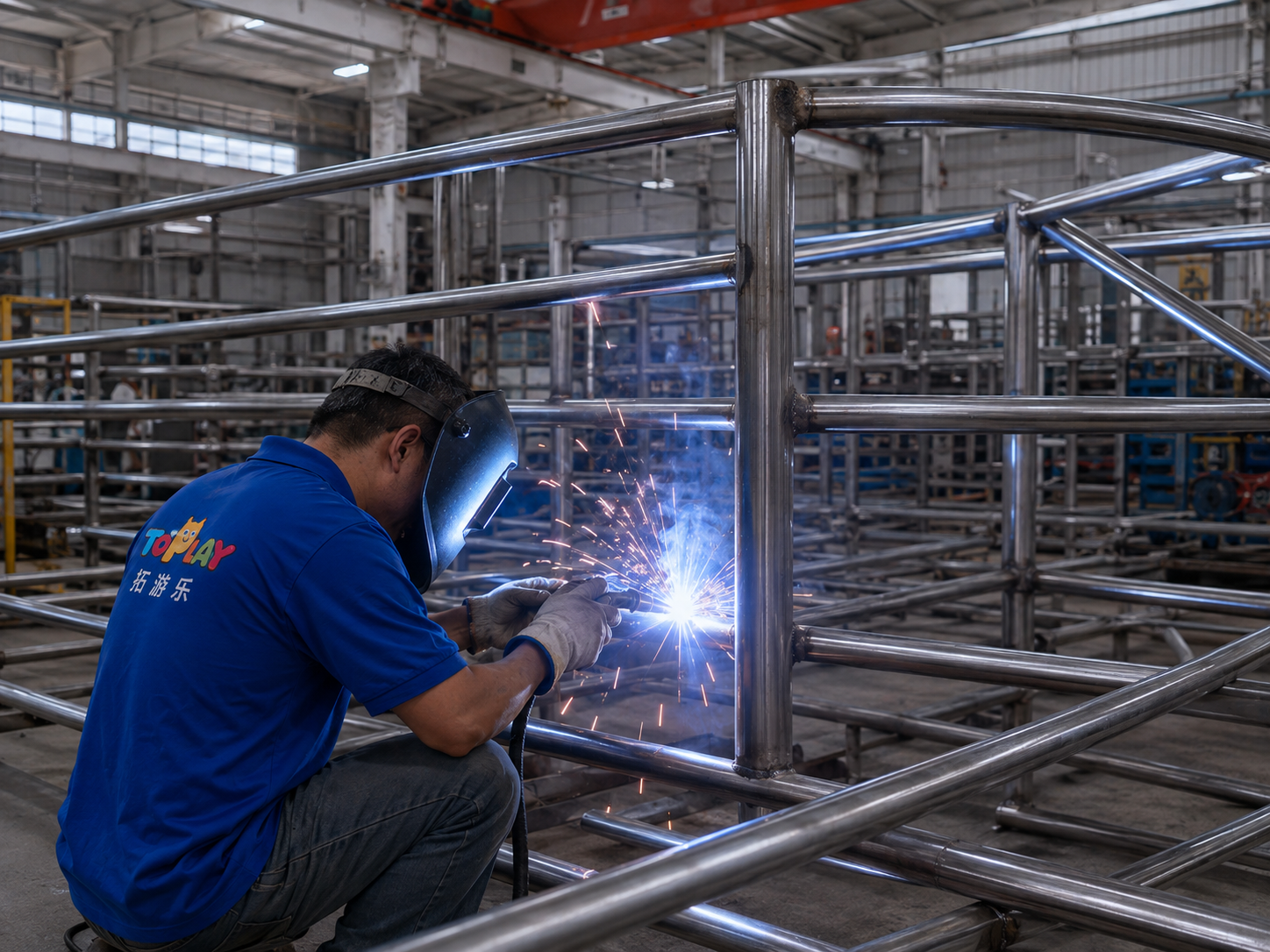
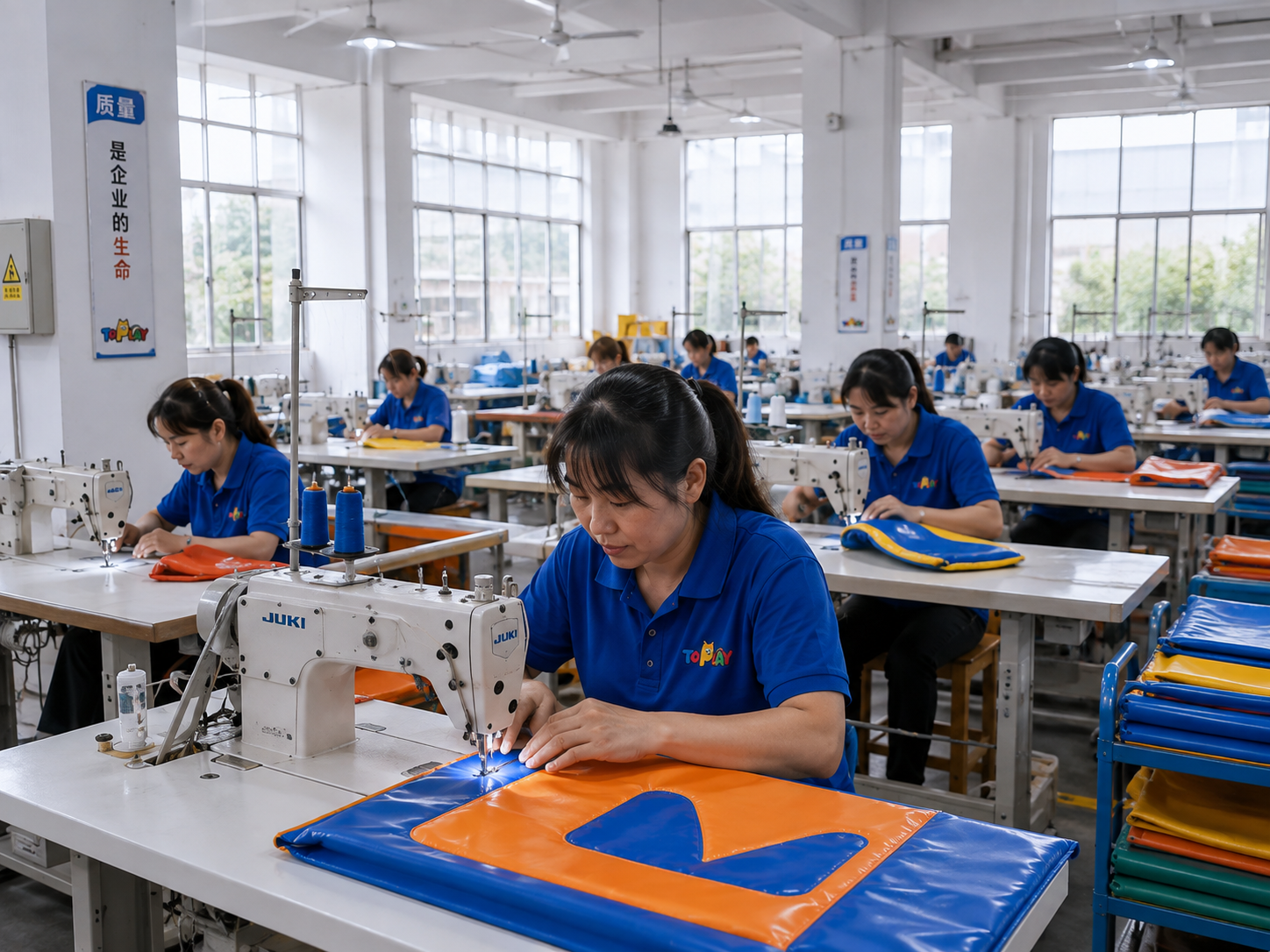
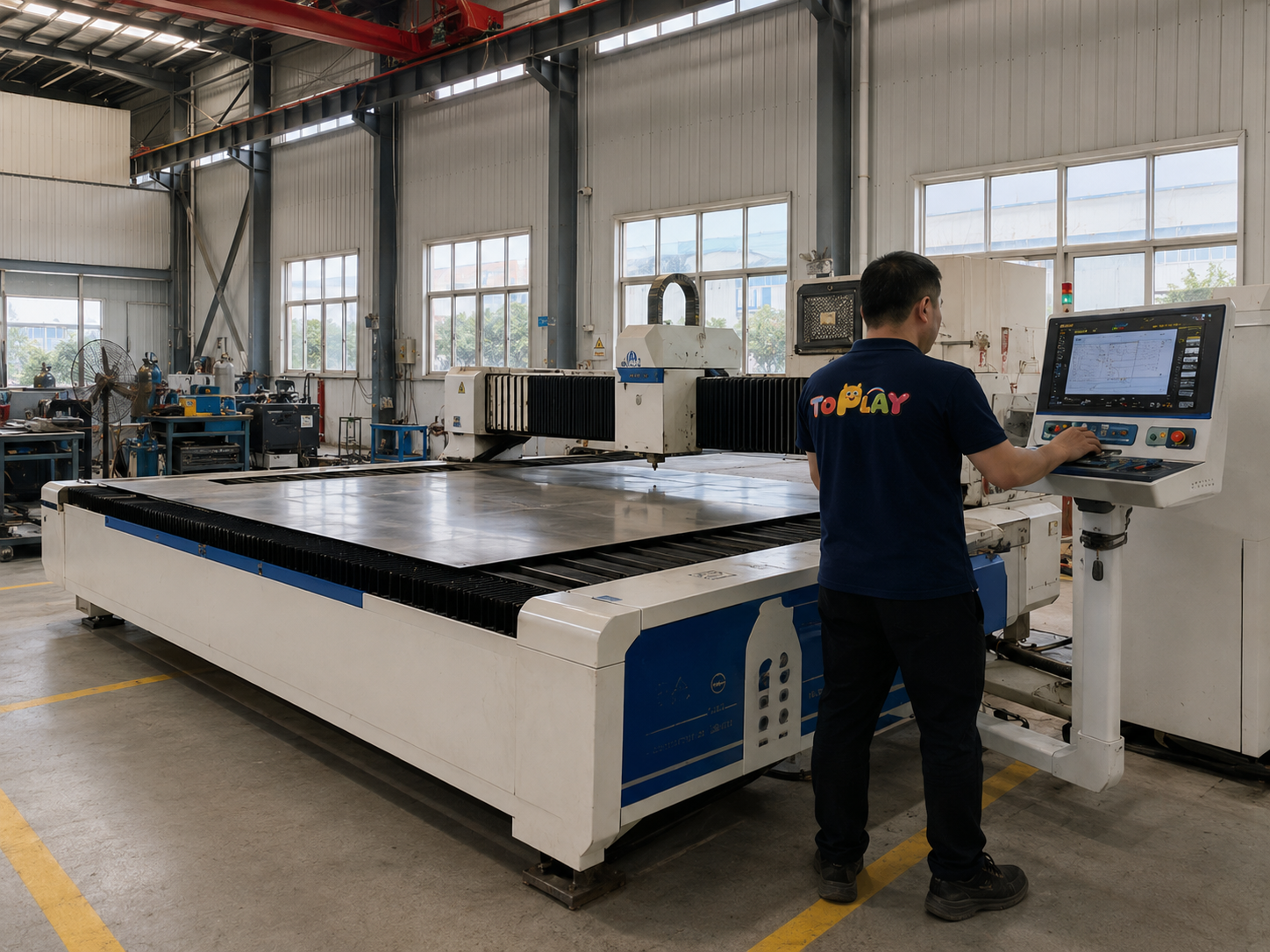
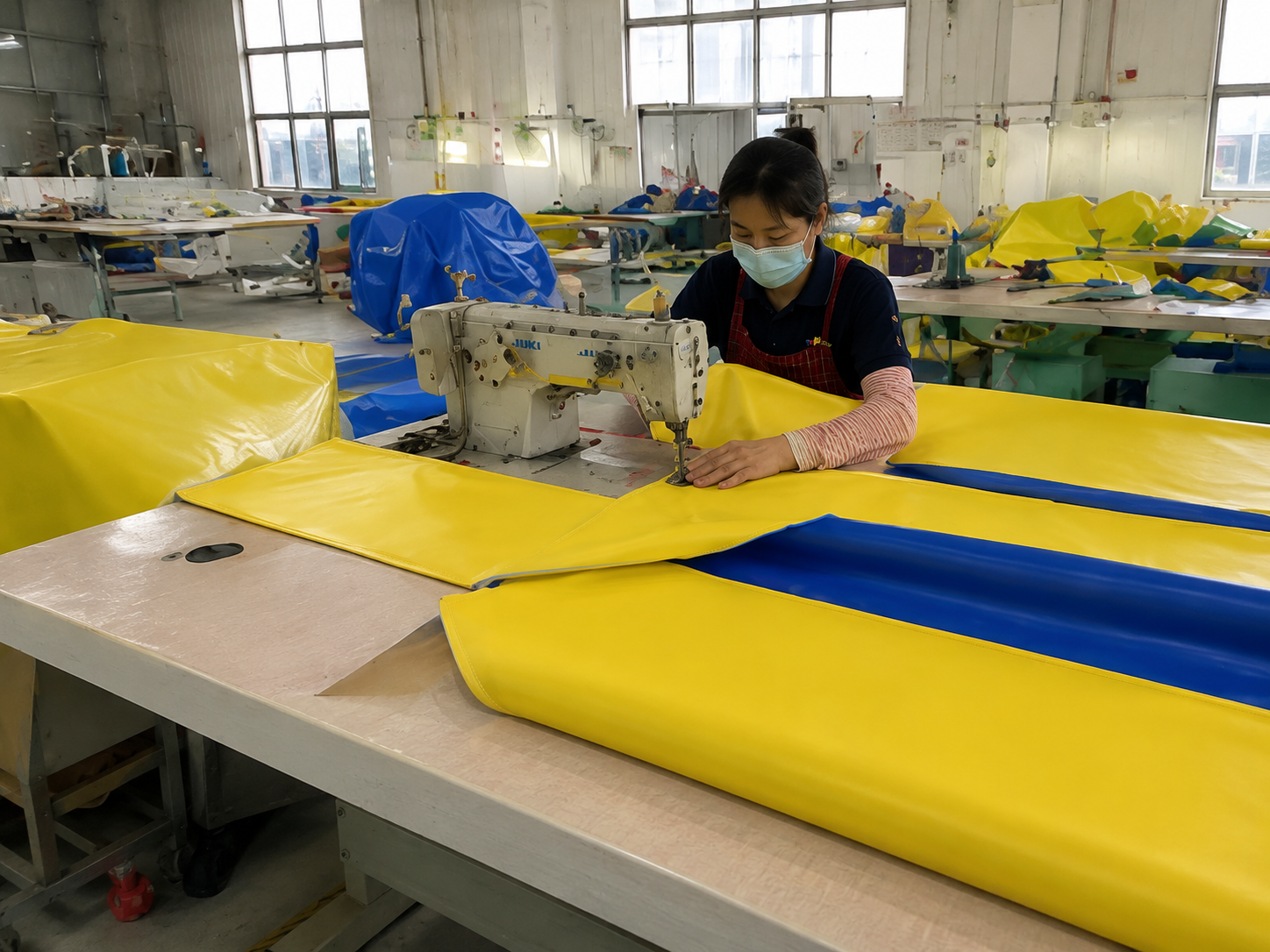
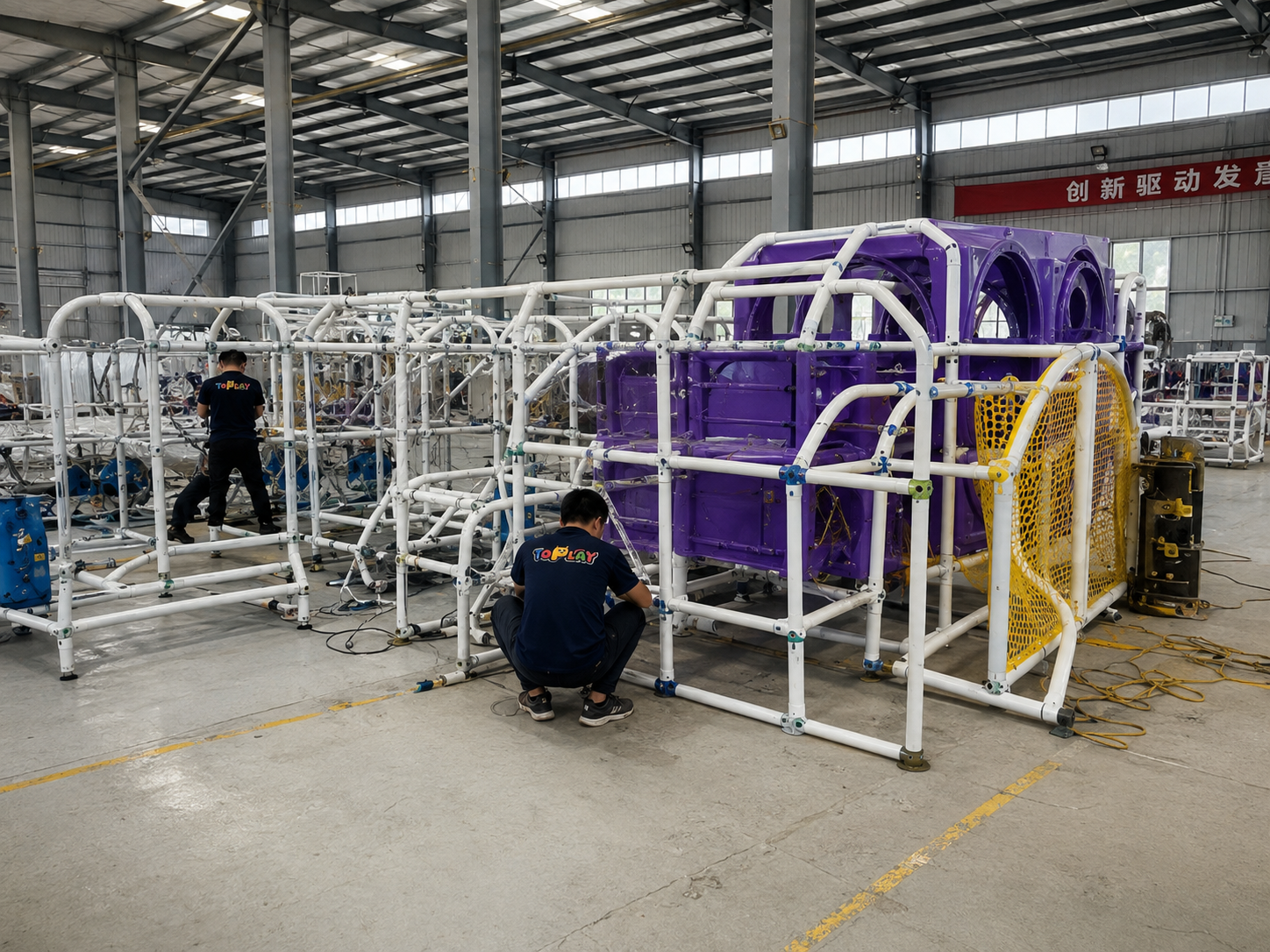
The Seam Question is worth putting to every supplier on your shortlist, including this one. At Toplay both stages happen on our own premises — the frame on the machines listed below, the padding on our own sewing floor.

The Nine Equipment Categories on Our Steel Floor

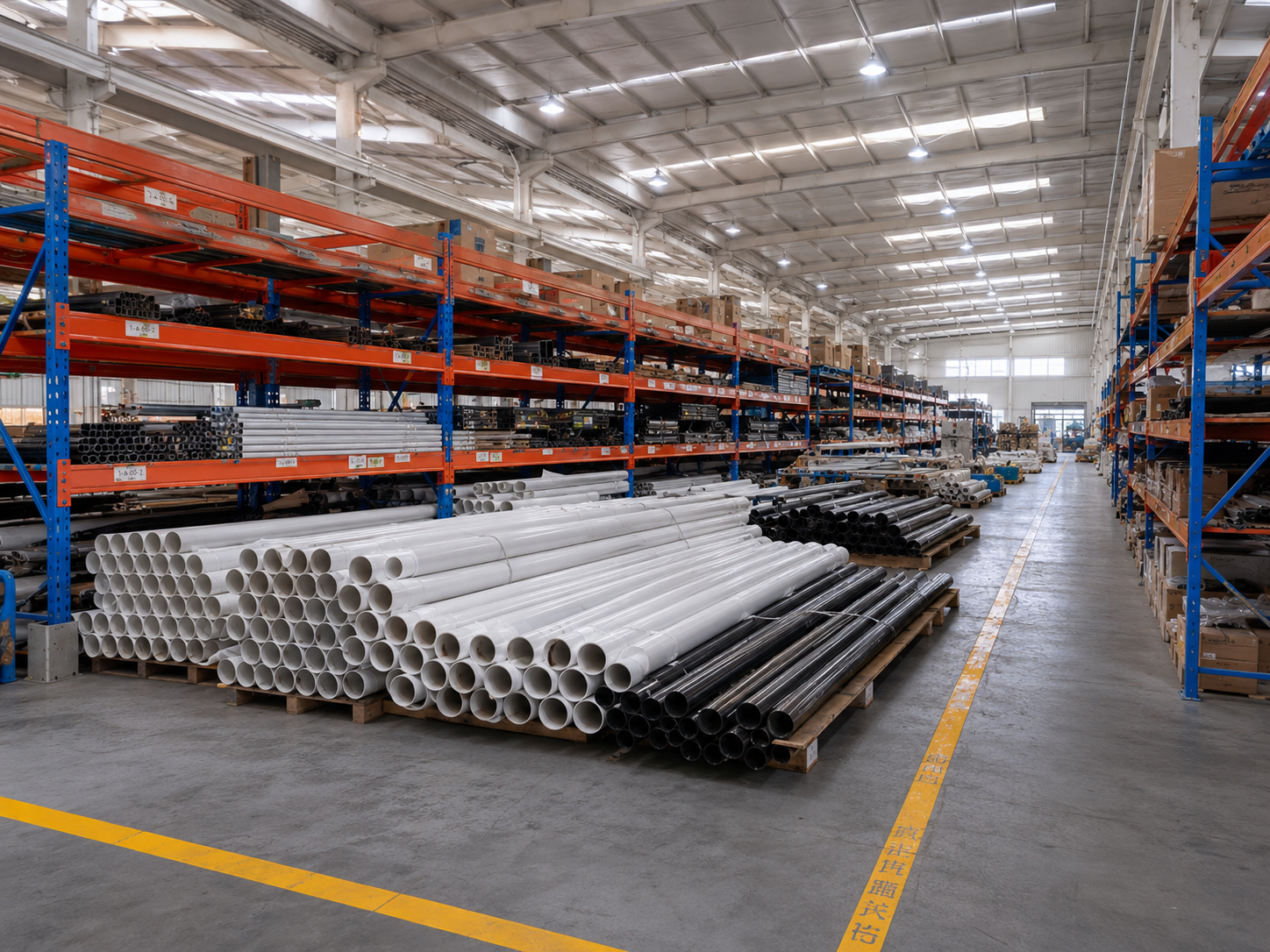
Nine categories of steel-working equipment, grouped by what each does to the material. These are categories, not a machine count.

Cut

laser tube cutting machines, tube saws

Join

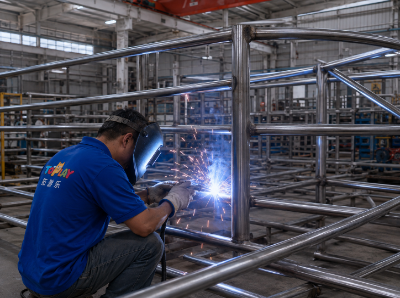
MIG / TIG / CO₂ welders, robotic welding equipment

Form

punching machines, drilling equipment, tube benders, press brakes

Finish

grinding and polishing equipment

One Check You Can Run From a Photograph

Ask any supplier for a photograph of a finished curved rail, then look at the curve itself.

That tells you which forming equipment was on the floor when the part was made. It works on any supplier’s structure, not only ours.

A formed radius

carries the bend through one continuous tube, with no joint in it.

A curve built from straight segments

carries a weld at every junction.

What the Steel Itself Has to Answer For

US federal guidance for playground equipment sets three separately auditable expectations for metal structures: fasteners that are corrosion resistant, metals that are painted, galvanized or otherwise treated against rust, and finishes that meet the lead-in-paint regulation.2

Ask us anything, no quotation involved:

ask which standard applies in your destination market and get a written answer.

Contact Engineering Team

“The reason we keep both stages here is not pride in the machines. It is that when a padded panel measures wrong, the person who has to re-cut it is thirty metres from the person who welded the frame it wraps.”
— Toplay Project Engineering Team

Play Systems We Build, and Where Each One Lives

Three ways into a project, depending on where yours currently stands. Every system here starts as playground design work against your room, and we customize the result to the drawing rather than to a catalogue page.

Commercial Play Equipment

Commercial Play Equipment

The equipment line-up itself, from single zones to the fitted multi-level structure, quoted against your drawing rather than a catalogue tier.

Venue Solutions

Venue Solutions

Commercial indoor playgrounds planned by venue type, with the compliance routing that changes between a mall, a kindergarten and a play cafe.

Design & Project Delivery

Design & Project Delivery

Layout planning, custom theming, manufacturing, shipping coordination and the installation model written into your quotation.

Commercial Play Equipment

What an Indoor Play Structure Is Made Of

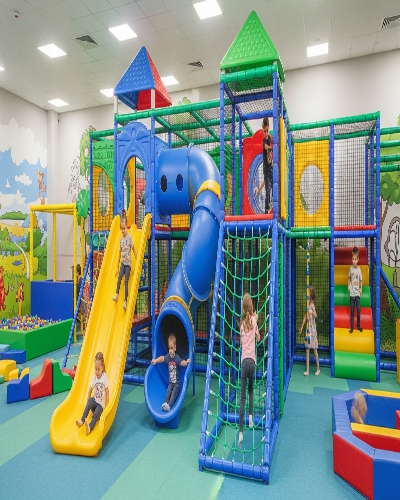
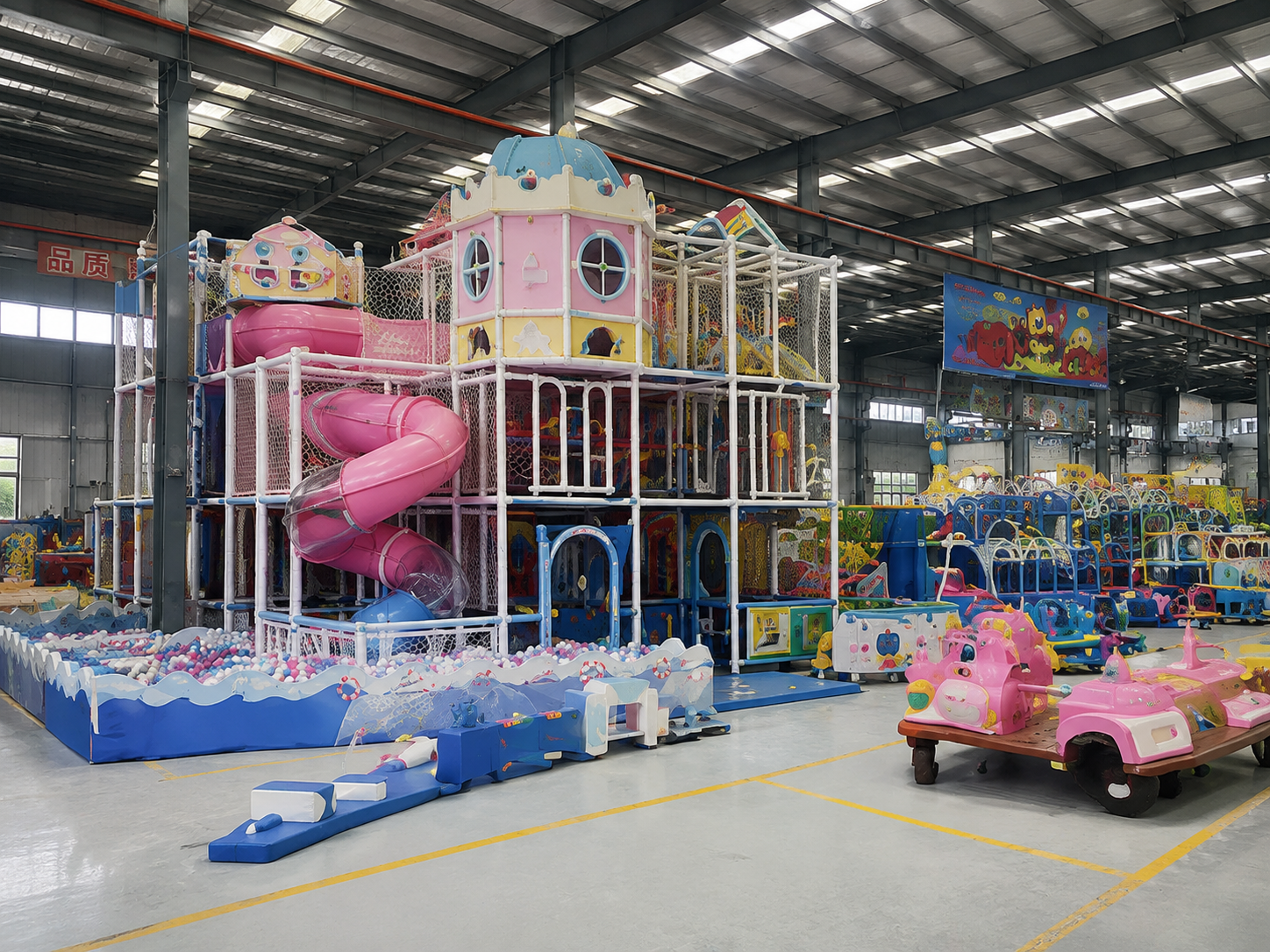
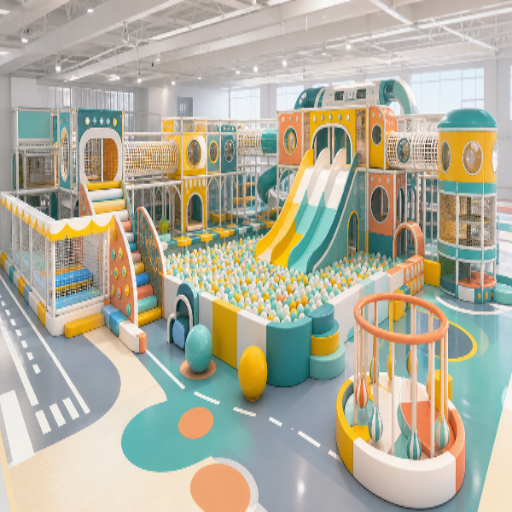
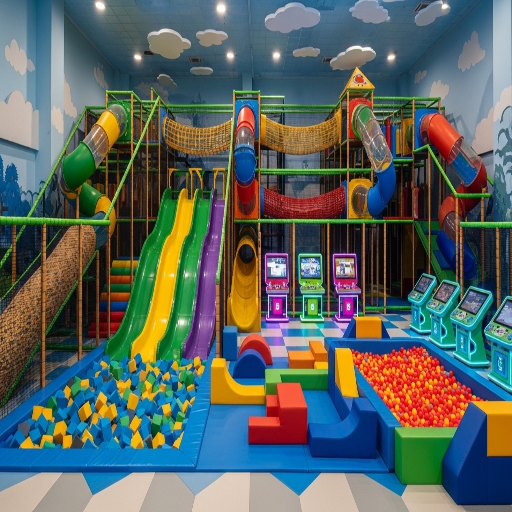
The regulator’s own term for this product is a soft contained play structure: a fully enclosed play environment built from pliable materials such as plastic, netting or fabric.1 That definition is the reason it has its own standard, separate from open playground equipment.

Two things buyers discover late, and both are drawing decisions rather than taste decisions. One is internal clear height: get it wrong and an adult cannot get inside to reach a child. The other is that a photograph online cannot tell you what survives commercial use, because the parts that fail first are never the ones photographed.

Steel skeleton

uprights, cross tubes and walkway framing, cut, formed, welded and finished

Soft play upholstery

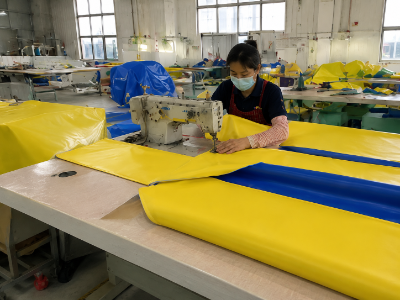
PVC-covered foam padding over every reachable edge, cut and sewn on floor

Enclosure netting

the consumable layer, carried on its own inner frame so net tension stay separate

Decks, tunnels and slides

the multi-level circulation that gives a small footprint its usable volume

Ball pits & toddler areas

lower-height zones with their own age banding

Kindergarten modular

sized to the room rather than to a catalogue page

Small indoor playground equipment

for a play cafe corner or a restaurant zone, quoted as a complete system rather than a part list

We build the structural range single-category vendors do not. Not just a ball pit, not just a toddler corner, but the fitted commercial indoor playground equipment a venue actually needs.

Commercial Indoor Playgrounds

Venue Types, and What Changes Between Them

Venue type shapes the brief more than floor area does. Supervision model, age banding and sightlines all shift between these five, and our venue solutions guide works through each one in turn.

Shopping malls & mixed-use complexes

footfall infrastructure, where durability and throughput matter more than revenue per head.

Family entertainment centers

the fitted anchor attraction, quoted as one system rather than a batch of parts

Dedicated indoor play centers

where the structure is the business, so throughput and consumable replacement drive

Kindergartens & daycare rooms

tighter age banding, and a supervision model built into the layout

Family restaurants & hotels

the category the US regulator specifically notes is frequently found inside restaurants

Clinics & waiting spaces

where infection-prevention guidance favours smooth, cleanable surfaces

Two numbers, no drawing needed: send only your clear height and floor area and we will tell you whether the shell fits before anyone draws anything.

Design Envelope and What Each Standard Actually Covers

Most requests for quotation in this category name the wrong standard. Indoor soft contained play has its own document, and the one buyers usually ask for governs open public playgrounds instead.

Document Current edition What it covers Age envelope What it does not cover
ASTM F1918 F1918-21, active since 03 Sep 2021 Soft contained play equipment — the enclosed indoor structure itself 35th percentile 2 year old to 95th percentile 12 year old Public playground equipment, home playground equipment, sports equipment, amusement rides, water attractions, toys
ASTM F1487 F1487-25 Public playground equipment for public use — the standard most buyers ask for by name 2 to 12 years Enclosed soft contained play, which sits outside its scope
BS EN 1176-10 2023, published 30 Sep 2023, superseding the 2008 edition Fully enclosed play equipment installed inside and outside buildings, including emergency procedures, fire safety management and evacuation4 Up to 14 years Structural strength alone — its distinctive content is exits, visibility and evacuation
ASTM F1292 F1292-22 Impact attenuation of surfacing, expressed as a critical height rating2 n/a — surface property Anything about limb injury; it models head impact only
CPSC Publication 325 July 2025 Public playground safety guidance, and it names soft contained play equipment among the categories it is not intended for1 Under 12 years This product. The exclusion is explicit and repeated.
IPEMA certification Programme lists 6 scopes ASTM F1487-25, CSA Z614:20 Update No. 1, F1292-22, F3351-19e1, F2075-26, F3012-225 per each standard ASTM F1918 is not among the six, so no IPEMA seal covers an indoor soft contained structure
16 CFR 1110.7(a) current through 27 Aug 2026 Who issues the certificate for an imported children’s product7 children’s products Any performance requirement — it is a certification-duty rule, not a design rule
Premium B2B Indoor Play Structure Engineering

Three Consequences of That Table

An IPEMA seal does nothing for an indoor soft contained structure. The mark certifies to six standards and F1918 is not one of them, so nobody selling this product can show you one.

Asking for an F1487-compliant indoor playground is the wrong answer to the right question. The two standards share a 2-to-12 anthropometric envelope, but F1487 governs open public playgrounds whereas F1918 governs the enclosed structure.

The US and European age envelopes disagree. F1918 stops at the 95th percentile 12 year old; EN 1176-10 runs to 14 years. A structure dimensioned for one market is not always dimensioned for the other.

A supplier’s own document is not a substitute for the one your border asks for. That is a separate question, answered further down.

Red Flag: The tell is which designation a supplier reaches for first. Quoting F1487 or an IPEMA number against an enclosed indoor structure is a red flag worth one clarifying email before it becomes a purchase order.

Integrated Indoor Trampoline and Climbing Walls

Adjacent Attractions Sit Under Different Rules

A venue rarely contains only one attraction class, and the safety standard changes at the boundary between them.

Bouncing elements built into an enclosed play structure are covered by EN 1176-10 alongside the structure itself.4

A standalone trampoline park is a separate attraction class with its own standard family, quoted and certified separately from the contained structure.

A climbing wall is likewise treated on its own terms rather than as part of the enclosed play envelope.

Open outdoor playground equipment sits under ASTM F1487 and is outside this page entirely.

If your brief mixes an enclosed structure with a trampoline park or a climbing wall, say so at layout stage. It changes which safety standards apply to which part of the room, and therefore which documents you will need at handover.

Accessibility and Structural Venue Design

Accessibility Sits With the Venue, Not the Standard

US accessibility guidance treats entry points as a design-time decision, not a retrofit.8

≤ 3

Three or fewer entry points — at least one must sit on an accessible route.

≥ 4

Four or more entry points — at least two must sit on an accessible route.

!

Adding a fourth entrance therefore doubles the obligation. Our accessible entry calculator works this out against your own entry count, and it runs on any supplier’s layout.

Commercial Terms

Quotation, Lead Time and Trade Terms

Nobody in this category publishes their commercial terms. We publish ours, with the event that starts each clock, because a number without a start event is not a schedule.

Get Instant Quote

The Four Published Clocks

The Four Published Clocks exist so you can schedule backwards from an opening date instead of forwards from a purchase order.

Clock Duration What starts it What is not inside it
Quotation 3 working days Usable project inputs reach us Time spent waiting for dimensions
Layout deliverable 3–4 working days Usable dimensions reach us Revision rounds after your feedback
Production window 45–75 days Design approval and deposit Freight time, which is separate
Balance Before shipment Production completion —

How the Price Is Built

There is no price list, because a fitted system has no unit. Six drivers move your figure.

Structure volume

Footprint multiplied by usable levels, not floor area alone.

Clear height

And the deck levels the clear height allows within the facility.

Padding coverage rule

Which edges and which faces get wrapped in safety padding.

Netting & Cover

The specific netting and protective cover specifications applied.

Theming depth

A themed build with moulded elements vs standard finishes.

Destination

Trade term, comprehensive documentation set, and packing method.


Landed Cost

What We Can Tell You, and What Your Broker Must.

Indoor playground equipment cost is a project question, not a catalogue one. We’d rather say that than repeat a false number.

Duty is a real line item and hiding it helps nobody. Children’s play structures imported into the United States classify under HTS 9506.99.60, which carries a 4% general rate of duty, and US Customs has issued a binding ruling classifying children’s play structures from China into 9506.99.6080 with an additional 7.5% Section 301 duty.

Those two layers are verifiable. We deliberately do not publish a total 2026 duty stack, because the additional tariff layers on Chinese goods have moved repeatedly. Confirm the stacked rate with your customs broker before each PO.

Ocean freight moves weekly, and it costs you more than most equipment line items. On the assessment dated 27 August 2026, the Drewry World Container Index composite stood at $4,473 per 40ft container, with Shanghai to Los Angeles at $6,818.

Equipment is one line inside a larger project. A US indoor-playground franchise disclosed a total estimated initial investment of $748,633 to $1,834,833 in its 2025 franchise disclosure document — a whole-venue figure covering fit-out, working capital and fees.

Payback figures in this category are vendor-published. Every ROI number we could trace originates from an equipment manufacturer’s own blog with no cited survey. The one genuine operator benchmark sits behind a paid licence.

Quality Control and the Documents That Ship With Your Order

A badge on a homepage cannot be audited. A document that arrives in the crate can.

Document Verification

With your order we ship the requested standard reference, a test report, product identification and a handover document. The document list is agreed in the written quotation before production starts.

Who Produces what Cannot produce
Toplay The standard reference, a test report on the shipped configuration, product identification and a handover document Your import certificate — that is not ours to issue
A CPSC-accepted laboratory The passing test results a certificate is built on The certificate itself; the lab supplies results, not certification
You, as importer The Children’s Product Certificate. For a children’s product manufactured outside the United States, only the importer must certify compliance.7 Test data — which is why the report has to come with the goods

The Shipped Document Set is designed around that split. What you need from an overseas factory is evidence you can build your own certificate on, not a factory-issued document that carries no legal weight at your border.

Fire Safety Standards

Model building code §424.2 names the fire tests for this exact product category, by number, once a structure crosses the code’s size threshold for indoor play structures.14

This is the moment projects stall. Your plan reviewer holds up the code and the supplier says it never applied to them — a scene a US building official described in a public practitioner forum in January 2026. A supplier who can name these five tests before you ask is answering a question the reviewer will ask anyway.

Component Test named in code Criterion
Textiles and films — the sewn PVC padding NFPA 701, Test Method 1 or 2 as appropriate Fire propagation performance criteria
Rigid plastic components — tubes, panels, slides, decks ASTM E1354 Peak rate of heat release not exceeding 400 kW/m², at 50 kW/m² incident heat flux, horizontal, 6 mm thickness
Foam plastics, including pipe foam UL 1975 or NFPA 289 100 kW ceiling
Ball pool balls UL 1975 or NFPA 289 100 kW ceiling
Floor covering under the structure NFPA 253 Class I

Read the size threshold carefully. Adopted editions of §424.1 word it differently — some read “exceeds 10 feet in height or 150 square feet in area”, others read “and”.14 A project sitting close to that line should run our clear height and code threshold planner, which reports which side of both figures the envelope falls on, then confirm the wording of the adopted edition with your authority having jurisdiction before the layout is frozen.

What Happens on the Floor

Quality Check

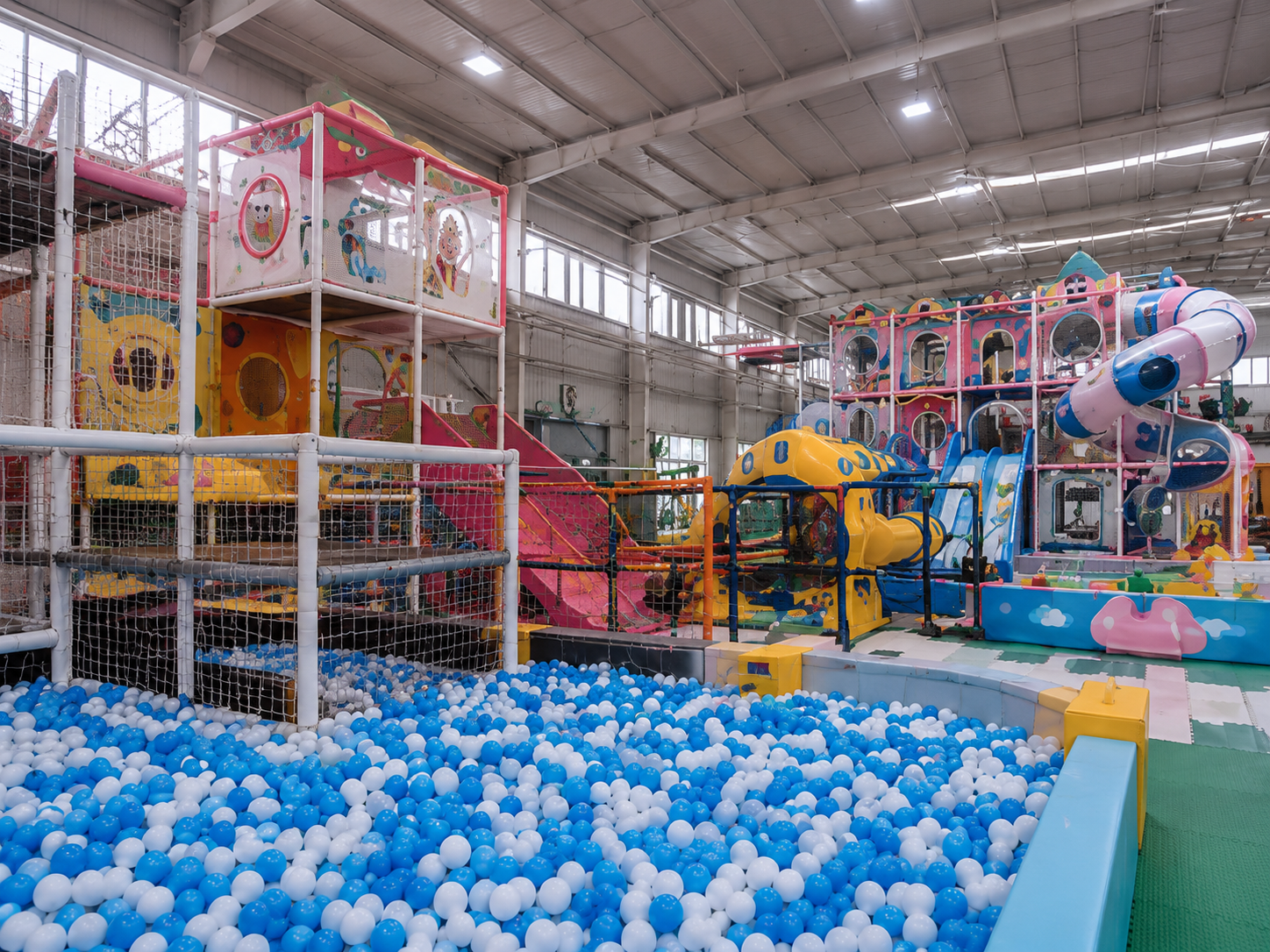
If a component measures outside the approved drawing, it is reworked or remade against the same written acceptance criteria used at the first check.

Trial Assembly

The order is trial-assembled, photographed and reconciled against the component schedule before loading.

Material Treatment

Metals that are not inherently corrosion resistant are painted or otherwise treated, fasteners are corrosion resistant, and finishes meet the lead-in-paint regulation.2

Consumable Netting

Netting is treated as a consumable, carried on its own frame so it can be swapped without dismantling the durable steel structure around it.
Ask about the consumables rather than the steel. The durability complaint in this market is not about frames: pads, nets and attachments are the parts that wear out first, and the trade-off a buyer actually makes is between a lower invoice today and a replacement-part conversation in year four.

What a Certificate Does Not Prove

This part is uncomfortable and worth saying anyway. Impact-attenuation testing models a dropped headform, which is why a surfacing certificate speaks to head injury and to nothing else.
Run it on us: the 12-point supplier check works on any supplier, including this one. Nothing is captured; the score stays in your browser.
1

Epidemiological Data

A cluster-randomised trial across 37 schools recorded an arm-fracture rate of 1.9 per 100,000 student-months for falls into sand against 9.4 for the standards-favoured engineered wood fibre — on surfaces that had all passed headform drop testing. The authors noted that surfacing standards are not based on epidemiological data or actual injury experience.11

2

Fracture Rates

US emergency-department rates of playground-equipment extremity fractures stayed flat across 2006 to 2016 at an annual average of 72,889 children, despite a decade of tightened standards.12

3

Legal Responsibility

UK play-safety guidance states plainly that compliance with the standards does not remove the operator’s responsibility to ensure equipment is safe, and cannot necessarily be used as a defence in the event of litigation.13

4

Independent Inspection

The same guidance asks for a post-installation inspection before a facility opens, and an annual inspection independent of both operator and supplier.13 A supplier’s own sign-off is explicitly not sufficient, which is exactly why we build for inspection access and ship the paperwork an inspector will ask to see.

From Floor Plan to Documented Handover

Six steps, each with the deliverable that closes it. We deliver documents at every one of them, because a step with no artefact is a step nobody can check.

1

Send the floor plan

CAD or DWG floor plans, site photographs or a dimensioned sketch, plus clear height, target ages and destination market.

2

Layout and quotation

A free 2D layout and 3D render in 3–4 working days after usable dimensions, and a written quotation in 3 working days.

3

Design approval

Zones, age banding, entry-point count and padding coverage are fixed here to manage the code threshold.

4

Production

45–75 days from design approval and deposit, on the nine equipment categories above and our own sewing floor.

5

Pre-shipment reconciliation

Trial assembly, photographs and a component-schedule check before the container is loaded.

6

Export and handover

The Shipped Document Set travels with the goods, and the written quotation defines the installation model.

Steps 1 to 4 are The Four Published Clocks in sequence. Nothing in that sequence starts on a date we choose; each starts on something you hand over, which is what makes the schedule checkable rather than promised.

Steps 5 and 6 exist because of two documented failures in this market. In one, entire components go missing, not just fasteners, and nobody finds out until the crate is open; in the other, one installer arrives instead of the crew you were promised, and the structure waits. Ask any supplier for installation headcount, duration and local-labour scope in writing at step 2 — ask us for ours.

Where Our Responsibility Stops

Trade terms allocate delivery, cost, risk, clearance and unloading. They do not define assembly, supervision, local construction, inspection or operational handover.

Ocean transit and port dwell are outside the production clock, and outside our control.

Local building approval, fire-marshal acceptance and operating permits sit with you and your authority having jurisdiction.

The installation model — who is on site, for how long, and who supplies local labour — is fixed in your written quotation, not assumed from this page.

Where the scope boundary matters most, the venue solutions page sets it out per venue type, and the turnkey delivery page carries the full responsibility schedule.

Playground Operational Handover

Our Global Footprint

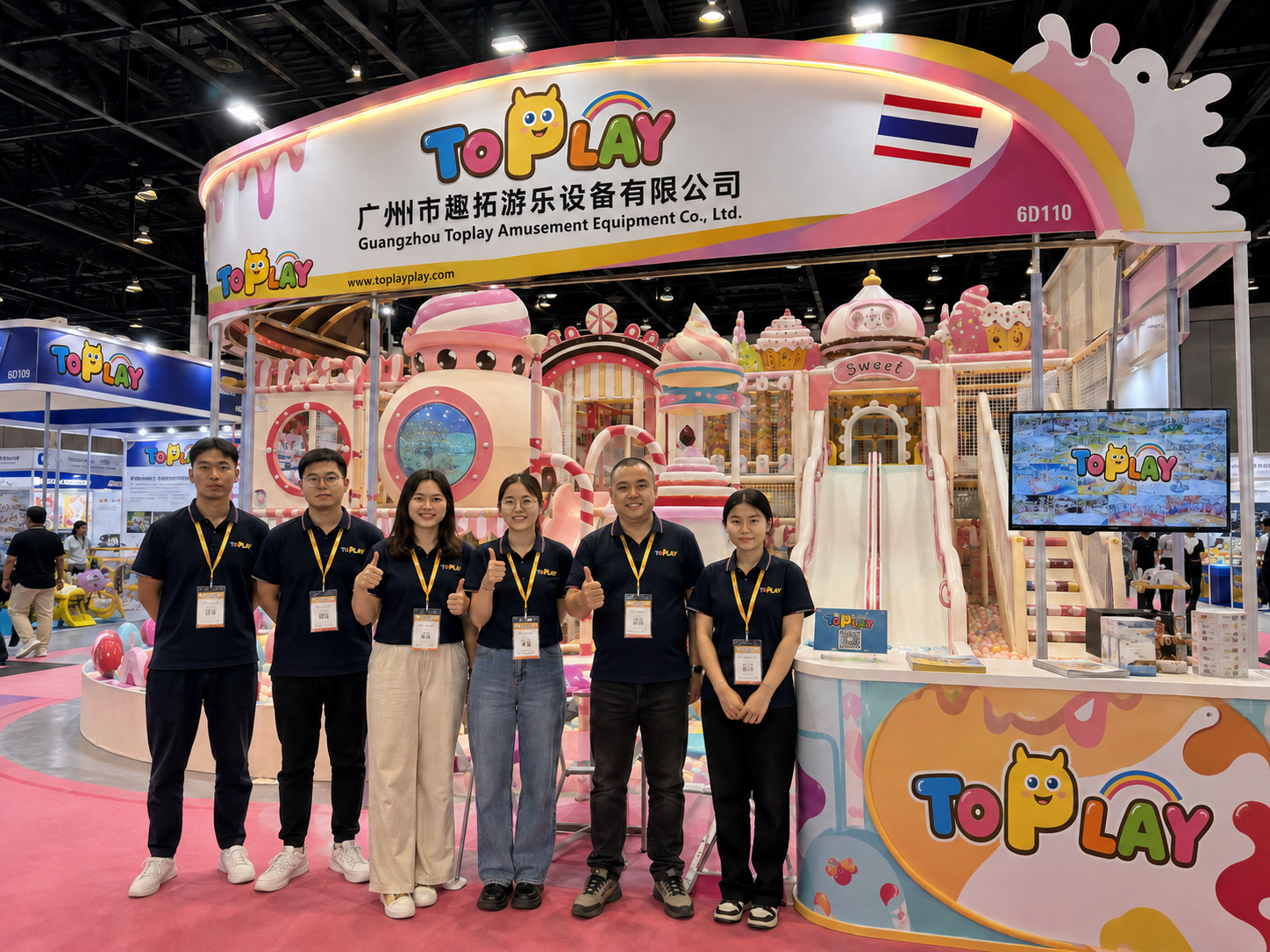
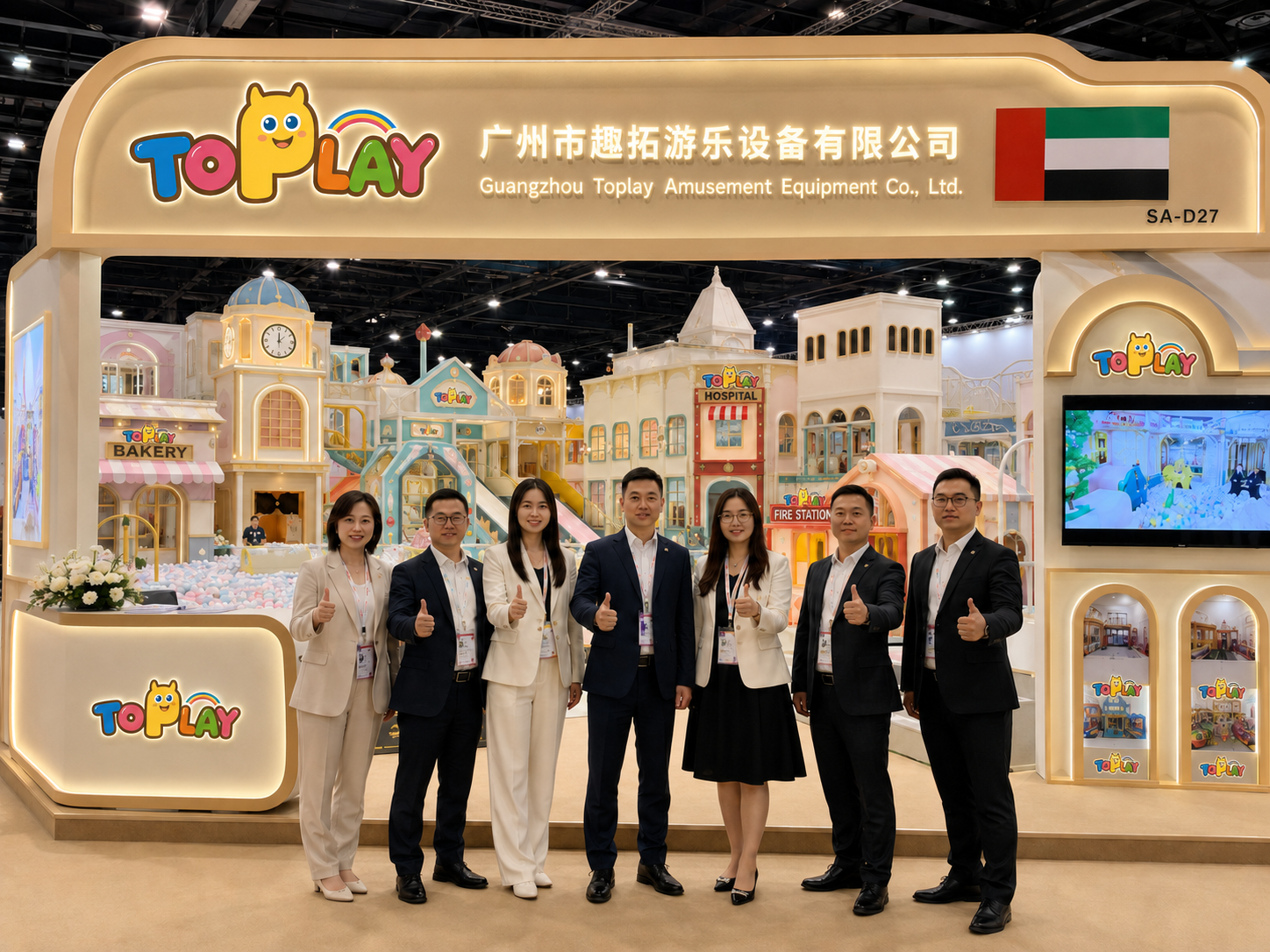
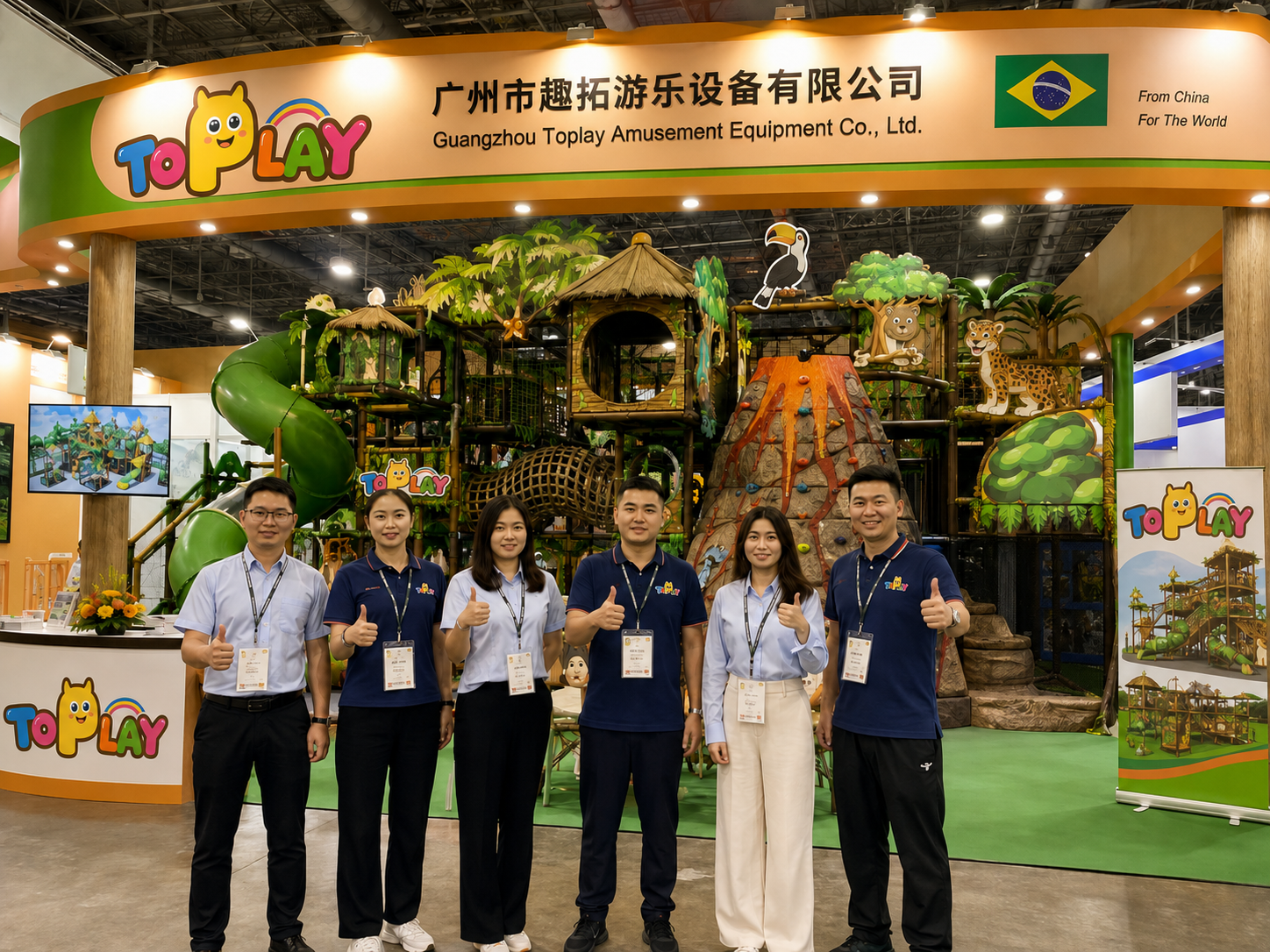
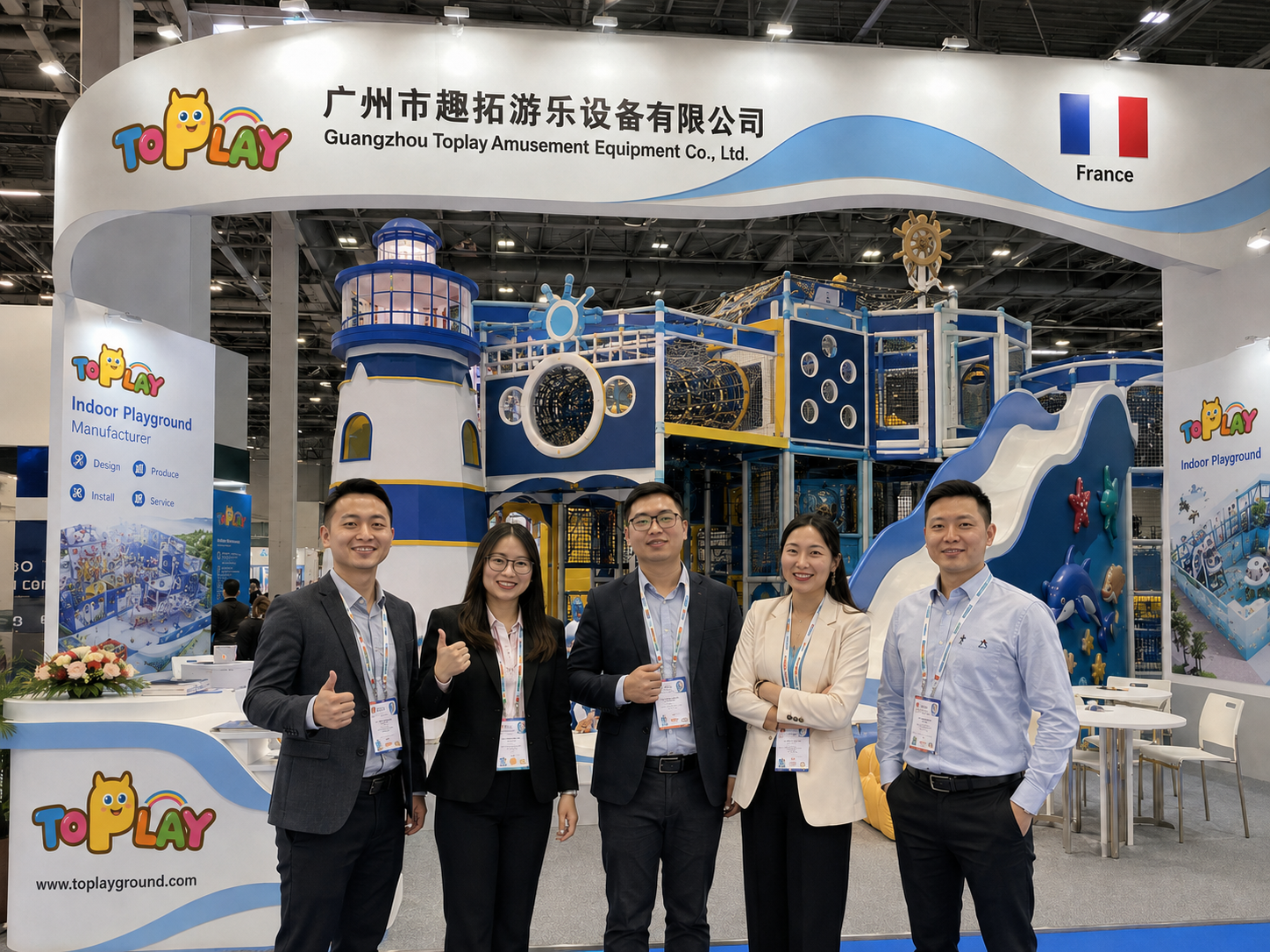
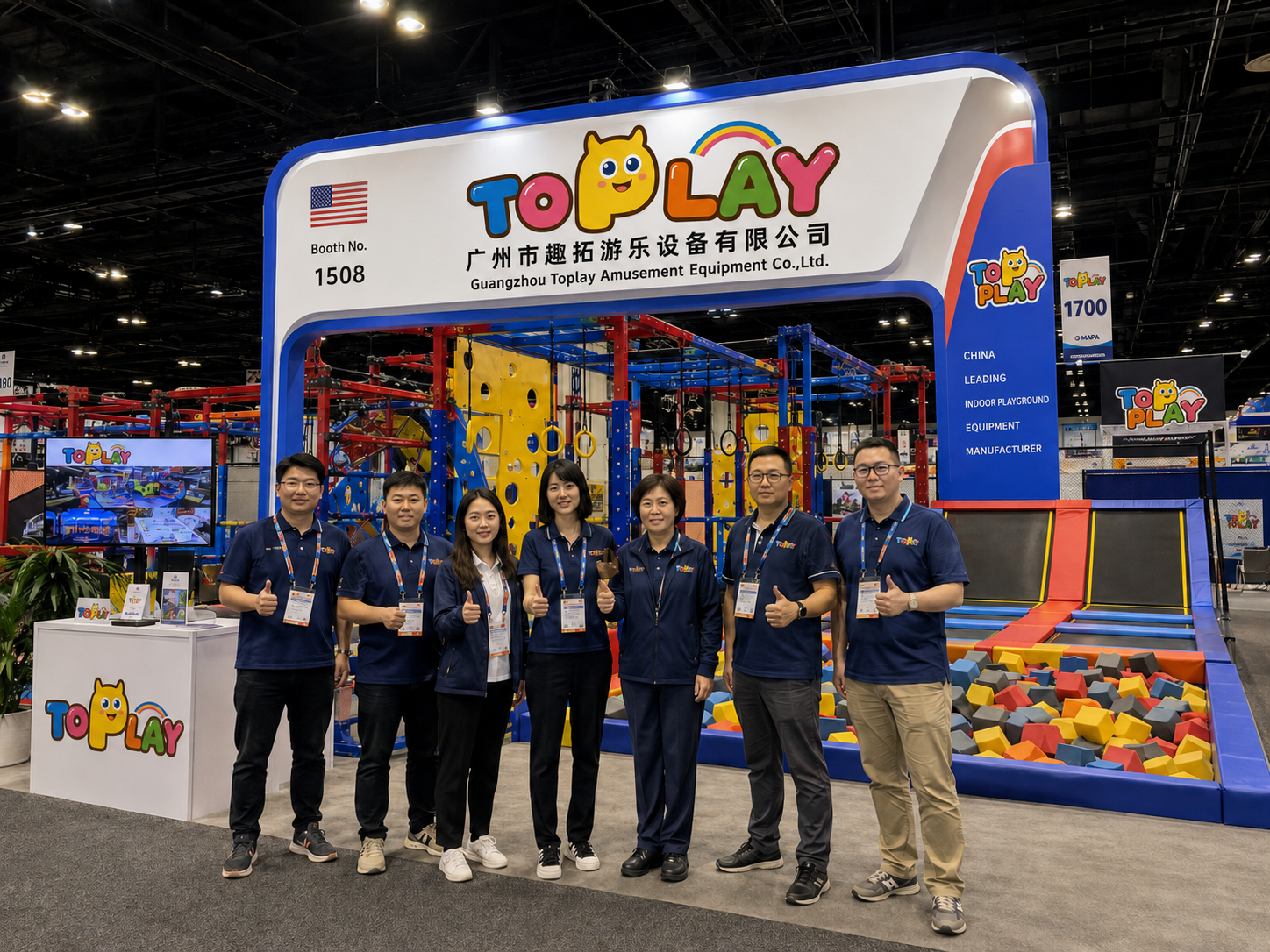
Global Exhibitions & Industry Milestones

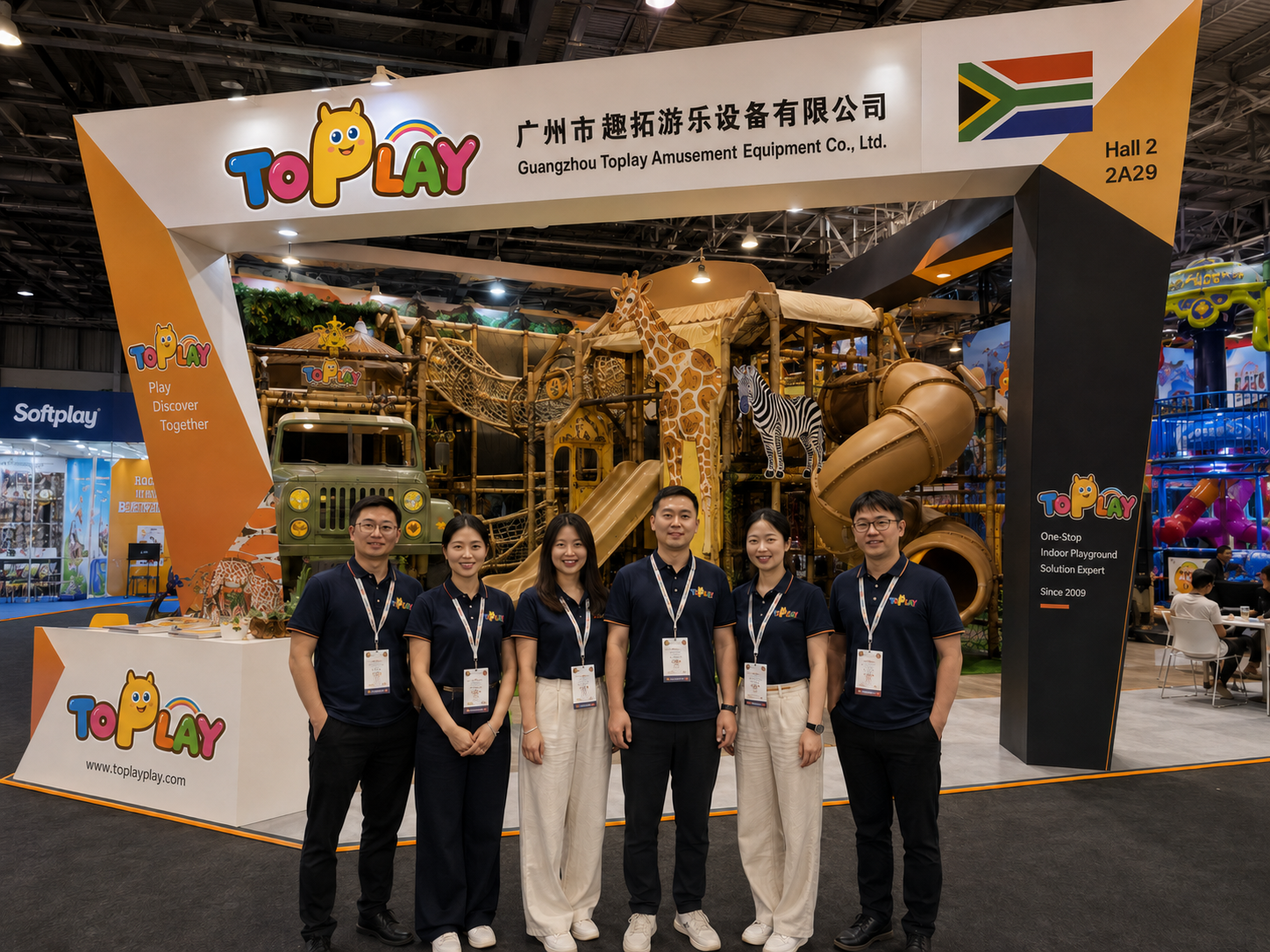
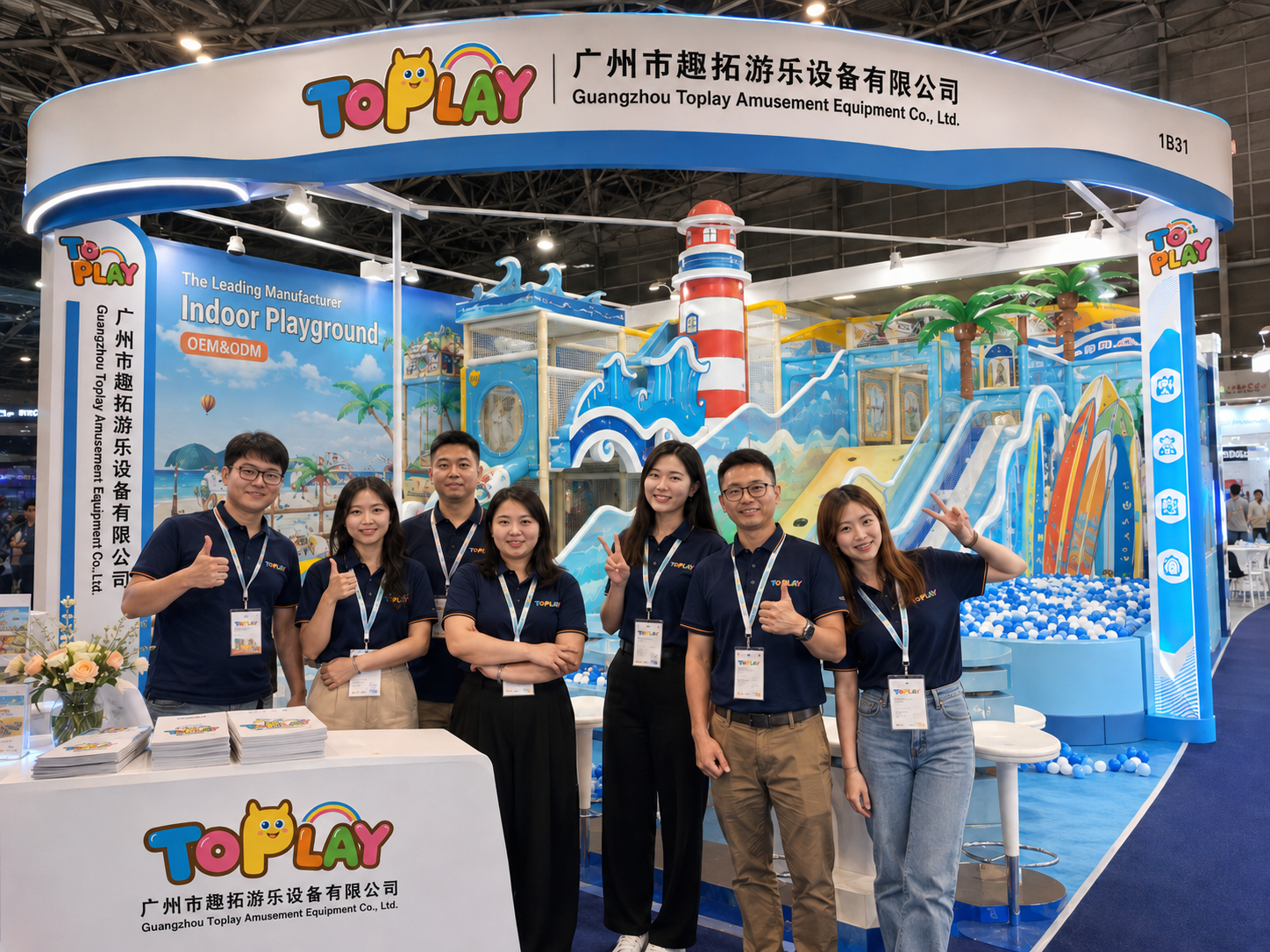
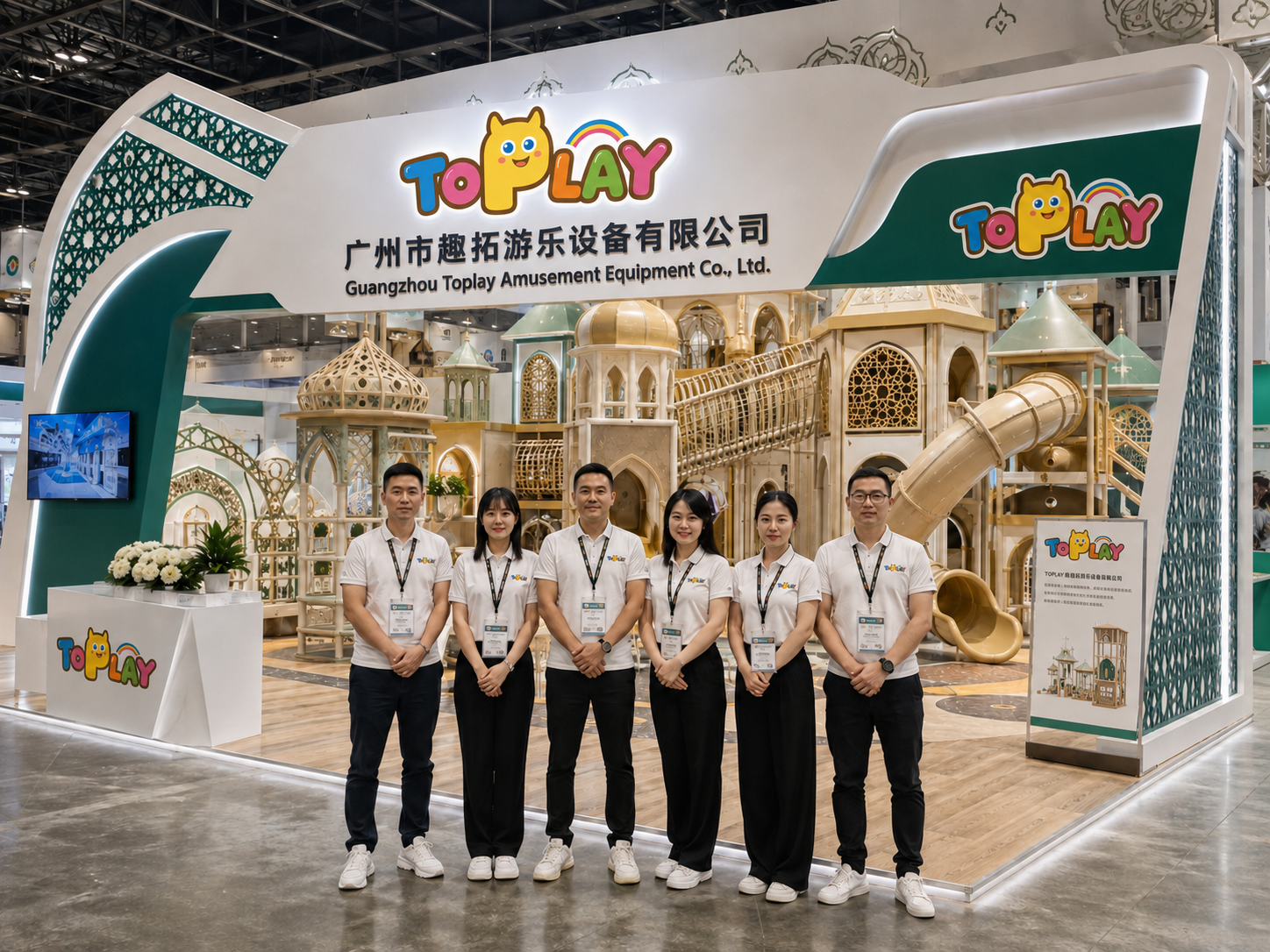
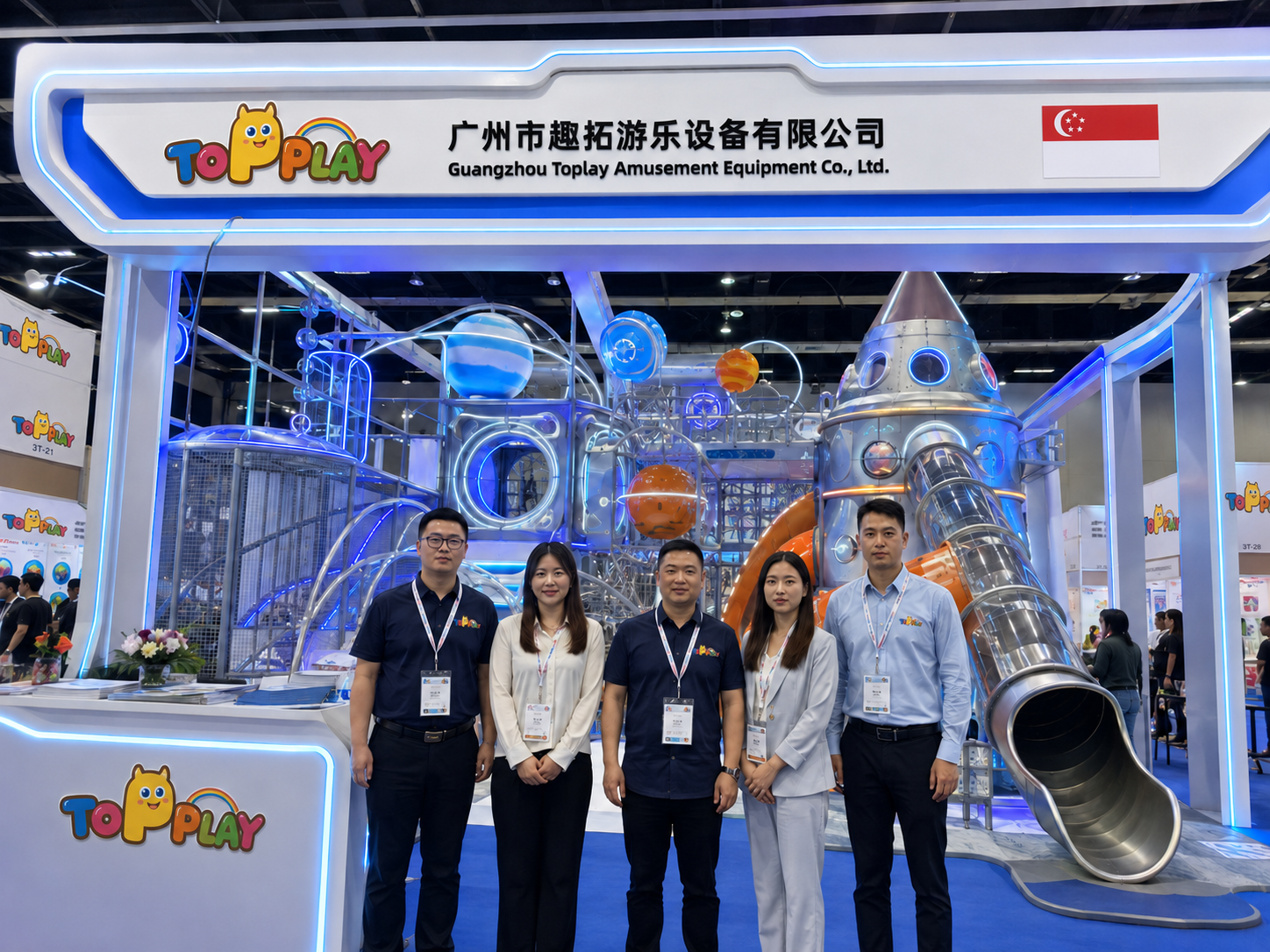
Discover our legacy of manufacturing excellence and B2B partnerships showcased at premier international trade events.

Factory, Export Reach and Support

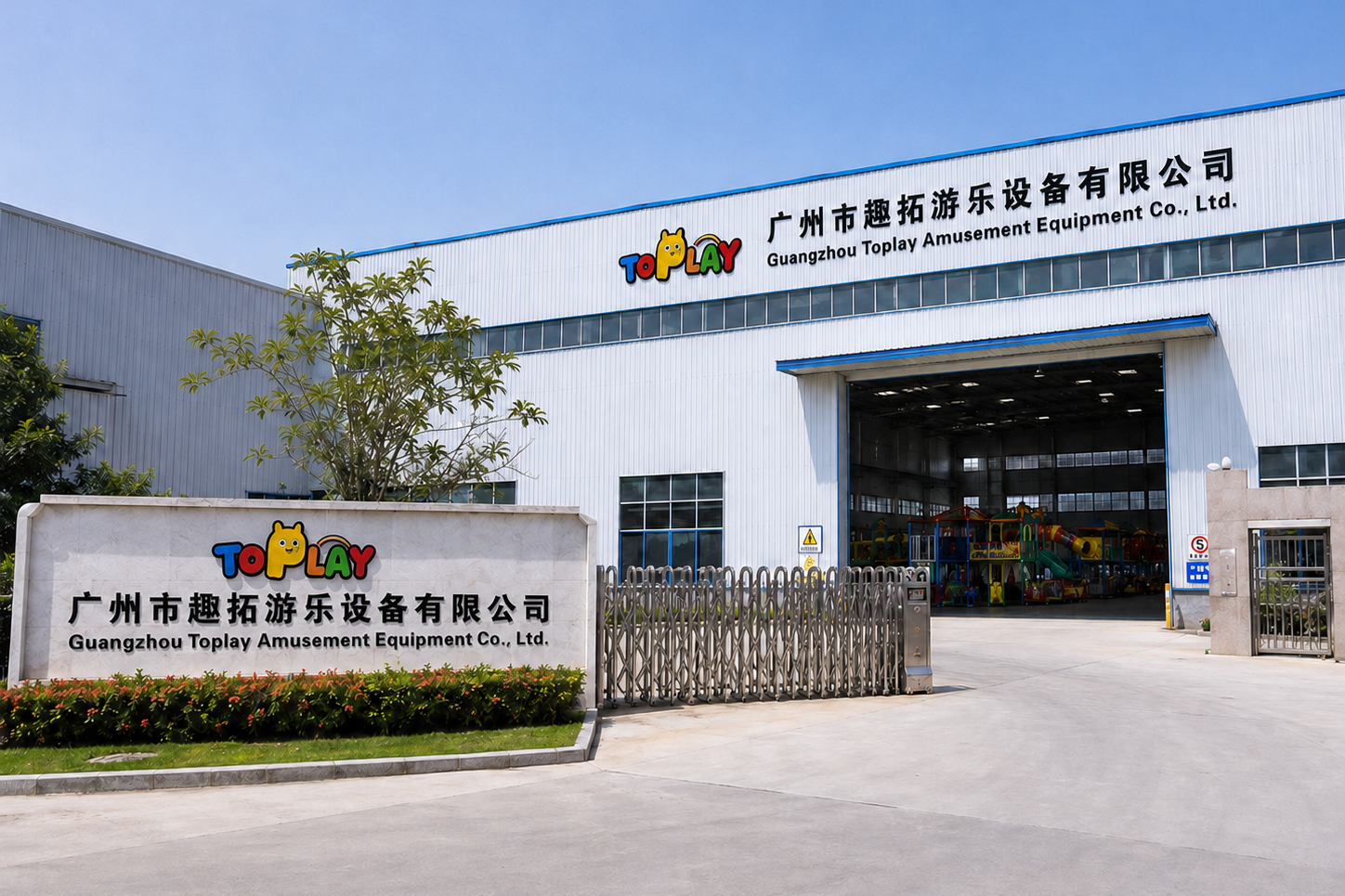
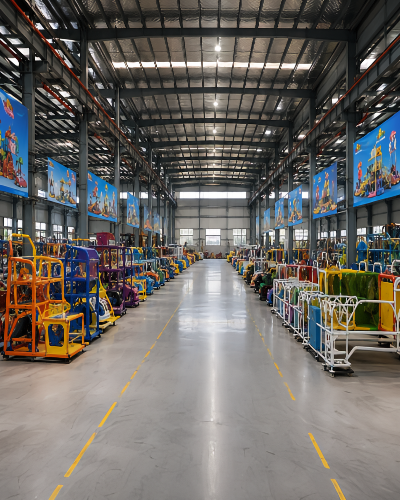
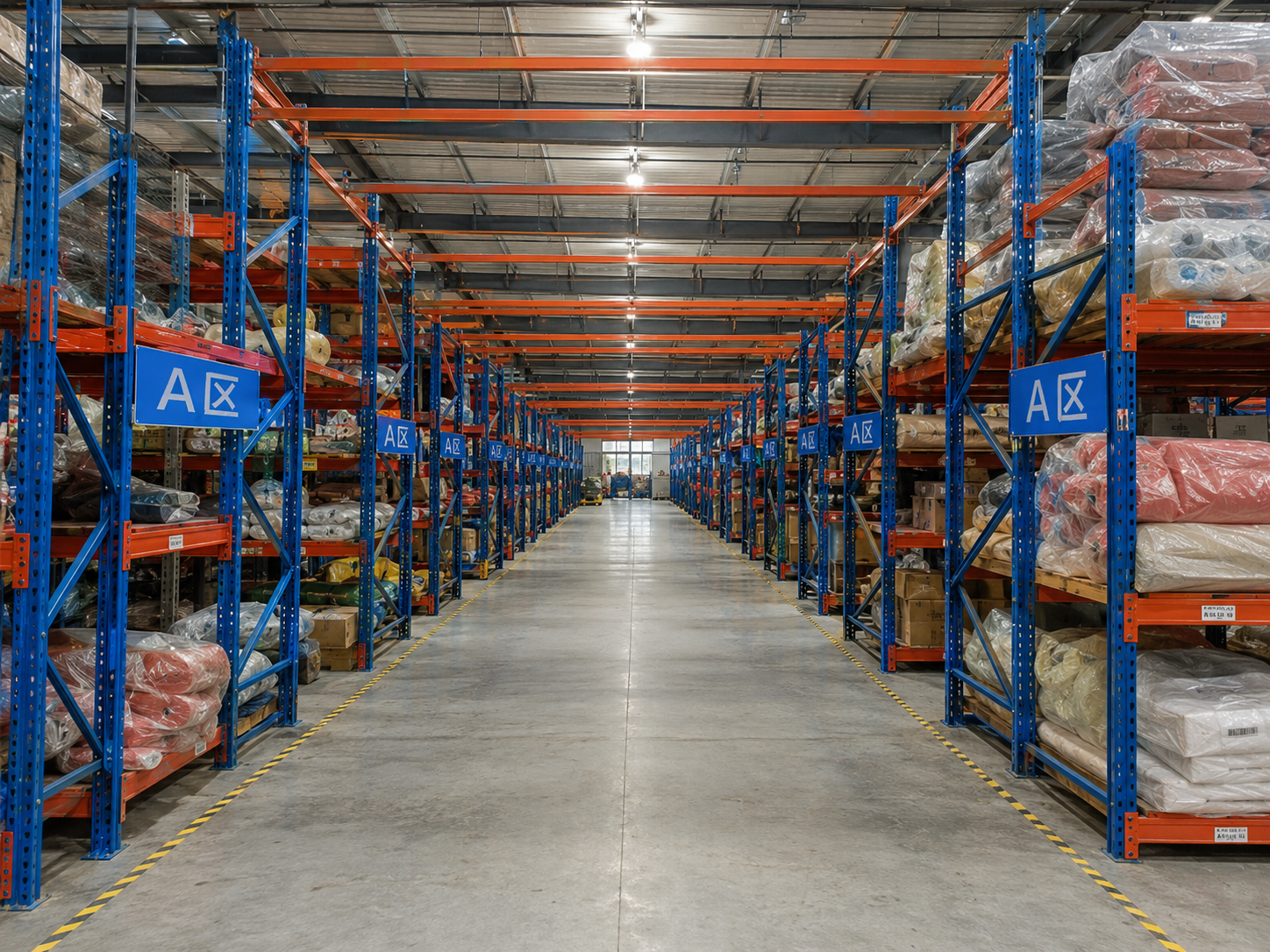
Guangzhou Toplay Amusement Equipment Co., Ltd. is an indoor playground equipment manufacturer with 300 people across the steel floor, the sewing floor, design and export operations.

Over 90% of output is exported, to destinations including France, India, Sri Lanka, South Africa, Mexico, Malaysia and Poland.

North America, Europe, Southeast Asia and the Middle East, which is why the standards routing above is written for more than one jurisdiction: ASTM F1918-21 in the US market and BS EN 1176-10:2023 in Europe.

24/7 online consultation and after-sales support once the venue is open, because the venues we ship to sit in time zones that do not overlap with the Guangzhou working day.

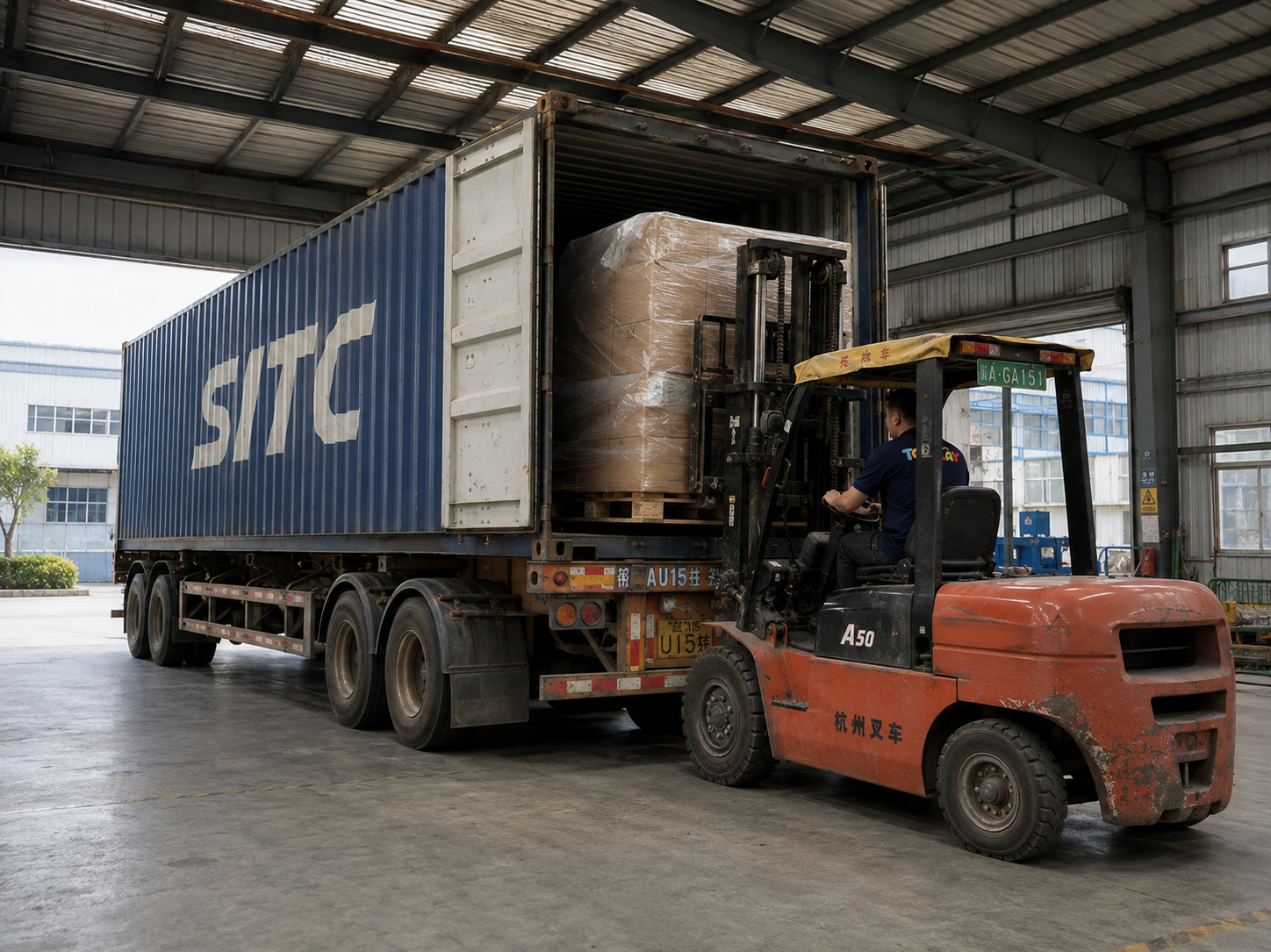
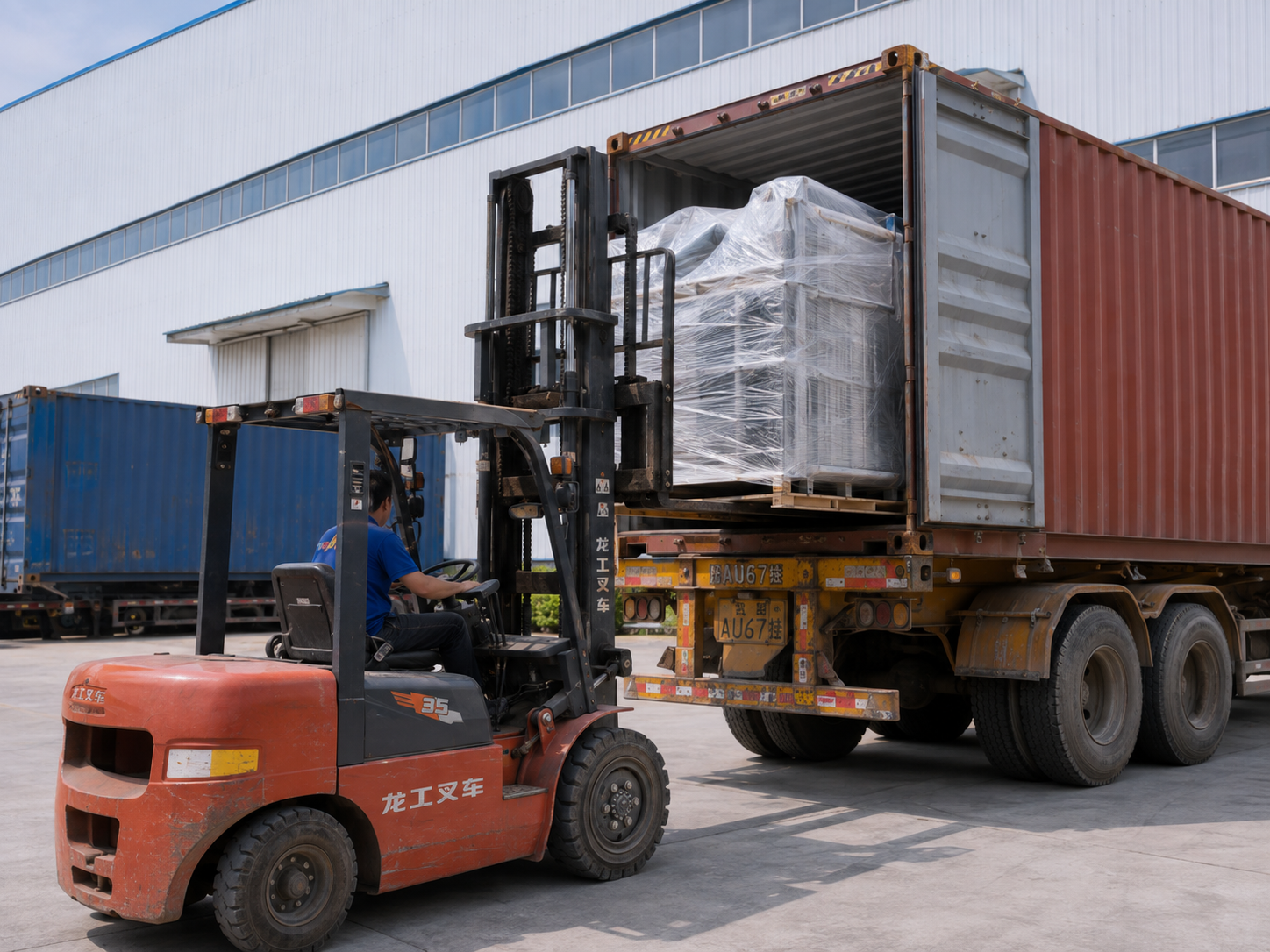
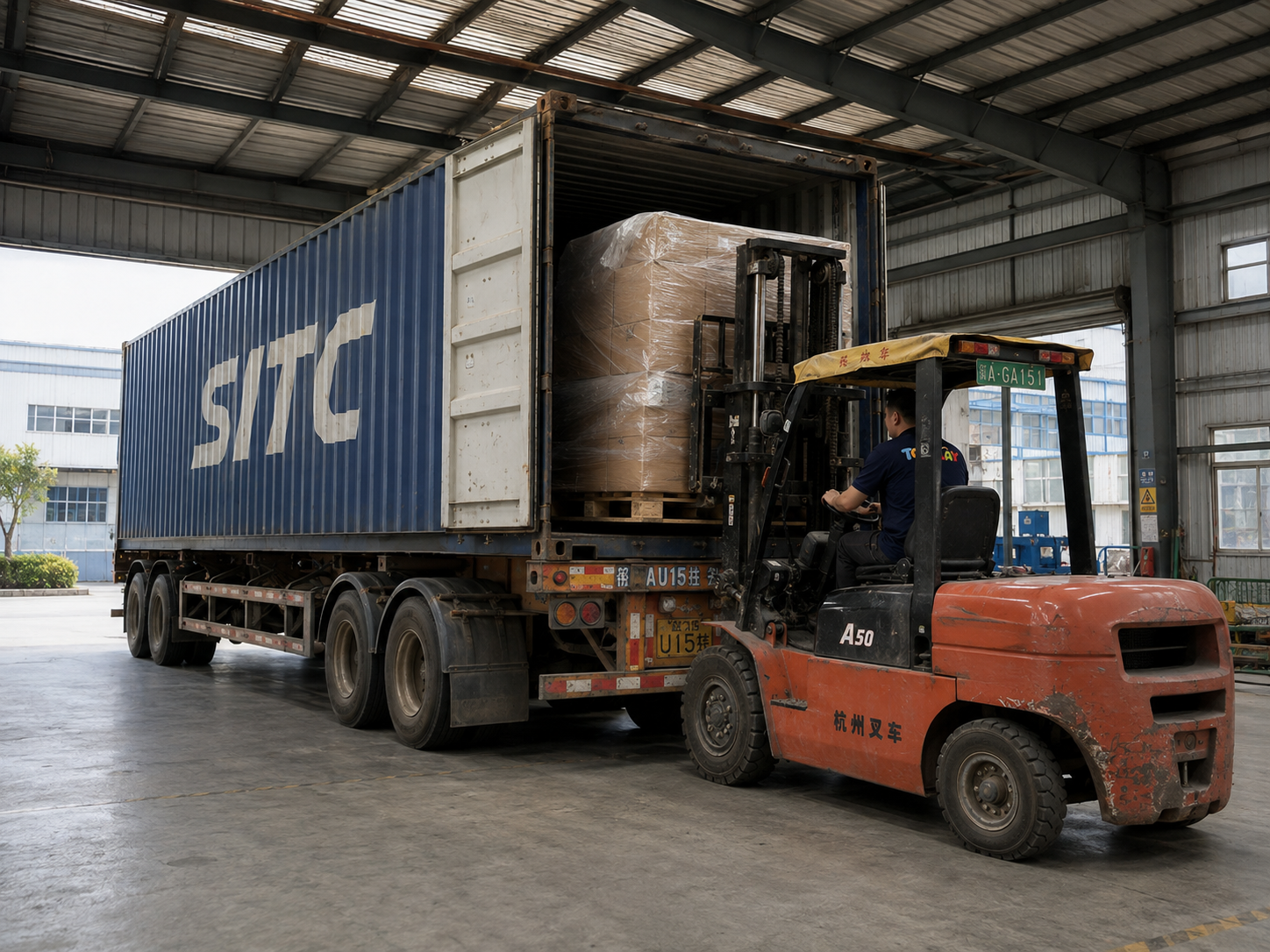
Palletised and shrink-wrapped goods loading at the plant. Export documentation travels with the container.

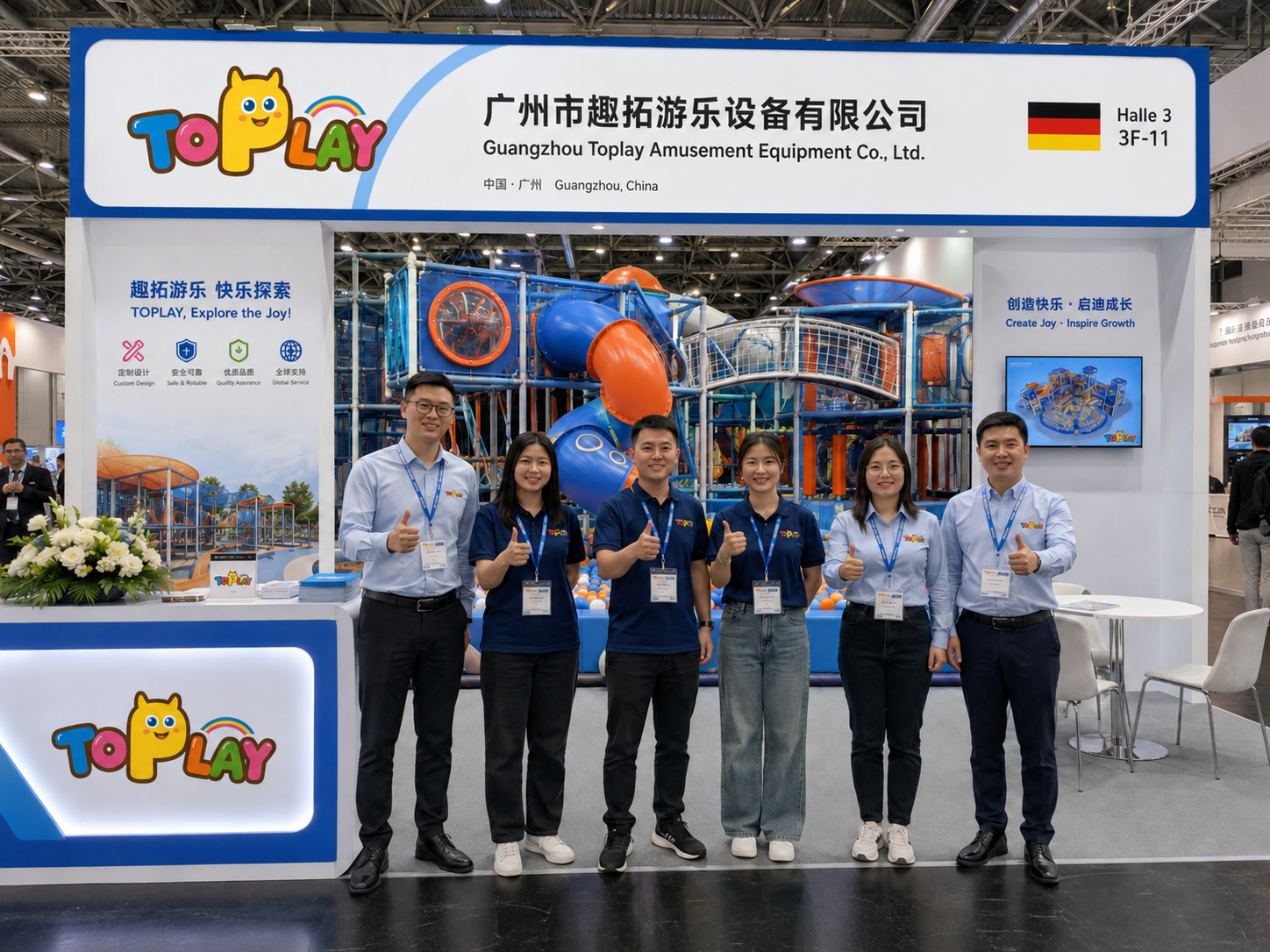
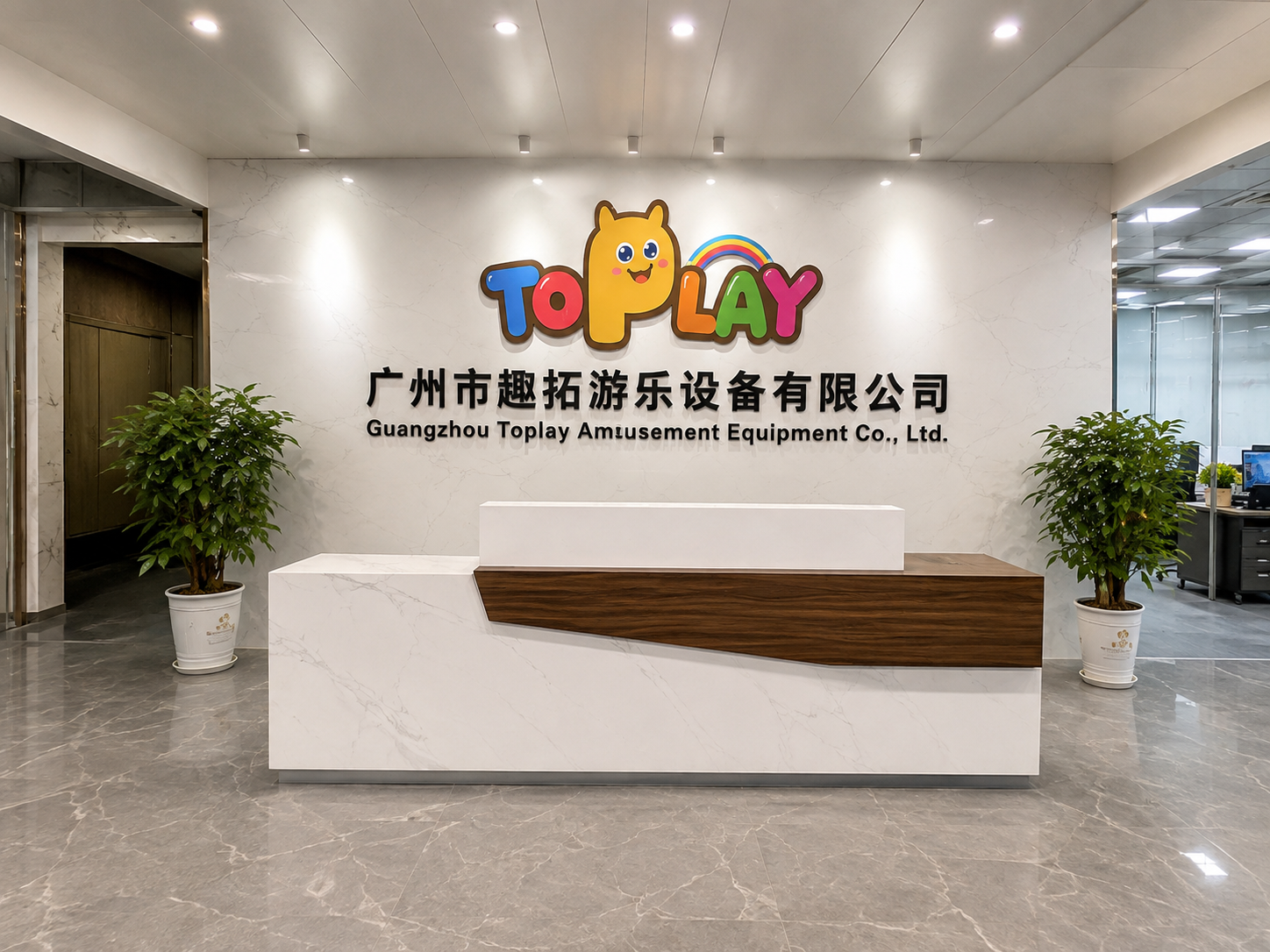
Reception at Guangzhou Toplay Amusement Equipment Co., Ltd. — the legal entity that quotes, manufactures and invoices your order.

Transparency

Why This Page Publishes Its Terms

We build soft contained play equipment, and this category hides its commercial terms almost universally. Publishing our clocks, our minimum order and our payment split lets you compare us against anyone without an email exchange. It also means we cannot quietly change them later.

The hard part of shortlisting an indoor soft play equipment manufacturer is that every website says the same adjectives. Unlike an adjective, a start event, a document name and a tariff line can be checked before you write the first email — which is why they are on this page rather than behind a form.

When Toplay Is the Wrong Supplier

Three situations where a different supplier serves you better. The Seam Question is worth asking of whoever you choose instead, and each case here has an alternative worth naming.

// 01

You need a catalogue item shipped this week.

Every build starts from your floor plan, and the layout stage exists precisely because a fitted structure is not a stock line. Where to look instead: a distributor holding inventory in your own market.

// 02

Your structure will sit outdoors.

We build for indoor venues. Outdoor commercial playground equipment is a different product class governed by ASTM F1487, and it belongs there instead.

// 03

Manufacturer's own crew on site.

The written quotation defines the installation model for your project, and for many destinations that model is documentation and guidance for your local crew rather than a Toplay team on the floor for the full duration. If your project cannot proceed without a manufacturer-supplied crew, say so before the layout stage rather than after the container ships.

Not sure which of these applies to you? Run the 12-point supplier check — it is the same twelve questions either way, and it works on any supplier.

Two Constraints That Bite After the Container Ships

// 04

Clearances.

Model building code §424.4 calls for horizontal separation from building walls, partitions and elements of the means of egress, and a further separation between separate play structures inside a mall.14 A layout drawn to fill the tenant line can fail on clearance alone.

// 05

Area caps.

Section §424.5 caps a play structure's area unless a special investigation acceptable to the building official demonstrates adequate fire safety14 — and the number in that cap changed between code editions, so a consultant memo written a few years ago may carry the earlier figure.

PLANNING_RESOURCES.EXE

Project Planning & Verification

SYS.ONLINE // CHK-01
SEC: CORE

The 12-Point Supplier Check

Twelve questions worth putting to any indoor playground supplier quoting your project — including Toplay. Six of them are weighted double because they are the ones a non-manufacturing intermediary cannot answer consistently.

Data Privacy Protocol

Nothing you enter is captured or sent anywhere. Fully client-side execution.

Access_Checklist
CALC.READY // ACC-02
SEC: REQ

Accessible Entry Calculator

Entry-point count is a drawing decision, not a retrofit. US accessibility guidance for soft contained play structures sets the obligation by how many entry points the structure has, so the number changes the moment a fourth entrance goes on the plan. Works on any supplier’s layout.

Run_Calculator
PLAN.ACTIVE // HGT-03
SEC: BLD

Clear Height & Code Threshold

Two numbers decide most of what a room can hold: the clear height you actually have once services are accounted for, and the footprint the structure occupies. The same two numbers decide whether the model building code’s play-structure section applies to your project at all.

Init_Planner

Frequently Asked Questions

What is the difference between home indoor play equipment and commercial indoor play equipment?

Commercial equipment is designed for continuous use by many children with no adult present per child, and it is dimensioned against a published age envelope rather than a single family's needs. Soft contained play equipment has its own standard, ASTM F1918-21, whose design population runs from the 5th percentile 2 year old to the 95th percentile 12 year old.3 Home play equipment sits outside that specification entirely.

What is soft contained play equipment, and which standard applies to it indoors?

It is a play structure where the user enters a fully enclosed play environment built from pliable materials such as plastic, netting or fabric.1 Indoors, ASTM F1918-21 is the US standard for it and BS EN 1176-10:2023 is the European one. The familiar public playground handbook explicitly does not cover it.

Which age range is an indoor play structure designed around?

Under the US standard, the 5th percentile 2 year old to the 95th percentile 12 year old.3 The European standard for fully enclosed play equipment runs to 14 years.4 If your venue serves under-2s or over-12s, that belongs in the brief before the layout stage, because it changes zoning rather than decoration.

Does an IPEMA mark cover indoor soft contained play equipment?

No, and no supplier can show you one for this product. The IPEMA certification programme validates conformance to six standards, and ASTM F1918 is not among them.5 An IPEMA seal seen alongside indoor soft play is certifying something else, most often surfacing.

Is Toplay a factory or an indoor playground supplier that subcontracts?

Toplay runs its own steel fabrication on the nine equipment categories listed above, and its own sewing floor for the soft play that wraps it. Both stages happen on our premises, which is what makes this an indoor playground factory rather than a sales office in front of one. That is what The Seam Question is for — ask it of every indoor playground supplier you shortlist, and ask to see the answer rather than hear it.

What is the minimum order?

One complete playground system. A single play cafe corner or a single restaurant zone is a complete order rather than a sample request. Paid sample orders for individual play parts are available separately when you need to review a component.

What is the lead time, and what starts the clock?

Production runs 45–75 days, starting after design approval and deposit, with freight time separate. Quotation takes 3 working days from usable project inputs and the free layout takes 3–4 working days from usable dimensions. Those are three of The Four Published Clocks; ocean transit and port dwell sit outside all of them, and we do not control either.

What certifications does Toplay hold?

We publish no certificate number here, and the reason is worth understanding rather than glossing over. For a children's product manufactured outside the United States, only the importer must certify compliance,7 and a CPSC-accepted laboratory supplies test results rather than a certificate.

  • What ships from us — the requested standard reference, a test report on your configuration, product identification and a handover document.
  • What only you can issue — the certificate itself, built on that evidence. A factory-issued document is not a substitute for it.
  • What to send us — your destination market and component scope, and we confirm in writing what applies to your order.

What documents ship with the order?

The Shipped Document Set is four items: the requested standard reference, a test report, product identification and a handover document, with the list agreed in the written quotation before production. The order is also trial-assembled, photographed and reconciled against the component schedule before loading, so the packing record matches the assembly drawing.

Do you install on site, or do we need a local crew?

The written quotation defines the installation model for your project. For many destinations that means module-by-module guidance for a local crew you appoint, with export documentation and shipping coordinated from our side. Ask for the installation scope in writing at quotation stage rather than at container arrival.

Which Incoterms do you quote?

We ship EXW, FOB, CFR and CIF, with DAP and DDP quoted on request for a stated destination. Note what trade terms do not cover: they allocate delivery, cost, risk, clearance and unloading, and they say nothing about assembly, supervision, site works or operational handover. Those sit in the quotation instead.

Should I buy indoor playground equipment from a Chinese manufacturer or a US supplier?

Answer it on documents rather than on geography, whether you are comparing soft play equipment suppliers at home or abroad. Design defects are not a function of country of manufacture — the US recall record includes domestically manufactured contained-play climbers withdrawn over platform spacing, after dozens of reported incidents.

  • Test reports written against the right standard for your market, not generic ones.
  • Questions on capacity, lead time and in-house processes answered without deferring to someone else.
  • Commercial terms published before you ask for them.

Those three are what to compare, and all three are on this page.