Get in touch with Guangzhou Toplay amusement equipment co. Company

Updated October 2026
For ninja course equipment to work best, the movement, visitor and operating plan should be aligned. When designing the obstacle course, envision ninja training based on the experience your venue wants to deliver. Then choose obstacles and the system support associated with it. This manual covers nine operator choices from first grip challenge to what’s considered appropriate evidence after the solution has been implemented.
At a glance
- Choose movement demands before collecting obstacle names.
- Make the introductory experience complete, including its exit.
- Observe briefing, attempts, exit and reset before adding equipment.
- Match reports and instructions to the actual installed system.
Quick planning reference
- Audience: commercial venue operators, coaches and facilities teams.
- Equipment families: suspended rigs, padded circuits and home sets with different declared uses.
- Planning outputs: movement map, operating observations and a site-specific brief.
- Safety evidence: classification, configuration, test conditions and installed acceptance.
- Price basis: project scope and service requirements, rather than a universal price per obstacle.
What Ninja Course Equipment Includes
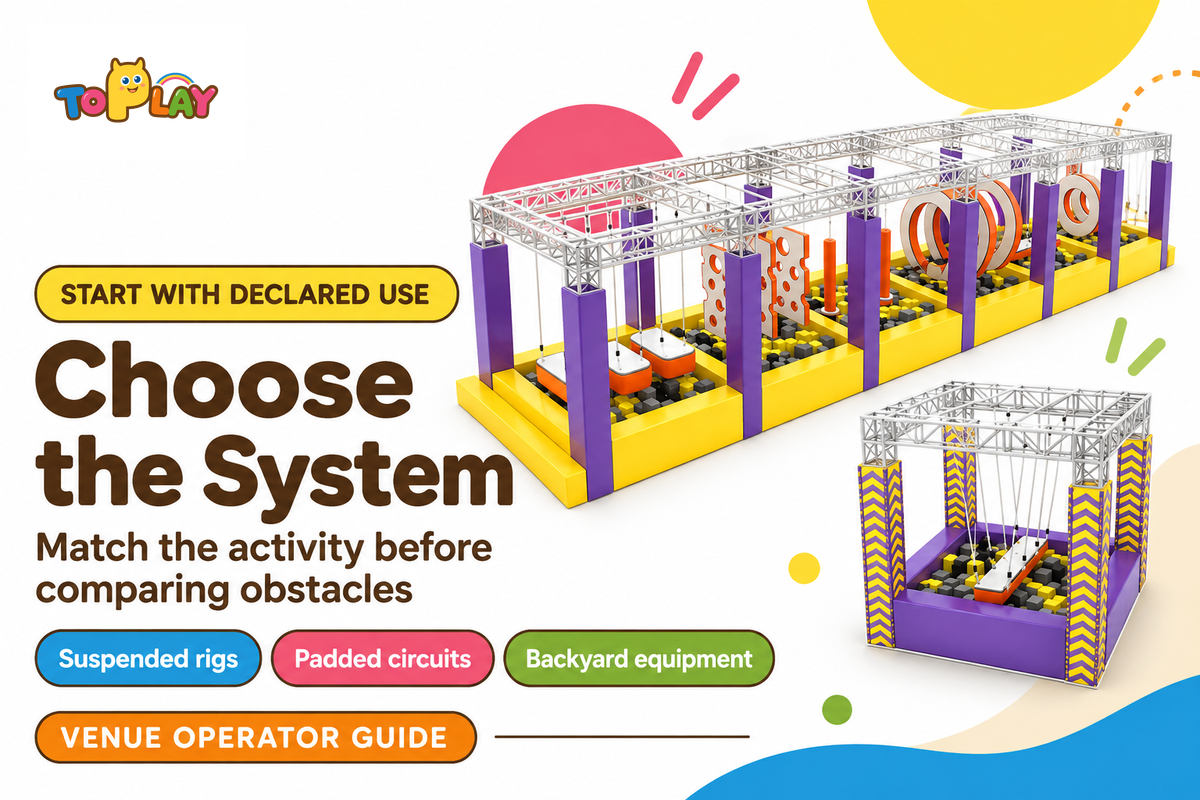
Ninja course equipment consists of obstacles, a supporting structure, a landing system and operating controls. All these components allow a user to practice challenges in linked movements. A hanging rig, portable padded circuit and a backyard set share obstacle names, but serve different purposes. Start by determining the main activity and user group and compare systems in that context.
A rig in Ninja courses holds suspended training equipment (bars, rings and ropes); compare training rigs by their declared use, because pull-up bars and linked crossings serve different tasks. A padded circuit can serve challenges in stepping and climbing and balance close to the floor. Neither of these forms of circuits becomes suitable for paid public use just because it has a steel frame, a thick mat or a commercial type covering.
Declared use, complete configuration and instructions are evaluated together.
Ninja Warrior and Obstacle Course Training Equipment
| System form | Activity to investigate | First buying question |
|---|---|---|
| Suspended ninja rigs | Hang, swing and transfer between holds | Does the offered system include the structure, attachments, landing specification and operating instructions for this use? |
| Portable padded obstacles | Ground-based routes and coached movement stations | Which floor, joining method and supervision arrangement does the manufacturer specify? |
| Backyard equipment | Private home practice | Does the manufacturer expressly support the proposed commercial use? |
A distinction in Athletic Business’s 2019 facility report is drawn between a single element of movement and an obstacle that consists of multiple elements of movement toward an end goal. Buying various elements of movement doesn’t create a complete course. A transition can integrate both elements into a different task.
For an increased attraction mix, compare indoor playground equipment types prior to determining the ninja area’s role. A gymnastics school, a ninja gym and a family entertainment center may be looking for different experiences from similar training products. Equipment inspired by American Ninja Warrior also requires a context specific purpose; a parkour session is a different purpose from a timed hanging circuit.
A Skill-to-Station Map for Choosing Obstacles
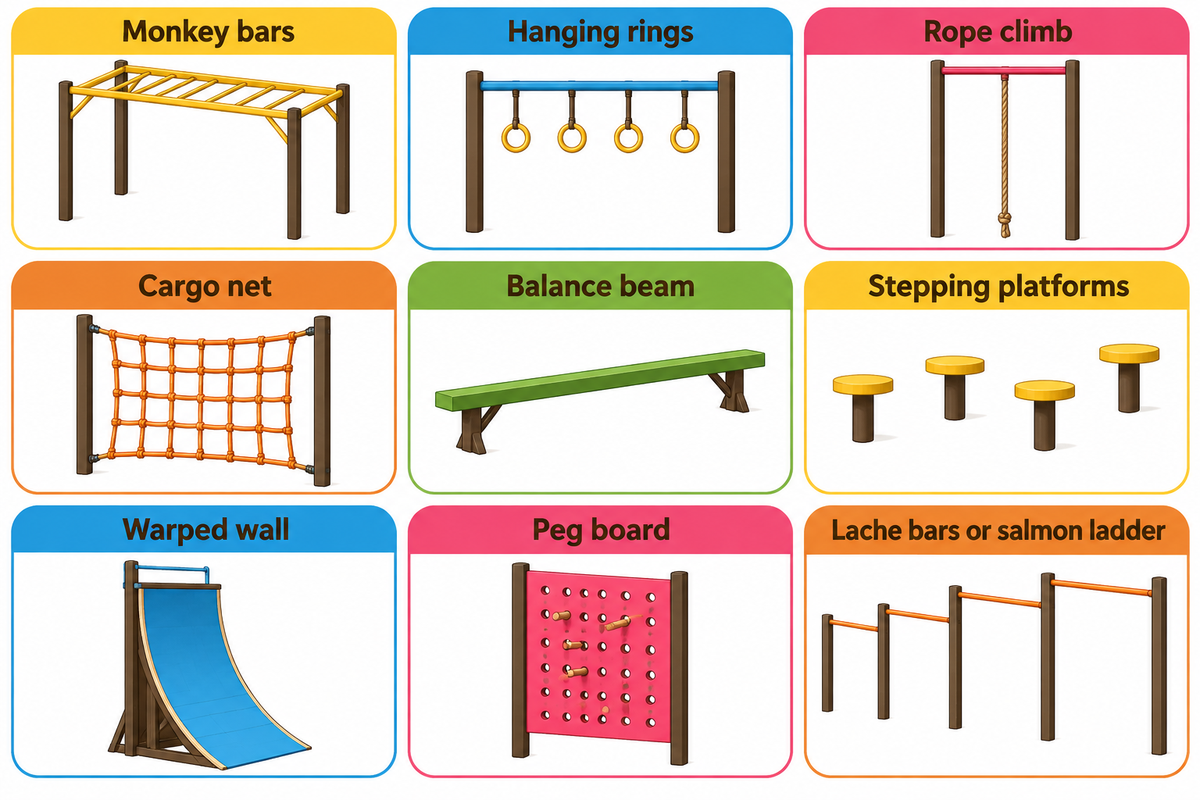
For ninja warrior training, consider the movement performed by the visitor, the support provided during the movement and the consequence of not completing the movement. Grip strength forms a part of this. Reach, foot support, coordination, confidence and the route back to the queue can change how the same named obstacle works in your venue.
The Skill-to-Station Map, below, is an operator’s discussion tool. Use it with a qualified coach and the equipment supplier to describe training options, rather than assigning a universal age, pass standard or difficulty score.
A station appropriate for an athletic regular may offer no starting action suitable for a first time visitor.
| Station | Movement demand | Progression question | Operating consequence |
|---|---|---|---|
| Monkey bars | Repeated grip transfers with the body suspended | Can visitors practise a controlled starting action before a linked crossing? | Provide an approved way to finish or leave an attempt. |
| Hanging rings | Grip transfer plus control of moving holds | Is the challenge reaching the next hold or controlling its movement? | Observe swinging elements before the next permitted start. |
| Rope climb | Pulling, grip and any permitted foot assistance | Does instruction match the manufacturer-approved climbing method? | Plan observation and the return from the climb. |
| Cargo net | Coordinated hand and foot placement | Is the route an ascent, traverse or transition? | Check visibility through and around the net. |
| Balance beam | Foot placement and body control | Is the task steady travel or movement under a time rule? | Keep the approved landing and exit area clear. |
| Stepping platforms | Sequential foot placement and agility | Does the next step add reach, direction or instability? | Look for hesitation and traffic crossing the route. |
| Warped wall | Approach, upward movement and exit | Can users learn the approved approach and return sequence? | Reserve the complete movement and exit envelope. |
| Peg board | Upper body support while changing hand positions | Does the visitor have a permitted introductory task? | Include recovery and clear withdrawal from the station. |
| Lache bars or salmon ladder | Dynamic transfer, timing or explosive power | Is an appropriate coached prerequisite available? | Treat release, movement and retrieval as distinct operating tasks. |
Should you prioritize grip challenges, climbing walls, or balance elements?
Movements can be emphasized through Grip training even if they don’t dominate the visit. Prioritize the movement missing from the experience you want to offer.
Consider different activities for areas dominated by hanging tasks. Repeatable skill stations may be better for coached training areas. Review complete attempts, including a missed transfer and exit, before adding a more technical obstacle.
Do not assume that static means easy. A 2025 campus-exercise study by Exel and colleagues assessed 20 advanced or elite climbers performing five trials of each exercise on a two-rung board. The abstract mentions different demands on the shoulders during the various phases of static and dynamic movement.
This study of trained climbers supports separating movement demands; however, it does not set loads, spacing or readiness rules for ordinary ninja visitors.
Ask a coach what they changed when an obstacle becomes harder: available support, the movement, the reach, or the rule. Lowering a support may change access without removing the need to support body weight. Changing a balance element from pausing to moving across quickly creates a different problem.
Plan Progression Before Maximum Difficulty
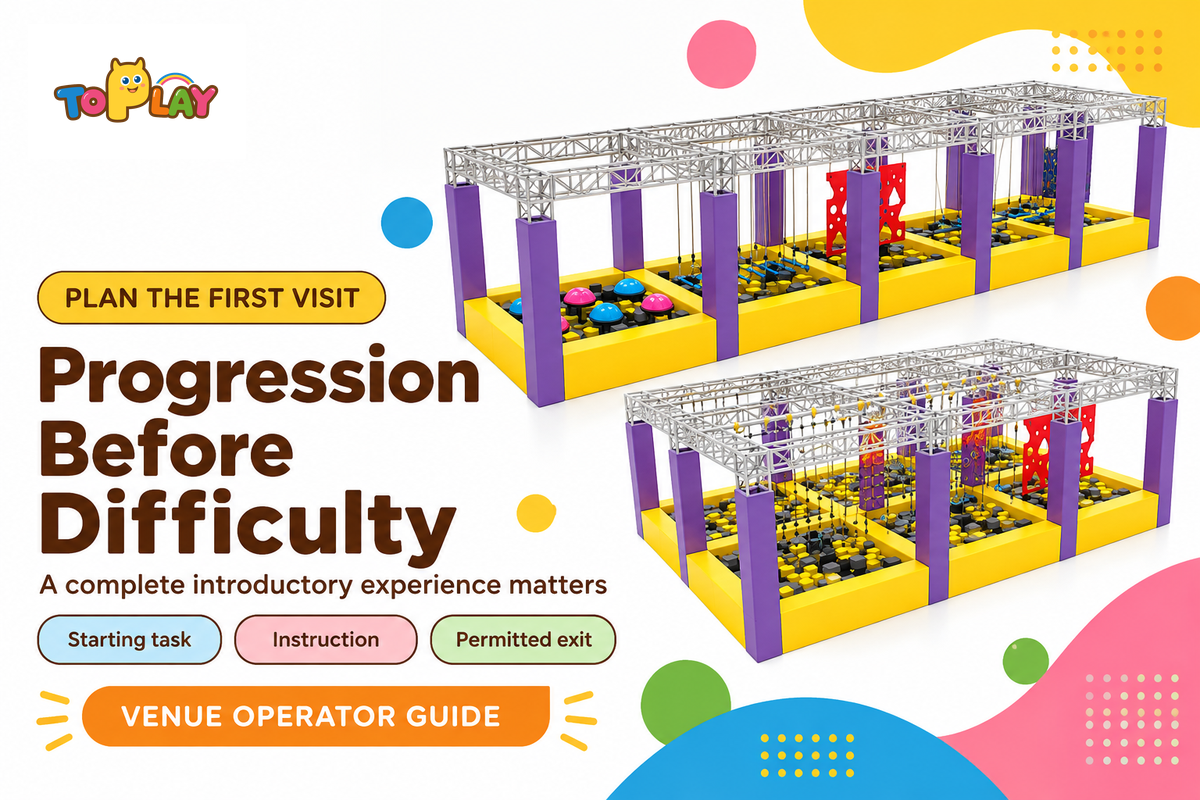
Plan progression as a sequence of achievable tasks and clearly explained next challenges. The beginner experience should have a satisfying finish even when a visitor skips the most demanding station. Difficulty labels help orientation, but the activity, instruction and approved exit determine whether people can participate meaningfully and return for another attempt.
A ninja obstacle training program starts with the opening experience before choosing a spectacular final obstacle. A new ninja visitor needs to understand where to begin, what a successful action looks like and how to leave an attempt. The coach’s explanation must fit the equipment instructions; the layout should support that explanation rather than require staff to improvise around it.
A first visit needs more than a harder route
An Athletic Business case from 2019 describes ORTHDX in Madison introducing members to its rig through familiar classes in the same space. It’s a useful historical example of a programming choice: people could encounter obstacle training without first identifying as competitive ninjas. It isn’t a measured promise of membership growth.
Illustrative scenario: A family entertainment center wants a birthday group to enjoy the same attraction as returning members. The operator initially proposes a continuous line of hanging obstacles. During a planning session, the coach instead describes an introductory stepping task, a supported movement exercise and a separate challenge for experienced visitors. A guest can complete the introductory experience without attempting the advanced transfer. Staff demonstrate the permitted exit, then direct the guest back to the appropriate waiting point. The design question becomes whether these different movements and return paths can coexist within the approved arrangement. The answer isn’t simply to print three difficulty labels on the original line.
There’s a human reason to make that starting point visible. In an accessible beginner discussion on Reddit, the original poster describes feeling unready to attempt obstacles and finding a local program mainly geared toward children. Treat that as one person’s concern, not a representative survey. A clear welcome and an attainable task address the concern without promising that every station suits everyone.
For staff observation, distinguish unwillingness to try, difficulty reaching a start, losing a grip and not understanding the sequence. These call for different responses. An age category alone doesn’t tell the operator which issue caused the failed attempt.
Fit the Course to the Room and Operating Mode
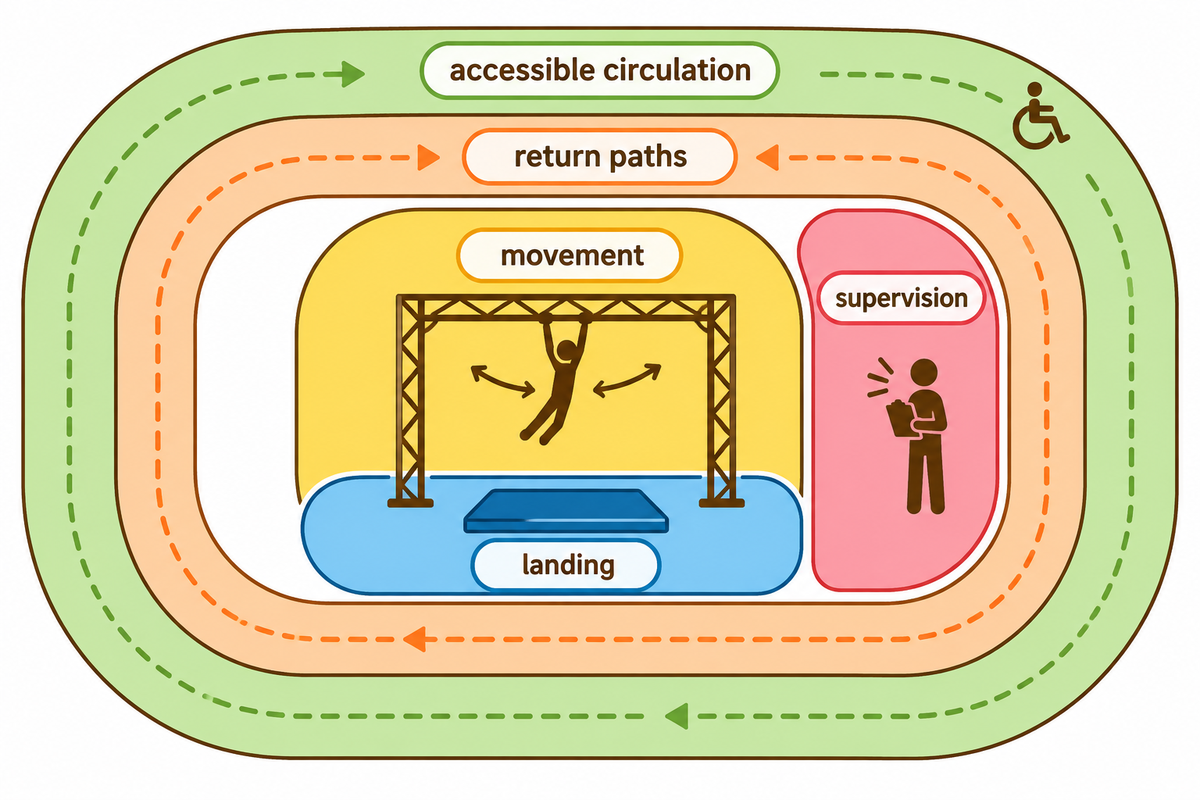
Fit the course to its full operating envelope, including movement, landing, supervision, accessible circulation and return paths. The available space is larger than the equipment footprint and smaller than the room’s gross area. Compare a permanent open-play attraction with a coached or shared-space model before fixing the configuration or purchasing additional stations.
Start a room sketch at the lowest obstruction, not the advertised ceiling height. Record measurements with the precision requested by the designer. Record columns, lights, sprinklers, doors and the access route used to deliver and service equipment. Add the manufacturer’s project-specific movement and landing requirements. An engineer should resolve structural support and anchoring questions before layout convenience turns into an assumed design approval.
“Evaluate site conditions early on.”
Scott Hornick, then Adventure Solutions CEO, quoted in Athletic Business, 2017
| Mode | Space to reserve | Question for the operator |
|---|---|---|
| Permanent open-play area | Course envelope, queue, permitted exits and observation positions | Can staff observe the intended activity while visitors circulate? |
| Coached class | Teaching position, practice stations and group transitions | Can the coach demonstrate and manage the specified activities? |
| Shared gymnastics or fitness floor | Use envelope plus approved storage and setup route | Who installs, checks, puts away and reopens the system? |
A functional fitness venue must decide where its coached workout starts and how the next group enters. Shared space can be versatile, but it carries work. The 2019 facility report includes a supplier’s account of a wall-mounted system requiring two people and 12 or 13 minutes to put away. That historic, product-specific example illustrates a labor question to ask; it isn’t a setup allowance for a different model.
Accessibility also needs its own design review. The US Access Board’s exercise-equipment provisions and clear-floor-space requirements address routes and transfer or wheelchair-use space where that equipment classification applies. A beginner lane isn’t a substitute for an accessible route. Ask the project designer to establish the applicable classification and preserve the required spaces when the course changes.
Use the indoor playground floor plan guide to place the attraction within the wider venue. A low padded obstacle can still conflict with a queue or exit; height alone doesn’t settle the layout.
Find the Bottleneck Before Adding More Obstacles
Find the operating bottleneck by studying the whole visitor cycle i.e. explanation, attempt, exit, and equipment reset. Record why a stage takes time before changing it. A long queue may reflect a fuzzy start or blocked return or a safety task; therefore obstacles alone may leave the real constraint untouched.
The Lane-Cycle Friction Map captures those observations for a ninja obstacle course. Its method is based on the concept of timing operations and transfers in the US Environmental Protection Agency’s process-analysis guidance, which is in the manufacturing context. Applying a stage log to a ninja attraction is an editorial diagnostic analogy, not a tested safe-capacity formula.
| What staff observe | Stage to inspect | Record | Decision to investigate |
|---|---|---|---|
| Guests repeatedly ask where to begin | Briefing | Which instruction is repeated | Improve the explanation and permitted start signage. |
| A visitor cannot initiate the first task | Attempt | Reach, support or comprehension issue | Review the introductory task with the coach. |
| A station attracts repeated coached attempts | Attempt | Session purpose and retry rule | Separate learning time from any timed-run format. |
| A completed visitor waits beside the landing | Exit | Why the approved exit is unavailable | Review the return route and supervision arrangement. |
| The return crosses the waiting group | Exit | Location and cause of crossing | Resolve circulation with the designer before increasing starts. |
| A moving hold must settle before reuse | Reset | Required readiness check | Preserve the specified condition for the next start. |
| Staff leave position to retrieve an item | Reset | Retrieval method and interruption | Review the approved reset method and staff duties. |
| People gather at the timer screen | Circulation | Whether they obstruct the route | Relocate viewing within the approved layout. |
| A shared-space class starts late | Setup | Storage, installation and opening checks | Compare the full changeover workload with the timetable. |
For illustration, a stopwatch recording example, assuming observations: A manager recorded 25 seconds for an explanation, a 45 second attempt, 15 seconds waiting to leave and a 35 second reset on one trial. These are planning examples, not design standards. Watching the reset revealed staff cross the return path to retrieve an item. Buying an additional hanging obstacle wouldn’t resolve that staff crossing. The manager requested the supplier review approved retrieval methods and the designer review circulation. Observations should account for different visitors, missed attempts and busy sessions. Any revised dispatch method still requires operating approval; the stopwatch doesn’t supply that.
Don’t reduce required instruction, clearance checks or reset checks to improve the look of a spreadsheet. The UK Health and Safety Executive’s event guidance treats arrival, circulation and departure as separate crowd management issues. It also states queuing shouldn’t block emergency access and routes. That’s useful planning context, rather than a US ninja-course occupancy rule.
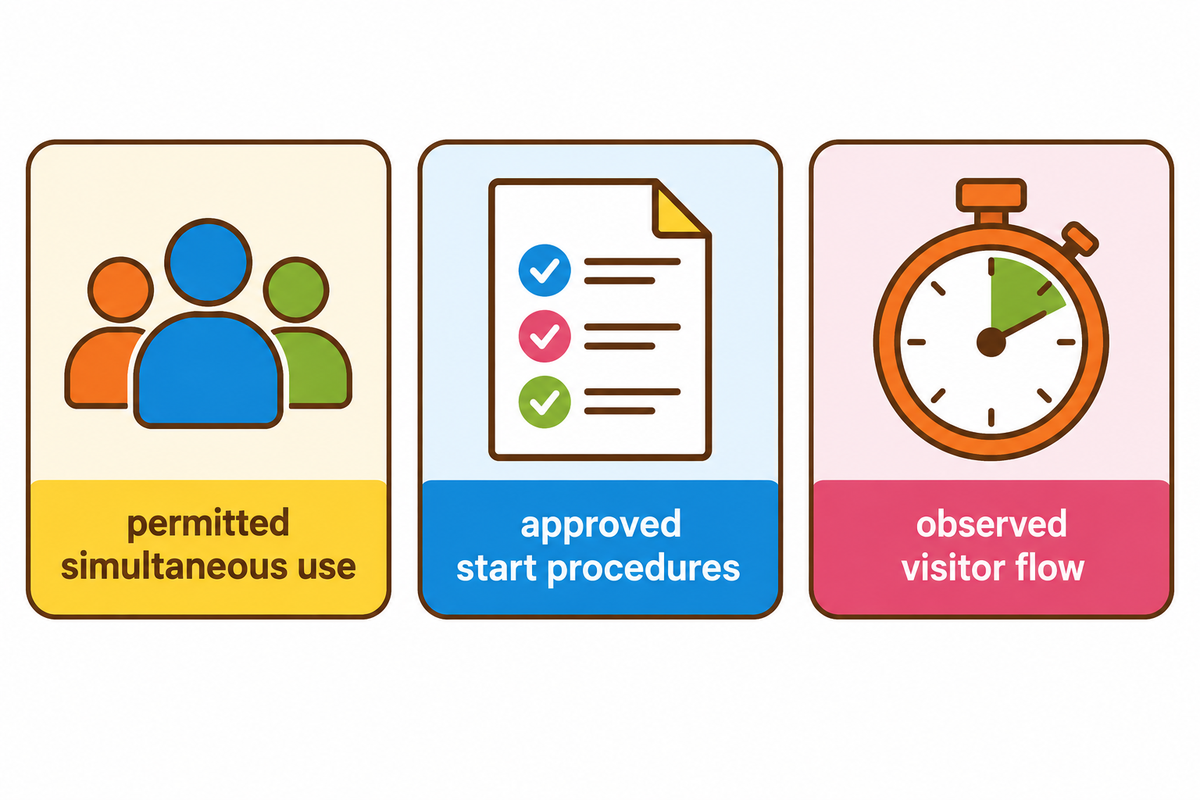
Keep three separate records: permitted simultaneous use, approved start procedures and observed visitor flow. A rate observed during a quiet demonstration doesn’t establish the other two.
Read Safety Evidence at the Equipment Boundary
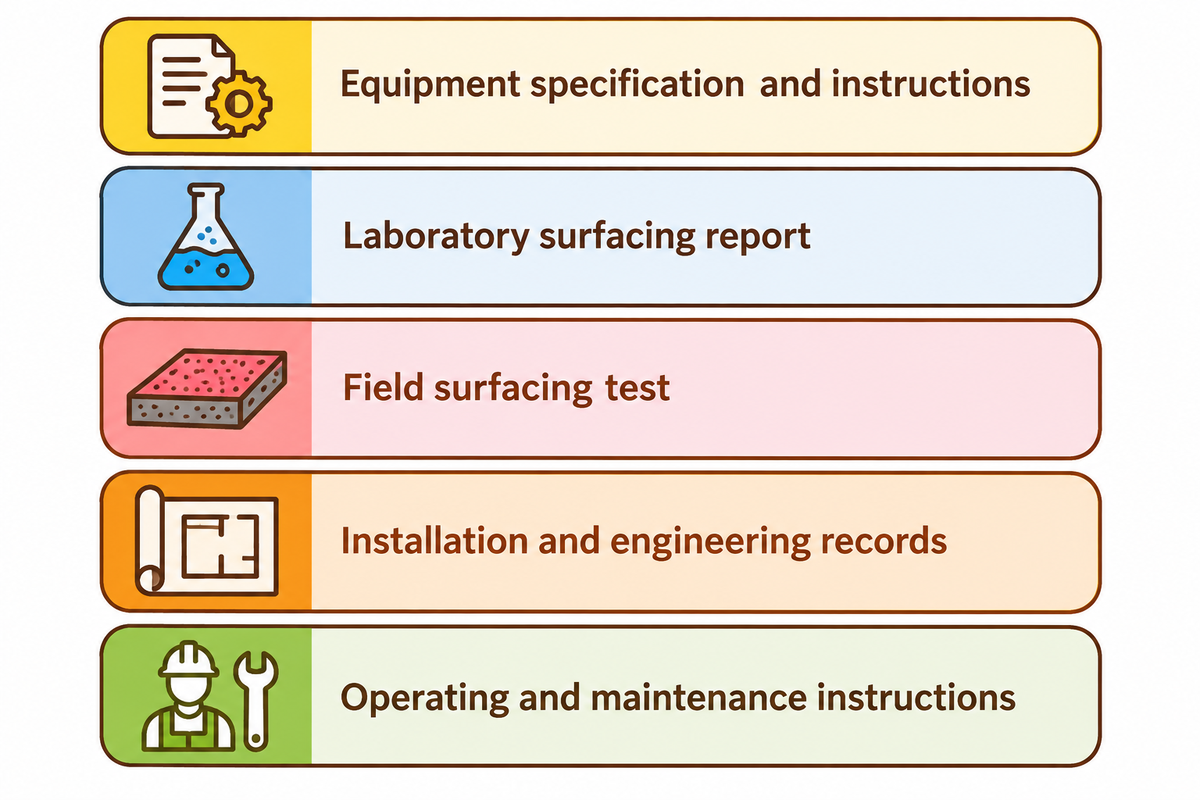
Consider safety evidence as a chain that links the equipment category, the specified configuration, the test conditions, and the installed situation. A standard only addresses the scope within the question. For surfacing, distinguish laboratory performance from field testing, then identify who will approve the project’s structural, operational, and maintenance arrangements.
The examples from the public ASTM documents illustrate the importance of differentiating the scope. ASTM F1487-25, for instance, includes public playground equipment for a stated percentile-based child user range, and excludes several categories, including fitness equipment intended for users over the age of 12, and soft contained play equipment. ASTM F1918-21 is another example for soft contained play equipment. Another example, ASTM F3101-21a, is for permanently anchored outdoor fitness equipment for unsupervised use by persons aged 13 and older.
Those are scope descriptions, not a universal ninja age rule.
| Evidence | What it can establish within scope | What to connect to the project |
|---|---|---|
| Equipment specification and instructions | Declared use, configuration and operating limits | The actual installed arrangement and intended participants. |
| Laboratory surfacing report | Performance of the identified tested surfacing sample/system | Material identity, thickness, substrate and field conditions. |
| Field surfacing test | Installed impact attenuation at the time and conditions of testing | Test locations, applicable criteria, report and follow-up actions. |
| Installation and engineering records | The work and checks documented for the supplied design | Anchors, interfaces, as-built differences and acceptance. |
| Operating and maintenance instructions | How the particular system is to be used and maintained | Staff training, checks, records and removal-from-service criteria. |
ASTM F1292-26 now expressly describes laboratory testing in its title. The public scope addresses impact attenuation and remarks on limitations and the injury question it addresses. A laboratory sheet therefore cannot by itself show how an aging installed floor performs.
There is also a field testing path. ASTM F3313-26 describes testing of impact attenuating systems that are installed, and comparison of results with laboratory results or with contractual and warranty requirements.
Its public scope also states it does not define the critical height of installed systems. Ask which tests and acceptance criteria apply, who performs the work, and how the findings are accepted. Do not consider either report as approval of the entire attraction.
The CPSC’s August 2025 Handbook update notice states that the Handbook is a technical reference document and does not establish legally enforceable responsibilities. Local regulations, adopted standards, and contracts can impose other requirements and obligations. Relying on a sales label to state the product is “ASTM certified” is insufficient; put specific editions and acceptance responsibilities in writing.
For the rest of the issues, the indoor playground safety standards guide can help with organization of questions. Final acceptance and classification are specific to the equipment and the jurisdiction.
Budget for Wear Parts and Course Refreshes
Budget for components that wear, the work needed to replace them and the checks required after a course change. Frame life, grip condition, rope wear and landing-system performance are different questions. Keep replacement identity and removal criteria with each component so a course refresh doesn’t become an undocumented substitution.
A durable-looking structure can still become unavailable because a compatible wear part is missing. A lightweight grip and an individual pad still need the correct part identity. Ask for part identifiers, approved substitutions, attachment instructions and access requirements. Separate a consumable replacement from a change that alters geometry, movement, loading or the landing arrangement; the latter can require a broader review before reopening.
How can you set up a versatile training area that evolves with your skills as you improve?
Choose a system with documented compatible training features and a controlled method for changing them. Ask who’s authorized to configure the system and what makes its layout configurable. Keep a baseline layout, identify the purpose of each station and record each approved configuration. A coach can then propose a different movement challenge while the supplier and responsible designer check the effects on attachments, circulation, landing and supervision.
The CPSC’s soft-contained-play checklist identifies tears or fraying in netting and cargo webbing, damaged floor surfacing and other visible problems within that category. The US Access Board’s play-area guide separately connects accessible-surface maintenance frequency to use and surface type. Neither provides a universal retirement birthday for every ninja component.
Illustrative maintenance scenario: A venue plans a refreshed route for the next holiday period. The finance lead sees a modest replacement-parts allowance; the maintenance lead sees a less convenient task. A grip has an uncertain part number, the proposed replacement uses a different connector and reaching the attachment requires closing the adjacent route. The team pauses that substitution and obtains the compatible part and installation instructions. It then schedules access, the specified checks and a documented reopening. The relevant budget includes the replacement, access work and interrupted use. Counting only the purchase price would miss the reason the refresh might delay the program.
A reported change schedule isn’t a maintenance rule. The 2019 Athletic Business article describes one operator changing two obstacle bays each week to keep challenges fresh. A different venue should choose a refresh plan around its approved system and programming needs, while following its own inspection and replacement requirements.
Use the existing indoor playground maintenance checklist for the broader venue record. For the ninja area, add the component, observed condition, instruction consulted, action, responsible person and release-to-use record. Cleaning and appearance shouldn’t stand in for the required inspection.
Move From the Guide to a Site-Specific Brief
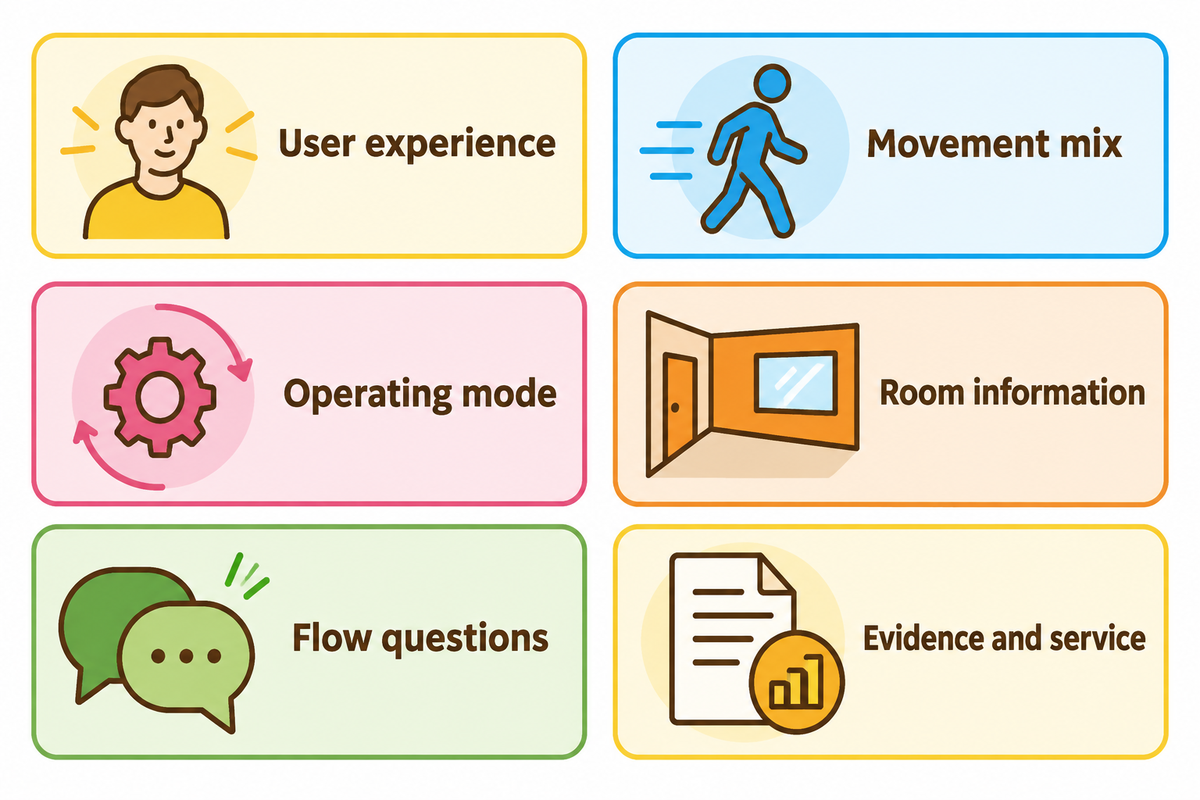
The guide becomes a brief describing what you want from the experience, who will benefit and how the venue will operate it. Provide the supplier the site constraints and the unresolved questions, along with that brief. This provides a site-specific commercial proposal tied to an operating model rather than an attractive list of obstacle names.
The best hand-off includes the views of three people. The operator states the session and circulation needs. The coach describes the beginning tasks and how the experience will progress. The facilities or maintenance person outlines service access, approved part changes and evidence needed to support reopening. Finance can then compare the scope and ongoing work behind each price.
Operator brief to include with a project enquiry
A brief connects the guide to a site-specific commercial proposal.
| Include | Describe the decision |
|---|---|
| User experience | Introductory participation, coached practice or a defined competition format. |
| Movement mix | Grip, balance, climbing and transition tasks you want to offer. |
| Operating mode | Open play, classes, parties or shared-space sessions. |
| Room information | Measured obstructions, access and the current plan. |
| Flow questions | Waiting, permitted exits, return paths and reset duties. |
| Evidence and service | Applicable classification review, installation acceptance, spare-part identity and training. |
When comparing ninja warrior equipment for your room, use Toplay’s commercial ninja course equipment solution page.
This is where you can adjust the project and get a quotation. Bring movement and operating briefs with measurements in order to settle on a project layout and service scope during the next meeting.
An attraction can be cost-effective when it fits the program the venue can deliver. Ask how required training, inspections and changeovers affect that program before using projected visits as a return calculation. The decision is if the entire operating arrangement works for the site.
Keep a Refresh and Reassessment Plan
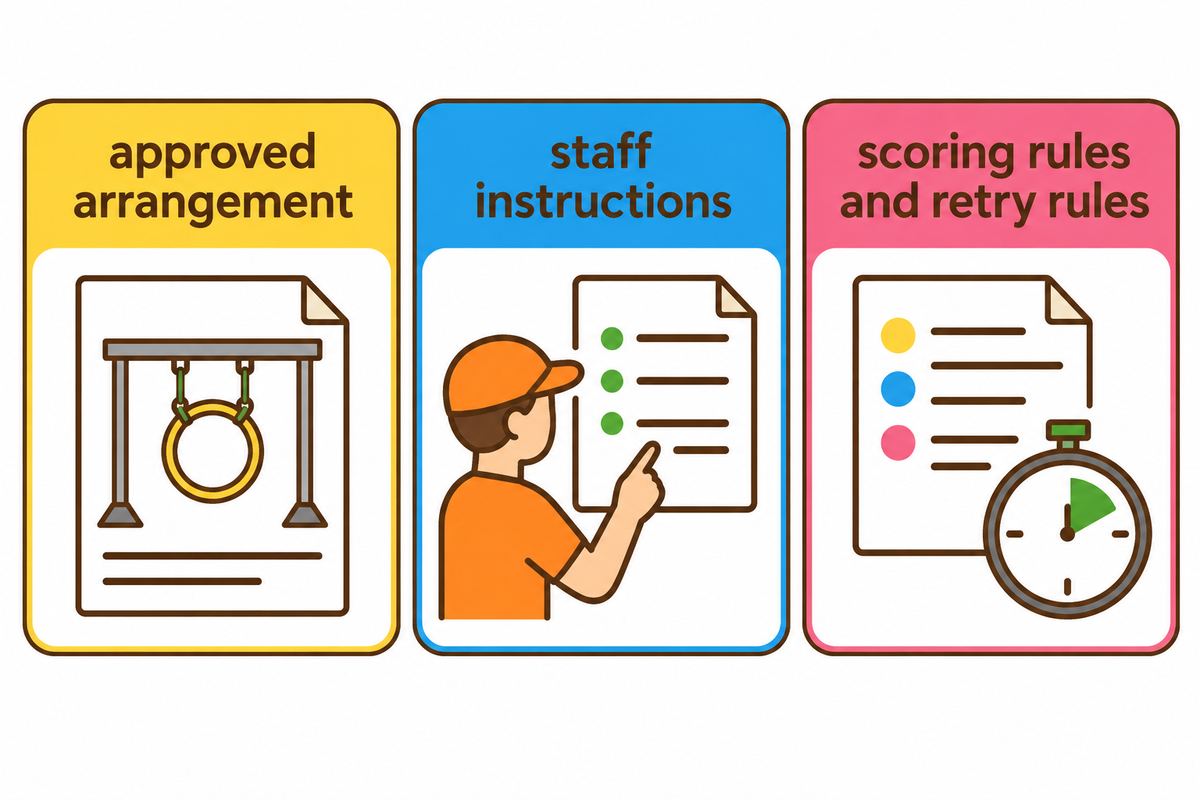
Keep a review plan for changes in the activity format, equipment arrangement, and the documents used to accept it. Modular hardware and timing systems are flexible enough to support different programs, but the program defines the constraints for the hardware and the timing systems. Assess those constraints before enabling a new feature or changing the course rules.
Let’s look at an example. The World Ninja League’s Full Course format awards difficulty and time points for successful individual obstacles. The League directs athletes to proceed to the next obstacle after an attempt. Other formats of the League are different. An operator choosing a timing system or a display for competition should define the scoring rules and retry rules before deciding on the system and the software. Those rules don’t apply to all the public sessions.
For a new configuration, document the approved arrangement, and staff instructions. For a changed document, review if the project specification or acceptance plan requires modification. The 2026 editions for laboratory and field surfacing testing highlight the need for a review of equipment along with the other documents. This is a routine maintenance task, and it doesn’t depend on speculative assumptions about market changes.
Frequently Asked Questions
What makes ninja course equipment worth the investment?
An investment case needs a suitable audience, an operable layout and credible venue-specific demand assumptions.
Ninja course equipment is worth evaluating when the attraction fits your audience, room and operating model, and the business can support staffing and upkeep. The equipment price alone can’t establish a return. Compare the full scope with your own demand assumptions, then test whether introductory sessions, repeat visits or coached programmes provide a credible reason for customers to use the course.
Use a conservative case as well as an optimistic case. A generic payback promise isn’t a substitute for your venue’s operating records.
Does ninja course equipment have an expiry date?
Component retirement should follow the installed system’s instructions and condition, rather than one generic age for the whole course.
There’s no useful universal expiry date for every ninja course component. Follow the supplied inspection, retirement and replacement instructions for the installed system, and retain the records needed to identify each part. A steel frame, rope element, gripping surface and protective mat can require different actions; appearance alone doesn’t establish whether any of them remains fit for use.
Plan replacement access and part references before opening. Changes to an obstacle also need review of its interfaces and surrounding space.
What should a commercial ninja equipment warranty cover?
Written warranty terms should identify the covered parts, defects, claim process, exclusions and who pays the associated costs.
A commercial ninja equipment warranty should identify the covered components, covered defects, duration and start event, claim evidence, exclusions, and responsibility for parts, freight and labour. Request the written terms for the actual proposal. A broad marketing statement can’t tell you how a damaged grip, installation error or normal wear item will be handled, or how long the attraction might remain unavailable.
Keep warranty terms separate from your inspection and maintenance duties. Compare the same claim scenario rather than only headline warranty length.
Where is ninja course equipment manufactured?
The manufacturer, component source and service provider can differ; establish each in the actual proposal.
Manufacturers and distributors offer ninja equipment in several countries. Ask who fabricates the rig, supplies contact parts and supports the assembled system. The seller’s address alone doesn’t establish origin or replacement support.
Can a portable padded course replace a hanging ninja rig?
A padded circuit and a hanging rig are alternatives only when they meet the same defined activity and intended-use needs.
A portable padded course and a hanging rig can serve different activities. Compare the actions, intended users, setup requirements and operating instructions instead of treating one as a cheaper version of the other. Floor-level stepping and climbing tasks don’t automatically deliver the same grip and traverse challenges as suspended obstacles, and neither product family supplies a universal safety case.
For a proposed combined attraction, request review of interfaces, participant routes, supervision and clear space. A familiar obstacle name doesn’t prove compatibility between systems. The equipment list should follow the activity brief; the activity brief shouldn’t be reverse-engineered from the cheapest package. Ask the designer to show the difference in the actual room and to identify the supporting manufacturer instructions.
Can a ninja course be added to a trampoline park?
A separate ninja attraction can be evaluated within a trampoline venue, with review of its interfaces and operating arrangement.
A ninja course can be considered as a separate attraction within a trampoline venue. Check equipment scope, circulation, supervision and interaction with existing activities. Evidence for the trampoline court doesn’t automatically cover the added obstacles.
How this operator guide was prepared
Toplay supplies indoor play and ninja equipment, so this guide approaches obstacle selection from a commercial venue’s perspective. The Skill-to-Station Map and Lane-Cycle Friction Map combine public-source research with explicitly labeled planning examples. They aren’t reports of Toplay customer trials. Read Toplay’s manufacturing background alongside a project-specific proposal and its supporting documents.
References & Sources
- How to Implement Ninja Obstacle Programming — Athletic Business, 2017
- Adapting Your Facility for Ninja/Obstacle Training — Athletic Business, 2019
- Characterization of Shoulder Moments and Force Application in Static and Dynamic Campus Exercises — Exel et al., ISBS Proceedings, 2025
- ADA Standards, Chapter 2 — US Access Board
- ADA Standards, Chapter 10 — US Access Board
- Lean Thinking and Methods: Cellular Manufacturing — US Environmental Protection Agency
- Put Crowd Controls in Place — UK Health and Safety Executive
- ASTM F1487-25 — Public Playground Equipment, public scope
- ASTM F1918-21 — Soft Contained Play Equipment, public scope
- ASTM F3101-21a — Unsupervised Public Use Outdoor Fitness Equipment, public scope
- ASTM F1292-26 — Laboratory Impact Attenuation, public scope
- ASTM F3313-26 — Field Impact Attenuation Test Method, public scope
- Public Playground Safety Handbook Update — CPSC notice, August 13, 2025
- Soft Contained Play Equipment Safety Checklist — CPSC
- Guide to the ADA Accessibility Standards: Play Areas — US Access Board
- Full Course Format — World Ninja League