Get in touch with Guangzhou Toplay amusement equipment co. Company

Indoor Playground Maintenance Checklist: 42 Checks Across Four Cadences

Project Build Support
Need an indoor playground layout before your next quote?
Send venue size, ceiling height, age range, theme direction and opening schedule. Toplay can match the play route, safety surface and delivery scope before you lock the quotation.
Layout fitFootprint, traffic and age zones
Build scopeEquipment, surface and installation
Quote pathFactory review before RFQ
RFQ Checklist
What to include for faster project matching
Venue and capacity
Floor size, ceiling height, entrance route, target age groups and daily visitor expectations.
Theme and operation
Brand direction, supervision plan, opening timeline and any food, retail or party-room requirements.
Delivery context
Send Project Details
City, floor access, installation window, local review needs and budget direction.
An indoor playground maintenance checklist is a written schedule of recurring equipment checks, each with a named owner and a stop condition. This one covers 42 checks divided into four cadences: 12 daily checks run before the doors open, 11 weekly hands-on hardware and surface checks, 11 monthly checks that need a ladder and a closed play area, and 8 quarterly or annual checks. Each one names the person who performs it. The 23 daily and weekly checks carry an explicit stop condition; the 11 monthly rows name the finding that closes the component under the decision rule below; the 8 seasonal and annual items are scheduled reviews rather than pass-or-fail gates.
Go looking for a checklist for this task and what comes back was designed for outdoor public playground equipment. The document those forms refer to, the CPSC Public Playground Safety Handbook (Publication 325), states on its own scope that it doesn’t apply to soft contained play equipment. CPSC’s Safety Education Materials directory separately lists its Soft Contained Play Equipment Safety Checklist, developed to help parents and children use play equipment safely. Work down one of those forms against your own structure and count: the rows describing swings, spring riders and wood-fiber use zones have nothing to inspect in a netted, padded, ball-filled building.
Three federal documents do address this equipment: the CPSC safety checklist for soft contained play equipment, the CPSC soft contained play equipment safety review of 2002, which reports on a review carried out between May and October 1995, and chapter 10 of the US Access Board’s ADA guide. No one wrote them for the person who opens the building in the morning, and this checklist assembles what they say into a sequence that person can actually run, with each check set out in enough detail to be repeatable.
The decision rule behind this checklist
If a check fails, the affected component and its fall zone stay closed until the finding has been recorded, the repair or corrective action is complete, and a designated person has recorded who released it back into service. A condition report should identify what was found, what action was taken and who made the release decision; “it looked fine” is not a condition report.
On this page
- Why most checklists inspect the wrong play equipment
- The Maintenance Duty Split: which document requires each task
- Daily opening inspection, 12 checks
- Weekly hardware and surface checks, 11 checks
- Monthly playground inspection, 11 checks
- Cleaning and disinfecting the play area
- The Load-Cycle Inspection Calendar, 8 seasonal and annual checks
- How often do playgrounds need to be inspected?
- Wear Signature Index: what each component does before it fails
- What your maintenance documentation has to show
- Repair, refurbish or replacement
- How often should a playground be replaced?
- Frequently asked questions
Why Most Indoor Playground Safety and Maintenance Checklists Inspect the Wrong Play Equipment
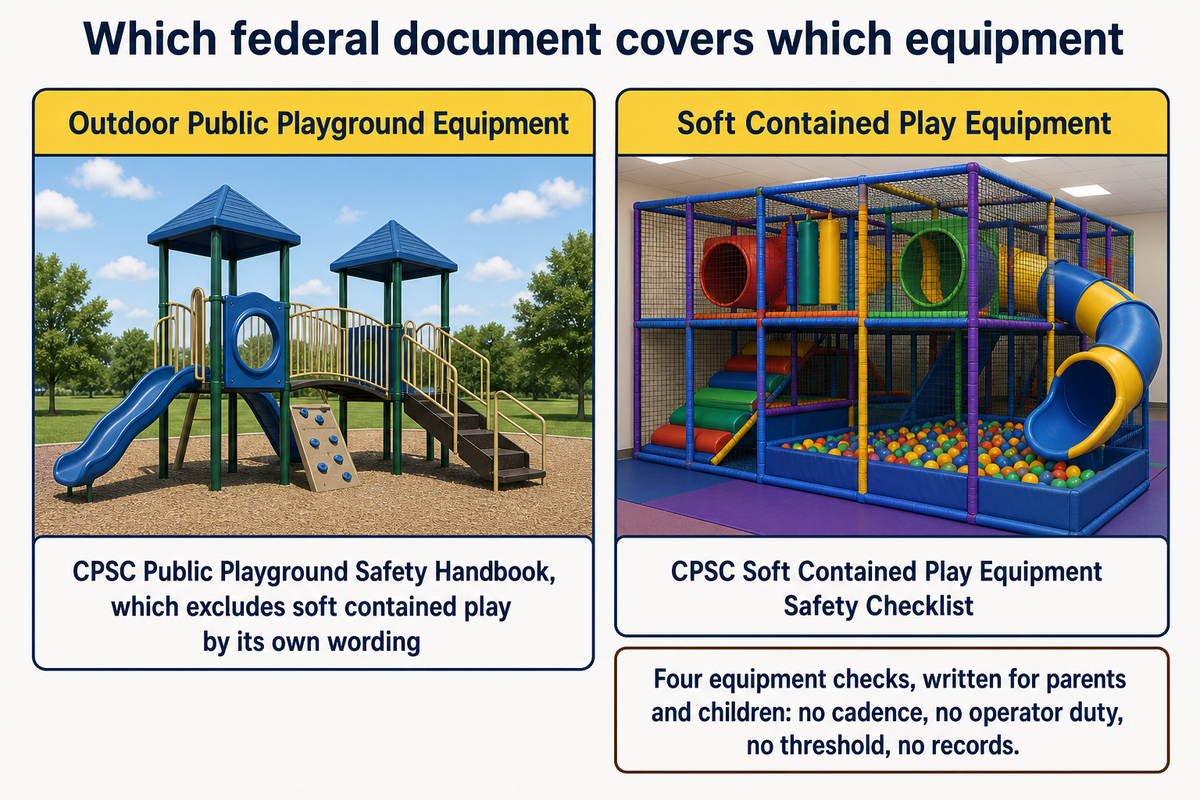
Checklists in circulation come straight from outdoor public playground guidance, and the federal handbook they rest on excludes soft contained play equipment by its own wording. A form that lists swing chains and fall zones in the same table with your building is reviewing a different structure.
There’s a federal checklist for this exact equipment class, and it is written for parents rather than for the people who open the building. CPSC publishes a Soft Contained Play Equipment Safety Checklist. It’s four equipment checks long, netting for tears or frays, cargo webbing and rope for tears or frays, floor surfacing for tears, and general cleanliness, and it opens by saying it exists “to help parents and children use Soft Contained Play Equipment safely.” It carries no cadence, no interval, no operator duty, no record-keeping requirement and no threshold. CPSC files it in the parent-facing Safety Education Materials catalogue, under the blurb “Follow these safety tips to prevent injuries to your child on play equipment often found in fast food restaurant play areas and elsewhere,” which is not where an operator goes looking for an operations document.
One line in that document deserves to be read by every venue owner, because it is not advice to the operator at all:
“Dirty equipment is an indication that the owner/operator may not have kept up with the routine maintenance and repair.”
U.S. Consumer Product Safety Commission, Soft Contained Play Equipment Safety Checklist
CPSC is instructing parents to police you. It invites the public to treat visible cleanliness as a proxy for whether the maintenance program behind it is working. That is a weak inference in engineering terms and a durable one in practice, and it is the inference your visitors are being told to draw. On where the duty itself sits, CPSC’s 2002 Soft Contained Play Equipment Safety Review is explicit: “the owner or operator is responsible for maintenance of SCPE. This includes routine cleaning, inspection and repair of the equipment and support structure.” That same document then records that “a detailed study of the maintenance and hygiene issues was beyond the scope of this report”, and its very next sentence hands the subject on: “The ASTM subcommittee F15.36 on Soft Contained Play Equipment plans to address these issues in its voluntary safety standard.” That standard is F1918, whose section 11 is titled Maintenance and sits behind a paywall. So the federal gap was passed to a document you have to buy, and that is the gap this checklist exists to fill.
Behavior at the structure is a separate control from equipment condition, and conflating them produces a form that does neither one well. Staff procedure on the day, the opening-shift stop-go card and the close, record, repair and reopen sequence, belongs on its own sheet; this form is about the condition of the play equipment itself, and the cadence on which that condition is recorded.
The Maintenance Duty Split: Which Document Actually Requires Each Recurring Task
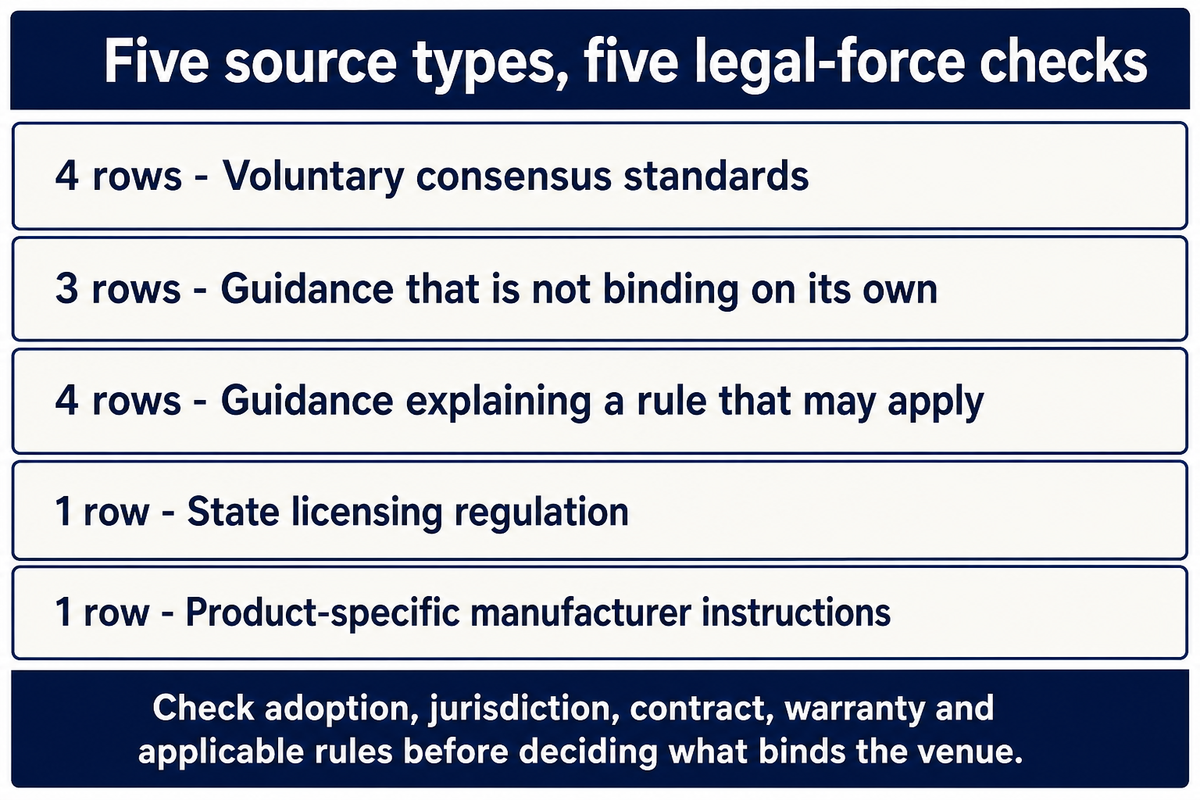
No single publicly readable source reviewed here provides a universal maintenance schedule for all soft-play venues. ASTM F1918-21 may be relevant, but it is paywalled, this article did not read it, and nothing here is a claim about what its Maintenance section says. Everything you can read for yourself falls into five different kinds of source, and they don’t all have the same legal weight, which is why the table below records legal force as its own column.
Maintenance Duty Split: “a document mentions it” and “you are legally required to do it here” are two different findings. Record both, per task.
| Recurring task | Governing document | Legal force | What it actually says | What it does not reach |
|---|---|---|---|---|
| Check netting, webbing, floor surfacing and cleanliness | CPSC Soft Contained Play Equipment Safety Checklist | Federal guidance, non-binding | Four equipment checks, written for parents and children | No cadence, no operator duty, no threshold, no records |
| Maintain the structure to the standard it was built to | ASTM F1918-21, section 11 | Voluntary consensus standard | Catalogue table of contents numbers Maintenance as section 11 of 13 numbered sections plus Annex A1; developed by subcommittee F15.36 and runs to 36 pages | Paywalled; not law unless adopted or written into a contract |
| Verify surfacing impact performance | ASTM F1292-22 | Voluntary consensus standard | Critical fall height, measured as g-max and Head Injury Criterion; scope 1.2 names F1918 | A performance criterion you test for, not a wear limit you can eyeball |
| Watch surfacing for degradation | ASTM F1292-22, scope 1.7 | Voluntary consensus standard | Names aging, moisture, maintenance, temperature extremes, ultraviolet light, contamination, compaction, loss of thickness, shrinkage and submersion | Lists the factors; publishes no numeric limit for any of them |
| Inspect accessible route and ground surface | US Access Board, ADA guide chapter 10 (explains the ADA rules enforced by the Department of Justice) | Federal guidance explaining a binding rule | Surfaces must be “inspected and maintained regularly and frequently” against ASTM F 1951-99, the edition the US Access Board guide itself names; frequency depends on amount of use and surfacing type | Sets no fixed interval; scope is covered public accommodations in the United States |
| Keep accessible entry points usable | US Access Board, ADA guide chapter 10 (explains the ADA rules enforced by the Department of Justice) | Federal guidance explaining a binding rule | The count is fixed at design time, one entry point on an accessible route where three or fewer exist and two where four or more exist; what recurs is keeping every one of them usable | Written as a design rule; the maintenance consequence is yours to draw |
| Tell a routine maintenance job apart from an ADA alteration | US Access Board, ADA guide chapter 10 (explains the ADA rules enforced by the Department of Justice) | Federal guidance explaining a binding rule | “Normal maintenance activities such as replacing worn ropes or topping off ground surfaces are not considered alterations” | Read in the Alterations section: it keeps the rope change out of the alteration trigger, it does not ask you to make it. A genuine reconfiguration is still an alteration |
| Clean, sanitize and disinfect the play area | Minnesota Department of Health, indoor play area guidance for food-licensed premises | State guidance explaining a binding rule | Its routine cleaning advice says to clean and sanitize the indoor play area surfaces daily or more often, even if they do not look dirty | Daily is the department’s advice, not the rule it explains: the food code it cites (4626.1520 / 6-501.12A) asks only that facilities be cleaned as often as necessary to keep them clean, and it reaches Minnesota food-licensed premises only |
| Hold a maintenance checklist on file | Texas HHS child-care minimum standards, chapter 746 | Binding regulation where adopted | Names a playground maintenance checklist as a required record | Binds licensed Texas child-care centers only, not pay-to-play venues in other states |
| Set the in-service inspection interval | UK Health and Safety Executive guidance | Regulator guidance, not binding in itself | A competent person determines the interval, with a maximum of 12 months for the in-service inspection of a sealed inflatable device | British practice; not United States law; written for sealed inflatables, which are a different equipment class from a soft contained structure |
| Build the inspection, maintenance and operation regime | BS EN 1176-7:2020 | Voluntary European standard/framework; may gain force if adopted or incorporated | A European framework for site-specific inspection, maintenance and operation | Not by itself a universal United States rule. Fully enclosed structures have a part of their own, BS EN 1176-10:2008 |
| Apply component removal and replacement criteria | Manufacturer installation and maintenance instructions | Product-specific instruction | Product-specific frequency, method, torque values, approved parts and exclusions | Controls product-specific maintenance and may become binding when incorporated into a contract, warranty or applicable rules; differs per structure and is not transferable between suppliers |
| Follow general playground operating guidance | CPSC Publication 325, 2025 edition | Federal guidance, non-binding | Inspection and maintenance considerations for public playgrounds; “frequently used playgrounds will require more frequent inspections and maintenance” | States in its own scope that it does not cover soft contained play equipment |
Read down the legal-force column before you read anything else. Four rows are voluntary consensus standards. Three are guidance that binds nobody on its own. Four are guidance that explains a rule which may apply, the ADA for two accessible-route rows and one row that draws the line between maintenance and alteration, and Minnesota’s food-code rules for the cleaning row. One, Texas chapter 746, is a licensing regulation in a single state. Manufacturer instructions control product-specific maintenance and can become binding when a contract, warranty or applicable rule incorporates them. A venue providing indoor play areas designed for kindergartens in a state that licenses childcare may have an additional licensing requirement; a pay-to-play venue in a state with no equivalent rule may not. When a room hosts more than one class of equipment, identify which standard applies to a specific structure rather than attaching one number to the entire facility.
Daily Opening Inspection: Play Equipment Checks Before the Doors Open
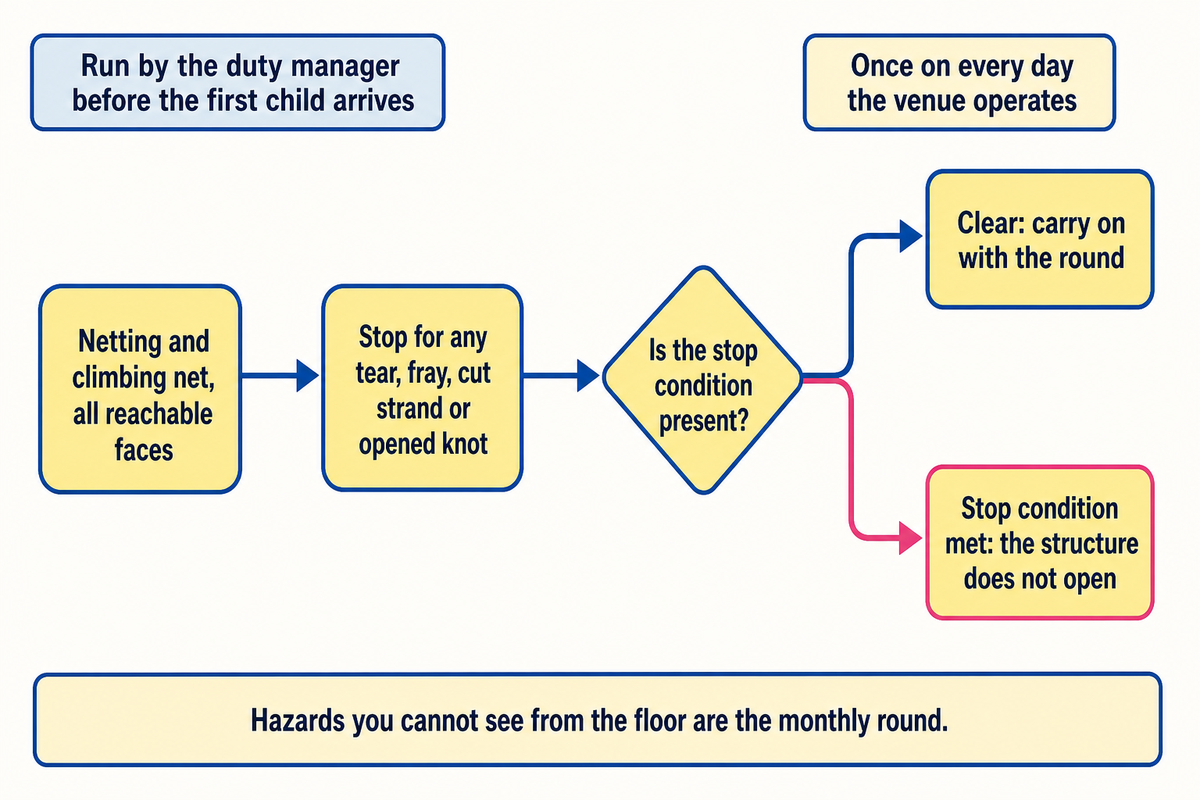
The daily walk addresses one specific question: is there an observable condition that renders this structure unusable for the next few hours? Twelve checks, run before the first child arrives, once on every day the venue operates. The duty manager owns eight of them and opening staff the other four; the order below is the one that walks the building most efficiently, not a sequence any authority prescribes.
Before the list, a limit worth declaring once. The daily, weekly, monthly and annual division below is a proposed template, not an enforced schedule any authority applies. CPSC ties frequency to use rather than to the calendar, the US Access Board states surfacing frequency “depends on the amount of use and the type of surfacing installed,” and the HSE interval is for sealed inflatable devices and is not direct cadence authority for soft-contained play. Venues running near capacity most days of the week should compress these intervals into an ongoing maintenance plan built around their own load. Quiet weekday-only sites can justify stretching some of them, in writing, with a reason.
| No. | Daily check | Stop condition | Run by |
|---|---|---|---|
| 1 | Entry gate, sock control and exit door | Latch damaged, gate propped, or a child could pass the point of sale desk and leave unseen | Duty manager |
| 2 | Netting and climbing net, all reachable faces | Any tear, fray, cut strand or opened knot | Duty manager |
| 3 | Cargo net webbing and rope terminations | Fray, lifted stitching, or a loose swage at the fitting | Duty manager |
| 4 | Floor surfacing around the structure base | Tear, gap, lifted seam or exposed subfloor | Duty manager |
| 5 | Padding on posts, platform lips and edges | Split seam, exposed foam, or a pad that has slipped off the hazard it was installed to cover | Opening staff |
| 6 | Ball pit surface sweep | Broken balls, foreign objects, food debris or a soiled area | Opening staff |
| 7 | Slide bed and run-out zone | Crack, sharp edge, loose joint or an obstruction at the exit | Opening staff |
| 8 | General cleanliness of the surfaces children touch most | Visible soiling on rails, panels, tunnels or the entry deck | Opening staff |
| 9 | Accessible route from entrance to structure | Route blocked by furniture, buggies, stock or a queue barrier, or new tripping hazards along it | Duty manager |
| 10 | Fire exits, evacuation route and extinguisher access | Anything stored in front of an exit or an extinguisher | Duty manager |
| 11 | Signs: height, age band, sock rule and supervision rule | Signs missing or damaged, unreadable, or contradicted by how the room is set up | Duty manager |
| 12 | Open defects carried over from the previous day | Any tagged item with no recorded repair and no named release | Duty manager |
Checks 2, 3, 4 and 8 are the four that CPSC posed to parents in its checklist for soft contained play equipment. They sit inside the opening round rather than at the end of it, so the things your customers were told to look at are the things you looked at before they arrived.
Weekly Hardware and Surface Checks: Loose Fasteners, Soft Play Netting and Padding
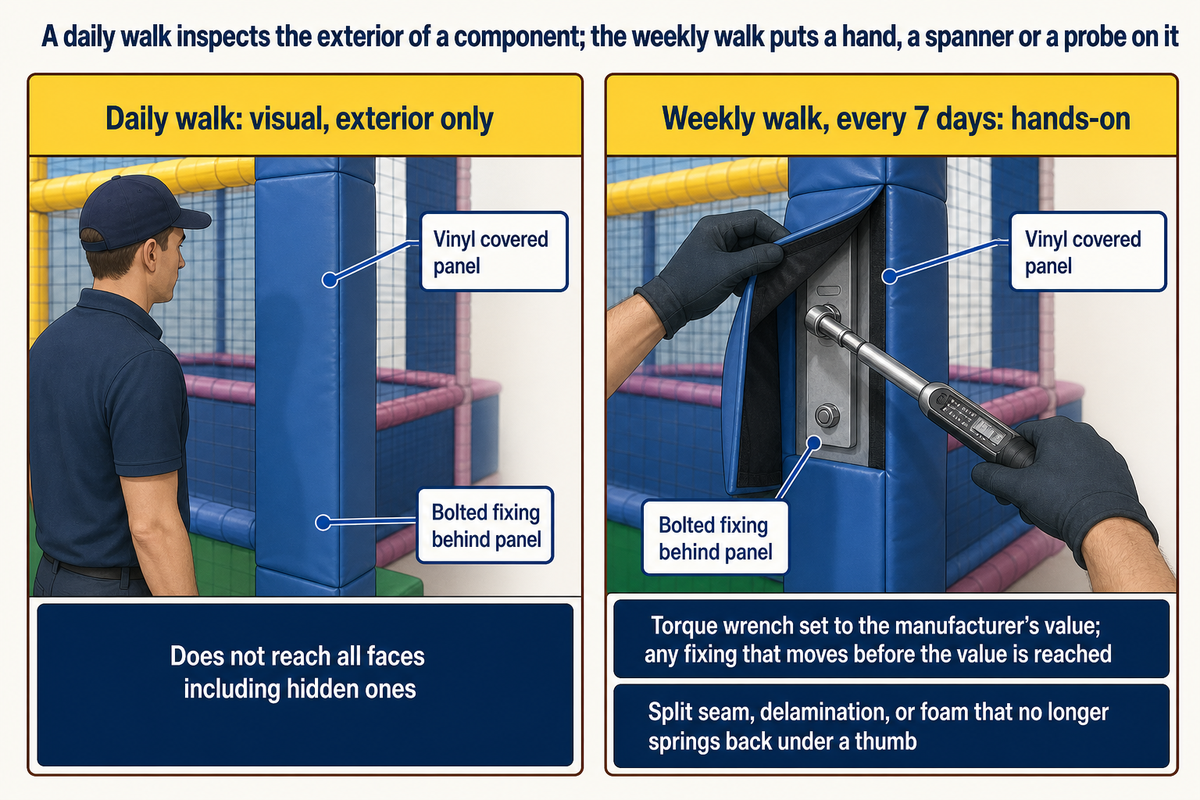
Weekly checks are hands-on. The daily round catches the issues a user would meet on arrival; this one catches the issues nobody meets until later. A daily walk inspects the exterior of a component; the weekly walk puts a hand, a spanner or a probe on it, and reveals wear that hasn’t yet resulted in anything observable.
| No. | Weekly check | Method and stop condition | Run by |
|---|---|---|---|
| 13 | Fastener and bolt torque, sample of dynamic fixings | Torque wrench set to the manufacturer’s value; any fixing that moves before the value is reached | Maintenance lead |
| 14 | Clamps and connectors on climbing net and cargo net | Hand check every connector on the climber, turning each one; any missing, opened or deformed clamp | Maintenance lead |
| 15 | Anchor points and floor fixings | Push test at the top of each upright; any anchor that is no longer secure at the base | Maintenance lead |
| 16 | Cushion mat condition and position | Compression by hand; a mat that stays indented, has migrated, or no longer covers the impact area | Maintenance lead |
| 17 | Netting seams and stitching at load points | Run a hand along each seam; lifted thread, thinning or a hard spot where fibers have fused | Maintenance lead |
| 18 | Rope terminations and swaged fittings | Gloved hand over each termination and the adjacent rope length specified by the manufacturer or manual; any exposed steel core, swage that has slipped clear of its mark, or rope that has lost its lay | Maintenance lead |
| 19 | Slide bed, joints, rivets and side wall alignment | Flat palm down the bed, feeling for scoring; any step between sections, proud rivet or side wall that has spread | Maintenance lead |
| 20 | Bounce elements, springs and mats where fitted | Load each element by hand and look under it; any broken spring, stretched hook or mat stitching that has opened | Maintenance lead |
| 21 | Ball pit agitation and full-depth debris sweep | Turn the balls through; broken shells, sharp fragments or anything organic at the base | Cleaning staff |
| 22 | Vinyl and foam padding, all faces including hidden ones | Thumb pressure along each face, including the faces turned to the wall; split seam, delamination, or foam that no longer springs back | Maintenance lead |
| 23 | Interactive panels, cabling and sensors | Function test each one; intermittent response, exposed cable or a warm connector | Maintenance lead |
No public source reviewed for this article reveals a quantitative wear limit for any of these components. There is no maximum tear size for netting, no minimum foam density for padding, and no published torque number you can apply to somebody else’s structure. Where a numeric limit exists at all, it is bound to a particular product. ASTM F1918-21 titles its section 11 Maintenance, but the text sits behind a paywall and this article did not read it, so it claims nothing about what that section says. What you can actually act on sits in the manufacturer’s manual, the instruction pack handed over with the installed soft play equipment, which is where the torque values and the approved parts for your structure are written down. That is a finding rather than an oversight, and any checklist that hands you a percentage strength reduction for netting has not told you which product that number belongs to.
One public number does exist, and it is a different kind of number. ASTM F1292-22, Standard Specification for Impact Attenuation of Surfacing Materials Within the Use Zone of Playground Equipment, sets a performance criterion for surfacing, expressed as a critical fall height and measured as g-max and Head Injury Criterion. Its scope names F1918 among the equipment specifications it applies to, alongside F1148, F1487, CSAZ614 and SS457, and it is developed by subcommittee F08.63 — a different committee from the one that owns the equipment standard. A performance criterion is verified by test, not by eye, which is exactly why it never appears on a walk-around form.
The standard itself is paywalled, but the scope abstract on its catalogue page is not, and that abstract lists what ASTM says degrades installed surfacing: aging, moisture, maintenance, exposure to temperature extremes, exposure to ultraviolet light, contamination with other materials, compaction, loss of thickness, shrinkage and submersion in water. This article uses that factor list as a weekly inspection prompt; the scope abstract does not prescribe a weekly cadence. What is quoted here is the published scope abstract, not the body of the standard, which this article did not read.
Monthly Playground Inspection: Hazards You Cannot See From the Floor
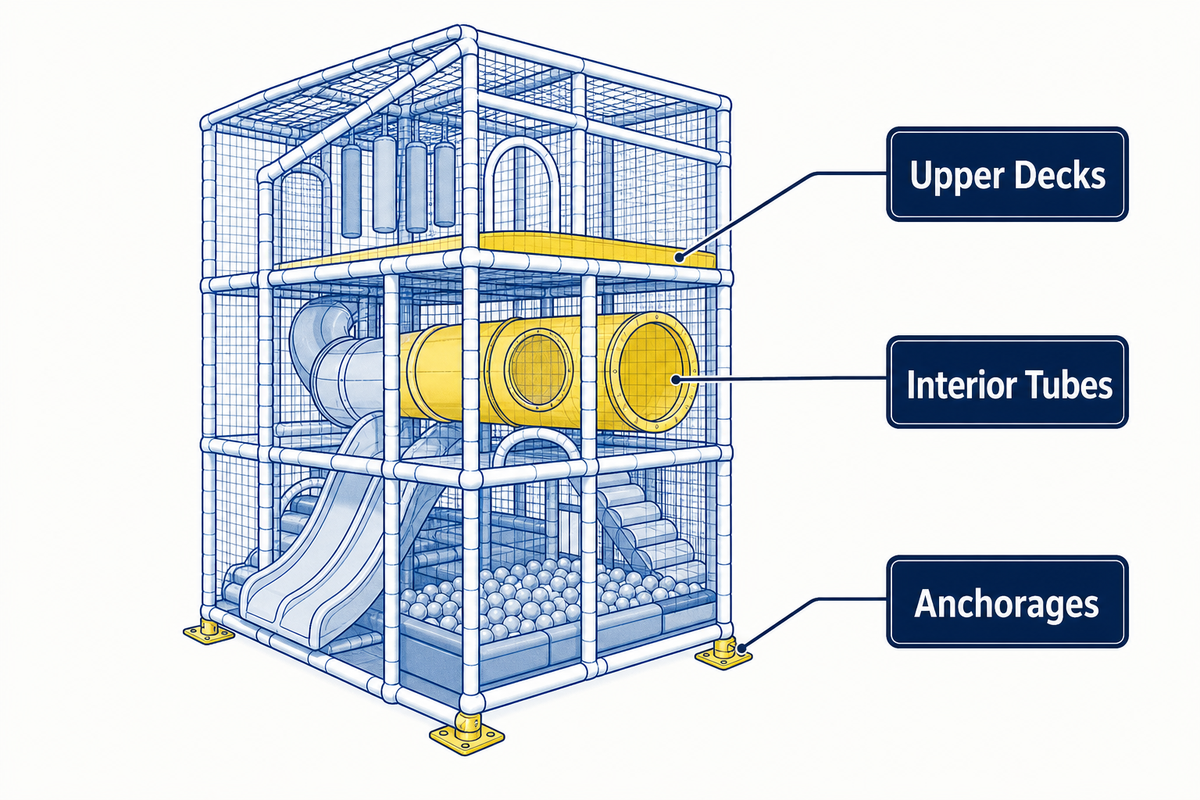
Most of a soft contained structure’s surface area is inside it, and none of that is visible from the cafe seating, so the potential hazards that matter most need special attention on a cadence of their own. Daily and weekly rounds work the parts of the structure a standing adult can reach; the interior tubes, the upper decks and the anchorages are only reachable once the area is closed. The monthly round runs once a month and needs the area closed, a ladder and a flashlight. The two checks worked from inside the structure, the interior crawl and the internal net hardware, need a second person stationed outside it; the rest are single-operator work with the area closed.
| No. | Monthly check | What you are looking for, and what closes the component | Run by |
|---|---|---|---|
| 24 | Full interior crawl of tubes and tunnels | Internal padding gaps, exposed frame, vandalism or graffiti covering damage, trapped items | Maintenance lead, with a spotter |
| 25 | Upper-deck platforms and guardrail fixings | Movement at the deck-to-post joint, guardrail height reduced by added padding | Maintenance lead |
| 26 | Structural frame, welds, uprights and bracing | Weld cracking, paint flaking at a joint, a brace carrying load it was not built for | Maintenance lead |
| 27 | Entrapment openings that wear has changed | Any opening that has stretched, sagged or opened since installation | Maintenance lead |
| 28 | Net attachment hardware inside the structure | Working inward from the entry: any internal net fixing that turns by hand, has lost a locking element, or shows a witness mark where it has moved | Maintenance lead, with a spotter |
| 29 | Foam blocks and soft module cores | Cores that have compacted, absorbed moisture, or separated from their covers | Maintenance lead |
| 30 | Slide underside, supports and brackets | Bracket elongation at the bolt hole, support contact that has shifted | Maintenance lead |
| 31 | Lighting and ventilation inside the structure | Sections without adequate lighting for a supervisor to see into; still air in the deepest tube | Maintenance lead |
| 32 | Fire detection coverage and rescue from height | Any deck or tube outside detector coverage, or any top-deck position with no rehearsed way to bring a child down, closes that level until both are in place | Venue manager |
| 33 | Deep sanitize of ball pit and soft modules | Clean balls in bulk, clean the pit base, wipe and dry modules before reassembly; any module returned damp, or a pit base still soiled, keeps the pit closed | Cleaning staff |
| 34 | Accessible route and ground surface | Transfer system or platform lift clear and operable, required entry points unobstructed, resilient surfacing not compacted, displaced or thinned below its installed depth | Maintenance lead |
Check 34 sits in this article’s monthly template because it is planned for the interior-access round, not because a federal rule prescribes a monthly cadence. The US Access Board guide, which explains the ADA requirements the Department of Justice enforces, states that ground surfaces “must be inspected and maintained regularly and frequently to ensure continued compliance with the ASTM F 1951-99 standard.” That is the edition the guide names, so confirm the current designation with ASTM before you commission a test against it. The same guide carries a section headed Soft Contained Play Structures. Blocking a transfer platform therefore does more than take one component out of service: it removes the accessible route the guide is describing, and that route is what a complaint would be about.
Cleaning and Disinfecting the Play Area: Where the Food Code Reaches Your Ball Pit
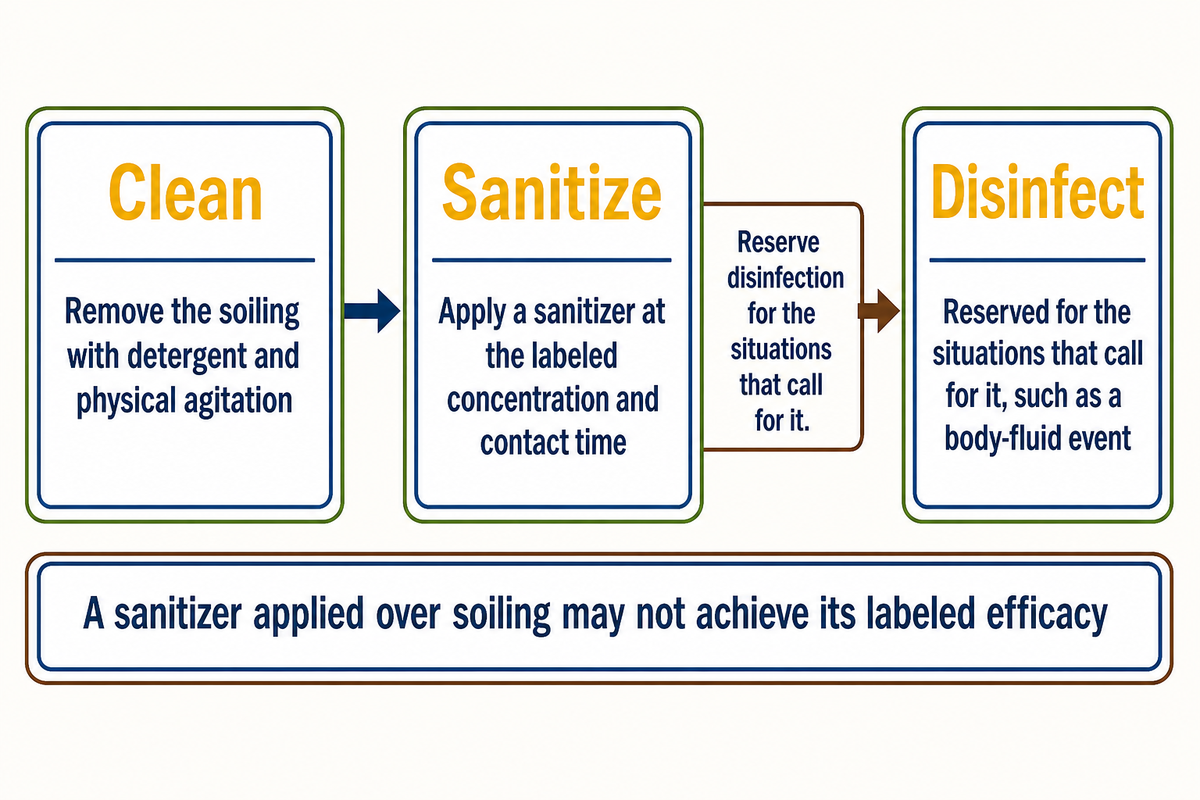
Minnesota Department of Health indoor play area guidance carries the only written daily cadence any authority in this article publishes: clean and sanitize the surfaces of the indoor play area daily or more often, even if they do not look dirty. Read that page to the bottom before you treat it as a duty. The daily line sits in the department’s routine cleaning and sanitizing advice; under the Regulations heading below it, the food code it actually cites is 4626.1515, that physical facilities be maintained in good repair, and 4626.1520, that they be cleaned as often as necessary to keep them clean. Neither says daily. Guidance from the department that also enforces the food code is not the food code, and telling those two apart task by task is exactly what the legal-force column above is for. Cleaning and sanitizing are separate operations, and the order between them is chemistry rather than regulation: a sanitizer applied over soiling may not achieve its labeled efficacy.
Cleaning duties can come from applicable state health or food regulation, a licence condition or a contract when the play area sits inside a food establishment. In Minnesota, the department’s daily line is guidance; the underlying food-code requirement is to clean as often as necessary. Check the rule, licence condition and contract that apply to your venue rather than treating the guidance as a universal mandate.
This article’s procedure template is to remove soiling with detergent and physical agitation before applying a sanitizer at the labeled concentration and contact time, and to reserve disinfection for situations that call for it, including a body-fluid event. Ball pit balls need bulk cleaning that reaches every surface, and the pit base needs cleaning separately, because that is where anything heavier than a ball ends up. This article’s starting template is to wipe high-frequency touch points every 24 hours, dry them properly, and record which method was used; adjust it to applicable regulation, licence conditions, contract terms and use.
The overlay differs by venue type. A licensed childcare setting may have separate duties under its licensing agency; the licensing checklist a childcare center works from covers that ground. A standalone pay-to-play venue should identify any applicable regulation, licence condition or contract requirement. CPSC tells customers that dirty equipment can signal a maintenance program that has slipped, but that observation does not create a separate legal duty.
The Load-Cycle Inspection Calendar: Seasonal and Annual Checks, and Why Spring Is the Wrong Default
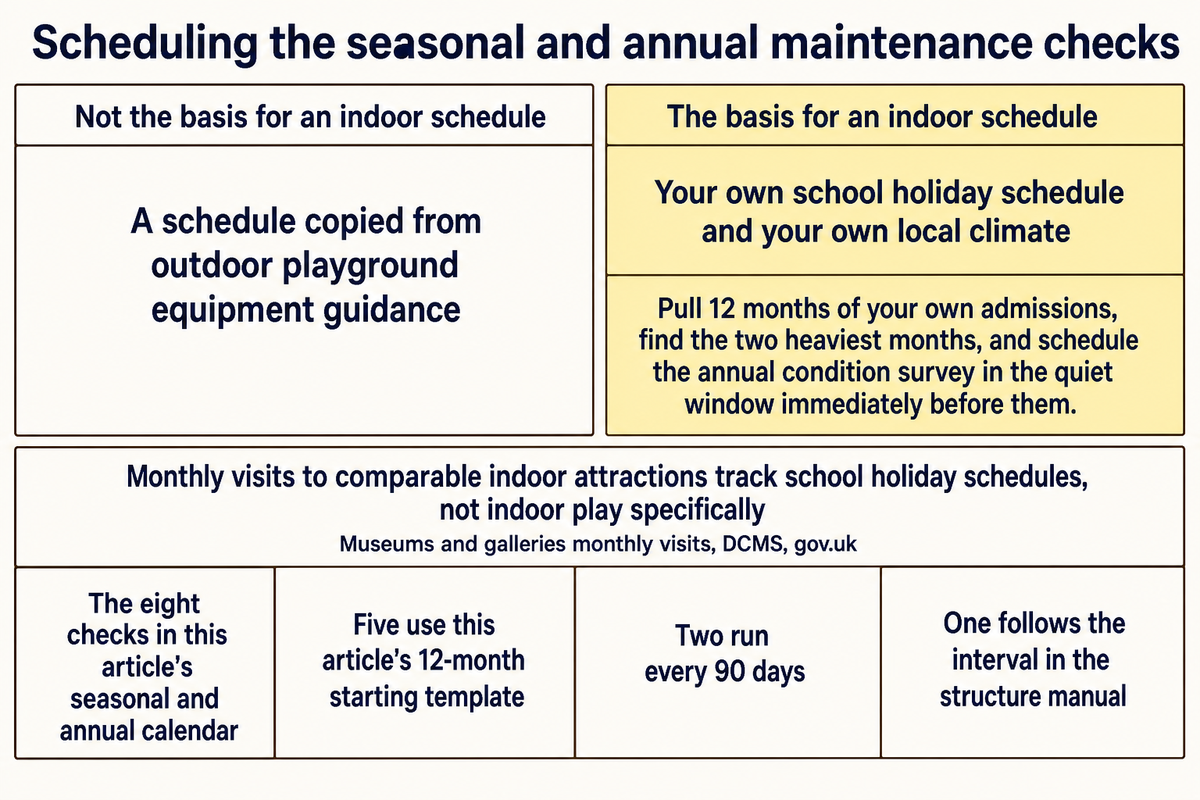
An indoor play venue’s load cycle follows its own school holiday schedule and its own local climate, not the season out of doors. A spring overhaul is the outdoor default, and an indoor structure has no outdoor season to recover from, so a schedule copied from outdoor playground equipment guidance schedules your heavy work for somebody else’s calendar. Five of the eight items below use this article’s 12-month starting template, two run every 90 days, and one follows the interval in the structure manual.
Two things can shape an indoor venue’s load cycle, and neither is necessarily the season out of doors: the school holiday calendar and the local weather. UK government monthly attendance statistics for sponsored museums and galleries, which are comparable indoor attractions rather than indoor play specifically, attribute monthly visit swings to school holiday schedules. A hot-climate venue’s peak may differ from a cold-climate venue’s, so there is no universal peak month and this article will not invent one. This article’s load-cycle scheduling template is to pull 12 months of your own admissions, find the two heaviest months, and schedule the annual condition survey in the quiet window immediately before them. Venues combining soft play with trampoline park equipment should confirm whether a shared load cycle and closure window justify using the same exercise across both attractions.
| No. | Seasonal or annual check | Interval | Run by |
|---|---|---|---|
| 35 | Documented condition survey of the whole structure | Starting template: every 12 months; use the structure manual’s interval where specified | Competent person, independent of daily operations |
| 36 | Surfacing impact performance verified against the ASTM F1292-22 criterion | This article’s proposed starting template: every 12 months, and after any surfacing change or repair | Test house or qualified surfacing contractor |
| 37 | Manufacturer service visit and spare-part review | Use the structure manual’s interval where specified | Equipment supplier |
| 38 | Recall surveillance sweep against published CPSC recall notices | Every 90 days | Venue manager |
| 39 | Fire and evacuation drill, including rescue from the top deck | Every 90 days | Venue manager |
| 40 | Net, rope and padding replacement assessment | Every 12 months, against the supplier’s removal criteria | Maintenance lead with the supplier |
| 41 | Insurance, licensing and accessibility documentation review | Every 12 months, before renewal | Venue manager |
| 42 | Load-cycle calendar reset against the last 12 months of admissions | Every 12 months | Venue manager |
How often do playgrounds need to be inspected?
No standard or authority reviewed for this article sets a universal inspection interval for indoor soft contained play equipment. The sources say frequency follows use: CPSC states that frequently used playgrounds require more frequent inspections and maintenance, and the US Access Board ties surfacing inspection frequency to the amount of use and the type of surfacing installed. Neither names a number, which is why this article sets its cadences out as a template rather than a requirement.
Health and Safety Executive guidance describes a 12-month in-service inspection ceiling and a competent-person role for sealed inflatable devices, an adjacent equipment class rather than indoor soft-contained play. It is not direct cadence authority for this equipment. For a United States venue, use the four cadences above only as this article’s starting template, then adjust them to the structure manual, applicable regulation, licence conditions, contract terms and documented use.
Wear Signature Index: What Each Component Does Before It Fails
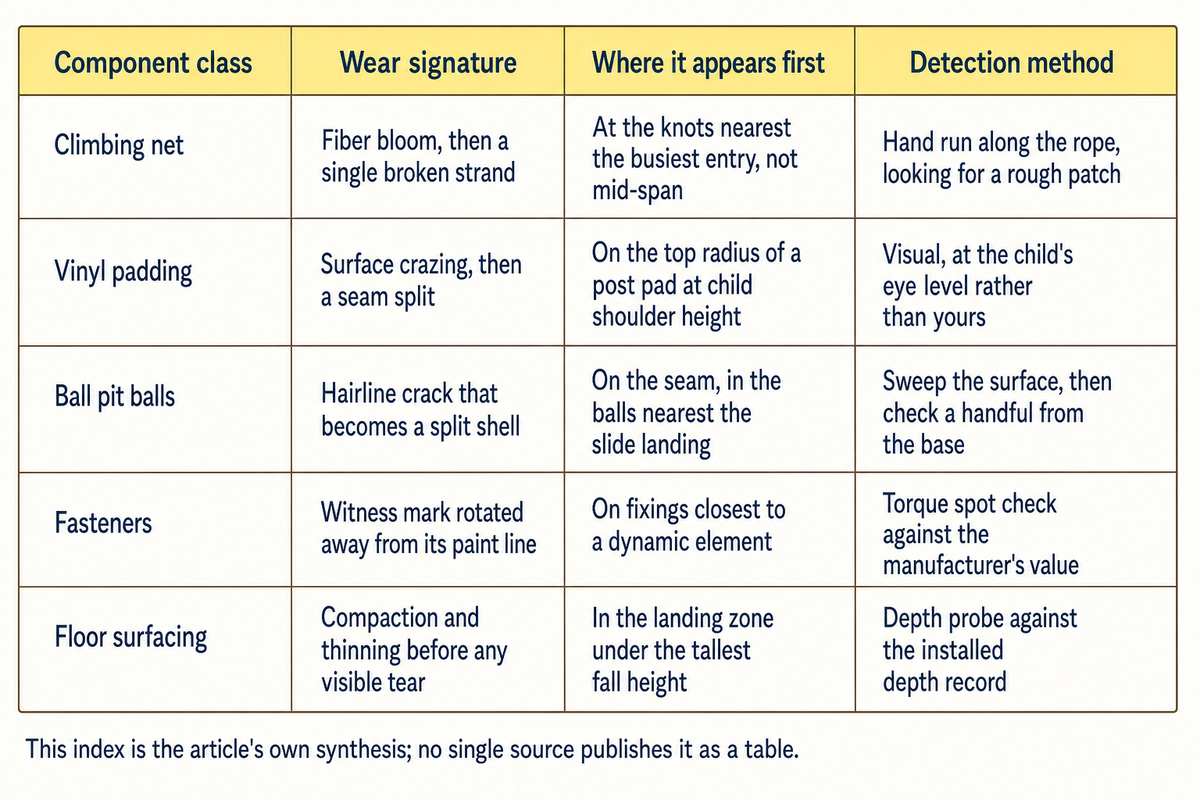
This article uses observable changes as inspection prompts; it does not claim that every failure gives advance warning. The four cadences above set when you look; this index sets what you are looking for, so the schedule and the signature work together. The sources identify general inspection categories; the detailed signatures and first-appearance locations below are practitioner judgment and should be checked against the structure manual.
| Component class | Wear signature | Where it appears first | Detection method | Catchable on |
|---|---|---|---|---|
| Climbing net | Fiber bloom, then a single broken strand | At the knots nearest the busiest entry, not mid-span | Fiber bloom is visible from the deck on the daily walk; the broken strand is found by running a hand along the rope, which is a weekly job | Every 24 hours by eye, every 7 days by hand |
| Cargo webbing | Edge fray and lifted stitching thread | At the stitched termination where the load turns | Edge fray is visible on the daily walk; the firm tug at the anchor belongs to the weekly round | Every 24 hours by eye, every 7 days by hand |
| Steel-cored rope | Outer fibers worn until the core shows | Immediately under the swaged fitting | Visual and feel through a gloved hand | Every 7 days |
| Vinyl padding | Surface crazing, then a seam split | On the top radius of a post pad at child shoulder height | Visual, at the child’s eye level rather than yours | Every 24 hours |
| Foam core | Loss of rebound and a permanent indentation | Behind the vinyl on the most-struck face | Press with a thumb and count how long it takes to return | Every 7 days |
| Ball pit balls | Hairline crack that becomes a split shell | On the seam, in the balls nearest the slide landing | Sweep the surface, then check a handful from the base | Every 24 hours at the surface, every 7 days to full depth |
| Slide bed | Gloss loss, then fine scoring across the travel direction | In the last third before the run-out | Flat palm down the bed; scoring is felt before it is seen | Every 7 days |
| Fasteners | Witness mark rotated away from its paint line | On fixings closest to a dynamic element | Torque spot check against the manufacturer’s value | Every 7 days |
| Floor surfacing | Compaction and thinning before any visible tear | In the landing zone under the tallest fall height | Depth probe against the installed depth record | Every 30 days |
| Interactive panels | Intermittent response from connector fatigue | At the cable entry behind the panel | Function test every element, not a sample | Every 7 days |
This article’s practitioner inspection-route template starts at knots, terminations, brackets and swages where load changes direction, then follows the child’s path as well as the staff’s usual sightline. Confirm the route, expected wear locations and any changed sightlines against the structure manual and observed conditions before relying on it.
The Playground Inspection and Maintenance Guide is an industry guide published by PlayCore. The National Recreation and Park Association operates the Certified Playground Safety Inspector program, and its cited materials concern public playgrounds. Before relying on either for indoor soft-contained play, verify the scope and supplement it with product and manufacturer expertise.
What Your Indoor Playground Maintenance Documentation Has to Show
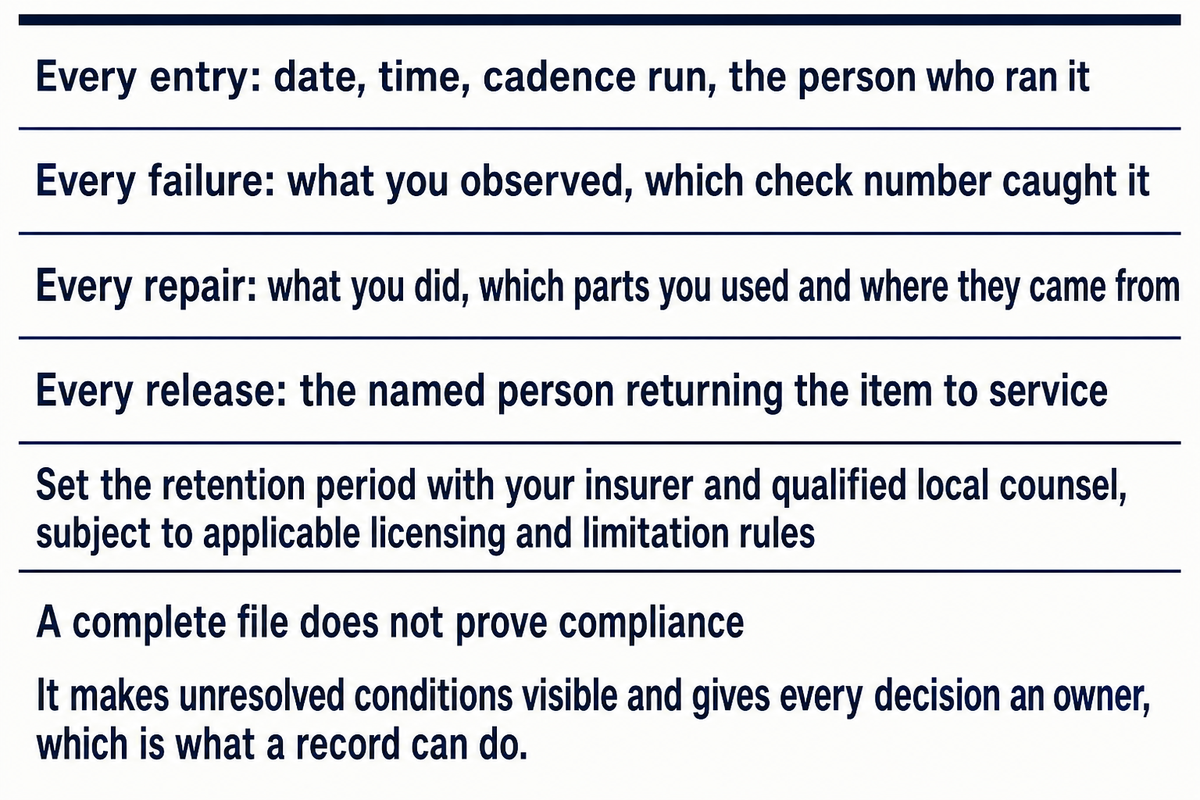
A maintenance record has to prove three things: that the check happened, that a named person decided what to do, and that the item came back into service by decision rather than by drift. Ticked boxes prove none of them.
The maintenance log: what to record, who signs, how long to keep it
- Record for every entry: date, time, cadence run, the person who ran it, and the structure or zone identified by name rather than “the play frame.”
- Record for every failure: what you observed, which check number caught it, the immediate disposition, the photograph, and whether the signs of damage looked new or carried over.
- Record for every repair: what you did, which parts you used and where they came from, and whether you followed the manufacturer’s method and torque procedure.
- Record for every release: the named person returning the item to service, and the date. This signature is the essential one, because it is what turns an observation into a decision with a name attached to it.
- Collect a signature from the duty manager for daily rounds, the maintenance lead for weekly and monthly rounds, the venue manager for the 90-day recall sweep and evacuation drill, and the competent person for the annual safety inspection.
- Keep the file: set the retention period with your insurer and qualified local counsel, subject to applicable licensing and limitation rules.
For a structure already installed, Toplay’s after-sales request pack generator assembles a service-request package: the order reference, the affected component and its location, the observed condition, the operating impact and the evidence. It structures a service request rather than a warranty decision.
Being plain about a limit: a complete file does not prove compliance, and this article does not claim that following it makes any venue compliant with any law. It makes unresolved conditions visible and gives every decision an owner, which is what a record can do. Treat the rows above as a working guideline you identify your own gaps against, not as a certificate.
Repair, Refurbish or Replacement: Reading the End of a Structure’s Service Life
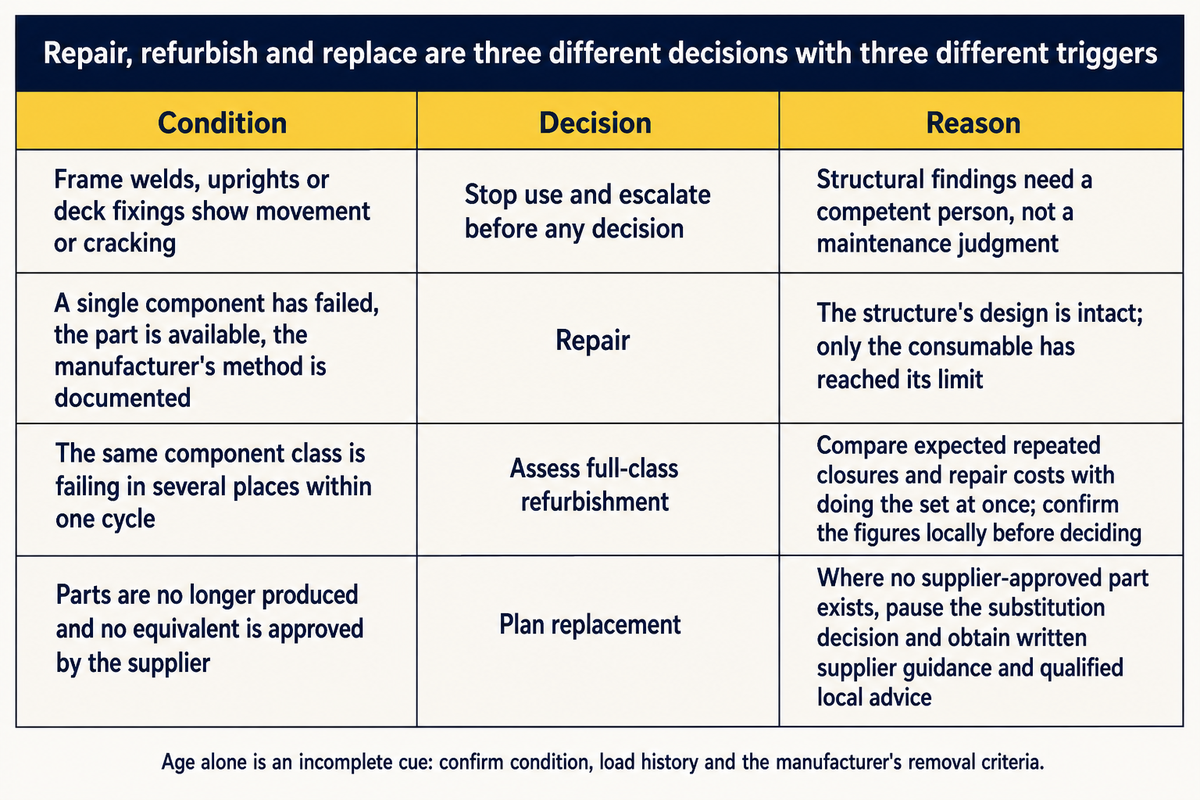
Repair, refurbish and replace are three different decisions with three different triggers. In this article’s decision template, age alone is an incomplete cue; confirm the observed condition, load history and the manufacturer’s removal criteria before choosing among them.
| Condition observed | Decision | Why |
|---|---|---|
| A single component has failed, the part is available, the manufacturer’s method is documented | Repair | The structure’s design is intact; only the consumable has reached its limit |
| The same component class is failing in several places within one cycle | Assess full-class refurbishment | In this article’s template, compare expected repeated closures and repair costs with doing the set at once; confirm the figures locally before deciding |
| Padding and netting are sound, but the theme, graphics and panels are dated | Refurbish cosmetically | A commercial decision, not a safety one; keep the two conversations separate |
| Frame welds, uprights or deck fixings show movement or cracking | Stop use and escalate before any decision | Structural findings need a competent person, not a maintenance judgment |
| Parts are no longer produced and no equivalent is approved by the supplier | Plan replacement | Use a supplier-approved part where one is available; where none is approved, pause the substitution decision and obtain written supplier guidance and qualified local advice before proceeding |
| The layout no longer matches the age bands or attendance the venue now serves | Assess replacement planning | In this article’s template, assess the venue’s actual supervision issues and costs before deciding whether a design-and-use mismatch justifies replacement |
| Surfacing no longer meets its critical fall height on test | Replace the surfacing before anything else | This is the one criterion with a published performance test behind it |
How often should a playground be replaced?
The public sources reviewed for this article did not yield a universal replacement interval or service life for indoor soft-contained play structures. Treat service-life figures on vendor pages as product-specific claims to verify against the structure documentation rather than as a universal schedule.
Replace on condition, on parts availability and on fit with your current audience, and get a written removal criterion from your supplier at purchase so the decision has a documented basis later. Review material selection and installation records alongside observed condition; neither sets a universal replacement date. Toplay’s after-sales and quality support covers replacement parts and maintenance requests for structures already installed.
Frequently Asked Questions
Which injuries does maintenance actually act on, and what is known about how often they happen?
Falls are the pattern the surfacing standard is built around: ASTM F1292-22 sets a critical fall height, which describes what a fall does rather than how often one happens. The one published breakdown, 44% falls and 23% equipment-related, is emergency-department data for playground-related injuries as a whole rather than for soft contained indoor play, so no share is claimed for your equipment class. Maintenance acts on the equipment-related causes through the fastener, netting and padding checks.
How can you ensure an indoor playground is safe for the children who play there?
No inspection routine makes a venue safe on its own. Combine a daily walk with a stop condition, hands-on weekly checks, a monthly interior inspection, an annual condition survey by a competent person, and supervision that matches the layout of the structure.
No single one of those five closes the gap on its own. The four inspection cadences have named owners and intervals; supervision is a separate operating control.
Why is inspection and maintenance important if the structure looks fine?
Some components can deteriorate beneath the surface or on faces not visible from the floor, so combine floor-level observation with the hands-on and interior rounds in this article. This is why a structure that looks fine still requires scheduled inspection.
CPSC also tells parents that dirty equipment signals a maintenance program that has slipped, which means visible condition is being read by your customers as evidence about the parts they cannot see.
How often should ball pit balls be cleaned?
No source reviewed for this article sets a universal interval. This article’s proposed starting template is to sweep the surface every 24 hours for broken shells and foreign objects, agitate the pit to full depth every 7 days and clear the base, and run a bulk clean of the balls and the pit shell every 30 days. Pull a sample handful from the base before deciding the pit is clean, because the base collects anything heavier than a ball.
Where the play area sits inside a food establishment, check applicable regulation, licence conditions and contract terms for any required frequency. In this article’s template, increase the frequency after any body-fluid event, after a peak-attendance period, or whenever the sample handful you pull from the base comes up dirty. Record which method was used and when, because a cleaning claim without a record is difficult to substantiate.
What has to be in an indoor playground maintenance log?
Date of task, time of completion, cadence of task (daily, weekly, monthly, seasonal or annual), identity of the individual performing the task, and the identified structure. Name the structure or zone rather than writing “the play frame”, and record the cadence the round belonged to, because an entry that cannot be tied to a schedule cannot show the schedule was kept.
Record the person who returned an item to service and the date, then set retention with your insurer and qualified local counsel, subject to applicable licensing and limitation rules.
Include, for each defect found, what was discovered, the immediate corrective action taken, and a dated photo of the issue; list each repair by type of repair done, manufacturer and part number of the supplies used and where those supplies were purchased; and record for each return to service the name of the person releasing it and the date.
Is an annual inspection by a competent person required in the United States?
The federal materials reviewed for this article do not establish a uniform nationwide annual-inspection requirement for indoor soft-contained play. An annual survey may still be required by applicable state or local rules, a licence condition, insurance terms or a contract; check the requirements that apply to your venue. BS EN 1176 is a European inspection and maintenance framework, not by itself a universal United States rule.
Health and Safety Executive guidance describes a 12-month ceiling for sealed inflatable devices, an adjacent equipment class, rather than indoor soft-contained play. It should not be treated as direct cadence authority for this equipment. A contract can impose requirements even where no statute does.
“Competent person” is a UK term used here only as a role description: someone with the training, structural knowledge and current experience to judge this equipment, and independent enough of daily operations to record an unwelcome finding. The federal materials reviewed do not establish a uniform nationwide United States definition, licence or credential for that role; specify the needed competence in writing and supplement it with product and manufacturer expertise.
Can staff inspect in-house instead of hiring a certified playground safety inspector?
Daily, weekly and monthly rounds are in-house work by design, and the people who run them daily see changes an occasional visitor will not. The annual condition survey can benefit from someone independent of daily operations. If you use a Certified Playground Safety Inspector, verify the public-playground scope of that program and supplement it with product and manufacturer expertise for soft-contained play.
Print sheet: how the 42 checks divide
- Checks 1–12 run daily, every 24 hours — duty manager and opening staff, before the first child enters. Four of these are the checks CPSC put in front of parents.
- Checks 13–23 run weekly, every 7 days — maintenance lead, hands-on, with a torque wrench and the manufacturer’s values.
- Checks 24–34 run monthly, every 30 days — maintenance lead; checks 24 and 28 with a spotter, area closed, ladder and flashlight. Check 34 carries a federal accessibility obligation.
- Checks 35–42 include five at this article’s proposed 12-month starting cadence, two at 90 days, and one at the structure manual interval — competent person, supplier and venue manager, scheduled against your own load cycle rather than the outdoor season.
- Close out every round the same way: a name, a date, and a disposition for anything that failed.
The best checklist is not the longest one. It is the one that names the equipment class correctly, attributes each duty to the document that actually imposes it, separates observation from technical proof, routes every failure to a named owner, and records how the item came back into service.
According to the company information supplied for this article, Guangzhou Toplay Amusement Equipment Co., Ltd. describes itself as a manufacturer of customizable indoor children’s playground equipment. For a project-specific service request, bring your room dimensions, age bands, attendance pattern, current equipment inventory, accessible-route inputs and the handover documents you already hold, so the discussion starts from evidence rather than from a generic specification.
Need the maintenance documentation for a structure you already own?
Send your layout, equipment inventory and current checklist, and contact the Toplay after-sales team to discuss a service request.
References & Sources
- U.S. Consumer Product Safety Commission: Soft Contained Play Equipment Safety Checklist
- U.S. Consumer Product Safety Commission: Public Playground Safety Handbook, Publication 325 (2025)
- U.S. Consumer Product Safety Commission: Soft Contained Play Equipment Safety Review (5/02)
- U.S. Access Board: ADA Guide, Chapter 10 Play Areas
- ASTM International: ASTM F1918-21, Soft Contained Play Equipment
- ASTM International: ASTM F1292-22, Impact Attenuation of Surfacing Materials
- Minnesota Department of Health: Indoor Play Area Maintenance and Sanitation
- UK Health and Safety Executive: Sealed Inflatables — An Inspection Body’s Responsibilities
- PlayCore: Playground Inspection and Maintenance Guide
- Texas Health and Human Services: Minimum Standards for Child-Care Centers, Chapter 746
- BSI: BS EN 1176-7:2020, Guidance on Installation, Inspection, Maintenance and Operation
- BSI: BS EN 1176-10:2008, Additional Specific Safety Requirements and Test Methods for Fully Enclosed Play Equipment (the part of the family written for this equipment class)
- UK Department for Culture, Media and Sport: Museums and Galleries Monthly Visits
- Children’s Safety Network: Playground-Related Injuries Treated in the Emergency Department
- U.S. Consumer Product Safety Commission: Recalls and Product Safety Warnings (the monitoring feed used for check 38, not a source for any claim above)
Evidence boundary: public sources were initially retrieved during research on September 4, 2026. The US Access Board guide, the Health and Safety Executive page, CPSC’s soft contained play equipment safety checklist, the ASTM catalogue entries and the BS EN 1176-10 catalogue entry were re-checked on September 5, 2026. Every direct quotation attributed to those sources or to the 2002 CPSC safety review is verbatim from the cited source; the 2002 CPSC safety review is quoted from the September 4 retrieval of its PDF. ASTM F1918-21 and ASTM F1292-22 are the current active editions on the publisher’s own catalogue; designations such as “F1918-22” that circulate on vendor pages do not exist. No repair price is published here because no public source gives one for soft contained equipment.



