Get in touch with Guangzhou Toplay amusement equipment co. Company

Indoor Playground Safety Standards: A 2026 Compliance and Verification Guide

Project Build Support
Need an indoor playground layout before your next quote?
Send venue size, ceiling height, age range, theme direction and opening schedule. Toplay can match the play route, safety surface and delivery scope before you lock the quotation.
Layout fitFootprint, traffic and age zones
Build scopeEquipment, surface and installation
Quote pathFactory review before RFQ
RFQ Checklist
What to include for faster project matching
Venue and capacity
Floor size, ceiling height, entrance route, target age groups and daily visitor expectations.
Theme and operation
Brand direction, supervision plan, opening timeline and any food, retail or party-room requirements.
Delivery context
Send Project Details
City, floor access, installation window, local review needs and budget direction.
Indoor playground safety standards are the equipment, surfacing, accessibility, installation, and operating requirements selected for a defined facility, product class, user group, and jurisdiction. Different scenarios require different approaches. This includes the location of the project, the intended use (public or private), the expected users and their ages, the category of equipment, surfacing, context of the structure, and any local adoption or approval. So, the challenge isn’t to collect as many certificates as possible. It’s about matching the correct requirements to the supplied equipment, the existing conditions and the person who has the authority to accept each decision.
This guide is intended for owners, developers, designers, procurement teams, operators and project managers who plan to install commercial fixed indoor play areas. It explains how to classify a project, compare major U.S. and European frameworks, review evidence, coordinate accessibility, establish inspection limits, and manage changes that occur after the project is complete. It provides guidance that’s educational and isn’t intended to be legal, engineering, inspection, or certification advice. Verify the latest versions of this guide with the authority having jurisdiction (AHJ), qualified professionals, the insurance provider, and the equipment manufacturer.
Key takeaways
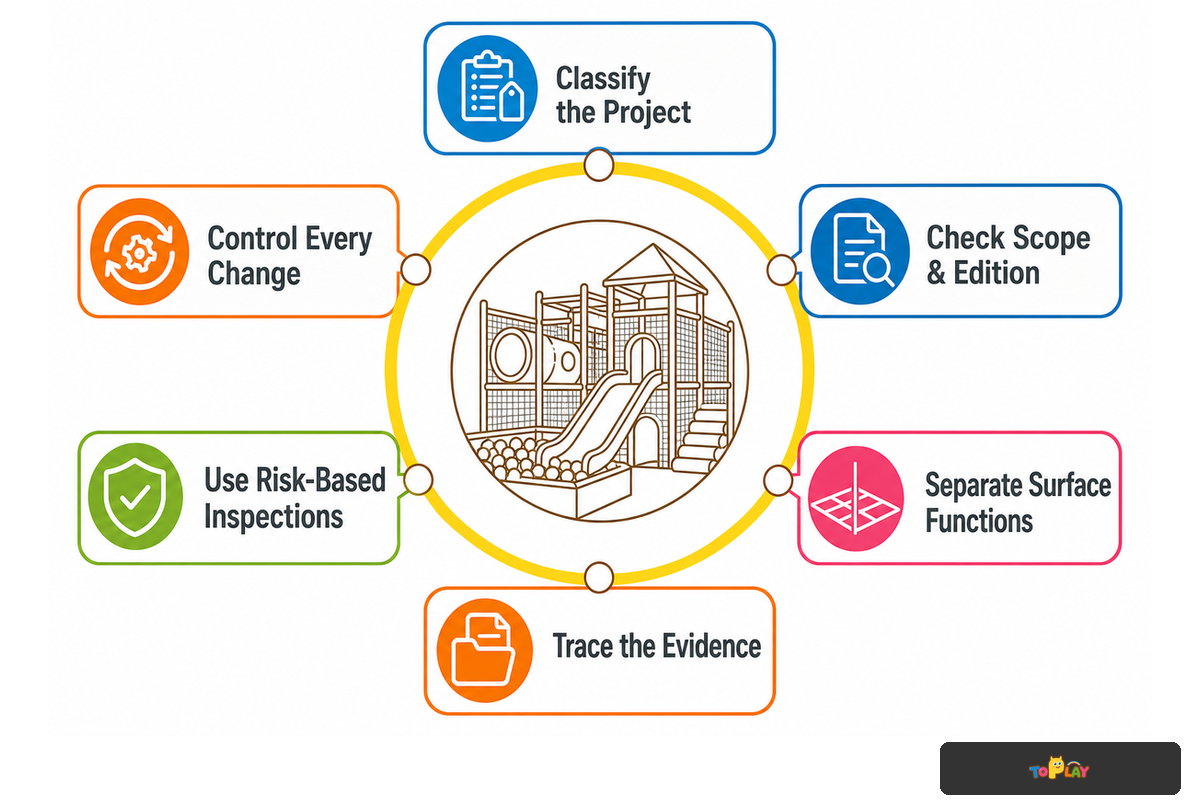
- Classify the facility, users, and equipment before choosing a standard.
- ASTM F1918, F1487, F2373, and F2374 differ in their product scopes and are not interchangeable. The official ASTM F1918-21 listing is one example of why the exact edition and scope must be checked.
- Evidence for surfacing impact attenuation and surface accessibility are distinct.
- When a report is issued, it can only be of use if the edition, scope, sample, supplied item, and the installed condition can be known.
- Inspection frequency should be driven by risk, use, and local considerations and their findings, and not imaginary intervals.
- Assumptions made for repairs, substitutions, relocations, and changes to the age zone should prompt a review. A missing change record creates a project risk, so the facility operator and qualified inspector should document the affected equipment and acceptance decision.
What Indoor Playground Safety Standards Apply?
No safety standard applies to all indoor playgrounds; the governing framework depends on jurisdiction, facility and project history, intended ages, equipment class, surfacing, accessibility, building interfaces, installation, operations, and the authority that will accept each decision for the defined site and use.
Working rule: When classification, evidence, or approval ownership is unclear, treat the gap as a project risk and stop the affected decision until a qualified reviewer or the AHJ confirms the basis.
That pediatric soft-contained structure may share a building with a public-use play unit, toddler product, inflatable attraction, or a small toy. Their classification may differ and so may the implications. The local law, permits, contracts, and insurance may dictate the voluntary standard for a particular project.
The first mistake is to consider indoor playground as a complete product classification. Analyze two questions in parallel: where and under whose authority will the facility function, and what will be supplied and used? Note if the work is new construction, an alteration, or a phased modification as project history can be important in the approvals process.
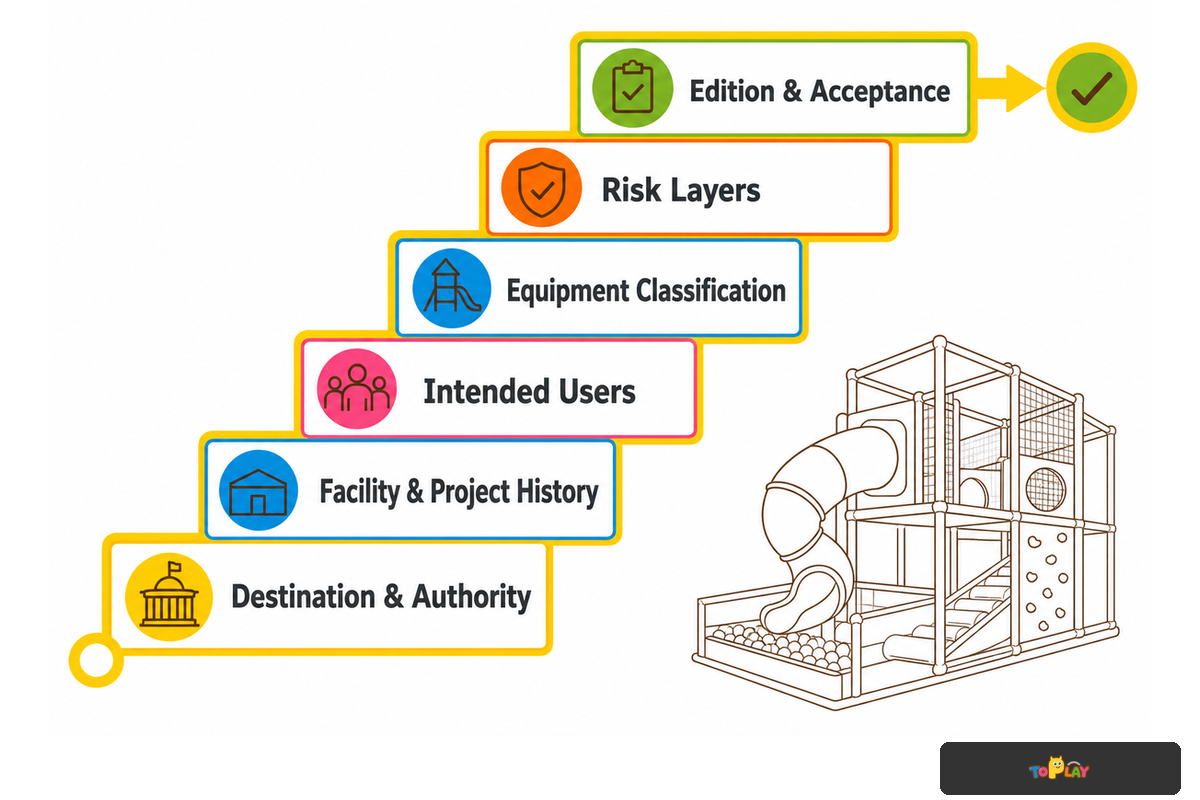
The Standards Applicability Ladder
| Level | Question to resolve | Evidence to collect | Decision owner |
|---|---|---|---|
| 1. Destination and authority | Country, state or province, municipality, permit path, insurer, and contract requirements | Written code basis, AHJ comments, insurer conditions, and contract specification | Owner with local qualified reviewer |
| 2. Facility and project history | Public or private use, building type, new work or alteration, project phasing, and prior modifications | Facility brief, existing approvals, alteration record, and project scope | Owner, architect, and AHJ |
| 3. Users | Intended ages, abilities, capacity, supervision model, and any separated zones | User-age statement, operating policy, plans, signage schedule, and accessibility review | Owner and designer |
| 4. Equipment classification | Soft contained, public-use fixed equipment, under-two equipment, inflatable, ride, trampoline, water feature, home-use product, or hybrid | Equipment inventory, drawings, intended-use statement, and manufacturer classification | Designer and supplier, confirmed by qualified review |
| 5. Risk layers | Equipment, surfacing, accessibility, building interfaces, fire and evacuation, installation, operations, and maintenance | Standards matrix, test plan, code review, installation plan, and operating controls | Named competent party for each layer |
| 6. Edition and acceptance | Which dated edition, part, method, or local adoption applies—and who will accept it? | Current official source, report scope, approval record, and closeout index | AHJ, contract administrator, insurer, or other named approver |
A quick classification screen can prevent expensive misrouting. For a commercial soft-contained system intended for children ages 2–12 years, investigate ASTM F1918 and destination rules. For non-soft-contained public-use playground equipment in that 2–12 years range, investigate ASTM F1487. For certain public-use equipment intended for children 6–23 months, investigate ASTM F2373. Route commercial inflatable amusement devices to ASTM F2374 and any applicable amusement-device rules. The CPSC business guidance for playground equipment also shows why intended home or public use changes the federal product-requirement inquiry.
Stop examination when a project uses a trampoline, mechanical ride, water attraction, fitness apparatus, or a combination of amusements for which the best way to characterize the amusement still hasn’t been defined. Don’t attempt to force an analogous type of product into the playground standard merely because they occupy the same location.
One characteristic of an amusement isn’t sufficient to classify it. For example, the inclusion of a slide in a unit is irrelevant concerning the framework of the overall system. Ensure the equipment inventory describes the entire product and the intended use. Safety rules and accident-response procedures belong in the operating layer, and can’t correct a classification error.
Why a Standards Logo Is Not a Compliance Decision
Standards logos, laboratory names, or certificates can be useful, but none solely describes the complete system that was installed. Reports typically include a defined sample, configuration, method, date, and a defined scope. The constructed system may vary in several ways pertaining to dimensions, materials, anchorage, surfacing, substitutions, or site interfaces. The CPSC playground-equipment business guidance likewise starts with intended-use classification, which is separate from facility acceptance.
Permission to open may also be affected by building, fire, accessibility, licensing, or local inspection requirements beyond a product report; during procurement, the buyer should treat a missing acceptance record as a risk and ask the supplier or qualified inspector to document the gap.
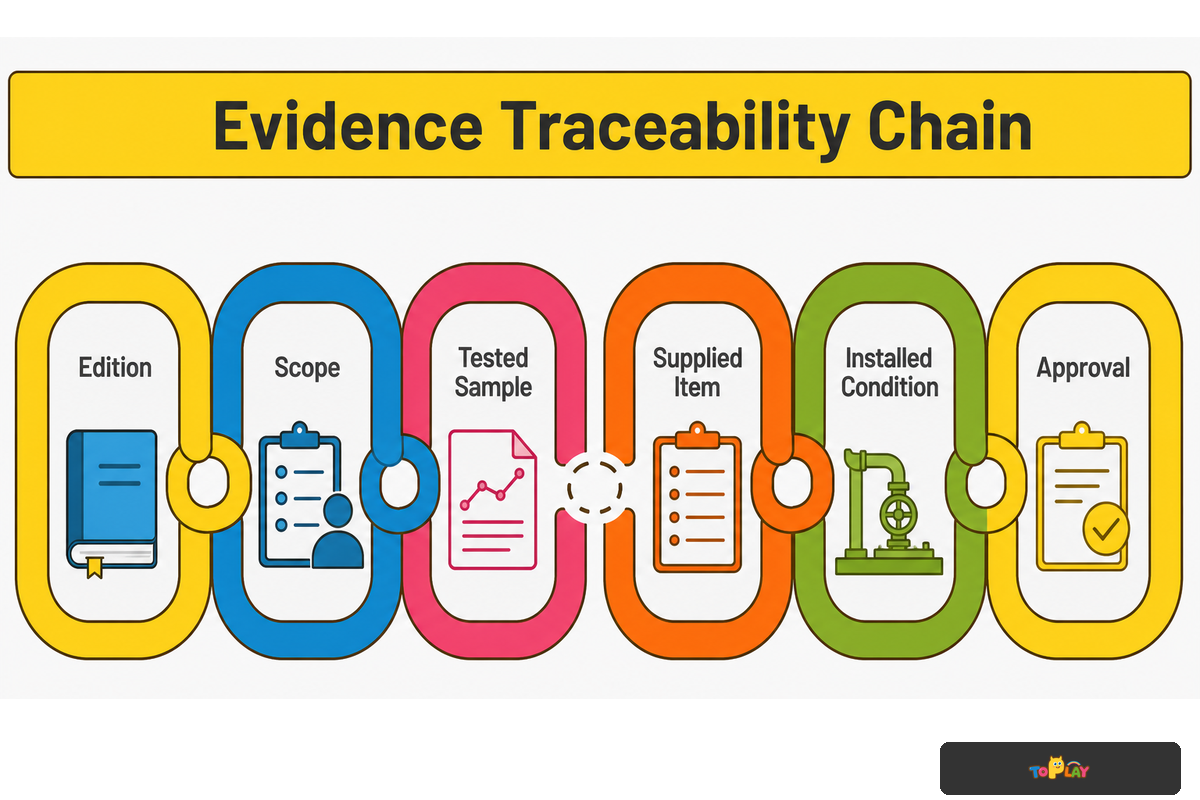
Use a six-link traceability test:
- Edition: Has the correct dated edition and relevant part been identified in the report?
- Scope: Does the scope of the standard address the equipment class and intended users?
- Tested sample: Can the reporting sample be related to a drawing, material, component, model, or specimen?
- Supplied item: Do the model, bill of materials, batch, and approved substitutions support the evidence?
- Installed condition: Are layout, anchorage, use zones, fall heights, surfacing, and site interfaces consistent?
- Approval: Has that responsible unit of the decision accepted it, with unresolved deviations reported closed?
If one link in an argument is missing, record the gap rather than rename the evidence. Thick document folders without any project-specific traceability are weaker than a smaller, indexed file which states what each item contains and what it doesn’t contain.
U.S. Standards Map: Different Standards Do Different Jobs
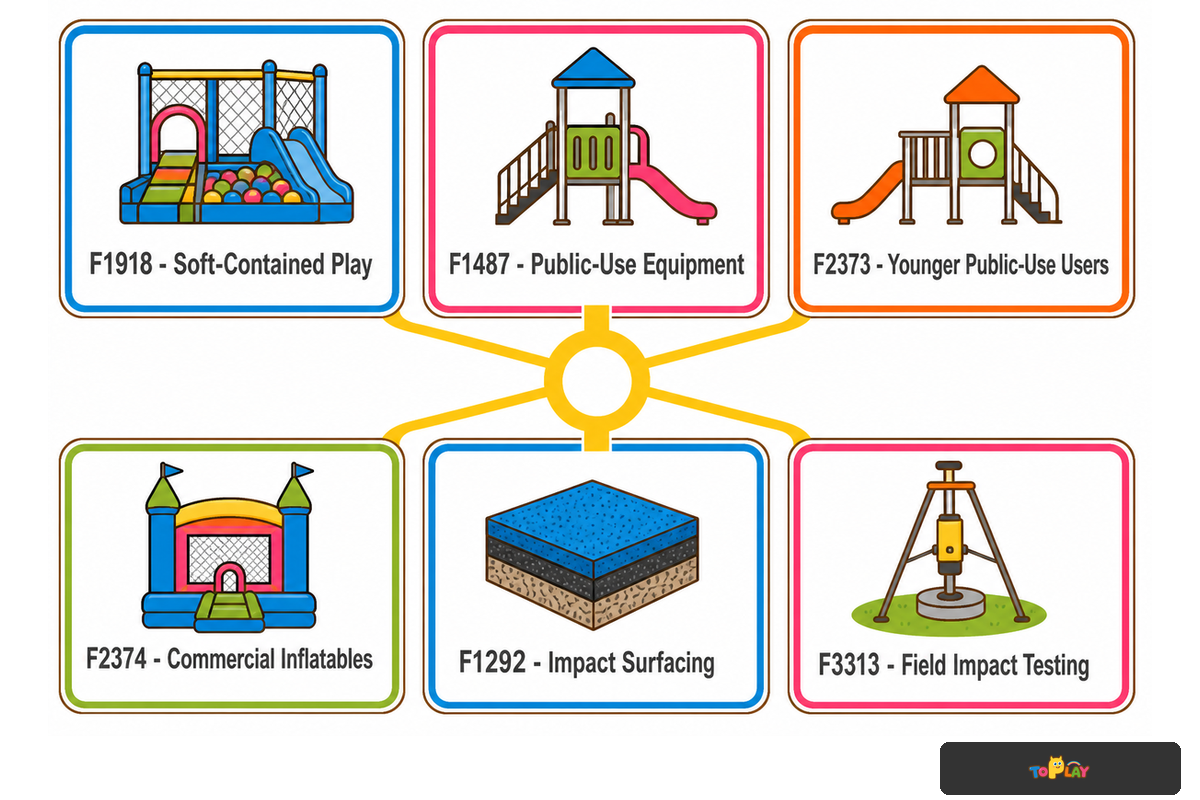
The official ASTM pages reviewed herein show several active standards with purposefully dissimilar scopes. Please confirm their status at the time of procurement, testing, approval, and amendment.
- Soft-contained play: ASTM F1918-21 caters to users intended for ages 2–12 years. The public scope information indicates that equipment can be needed for fire safety and evacuation. This is not a generic label that can be placed on all equipment that is placed indoors.
- Public-use equipment: ASTM F1487-25 addresses children ages 2–12 years and excludes soft contained play equipment. That exclusion is why F1487 and F1918 should not be treated as synonyms.
- Younger public-use users: ASTM F2373-24 addresses certain equipment for children 6–23 months old and excludes the soft contained play area. Therefore, the soft play for children under 2 years deserves a different project-specific review, as opposed to being addressed by a simple cite to F2373.
- Commercial inflatables: ASTM F2374-24 pertains to commercial inflatable amusement devices. An inflatable located at a family entertainment center should not necessarily adopt the fixed soft-play standards.
- Impact-attenuating surfacing: ASTM F1292-22 addresses materials within the playground equipment use zones.
- For field impact testing: ASTM F3313-20 describes the impact attenuation method of surface. The public scope of the method indicates that use of this method does not certify a surface product to F1292 or address all of the fall-related problems.
The CPSC Public Playground Safety Handbook, Publication 325, July 2025, is considered federal guidance; it isn’t a nationwide general permit. The handbook states that its recommendations are voluntary on a federal basis, and some state or local jurisdictions may require compliance. The Federal Register notice indicates that the 2025 publication is available. Consider this handbook to be an important government reference, then find out the path of approval for the location of the project.
EN 1176 Is a Series, Not an Interchangeable ASTM Label
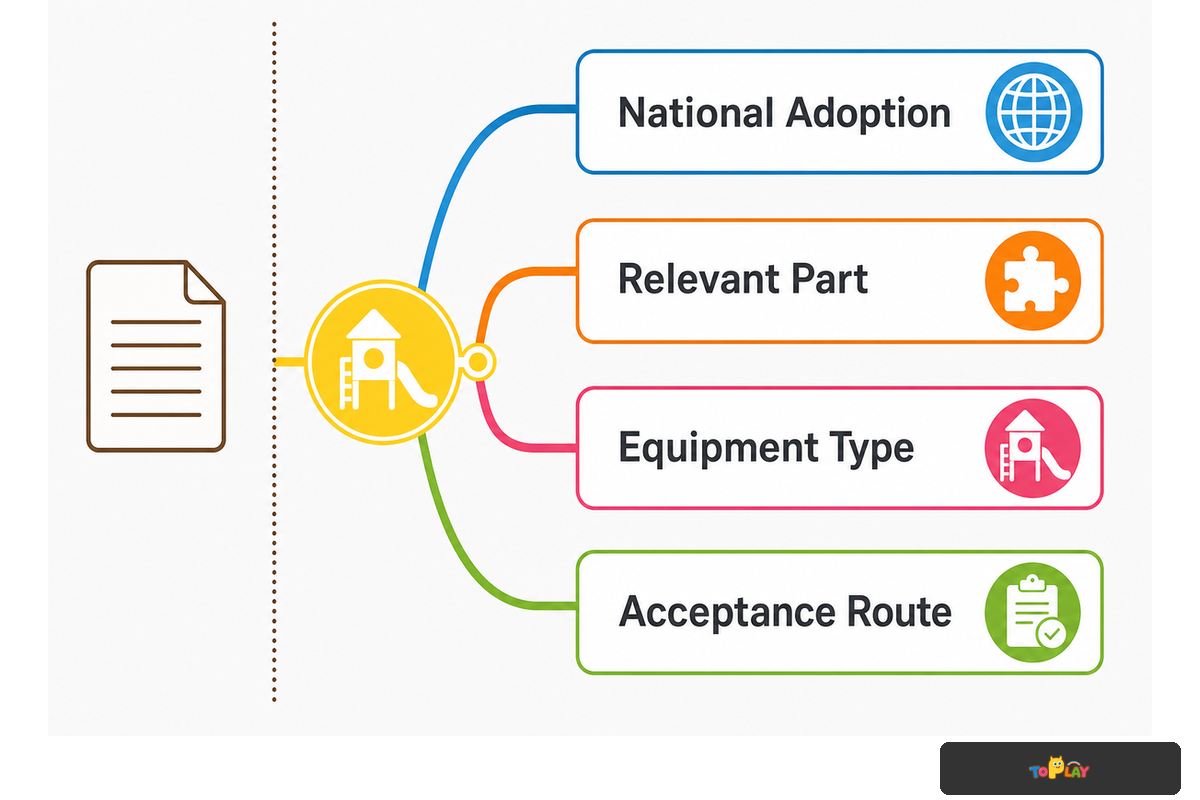
For projects using European or destination-specific requirements, identify the exact national adoption and relevant parts of the EN 1176 series. BSI lists BS EN 1176-1:2017+A1:2023 as current general safety requirements and test methods. It also lists BS EN 1176-10:2023 as current additional requirements for fully enclosed play equipment installed inside or outside buildings.
| Framework | First scope question | Evidence to request | Who confirms applicability? |
|---|---|---|---|
| ASTM F1918 | Is this soft contained play within the stated user scope? | Exact edition, equipment identification, report scope, exclusions, and project traceability | Project team with local qualified reviewer and AHJ |
| ASTM F1487 or F2373 | Is this non-soft-contained public-use equipment, and for which age range? | Age designation, equipment classification, edition, and installation evidence | Project team with local qualified reviewer and AHJ |
| EN 1176 national adoption | Which country’s adoption and which equipment-specific parts apply? | National designation, dated parts, test or inspection scope, and destination approvals | Destination-market specialist and relevant authority |
A specification that says only “EN 1176 compliant” or “ASTM certified” is incomplete. The specification should include the document name, part number, date, equipment scope, test or inspection scope, exclusions, and identification of the acceptance party. For projects involving destinations that include Canada and are within separate national frameworks, verify the current official publication and local application before naming an edition in the project matrix.
Accessibility Is a Separate, Coordinated Verification Layer
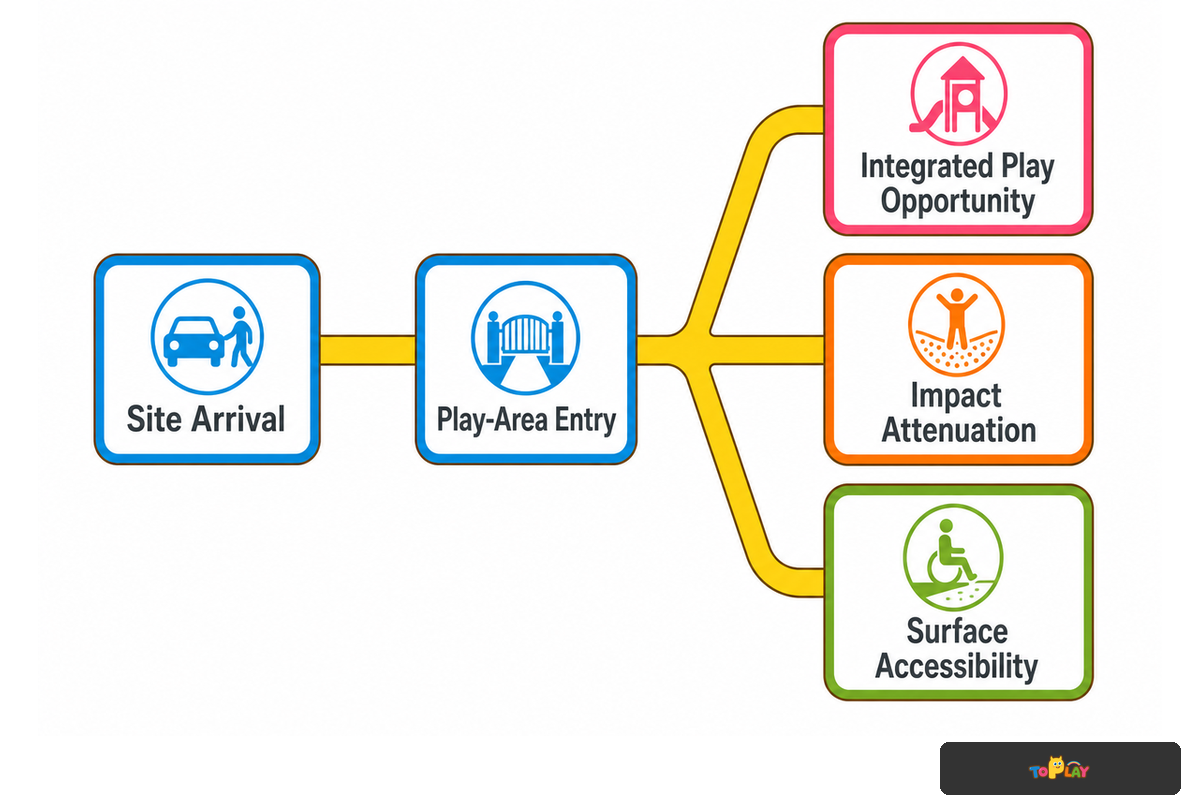
Accessibility should be incorporated into the design of the equipment and the facility rather than evaluated as a last-minute addition. The U.S. Access Board guide to play areas explains ADA provisions for play areas, including play areas within buildings and provisions scoped to soft contained play structures for children ages two and older. The applicability of the requirements may depend on the facility, the project, new work versus alteration, the exceptions and limitations of the law, phasing, etc.
Assess the integrated journey from arrival to play area entry where the required play components and rest area are located, considering clear spaces, surfaces, and restroom egress. Because a hidden gap among these elements can create a project risk, a qualified inspector and the facility operator should document the route review and acceptance decision. An accessible entrance to an integrated play opportunity that’s inclusive of all users is a different experience from providing an accessible, inclusive entrance to no integrated play opportunity.
Surface evidence has two main functions. The active ASTM F1951-21 page addresses accessibility of surface systems under and around playground equipment. Impact attenuation is addressed by F1292. The Access Board guide to play surfaces covers these as two different performance concerns. Passing an impact test does not grant accessibility, and accessibility evidence does not grant impact attenuation. Combine the two with installed thickness, substrate, maintenance, route, and project-specific conditions.
Build an Evidence Pack That Can Be Audited
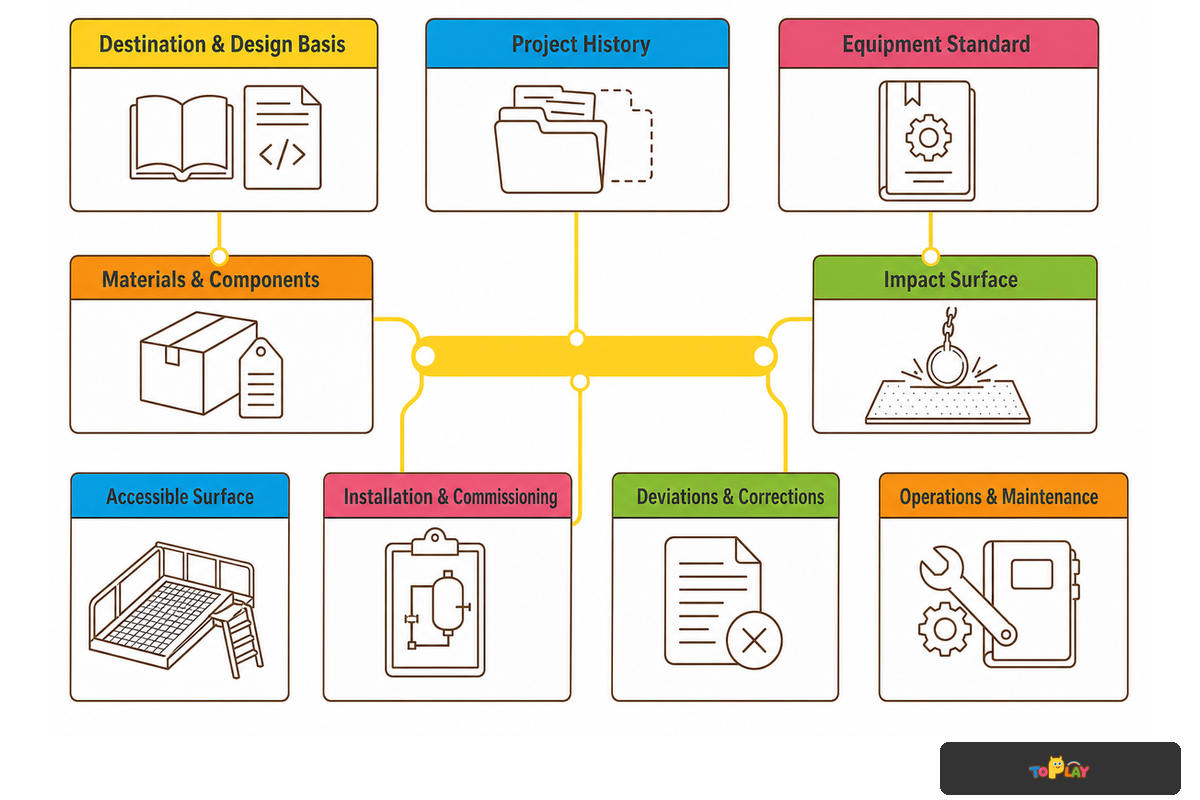
The evidence pack should function more like a decision index and less like an arbitrary upload folder. The CPSC Public Playground Safety Handbook also connects inspections, maintenance, repairs, instructions, and incident records in an operating record trail. Every item should have a purpose and defining attributes, ID, a responsible person, and an acceptance criterion. The following matrix is designed to be flexible through the entire design and procurement process.
Evidence Pack Matrix
| Decision category | Evidence | What must match? | Owner | Acceptance point |
|---|---|---|---|---|
| Destination and design basis | Code and standards matrix, AHJ comments, insurer and contract requirements | Site, facility, use, jurisdiction, and dated requirements | Owner and local design team | Before design freeze |
| Facility and project-history scope | New-work or alteration brief, earlier approvals, phasing record | Actual construction scope and existing conditions | Architect or responsible professional | Before accessibility and permit decisions |
| Equipment standard | Official scope, dated edition, test or inspection report | Equipment class, users, model, configuration, and exclusions | Supplier and qualified reviewer | Before purchase and again before acceptance |
| Materials and components | Approved submittals, specifications, bill of materials, sample or batch identification | Report specimen to supplied item | Supplier and quality lead | Before shipment |
| Impact-attenuating surface | F1292-related product evidence and field evidence where required | Fall height, use zone, system, thickness, substrate, and installed condition | Surface supplier, installer, and tester | Before opening and after relevant changes |
| Accessible surface | F1951-related evidence where applicable and route review | Installed surface system, transitions, route, and maintenance condition | Accessibility reviewer and owner | Design review and final inspection |
| Installation and commissioning | Approved drawings, installation records, anchorage checks, punch list, photographs | Approved configuration to as-built condition | Installer and project manager | Before handover |
| Deviations and corrections | Nonconformance, technical review, corrective action, retest or reinspection | Affected assumption and final accepted condition | Named deviation owner | Before reopening or handover |
| Operations and maintenance | Instructions, inspection logs, repair records, incident records, staff responsibilities | Installed equipment, current condition, and operating policy | Facility operator | At handover and throughout service life |
Evidence red flags
- The report cites an earlier edition with no stated project justification.
- The sample, model, material, batch, or drawing can’t be associated with the item provided.
- A generic certificate is provided with no scope, exclusions, or details of the issuing authority.
- An approved component or configuration was substituted without review.
- Field changes impact fall height, use zones, anchorage, barriers, surfacing, and accessible routes.
- A deviation is noted, but there’s no record of CAV or acceptance.
How Often Should an Indoor Playground Be Inspected?
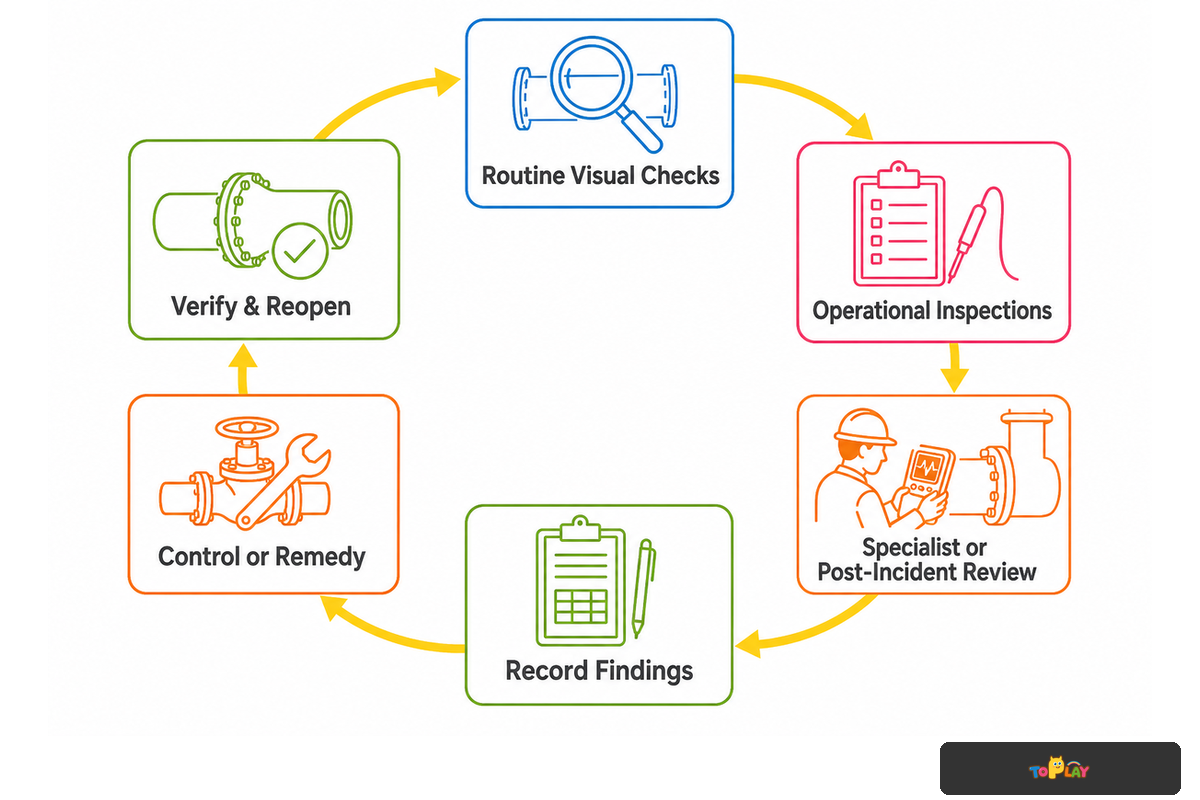
There’s no universal answer such as “every playground must receive the same daily, monthly, and annual inspection.” The 2025 CPSC handbook advises on a case-by-case basis based on the use and local situation, and recommendations by the equipment manufacturer, should also be considered. Project specific equipment, environment, incidents and findings should also influence the program. Consult the July 2025 handbook for that federal guidance, then verify local and manufacturer requirements for the actual facility.
List at least three separate operating needs: routine visual checks for obvious issues, detailed operational inspections, and specialist assessments or post-incident reviews for the assessment of competency and verification of testing. The names and intervals should come from the manufacturer’s guidance in combination with best practice and assessment of risk on site. They shouldn’t be taken from templates without context.
The quality of records justifies the schedule. Include the date, signatory, area inspected, observation, control measure or remedy, verification, and the reopening signator. Record relevant inspection instructions, inspections, and repairs along with incident and injury records. If the same problem continues to occur, focus on the cause rather than repeating the same remedy.
Use Change Control After Handover
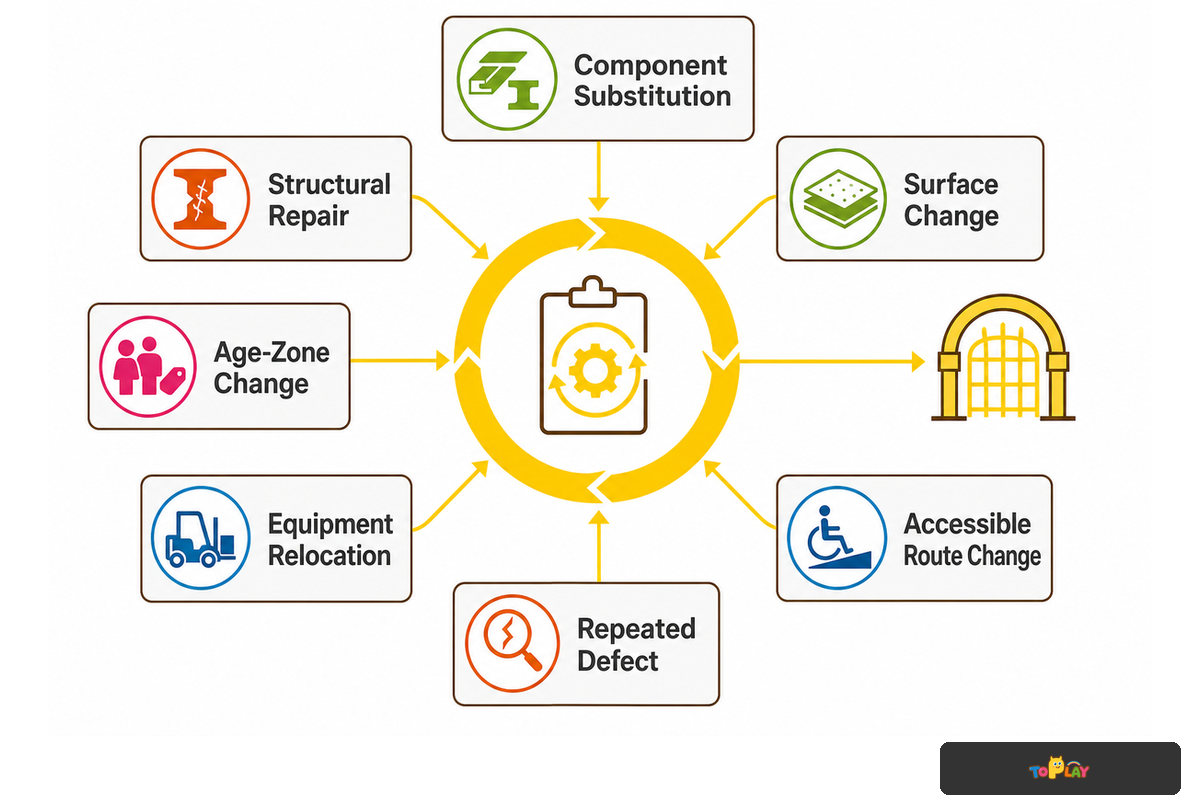
Safety evidence captures existing state conditions. The CPSC handbook treats maintenance, inspection, repairs, and records as connected activities; a change record keeps that connection visible. Changes including repairs, replacements, new play events, and changes in layout break the connection between the evidence and the live facility. The trigger map is intended to help staff recognize when routine maintenance crosses the line into a substantial design change.
Change-Control Trigger Map
| Trigger | Assumption that may change | Minimum response |
|---|---|---|
| Substituted material or component | Tested sample, material properties, dimensions, or supplier traceability | Hold acceptance; compare specification and evidence; obtain technical approval |
| Barrier, geometry, anchorage, or structural repair | As-tested or approved configuration and load path | Control access; document repair; inspect or test as directed by a qualified party |
| Surface replacement or thickness change | Impact attenuation, accessibility, transitions, drainage, and fall-height relationship | Review F1292 and F1951 evidence as applicable; verify installed condition |
| New play event or changed age zone | Product classification, intended users, capacity, rules, and supervision | Repeat classification and operating review; update signs and records |
| Equipment relocation or use-zone change | Clearances, circulation, fall zones, visibility, accessibility, and egress interfaces | Review layout and approvals before reopening |
| Altered accessible route | Connected route, slope, width, transition, entry, and integrated experience | Restore access or obtain qualified accessibility review |
| Incident trend or repeated defect | Risk assessment, inspection cadence, operating rule, or component suitability | Escalate root-cause review; implement and verify corrective action |
A 12-Question Buyer Verification Checklist
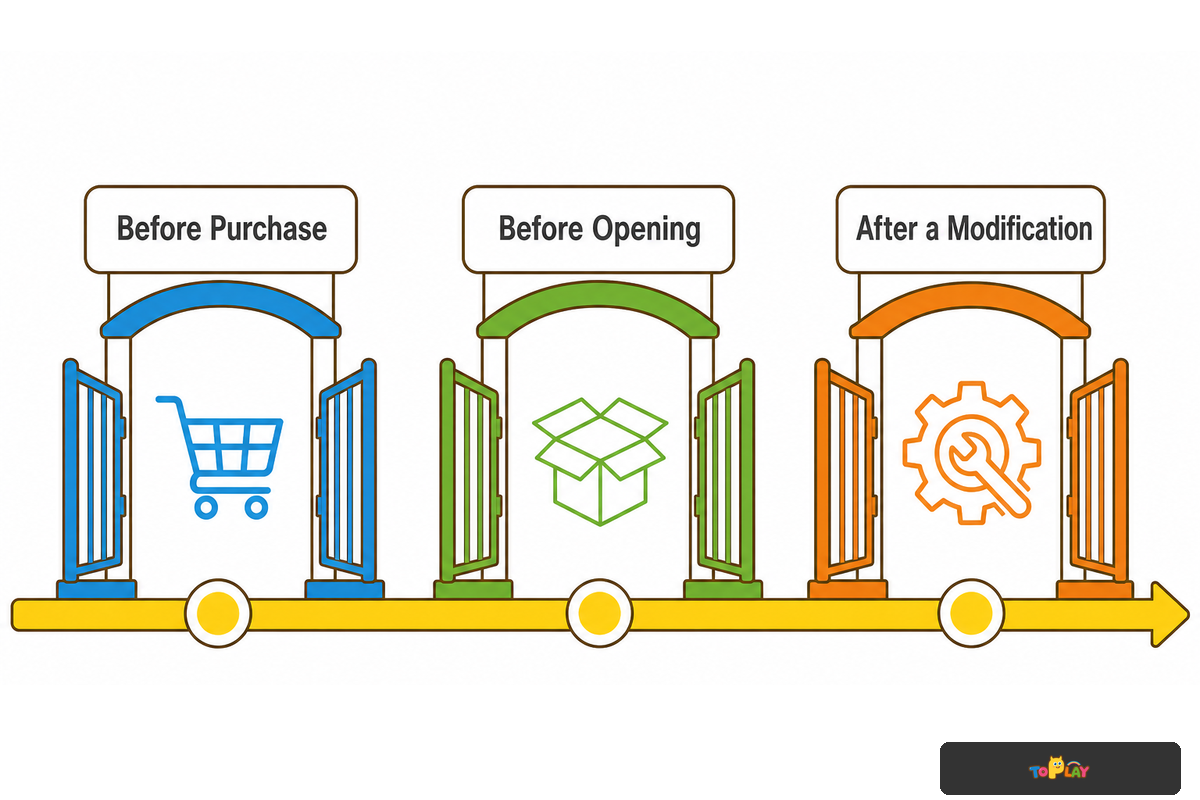
At three decision points, answer the following questions. Answers should refer to evidence not simply a sales argument. Use the official CPSC classification guidance when the public-use versus home-use branch is not yet settled.
Before purchase
- Have we documented the destination, AHJ, permit path, insurer requirements, and contract standards?
- Have we classified every play element compared to applying one standard to the entire facility?
- Are the intended users, age zones, capacity assumptions, and supervision model documented?
- Does the document index name the current versions, relevant portions, exclusions, and acceptance owners?
Before shipment and opening
- Is each test or inspection report traceable to the model, drawing, material, sample, or batch?
- Are approved substitutions and deviations visible, technically reviewed, and closed?
- Do installation, anchorage, as-built, and commissioning records agree with the approved layout?
- Is surfacing evidence tied to actual fall heights, use zones, thickness, substrate, transitions, and field conditions?
- Has accessibility been reviewed as its own coordinated layer, including routes, entries, associated equipment, transfers and surfaces?
- Are all local, insurer, contract, and responsible-professional approvals recorded prior to opening?
After a modification
- Does the change record document every design, test, accessibility, installation, and operational assumptions?
- Does the reopening record document the required inspection, retest, and named approval?
Who Should Verify What?
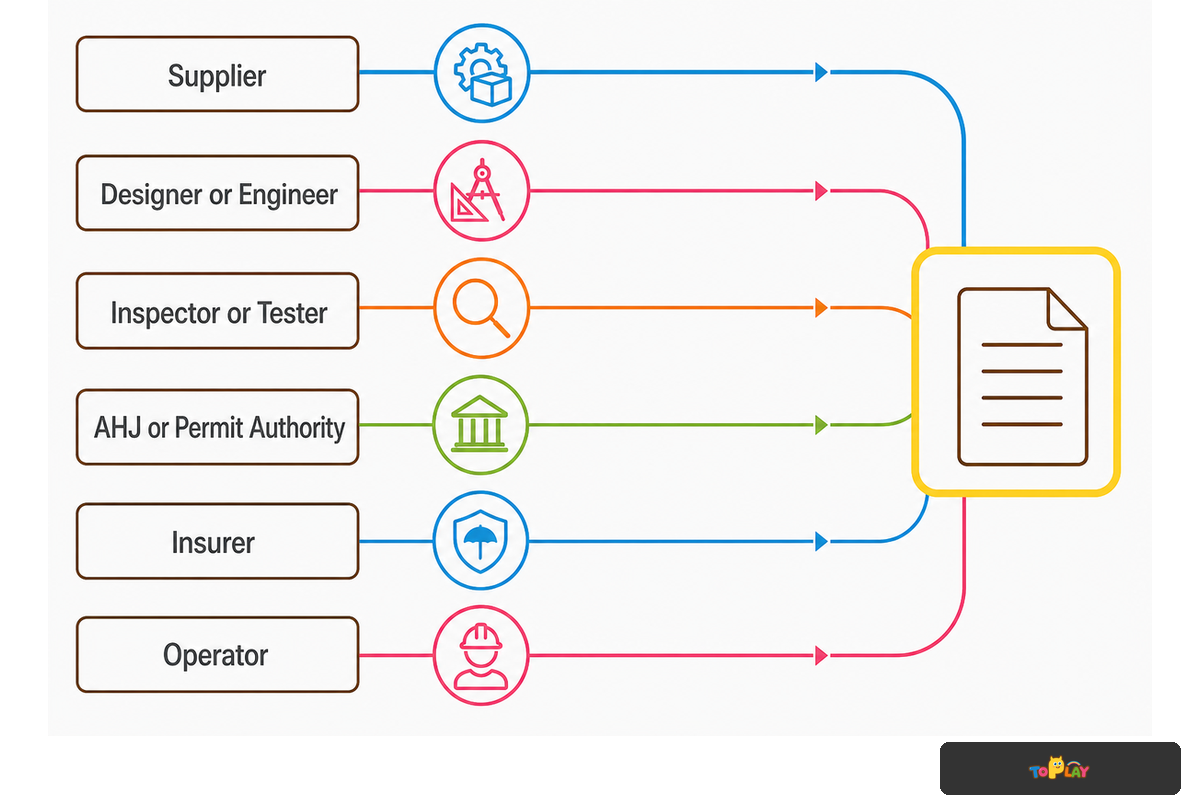
Responsibility should follow competence and authority. For the materials supplied, the supplier should be able to identify the supplied equipment and provide scope documentation and instructions. For the design and interfaces, the designer or engineer can take that responsibility within their scope of practice. Qualified inspectors or testers can report findings within the stated scope of the inspection or the test. The Access Board play-area guide helps define accessibility questions, while project authority and acceptance remain location-specific.
The AHJ or permit authority can answer local adoption and approval questions. The insurer can set the policy-related conditions. The operator can take responsibility for continuing access control, records, and response procedures and maintenance.
None of the participating stakeholders should be absorbing the responsibilities of others. Laboratory reports shouldn’t be used to obtain building permits. Supplier comments shouldn’t replace local opinion on accessibility. AHJ approval doesn’t mean the equipment is maintained after opening. Name the owner and acceptance evidence for every row in the project matrix.
For implementation support, Toplay provides the details on its commercial project controls, document handover, and after-sales processes on its safety, quality, and after-sales framework. This guide stops at the educational verification method; the process described in the linked page is the next stage for commercial evaluation of a specific project. According to Toplay’s company profile, the company was founded in 2014 and combines design, fabrication, upholstery, assembly, and pre-shipment testing in Guangzhou. Consider the information concerning the company as first-party information and verify the project-related capabilities during the procurement process.
Turn the Guide Into a Project Evidence Plan
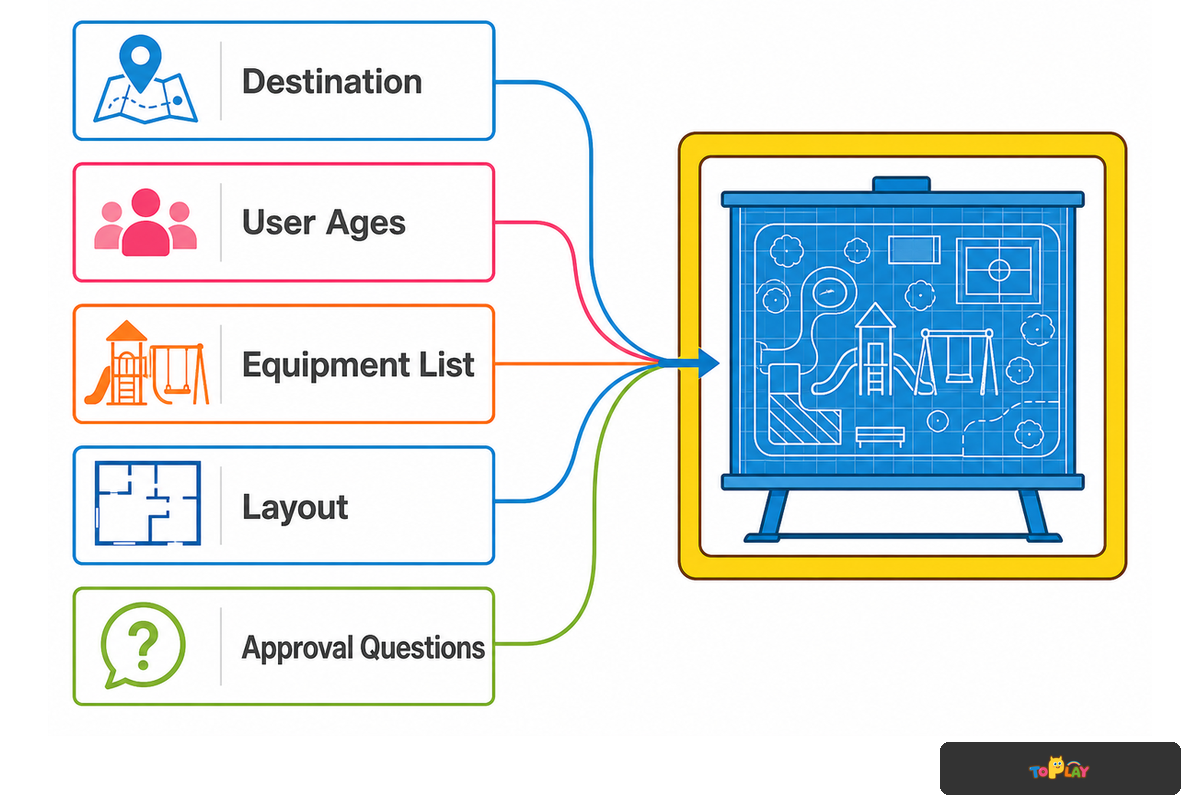
Bring your intended destination, the anticipated ages of the users, a list of equipment, the layout, and questions related to approvals. Toplay can help support the project discussion related to the documentation, scopes, installations, and handover. That supplier discussion should expose evidence gaps, identify the qualified reviewer or inspector, and keep unresolved approval risk visible before an RFQ becomes an order. Before the discussion, check an official standards listing for the current edition and scope relevant to the classified equipment.
Frequently Asked Questions
What is the main safety standard for an indoor playground in the United States?
There’s no one standard for all indoor playground guidelines; the applicable framework depends on the destination jurisdiction, intended user ages, equipment classification, surfacing, accessibility, installation, operating conditions, and the authority responsible for reviewing each part of the project before opening.
For users between the ages of 2 and 12, F1918-21 addresses soft contained play, and F1487-25 addresses public-use equipment and doesn’t include soft contained play. F2373-24 includes guidelines for certain public-use equipment for the age group 6–23 months but excludes soft contained play. In order to classify equipment and ages, the team must check local adoption, surfacing evidence, permits, contracts, and insurance.
Are ASTM F1918 and EN 1176 the same?
No. They’re separate frameworks developed in different standards systems, with different structures, terminology, scopes, and test provisions. Reports prepared for one shouldn’t be relabeled as evidence for the other. Identify the destination market and national adoption first, then check the exact equipment category, current edition, relevant parts, and evidence requested by the approving authority. For fully enclosed play, EN 1176-10 may sit alongside Part 1, and the national adoption still needs confirmation for the project’s location, approval route, and scope.
How often should indoor playground equipment be inspected?
Use a risk-based evaluation instead of a universal copy. The CPSC handbook points to manufacturer recommendations, equipment use, and local requirements. High-use zones or recurring defects may require more frequent reviews. Record the inspector’s name, date of inspection, findings, action taken, how the finding was confirmed, and who authorized reopening after a safety-related correction.
Does a test certificate prove the entire playground complies?
Not usually. Certificates may cover one of many materials, samples, components, editions, configurations, or test conditions. Evidence must relate to the item provided and its installed condition, and identify the issuing body, scope, date, sample or component, exclusions, and remaining field-verification steps.
Do ADA play-area requirements apply indoors?
The U.S. Access Board’s play-area guidance covers play areas, and addresses soft contained play structures for children ages 2 years and older for which ADA scoping is applicable. Review accessibility separately, including the route from site arrival to the play area, required components, clear spaces, transfer systems, transitions, and the installed surface. New construction, an alteration, phased work, or an earlier modification can change the scoping question.
Impact-attenuation evidence alone doesn’t address accessibility. A qualified project reviewer should connect the ADA text, facility history, equipment plan, and the actual construction scope, before the owner assumes the route is compliant.
Keep the review record with the drawings and equipment schedule. It should state which play components were counted, how the accessible route and transfer points were checked, what surface conditions were observed, and who accepted unresolved deviations before opening or a later alteration.
Official References & Sources
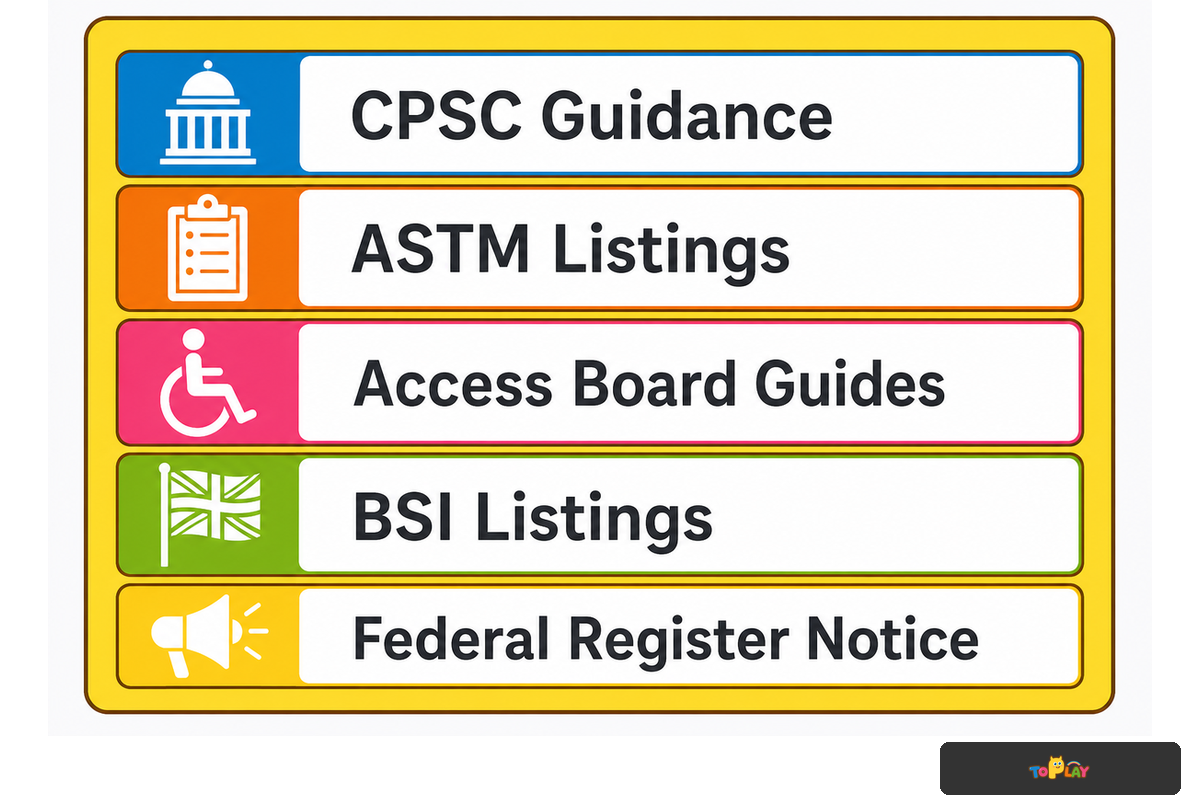
- U.S. Consumer Product Safety Commission: Public Playground Safety Handbook, Publication 325, July 2025
- U.S. Consumer Product Safety Commission: Playground Equipment Business Guidance
- Official ASTM page for F1918-21: Soft Contained Play Equipment
- Official ASTM page for F1487-25: Public-Use Playground Equipment
- Official ASTM page for F2373-24: Public-Use Play Equipment for Children 6 to 23 Months
- Official ASTM page for F2374-24: Commercial Inflatable Amusement Devices
- Official ASTM page for F1292-22: Impact Attenuation of Playground Surfacing
- Official ASTM page for F3313-20: Field Test Method for Playground Surfacing Impact Attenuation
- Official ASTM page for F1951-21: Accessibility of Playground Surface Systems
- U.S. Access Board: Guide to Play Areas
- U.S. Access Board: Guide to Play Surfaces
- BSI: BS EN 1176-1:2017+A1:2023
- BSI: BS EN 1176-10:2023



