Get in touch with Guangzhou Toplay amusement equipment co. Company

Custom commercial indoor play projects
Commercial Soft Play Equipment for Indoor Venues
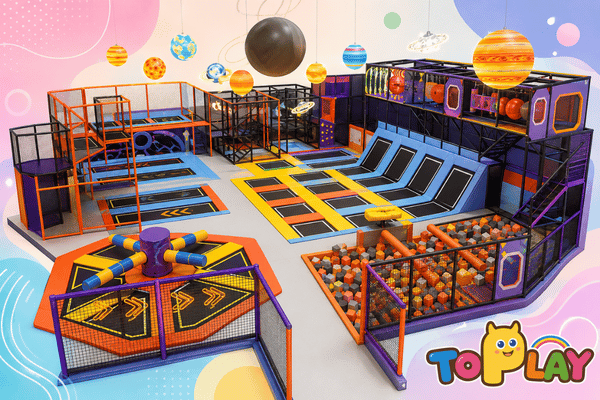
Toplay designs customizable soft play equipment for family entertainment centers, indoor playgrounds, shopping malls, early-learning spaces, hotels, restaurants and community venues. Your floor plan, target age groups and activity plan become a scoped commercial soft play system rather than a loose collection of home-use foam pieces.
- 30 to 60 days after released scope
- One custom project or one set
- International shipping terms available
- 24/7 online support
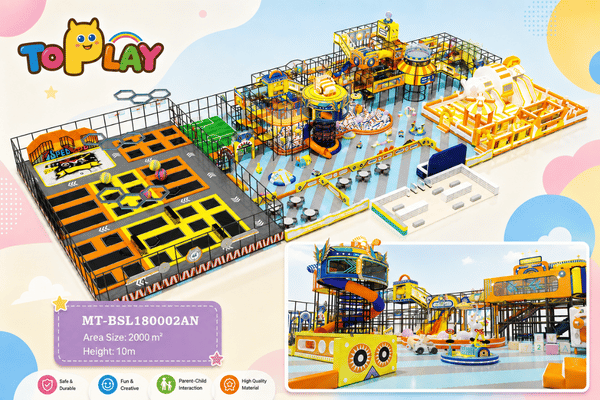
Venue-to-Play-System Fit
A useful soft play equipment shortlist starts with the venue model, not the number of slides in a catalogue. The review covers available space, intended users, supervision pattern, activity intensity and operating priorities before a system class is recommended.
The Venue-to-Play-System Fit Matrix
| Venue | Primary planning goal | System direction | Inputs that change the answer |
|---|---|---|---|
| Family entertainment center | Layer active play with repeat-visit variety | Multi-zone indoor playground with climbers, slides, ball-pit play and optional adjacent attractions | Ceiling, throughput plan, party flow, staffing and maintenance access |
| Shopping mall or mixed-use complex | Fit circulation, dwell time and visible attraction value | Open-view soft play zone or compact contained play system | Lease boundary, entrances, sightlines, fire strategy and neighboring tenants |
| Toddler play center | Separate lower-intensity movement and discovery | Ground-level foam play in a bounded toddler zone, with low slides, soft blocks, a ball pool and sensory activities | Age policy, caregiver access, sanitation routine and collision separation |
| Kindergarten, daycare or early-learning room | Link play behavior with a supervised daily schedule | Modular toddler soft play and motor-skills activity zones | Class size, room transitions, storage, cleaning and local childcare rules |
| Hotel or family restaurant | Add a contained family amenity without disrupting service flow | Compact play area with clear entry, visibility and controlled activity mix | Dining sightlines, noise, access route, opening hours and staff ownership |
| Community activity venue | Serve different programmes in one flexible space | Modular play set or zoned commercial soft play system | Programme calendar, age changes, storage, accessibility and local approvals |
Age zoning belongs in the first brief
Smaller children are at a disadvantage when they mix with larger children in more energetic play, which is why the United States Consumer Product Safety Commission calls for following size recommendations and keeping older children out of toddler sections.[3] The age plan shapes zones and transitions; your operator remains responsible for the rules and supervision used after opening.
Commercial scope versus home-use foam sets
Commercial venue project
Requires a measured layout, component schedule, responsibility split, installation handoff, operating access and destination-market document review.
Home-use soft play set
Usually serves one household in a portable or compact format; product classification and applicable rules can differ from a public or paid venue.
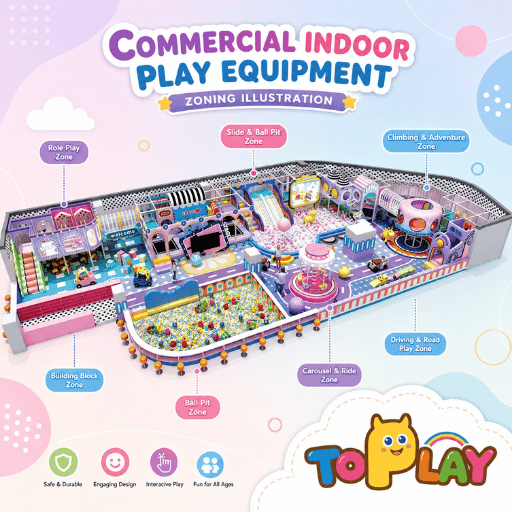
Soft Play Component Families
Toplay configures component families around the play behavior you want to create, the children you plan to serve and the way staff will supervise and clean the play area. The visual label “soft play” does not place every ball pit, foam block, climber, slide or fully enclosed structure under one standard. For an indoor soft play project, each play structure sits within the indoor playground equipment schedule and remains distinct from larger play structures.
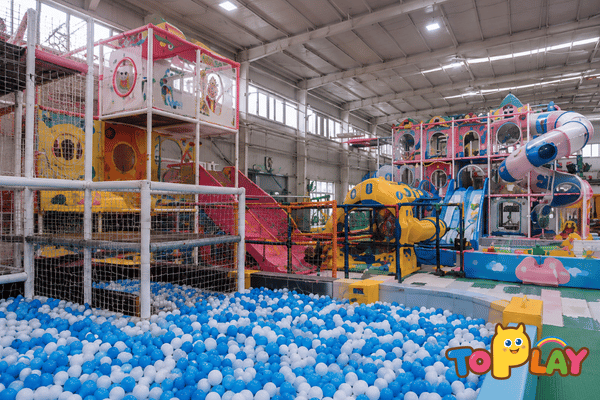
Ball-pit and ball-pool zones
Best used as a deliberately bounded activity area with clear entry, visibility and cleaning access. Slide exits and climbing bases need a layout review because children can linger or hide among the balls.
Climbing and crawling routes
Climbers, crawl tubes, netted passages and climbing structures add movement and progression. Entry, exit, circulation and supervision are mapped before the activity chain is released.
Soft play blocks and foam shapes
Foam blocks support open-ended, imaginative play and motor skills in toddler soft play areas. Their intended use, portability, cover construction and storage plan belong in the component register.
Slides and transitions
Low slides, tube slides and connecting transitions affect circulation rather than acting as decoration. Exit areas must be kept clear in the operating plan.
Balance and movement elements
Stepping, rocking and balance activities create a different play experience from a climbing wall or trampoline park. Those activity goals stay separate so the layout does not force conflicting movement into one zone.
Themed play and interactive elements
Theming can connect the playground to your brand, while interactive elements can change how children move through it. Graphics, physical activity and optional digital features remain separate scope lines.
For theme-led equipment options, explore themed play environments.
Play mats and floor mats
Play mats, soft foam pads and bonded floor sections mark where a toddler zone begins and where an activity area ends. Their coverage, joint detail and cleaning method belong in the same component register as the structures standing on them.
Component classification register
- List every component family and its intended play behavior.
- State whether each product is fixed, anchored, integrated, portable or stored between sessions.
- Identify the intended venue, target age group and destination market for each component.
- Name the manufacturer, importer, facility owner and installer responsibilities that need documents or approval.
- Confirm which items are included in the equipment scope and which sit with the local project team.
Classification comes before the standard
ASTM F1918-21 applies to soft contained play equipment within its stated scope, and excludes public playground equipment, home playground equipment, amusement rides, toys and other adjacent categories. The component and its intended use are therefore reviewed before a destination-market standard is placed in the project document list.
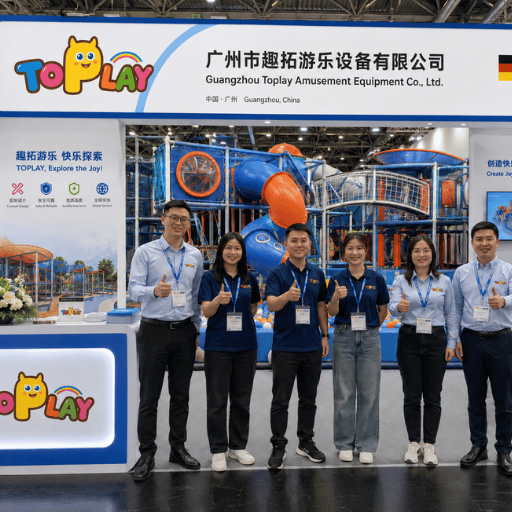
Custom Themes, Colours and Activity Mix
All Toplay products are customizable for the project brief, and the customization is scoped in the same quotation as the equipment. Colour, theme, activity sequence and component mix support the venue concept while the commercial scope stays readable.
Brand and theme direction
Share your logo, colour references, audience and visual story. Those inputs become a coordinated design direction without treating decoration as a substitute for layout or operating fit.
Activity pacing
Choose whether the play space should emphasize toddler discovery, climbing, crawling, balancing, ball play, imaginative play or a mixed route. High-energy and lower-intensity activities are placed deliberately.
Supervision sightlines
Tell us where staff and caregivers will stand, which areas need open views and where entries must be controlled. Those sightlines are reviewed with the equipment layout.
Cleaning and repair access
Cleaning access and supervision sightlines are operating constraints, not cosmetic preferences. The operator brief should show access to tunnels, pads, netted sections, ball-pit areas and replaceable components.
Combine, separate or review
| Planning decision | Combine when | Separate or review when |
|---|---|---|
| Toddler and older-child play | The activity intensity and operating rules remain compatible | Size, speed or rougher play exposes smaller children to collisions |
| Ball pit and slide | The exit is controlled and children cannot linger in the landing path | The slide enters an obscured ball area or a climbing base shares the same space |
| Static and interactive features | The interaction supports the same movement route | Power, maintenance, staffing or reset requirements create a different operating scope |
| Play area and café seating | Caregiver sightlines, sound and circulation work together | Service traffic crosses the child entry or the play zone blocks emergency movement |
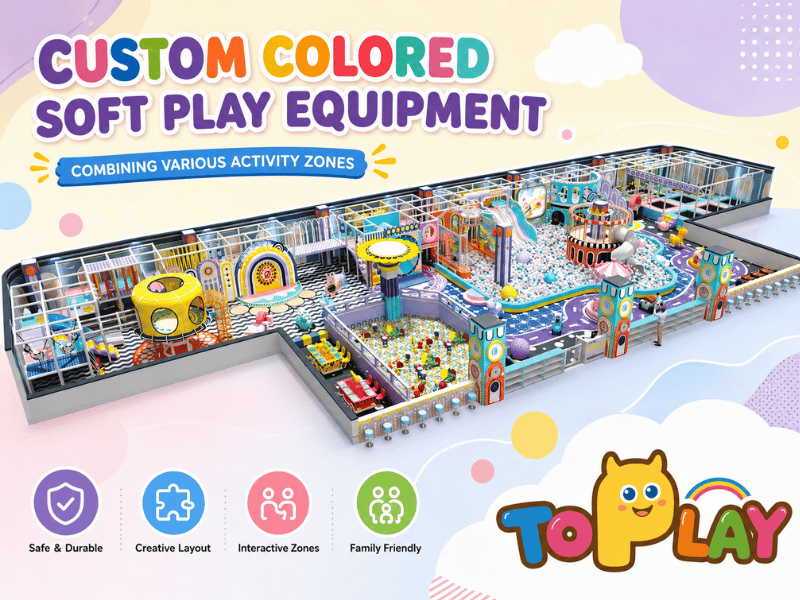
Verified Project and Commercial Parameters
Technical dimensions, capacities, age limits and material specifications are confirmed for the approved configuration rather than copied from another project. The values below are the business facts and quotation-stage terms available for this page.
| Parameter | Published value | Scope |
|---|---|---|
| Production window | 30 to 60 days | Starts after the project scope is released and is confirmed in the quotation. |
| Payment structure | 30% T/T deposit and 70% balance before shipment | Written into the quotation for the order. |
| Online support | 24/7 | Online consultation and after-sales support. |
| Established | 2014 | Guangzhou Toplay Amusement Equipment Co., Ltd. |
| Products sold globally | Over 90% | Company-wide international sales profile. |
| Export reach | More than 40 countries | Includes France, India, Sri Lanka, South Africa, Mexico, Malaysia and Poland. |
| Average annual growth | Over 20% | Company growth statement. |
| Minimum order | One custom project or one set | Project scope and final configuration are quoted together. |
Price, Scope, Lead Time and Shipping
Soft play equipment is priced from the approved project scope, not from one universal price per square metre. A low equipment quote may be incomparable because a scope mismatch creates delay and risk when freight, unloading, installation support or local site work sits outside it. Unlike a headline price, the tradeoff becomes visible when equipment, shipping and local responsibilities occupy separate quote lines.
The Project Scope Boundary Card
Toplay equipment scope
- Approved soft play component schedule
- Agreed colour and theme work
- Production and export packing scope
- Documents and online support named in the quotation
Buyer and local-project scope
- Final site measurements and building information
- Local approvals, fire strategy and accessibility review
- Import, unloading and inland delivery unless quoted
- Site readiness, local labor and operating procedures unless quoted
Cost drivers and buyer controls
| Driver | Why it changes the quote | Buyer control |
|---|---|---|
| Usable footprint and ceiling | They set the buildable envelope and the number of interfaces. | Send measured dimensions and fixed obstructions before concept release. |
| Component and zone count | More activity families add parts, transitions, review work and packing lines. | Prioritize the experiences that matter to the operating model. |
| Theme complexity | Custom graphics and shaped elements add design and production work. | Separate must-have brand features from optional decoration. |
| Freight and delivery basis | Equipment price, export freight, import charges, unloading and inland delivery are different cost lines. | Compare quotations on the same Incoterm and destination boundary. |
| Installation support | Drawings, remote guidance, supervision and local labor are not the same service. | Name the installer and support deliverables in writing. |
| Site works | Floor preparation, power, lighting, fire systems and building alterations sit outside the equipment unless included. | Keep a local contractor scope beside the equipment quotation. |
Total project cost, not a borrowed ROI number
A project estimate should combine equipment, shipping, the import boundary, installation responsibility, site work, staffing and ongoing operating needs. We do not publish a generic payback period, because venue rent, admissions, parties, staffing, food and beverage, traffic and operating hours belong to your business model rather than to the equipment specification.
Quotation-stage terms
- We quote a production window of 30 to 60 days after the project scope is released.
- We accept one custom project or one set as the minimum order.
- Orders use a 30% T/T deposit and 70% balance before shipment.
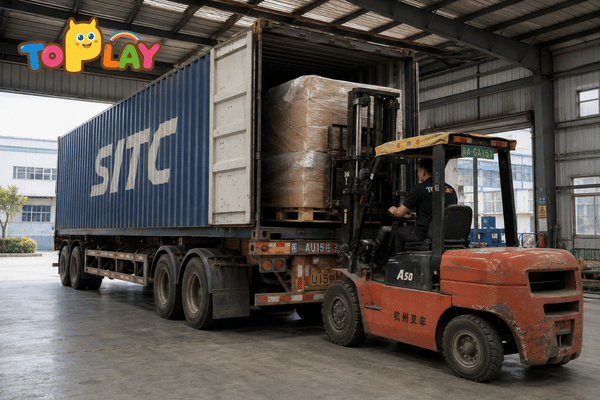
- We quote EXW, FOB or CIF and can quote DAP or DDP on request.
- We consider expedited scheduling only after capacity and project-scope review.
Classification, Safety and Quality-Control Workflow
A standards list is not the same as a compliant project. The review starts with the component register, intended use, user group, destination and responsible parties, then places the required documents and review points into the approved scope.
Destination-market examples
United States soft-contained systems
ASTM F1918-21 is the active soft-contained-play specification within its published scope; it also states that accessibility is outside most of that specification.
United States product responsibility
CPSC guidance says requirements depend on home versus public use and product characteristics. For covered children’s products, the responsible domestic manufacturer or importer must determine applicable testing and certification duties.
United States accessibility
The Access Board connects soft-contained entry points to accessible routes and broader play-area provisions. When three or fewer entry points are provided, at least one must be on an accessible route; four or more require at least two.
United Kingdom and European projects
BSI lists BS EN 1176-10:2023 as the current release for fully enclosed play equipment. The buyer and local project team still need to confirm adopted editions and facility rules.
Project review checkpoints
- Classify the component. Record intended use, venue context, fixed or portable construction and target users.
- Assign document ownership. Name the supplier, importer, buyer, installer and local consultant responsibilities.
- Freeze the drawing and component schedule. Use one approved version to control production and installation discussion.
- Review production against released scope. Keep fabrication, packing and document checkpoints tied to the quoted configuration.
- Handover operating responsibilities. Give the operator the information needed to build inspection, cleaning and repair procedures.
Operator checks remain part of safe use
The CPSC user checklist highlights torn netting, damaged rope or webbing, torn surfacing, cleanliness, clear walkways, age separation and unobstructed slide exits. These are useful handover topics, but the parent-and-child checklist is not a substitute for the operator’s inspection programme or local requirements.
Custom Design from Floor Plan to Production
A late ceiling, column, exit or services discovery can force a layout change after commercial expectations are set. The process therefore moves from a usable project brief to an approved component and responsibility scope before production release. That sequence keeps the floor plan, commercial terms and installation handoff connected.
The Six-Input Floor-Plan Brief
Usable footprint
Send measured length and width, not the gross lease area.
Finished ceiling height
Include beams, ducts, lights and any lower zones.
Fixed constraints
Mark columns, exits, doors, services and no-build areas.
Target age groups
State the operator’s intended age and size policy.
Preferred activity mix
Rank climbing, crawling, slides, ball play, toddler play and themed interaction.
Destination market
Name the country, importing entity and local approval route.
Classification and document addendum
- Component family and intended use for every quoted line.
- Public, commercial, childcare or other venue context.
- Fixed, anchored, integrated, portable or stored construction.
- Requested standard, test report, product identification and handover document.
- Importer, manufacturer, installer, facility and local-consultant ownership.
Project sequence
01
Brief review
We check whether the six inputs and component classification addendum are complete enough to discuss a layout.
02
Concept zoning
We map entries, age zones, activity relationships, circulation and supervision points.
03
Scope confirmation
We separate equipment, theme work, packing, freight, installation support and local site work.
04
Drawing review
You verify the controlling dimensions, fixed constraints and responsibility notes.
05
Production release
We schedule the approved configuration and manufacture the quoted scope.
06
Packing and support handoff
We prepare the agreed shipment basis and continue online after-sales support.
Toplay Manufacturing and International Support
Guangzhou Toplay Amusement Equipment Co., Ltd. has manufactured indoor children’s playground equipment since 2014. Products are customized for the project brief, with international-buyer support from early consultation through after-sales communication.
Global sales profile
Over 90% of our products are sold to global markets.
Export reach
We have exported to more than 40 countries, including France, India, Sri Lanka, South Africa, Mexico, Malaysia and Poland.
Business growth
Our average annual growth rate is over 20%.
International fairs
We actively participate in international fairs and meet overseas project buyers in person.
Custom project work
We customize soft play and indoor playground products around the approved venue brief.
After-sales channel
We provide 24/7 online consultation and after-sales support.
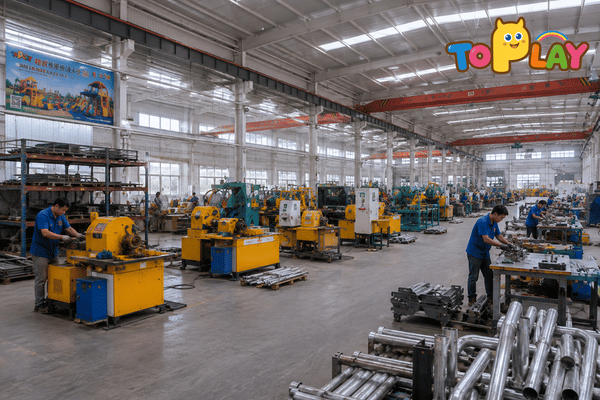
Production processes
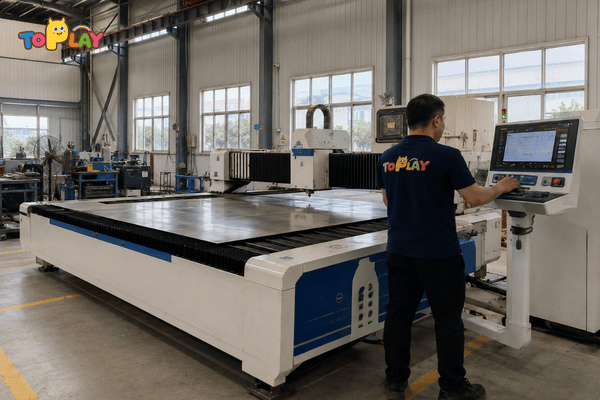
Our production scope includes laser tube cutting, tube sawing, punching, drilling, tube bending, press braking, MIG, TIG and CO2 welding, robotic welding, grinding and polishing. Those processes make the released equipment configuration; the approved project documents remain the basis for acceptance.
- Tube preparation: laser cutting, sawing, punching and drilling.
- Forming: tube bending and press braking.
- Joining: MIG, TIG, CO2 and robotic welding.
- Finishing preparation: grinding and polishing.
“Our partnership is just the beginning; our commitment to after-sales service is endless.”
Where Soft Play Needs a Different Project Decision
Soft play is a strong fit for many indoor venues, but it does not solve every attraction, building or business-model problem. The early brief identifies when the project needs a different product category, a local specialist or a broader venue plan.
| Situation | Why it works against the project | Better next step |
|---|---|---|
| A home-use foam set is planned for a high-traffic commercial venue | Intended use, duty cycle, documentation and operating responsibility do not match. | Start with a commercial project brief and component classification. |
| The attraction plan depends on high-speed rides or trampoline activity | Those product families sit outside the soft-contained-play scope; ASTM F1918-21 excludes amusement rides from its own specification,[1] so different standards and operating requirements apply. | Split the attraction scopes and obtain category-specific design and compliance review. |
| The building route, fire strategy or accessibility plan is unresolved | Equipment layout cannot replace the facility’s local approvals and connected-route design. | Bring the landlord, architect or local consultant into the floor-plan review. |
| The venue model relies only on the equipment to generate profit | Rent, staffing, admissions, parties, food and beverage, marketing and seasonality drive the business result. | Build the operating model separately, then choose the activity mix that supports it. |
| Cleaning, repair and supervision ownership is undefined | Even a well-designed play space needs routine inspection, cleaning and clear operating rules. | Name the operator procedures and handover documents before opening. |
Soft Play Equipment Planning Tools
Venue-to-Play-System Fit Selector
Determine the ideal planning emphasis based on your venue type, age mix, and supervision style.
Launch Tool
Six-Input Floor-Plan Brief Builder
Compile your site dimensions and constraints into a standardized brief ready for commercial layout design.
Launch Tool
Project Scope Boundary Checker
Clarify the split of responsibilities between equipment supply, local site works, and installation.
Launch Tool
Send Your Floor Plan for a Scoped Recommendation
Bring the six project inputs, your component ideas and the destination-market document list. Those inputs support a custom commercial soft play equipment discussion and a scope that can be compared line by line.
Usable footprint and finished ceiling height
Columns, exits, services and no-build areas
Target ages and preferred activity mix
Destination, freight basis and installation responsibility
Soft Play Equipment Procurement FAQs
Send the usable footprint, finished ceiling height, columns and exits, target age groups, preferred activity mix and destination market. Add the venue type, importing entity, requested documents and any freight or installation-support requirements.
Price follows the footprint, component and zone count, theme complexity, design interfaces, destination, freight basis, installation support and local site scope. The figure comes back in a written project quotation rather than a published price that ignores those inputs.
We accept one custom project or one set. The quotation fixes the component schedule, theme work, shipment basis and support scope for that order.
Our production window is 30 to 60 days after the project scope is released. The quotation confirms the schedule for the approved configuration, and expedited scheduling is considered only after capacity and scope review.
We quote EXW, FOB or CIF and can quote DAP or DDP on request. Confirm the destination, unloading, inland-delivery and import responsibility so competing quotes use the same boundary.
Yes. Share your brand references, audience, preferred activity mix and venue concept so we can include the agreed colour and theme work in the project scope.
There is no universal ceiling number for every soft play system. Send the finished height together with beams, ducts, lights, sprinklers and any lower zones, then the layout can be developed within the actual envelope.
Start with the operator’s age and size policy, then separate activities where speed, height or rougher play can put smaller children at a disadvantage. CPSC guidance specifically warns against mixing smaller children with larger children in more energetic play.[3]
The answer depends on each component, its intended use, whether it is fixed or portable, the venue context and the destination market. ASTM F1918-21 and BS EN 1176-10:2023 are examples for particular categories, not blanket certification claims for every item.
We provide 24/7 online consultation and after-sales support. The quotation should state whether installation drawings, remote guidance, supervision, local labor, tools, unloading and site work are included or assigned to the local team.
Build a routine around netting, rope and webbing, padded surfaces, cleanliness, walkways, age-zone control and slide exits, then add the manufacturer instructions and local inspection requirements for the installed system. The CPSC checklist is a useful user-safety reference, while the operator still needs a site-specific programme.



