
Get in touch with Guangzhou Toplay amusement equipment co. Company

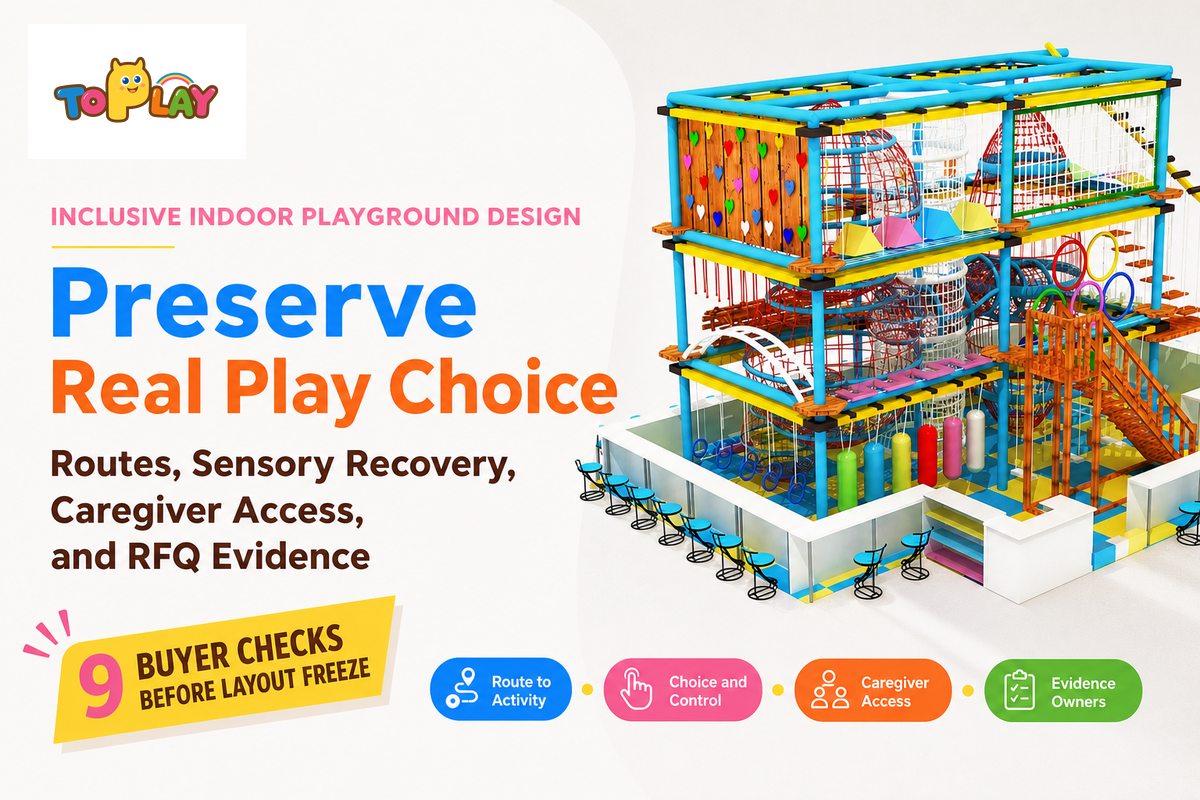
Inclusive indoor playground design is the planning of multiple routes and meaningful play choices so children and caregivers with different access, sensory, and support needs can participate in the same indoor room. A proper design considers multiple pathways and access points to different play elements throughout the indoor play space, not just the point of play space entry. Buyers should test nine things: participation, routes, sensory control, distributed choice, play value, interfaces, caregiver access, operations, and evidence.
The nine buyer checks
- Trace the participation journey.
- Connect routes to real activities.
- Budget sensory load and recovery.
- Distribute choices without segregation.
- Compare equivalent play value.
- Inspect surfaces and transfers.
- Include disabled caregivers.
- Assign staff and operating duties.
- Bind promises to evidence.
Important boundary: The four planning tools described in this document are synthesized from published concerns. They are planning aids, not validated regulatory or effectiveness-assessment instruments. Most empirical playground research reviewed here concerns outdoor settings rather than enclosed commercial rooms.
Inclusive Playground Design Is More Than Accessibility
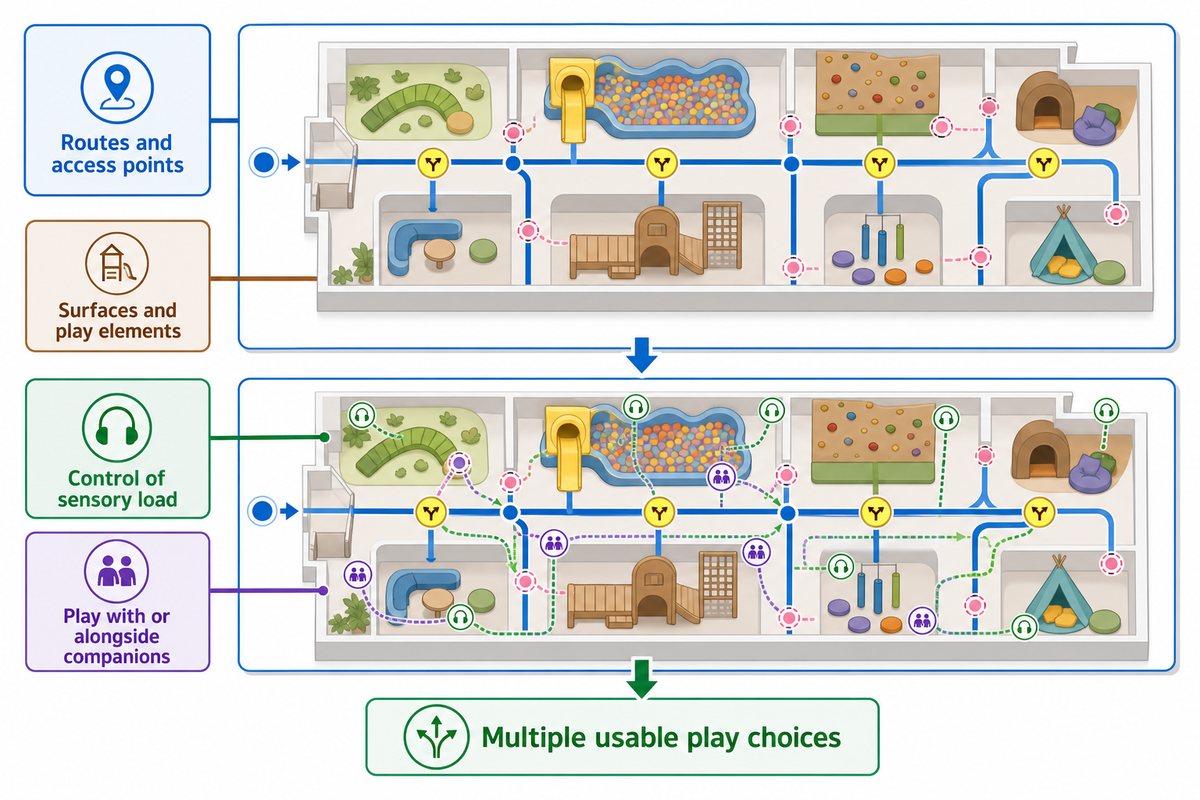
Incorporating universal design checks whether specified routes, access points, surfaces, and play elements are usable by visitors. Inclusive design goes a step further and addresses control of sensory load, the ability to play with or alongside companions, and the ability to leave the play space. An indoor play space that incorporates universal design should be reviewed for multiple usable play choices across defined user groups.
| Review layer | Question | Evidence a buyer can inspect |
|---|---|---|
| Access | Can the user enter and move along the intended route? | Marked route, entry, surface transition, turning or transfer provision |
| Participation | What can the user actually choose and do? | Activity reached, play mode, challenge, companion position |
| Regulation | Can intensity be anticipated, adjusted, or left? | Transition cue, control, alternate path, recovery choice |
| Operations | Can staff and caregivers support the experience? | Sightline, assistance route, role owner, operating procedure |
“The Access Board does not evaluate or certify products for compliance with the accessibility guidelines.”
U.S. Access Board, Guide to the ADA Accessibility Standards: Play Areas
Buyer rule: Don’t consider “ADA-certified” equipment as evidence that applicable accessibility requirements are met. Ask for the rule that applies to the location served, the supplier’s drawing interpretation, what’s outside the supplier’s responsibility, and who will review and verify the completed installation.
How to Design an Inclusive Playground: Use the 7-Checkpoint Participation Friction Audit Framework
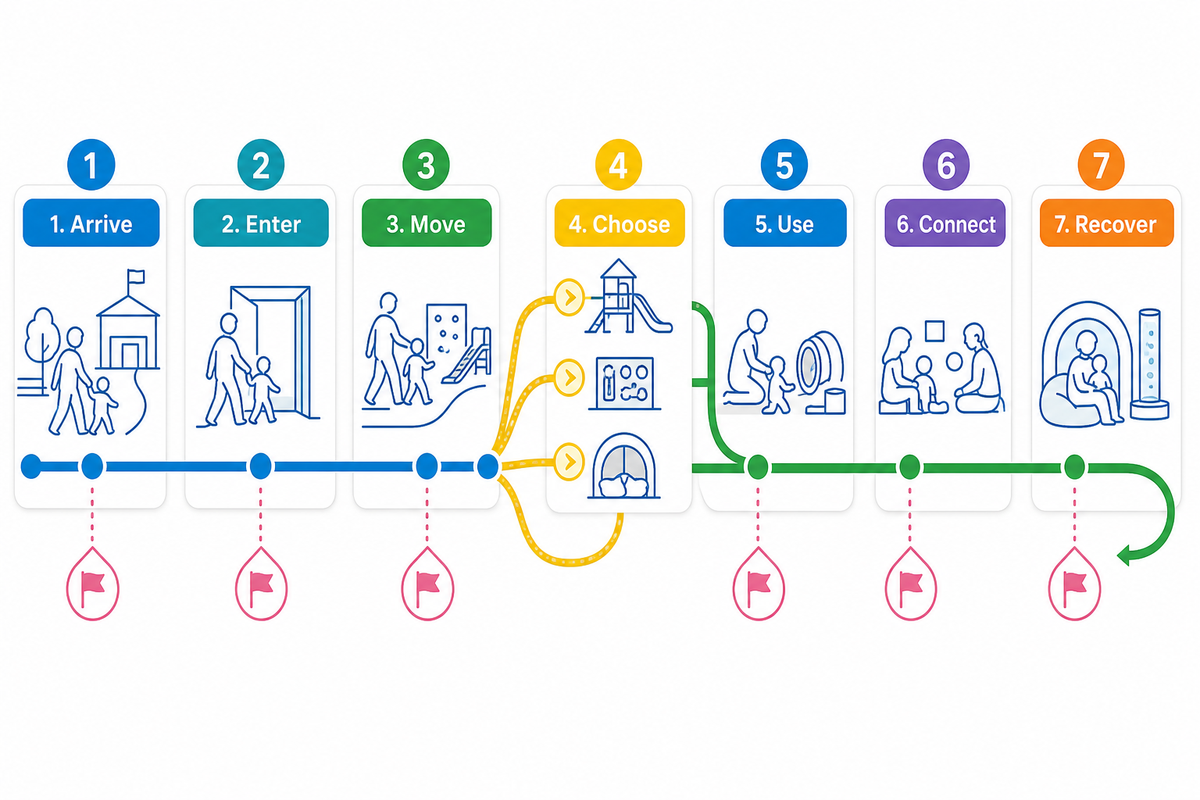
The Participation Friction Audit is a review conducted by a buyer prior to finalizing the equipment list. This audit follows the journeys of children and caregivers and notes where effort or exclusion occurs. These unresolved points are recorded, assigned to a drawing, operating plan, or decision owner, and tracked to resolution. Resolution may take the form of a change in design or a decision by management.
| Checkpoint | Ask | Observable review evidence | Failure signal |
|---|---|---|---|
| 1. Arrive | Can the party reach reception together? | Arrival path and waiting position | A companion must split from the group |
| 2. Enter | Is the intended entry usable without improvisation? | Entry, gate, storage, and check-in detail | Staff must move barriers each time |
| 3. Move | Do routes continue through the room? | Connected path with turning and passing decisions | The route stops at an observation point |
| 4. Choose | Are different play modes genuinely available? | Active, imaginative, social, parallel, and quiet choices | One token panel is the only reachable option |
| 5. Use | Can the activity be started and controlled? | Reach, transfer, control, support, and companion position | Reachable but not operable |
| 6. Connect | Can children play together or alongside? | Shared edge, companion space, and visible alternatives | Accessible choices are isolated in one corner |
| 7. Recover | Can a user lower stimulation without leaving the venue? | Predictable transition and visible recovery option | The only escape is the exit |
Use it correctly: this audit exposes questions; it doesn’t score a child, certify a design, or prove effectiveness. The 35-study scoping review behind several prompts also identifies staffing, supervision, and the design process as separate concerns.
Map Accessible Routes to Real Play Choices
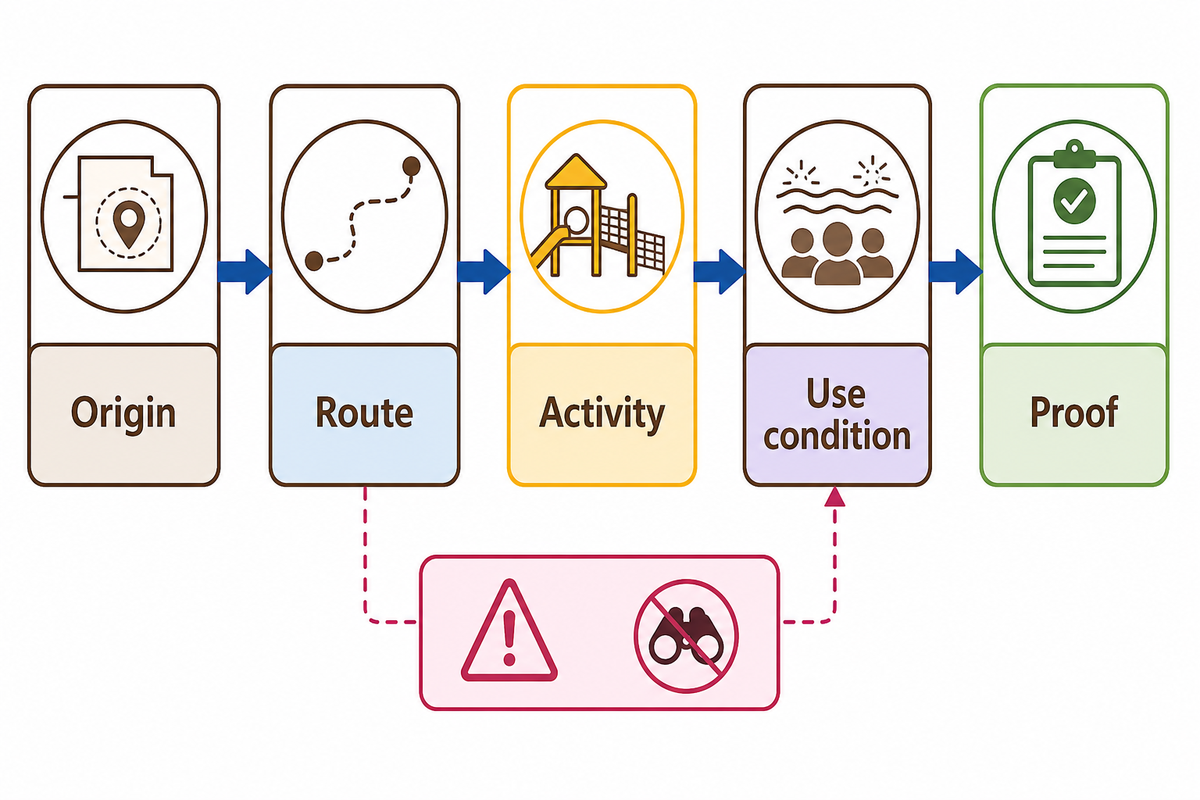
A route is procurement-worthy if it describes the activity, the use condition, the decision-point space, how a user engages, and the companion position. Further, this participation check should indicate in the design how the user would engage with the structure. A line may document the route. However, this route may document circulation without addressing participation.
Access-to-Activity Evidence Trail
Write every route promise as five linked fields: origin → route → activity → use condition → proof. If one field is blank, the promise isn’t ready for an RFQ.
| Field | What to record | Weak answer |
|---|---|---|
| Origin | Reception, seating, toilet route, or zone entry | “From the entrance” with no point marked |
| Route | Continuous path, transitions, conflict points, and destination rule | A colored line with no dimensions or interfaces |
| Activity | Named play action, not a product family | “Sensory area” |
| Use condition | Reach, transfer, control, support, and companion position | “Accessible” without a user action |
| Proof | Drawing reference, equipment schedule, review stage, and owner | A brochure photograph |
Use Toplay’s accessible entry route calculator as an intake aid, then ask the project team to show the resulting route on the actual layout. Calculator output doesn’t replace destination-specific review or a completed-plan inspection.
Give the Room a Sensory Load Budget
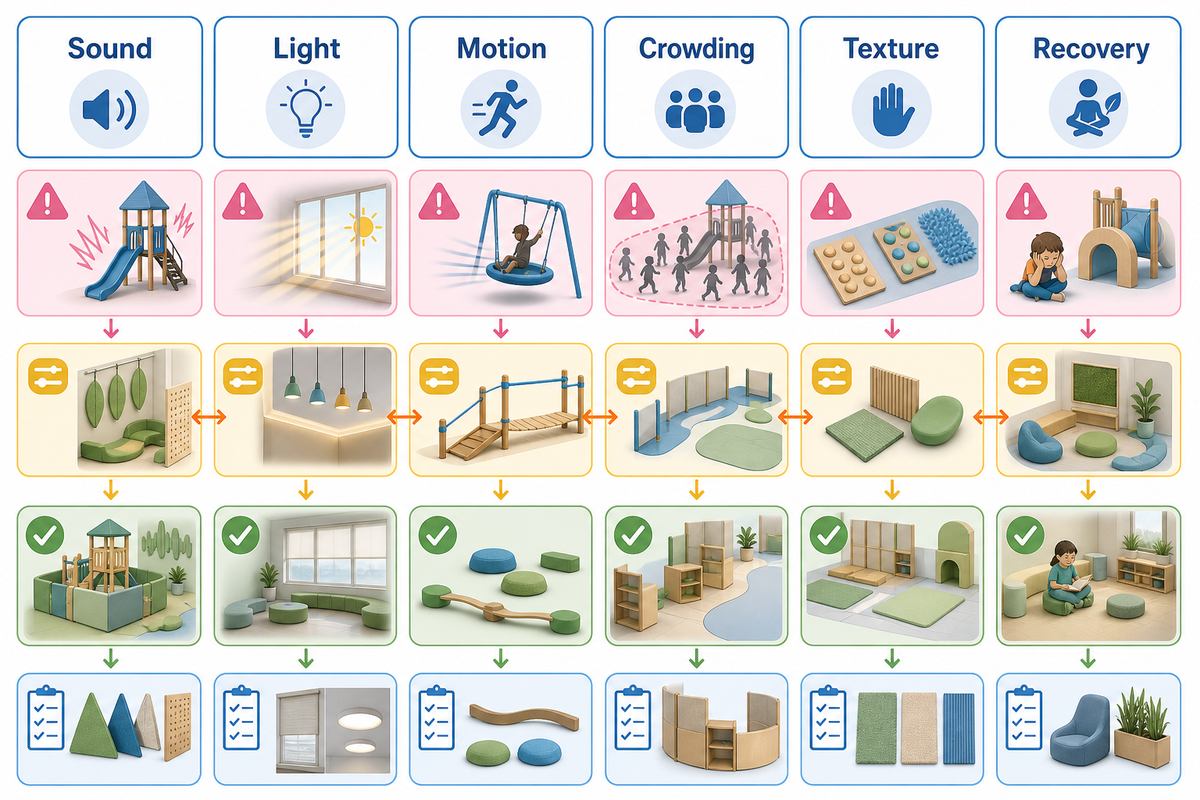
A sensory-friendly room isn’t necessarily a quiet room. When designing for sensory needs, consider whether children can make their own decisions about intensity, take a break, or choose an alternative activity without crossing an activity used by many other children.
| Load source | Pressure to inspect | Design response | RFQ evidence |
|---|---|---|---|
| Sound | Overlapping impact, music, fans, voices | Separate peaks, add absorption, show a quieter route | Acoustic assumptions and material schedule |
| Light | Glare, flicker, high contrast, animated effects | Control layers and provide a lower-intensity option | Lighting zones, controls, and effect locations |
| Motion | Fast movement crossing slow or stationary play | Make paths legible and protect pause points | Movement arrows and conflict review |
| Crowding | Queues, bottlenecks, uncertain entry order | Offer visible alternatives and holding space | Queue location and operating response |
| Texture | Forced contact with one material or transition | Provide optional tactile engagement and alternate route | Material sample and transition detail |
| Recovery | Retreat is hidden, isolated, or reached through peak load | Keep recovery visible, dignified, and easy to rejoin from | Location, sightline, occupancy, and re-entry path |
A study of 41 autistic children aged 4–12 in a multisensory environment associated control over sensory changes with several behavioral differences, but not every measured outcome changed. Use that finding as a reason to design choice and control, not as evidence of a universal response.
Select soft play equipment options only after the load map is marked. A component can be soft to touch and still sit in a noisy, crowded, visually intense position.
Distribute Play Choices Without Segregating Children
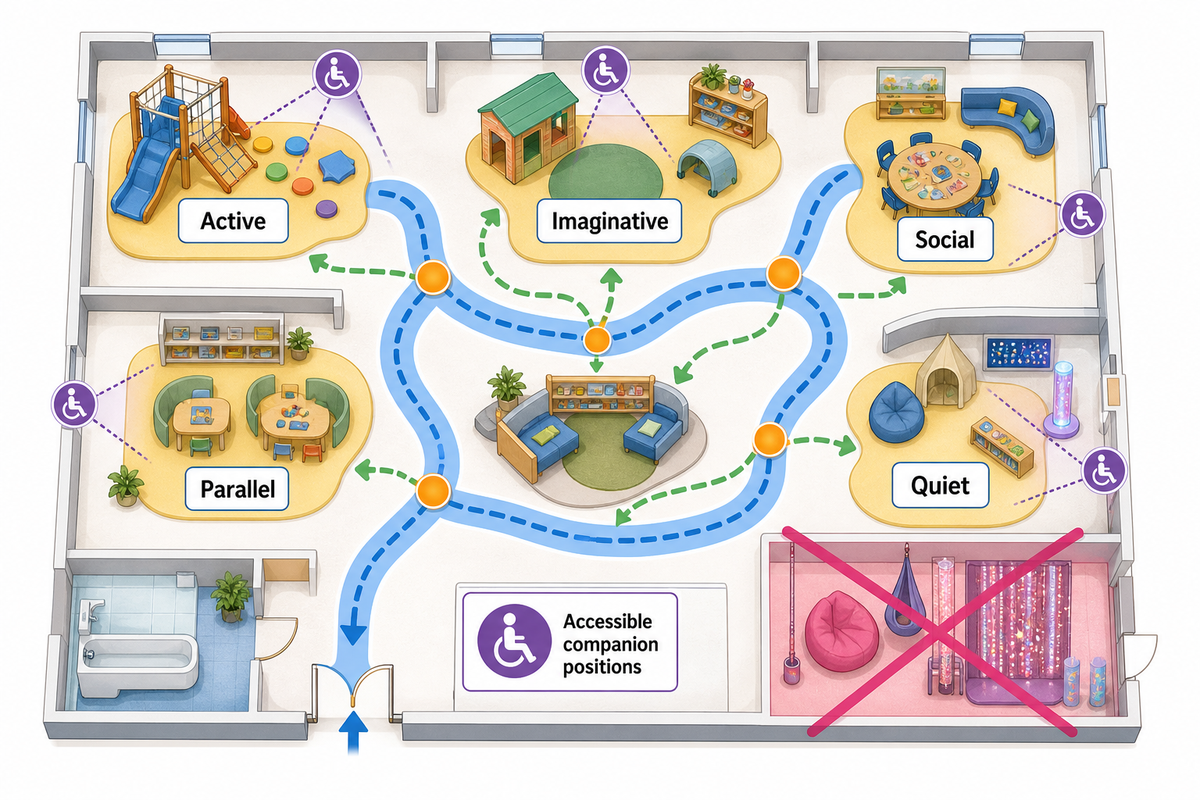
These areas should address intensity level, children’s developmental stage, and how children interact, including conflicting movement; the sensory-load map should guide the zones. Use developmental stage to shape challenge and routing, rather than grouping children together or segregating them by disability. Give children the opportunity to play interactively, independently, or competitively by offering activities that allow meaningful choice. This gives children the opportunity to engage with others if they wish, rather than forcing them to play with others. This also helps children who prefer to play on their own without isolating them from others in the shared room.
Integration warning: U.S. Access Board guidance says grouping all ground-level components accessed by children with disabilities in one location isn’t considered integrated. That rule is jurisdiction-specific, but the buyer lesson is broadly useful: convenience for the drawing team can create segregation for users.
| Layout situation | Design response | Check against isolation |
|---|---|---|
| Fast circulation crosses quiet play | Move the route or protect the edge | Quiet users still see and rejoin shared choices |
| One ground-level activity serves every access need | Distribute different play modes along the route | Choice is not reduced to a token panel |
| Younger and older users share an entry | Make destinations legible before paths split | Families are not routed through a high-load zone |
| A recovery space sits behind a closed wall | Provide privacy with a supervised sightline | Recovery does not become exclusion |
| Caregiver seating is outside the play edge | Add accessible companion positions near multiple choices | Support does not require blocking circulation |
| Staff cannot reach an enclosed activity quickly | Change access or operating capacity for that zone | The assistance route works during peak use |
In one observational study of an outdoor universally designed playground, observations included 71% active play, 88% functional play, 48% peer play, 26% adult play, 22% solitary play, and 4% parallel play; categories could overlap. These figures are not indoor design targets and should not be generalized beyond the study setting, but they show why a brief should preserve several play modes instead of treating constant social interaction as the only successful outcome.
Pair Activities by Play Value, Not by Appearance
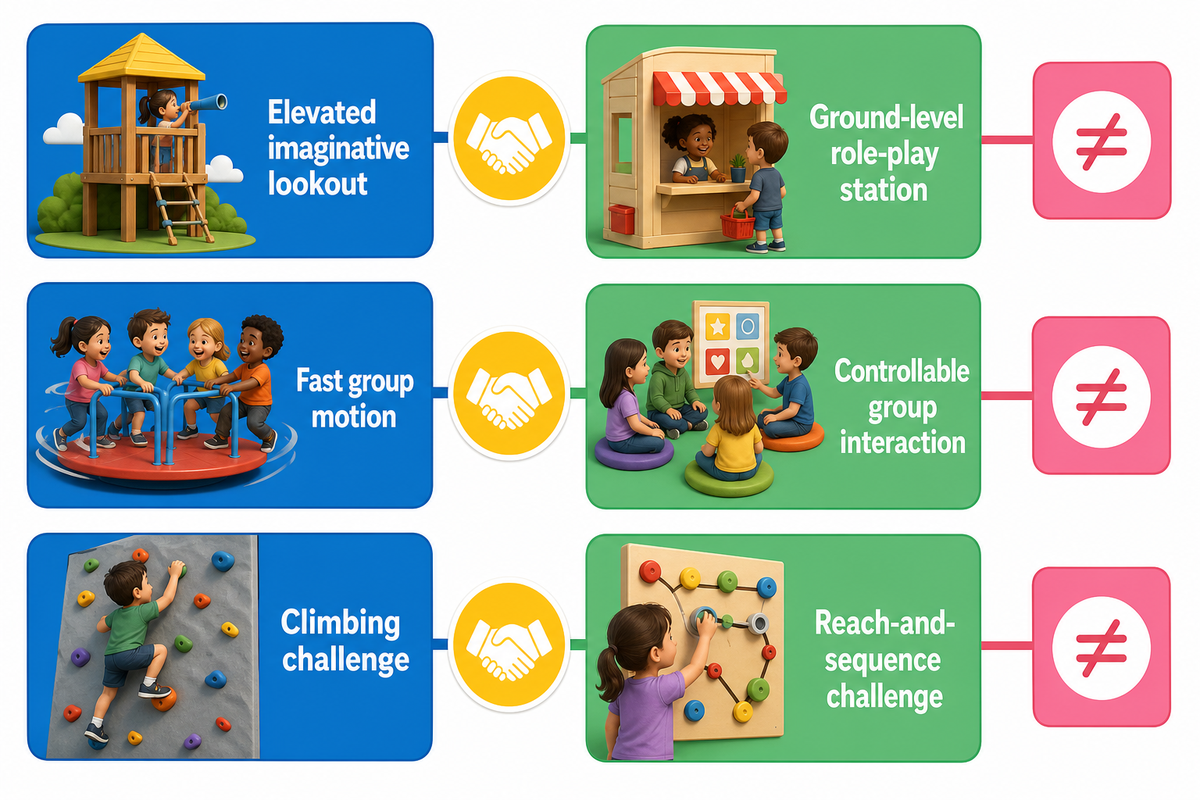
Equivalent Choice Pairing determines if a prominent action in the design has an alternate version that also has play value. In this method, components don’t have to be similar. The alternative may preserve play value through sensory stimulation, motion, imagination, cooperation, challenge, or agency. When evaluating play value for individuals with autism or for wheelchair users, it’s important to evaluate the play value of the different features and elements of a playground. For example, check whether playground equipment has different features or play elements that vary in challenge level and meet the needs of a diverse user group.
Agency
Can the child start, stop, choose, or change the action?
Can the child start, stop, choose, or change the action?
Challenge
Is there a meaningful level of effort or mastery?
Is there a meaningful level of effort or mastery?
Motion
What body movement or movement feedback is offered?
What body movement or movement feedback is offered?
Cooperation
Can another child or caregiver participate alongside?
Can another child or caregiver participate alongside?
Imagination
Can the activity support roles, stories, or open-ended use?
Can the activity support roles, stories, or open-ended use?
Sensory value
Is intensity controllable, optional, and recoverable?
Is intensity controllable, optional, and recoverable?
| Prominent experience | Possible pairing | Not equivalent when… |
|---|---|---|
| Elevated imaginative lookout | Ground-level role-play station with shared story cues and a high visual outlook | The alternative is a passive picture panel |
| Fast group motion | Controllable group interaction with movement feedback and companion space | Only the fast option allows cooperation |
| Climbing challenge | Reach-and-sequence challenge with adjustable difficulty and a visible completion | The alternative removes agency and mastery |
Use the worksheet to define what’s missing, and then outline play components that are accessible within the scope of the project. Equivalent choice pairing is a method to be used during the design process to evaluate components of a play area. This method doesn’t attempt to prove that both components meet the same applicable requirements or deliver equivalent outcomes.
Check Interfaces, Caregiver Access, Staffing, and Sightlines
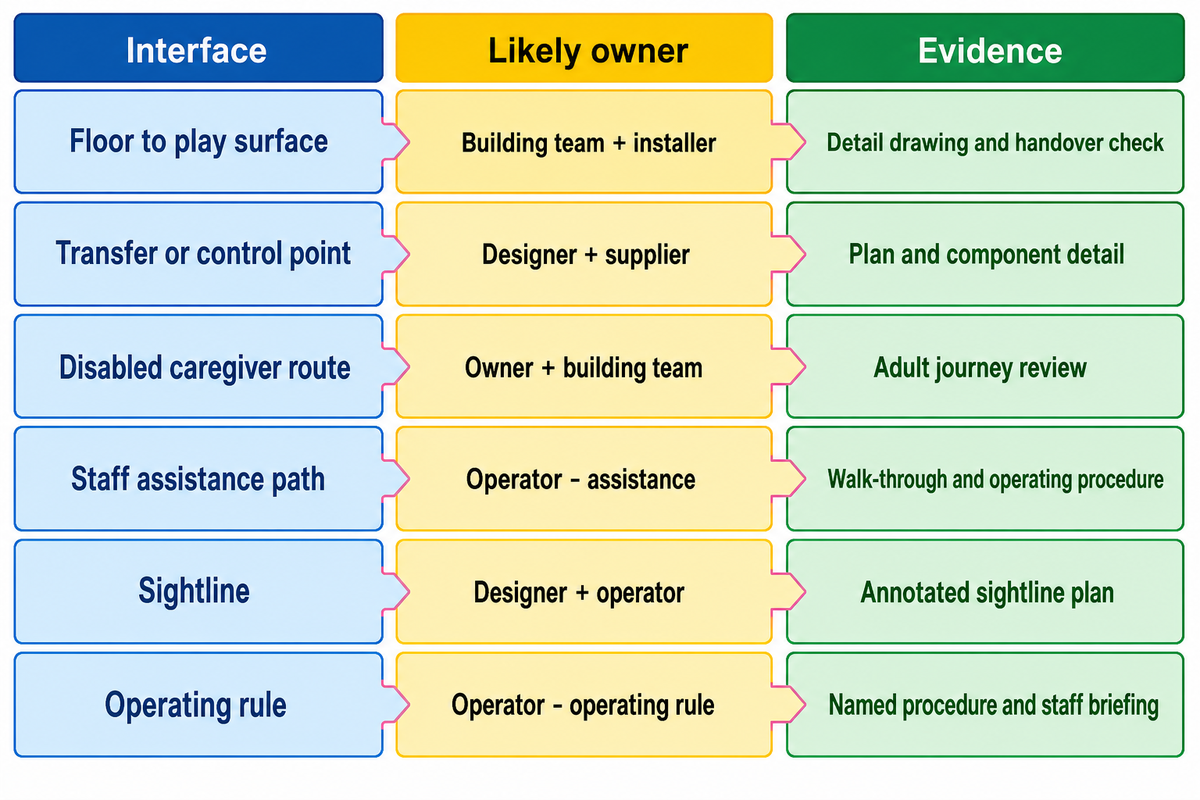
Components of an inclusive design can fail where they come in contact with other room elements at transitional points. These points may include transitions, thresholds, transfer positions, staff and maintenance access, supporting facilities, queues, and operating procedures.
| Interface | What to inspect | Likely owner | Evidence |
|---|---|---|---|
| Floor to play surface | Level change, firmness, edge, maintenance condition | Building team + installer | Detail drawing and handover check |
| Transfer or control point | Approach, support, companion position, obstruction | Designer + supplier | Plan and component detail |
| Disabled caregiver route | Reception, seating, toilet, drinking facility, supervision position | Owner + building team | Adult journey review |
| Staff assistance path | Reach time, gate operation, enclosed access, peak-use conflict | Operator | Walk-through and operating procedure |
| Sightline | Blind spots, recovery-space privacy, supervision position | Designer + operator | Annotated sightline plan |
| Operating rule | Admission, queue, assistance, communication, reopening | Operator | Named procedure and staff briefing |
ASTM F1918-21 addresses safety and performance for soft-contained play equipment; it does not establish an accessibility or inclusion certificate. Ask for safety and after-sales documentation, then keep building access, operating controls, and destination-specific requirements in their correct scopes.
Turn Inclusion Requirements Into an RFQ
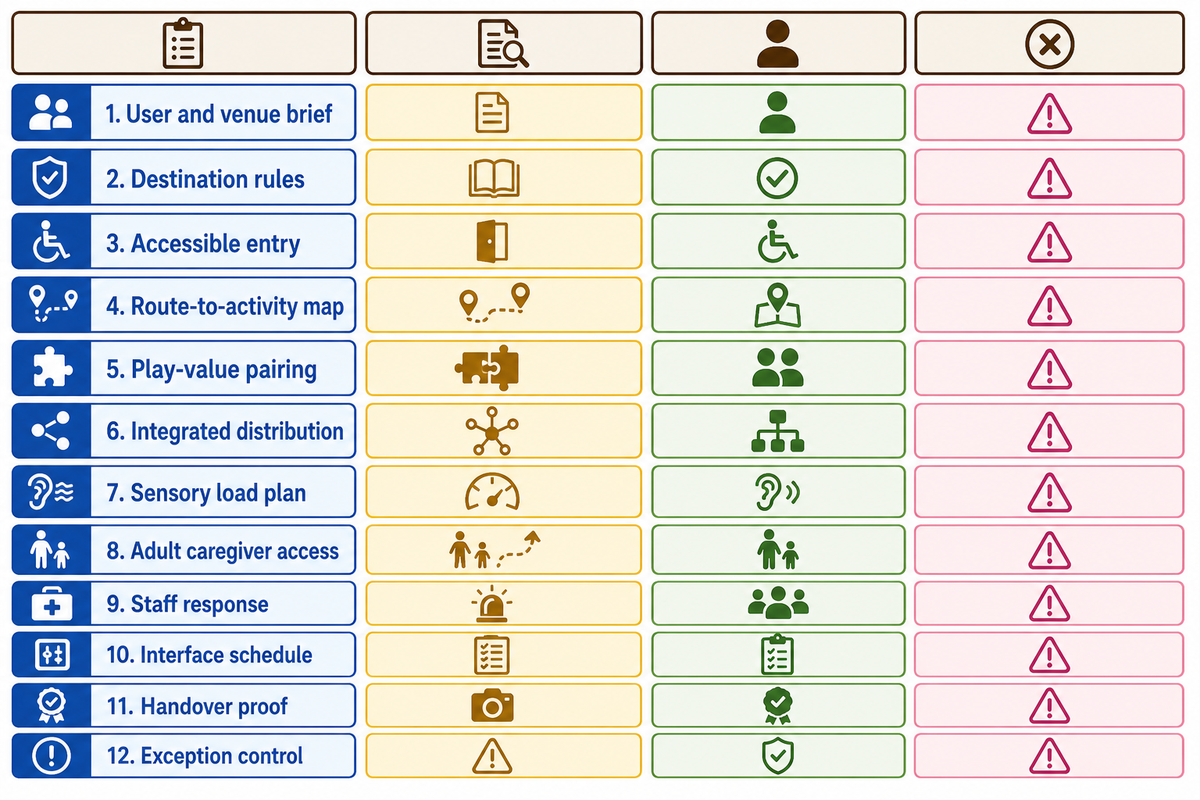
Issuing an inclusive RFQ provides reviewable records to capture and track interface and operating responsibilities. The 12-row RFQ below forces each promise into a requirement, evidence request, responsibility owner, verification stage, and reject condition. Each line item should include the requirement, evaluation evidence, responsibility, checking point, and exception process. Suppliers are unable to price or validate an ownerless assertion such as “Make the playground inclusive.” “Owners” should be included as part of the project team to consider and incorporate the needs of potential users in the design project, together with operators, the design team, parents and caregivers, and any qualified accessibility reviewer.
| Requirement type | Evidence requested | Owner / verification stage | Reject this answer |
|---|---|---|---|
| 1. User and venue brief | Age ranges, support needs, caregiver journey, operating model | Owner / before concept | “Suitable for all children” |
| 2. Destination rules | Applicable jurisdiction, venue, building, and equipment scopes | Owner + qualified local reviewer / concept | One standard number for the whole project |
| 3. Accessible entry | Marked gate, approach, storage, and check-in interface | Designer / drawing review | “Ramp included” |
| 4. Route-to-activity map | Every priority route linked to a named activity | Designer + supplier / layout freeze | A route ending at the perimeter |
| 5. Play-value pairing | Agency, challenge, motion, cooperation, imagination, sensory value | Owner + educator / concept review | Component count without experience |
| 6. Integrated distribution | Accessible choices distributed through shared areas | Designer / concept review | All accessible components in one corner |
| 7. Sensory load plan | Sound, light, motion, crowding, texture, transition, recovery | Designer + operator / layout freeze | “Sensory wall included” |
| 8. Adult caregiver access | Reception, seating, supervision, toilet, and assistance journey | Owner + building team / design review | Child route reused as adult proof |
| 9. Staff response | Assistance access, communication, queue, and recovery procedure | Operator / pre-opening trial | “Staff will handle it” |
| 10. Interface schedule | Surface, threshold, transfer, control, and companion details | Building team + installer / shop drawing | “By others” with no named owner |
| 11. Handover proof | As-built drawing, schedule, manuals, exception list, training record | Supplier + owner / handover | Brochure plus verbal assurance |
| 12. Exception control | Unmet requirement, reason, impact, decision owner, disposition | Procurement + owner / every review | Silent deletion from the next drawing |
The evidence-trail rule
A requirement is complete only when the drawing or schedule location, responsibility owner, verification stage, and exception status are all recorded. Use that packet to turn inclusion criteria into a space plan that can be compared across quotations.
Apply the Checks to a Kindergarten or Early-Learning Room
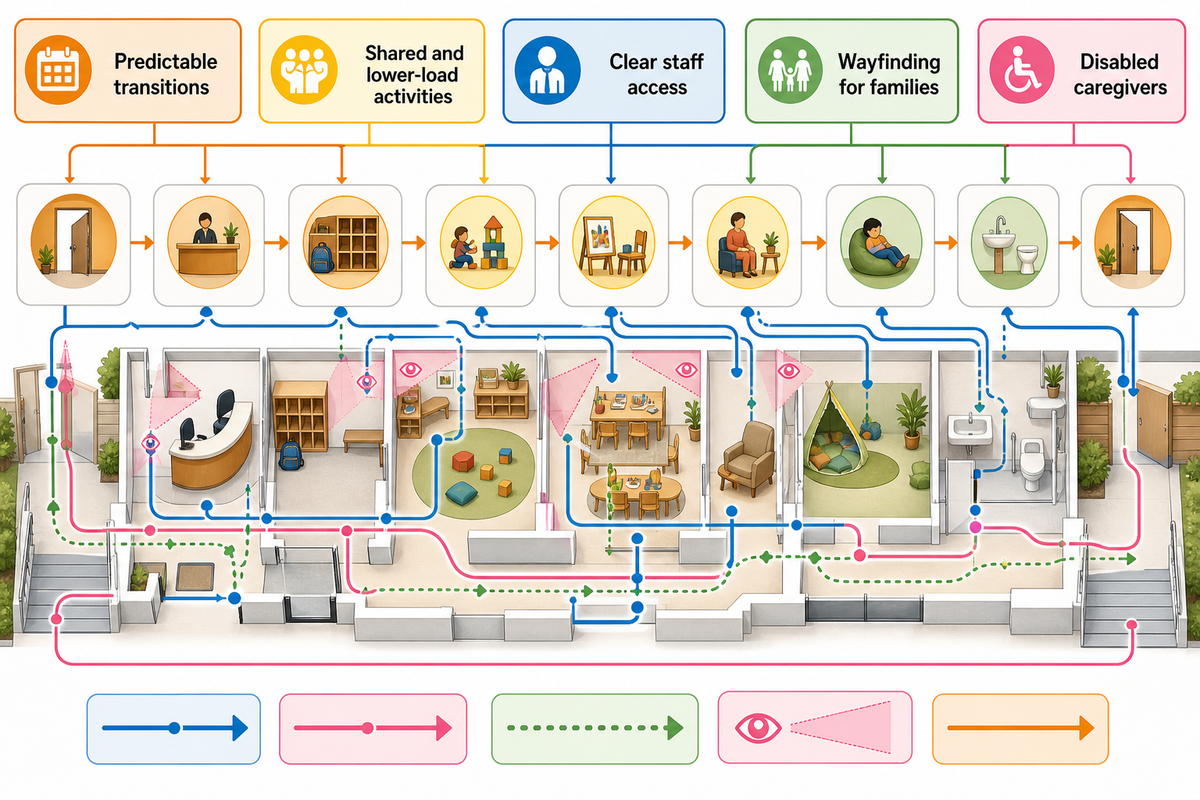
A kindergarten design should incorporate several user-centered features, including predictable transitions, shared and lower-load activities, clear staff access, and wayfinding for families. Designs should include routes that accommodate disabled caregivers as well as children with disabilities. A kindergarten room should not inherit an entertainment center layout. Review daily routines before finalizing assistance, arrival, and recovery provisions. There should be a review of usual daily kindergarten activities to determine staff and caregiver assistance, escort patterns at the beginning and end of the day, and other recurring transitions.
| Generic brief | Inclusive early-learning brief |
|---|---|
| “Add a quiet corner.” | Show the lower-load route, staff sightline, occupancy, transition cue, and re-entry path. |
| “Separate by ability.” | Distribute reachable play modes while managing intensity and developmental fit. |
| “Teachers will supervise.” | Mark supervision positions, assistance routes, gates, blind spots, and the operating owner. |
| “Accessible entrance provided.” | Trace arrival through reception, storage, play choices, caregiver seating, supporting facilities, and exit. |
Toplay’s venue page requests space, user, activity, flow, component, and entry/exit inputs for indoor playground planning for kindergartens. Consider these as a project brief and also provide participation, caregiver, sensory and operating evidence.
Want to assess a kindergarten idea using the nine checks?
Send the room plan, user groups, preferred activities, destination market, and support needs. Based on this information, Toplay can discuss a customized equipment and layout concept. Other accessibility and operation decisions will be made on a case-by-case basis.
What Search Demand Says About Inclusive Playgrounds
The exact focus phrase does not provide enough information to determine market growth, so it cannot support a market growth claim. In the U.S. DataForSEO pull dated September 22, 2026, related terms showed some interest for inclusive design and equipment as well as sensory playgrounds. The run reviewed a matrix of 185 unique keywords, a 30-term twelve-month trend pull, and a separate 20-term AI search-volume pull collected on 2026-09-22. For this case, treat the numbers as an approximation of search-related interest, not sales.
Turn Search Language Into Procurement Tests
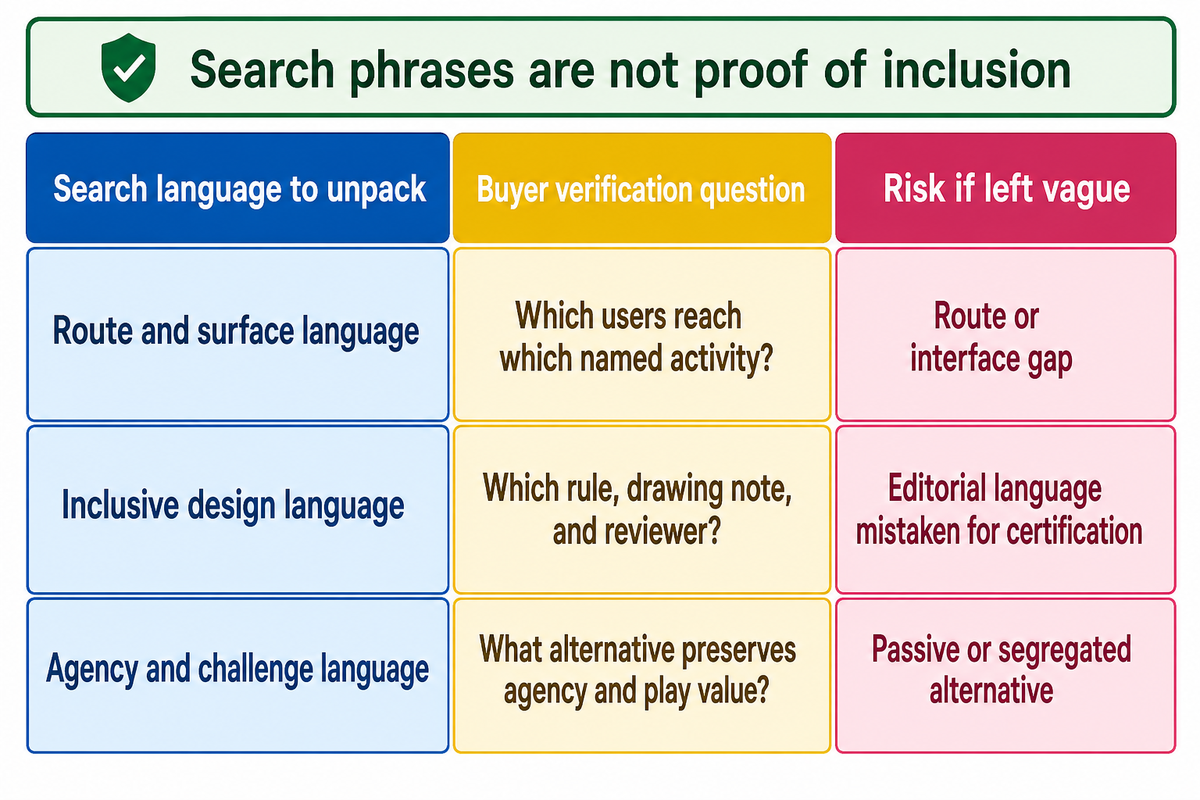
Search phrases are not proof of inclusion. The table below groups the exact language buyers encounter and converts it into a drawing, operating, or evidence question.
| Search language to unpack | Buyer verification question | Risk if left vague |
|---|---|---|
| play structure; playground surfacing; play environment; ages and abilities; play experience | Which users reach which named activity, across the surface transition? | A room-level promise hides a route or interface gap. |
| inclusive play design guide; truly inclusive; accessible play; designing inclusive playgrounds; universal playground design | Which cited rule, drawing note, and reviewer support the claim? | Editorial language is mistaken for certification. |
| design principles; custom playground; accessible playgrounds; interactive play; regardless of ability | What is customized, and which interaction remains available through an alternative? | Customization changes appearance without changing participation. |
| variety of play; wide enough; inclusive playground elements; create inclusive; playground more inclusive | How is variety counted, and where are route width and decision space verified? | Undefined adjectives prevent quotation comparison. |
| parts of the playground; kids who use wheelchairs; range of physical; throughout the playground; accessible play spaces | Does the route reach a distributed set of choices rather than one token zone? | Access is concentrated at the room edge. |
| social skills; playground elements like; impairment; play options; design consultation | Were users and caregivers consulted, and can a child choose social or independent play? | A claimed outcome is attached to equipment alone. |
| people of all ages; playground design principles; good design; social play; unstructured play | Which age groups and play modes are actually in the brief? | A universal audience claim has no defined user range. |
| accessible play elements; play for all ages; abilities can enjoy; wide range of physical; play independently | What alternative preserves agency, challenge, and play value? | The alternative becomes a passive or segregated activity. |
| play alongside; inclusion and create; play freely; children with autism; opportunities for children | Can users control proximity, intensity, transition, and recovery? | Social contact is forced or sensory escape requires leaving. |
| designing play; play features; benefits of play; great way to encourage; designing an accessible | Which observable use condition replaces the claimed benefit? | Promotional benefit language enters the RFQ as an untestable promise. |
| abilities and preferences; varying challenge levels; play based; kids to engage; designed to accommodate | Where are challenge, choice, and user control shown on the equipment schedule? | A broad accommodation claim lacks a usable design response. |
| play offers; abilities to use; build their motor; feel more comfortable; love the thrill | Which activity, intensity, assistance condition, and evidence support each outcome? | Emotional or developmental claims outrun the available evidence. |
| throughout the space; surfacing is one; families and community; environment is designed; beneficial for children; striving to make | Who owns room interfaces, operations, maintenance, and final destination review? | Whole-environment responsibilities fall between supplier and operator. |
| U.S. query | Monthly search volume | Safe interpretation |
|---|---|---|
| inclusive playground design | 110 | Measured design interest |
| inclusive playground equipment | 1,000 | Stronger adjacent commercial interest |
| sensory playground | 880 | Distinct sensory-planning interest |
Information in this table is based on search volume. Search volume varies on the platform, location, and language. This information doesn’t provide any data regarding the size, growth rate, or profitability of indoor playgrounds.
Frequently Asked Questions
What are the seven principles of inclusive playground design?
The seven principles of universal design are equitable use, flexibility in use, simple and intuitive use, perceptible information, tolerance for error, low physical effort, and appropriate size and space for approach and use. For an indoor buyer, these principles guide design decisions about route selection, control choice, signage, surfacing, companion positioning, recovery, and choice. Inclusive play design can draw on these principles; however, applying these principles does not guarantee that every child can use every playground element.
How do you design an inclusive indoor playground?
Begin with users and caregivers. Understand the daily activities of the user and any limits placed upon the user by the destination. Model the user’s actions and choices and the consequences thereof, the connections made, and the services used. Identify the activities for which the user is required to wait. Model the distances and routes covered by the user. Determine the choices that remain available to the user at any time, and identify the interfaces that the user operates.
How much does an inclusive playground cost?
No single premium could be justified based on the evidence reviewed. Multiple variables, including facility condition, play equipment, activity offer, pathways, construction, surfacing, controls, rules and regulations, and facility operations, can impact cost. Compare quotations only after every supplier prices the same route-to-activity map, interface schedule, evidence requirements, and exception list. A lower cost may result from failing to include work that higher bidders included.
Does an accessible route make a playground inclusive?
No, an accessible route can still end at observation instead of participation, so the drawing must identify a reachable activity, the way it is used, and the companion position. Describe the named activity and how it’s used. Show where companions remain involved.
How can a quiet zone support children without isolating them?
Place it on a lower-load route that staff can easily see. Use clear entry and exit signals. Don’t make this your only option for kids with particular needs. Ideally, this would support children to recover sufficiently to return to more shared play.
What should an inclusive-playground supplier provide?
Request a route-to-activity plan, equipment schedule, interface details, sensory-load assumptions, caregiver and staff routes, applicable standards scope, owner matrix, verification stages, handover documents, and a recorded exception list. Have the supplier differentiate equipment conformance from room, facility, building, installation, system, and operating responsibilities. For each promise, identify the drawing location, verification point, evidence document or test record, decision owner, and verification stage. Reject overall or generic statements without a supporting evidence trail.
Upon final analysis, decision-makers will choose the supplier whose proposal provides the strongest evidence trail, not the one that uses the word “inclusive” the most. A design is considered open until the route, activity, sensory, caregiver, staff, and exception questions have been assigned specific owners.
References & Sources
- U.S. Access Board: Guide to the ADA Accessibility Standards, Play Areas
- U.S. Access Board: Chapter 2 Scoping Requirements
- Scoping review: evidence-informed recommendations for inclusive playgrounds
- Scoping review: Incorporating universal design to promote outdoor play and social participation
- Observational study of play participation in a universally designed playground
- Study of control in a multisensory environment for autistic children
- Playground Research: Playgrounds That Support Neurodivergent Children
- ASLA Universal Design Guide: Playgrounds
- ASTM F1918-21 official standard page: Soft Contained Play Equipment



