
Get in touch with Guangzhou Toplay amusement equipment co. Company

Commercial Play Equipment is equipment selected for managed public or institutional use; this guide provides guidance to the owner and operator. In managed settings, the equipment may serve public, institutional, hospitality, education, or recreational settings. Owners manage public-use equipment and systems beyond visible play elements. Owners also control acceptance, inspection, cleaning, repair, maintenance, replacement, and related responsibilities.
This is an owner-and-operator guide, not a second product catalogue. If you already need project-specific configurations, drawings, specifications, lead times, or a quotation, use Toplay’s commercial indoor playground equipment solution page. In the meanwhile, consider what factors will your team have to consider, decide and retain before, during and after the purchase.
The short answer
Evaluate commercial play equipment as an owned system, not a list of attractions. First classify the equipment and venue. Then test user fit, play value, evidence, maintainability, acceptance, and change triggers. A suitable choice is one your team can inspect, clean, isolate, repair, document, and reassess, not merely one that looks complete on a render.
1. What Makes Play Equipment Commercial?
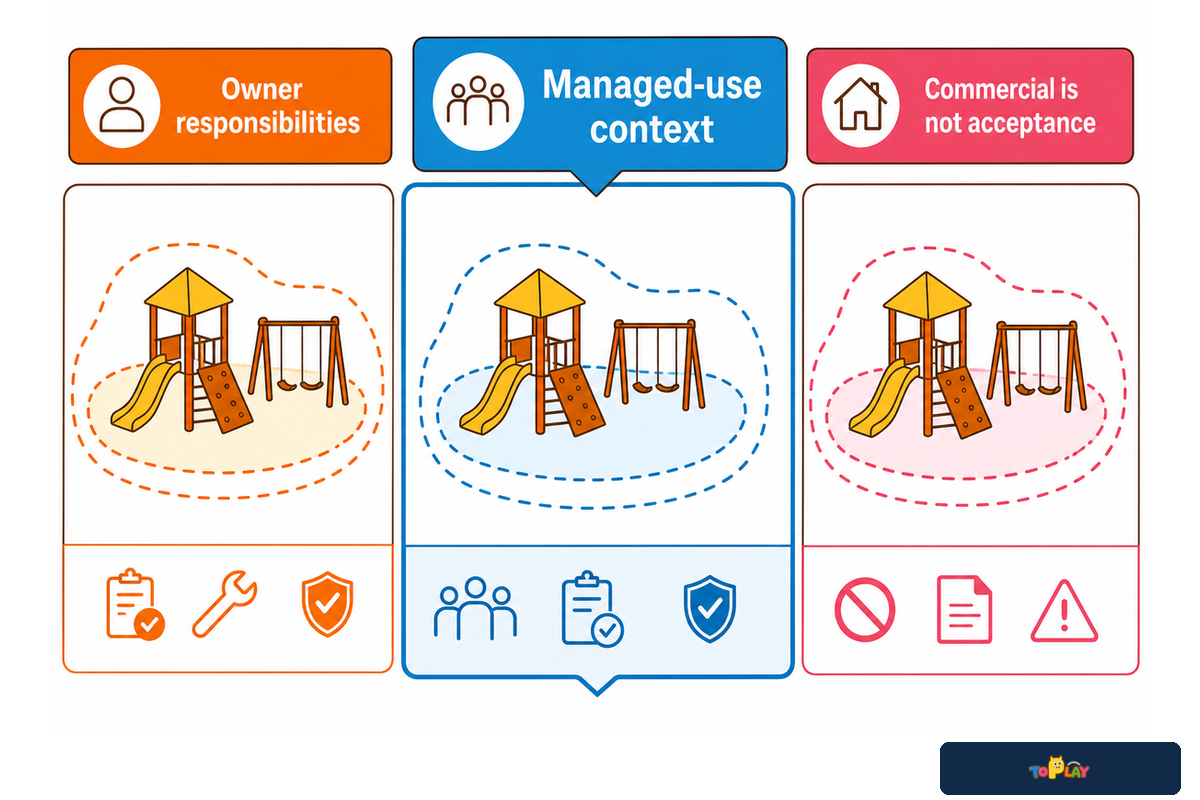
Commercial Play Equipment refers to a managed-use context, not just material or size. These labels describe different buyer briefs: schools may need commercial playground equipment for schools; indoor venues may need commercial indoor playground equipment or commercial soft play equipment; operators may compare heavy duty commercial play equipment, commercial play structures, or small commercial playground equipment. Repeated use adds stakeholders, records, interfaces, and continuing responsibilities. The term “commercial grade” doesn’t by itself fulfil the owner’s acceptance requirements.
Classification is the first safeguard. The U.S. Consumer Product Safety Commission’s playground-equipment business guidance separates home and public-use equipment and explains that requirements can also depend on whether an item is considered a children’s product or toy. That makes equipment class, intended users, venue type, and jurisdiction the first four fields in the owner’s brief.
This is significant because a sentence that’s valid in one context may not be valid in another. Directives for public playgrounds shouldn’t be generally applied to amusement attractions, soft-contained systems, childcare settings, or every indoor venue. One agency’s lack of product-certification activity doesn’t mean that no conditional testing or certification duty applies through other authorities.
Do
- Name the equipment class and venue
- Record intended users and use context
- Verify the current applicable evidence
- Assign post-handover ownership
Do not
- Treat “commercial-grade” as approval
- Transfer one source across every product class
- Assume an attractive render proves maintainability
- Let supplier records disappear at handover
In the context of a commercial decision, the guide is distinct from a transaction document which captures the details of models, specifications, quotes, lead time and conversion to a service. This guide must assist the owner in answering five questions. Ask: what’s to be installed, who’s to use it, what evidence applies, who accepts it, and what triggers further action.
2. Sort Equipment by the Job It Performs
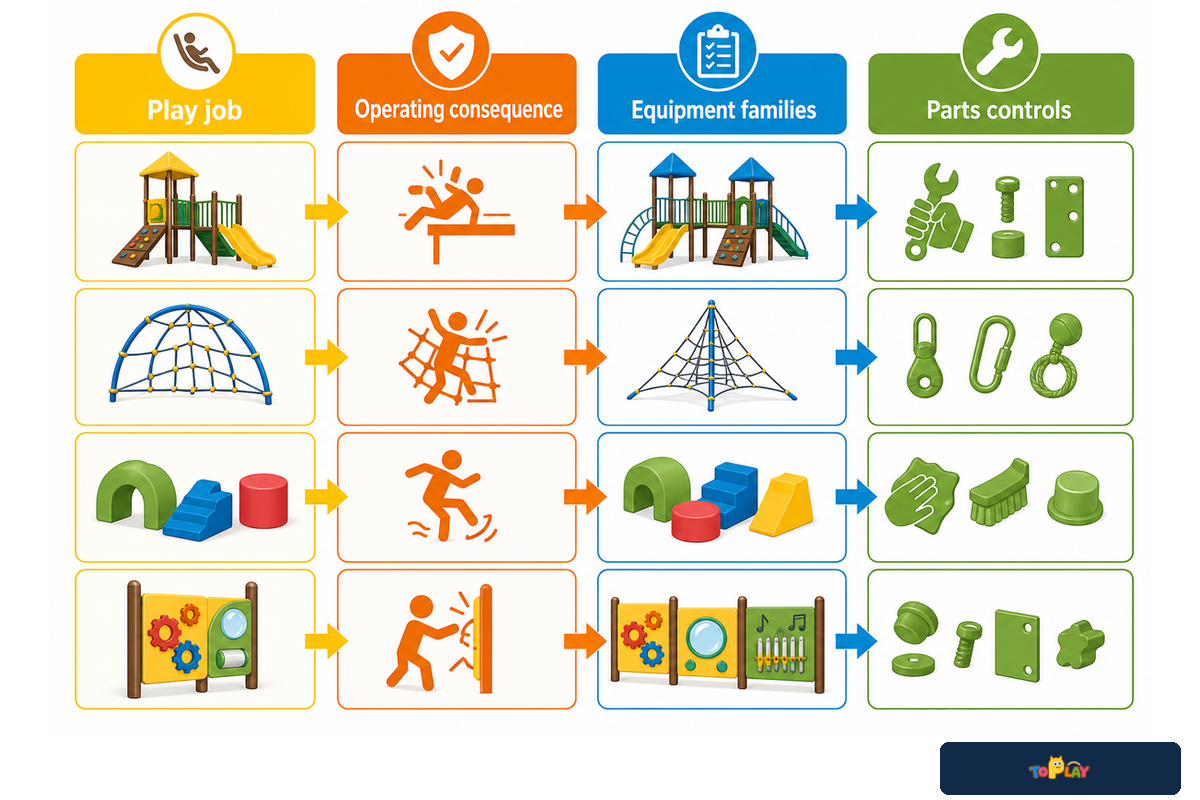
When developing a map of equipment, the starting point should be the play job and operating consequence, rather than how the equipment appears in a catalogue. Different equipment families may require different inspection, cleaning, isolation, maintenance, and parts-replacement controls; that lens separates a playground structure from support systems, site amenities, and play systems with different evidence.
| Equipment family | Primary play job | Owner question | Common hidden interface |
|---|---|---|---|
| Connected structures | Movement sequence and route choice | Can intended users enter, progress, exit, and be supervised? | Joints, enclosed routes, access panels |
| Freestanding motion | Swinging, spinning, rocking, balancing | How are motion, surrounding space, and isolation controlled? | Moving parts and wear visibility |
| Soft play | Low-height crawling, climbing, sliding, social play | How are covers, seams, foam, nets, and closed spaces accessed? | Drying, sanitation, concealed damage |
| Toddler-scale elements | Developmentally appropriate exploration | Is the user group defined beyond a broad age label? | Mixed-age access and supervision |
| Sensory and social features | Choice, communication, quieter engagement | Does participation remain meaningful without forcing one route? | Controls, loose pieces, sound or light modules |
| Support systems | Access, surfacing, boundaries, signs, storage | Are these treated as owned systems rather than accessories? | Interfaces between suppliers and trades |
Different domains of evidence may be present in the same room of an indoor project, including a custom playground, playground sets, commercial playsets, and a custom design and installation package. Where evidence domains are combined, the owner shouldn’t assume one certificate, maintenance instruction, or inspection rule covers every element; commercial playground equipment for parks and outdoor fitness can carry different evidence from indoor play.
A single play structure can join multiple play elements, while a freestanding climber or spinner creates a different kind of movement and requires different maintenance. A play space can combine elements of play within an interior space with outdoor play and safety surfacing. During repeated use, these elements of play shouldn’t obstruct the users’ ability to engage in the desired physical activity and remain accessible for inspection.
This article stops before project configuration. Toplay’s solution Page covers indoor equipment families and project-specific deliverables. For floor plan, zoning, circulation, and adjacency decisions, use the separate indoor playground space-planning guide.
3. Evaluate Users and Play Value Before Counting Features
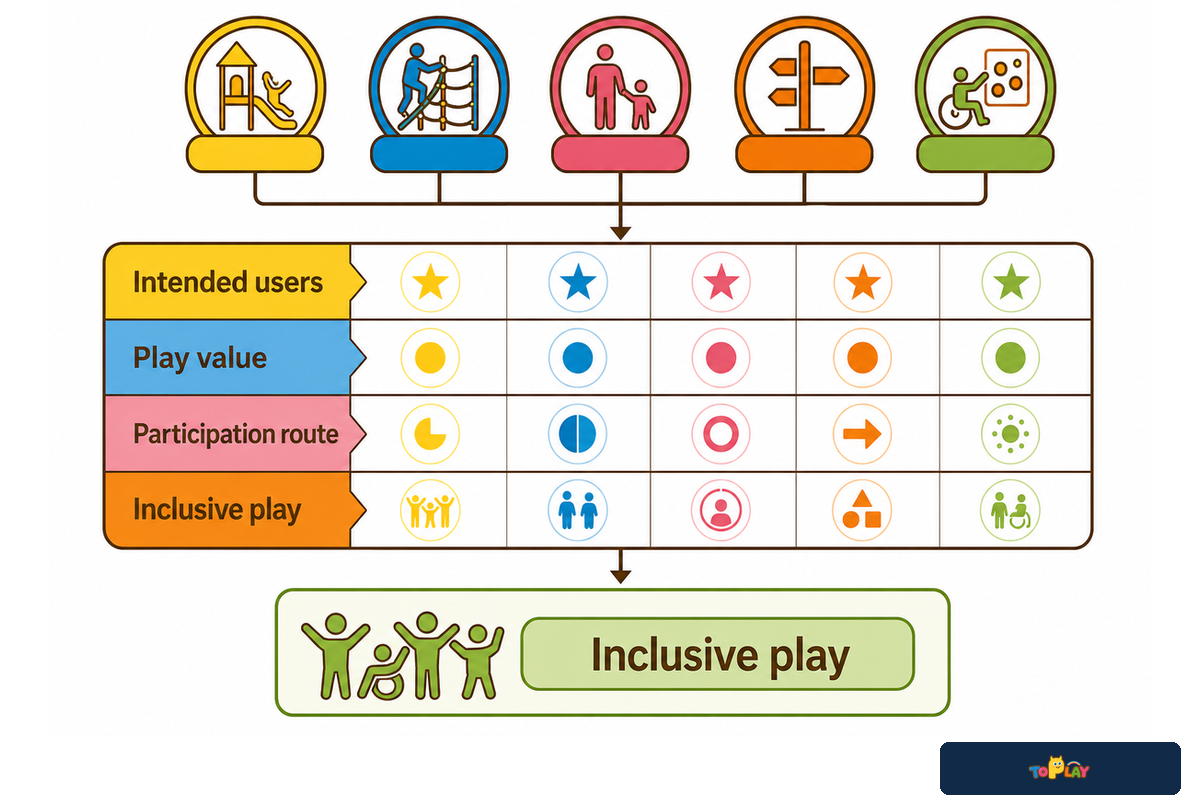
During evaluation of children’s play spaces, play value should include opportunity, choice, challenge, repetition, imagination, and social participation. It’s important to go beyond the numbers of slides and panels to understand whether users can enter, choose, progress, pause, and rejoin in different ways.
Start with intended users and five questions: age range, developmental fit, ability range, participation route, and challenge progression. It’s also important to understand the choices provided for engagement and participation. An “inclusive” label should describe the challenge provided for a user to engage with a play element; supervision, choices, and user engagement during play also matter.
An item marked as inclusive playground equipment won’t by itself create inclusive play. A budget may limit the first phase; however, the owner must define age-appropriate participation for children of all abilities and identify future choices that must be retained. Questions pertaining to the ADA should be handled in the project accessibility review rather than through a vendor badge.
The U.S. Access Board play-area guide is useful for accessibility scoping and alteration questions, but it also states that the agency doesn’t evaluate or certify products. Owners still need project-specific review and must not convert an example, route count, or product claim into blanket approval.
| Example condition | Published figure | Owner action |
|---|---|---|
| General ground-level accessible route | 60 inches (1,525 mm) minimum clear width | Confirm that the cited U.S. rule and route type apply |
| Smaller play-area exception | Under 1,000 square feet (93 m²): 44 inches (1,120 mm) may apply | Verify every condition before using the exception |
| Permitted route narrowing | 36 inches (915 mm) for 60 inches (1,525 mm) | Check location, frequency, and the complete route rule |
| Transfer-system route | 24 inches (610 mm) minimum width | Confirm that a transfer system is the applicable access method |
| Transfer-platform height | 11 inches (280 mm) to 18 inches (455 mm) | Link the figure to the correct platform and current provision |
| Transfer-platform plan | At least 24 inches (610 mm) wide and 14 inches (355 mm) deep | Review shape, approach, clear edge, and adjacent space together |
| Transfer-step rise | 8 inches (205 mm) maximum | Do not detach one number from the full transfer-system rule |
| Accessible component entry or seat | 11 inches (280 mm) to 24 inches (610 mm) | Verify component type, route, and clear-space requirements |
| Ramp handrail gripping surface | 20 inches (510 mm) to 28 inches (710 mm) above the ramp | Use the current project review, not this summary, for compliance |
Listing examples and illustrations in an Accessibility Guide doesn’t ensure that a particular play-area element meets the standard. To reach that conclusion, the owner needs a project review that confirms the applicable route type, play-area size, access method, component, and current provision.
Three-role test
Ask a caregiver whether participation is meaningful, an operations lead whether supervision is workable, and a maintenance lead whether the same route can be inspected and restored. A choice that works for only one of those roles isn’t ready for approval.
Ability isn’t the same as age or experience. Similar-looking equipment may be used in a school, mall, family entertainment centre, restaurant, hotel, or early-childhood programme under different levels of supervision and operating control. Owners should distinguish such differences rather than assume a uniform level of control and supervision of users of its services.
4. Use the Commercial Play Lifecycle Canvas
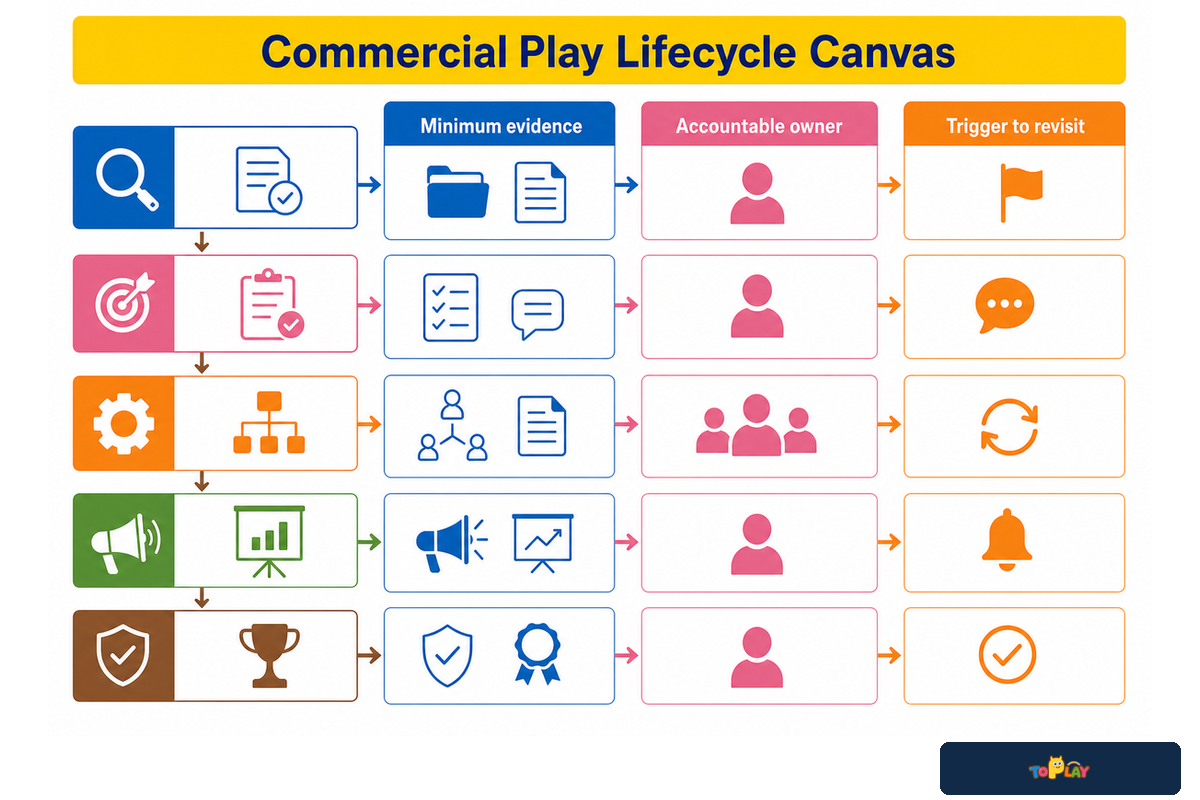
The Commercial Play Lifecycle Canvas is an owner’s worksheet consisting of six stages. It links decisions to the least amount of justification, an accountable person, a living document, and a mechanism to challenge and/or verify that decision. It’s a management tool that isn’t endorsed by any government or professional body.
| Stage | Decision | Minimum evidence | Accountable owner | Live record | Trigger to revisit |
|---|---|---|---|---|---|
| 1. Define context | Users, venue, equipment class, jurisdiction | Approved brief and scope assumptions | Project sponsor | Decision brief | User or venue change |
| 2. Screen families | Play jobs and participation routes | Family map and exclusions | Design lead | Option register | Layout or programme change |
| 3. Verify evidence | Applicable basis and supplier submittals | Current source, drawing, declaration, report | QA or compliance owner | Evidence register | Classification or revision change |
| 4. Accept installation | Installed basis, deviations, open items | Inspection and closure evidence | Acceptance owner | Acceptance board | Defect, deviation, failed check |
| 5. Operate and maintain | Inspection, cleaning, repair, spares | Approved programme and current instructions | Operations and maintenance | Asset history | Recurring finding or changed use |
| 6. Retain or change | Monitor, repair, upgrade, isolate, replace | Condition, parts, evidence, applicability review | Owner or risk authority | Disposition record | Approved action or new risk |
Procurement uses the Canvas to identify incomplete packages and unverified assumptions. It supports Operations by showing which assumptions will become daily work. Maintenance uses the Canvas to request access and references before installation. Quality Assurance uses the Canvas to track outstanding work. For finance, the Canvas supports understanding and managing downtime exposure without inventing a lifecycle-cost figure.
To be effective, a management system requires that a series of accountable steps be completed.
For project-specific configurations after the brief is complete, the next step is the indoor playground equipment Page, not another round of generic feature research.
5. Build an Evidence-to-Owner Handoff Chain
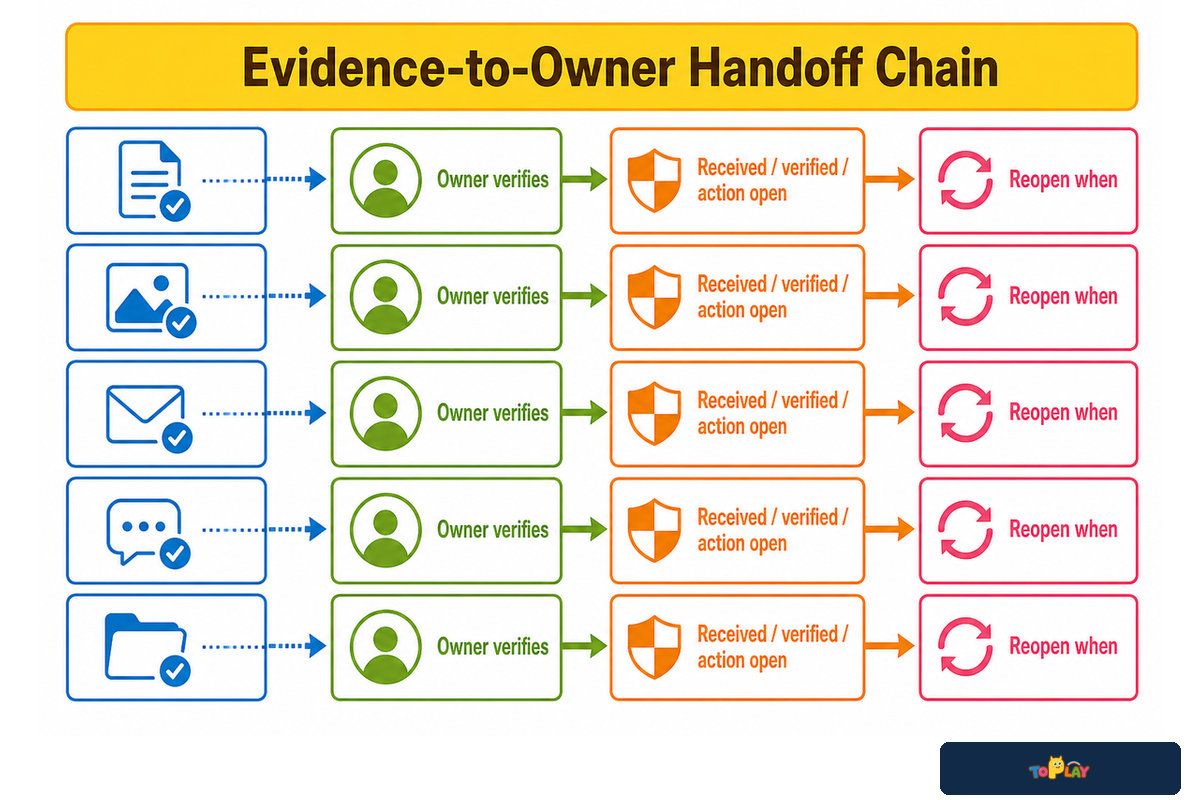
Controls are effective only when an owner receives, verifies, accepts, and retains evidence against the installed system. An Evidence-to-Owner Handoff Chain converts supplier and installer evidence into a live owner register; at least 2 named roles should be visible—the verifier and the acceptance owner—and if applicability remains unresolved or no action owner is named, the handoff remains incomplete.
| Evidence class | Owner verifies | Status | Reopen when |
|---|---|---|---|
| Intended use and users | Venue, ages, abilities, supervision, exclusions | Received / verified / action open | Programme or user group changes |
| Classification and basis | Product class, jurisdiction, current source | Received / verified / action open | Scope or rule changes |
| Approved drawing | Revision, boundaries, interfaces, access | Received / verified / action open | Any field deviation |
| Declarations and reports | Identity, scope, model, edition, exclusions | Received / verified / action open | Component or classification change |
| Delivery and damage record | Item identity, condition, shortages, photos | Received / verified / action open | Repair or replacement at site |
| Installation record | Installed basis, installer, dates, interfaces | Received / verified / action open | Adjustment or relocation |
| Deviation register | Difference, approval, risk, closure | Received / verified / action open | Related defect or later change |
| Acceptance checks | Condition, evidence, open actions, decision | Received / verified / action open | Failed check or incident |
| Inspection and cleaning programme | Task, frequency basis, competence, record | Received / verified / action open | Use intensity or finding pattern changes |
| Spare and change history | Approved reference, compatibility, installed date | Received / verified / action open | Part unavailable or configuration altered |
CPSC’s public-playground checklist supplies condition categories such as surfacing, openings, protruding hardware, and guardrails. Those are useful input fields within its scope, but they don’t replace a project-specific acceptance plan. The CPSC voluntary-standards page also explains its role without certifying a supplier.
According to Toplay’s site, orders come with an installation manual, dimensioned assembly drawings, and an installation video. Include these in the quote and provide them upon acceptance. Don’t consider them independent acceptance proof for the installed venue. For company context, see About Toplay.
6. Expose Hidden Operating Bottlenecks Before Purchase
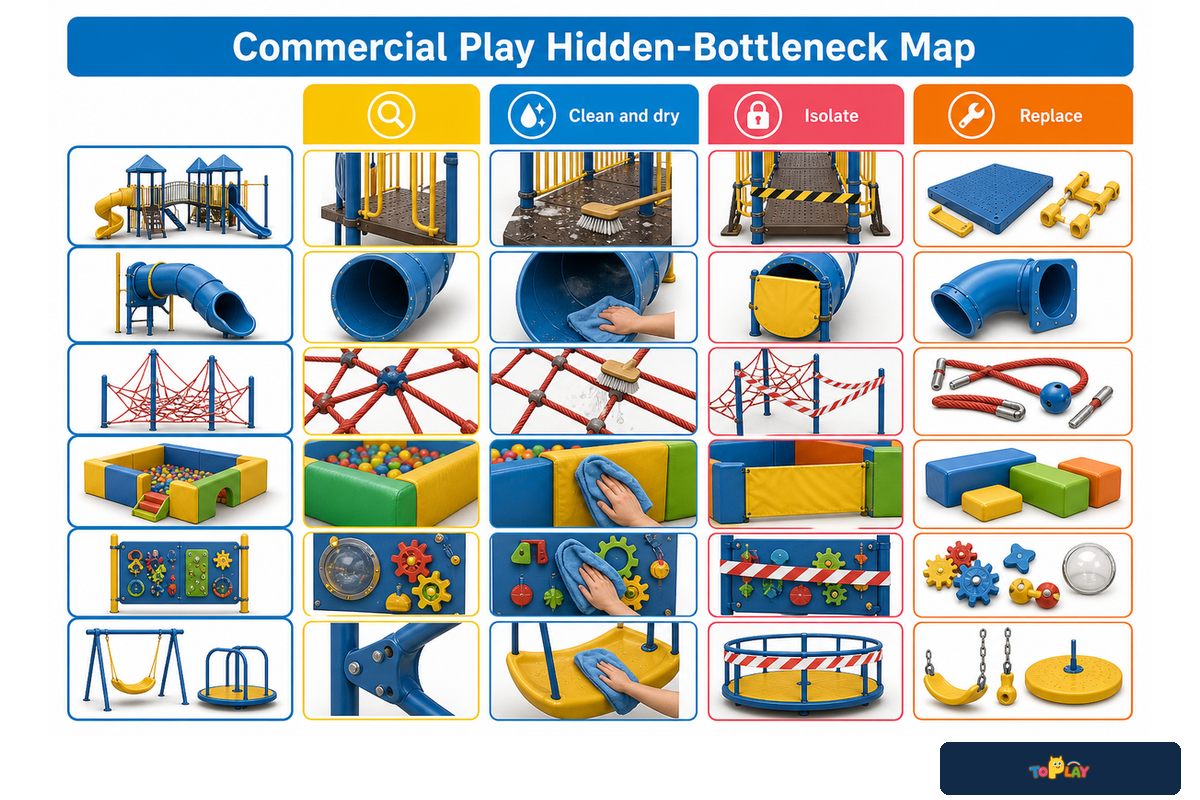
The Commercial Play Hidden-Bottleneck Map shows what catalogue images rarely describe: access for cleaning, drying, inspection, fault isolation, wear detection, service, and spare replacement. While components may be durable, they may not be maintainable. Component placement, interfaces, visibility, instructions, and ownership determine whether a small defect can be found and serviced.
| Family | Inspect | Clean and dry | Isolate | Replace | Owner decision |
|---|---|---|---|---|---|
| Connected structure | Ask how enclosed joints are reached | Verify access and drainage | Define zone closure | Check route and panel removal | Accept access before handover |
| Freestanding motion | Expose wear points | Verify material-compatible method | Prevent unintended use | Confirm part identity | Set stop-use criteria |
| Soft play | Check seams and concealed foam | Verify drying and reassembly | Close affected module | Match cover and insert | Define moisture escalation |
| Net and rope | Make abrasion visible | Reach contact points | Control adjacent routes | Verify termination and tension basis | Record repair limits |
| Sensory panel | Check controls and attachments | Protect openings and electronics | Disable safely | Retain module reference | Decide acceptable degraded mode |
| Surfacing | See displacement and damage | Use approved care method | Close affected use zone | Match system and performance basis | Define retest need |
| Boundary or gate | Observe hardware and operation | Reach tracks and latches | Control entry | Confirm compatible hardware | Set closure response |
| Themed finish | Separate cosmetic from functional damage | Verify coating care | Protect users from repair area | Match approved material | Route technical change separately |
| Mixed supplier interface | Name inspection boundary | Resolve method conflict | Assign shutdown authority | Control cross-system compatibility | One owner closes the interface |
The Hidden Bottleneck Map represents the tradeoffs between the requirements and constraints of the design process. The tradeoffs are represented by the views of different stakeholders. All of these inputs must be integrated before the final design is created.
For detailed visual and creative governance, use the separate custom indoor playground design guide. Theme decisions and operating-access decisions can interact, but they shouldn’t share one approval owner by accident.
7. Accept Installed Equipment Before Opening
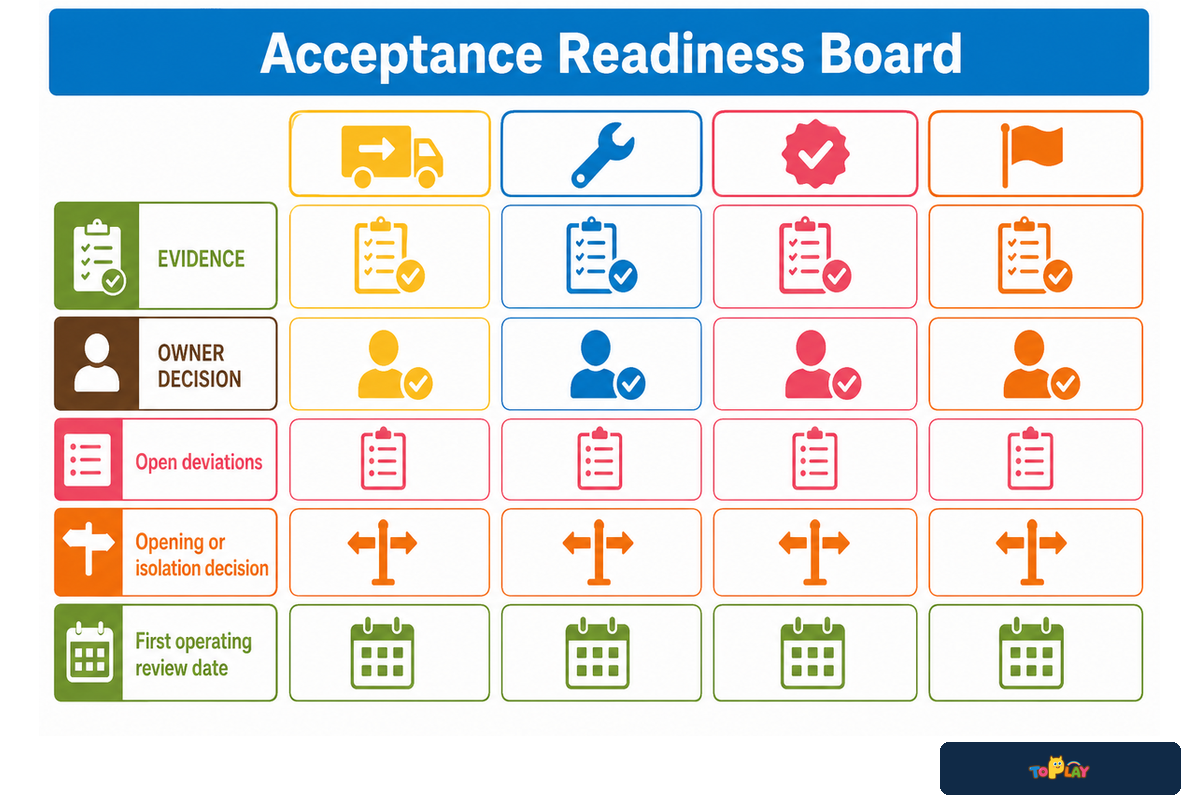
There are four distinct decisions: delivery, installation completion, acceptance, and opening readiness. Just because items show up on a packing list doesn’t mean they were installed as approved. It doesn’t mean deviations were resolved, owner records were received, or conditions are ready for users. Only the acceptance owner can change those conditions.
- Match the installed basis — identify drawing revision, equipment identity, location, and approved interfaces.
- Record deviations — photograph and describe every field difference, including its approval owner.
- Verify the evidence pack — connect each declaration, instruction, report, and supplier document to the installed item.
- Inspect conditions — record exact location, finding, immediate action, and closure evidence.
- Decide opening scope — open, restrict, isolate, or hold with a named authority and review date.
- Anchor the first operating review — set the applicable inspection and maintenance programme from the accepted configuration.
Use an Acceptance Readiness Board to capture installed configuration, open deviations, evidence status, corrective owner, opening or isolation decision, and first operating review date. Document a photo, date, owner, and decision for each item. Indicate the first operating review date, not just the first-use date. Be precise about location so a later reviewer can distinguish a closed defect from a similar new defect.
The CPSC checklist is useful evidence within its public-playground scope, while the 2025 Federal Register notice confirms the current handbook update. Neither source accepts the installed project for the owner. Opening authority remains a project and jurisdiction decision.
8. Operate, Inspect, Clean, and Change Without Losing Control
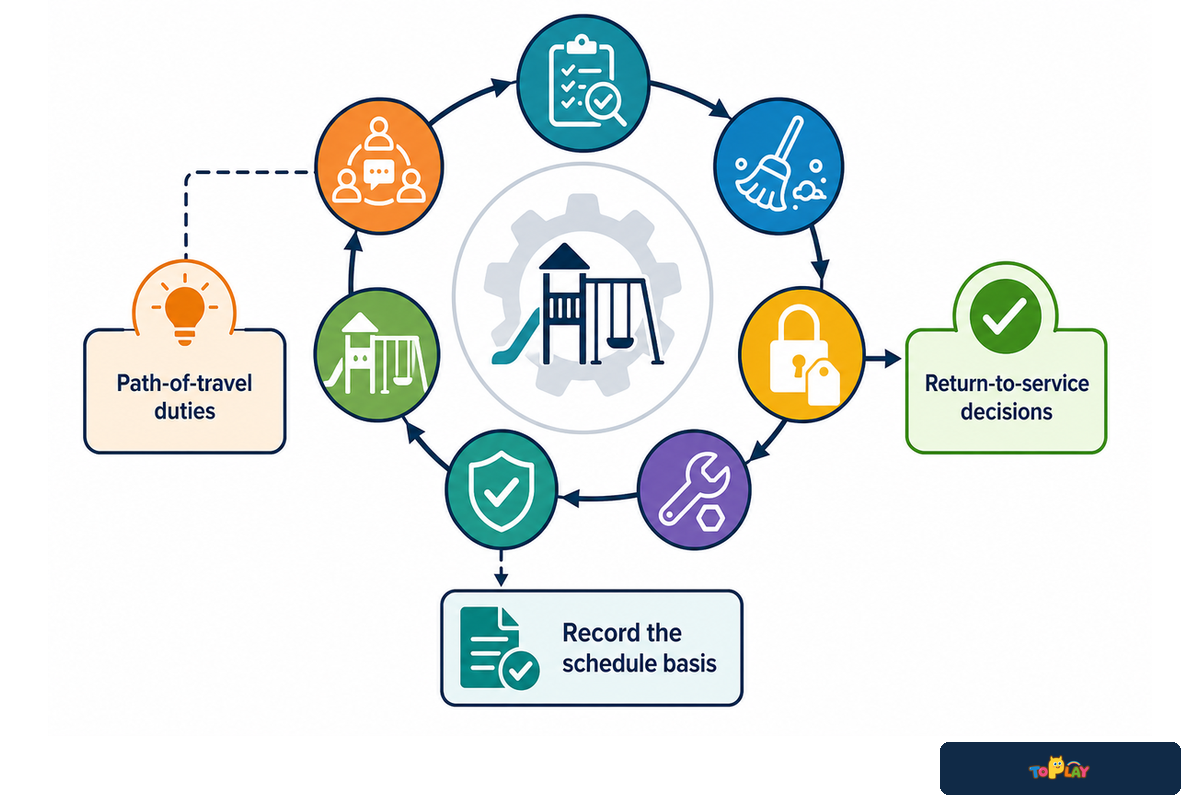
Although the Commission’s playground-equipment guidance may inform an inspection programme, other factors may dictate a more or less stringent interval. Base the inspection programme on available evidence, the applicable authority, programme rules, manufacturer instructions, use intensity, and prior findings. Record how equipment condition and environment affect the chosen schedule.
Venue-specific guidance can be more prescriptive. The federal Head Start playground-safety guidance describes a daily checklist and a longer monthly inspection checklist for early-childhood programmes. That’s a strong example of a programme-specific cadence; it shouldn’t be projected onto an unrelated mall, hotel, or entertainment venue.
“The requirements for playground equipment depend on whether it is intended for use at a home or at a public playground.”
U.S. CPSC, Playground Equipment business guidance
CPSC’s public-playground guidance indicates that inspections alone don’t constitute a complete maintenance programme. Other actions, such as isolating and fixing the issue, are also required.
There are several types of inspection, and to document one fully, record its type, location, anomaly, isolation decision, work owner, target completion, work reference, closure check, and release-for-service decision. If documentation doesn’t capture the closure check and release for service, a maintenance item may be documented while the system configuration remains unmaintained.
Changes made to a system require re-evaluating its configuration, applicability, accessibility, and maintenance. For an altered play area, the Access Board’s guide addresses relevant issues. Alterations can trigger path-of-travel duties; they aren’t simply labelled system modifications. Owners should perform a similar review to determine whether the alteration affects the original accessibility decisions.
Inspect and isolate affected equipment. Diagnose and document the corrective work. QA verifies completion. Control the procure-to-pay process for approved items and services. Disposition approval comes from the owner or risk authority. For Indoor version, see Toplay’s indoor playground safety rules guide.
9. Use the Replace-or-Retain Trigger Card
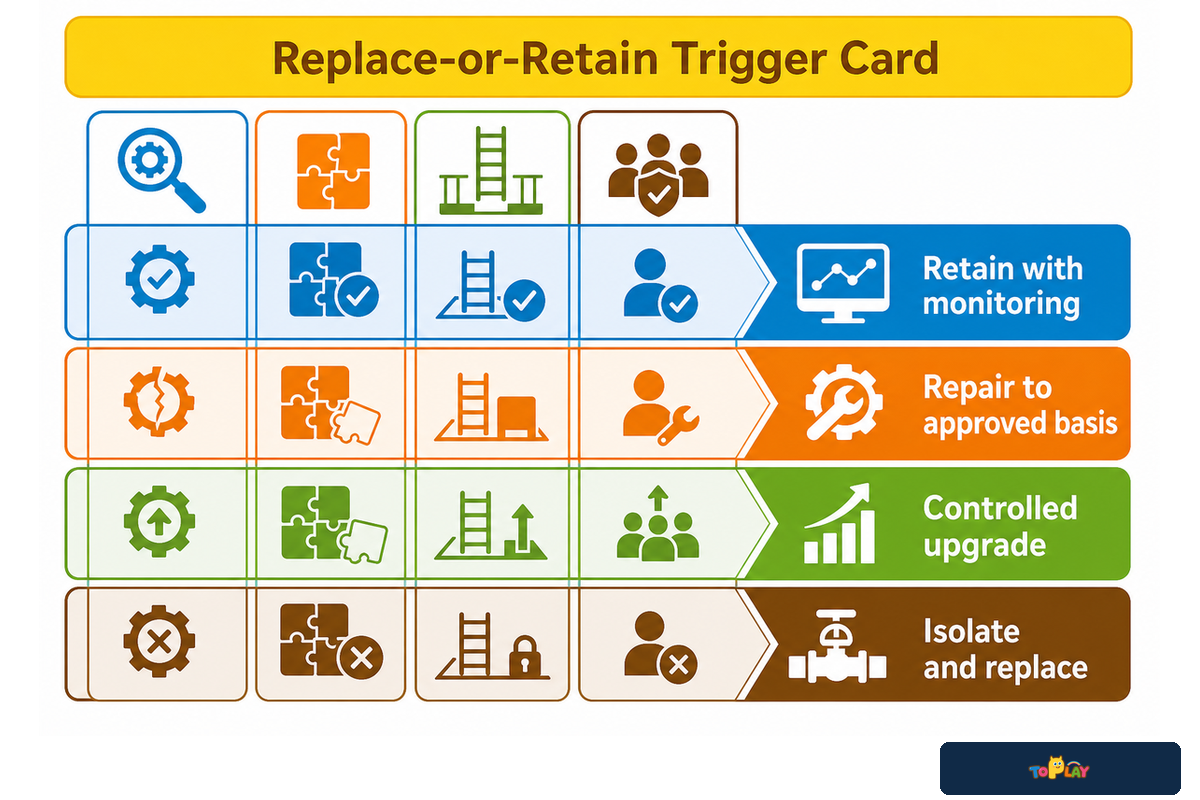
The decision to keep or replace a part isn’t based on age alone. A number of other factors are also considered and documented on the Replace-or-Retain Trigger Card, including evidence and user fit, access, and part compatibility. This card directs the owner to four controlled actions without inventing a universal service life.
| Outcome | Use when | Evidence needed | Do not use when |
|---|---|---|---|
| Retain with monitoring | Condition is acceptable and a stable finding is controlled | Inspection basis, trend, owner, review date | A hazard or failed required check is open |
| Repair to approved basis | A compatible repair can restore the accepted configuration | Part reference, instruction, repair and closure record | Compatibility or structural effect is unknown |
| Controlled upgrade | User fit, access, operation, or maintainability can be improved | Change review, updated drawing, applicability and acceptance | The change is being used to avoid resolving a hazard |
| Isolate and replace | Safe restoration cannot be demonstrated, parts are incompatible, or evidence is unrecoverable | Isolation record, decision authority, replacement brief | The decision is based only on cosmetic age |
Repeated defects deserve particular attention because they may point to a system problem involving access, the environment, user fit, instructions, interface ownership, or part selection. A trigger isn’t simply a third repair. It’s the point at which the team can no longer demonstrate controlled restoration to an accepted basis.
Key takeaway
Keep equipment when control is demonstrated, repair it when the approved basis can be restored, upgrade it through change control, and isolate it when evidence or condition cannot support continued use.
10. Turn This Guide into a Project Brief
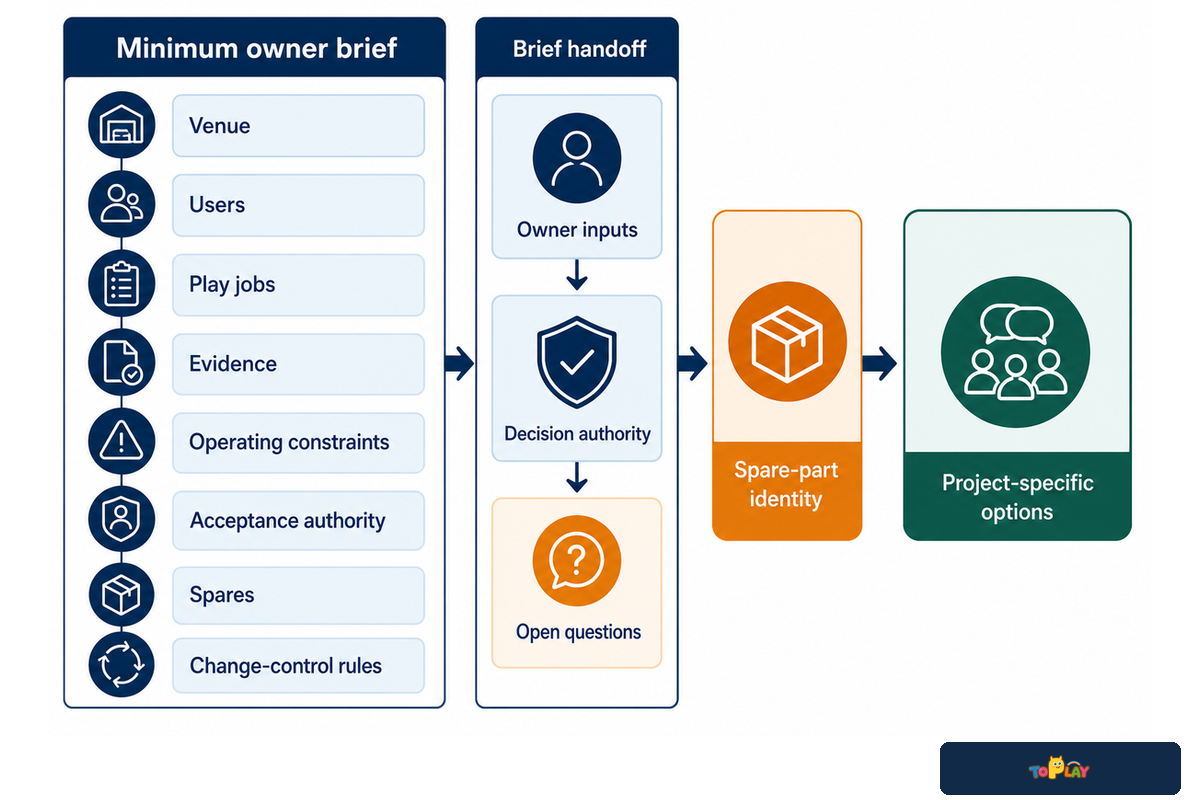
Writing a succinct brief can advance commercial discussions by separating owner decisions from supplier selections. Summarize the decisions that have already been made by the project team, including the venue, users, job aids, participation paths, evidence, operating constraints, acceptance criteria, expectation gaps, and change control. It should also identify the decision-making authority for the project. Search results may mention little tikes commercial products, a place of worship, early learning, ASTM, the Society for Testing and Materials, CAD, the Consumer Product Safety Commission, or commercial playground equipment designed for a park; verify each source’s scope before relying on it.
When developing a proposal for a new playground project, the owner brief and the playground proposal must be developed separately. Build the owner brief before the proposal scope and playground solution is defined. That scope and playground solution define the design and engineering of the solution, as well as supporting evidence. A buyer may compare the play environment, existing playground, every community, children of different ages, different ages and abilities, residential play, heavy use, and the benefits of playgrounds; only project evidence should decide. Information order matters because equipment designed for one venue may not be appropriate in another. Search labels may also say “make playground,” “commerical playground,” “playground possible,” “explore commercial playground equipment,” “spaces where children explore the world,” “playgrounds are designed,” “equipment built,” or “equipment creates”; those phrases describe positioning, not a control basis. Search and competitor copy may call a project “the perfect playground,” “best commercial,” “best playground,” “safe play,” “power of play,” “long-lasting,” “nature-inspired,” or “new commercial playground equipment”; those labels can also promise “commercial-grade play equipment,” “playground products,” “play components,” “years of active play,” “durable materials,” “inclusivity,” “decades of experience,” a “play experience,” a community’s identity, or “standards for commercial” coverage; treat all such phrases as marketing language, not evidence.
Minimum owner brief
- Venue type, jurisdiction, equipment class, intended ages and abilities
- Required play jobs and meaningful participation routes
- Applicable-evidence questions and who will verify them
- Inspection, cleaning, drying, access, isolation, and repair constraints
- Acceptance owner, opening authority, and closure-evidence rules
- Spare-part identity, compatibility, and expected record handoff
- Events that trigger reclassification, reassessment, upgrade, isolation, or replacement
Send that brief with your dimensions when you are ready to compare project-specific options. Toplay’s commercial Page owns layouts, equipment configurations, specifications, lead time, quotation, and trade terms. The indoor playground safety standards guide handles detailed applicability questions, while the childcare guide is the better route for daycare and early-education equipment decisions.
Discuss your indoor play project
Bring your owner brief, floor dimensions, intended users, and evidence questions. Toplay can then discuss a project-specific configuration without turning this guide into a quotation page.
Frequently Asked Questions
What is commercial play equipment?
Commercial play equipment is selected for managed public, institutional, hospitality, education, or leisure use. Size alone is not the important distinction. Owners must identify the equipment class, intended users, use context, evidence, installation basis, acceptance, inspection, cleaning, repair, and change responsibilities. Exact requirements still depend on the product, venue, jurisdiction, and current applicable guidance.
What is the difference between commercial and residential playground equipment?
Residential equipment is normally intended for a private household and a limited user group. Commercial equipment sits in a managed setting with more stakeholders, documentation, supervision, operating interfaces, and continuing controls. CPSC guidance also distinguishes home and public-use categories. A “commercial-grade” label is therefore not an acceptance verdict; classification and project-specific verification still come first.
What types of commercial play equipment are there?
Useful owner-side families include connected structures, freestanding motion or balance elements, soft play, toddler-scale components, sensory and social features, and support systems such as access routes, surfacing, boundaries, signs, and storage. Categories overlap. Compare the play job, intended users, participation routes, inspection access, cleaning burden, isolation method, and spare-part path, not just the catalogue name.
How do you evaluate commercial play equipment before buying?
Classify the equipment and venue, then use the Lifecycle Canvas to assign each decision, evidence item, owner, live record, and review trigger.
How often should commercial playground equipment be inspected?
No single interval governs every equipment class and venue. Use the strictest applicable authority, programme requirement, manufacturer instruction, and owner control for the installed system. Federal Head Start guidance, for example, describes daily and longer monthly checklists for early-childhood playground programmes, but that cadence shouldn’t be transferred to unrelated venues without verification. Record why the chosen schedule applies, which configuration it covers, who performs each task, how findings are isolated and escalated, what evidence closes a repair, and who authorises return to service. Revisit the cadence when use intensity, environment, equipment condition, instructions, or the user programme changes.
References & Sources
- U.S. CPSC, Playground Equipment business guidance
- U.S. CPSC, Public Playground Safety Checklist
- U.S. CPSC, Public Playground Equipment voluntary-standard activity
- Federal Register, 2025 Public Playground Safety Handbook update
- U.S. Access Board, Guide to Play Areas
- Head Start, Playground Safety Tips for Early Childhood Programs
Scope note: these sources address different equipment, venue, accessibility, programme, and jurisdiction questions. This guide combines them into owner decision tools without treating any one source as blanket project approval.



