Get in touch with Guangzhou Toplay amusement equipment co. Company

Daycare Soft Play Equipment: A Buyer Brief for Easier-to-Run Rooms

Project Build Support
Need an indoor playground layout before your next quote?
Send venue size, ceiling height, age range, theme direction and opening schedule. Toplay can match the play route, safety surface and delivery scope before you lock the quotation.
Layout fitFootprint, traffic and age zones
Build scopeEquipment, surface and installation
Quote pathFactory review before RFQ
RFQ Checklist
What to include for faster project matching
Venue and capacity
Floor size, ceiling height, entrance route, target age groups and daily visitor expectations.
Theme and operation
Brand direction, supervision plan, opening timeline and any food, retail or party-room requirements.
Delivery context
Send Project Details
City, floor access, installation window, local review needs and budget direction.
Daycare soft play equipment is a room-scale play system, not just a collection of toys and colors. You should identify it as a complete operating system. Numerous details still need to be worked out before a layout is required. These include the function of each zone, supervision of children, and the role of staff. Also, the plan for cleaning the equipment and determining the location of evidence must be set before the layout.
1 shared briefGive every bidder the same room and use inputs.
4 decision rolesProgram, operations, facilities, and procurement.
7 room inputsFreeze access and constraints before drawings.
1 evidence registerTurn adjectives into document requests.
First, keep the product families separate
Soft-contained play structures
Enclosed or bounded play systems with padded components, netting, platforms, slides, and related elements.
Enclosed or bounded play systems with padded components, netting, platforms, slides, and related elements.
Public playground equipment
A separate equipment context with its own guidance, use zones, and surfacing considerations.
A separate equipment context with its own guidance, use zones, and surfacing considerations.
Loose toys and movable items
Blocks, mats, riders, or role-play pieces that are not automatically part of the installed structure.
Blocks, mats, riders, or role-play pieces that are not automatically part of the installed structure.
Protective surfacing
A floor or impact-attenuation component, not evidence that the whole play system meets every requirement.
A floor or impact-attenuation component, not evidence that the whole play system meets every requirement.
The distinction matters because the CPSC Public Playground Safety Handbook says its guidelines are not intended for soft-contained play equipment, while the public ASTM F1918-21 record identifies a separate soft-contained-play scope. Neither source certifies a supplier or a proposed daycare installation.
Translate market labels into buyer decisions
A number of catalogs and online retailer web pages use similar headings and labels. The table below converts these headings into questions for the next line.
| Label type | Examples a buyer may encounter | Translate into the RFQ |
|---|---|---|
| Category language | indoor play equipment, indoor playground equipment, indoor soft, indoor soft play, daycare playground equipment, childcare playground | Name the product family, intended use, installed boundary, and applicable evidence instead of accepting a broad category label. |
| Facility language | play area, play space, play environment, learning environment, environment for children, environment for young children, daycare facilities, daycare centers, childcare centers, preschools, kids play cafe, daycares, childcare providers | Define the actual facility, license context, user groups, room, schedule, staffing, and local-review owner. |
| Movement language | active play, climber, obstacle course, soft play climbers, rock climbing wall, climbing structures, encourages climbing, encourage active, active learning | Record the action, access and exit, traffic direction, potential conflicts, supervision position, and stop-use condition. |
| Social or creative language | cooperative play, play experiences, engaging play, spark creativity, nature-inspired, creative solutions | State the program goal without promising a developmental, educational, behavioral, or therapeutic result. |
| Component language | soft play sets, play items, play blocks, foam play, activity mat, sensory ball pit, indoor wooden, play products | Identify whether each item is installed, loose, replaceable, structural, a surface, or an accessory, then request material and care details. |
| Age language | little ones, toddlers and preschoolers, preschoolers, toddler playground, preschool playground equipment, ages 6-23 months and 2-5, 6-23 months and 2-5 years | Do not copy a catalog band as a universal rule; verify the specific configuration, abilities, actions, controls, and jurisdiction. |
| Development language | developing motor skills, fine motor skills, young children to explore, ideal for early childhood, early childhood | Describe an intended activity choice and involve qualified staff when an outcome or individual support need is asserted. |
| Safety and quality language | safe and fun, safety standards, playground safety, safe play, provide a safe environment, safe environment for young children, high-quality soft play equipment | Turn every adjective into a scoped evidence request; do not inherit a guarantee from marketing copy. |
| Commercial or customization language | commercial playground, playground solutions, custom indoor, custom play | Ask what changes, who approves it, which evidence remains applicable, and how drawings, parts, price, and responsibilities are revised. |
| Environment language | outdoor playground, outdoor play, outdoor playground equipment, indoor and outdoor, home play areas, indoor use | Keep environment-specific equipment and guidance separate; verify the offered product’s intended setting and installation conditions. |
| Search shorthand | play indoor, daycare play, play center, play zone | Rewrite the phrase as a measurable room, user, action, access, supervision, cleaning, and evidence requirement. |
| Design claim | play equipment designed for a named group or task | Request the design basis and configuration-specific evidence rather than assuming the phrase proves fit. |
1. Start With the Daycare Operating Brief, Not a Product List
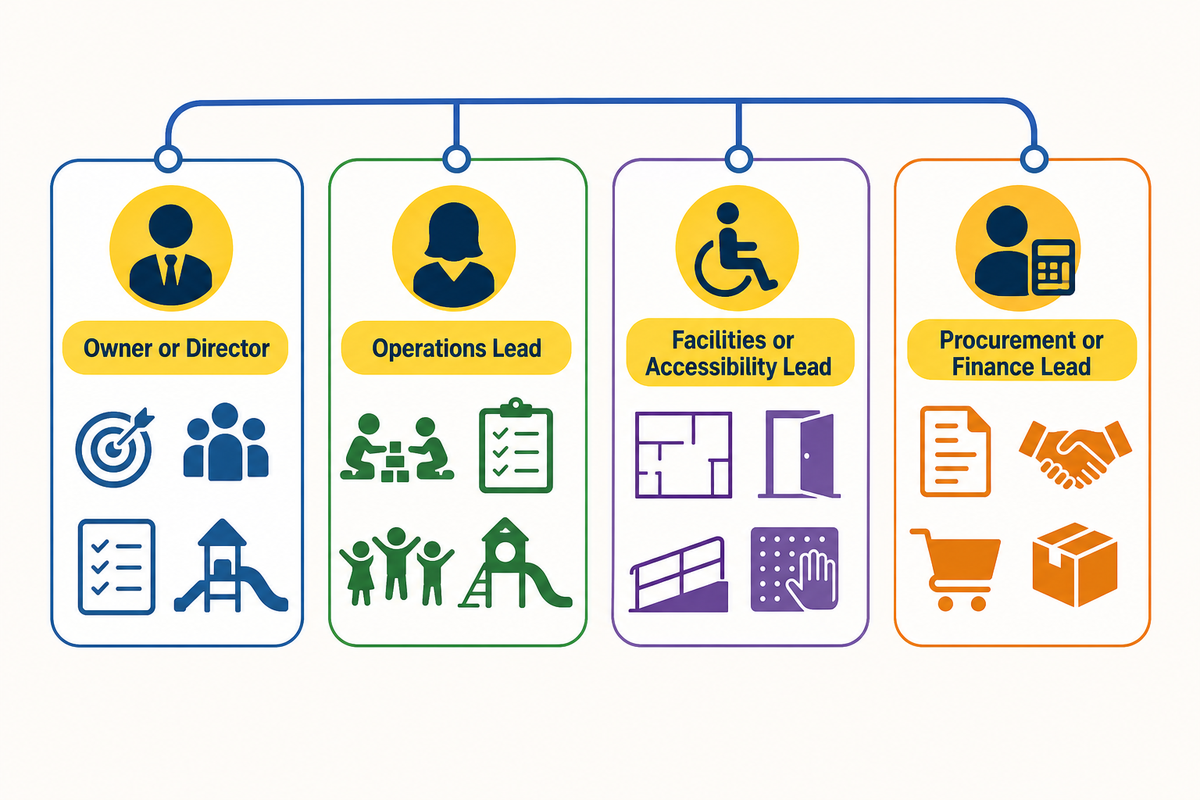
When designing a play space, pictures of equipment should be analyzed later because an unresolved staff-workflow mismatch creates procurement risk that a qualified reviewer must close. This is true only after the workflow of the staff has been analyzed and the other requirements of the situation have been clarified.
| Decision role | Owns before the RFQ | Questions that must be answered | Handoff evidence |
|---|---|---|---|
| Owner or director | Program purpose, operating boundaries, budget authority | Which children will use the room, when, and under what supervision model? | Approved operating brief and local-review owner |
| Child-development or operations lead | Age and ability gates, activities, transitions, behavior rules | Which play actions fit each group, and which interactions need separation? | Zone-use matrix and staff-flow notes |
| Facilities or accessibility lead | Measurements, routes, egress, utilities, access, installation constraints | Can the system be delivered, assembled, inspected, cleaned, and replaced? | Dimensioned room-and-access card |
| Procurement or finance lead | Common scope, evidence requests, exclusions, service terms | Are the quotations describing the same project and the same responsibilities? | Base RFQ, clarification log, and comparison sheet |
There are a number of stakeholders who may review the policies and procedures of a Head Start program. These may differ depending on the project, so record the name and scope of each reviewer.
2. Gate Every Zone by Age, Ability, Play Action, and Supervision
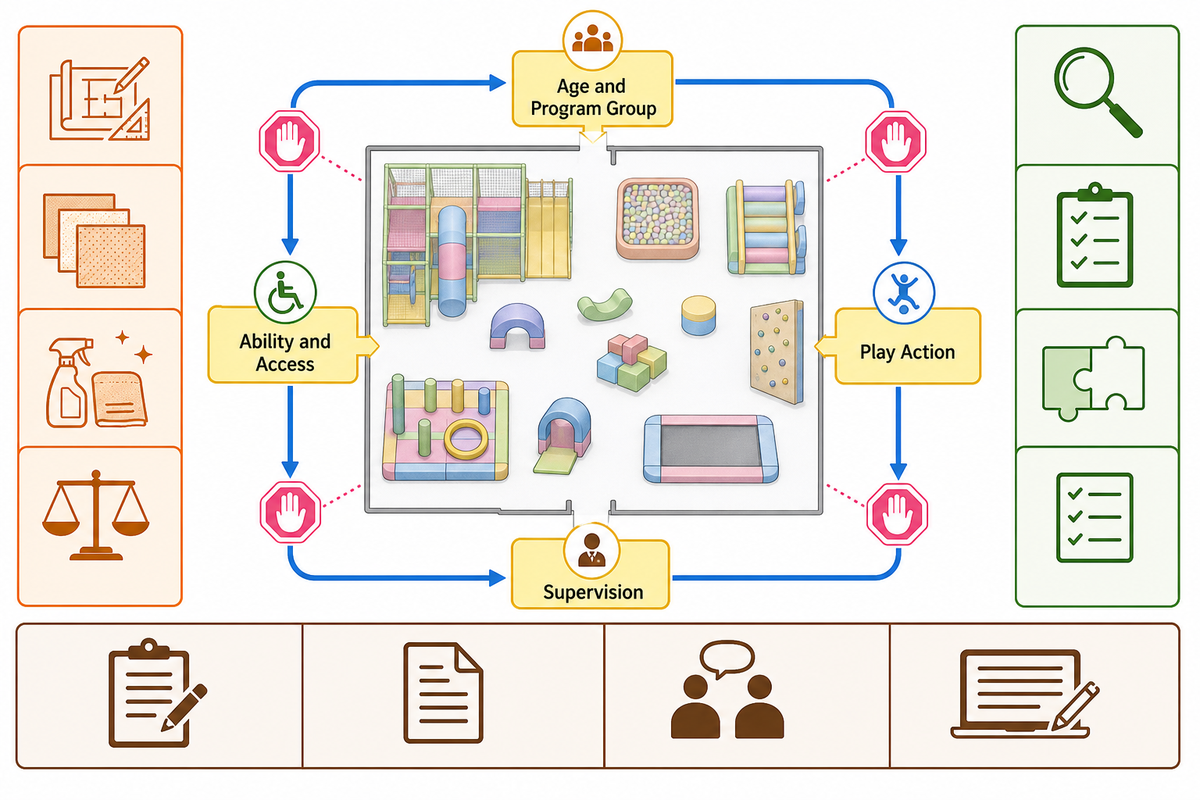
Different age groups have different abilities in play, so use the roles as a starting structure rather than a universal chart and treat any age-zone mismatch as a procurement risk. The equipment must be set up to control access to play and supervised to keep smaller children from older-child areas.
| Concurrent gate | Record in the brief | Design implication | Stop condition |
|---|---|---|---|
| Age and program group | Groups that may enter concurrently | Separate access, pacing, scale, and transitions where needed | The supplier uses one broad age label without explaining shared use |
| Ability and access | Mobility, balance, transfer, communication, and sensory-access questions | Offer more than one way to enter, participate, pause, or exit where the project requires it | A nominal age match hides an access barrier |
| Play action | Crawl, climb, balance, slide, build, pretend, or reset | Match circulation and landing areas to the action, not the product name | Conflicting actions cross the same path |
| Supervision | Staff position, sightline, intervention route, and head-count method | Remove blind pockets and preserve quick access to entries and exits | A child can disappear from view during normal use |
The CPSC soft-contained-play checklist includes prompts on posted size limits and separation of younger children from older children. With regard to Head Start programs, 45 CFR 1302.47 indicates that covered programs must address, among other things, age appropriateness, supervision, cleanliness, and equipment safety.
Buyer action: write one sentence for every zone in this form: “This zone is for [group], permits [actions], requires [staff position/control], and excludes [conflicting use].” If the sentence is hard to complete, the zone is not ready for supplier selection.
3. Match Each Play Action to a Developmental and Operating Goal
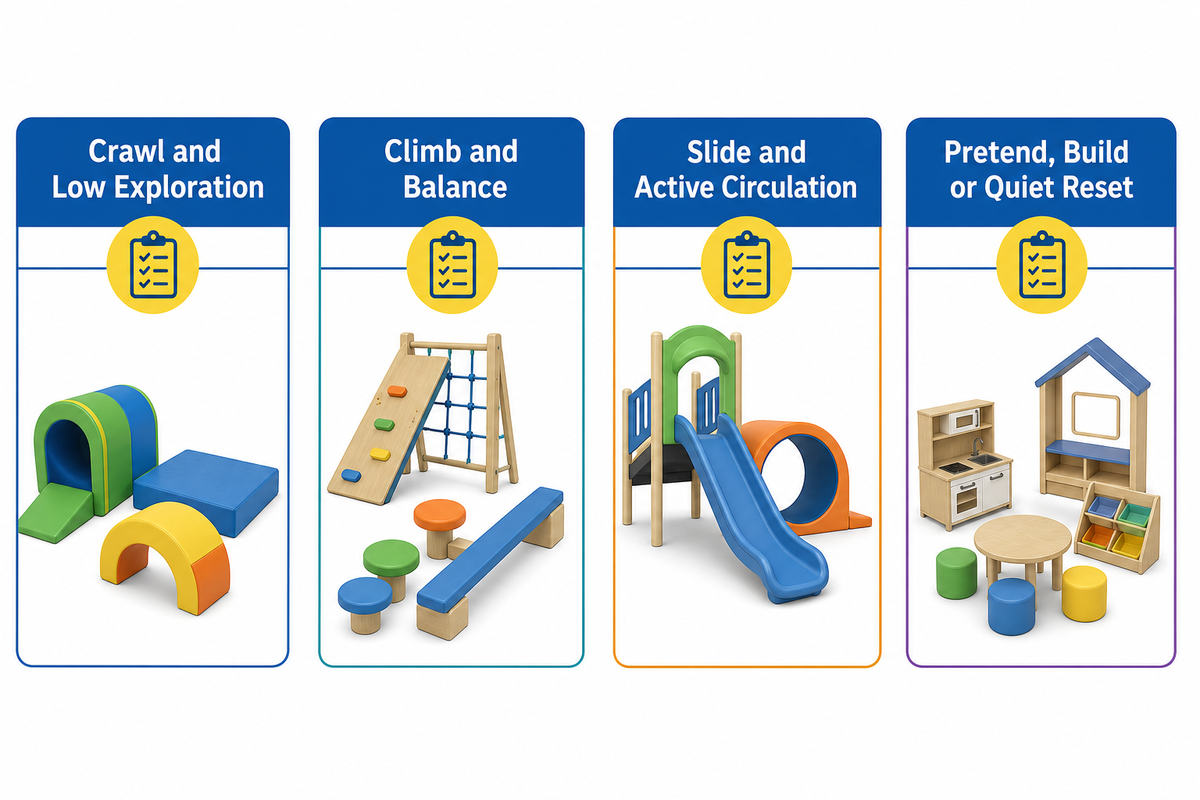
A feature earns floor space when it supports a stated program goal and can be managed in the available space. If an individual support need is in scope, record the goal, responsible reviewer, and evidence boundary without promising a therapeutic outcome.
Crawl and low exploration
Possible goal: offer a toddler or preschool group a lower-complexity movement choice.
Check floor transitions, edges, traffic crossings, caregiver access, and the route back to a quiet area.
Climb and balance
Possible goal: provide graded movement challenges without forcing every child into the same sequence.
Check entry control, the action above and below, staff reach, and the recovery route.
Slide and active circulation
Possible goal: create a predictable loop rather than a collision point.
Check the exit area, upstream queuing, opposite-direction use, and whether staff can interrupt unsafe behavior.
Pretend, build, or quiet reset
Possible goal: offer imaginative play and choice for children who don’t want continuous high-energy movement.
Check loose-part control, visibility, noise spillover, cleaning method, and whether a play set or ball pit creates hidden storage or supervision points.
Sensory components can be described by their available intensity levels and options for breaks. The component shouldn’t be presented as an individualized sensory activity for a child’s particular needs without qualified professional review.
4. Freeze Seven Room and Access Inputs Before Anyone Draws the Playground
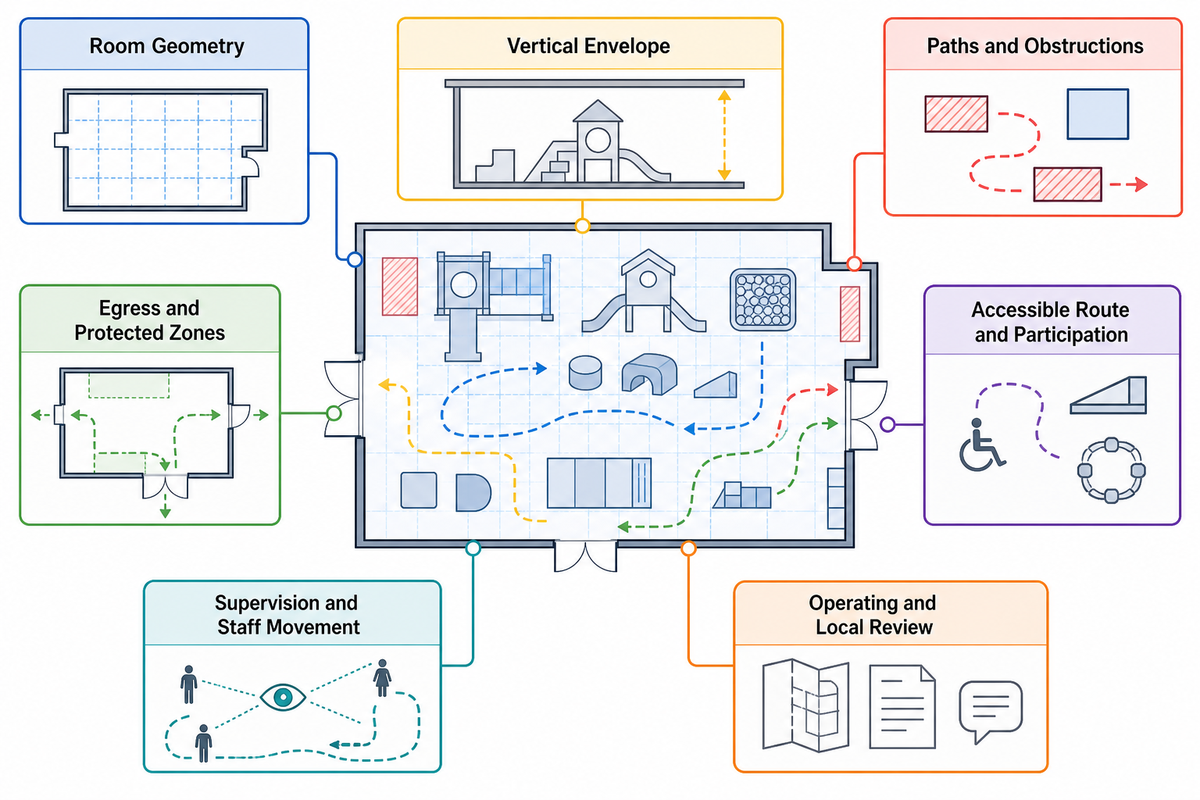
The definition of adequate space should be determined from the space’s location and use, the activities to be carried out, the equipment to be used, the number of persons using the space, and project rules because guessing from total area creates layout risk.
- Describe the layout of the room in terms of doors, windows, obstructions, etc. and state the total area of the room.
- Usable vertical envelope: State the total area of the vertical space of the room and explain what can’t be built over that space.
- State the total area of the pathways and describe any obstructions, but do not treat area as a universal square-foot figure.
- Egress and protected zones: Indicate the egress route and explain any barriers to the egress route.
- Accessible route and participation inputs: Identify issues related to the project’s definition of clear space, address changes of entry and exit points, surface types, and handoff locations.
- Position normal supervision and staff movement paths, handoff locations, paths to and from interventions and toilets.
- Document operating and local review inputs. These include occupancy, schedules, access for cleaning and service, building and licensing constraints, and fire and health restrictions.
Weak brief
“We have about 80 m². Please send a design.”
No clear dimensions, delivery path, ceiling conflicts, route, users, actions, or local review boundary are frozen.
VS
Comparable brief
“Use the attached seven-input card and mark every assumption.”
The supplier must show the proposed system, circulation, entries, supervision points, excluded areas, installation route, and open compliance questions.
For applicable U.S. projects, the 2010 ADA Standards include play-area and soft-contained-play provisions, but project applicability still requires qualified review. Use the full indoor playground design process for concept-to-installation decisions that sit outside this buying brief.
5. Ask for Evidence Behind “Safe,” “Commercial,” and “Easy to Clean”
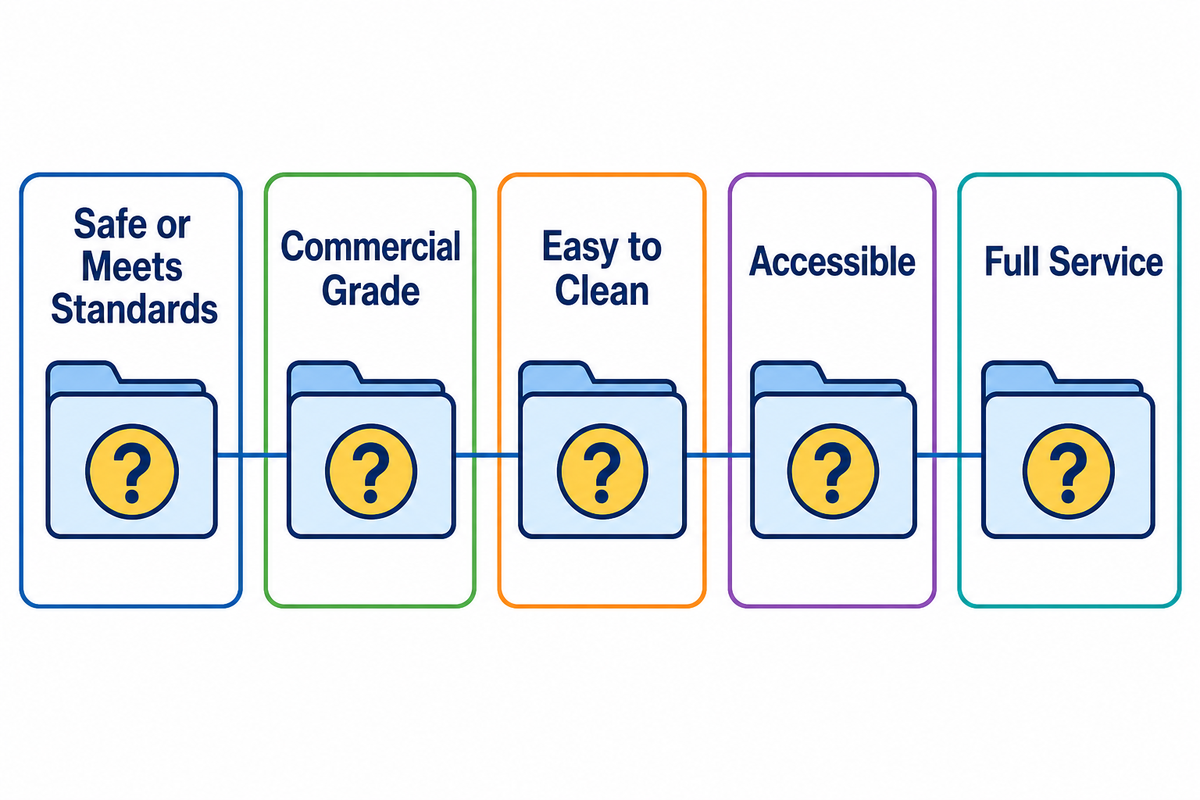
Each important claim is supported by reference to a specified configuration or plan and by the name of the owner of the review. General brochures don’t identify systems that are appropriate for the project.
| Supplier claim | Ask for | Bind it to | Keep open until |
|---|---|---|---|
| “Safe” or “meets standards” | Applicable standard and edition, report scope, issuing party, exclusions, and installation assumptions | Quoted model, materials, components, layout, and destination | Qualified review confirms relevance and the delivered evidence matches |
| “Commercial grade” | Material and construction schedule, intended use, inspection points, replaceable parts, and maintenance instructions | Actual user group, operating hours, actions, and room | The supplier defines what the phrase means for this offer |
| “Easy to clean” | Surface list, seams and closures, access method, approved products, procedure, drying or reopening conditions | Each material and component, including hidden or high-touch areas | Operations confirms the method is feasible and compatible |
| “Accessible” | Route, entry, transfer, clear-space, surface, and participation details with the applicable project criteria | Facility scope and proposed layout | The project’s accessibility reviewer closes the item |
| “Full service” | Responsibility matrix for design, freight, unloading, storage, installation, inspections, training, documentation, and after-sales support | Named party, place, timing, exclusions, and acceptance evidence | Every boundary is written into the commercial offer |
The public ASTM page identifies F1918-21 as an active soft-contained-play specification and describes its soft-contained-play scope. The public ASTM page identifies F1918-21 as an active soft-contained-play specification; it does not certify a quoted configuration or resolve project-specific accessibility requirements. Accessibility issues outside the cited scope require qualified project review.
Inspection handoff: procurement should not turn the operating routine into one line that says “maintain regularly.” Assign pre-opening, scheduled, incident-triggered, repair, and stop-use decisions through the existing daycare playground safety checklist.
6. Design for Staff Sightlines, Cleaning Reach, and Component Access
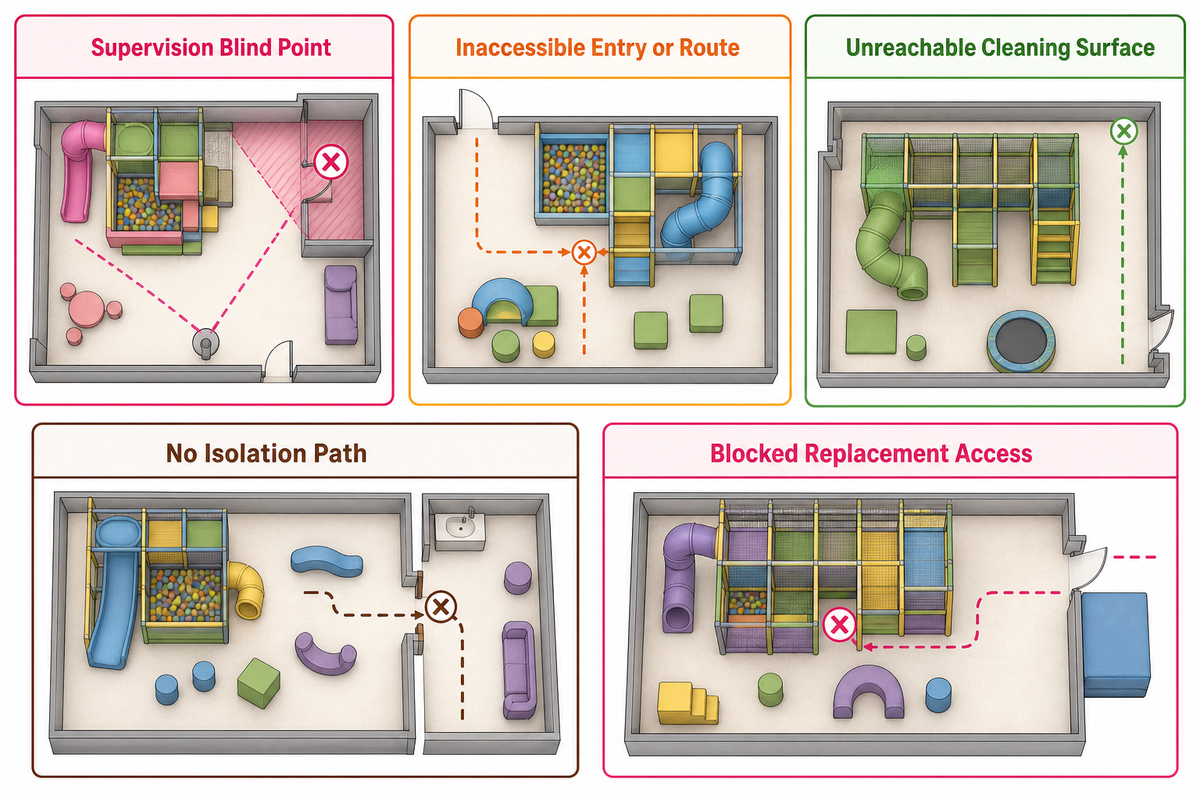
Consider staff supervision, surface care, inspection, and replacement before specifying materials or color because a qualified review should expose maintenance risk while changes are still possible.
| Hidden bottleneck | Red-line question | Evidence or demonstration | Go condition |
|---|---|---|---|
| Supervision blind point | Where can a child be hidden by a panel, turn, platform, or crowd? | Staff-position sightline review using the proposed layout | Normal staffing can see and reach the zone |
| Inaccessible entry or route | Does the intended route reach the required entry and participation point? | Dimensioned route and entry details reviewed for the project | Applicable access questions are closed, not deferred |
| Unreachable cleaning surface | Can staff reach seams, undersides, ball areas, enclosed corners, and high-touch points? | Supplier-led cleaning demonstration and surface schedule | The written method fits staff tools, time, and chemistry controls |
| No isolation path | Can one component or zone be closed without losing control of the rest of the room? | Barrier, signage, and stop-use procedure | Operations can isolate a defect or spill promptly |
| Blocked replacement access | Can a damaged panel, pad, net, or fastener be identified, removed, delivered, and installed? | Exploded parts view, identifiers, access route, and responsibility | The replaceable item is genuinely replaceable in the room |
The CDC’s early-care guidance defines the differences between cleaning, sanitizing, and disinfecting. Manufacturer’s instructions must be referenced for further guidance. Don’t make assumptions about the effectiveness of one chemical on all surfaces.
Clean
Remove dirt and organic material using a surface-compatible method; record tools, sequence, access, and drying conditions.
Sanitize
Use only when the operating plan and product directions call for it; record the target surface, product, process, and reopening rule.
Disinfect
Use an appropriate product and label-directed process for the defined circumstance; never improvise chemical mixing or universal compatibility.
Inspect and isolate
Pair surface care with checks for tears, loose connections, damaged padding, trip conditions, and other stop-use triggers.
Use the accompanying documents for the indoor playground operating rules and the indoor playground maintenance checklist. This text sets the procurement limits: make the room operable on paper before accepting the layout. Don’t accept the final layout of a space unless you can first adjust the design to make it operationally ready to use.
7. Compare Custom and Prefabricated Options on the Same Scope
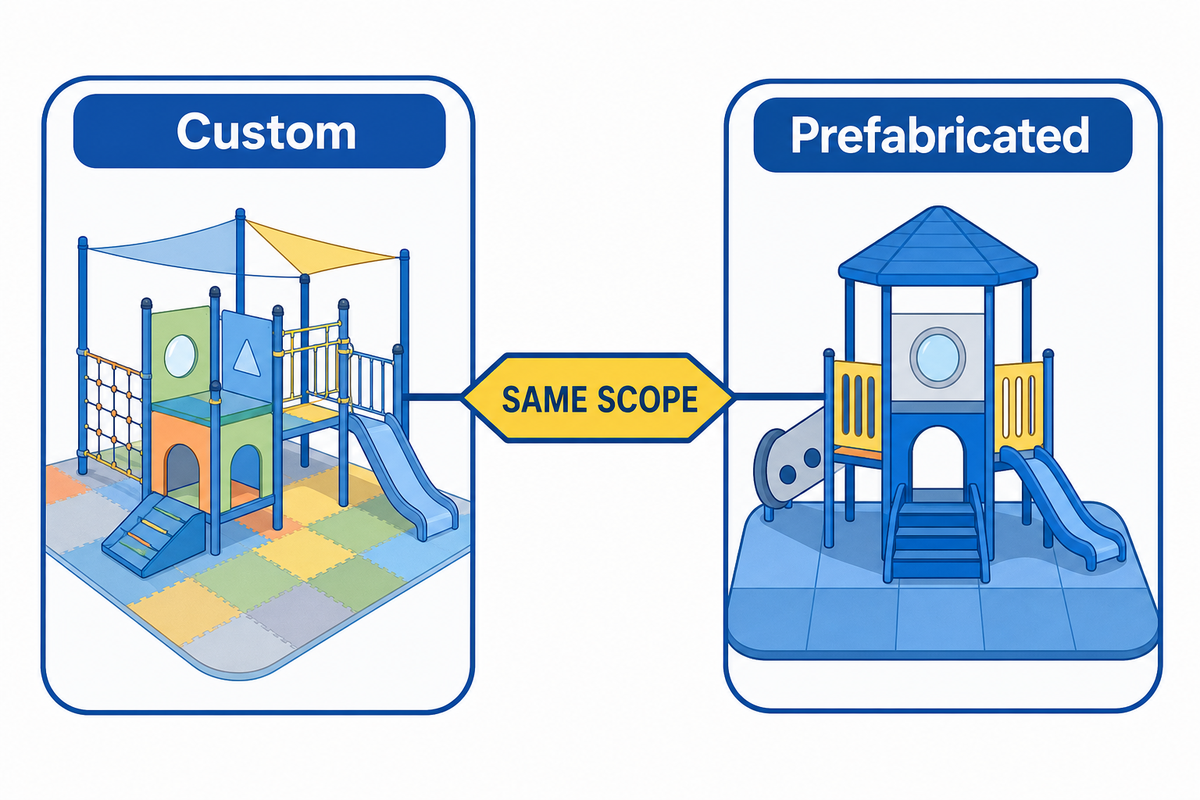
Any method to achieve room closure has advantages and disadvantages, so compare custom and prefabricated systems against the same documented scope because an unqualified shortcut creates procurement risk. The best method is determined by the extent to which it meets the use, maintenance, and alteration requirements of the system.
Custom may fit when
The room or program has hard constraints
- Columns, routes, ceiling conflicts, or egress zones sharply limit geometry.
- Activity mix, branding, access, or supervision requires a tailored arrangement.
- The buyer can support a longer review and change-control process.
- Drawings, component IDs, and acceptance evidence remain configuration-specific.
OR
Prefabricated may fit when
A known set closes the requirement
- The clear room envelope and access path suit the published configuration.
- The intended users and actions match documented limits.
- Standard components simplify review, parts identification, or future changes.
- The quotation still states installation, evidence, service, and exclusion boundaries.
A patent from years ago describes removable modular play elements. Patents and historical documents, in general, don’t provide any guarantees for safety and usability in the modern day. You must consider the methods by which the components are identified, accessed, and substituted. You must also take into account the documentation and acceptance processes for this project.
8. Issue One Base RFQ, Then Control Clarifications and Local Requirements
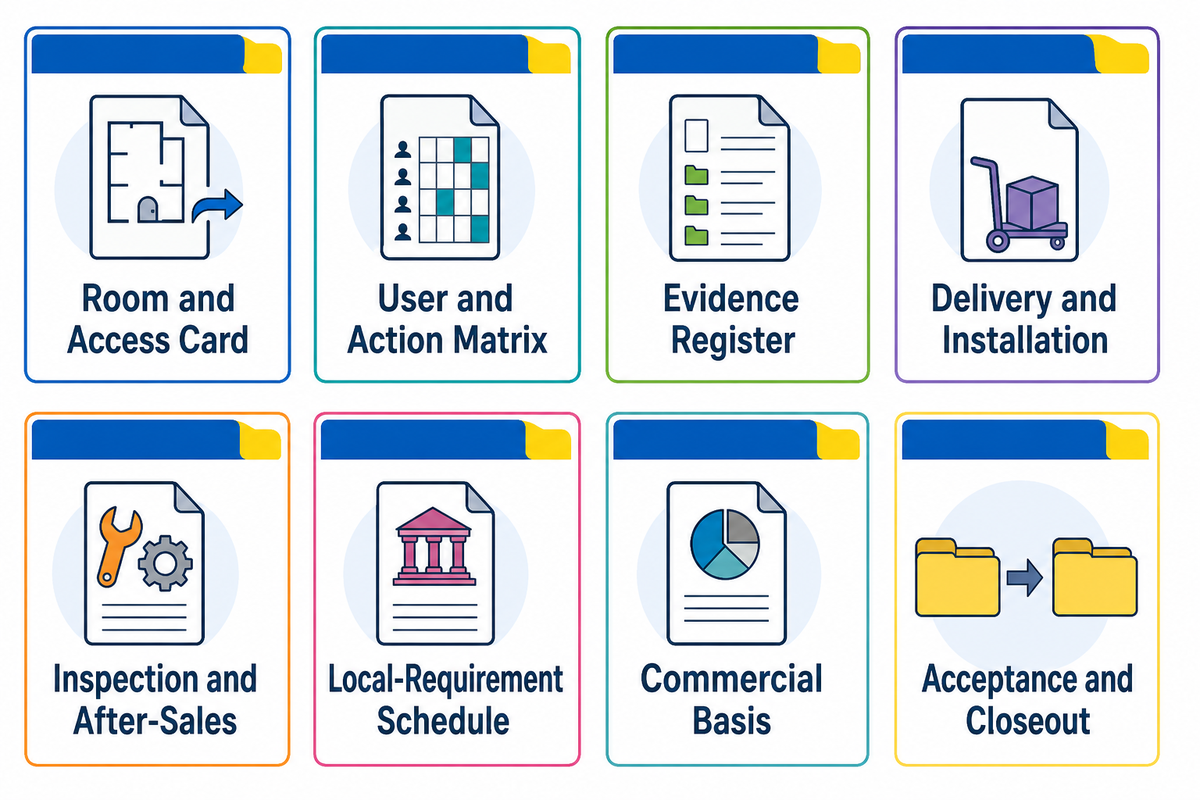
There can be too many price variations when suppliers assume different service boundaries, user groups, activity mixes, evidence scopes, and qualified review owners. Each quotation may use a different service boundary and assume a different user group and activity mix. Send the same request to each supplier, and attach a project requirement schedule.
25Room and access fit
20Age, ability, action fit
20Evidence completeness
20Operations and service boundary
15Commercial clarity
As stated earlier, the 100-point criteria are a hypothetical example. Change the example weights before bids arrive, record the reason, and apply the same version to every supplier.
| Requirement type | Required response | Clarification log | Comparison rule |
|---|---|---|---|
| Room and access card | Marked drawing plus every assumption and excluded zone | Revision, date, issuer, recipients | Score only the common revision |
| User and action matrix | Supported groups, intended actions, restrictions, and controls | Any proposed alternative and its impact | Do not reward an unrequested expansion |
| Evidence register | Document name, scope, configuration ID, issuer, date, exclusions | Open, answered, accepted, rejected | “Available” is not the same as attached |
| Delivery and installation | Freight, unloading, storage, route, assembly, site interfaces, protection, waste | Named responsibility for every handoff | Normalize owner-supplied work into the comparison |
| Inspection and after-sales | Commissioning, manuals, training, parts, response path, warranty terms | Requested term and written supplier answer | Compare written scope, not general promises |
| Local-requirement schedule | Buyer-identified licensing, building, fire, health, accessibility, and landlord items | Responsible reviewer and closure evidence | Do not make the supplier the unnamed authority |
| Commercial basis | Currency, taxes, payment events, quote validity, options, allowances, and exclusions | Any changed commercial assumption and recipient list | Normalize only documented differences |
| Acceptance and closeout | Drawing approval, delivered-document list, inspection ownership, punch list, and handover evidence | Required approver, due stage, and closure record | Do not treat shipment or installation alone as acceptance |
Childcare.gov explains that state and territory licensing requirements vary, so no single article or supplier statement can replace the relevant agency and project reviewers. Public procurement sources such as FAR 15.203 offer a useful analogy for stating a common requirement and evaluation basis, but this scorecard is a private-buyer framework rather than legal procurement advice.
Turn the brief into a project conversation
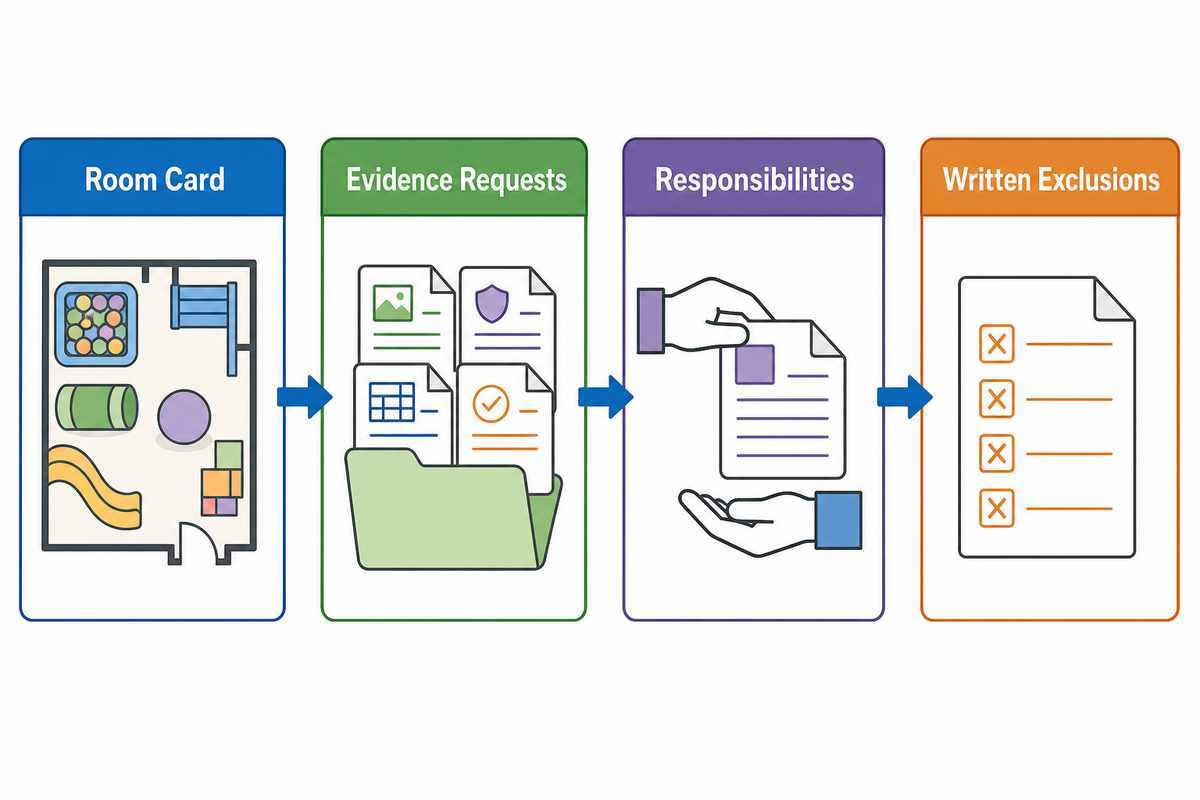
Toplay describes itself as a manufacturer of customizable indoor children’s playground equipment, established in 2014 and serving projects in more than 40 countries. Treat these as company-supplied background because assuming they apply to a specific configuration creates procurement risk; confirm the evidence, responsibilities, response terms, and exclusions with a qualified review owner in the written quotation.
When discussing configuration and quotation scope for the custom playground options for kindergartens and daycare rooms (link provided), use the information provided in the commercial handoff. Provide the same room card and supporting evidence to all bidders.
9. What the 2025–2026 Search Signals Change, and What They Do Not
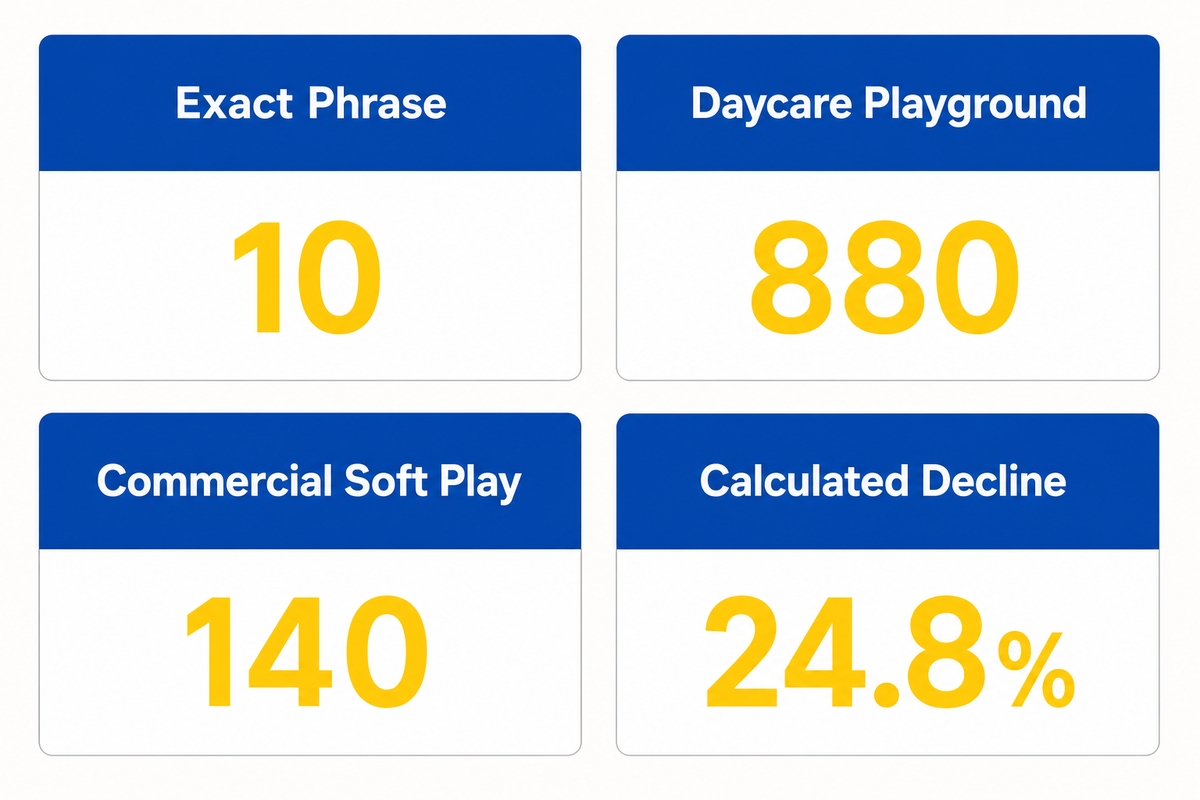
The phrase “daycare soft play equipment” is a narrow buyer expression; discovery labels also include “daycare soft play equipment prices,” “daycare soft play equipment for sale,” and “commercial soft play equipment for sale.” It isn’t a market index. The latest third-party keyword estimates show an average monthly search of 10 over the last year and a calculated 24.8% decline against months 24–36, not an expected decrease. Related terms were estimated to have higher search volumes, but treating platform estimates as project demand creates risk because a qualified buyer still needs room, use, evidence, and supplier-scope inputs.
| Signal | What it suggests | What it cannot prove | Decision |
|---|---|---|---|
| Exact phrase: 10 average searches | Specific procurement language has a small audience | Total category demand or revenue | Write for buyer task completion, not traffic volume alone |
| Daycare playground equipment: 880 | Many buyers use a broader parent term | That outdoor and soft-contained products are interchangeable | Use broader wording for context while preserving product boundaries |
| Commercial soft play equipment: 140 | Commercial intent extends beyond daycare | That every commercial product fits childcare use | Require daycare-specific use and operating evidence |
| Exact-query decline | The search phrase may be volatile or unusually narrow | Market contraction | Do not publish a market-growth percentage |
The relevant change is to add examples, explain or provide the answer to the buying concern. Don’t speculate on the company, provide/request business information and/or financial documents.
10. Frequently Asked Questions
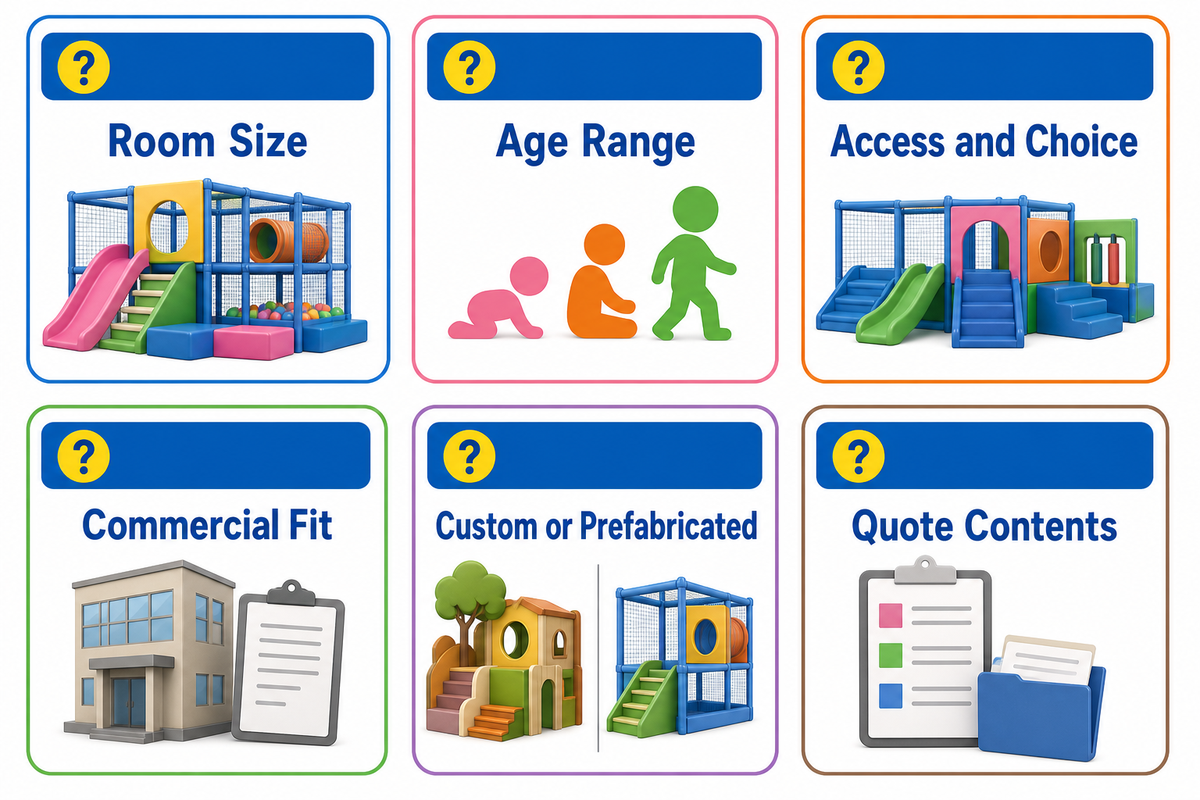
How much space do I need for daycare soft play equipment?
There’s no responsible universal area figure. Start with clear room geometry, ceiling and service conflicts, delivery path, exits and protected zones, accessible routes and entries, supervision positions, staff movement, intended users, play actions, and local requirements. Ask the supplier to mark assumptions, circulation, proposed equipment, entries, and applicable use zones on a dimensioned drawing, then have the responsible project reviewers confirm the layout before purchase.
What age range is indoor soft play equipment designed for?
The answer belongs to the specific product, configuration, activity, and operating plan. Record intended toddler, preschool, or other program groups; developmental abilities; size or use restrictions; access controls; and supervision together. Request the supplier’s documented limits and separate groups when their actions, speeds, abilities, or collision risks conflict, because one age label doesn’t establish readiness for every child or every zone.
Can indoor play equipment support children with sensory processing needs?
A buyer can ask for lower- and higher-intensity choices, predictable routes, pauses, visible exits, quieter imaginative areas, and different ways to participate. Treat these as access and choice features, not medical outcomes. If an individual support plan or therapeutic claim is in scope, assign it to a qualified reviewer and ask the supplier to document how the actual route, materials, sound, lighting, entries, and staff access work together.
What is the difference between home indoor play equipment and commercial daycare equipment?
Don’t rely on the adjective “commercial” alone. A home product, loose toy, public playground component, and soft-contained commercial system may have different intended uses, evidence, installation conditions, inspection needs, and exclusions. Ask for the offered product’s intended users, material and construction schedule, applicable standard scope, inspection and maintenance instructions, surface-care compatibility, installation assumptions, replacement-part method, warranty terms, and exclusions. Also ask who designs the site interface, who unloads and installs, which inspections occur before use, what documents identify replacement parts, and what the warranty doesn’t cover. Compare those answers with the daycare’s actual room, supervision plan, group schedule, local requirements, cleaning resources, and expected operating pattern. A product sold for frequent use still needs a project-specific fit decision.
Should a daycare choose custom or prefabricated soft play equipment?
Choose custom when hard room or program constraints require configuration-specific design and your team can support the review process. Choose a prefabricated set when a documented configuration closes the same requirement with fewer assumptions; in both cases, compare the same evidence and service boundaries.
What should be included in a daycare soft play equipment quote?
Include the configuration and drawing revision, intended users and actions, room and access assumptions, material schedule, applicable evidence, cleaning and maintenance instructions, delivery and installation responsibilities, training, parts, warranty, exclusions, price basis, schedule basis, local-review responsibilities, and a controlled clarification log.
Sources and Evidence Boundaries
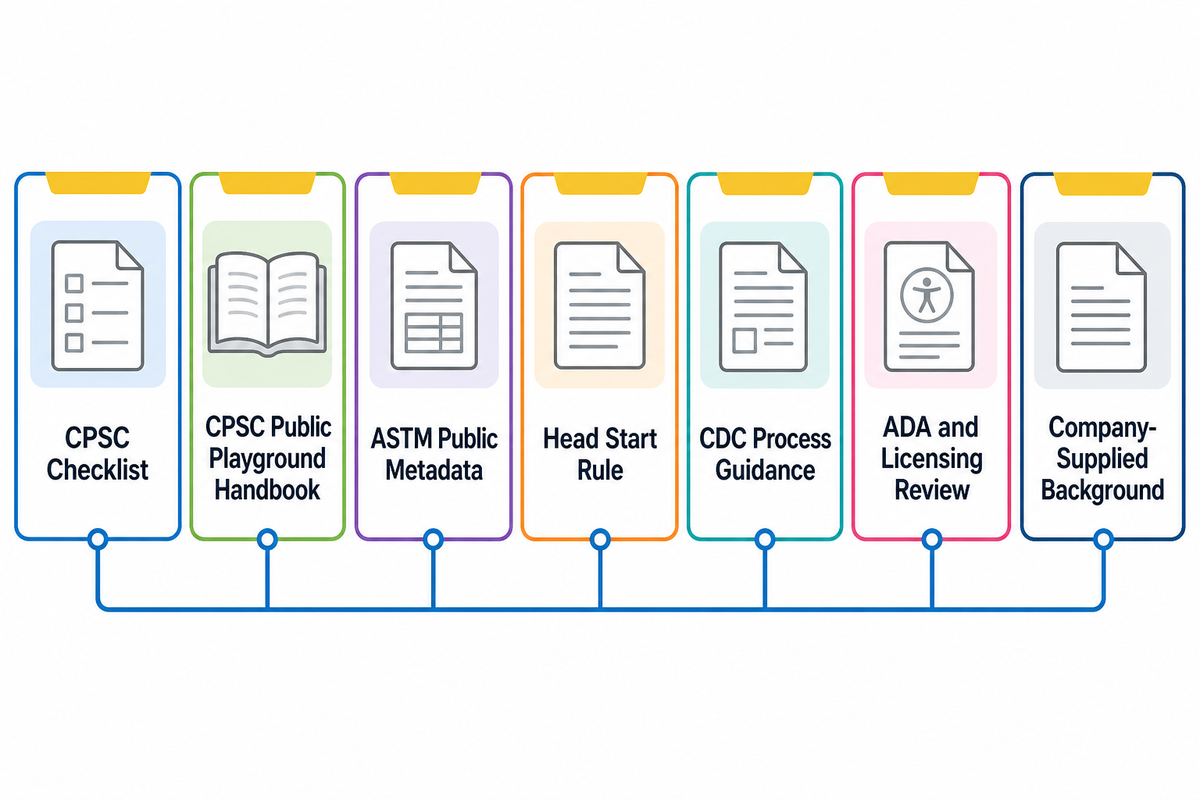
- References & Sources include inspection and safe-use prompts for soft-contained play equipment in the U.S. Consumer Product Safety Commission checklist; it isn’t supplier certification.
- The U.S. Consumer Product Safety Commission Public Playground Safety Handbook provides adjacent public-playground guidance and expressly excludes soft-contained play equipment from its intended scope.
- Public records of ASTM International F1918-21 contain public-access metadata, and do not include restricted-access procedure documents or product approvals.
- Head Start, 45 CFR 1302.47 Safety Practices: requirements for covered Head Start programs, not every daycare worldwide.
- CDC, Cleaning and Disinfecting in Early Care and Education Programs and Services, addresses best practices and offers process guidance, and doesn’t impose requirements.
- According to U.S. Department of Justice – 2010 ADA Standards, project applicability and interpretation should be determined by qualified personnel.
- Childcare.gov, Child Care Licensing and Regulations: overview and jurisdiction-routing source, not the final local rule set.
This Buyer Brief doesn’t ensure compliance with the law, set staffing ratios, mandate the use of a specific cleaning agent, or issue licenses. It also doesn’t replace the professional review of the project in question.



