Get in touch with Guangzhou Toplay amusement equipment co. Company

Ninja Obstacle Course Equipment for Indoor Playgrounds and Family Entertainment Centers
- Engineer-reviewed quotes within 48 hours
- Free 2D layout and 3D render in 3-7 working days
- One course minimum order
- AutoCAD DWG, PDF or a measured sketch accepted
We build ninja obstacle course equipment for family entertainment centers, indoor playgrounds and mixed-use venues, and we build it to your floor plan. Frame span, lane count, obstacle mix, surface treatment and installation scope are decided by the room you have, not by a catalogue kit.
Send a floor plan or a measured sketch. We return a layout drawn on your dimensions, and an engineer reviews the quote before it reaches you.
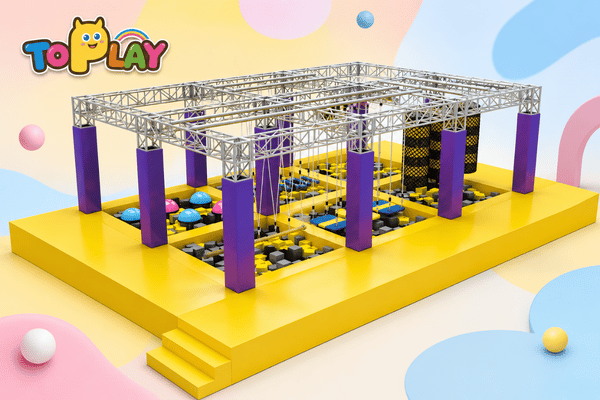
Quote turnaround·Within 48 hours, reviewed by an engineer
Before you order·A free 2D layout and 3D render on your floor plan, in 3-7 working days
Minimum order·One course, single courses accepted
Small-batch lead time·15-25 working days for a single-lane course up to 100 m² (1,076 sq ft)
Production lead time·30-45 working days
Payment terms·30% deposit, 70% balance before loading, by wire transfer
Trade terms·FOB from a South China port, other Incoterms on request
Files we work from·An AutoCAD DWG or PDF floor plan, or a measured sketch giving length, width and clear height
With every order·A CAD assembly drawing set, an illustrated installation manual and installation video
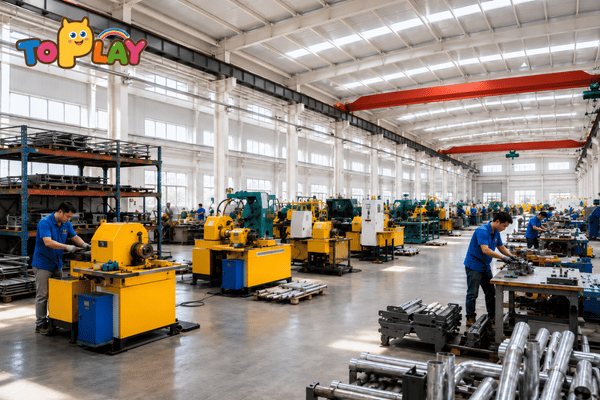
In-house scope·Steel tube fabrication, welding and finishing are done in-house
Quote turnaround·Within 48 hours, reviewed by an engineer
Before you order·A free 2D layout and 3D render on your floor plan, in 3-7 working days
Minimum order·One course, single courses accepted
Small-batch lead time·15-25 working days for a single-lane course up to 100 m² (1,076 sq ft)
Production lead time·30-45 working days
Payment terms·30% deposit, 70% balance before loading, by wire transfer
Trade terms·FOB from a South China port, other Incoterms on request
Files we work from·An AutoCAD DWG or PDF floor plan, or a measured sketch giving length, width and clear height
With every order·A CAD assembly drawing set, an illustrated installation manual and installation video
In-house scope·Steel tube fabrication, welding and finishing are done in-house
✦
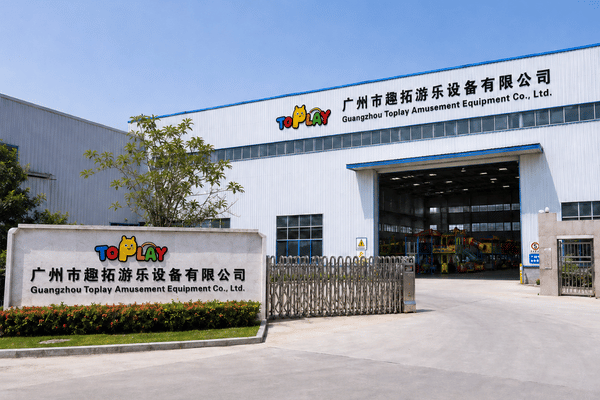
Ninja Warrior Course Equipment We Build
A ninja obstacle course is a run of suspended, climbing and balance obstacles carried on a steel rig, sized to a lane that one user crosses at a time. Most buyers comparing commercial indoor playground equipment come to us with a room rather than a specification, and the room is what actually decides the course. So the first thing we produce is not a price list but a layout drawn on your dimensions.
“Send the usable floor area, clear ceiling height and age mix before choosing obstacles. Those three inputs decide the lane geometry, circulation route and modules that belong in the first layout.”
Indoor Obstacle Course Equipment by Lane Type
Four lane types cover almost every ninja training layout we are asked to build. Which one fits your venue is decided by clear height before it is decided by taste.
Upper-body hanging lane
Monkey bars, rings, peg boards, lache rigs and cliff hangers in sequence. This lane needs the most clear height and the widest swing arc, and it sets the fall height that governs the surfacing under the whole run.
Balance and agility lane
Balance beams, floating boards, swinging steps and unstable bridges close to the floor. It fits low-ceiling rooms, suits younger users, and is the layout we reach for when a mall or restaurant space cannot give us height.
Climb and wall lane
Cargo nets, rope climbs, warped walls and salmon ladders. These obstacles convert floor area into vertical challenge, so they earn their space in a venue that is short on length but tall enough to build up.
Mixed progression lane
Two or more parallel lanes carrying the same obstacle types at different difficulty levels, so a family group can run side by side. Side-by-side progressive difficulty is a documented industry pattern rather than a design we claim as our own.
Ninja Warrior Playground Equipment for Mixed-Age Venues
Age is a design input before it is a marketing decision, because the standards split on it. ASTM F1487 covers public play equipment for a user range its scope defines as the 5th percentile 2-year-old through the 95th percentile 12-year-old, and its scope expressly excludes fitness equipment intended for users over the age of 12. US accessibility guidance treats a 2-5 area and a 5-12 area as separate play areas and assesses them separately.
For users under 12 in unsupervised free play, the course is being read as public play equipment, and clearance and use zones are standard-defined quantities rather than vendor opinion.
For users over 12, or for an operator buying ninja warrior gym equipment for adult competition training, the rig is training equipment rather than public play equipment. It sits outside ASTM F1487 by that standard’s own exclusion of fitness equipment intended for users over the age of 12, which changes which requirements your inspector and your insurer will be working from.
Operators gate on weight as well as age. In a 2021 trade report, a UK ninja-style assault course attraction published a minimum age of 8 and a 30-114 kg (66-251 lb) weight range, which is a venue operating rule rather than an equipment limit.
In-House Fabrication Line
Steel tube fabrication, welding and finishing are done in-house, on the process types below. We list processes rather than machine brands, model numbers or machine counts, because those are the claims a buyer cannot check from a web page.
- Laser tube cutting and tube sawing
- Punching and drilling
- Tube bending and press braking
- MIG, TIG and CO&sub2; welding
- Robotic welding
- Grinding and polishing
Obstacles We Build Into a Lane
This obstacle vocabulary is long-established third-party patent art. We build the mechanisms and name them the way the industry names them.
- Monkey bars and horizontal ladders
- Salmon ladder
- Warped wall
- Cargo net
- Rings and lache rig
- Peg board
- Balance beam
- Rope climb
- Swinging steps and quintuple steps
- Cliff hanger
- Floating boards and unstable bridge
- Landing platform and safety pit build-up
This obstacle vocabulary is long-established third-party patent art, including US 9,192,867 B1 and US 8,864,630 B2. We build the mechanisms and we name them the way the industry names them; we do not present the names, or the side-by-side difficulty layout, as our own invention.
Ninja Course Materials and Load-Bearing Components
Every component on a ninja course sits in one of two duties: it carries load, or it is the surface a child touches. That split matters because the two duties fail differently and are maintained differently.
Materials Outside the Standard List
Send the requirement with your floor plan and we will confirm what we can build and what it does to the price in the quotation.
Request a Ninja Course Quote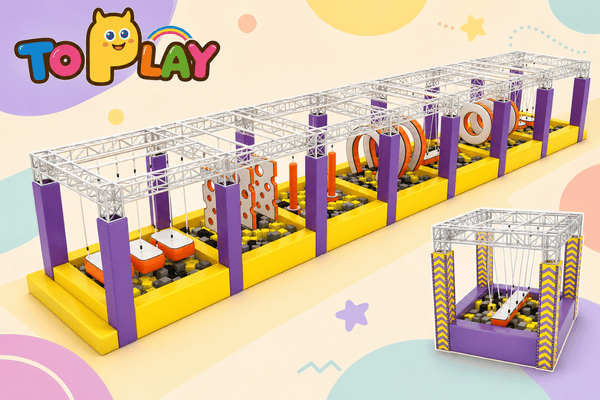
| Component | Material family | Why it is used | What it means for maintenance |
|---|---|---|---|
| Frame uprights and cross rails | Welded steel tube | Carries the whole rig and takes the dynamic load of a swinging user | Inspect welds and joints on a fixed routine; corrosion and impact damage show at the joints first |
| Support risers and height adjustment | Sleeved steel tube | Lets obstacle height be set at install and reset later without recutting the frame | Check that adjustment collars are still fully seated and secured after heavy use |
| Hanging hardware: rings, pegs, bars | Steel with a gripped contact surface | These are the parts users hang from, so they take the highest cyclic load per kilogram of material | The highest-wear items on the course; specify them as replaceable and order spares against the drawing set |
| Cargo net, slack ladder, rope climb | Rope and webbing on steel anchor points | Gives a climbing surface that absorbs and returns movement instead of resisting it | Rope wears from the inside and from ultraviolet exposure; the anchor point and the rope are inspected as one item |
| Warped wall face and climbing panels | Formed panel on a steel frame | Turns floor area into vertical challenge in a short run | The running surface takes shoe abrasion; the frame behind it rarely moves |
| Balance beams and step surfaces | Solid walking surface fixed to steel supports | Low-height challenge that works for younger users and for low-ceiling rooms | Surface finish and fixings are the wear items, not the beam |
| Fasteners and floor or structure anchors | Steel fixings | Transfers rig load into the slab or into building steel | Torque checks belong in the venue’s routine inspection, not only at handover |
| Protective surfacing under the lane | Impact-attenuating mat or loose fill | Manages the consequence of a fall rather than the chance of one | Loose fill migrates and compacts; mats need the seams and the fixing checked |
What the Standards Say About the Parts a Child Touches
Two standards in the United States divide this equipment cleanly between them, and the split is written into the standards themselves rather than invented by suppliers. ASTM F1487 covers the equipment and the dimensional requirements for its clearance and use zones; ASTM F1292 covers the impact attenuation of the surfacing inside that use zone, and its own scope names F1487 as the paired equipment standard.
SPEC-01
Lead limits are gated on the user age, not on the venue. US Consumer Product Safety Commission rules apply a 90 ppm limit in paint and surface coatings and a 100 ppm total lead limit in accessible parts to products primarily designed or intended for children 12 years of age or younger.
SPEC-02
That gate pulls three obligations with it. For a children’s product, Commission guidance describes third-party testing by an accepted laboratory, a Children’s Product Certificate, and a permanent tracking label carrying the manufacturer, the production date and place, batch information and the factory.
SPEC-03
Ask for the test report, not the data sheet. Commission guidance states that a Safety Data Sheet or similar document is not sufficient to certify compliance for a children’s product.
SPEC-04
ASTM F1292 addresses head injury. It sets impact attenuation against that risk and records that there is only limited evidence that conformance reduces the risk of other kinds of serious injury, giving long bone fractures as its example.
Read together, those four points change what a buyer should ask for. Surfacing is the answer to a head-injury question; fall-height management, difficulty progression and supervision are the answer to the rest, and no surfacing invoice closes that gap.
Surface Finishes and Grip Treatment
Finishing on a ninja course does three jobs: it removes what can cut, it protects the steel, and it makes the obstacle visible and holdable. Those are different jobs on different parts of the rig, so they are quoted separately. Grip feel and surface roughness are not interchangeable; the trade-off belongs in the maintenance plan because the contact layer wears while the steel frame remains structural.
| Finish | What it does | Where it applies | In-house or specified |
|---|---|---|---|
| Weld dressing | Removes weld spatter and breaks sharp edges everywhere hands and bodies pass | Every welded joint on the rig | In-house |
| Grinding and polishing | Takes the contact surface down to a consistent condition before any coating goes on | Handrails, rungs, hanging hardware | In-house |
| Protective coating on steel | Protects the frame from corrosion and from the abrasion of daily use | Frame and exposed steelwork | In-house |
| Grip surface on rungs, pegs and holds | Gives a predictable hand feel on the parts users hang from | Upper-body contact points | In-house |
| Colour and contrast marking | Raises the visibility of suspended elements and of landing zones | Suspended obstacles, edges, transitions | In-house |
| Padding and edge protection | Covers posts and hard edges that sit inside the use zone | Uprights within the use zone, platform edges | Specified with your order and confirmed in the quotation |
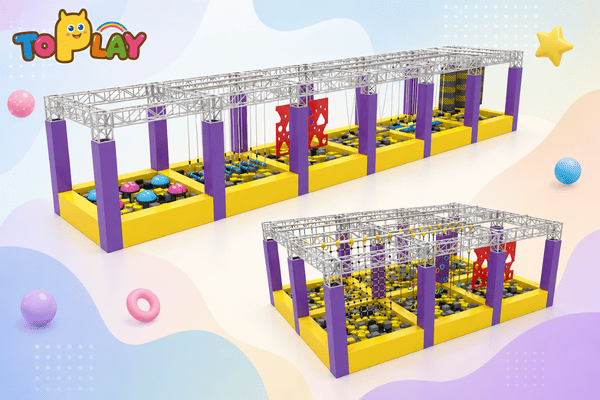
Why Colour Is a Safety Decision on a Ninja Lane
When the US Consumer Product Safety Commission published its 2025 handbook update, it addressed suspended elements directly, and concluded that the mitigations apply to both single suspended components, and multiple suspended components. It also clarified that features beyond bright colours or contrast with the surrounding equipment and surfacing may be used to increase visibility. By definition, a ninja lane is a row of multiple suspended components, so the colour scheme is doing safety work before it does any branding work.
What the Coating Rule Actually Covers
- 16 CFR 1303 sets the limit at 0.009% lead, which is 90 ppm, on paint and similar surface coatings.
- Scraping draws the line. If a layer can be scraped from the substrate and separated, it is treated as a coating at 90 ppm; a layer that cannot is treated as substrate at the 100 ppm total lead limit, and one product can carry both.
- Printing inks that become part of the substrate, electroplating and ceramic glazing sit outside the coating definition for this rule.
- This rule follows the paint onto your site. It reaches paint used in residences, schools, hospitals, parks, playgrounds and public buildings, so it applies to the painted surface in the venue and not only to the goods in the container.
Grip Strength Is Not the Same as Surface Roughness
A finish page will usually tell you that a rougher surface grips better. Instrumented climbing research says otherwise: across 14 hold surfaces tested with 22 climbers on real bouldering routes, mean coefficient of friction ran from 0.53 on Teflon to 0.84 on rubber, and the correlation between roughness and friction was insignificant while the correlation between perceived grippiness and friction was significant. That study is adult climbing holds rather than children’s ninja equipment, so it is an argument against a lazy design assumption and not a specification for our surfaces.
Ninja Warrior Course Dimensions and Site Requirements
Course length, lane count and obstacle mix are set by your building, so the figures below are the published ones a designer and an inspector will both be working from. Inch-pound values are the primary units in the US sources, with metric conversions given for information.
| Specification | Figure | Where the figure comes from |
|---|---|---|
| Design user range for public play equipment | The 5th percentile 2-year-old through the 95th percentile 12-year-old | ASTM F1487, scope clause 1.2 |
| Users the play-equipment scope excludes | Fitness equipment intended for users over the age of 12, and play equipment for children 6 to 24 months | ASTM F1487, scope clause 1.3 |
| Barrier threshold on elevated platforms | Recommended above 48 in (1,220 mm) over the protective surfacing, and lower on equipment for toddler and pre-school age children | CPSC handbook update, Federal Register, 13 August 2025 |
| Assumed upper reach above a play surface | 84 in (2,130 mm) | CPSC handbook update, Federal Register, 13 August 2025 |
| Preferred rung diameter for grip retention | 1.25 in (32 mm) | CPSC handbook update, Federal Register, 13 August 2025 |
| Net opening evaluation perimeter | 17-28 in (430-710 mm), derived from the small torso probe and the large head probe | CPSC handbook update, Federal Register, 13 August 2025 |
| Surfacing rating basis for a composite lane | One structure with a single critical height based on the highest fall height on that structure | CPSC handbook update, Federal Register, 13 August 2025 |
| Ground-level accessible route, clear width | 60 in (1,525 mm) minimum, narrowing to 36 in (915 mm) for no more than 60 in | US Access Board, accessibility guidelines for play areas |
| Ground-level route in a play area under 1,000 sq ft (93 m²) | 44 in (1,120 mm), with a wheelchair turning space wherever the route runs more than 30 ft | US Access Board, accessibility guidelines for play areas |
| Vertical clearance over that ground-level route | 80 in (2,030 mm) | US Access Board, accessibility guidelines for play areas |
| Maximum slope on an accessible route | 1:16 | US Access Board, accessibility guidelines for play areas |
| Transfer platform height | 11-24 in (280-610 mm) | US Access Board, accessibility guidelines for play areas |
| Standard production lead time | 30-45 working days, or 15-25 working days for a single-lane course up to 100 m² (1,076 sq ft) | Our own production schedule, confirmed in your quotation |
Obstacle Course Playground Equipment Clearances
Two of those figures are read wrongly more often than any others, so they are worth stating precisely. An 80 in vertical clearance applies to the 60 in accessible route, not to the entire play area, and it applies to ground-level routes rather than elevated routes. Transfer height is a band of 11-24 in rather than a single 24 in ceiling.
No published federal maximum equipment height exists. In the same 2025 notice, the Commission stated that it has not analysed data supporting specific maximum heights for different playground equipment, so any supplier quoting a legal height cap is quoting something that does not exist.
Overhead obstacles do not have to be lowered to be reachable. Access Board guidance names track riders, ring ladders, monkey bars and chin-up bars, and puts the duty on connecting their entry and exit points by an accessible route.
Ramps, decks and steps are not play components. They serve the course; they do not count toward the play value the accessibility scoping is measured against.
Measure These Before You Draw a Lane
Seven numbers decide almost every layout question, and you can take all seven with a tape measure before you speak to any supplier. Send them with your enquiry and the layout comes back on your building instead of on an assumption.
| What to measure | Why it decides the layout | What governs it |
|---|---|---|
| Clear height under the lowest obstruction, not to the roof deck | Sprinkler heads, ducts, beams and light fittings set the real ceiling; hanging obstacles need swing arc under that line | Your structure. Anything overhead also has to leave 80 in (2,030 mm) over a ground-level accessible route |
| The usable floor rectangle, not the gross area | A lane runs in a straight line, so the longest clean rectangle sets lane length and how many lanes fit beside each other | Your column grid and circulation |
| Fall height of the tallest obstacle you want | One tall obstacle sets the surfacing specification for the whole run, which is usually the surprise line in a budget | Composite structures take a single critical height from the highest fall height |
| Circulation width around and between lanes | Decides whether spectators, queuing users and staff can pass without walking through a use zone | 60 in (1,525 mm), or 44 in (1,120 mm) in a play area under 1,000 sq ft (93 m²) |
| The age band your venue is set up and insured for | Changes which standard family your inspector reads, and therefore which requirements apply to the same steel | ASTM F1487 covers the 2-to-12 user range and excludes over-12 fitness equipment |
| Slab construction and what is under it | Decides between floor-anchored uprights and a structure-braced frame, and it changes the installation scope | Your structural drawings, or a note that they are unavailable |
| Where a supervising adult will stand | A lane that cannot be seen end to end from one staffed position is a staffing cost, not a design detail | Your operating model |
Venue Types We Fit Courses Into
| Venue | What the layout usually has to work around | The extra input we need beyond the seven measurements |
|---|---|---|
| Shopping malls | Low clear height under services, and a footprint that has to read as an attraction from the mall floor | The hours the site is available to install in |
| Mixed-use complexes | Shared circulation with other tenants, and a route the equipment has to physically travel to reach the unit | Lift and door dimensions along the delivery route |
| Indoor children’s play centers | An existing soft play structure that already owns the tall part of the room | Existing equipment marked on the floor plan |
| Family entertainment centers | Throughput at peak, and how the course sits next to arcade or party space | Your peak-hour throughput target |
| Kindergartens | A younger user band and a supervision model that assumes staff are always present | Which room you intend to use, since ceiling height varies room to room |
| Early-childhood education centers | Low obstacle heights, short lanes, and equipment that suits a curriculum rather than a queue | How many children use the space at once |
| Family restaurants | Small footprint, noise, and a play area that has to be visible from the tables | The sight line from the seating area |
| Hotels | Rooms that were never designed for play, and equipment that has to suit unsupervised family use | Whether staff supervise the space at all |
| Community recreational spaces | Mixed ages in the same room, and a budget cycle that fixes the scope before the design | The scope your funding actually covers |
Ninja Course Equipment Pricing, Lead Times and Payment Terms
Price is determined by lane number, span, levels, obstacle configuration, surface finish and how much of the installation we handle. There is no fixed price list for a custom course, because no two rooms produce exactly the same layout. Your figure comes back in a written quotation against the layout we draw on your plan.
What Moves Your Price
| Driver | Effect on cost | How to reduce it |
|---|---|---|
| Number of lanes | The largest single lever, because each lane repeats the frame, the obstacles and the surfacing under it | Start with one lane built to take a second later, rather than two lanes built thin |
| Clear height and number of levels | Height adds frame, adds fall height, and adds surfacing specification to the whole structure | Put the tall obstacle where the room is tallest instead of raising the whole rig |
| Obstacle mix | Moving and suspended obstacles cost more to build and more to maintain than fixed ones | Mix a few signature suspended obstacles with fixed balance elements rather than making everything move |
| Surface finish and colour scheme | Coating, contrast marking and grip treatment are quoted per surface, not per course | Specify contrast where it does safety work and leave the rest in the standard finish |
| Protective surfacing | Set by the highest fall height on the lane, so one tall obstacle can raise the surfacing spec across the whole run | Decide the tallest obstacle before you decide the floor |
| Installation scope | Supervised local installation costs differently from a container that your own contractor erects | Tell us at enquiry which one you want, so it is priced rather than discovered |
How Your Quote Is Produced
Send an AutoCAD DWG or PDF floor plan, or a measured sketch giving length, width and clear height, and an engineer reviews it and returns a quotation within 48 hours. There is no physical sample for a fitted ninja course; the pre-order deliverable is a free 2D layout and 3D render built on your floor plan, returned in 3-7 working days. The minimum order is one course, and single courses are accepted.
Payment and Trade Terms
- Payment terms are 30% deposit payable by wire transfer and 70% balance payable before loading.
- Trade terms are FOB from a South China port, with other Incoterms available on request.
- Our export record covers more than 40 countries, including France, India, Sri Lanka, South Africa, Mexico, Malaysia and Poland.
- Duties and tariffs sit outside our quotation and change by destination, so confirm them with your own customs broker before you fix a landed budget.
Lead Times by Order Stage
| Order stage | Lead time | What it covers |
|---|---|---|
| Quotation | Within 48 hours | Engineer review of your plan and a written price against a stated scope |
| Layout and render | 3-7 working days | A free 2D layout and 3D render drawn on your floor plan, before any order is placed |
| Single-lane course up to 100 m² (1,076 sq ft) | 15-25 working days | Fabrication, finishing and factory assembly test after drawing approval |
| Full production run | 30-45 working days | Multi-lane or multi-level courses, confirmed with your quotation |
Lead time begins when the layout drawings are signed-off; this does not include shipping or on-site installation. These latter are priced separately so that a delay in shipping is never mistaken for a delay in production.
Obstacle Course Equipment Quality Control and Handover Documents
A course is checked five times before it leaves, and each check has a named owner and a written output. The point of naming them is that a buyer can ask for any one of the five by name and see what it produced.
How Every Course Is Checked
- At each operation, cut, bend, punch and drill work is checked against the approved drawing before the part moves to the next station.
- Weld inspection covers every joint on the load path before finishing hides it, because a coated joint cannot be read.
- Factory trial assembly proves fit, alignment and adjustment range before anything is packed.
- Whole-course function testing loads and cycles moving and suspended obstacles on the assembled rig, not on the bench.
- Packing count checks every part and fastener against the assembly drawings, so what arrives matches what you install from.
If Something Is Not Right
- During installation, send a photograph and the drawing reference. We work from the same assembly drawing you are holding, which is why the drawing set ships rather than being emailed on request.
- Rings, pegs, bars and rope elements are the parts that wear on any ninja course. Order replacements against the drawing set rather than describing the part.
- If manufacture does not match the approved drawing, we rework or remake it against the same drawing the trial assembly was checked on.
Document Summary
- CAD Assembly Drawing Set
- Illustrated Installation Manual
- Installation Video Guide
- Documented Hazard Analysis
- Quality Control Sign-offs
Hover to reveal
Documents That Ship With Your Order
A CAD assembly drawing set, an illustrated installation manual and installation video ship with your order. The drawing set is the document that matters after year one, because it is how a replacement part is identified and ordered by reference instead of by description.
Hazard Analysis for an Unlisted Equipment Type
ASTM F1487 anticipates equipment that does not fit the designated types it lists, and clause 1.6.1 puts the resulting duty in writing. It states that the designer or manufacturer, or both, shall use professional judgment to perform and document a hazard analysis and follow appropriate requirements to mitigate the hazards. Ninja obstacles are not a designated equipment type in that standard, so this is the clause that governs them.
- Ask every supplier for it by name, including us: request a documented hazard analysis covering your specific layout.
- Treat a certificate number offered in its place as a non-answer. Clause 1.6.1 asks for analysis of the equipment in front of you, not a general listing.
- Keep the analysis with your inspection records. It explains why the equipment is built the way it is, which is what an insurer wants after an incident.
What Stays With the Venue After Handover
Some obligations are the operator’s by design, and a supplier who implies otherwise is not doing you a favour. These three sit with the venue in every jurisdiction we ship to.
- Confirm how your installation is classified. Applicable standards follow the user age and the operating model, and that determines which requirements your inspector and your insurer apply. Confirm it with them rather than accepting a supplier’s classification, including ours.
- Run an inspection routine because fixings loosen, ropes wear and surfacing compacts. A written routine with dated records is what an insurer asks to see after an incident.
- Keep the surfacing rated to the tallest obstacle. A composite structure carries a single critical height taken from its highest fall height, so replacing surfacing like for like after a course change is not automatically correct.
Ninja Course Order Workflow
Ninja Warrior Course Design Workflow
1
You send an AutoCAD DWG or PDF floor plan, or a measured sketch giving length, width and clear height. Two numbers and a sketch are enough to start.
2
We quote within 48 hours after an engineer reviews the plan and returns a written price against a stated scope, not a range.
3
We draw your course as a free 2D layout and 3D render built on your floor plan, returned in 3-7 working days, before you commit to anything.
4
You approve the drawings, then production is scheduled against the approved set and the deposit. That approved drawing becomes the acceptance criterion for everything that follows.
5
We build, assemble and function-test the course in our factory. If it does not assemble here, it does not ship.
6
We ship the container with the drawing set, illustrated manual and installation video, and our engineers stay reachable through your installation.
Commercial Ninja Warrior Course Installation Support
Installation is where an imported course usually goes wrong, and it goes wrong for the same three reasons every time. We plan against all three before the container is loaded.
- Check the route into the room: lift dimensions, door widths and turning space decide how the rig is broken down for shipping, so we ask for them before we pack rather than after.
- Define the floor condition early because anchoring method is decided from your slab and structure at drawing stage, and changing it on site changes the layout.
- Use one assembly sequence. An illustrated manual and installation video follow the same numbering as the drawing set, so a local contractor works from one numbering system rather than three.
Design Decisions That Change Your Cost and Schedule
Decision
What to specify
Why it saves money or time
Lane length against room length
The longest clean rectangle, with columns marked
A lane planned around a column is cheaper than a lane redesigned after the column is discovered
Tallest obstacle
Which obstacle you want at maximum height, and where
It sets the surfacing specification for the whole run, so deciding it first prevents a late budget jump
Adjustable versus fixed obstacle height
Which positions you expect to change and how often
Sleeved risers cost a little more once and save a rebuild every time the age mix changes
Replaceable contact parts
Rings, pegs, bars and rope elements listed as separate line items
Wear items ordered by drawing reference avoid a whole-obstacle replacement later
Colour and contrast
Where contrast does safety work, not where it looks busy
Contrast is quoted per surface, so targeting it costs less than coating everything
Installation scope
Supervised installation or a container your own contractor erects
Priced at quotation instead of negotiated at the door
Ninja Course Planning & Costing Tools
Use our engineered calculators and checklists to scope, budget, and compare your indoor playground project.
TOOL-01
Ninja Course Project Timeline Planner
Map your production, shipping, and installation milestones based on standard manufacturing lead times.
Open Planner
TOOL-02
Ninja Course Landed Cost Quote Normalizer
Calculate true final costs by factoring in tariffs, ocean freight, and domestic transport fees.
Open Calculator
TOOL-03
Ninja Course Site Measurement Readiness
Verify your usable floor area, clear height, and structural limits before layout drawing begins.
Open Checklist
TOOL-04
Ninja Course Supplier Comparison Scorecard
Evaluate competing proposals based on material specifications, safety compliance, and handover documents.
Open Scorecard
Ninja Course Equipment FAQ
There is no published legal minimum, and any supplier quoting one is quoting something that does not exist; the US Consumer Product Safety Commission stated in 2025 that it has not analysed data supporting specific maximum heights for playground equipment either. What decides it in practice is the lowest obstruction in your room and the swing arc of the obstacles you choose. For reference, a European turnkey adventure-play venue reported in trade press worked with a ceiling of 8 m at the highest point down to 5.5 m at the lowest, and treated that as a real design constraint on what it could install.
The design range for public play equipment is defined in ASTM F1487 clause 1.2 as the 5th percentile 2-year-old through the 95th percentile 12-year-old, which is an anthropometric range rather than a simple age gate. Equipment intended for users over the age of 12 is excluded from that standard by clause 1.3, which is why an adult ninja gym is a different product decision with a different rulebook. Operators commonly gate on weight as well as age, and a 2-5 area and a 5-12 area are assessed as separate play areas.
Lane length is set by the obstacle sequence you choose, and the usable rectangle in your room matters more than total floor area, because a lane runs in a straight line. Around that lane you also need circulation: the US Access Board sets a 60 in (1,525 mm) ground-level accessible route, reduced to 44 in (1,120 mm) in a play area under 1,000 sq ft (93 m²), with a wheelchair turning space wherever that route runs more than 30 ft. Send the rectangle and the clear height and we return a layout in 3-7 working days at no charge.
Yes, and it is a well-established conversion: a 2021 trade report on a UK ninja attraction chain noted that its Wigan, Gloucester and Cardiff parks were all previously trampoline parks. The check to run first is not whether the equipment fits but whether the space you are willing to give up is the right space, because the trampolines usually occupy the tallest part of the building. ASTM F2970 governs the trampoline court itself and its scope object is the court, so adding a ninja lane does not bring the lane under that standard.
The steel frame and the contact parts age on completely different clocks, so a single service-life number would be misleading. Frames are inspected at the welds and joints, where corrosion and impact damage show first; rings, pegs, bars and rope elements are the wear items and are specified as replaceable from the start. Order replacements against the CAD assembly drawing set that ships with your course, and keep dated inspection records, because that record is what an insurer asks for.
Playground surfacing is covered by ASTM F1292, which sets impact attenuation inside the use zone and names ASTM F1487 as the paired equipment standard. The equipment standard defines the use zone, and the surfacing standard defines what has to happen inside it. Two limits matter when you read a supplier’s surfacing number.
- A laboratory critical fall height does not account for ageing, moisture, maintenance, temperature, ultraviolet exposure, compaction or thickness loss on an installed surface.
- F1292 records that its requirements are specific to head injury, with only limited evidence that conformance reduces the risk of other serious injuries such as long bone fractures.
Surfacing is therefore necessary and not sufficient: fall-height management, difficulty progression and supervision carry the rest.
Anchoring is decided from your slab and structure at drawing stage, not on site, because changing it later changes the layout. Send structural drawings if you have them, or tell us plainly that you do not, and we will design the frame around what is known rather than around an assumption. Fixing torque checks then belong in the venue’s routine inspection, not only in the handover.
Yes, and it is worth designing for at the start: sleeved risers let obstacle height be reset without recutting the frame, and contact parts specified as separate line items can be swapped one at a time. The reason to plan it is commercial rather than technical. Arcade operators reinvest 5-10% a year in new titles to keep an attraction fresh, according to IAAPA’s Funworld guidance on arcade operations; a ninja course fights the same staleness by swapping obstacles, which only works if the mounting was designed for it.
One user per lane is the operating assumption a ninja lane is designed around, which is why lane count rather than floor area is what actually sets your throughput at peak. If you need to move more people, two shorter lanes side by side will usually beat one long lane. Tell us your peak-hour target with your enquiry and it becomes a layout input instead of a discovery after opening.
Send an AutoCAD DWG or PDF floor plan, or a measured sketch giving length, width and clear height, and an engineer returns a written quotation within 48 hours. There is no physical sample for a fitted ninja course; the pre-order deliverable is a free 2D layout and 3D render built on your floor plan, returned in 3-7 working days. You are not committing to anything by asking for the layout.
One course. Single courses are accepted, so a first lane in one venue does not need to be bundled with a second site to be worth quoting.
30% deposit, 70% balance before loading, by wire transfer. We ship FOB from a South China port, with other Incoterms available on request, and our products have been exported to more than 40 countries including France, India, Sri Lanka, South Africa, Mexico, Malaysia and Poland. Import duties and tariffs sit outside the quotation and vary by destination, so confirm them with your own customs broker before fixing a landed budget.
A CAD assembly drawing set, an illustrated installation manual and installation video ship with your order. The drawing set is the one that keeps working after year one, because replacement parts are ordered against a drawing reference rather than a description. If your inspector or insurer needs the equipment described in writing before the course is commissioned, the drawing set is the document to give them.



