
Get in touch with Guangzhou Toplay amusement equipment co. Company

Updated August 2026 — an ultimate guide to indoor play space planning by venue type, not a generic template.
An indoor playground business plan is the written roadmap that matches equipment, footprint, and compliance requirements to one specific venue type before a single dollar goes into hardware. It has to answer a question most templates skip: which venue are you actually building for? Mall atriums, family entertainment centers, kindergarten rooms, and restaurant play corners each carry a different equipment mix, a different ceiling budget, and a different compliance layer — and conflating them is the single most repeated mistake in this niche. This guide walks through five venue types, the standards that actually govern soft-contained play equipment (not the ones vendors namecheck), the space math that most guides skip, and a startup-cost picture that is honest about what published figures do and don’t tell you.
What an Indoor Playground Business Plan Needs, by Venue Type
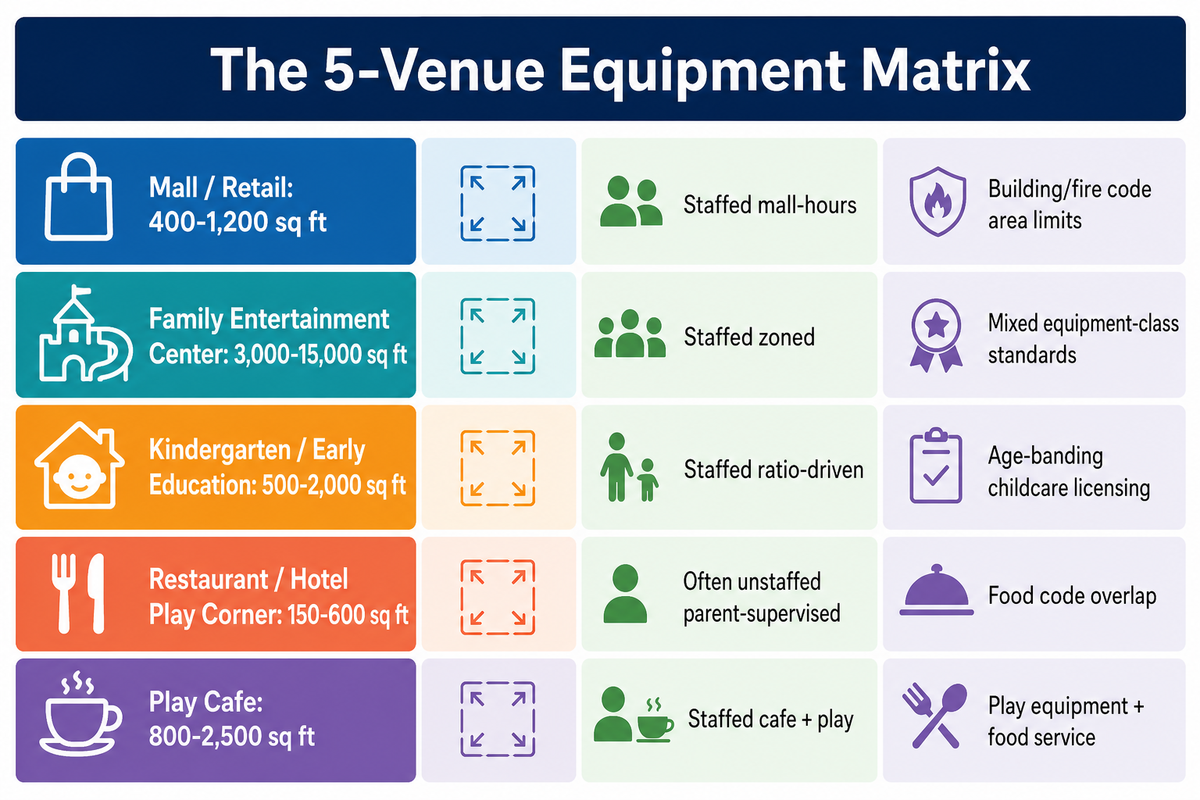
Five venue types drive five different equipment briefs, and a business plan written before that choice is locked tends to need a rewrite. Mall and retail spaces sell dwell time inside a fixed footprint; family entertainment centers stack the widest equipment mix under the tallest ceiling.
Kindergartens and early-education rooms answer to an age-banding rule most operators only learn about after an inspection; restaurants, hotels, and play cafes inherit a second regulatory layer through food service; and every one of them needs staff coverage sized to the equipment class, not just the square footage.
Quick Specs, The 5-Venue Equipment Matrix
| Venue Type | Typical Footprint | Staffing | Primary Compliance Layer |
|---|---|---|---|
| Mall / Retail | 400-1,200 sq ft | Staffed, mall-hours | Building/fire code area limits |
| Family Entertainment Center | 3,000-15,000 sq ft | Staffed, zoned | Mixed equipment-class standards |
| Kindergarten / Early Education | 500-2,000 sq ft | Staffed, ratio-driven | Age-banding, childcare licensing |
| Restaurant / Hotel Play Corner | 150-600 sq ft | Often unstaffed, parent-supervised | Food code overlap |
| Play Cafe | 800-2,500 sq ft | Staffed, cafe + play | Play equipment + food service |
Once you’ve picked a lane below, read the venue-by-venue indoor playground planning hub for the procurement workflow, Incoterm scope, and compliance tools.
Writing the Business Plan Document: What a Lender or Investor Actually Reads
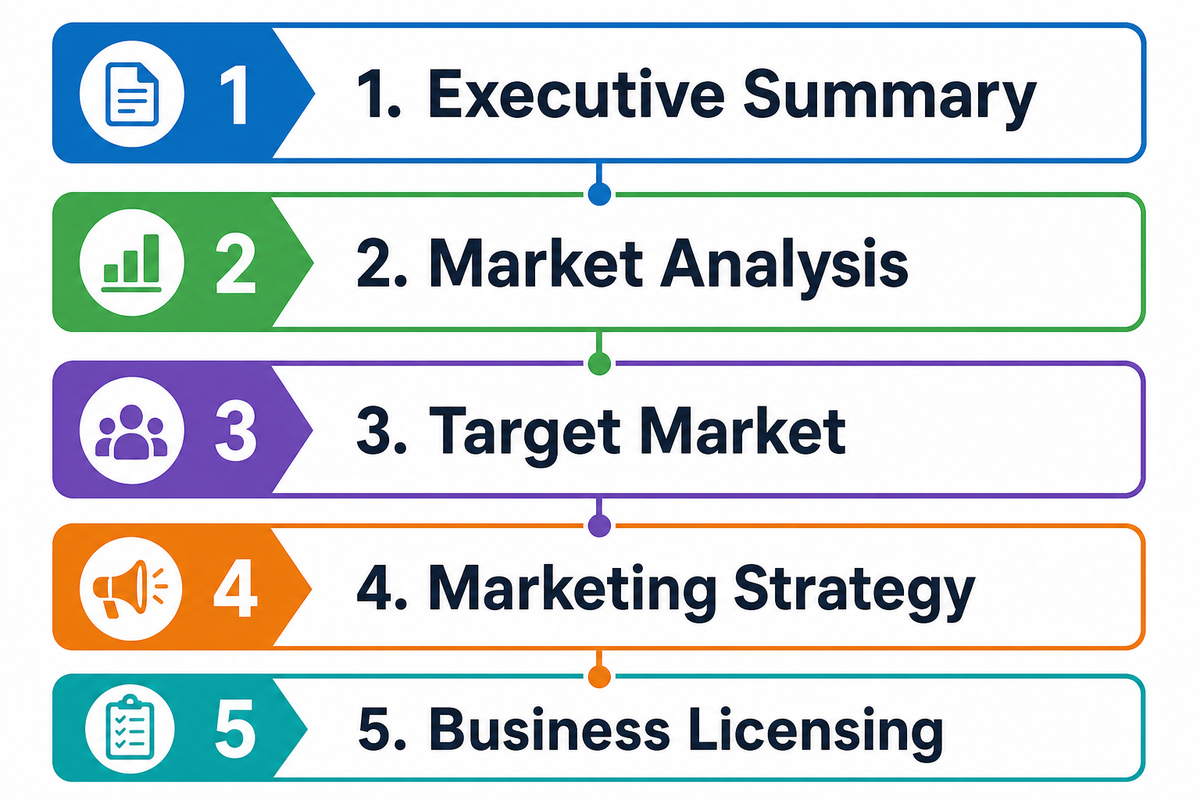
With the venue type picked from the table above, the next document to get right is the plan itself. A lender reading your business plan wants five sections answered in order, and skipping straight to equipment photos is the fastest way to get declined. The U.S. Small Business Administration’s business-plan guidance is a useful cross-check on the structure below. The executive summary states your venue type, target audience, and funding ask in a page or less. Market analysis and market research follow — local demographics, competing venues within your catchment area, and demographic research on household income and family density, not a generic national market-size number. Target market and target audience sections should name a specific age range and family profile, not “everyone with kids.” Next comes a marketing strategy section covering launch promotion, word-of-mouth referral mechanics, and how you plan to attract customers and build repeat visits, followed by business licensing — the permit list from the venue-type sections above, assembled into one document a bank can review.
A pattern that recurs across published lender and investor guidance in this space: a template alone will not save a business owner without real operational experience or an operator with prior business experience on the team. Continuous improvement built into the plan — a stated process for reading customer feedback and adjusting operations after the grand opening — signals more to an investor than an optimistic ROI projection. Build risk management into the plan explicitly: what happens if a single revenue stream (open play, birthday parties, or the ancillary play cafe) underperforms, and how does the multiple revenue model in the Startup Costs section absorb that. What separates a fundable plan from a downloaded form is a one-page profit-and-loss (P&L) projection tied to your specific venue type and operational efficiency assumptions, not a copied business plan template.
Malls and Retail: Space, Footfall and the Equipment That Earns Its Footprint
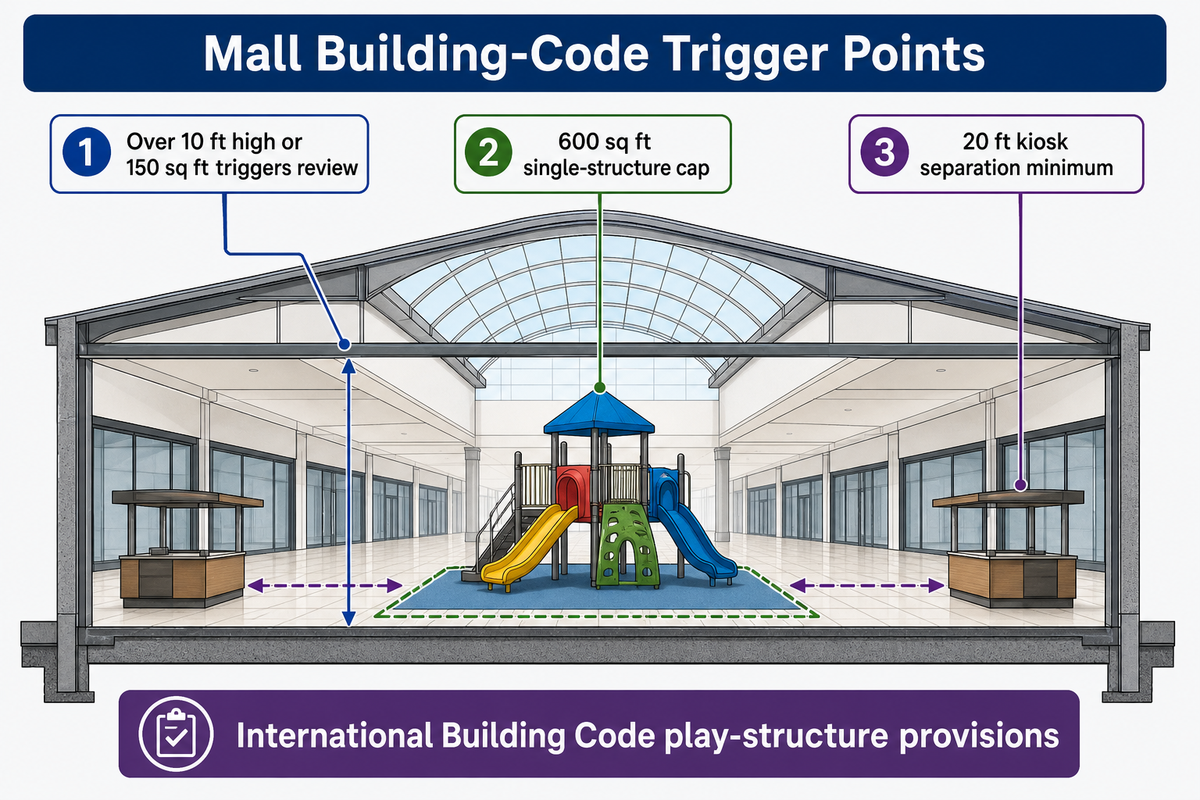
Mall and retail play areas trade square footage for foot traffic, so every fixture has to justify its footprint against a hard area cap most operators never see coming. Adopted US building and fire codes trigger additional review for a play structure over 10 feet high or over 150 square feet added inside an existing building, cap a single structure at 600 square feet absent a special fire-safety investigation, and require at least 20 feet of horizontal separation from kiosks and similar structures inside a covered mall. Even a structure that clears every product standard can still stall at permitting if these thresholds are ignored at the design stage.
📐 Engineering Note
These thresholds trace to the International Building Code’s play-structure provisions as adopted (and sometimes amended) state by state — the section numbering and exact figures shift between editions and jurisdictions, and this guide has not independently verified a single primary-text citation for every figure above. Treat 10 ft / 150 sq ft / 600 sq ft / 20 ft as the range you should expect to encounter, not a number to design against without confirmation — confirm the exact figures and section citation with your local building official before finalizing a mall floor plan. Run your own structure’s height and footprint through the Building-Code Trigger Check before you commit to a floor plan.
Family Entertainment Centers: The Widest Equipment Mix, the Highest Ceiling Draw
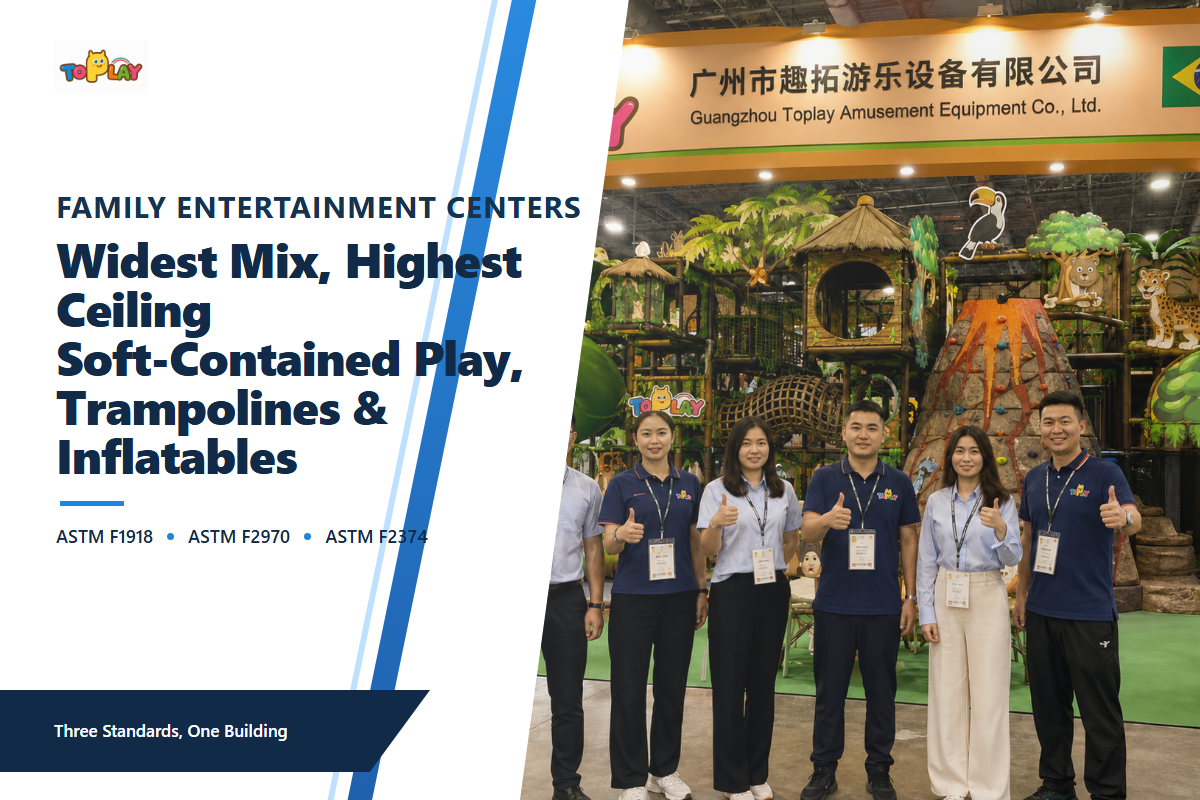
Family entertainment centers sit at the opposite end of the footprint spectrum from the mall play area above: they combine soft-contained play with higher-intensity attractions, and that mix means two separate document families govern the same building. A trampoline attraction is governed by ASTM F2970-25 under Subcommittee F24.61 of Committee F24 on Amusement Rides and Devices in the US, and by EN ISO 23659:2022 in Europe — both reach operation, maintenance and inspection, not manufacture alone. Inflatable amusement devices fall under a third document, ASTM F2374-24, whose scope names family entertainment centers explicitly alongside temporary and permanent installations. None of the three overlaps with ASTM F1918, the soft-contained play equipment standard that governs a netted, padded climbing structure. Birthday parties are the revenue engine that funds this equipment mix in most FECs — party-room throughput, not open-play admission alone, is what typically determines whether the higher ceiling and wider footprint pay for themselves.
The indoor playground industry rewards operators who commit to a full range of services rather than a single attraction type — active play zones, interactive activities, and a party-room package together are what turn one visit into a popular attractions destination families return to. Opening an indoor playground or launching an indoor playground inside an existing entertainment complex both start from the same equipment-classification question above, whether you are opening an indoor unit from scratch or converting existing floor space.
What equipment is needed for an indoor playground?
The honest answer depends on which document family your structure falls under. A soft-contained climbing structure (nets, padded platforms, tunnels) needs ASTM F1918 in the US or EN 1176-10 in Europe. Ball pits are typically evaluated as part of the soft-contained system they’re built into, not as a standalone item.
Trampoline walls and courts fall into a different equipment class entirely (ASTM F2970 / EN ISO 23659), and an inflatable bounce structure is a third (ASTM F2374). Buying a “playground package” without asking which document each component falls under is how FECs end up with equipment they can’t get inspected against the right standard.
Kindergartens and Early-Education Rooms: Age-Banding Is Not Optional
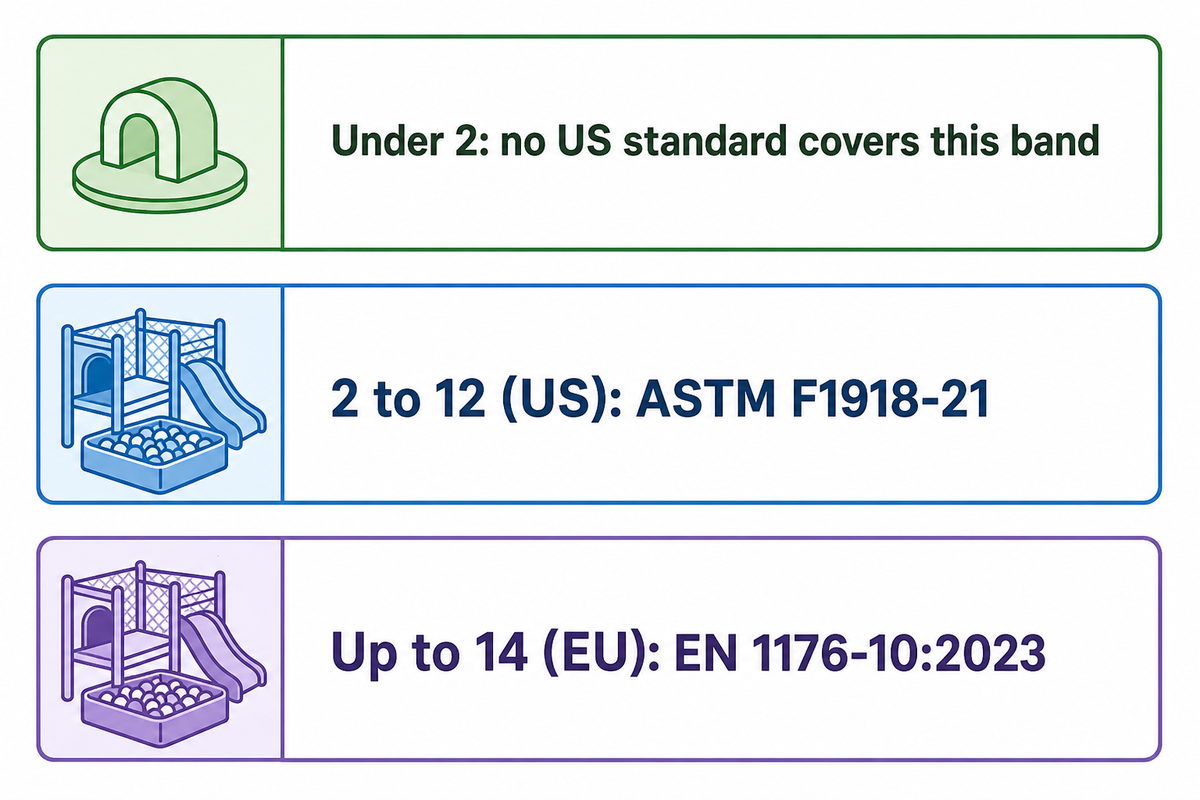
Age banding in a kindergarten or early-education play room is not a design preference — it is what a six-year multicentre injury registry says the data demands. In a study covering 891 children injured in Korean kids cafes, the median age of the injured child was three (interquartile range 2 to 5), and climbing carried by far the strongest association with a significant injury: an adjusted odds ratio of 14.94 (95% CI 1.51 to 147.72). The practical consequence for a mixed-age room is that the zoning line belongs at age three, with climbing equipment routed to a staffed, separately supervised zone rather than shared with toddlers.
| Age Band | Equipment Class | Applicable Standard | Limitations / Not Suitable For |
|---|---|---|---|
| Under 2 (contained envelope) | Low-relief soft play, no climbing | No US standard directly covers this band inside a contained structure | Not suitable for shared zones with 3+ year-olds |
| 2 to 12 (US) | Soft-contained climbing, slides, ball pit | ASTM F1918-21 | Not for public outdoor playground equipment or amusement rides |
| Up to 14 (EU) | Soft-contained climbing, slides, ball pit | EN 1176-10:2023 | No lower age bound stated; staffed supervision still required for young toddlers |
The US carries a gap the EU does not: ASTM F1918-21 is written for the 5th-percentile two-year-old through the 95th-percentile twelve-year-old, and ASTM F2373-24 (the standard for children 6 through 23 months) lists soft-contained play equipment among its own scope exclusions. A child under two inside a contained envelope falls outside both documents in the United States. EN 1176-10:2023 has no lower age bound, so the equivalent gap does not exist in Europe. Kindergarten operators serving toddlers under two should treat that age group as outside standard coverage entirely, not assume F1918 extends downward.
Restaurants, Hotels and Play Cafes: Where the Food Code Meets the Play Structure
⚠️ Important
Food-code adoption is a state and local matter in the US — the figures below illustrate one state’s approach, not a uniform national rule. Confirm which edition your own jurisdiction has adopted before writing your maintenance plan.
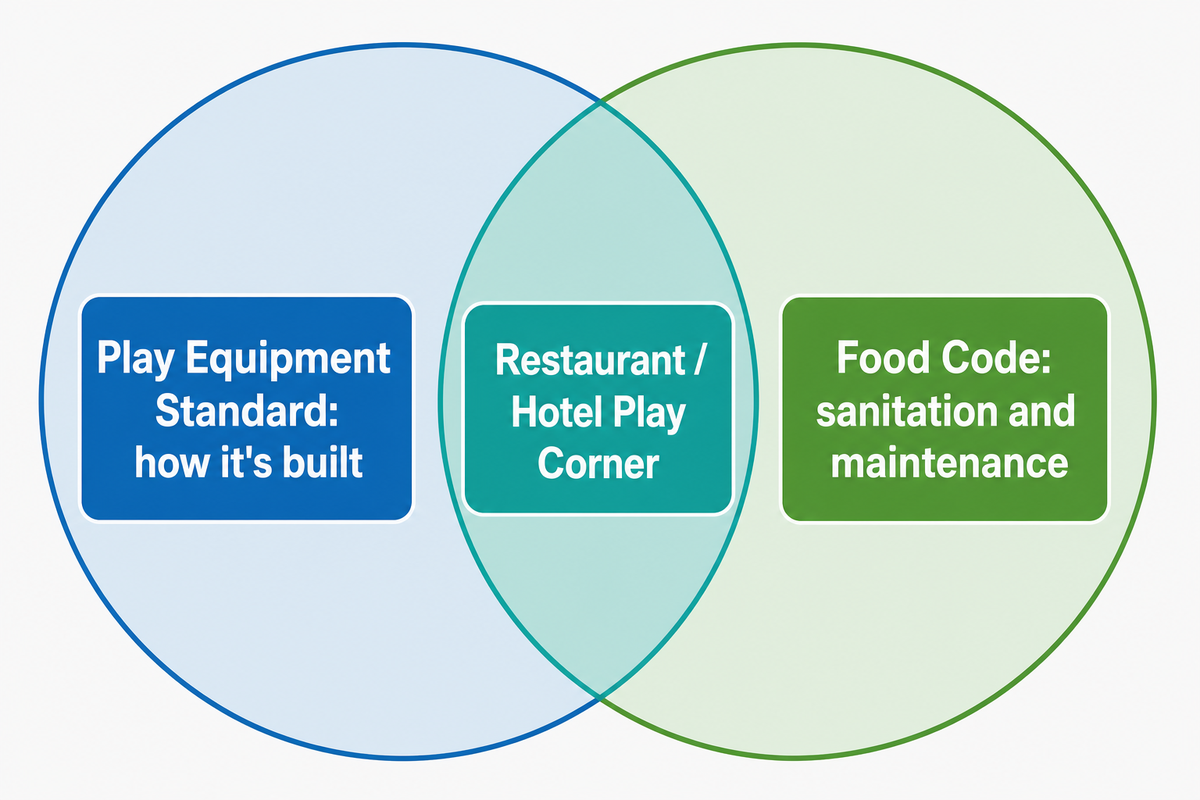
Restaurants that serve food alongside a play corner are courting a specific, valuable customer: working parents and local parent groups who pick a venue based on whether the kids stay occupied while the adults eat. Repeat visits from that audience come far more reliably from a kid-friendly, family-friendly layout than from a generic “kids eat free” promotion. A play corner inside a restaurant or hotel answers to the food code, not the play-equipment standard, for its sanitation and maintenance obligations. The Minnesota Department of Health publishes dedicated Indoor Play Area Maintenance and Sanitation guidance under Minnesota Food Code sections 4626.1515 and 4626.1520 specifically because a play structure sitting inside a licensed food establishment inherits that establishment’s health-department oversight — the ASTM or EN product standard covers how the structure is built, not how it gets cleaned once food service is happening ten feet away. Since the FDA Food Code is a model document that individual states adopt (and modify) on their own schedules, a restaurant or hotel operator’s first call should be to their local health department to confirm which edition and which specific play-area provisions apply locally, rather than assuming a single federal rule covers every location.
Which Standard Actually Governs Your Structure
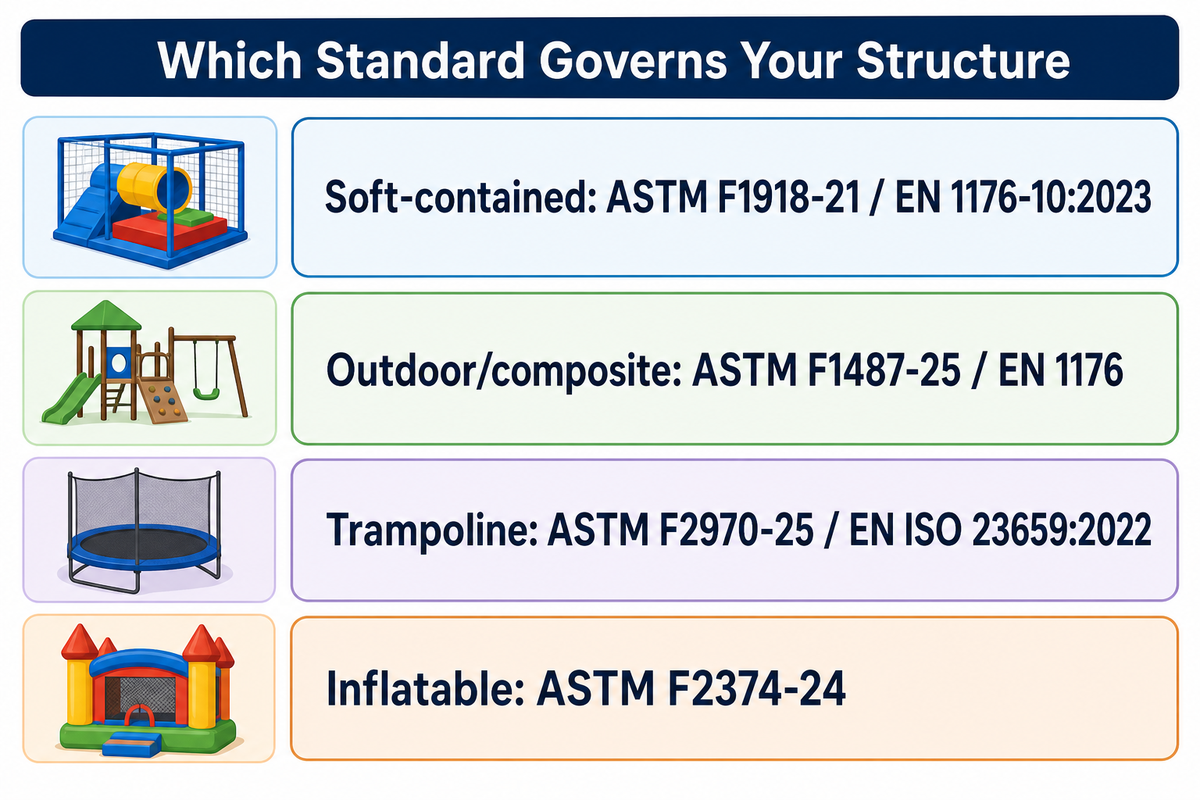
The standard that governs your structure depends on what it is before it depends on where it sits, and getting that order backward is the most common — and most expensive — mistake in this category. CPSC Publication 325 (the federal Public Playground Safety Handbook, updated July 2025) states plainly in its own scope section that its guidelines are not intended for soft contained play equipment.
That exclusion is why an indoor netted-and-padded structure needs ASTM F1918, not the CPSC handbook, even though CPSC lists F1918 among related standards. The Commission itself describes the handbook as guidance rather than a mandatory rule, which is a separate point from the scope exclusion — both matter, and neither substitutes for the other.
| Equipment Class / Type | US Standard | EU Standard | Limitations / Not Suitable For |
|---|---|---|---|
| Soft-contained (netted/padded) structure | ASTM F1918-21 | EN 1176-10:2023 | Excludes public outdoor playground equipment, sports equipment, amusement rides |
| Outdoor / composite public playground | ASTM F1487-25 | EN 1176 (main series) | Explicitly excludes soft-contained play equipment |
| Trampoline attraction | ASTM F2970-25 | EN ISO 23659:2022 | Covers operation/maintenance/inspection, not a substitute for structure-level product standards |
| Inflatable amusement device | ASTM F2374-24 | Varies by device type | Scope names FECs explicitly; not interchangeable with F1918 |
| Surfacing material (lab impact attenuation) | ASTM F1292-22 | BS EN 1177:2018+A1:2023 | A material certificate is not proof of the installed floor’s field performance |
| Installed surfacing (field verification) | ASTM F3313 | Not confirmed in sources reviewed for this guide | Field test required in addition to the material lab certificate, not instead of it |
| Under-2 contained-envelope play (US) | No standard directly covers this age band | EN 1176-10:2023 (no lower age bound) | F1918 starts at the 5th-percentile 2-year-old; F2373 explicitly excludes soft-contained equipment |
| CPSC Publication 325 (general guidance) | Guidance only, not a product standard | No EU equivalent in this table | Explicitly states it is not intended for soft-contained play equipment |
| IPEMA certification program (mark, not a standard) | Certifies F1487-25, CSA Z614:20, F1292-22, F3351-19e1, F2075-26, F3012-22 | No EU equivalent — program certifies to US and Canadian standards only | F1918 is not on the certified list; an IPEMA mark does not evidence soft-contained compliance |
The most common buyer mistake is conflating the outdoor-composite standard with the indoor soft-contained one. ASTM F1487-25 lists soft-contained play equipment among its own scope exclusions, so it does not cover a fully enclosed netted and padded indoor structure, and this finding contradicts the common assumption that IPEMA certification extends to indoor soft-contained play equipment. IPEMA’s published certification program enumerates ASTM F1487-25, CSA Z614:20, ASTM F1292-22, ASTM F3351-19e1, ASTM F2075-26 and ASTM F3012-22; F1918 is not on that list. An “IPEMA certified” claim on a soft-contained structure does not evidence F1918 conformance, because IPEMA’s program was never built to certify against F1918 in the first place.
ASTM currently has an open work item (WK94592) to revise F1918, prompted, per its public work-items listing, by product-definition language that still references pliable, foam-covered materials no longer representative of how soft-contained equipment is typically built today. That work item documents active revision effort — it does not mean a new edition has been published. The current active edition remains F1918-21; treat any claim of “already updated to the new F1918” as unverified until ASTM publishes the revision.
| Situation / Trigger | Value | Governing Standard | Primary Source |
|---|---|---|---|
| Mall/retail structure height or footprint review trigger | >10 ft high or >150 sq ft added | IBC play-structure provisions (state-adopted; section numbering varies) | Not independently verified against primary ICC text — confirm with your building official |
| Single mall structure area cap | 600 sq ft | IBC play-structure provisions (state-adopted; section numbering varies) | Not independently verified against primary ICC text — confirm with your building official |
| Mall kiosk horizontal separation | 20 ft minimum | IBC Section 402.6.3 (state-adopted) | Not independently verified against primary ICC text — confirm with your building official |
| Soft-contained climbing structure (any venue) | 5th-95th percentile child, 2-12 yrs | ASTM F1918-21 | ASTM International |
| Under-2 contained-envelope play (US gap) | no standard directly covers | ASTM F2373-24 excludes soft-contained equipment | ASTM International |
| ADA accessible entrances, 3 or fewer total entry points | at least 1 accessible entrance | 2010 ADA Standards | ada.gov |
| ADA accessible entrances, 4 or more total entry points | at least 2 accessible entrances | 2010 ADA Standards | access-board.gov |
| Restaurant/hotel play corner sanitation authority | food code, not play-equipment standard | State Food Code (Minnesota shown) | health.state.mn.us |
| Surfacing material lab certification | critical height >= actual fall height | ASTM F1292-22 | ASTM International |
| Installed surfacing field verification | required in addition to lab certificate | ASTM F3313 | ASTM International |
| Sprinkler stored-materials clearance (not a structure-height cap) | 18 in (45.7 cm) | 29 CFR 1910.159(c)(10) | osha.gov |
Key Factors to Consider Before You Request a Test Report
- Classify the component first (soft-contained vs. outdoor-composite vs. trampoline vs. inflatable) — the classification determines the destination standard, not the other way around.
- No clause-level requirement should be attributed to F1918 unless it comes from the standard itself — the publicly reachable ASTM pages carry the scope sentence and section titles, not numbered clause text, so specific clause claims are frequently fabricated by third-party summaries.
- When you’re presented with claims of “certified” status, ask which specific certification mark (if any) covers equipment that falls within your classified category, not simply if it’s “certified” generically.
The Space Math: Usable Height, Fall Height and the Accessible Route
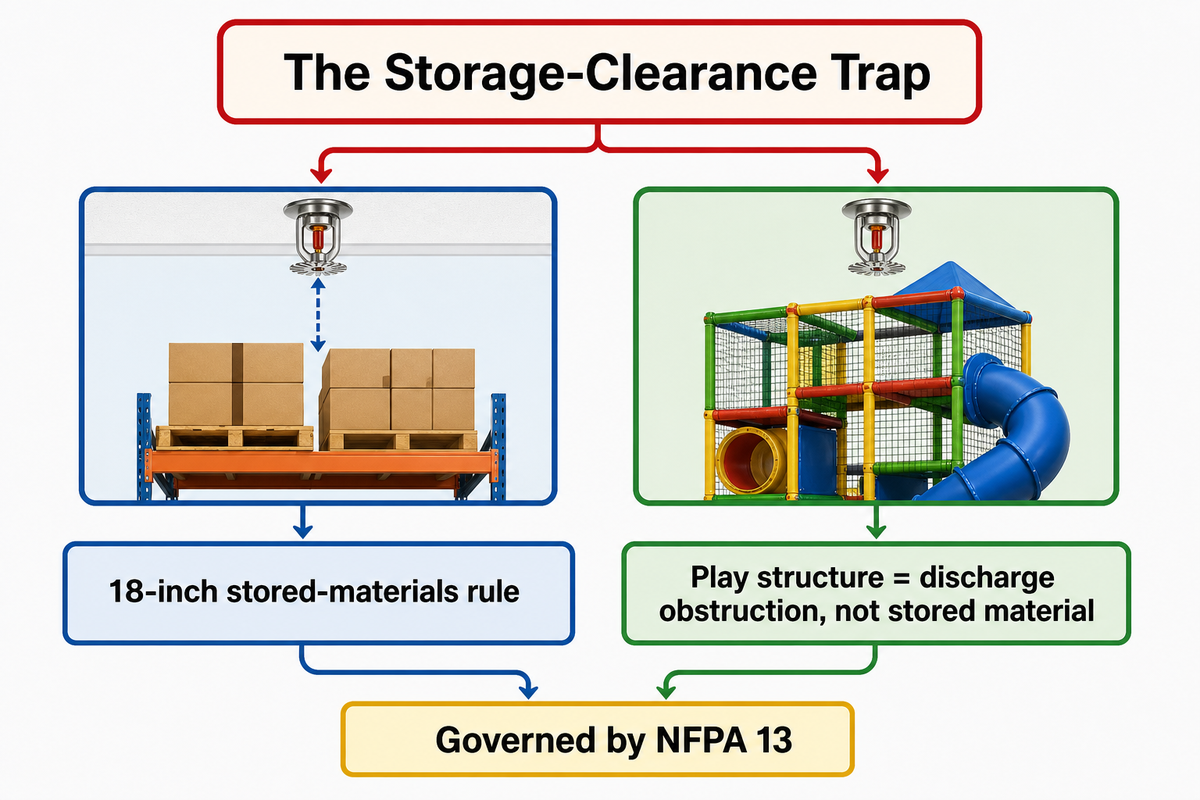
With the governing standard settled, the next question is how much of the ceiling above it you actually get to use. Two separate clearance rules govern that space, and mixing them up is an easy, expensive mistake. Operators researching sprinkler clearance frequently encounter the well-known 18-inch rule and assume it sets their maximum structure height — it does not.
“The answers given apply to clearance from stored materials only.”
— U.S. Occupational Safety and Health Administration, Standard Interpretation of 29 CFR 1910.159(c)(10), September 29, 2008
OSHA’s own interpretation of the sprinkler-clearance rule states this directly, and separately notes that obstructions to sprinkler discharge — structural members, decking, and yes, a tall play structure — fall under NFPA 13’s own requirements, which vary by sprinkler type rather than following one fixed number.
📐 Engineering Note — The Storage-Clearance Trap
Merchandise or inventory stored below a sprinkler head answers to the simple 18-inch stored-materials rule. A play structure tall enough to sit near a sprinkler deflector is a discharge obstruction, not stored material — and obstruction clearance is project-specific, governed by NFPA 13’s sprinkler-type-dependent requirements rather than a flat number. Bring your ceiling height and structure profile to a fire-protection engineer or your local Authority Having Jurisdiction before finalizing equipment height — do not assume the 18-inch figure clears your design.
Accessible-route requirements add a second, separately-scoped layer that changes with how many entry points your structure has. Under the 2010 ADA Standards, a soft-contained play structure needs at least one accessible entry point where three or fewer are provided, and at least two where four or more are provided. Separately, and applying to play areas generally rather than to soft-contained structures alone, at least 50% of elevated play components and at least one of each type of ground-level component must sit on an accessible route. The Accessible Route Sizing Check maps entry-point count to the exact route width your floor plan needs.
| Condition | Requirement |
|---|---|
| 3 or fewer entry points | At least 1 accessible entry point |
| 4 or more entry points | At least 2 accessible entry points |
| Ground-level route width | 60 in (1525 mm) minimum, reducible to 44 in (1120 mm) in a play area under 1,000 sq ft |
| Elevated route width | 36 in (915 mm), or 24 in (610 mm) where a transfer system is used |
| Vertical clearance over a ground-level route | 80 in (2030 mm) minimum |
Fall height and critical height are the two numbers buyers most often collapse into one. Fall height is the vertical distance from the highest designated play surface to the surfacing beneath it; a surfacing material’s ASTM F1292 critical-height rating must be greater than or equal to that fall height, and installed surfacing should additionally be tested to ASTM F3313 because a laboratory certificate for the material itself is not proof of the installed floor’s actual performance.
Does it have the right dimensions for your indoor play area requirements?
Run the numbers before you sign a floor plan: confirm your clear ceiling height, get a written sprinkler-obstruction clearance from a fire-protection professional (not a stored-materials calculation), map every entry point against the ADA thresholds above, and match your surfacing’s F1292 critical-height rating to your actual fall height — not a generic “meets code” claim from the supplier.
Hygiene and Maintenance by Venue Type
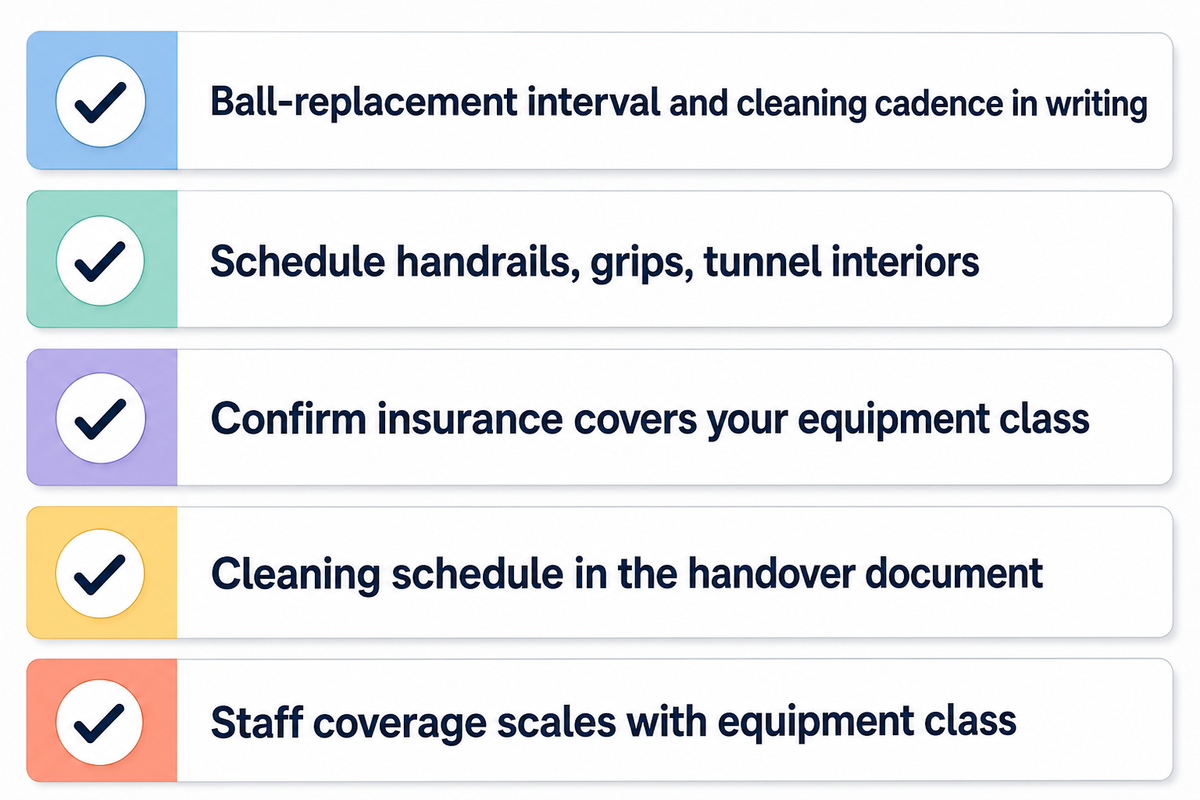
Space math and compliance settled, the next recurring line item is upkeep. A commercial ball pool needs a written cleaning cadence and ball-replacement interval agreed before handover, not a vague “we clean regularly” line in the equipment quote. Ball pits in physical therapy clinics — cleaned to healthcare standards — were still found to carry eight opportunistic pathogenic bacteria and one opportunistic yeast in one published study; that is a clinical setting, not a commercial venue, so it is a reason to schedule cleaning rather than a direct measurement of commercial-venue risk. The ball pool is not the only surface worth scheduling: a survey of 355 samples from playgrounds across 16 Hungarian cities recovered Staphylococcus aureus from 2.81% of them, none methicillin-resistant, with isolates concentrated especially on plastic surfaces. That study was conducted outdoors and does not rank indoor materials against each other, but it supports scheduling every high-touch plastic surface — handrails, climbing grips, tunnel interiors — rather than treating the ball pit as the only consumable.
-
✔
Put a written ball-replacement interval and cleaning cadence in the equipment handover documents, not just the verbal sales pitch -
✔
Schedule high-touch plastic surfaces other than the ball pit – handrails, grips, tunnel interiors -
✔
Double-check that liability insurance and general insurance costs cover your specific equipment class before you launch your business, rather than accepting a generic policy. -
✔
Cleaning and maintenance schedules belong in the same handover document as the insurance certificate, not a separate verbal promise -
✔
Staff coverage should scale with equipment class, not just square footage — active-supervision guidance (Head Start programs among them) emphasizes positioning, scanning, and engaging, not just having a staff member visible from a cafe seat
What a Manufacturer Quote Should Include (and What It Won’t)
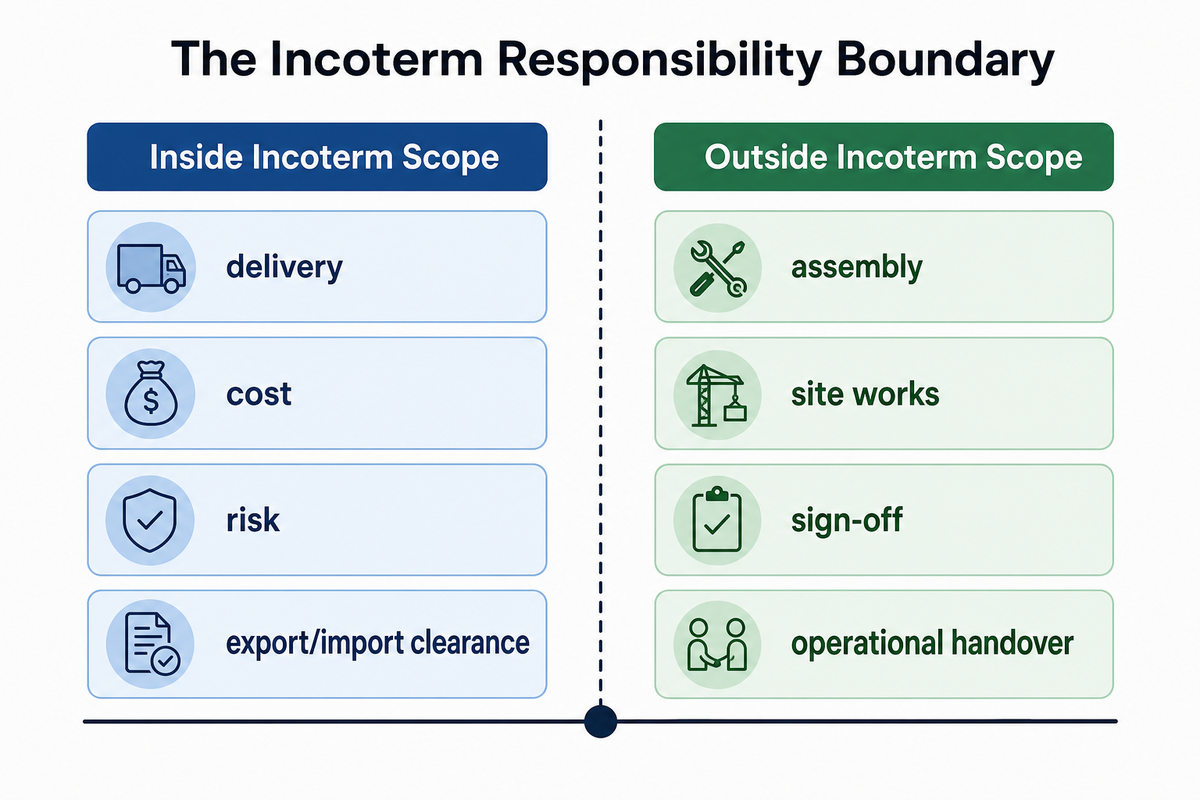
A manufacturer quote tells you the equipment price – it seldom tells you where the manufacturer’s responsibility stops. Incoterms allocate delivery, cost, risk, export/import clearance & unloading, and the U.S. International Trade Administration’s own Incoterms guidance states unambiguously that they don’t include several items buyers naturally expect to see — transfer of ownership and payment terms among them.
Assembly, supervision of installation, site works, sign-off, and operational handover routinely sit outside the Incoterm scope entirely — so a quote that only states an Incoterm (say, FOB or CIF) hasn’t even told you who supervises assembly on your site.
RFQ checklist — copy these into your quote request:
| Parameter | Recommended range | Why it matters | How to verify |
|---|---|---|---|
| Governing standard | ASTM F1918-21 or EN 1176-10:2023, stated explicitly | Confirms the equipment class matches your structure type | Ask for the test report referencing the exact standard and edition |
| Incoterm + scope boundary | Named Incoterm plus a written assembly/handover clause | Incoterms alone do not cover assembly or site supervision | Request a separate scope-of-work document, not just the Incoterm line |
| Surfacing critical height | ASTM F1292 rating >= your actual fall height | A lab certificate for the material is not proof of the installed floor | Request ASTM F3313 field-verification results after installation |
| Accessible-route compliance | Entry-point count and route widths stated against the ADA table | Retrofitting an accessible route after installation is costly | Confirm the vendor’s layout drawing marks the accessible route explicitly |
| Cleaning/maintenance handover | Written cleaning cadence and consumable-replacement schedule | Verbal “clean regularly” promises are not enforceable | Request the maintenance document as a signed deliverable |
Read the hub’s Incoterm Cliff and the responsibility boundary breakdown for the full procurement workflow, this guide deliberately stays at the equipment-and-compliance level, and the hub covers the transaction-and-handover level in depth, including three interactive checkers for building-code thresholds, accessible-route sizing, and the Incoterm Cliff Scope Splitter.
Startup Costs, Membership Revenue, and Where the Market Is Headed
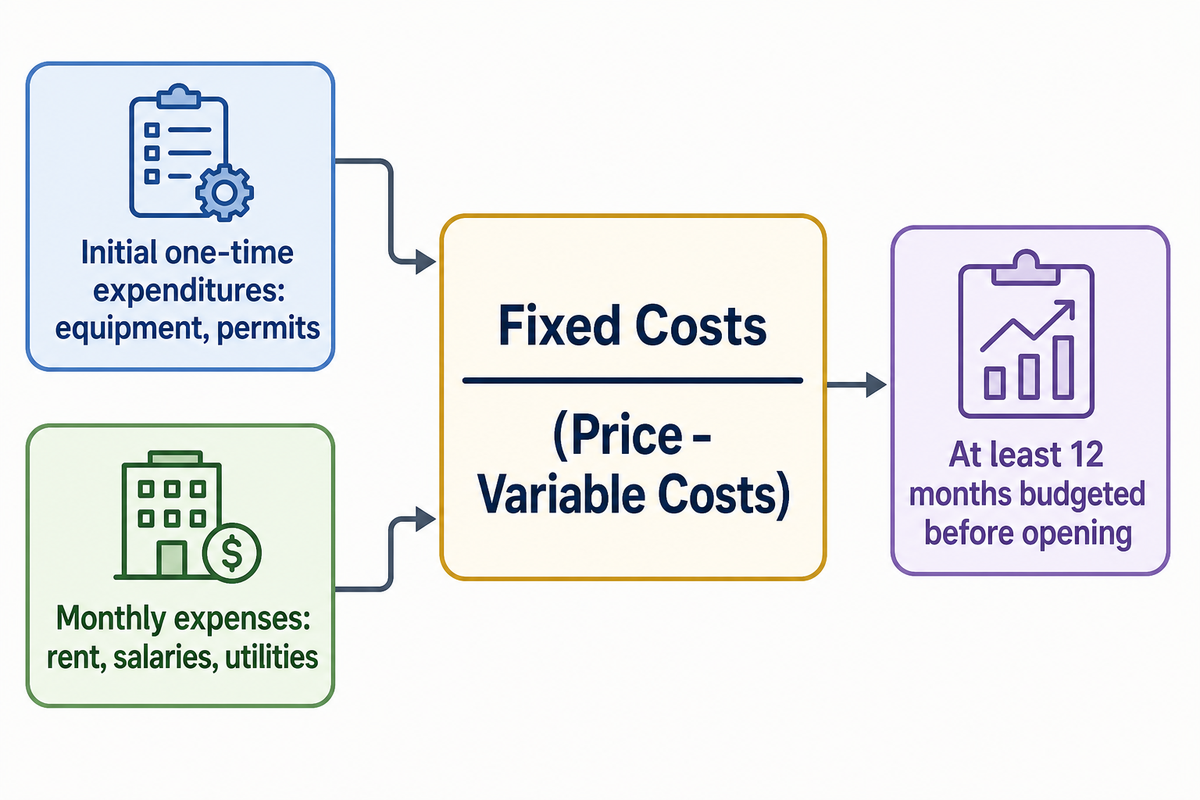
With the quote’s scope gaps mapped, the last piece is the number that decides whether the business gets funded at all. Whether you call the venue a play center, a commercial indoor playground, or a family entertainment center, starting a business in this category means setting business goals that match a specific target age band and a specific indoor playground market segment, not a generic “kids of all ages” pitch. The way you market your indoor playground after opening matters as much as how you plan it – the indoor playground market rewards operators who keep marketing going past the grand opening, not just during the launch window. Published startup-cost figures for this business vary by roughly an order of magnitude across sources, and no consistent methodology explains the spread – treat any single number you read elsewhere with serious skepticism. Instead of relying on one vendor figure, the U.S. Small Business Administration’s planning framework is a more defensible starting point: its break-even formula is Fixed Costs divided by (Price minus Variable Costs), and it breaks out startup costs into initial one-time expenditures (equipment, permits) and monthly expenses (rent, salaries, utilities), suggesting at least 12 months of monthly costs budgeted prior to opening. Use that framework against your own venue-type facts from the above table rather than importing a stranger’s total. If you’re searching for an indoor playground business plan template, treat it as a formatting shortcut only — an indoor playground business cost figure or an indoor playground franchise cost comparison copied from a downloaded template still needs to be replaced with your own venue-specific numbers before a lender will take it seriously.
Membership programs and birthday-party packages are the two revenue levers that most alter a venue’s break-even math beyond the admission gate. Play cafes and FECs with a strong membership base turn unpredictable daily admissions into recurring revenue, while party-room throughput at family entertainment centers regularly exceeds open-play admission as the core profit engine – which is why the equipment mix and staff model selected in the Family Entertainment Center section above should be sized around party capacity, not just peak walk-in traffic.
Search interest in planning this type of business isn’t flat, and the trend is worth stating explicitly: search-demand data for this precise planning question shows a structurally rising three-year trend, layered on top of a clear seasonal pattern that peaks around November and tapers through the spring and summer months. The take-away isn’t the year-over-year headline figure – it’s that investor research activity clusters in advance of spring openings, so a launch timeline built backwards from that seasonal window is more relevant than chasing an aggregate growth percentage. Market-size estimates for this industry diverge even more widely than cost figures across different research firms and scope definitions, which itself is worth knowing before you build out a pitch deck around any single total-addressable-market figure.
Why We Write This
Guangzhou Toplay Amusement Equipment Co., Ltd. has manufactured indoor playground equipment for operators in malls, family entertainment centers, kindergartens, and restaurant venues since 2014, exporting to more than 40 countries. This guide is provided because too many equipment quotes buyers forward to us during RFQ include a standard misapplied, an accessible-route requirement omitted, or a sprinkler-clearance figure borrowed from the wrong rule.
These are the same checks we ask our engineering team to raise on a drawing before we quote — your local building official, fire-protection engineer, and health department remain the deciding authorities.
Frequently Asked Questions
What a playground business plan should include comes up in nearly every conversation we have with first-time operators — the six questions below are the ones asked most often, answered against the venue-type, standards, and cost framework above rather than in the abstract.
Q: Is an indoor playground business profitable?
Whether you end up with a profitable indoor playground depends heavily on venue type, membership mix, and party-room throughput rather than admission revenue alone, and the answer changes meaningfully once you plug in your own venue-specific cost structure.
Standalone indoor playgrounds and family entertainment centers report outcomes that swing from a loss to a healthy margin depending on venue type and management; the SBA break-even framework above (Fixed Costs / (Price – Variable Costs)) is a more reliable starting point than any single published profitability percentage, because it forces you to plug in your own venue-specific costs and revenue mix rather than borrow an average from a business with a different footprint and staffing model.
Q: How much would it cost to set up an indoor playground?
Published figures vary by roughly an order of magnitude across sources with no consistent methodology, so a single “typical” number should be treated with caution.
Rather than anchor on one vendor’s total, use the SBA’s one-time-versus-monthly-expense framework from the Startup Costs section above, and price your own venue type, footprint, and equipment mix from the Quick Specs table rather than importing a stranger’s total cost figure. Get a written equipment quote and a separate site-works estimate before committing to a lease, since the two figures are rarely bundled by a manufacturer.
Q: What permits are needed for an indoor playground?
Building/fire code review, food-service licensing where applicable, and childcare licensing for kindergarten-adjacent venues are the three most common permit layers, though the exact combination depends entirely on which venue type you are opening.
Which permits apply depends on your venue type: mall and FEC installations trigger building/fire code review once a structure exceeds 10 feet in height or 150 square feet in area (see the Malls and Retail section); restaurant and hotel play corners inherit food-service licensing through the food code (see the Restaurants, Hotels and Play Cafes section); and kindergarten-adjacent venues carry childcare licensing requirements on top of the equipment standard. Confirm the exact permit list with your local building department before signing a lease.
Q: What kind of insurance do you need for an indoor playground?
General liability is the baseline; venue type and equipment class change what else you should ask a broker about, since soft-contained, trampoline, and inflatable equipment carry different underwriting risk profiles.
Insurance requirements are jurisdiction- and venue-specific — a broker familiar with amusement and recreation risk should confirm coverage against your specific equipment classes (soft-contained, trampoline, and inflatable equipment carry different risk profiles per the Which Standard Actually Governs Your Structure section above).
Q: Is starting an indoor playground business a good investment?
Whether an indoor playground business is a good investment depends more on venue-type fit and compliance discipline than on the industry-wide averages most guides quote.
The venue types that most often stall are the ones where equipment was selected before the business model was locked in — a mistake pattern that shows up consistently across the vendor and trade sources reviewed for this guide. Investors who work through the venue-type table, the standards-scope section, and the SBA break-even framework before signing equipment quotes are working from a materially stronger position than those who start with a vendor’s generic proposal.
Q: What makes an indoor playground safe by design?
Safe-by-design means matching the correct product standard to your equipment class, then verifying fall height, accessible routes, and sprinkler clearance against primary sources rather than a supplier’s summary.
The single biggest design-stage risk is applying the wrong standard to the wrong equipment class, see the Which Standard Actually Governs Your Structure section for the full scope-boundary table. After classification, the surfacing critical-height rating (ASTM F1292, field-verified with F3313), the ADA accessible-route dimensions, and correctly-scoped sprinkler clearance (see The Storage-Clearance Trap in the Space Math section) are the three checks most often skipped or oversimplified. Add the age-banding evidence from the Kindergartens and Early-Education section, zoning climbing equipment away from children under three based on the injury-registry data cited there, and a written cleaning and maintenance schedule from the Hygiene section, and you have a design-stage checklist that covers structure, surfacing, access, fire-code clearance, age zoning, and sanitation in one pass rather than treating each as a separate afterthought.
Related Articles
References & Sources
- Public Playground Safety Handbook, Publication 325 (July 2025 edition) U.S. Consumer Product Safety Commission
- Guide to the ADA Standards, Chapter 10: Play Areas U.S. Access Board
- 2010 ADA Standards for Accessible Design U.S. Department of Justice
- 29 CFR 1910.159, Automatic sprinkler systems Occupational Safety and Health Administration
- Standard Interpretation: Clarification of 29 CFR 1910.159(c)(10), Sprinkler spacing (2008-09-29) Occupational Safety and Health Administration
- ASTM F1918-21, Standard Safety Performance Specification for Soft Contained Play Equipment ASTM International
- WK94592, Revision of F1918-21 (active work item) ASTM International
- IPEMA Certification Program International Play Equipment Manufacturers Association
- Incoterms guidance International Trade Administration, U.S. Department of Commerce
- Indoor Play Area Maintenance and Sanitation guidance, Minnesota Food Code Minnesota Department of Health
- Multicentre injury registry study, kids cafes PMC (National Library of Medicine)
- Ball pit pathogen study, physical therapy clinics PubMed (National Library of Medicine)
- Playground surface Staphylococcus aureus prevalence study, Hungary PubMed (National Library of Medicine)
- Plan Your Business, break-even formula and startup cost planning U.S. Small Business Administration



