
Get in touch with Guangzhou Toplay amusement equipment co. Company

Quick Specs
| US governing standard | ASTM F1918 (soft contained play equipment) |
| EU governing standard | EN 1176-10 (fully enclosed play equipment) |
| Age coverage (US) | 5th percentile 2-year-old to 95th percentile 12-year-old |
| Age coverage (EU) | Up to 14 years, no stated lower bound |
| Typical indoor footprint | Small daycare 200-800 sq ft; full 5,000 sq ft facility for larger operators |
| Surfacing test method | ASTM F1292 critical fall height (200 g peak deceleration threshold) |
Childcare playground equipment is soft contained play equipment manufactured and verified to ASTM F1918 in the United States — also called daycare playground equipment — a separate specification from the ASTM F1487 document that governs rigid outdoor playground structures. Beyond the standards issue, this guide has been written to cover age-band choice, certification understanding, surfacing, construction compatibility, users’ needs, hygiene, budget considerations, and how to instruct a supplier to get what the buyer wants and nothing else so the new structure isn’t left hanging there in the gap between certs. Along the way, the answer is clear: a daycare, preschool, or early-education center wants structured indoor playtime that grows gross-motor skills and early teamwork, inside a space built to the standard that actually applies to it, not the one a web ad happens to mention.
In short: the rule that applies to a piece of equipment is determined by whether it’s hard or soft, not by whether it sits indoors or outside.
The ASTM F1487 standard (a typical playground climber) and the ASTM F1918 standard (a foam and netting play structure) can both govern the same site simultaneously, and both are valid–they just apply different standards.
Beyond the paperwork, the reason daycare centers, preschools, and toddler playground programs invest in dedicated equipment comes down to child development and childhood development more broadly. Age-appropriate soft contained systems built around unstructured play and cooperative play support fine motor skills, social skills, social interactions, and early learning and problem-solving, while activity panels, texture, and bright colors reflect a deliberate strategy of incorporating sensory elements that early-childhood educators associate with creative play, learning and creativity, and enrichment. For younger toddlers and little ones, the 2-5 years age group covered later in this guide (the 6-23 months band sits in the standards gap discussed below), the physical development and physical fitness benefits of climbing, crawling, and balancing are part of why childcare providers treat play time and adventure play as a curriculum input, not just a break. Whether a preschool-and-daycare or a preschool-or-daycare facility is choosing among interactive games, fitness products, or quieter play options, most manufacturers also offer customization options: design options, freestanding layouts, sustainable materials or other high-quality materials, and a design team that can adjust a playground set to a room’s footprint. The depth of that expert craftsmanship, and the applicable safety standards behind it, still trace back to the certification questions this guide covers next. As University of Georgia Extension human development specialist Diane Bales puts it, the key to a safe playground is the combination of proper equipment, good supervision, and ongoing maintenance — no single one of the three substitutes for the others.
What Counts as “Childcare Playground Equipment” — and Which Standard Actually Applies
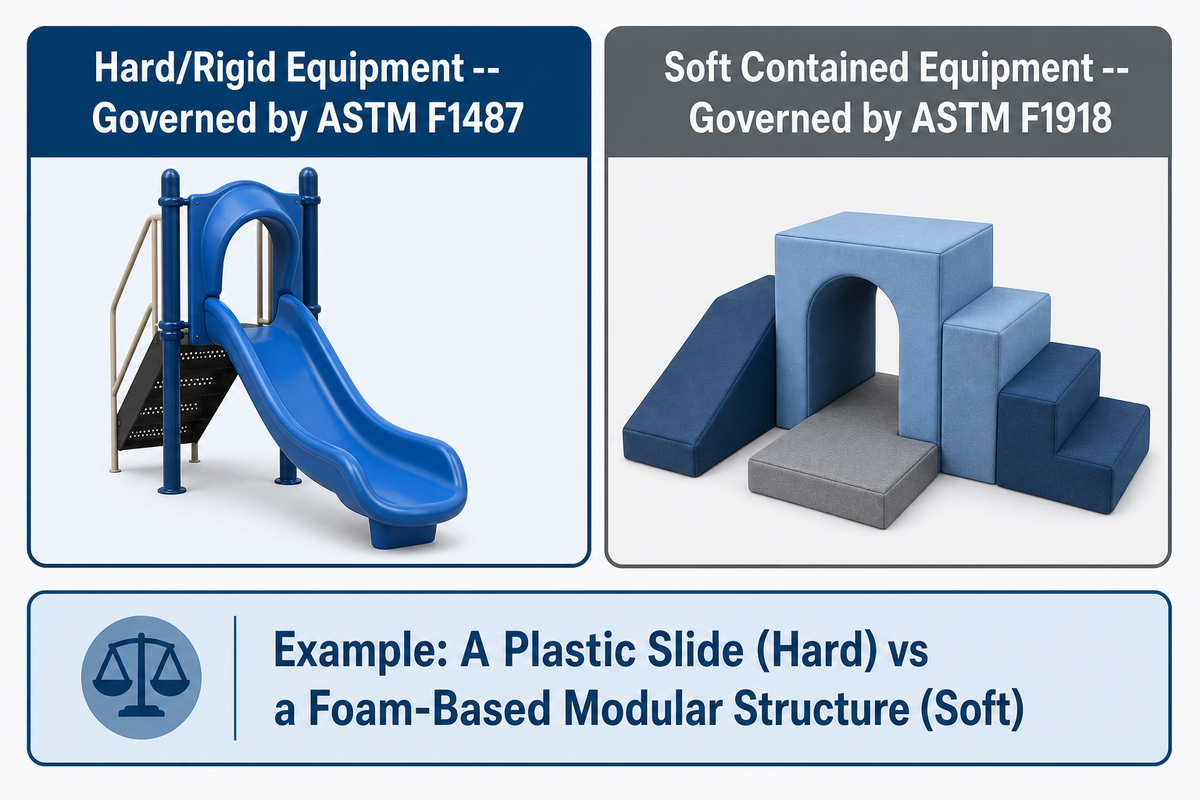
Whether the equipment is hard or soft determines which standard applies, not whether it sits indoors or outside. ASTM F1487 covers rigid public playground equipment for child-care centers, schools, and similar venues — but F1487’s own exclusions list rules out soft contained play equipment entirely. That equipment class, the padded, foam-and-netting indoor structures most people picture when they hear “childcare playground equipment,” is governed instead by ASTM F1918, written for the 5th percentile 2-year-old through the 95th percentile 12-year-old.
ASTM F1918, Standard Safety Performance Specification for Soft Contained Play Equipment, explicitly excludes public playground equipment, home playground equipment, sports equipment, amusement rides, water attractions, and toys from its scope — it covers only the padded, foam-and-netting structures this guide focuses on. F1487’s full title is Standard Consumer Safety Performance Specification for Playground Equipment for Public Use. Material and type differences mean a buyer can set up F1487-compliant hard equipment (a plastic slide) and F1918-compliant soft equipment (a foam-based modular structure) on the same property — but a supplier saying “our equipment meets ASTM standards” without specifying which can’t provide a complete answer.
There’s also a third set of standards most buyers don’t know exist: state child-care licensing requirements. Several US states impose their own square-footage and equipment-type rules for licensed child-care facilities on top of the ASTM standards, so checking with the state child-care licensing body — not the supplier’s certification claims or a blog post — is the reliable way to confirm what applies to a specific facility.
| Standard | Body | Covers | Age range | IPEMA certifies? |
|---|---|---|---|---|
| ASTM F1918 | ASTM | Soft contained play equipment (indoor) | 2-12 yr | No |
| ASTM F1487 | ASTM | Rigid public playground equipment; excludes soft contained | 2-12 yr | Yes |
| ASTM F2373 | ASTM | Public-use equipment for infants/young toddlers; excludes soft contained | 6-23 mo | No |
| ASTM F2374 | ASTM | Inflatable amusement devices (bounce houses, jump structures) | Names FECs, schools, camps | No |
| ASTM F1292 | ASTM | Impact attenuation of surfacing materials | All ages (use-zone spec) | Yes |
| CSA Z614 | CSA (Canada) | Children’s playground equipment and surfacing | General | Yes |
| EN 1176-10 | CEN (EU) | Fully enclosed play equipment, indoor or outdoor | Up to 14 yr, no lower bound stated | No (not a US program) |
| EN 1177 | CEN (EU) | Impact-attenuating playground surfacing, test method | All ages (use-zone spec) | No |
| CPSC Pub. 325 | CPSC (US federal) | Voluntary guidance handbook; states it excludes soft contained equipment | General | N/A (not a standard) |
💡 Pro Tip
Ask the supplier for the exact standard number and the year on their test report – just being “ASTM certified” could mean one of the 9 documents above.
Age Bands — Matching Equipment to Infants, Toddlers, Preschoolers and School-Age Kids
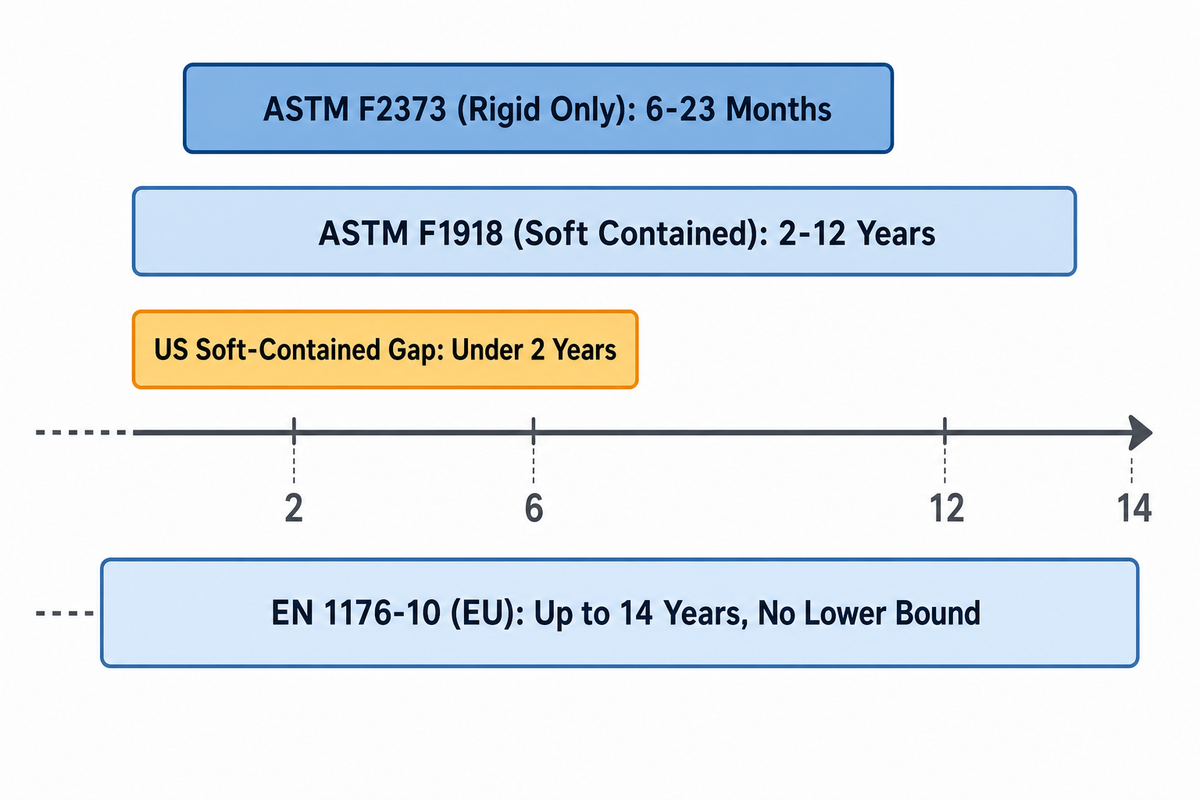
There’s a real gap between the covered ages in the US and Europe, and it hits kids under two hardest. In the US, F1918 covers kids from the 5th percentile 2-year-old to the 95th percentile 12-year-old. Toddlers between 6 and 23 months fall under a different document, ASTM F2373 — but F2373 explicitly excludes soft contained play equipment from its scope. The practical result: a child under two in a foam-and-netting structure falls outside both F1918 and F2373 coverage in the US.
Europe doesn’t carry the same gap: EN 1176-10 covers fully enclosed play equipment up to 14 years old with no stated lower age bound, and makes no mention of any such carve-out — which is why many soft enclosed play structures built for both markets end up conforming to whichever range is tighter. Toplay’s venue-solutions guide walks through this same age-banding evidence in a kindergarten-specific context, if that’s the venue type in question.
What Age Range Does ASTM F1918 Cover?
ASTM F1918 covers soft contained play equipment for children from the 5th percentile 2-year-old through the 95th percentile 12-year-old, a range broad enough to include most daycare, preschool, and after-school populations, with the notable exception of infants and toddlers under 24 months, who fall into the documented US standards gap described above.
| Age band | US coverage | EU coverage | Limitations / Not suitable for |
|---|---|---|---|
| Under 6 months | Not covered by F1918 or F2373 | EN 1176-10 has no stated lower bound | Not designed for non-mobile infants; check state licensing rules separately |
| 6-23 months | F2373 covers public-use equipment for this band, but excludes soft contained equipment | EN 1176-10 covers this band for enclosed equipment | This is the documented US soft-contained gap — verify with supplier what, if anything, they test to for this age |
| 2-5 and 5-12 years | F1918 (soft contained), F1487 (rigid, excludes soft contained) | EN 1176-10 (enclosed), general EN 1176 series (rigid) | Core coverage band for both frameworks; not a gap |
| 12-14 years | Outside F1918’s stated range | EN 1176-10 covers up to 14 | School-age programs with older children should ask specifically how equipment is rated above 12 |
Certification Literacy — What “IPEMA Certified” and “CPSC Compliant” Actually Mean
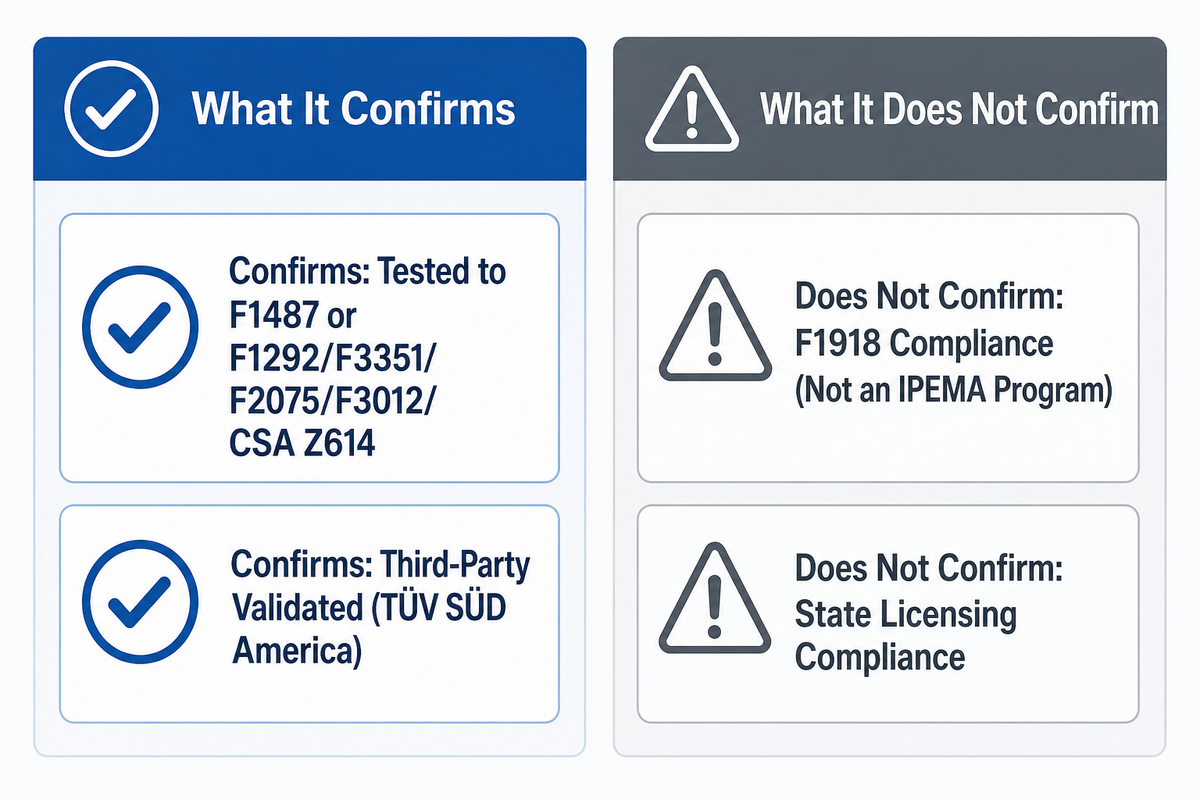
None of IPEMA’s certification programs list ASTM F1918. IPEMA’s equipment program covers ASTM F1487, and its surfacing program covers ASTM F1292, F3351, F2075, and F3012, plus CSA Z614 — but F1918 doesn’t appear on either list of record. That doesn’t mean no F1918-conforming products exist; it means an IPEMA-certified mark on a playground doesn’t by itself confirm F1918 compliance, since IPEMA’s third-party review doesn’t cover that standard. TÜV SÜD America serves as the third-party validator for IPEMA’s program.
Claims of CPSC compliance deserve the same scrutiny. CPSC’s own Publication 325, updated July 2025, states that its guidance was written for rigid public play structures and doesn’t apply to soft contained play equipment — and separately, the CPSC confirms there’s no playground-specific statutory certification standard to meet beyond the general rules for all children’s products (phthalate content regulation and the testing/certification obligations under 16 C.F.R. Part 1250 for any removable accessories or attachments).
Typically when a manufacturer indicates its product is compliant to the CPSC, they’re simply suggesting its compliance to existing broad safety regulation impacting all children’s products rather than demonstrating or attesting to compliance with a particular federal certification, because no such federal certification program exists for this equipment class in the first place.
✔ What a valid IPEMA mark tells you
- The product has been tested to F1487 (equipment) or F1292/F3351/F2075/F3012/CSA Z614 (surfacing)
- A third party (TÜV SÜD America) validated the testing
- The product was tested against the named standard, and the result was validated by a third party
⚠ What it does not tell you
- That the specific soft contained product is F1918-conforming (F1918 isn’t an IPEMA program)
- That the equipment satisfies your state’s separate licensing rules
- That the as-installed surfacing meets its lab-rated critical height (see the next section)
Safety Surfacing — Fall Height, Critical Height, and Why a Lab Certificate Isn’t the Whole Story
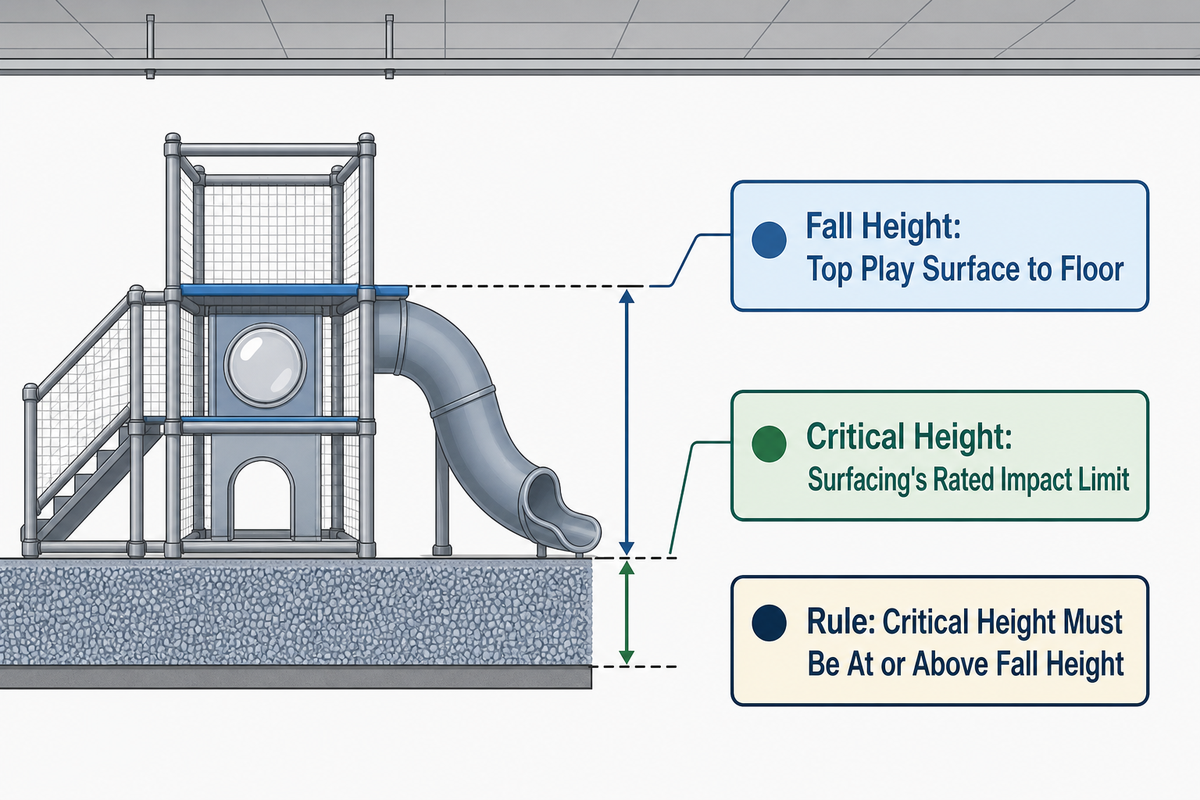
Confusing fall height with critical height is one of the most common specification mistakes buyers make. Fall height is the physical distance between the highest intended play surface of the equipment and the fall-protection surfacing below it. Critical height is specific to a given surfacing material: it’s the highest point from which an instrumented metal headform, dropped under ASTM F1292 test conditions, can fall and impact without exceeding a 200 g’s peak deceleration.
The critical-height rating for a surfacing material must sit at or above the equipment’s actual fall height — a 5-foot critical-height tile under a 6-foot fall height is out of spec, even with a valid F1292 lab report in hand.
Lab certificates are also not proof of field performance, and buyers shouldn’t treat them as one. Laboratory ratings measure head-impact attenuation under controlled conditions; they don’t, by themselves, measure limb-fracture risk in service. Published surfacing-outcomes research has reported different arm-fracture rates between surfacing types that both met the same lab standard, though with overlapping confidence intervals. Separately, ASTM F3313 provides a field-verification method for the installed floor, rather than relying on the material’s lab certificate alone. Surfacing compliance also isn’t permanent: engineered wood fiber and similar loose materials compact and degrade, and a floor that passed inspection at installation can fall out of spec months later without anyone re-testing it.
Fitting a Playground Into Your Building — Space, Ceiling Height and Fire-Code Thresholds
Locating a play structure indoors within an existing building brings permitting steps few buyers build into their projects. Adopted U.S. building and fire codes commonly add provisions once an indoor play structure exceeds 10 ft. in height or 150 sq. ft., and require at least 20 ft. of horizontal separation from kiosks and similar structures within a covered mall. These exact thresholds vary by jurisdiction and haven’t been standardized nationally, so confirm the applicable numbers with the local building and fire authority before designing — but the pattern (height/footprint minimums plus separation requirements) is consistent enough to budget a code-review step into the project timeline.
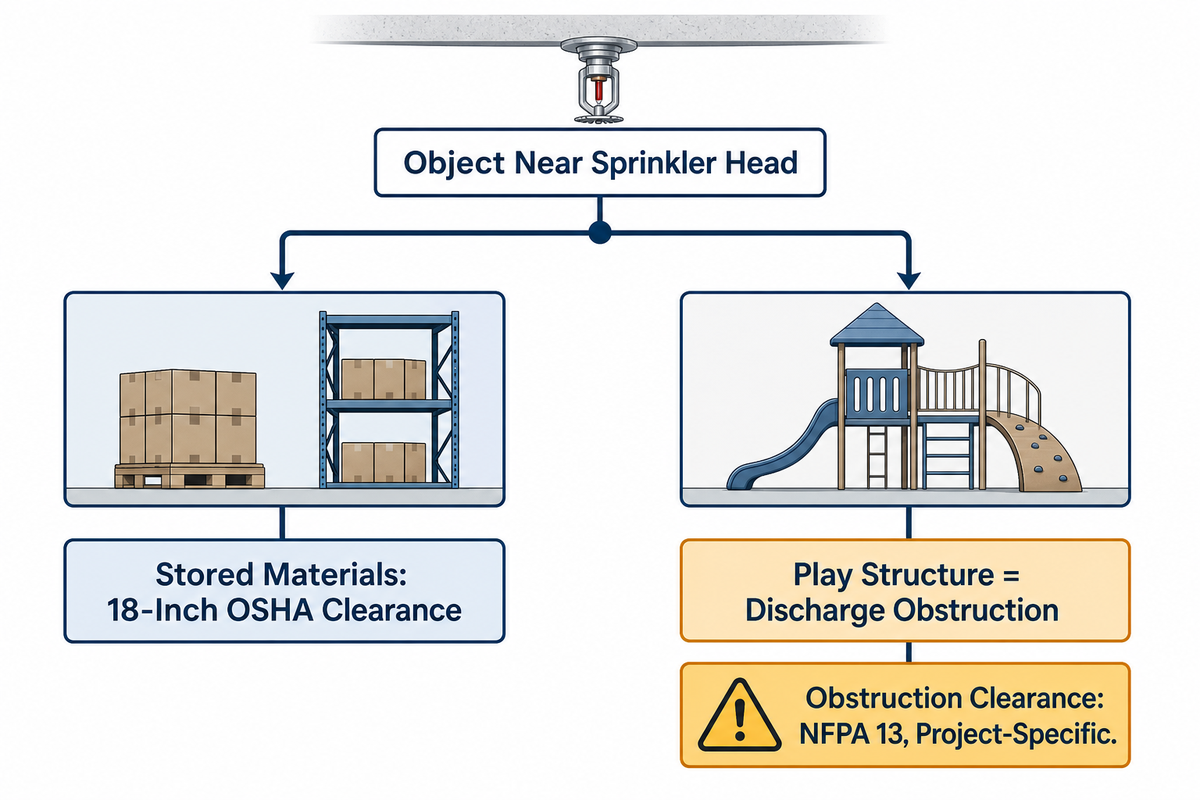
Two separate clearance rules govern how much of the ceiling above a play structure you actually get to use, and mixing them up is an easy, expensive mistake. OSHA’s workplace sprinkler regulation, 29 CFR 1910.159(c)(10), requires a minimum 18 inches of vertical clearance between a sprinkler head and anything below it — but that figure governs clearance from stored materials, for systems installed to meet an applicable OSHA standard. A play structure tall enough to sit near a sprinkler deflector isn’t stored material; it’s a discharge obstruction, and obstruction clearance is governed by NFPA 13’s sprinkler-type-dependent requirements rather than one fixed number. Bring your clear ceiling height and structure profile to a fire-protection engineer or your local Authority Having Jurisdiction before finalizing equipment height — don’t assume the 18-inch stored-materials figure clears your design. Toplay’s venue-solutions guide walks through this stored-materials-versus-obstruction distinction in more depth, with the OSHA interpretation letter that settles it.
Accessibility — What ADA Actually Requires for a Play Structure
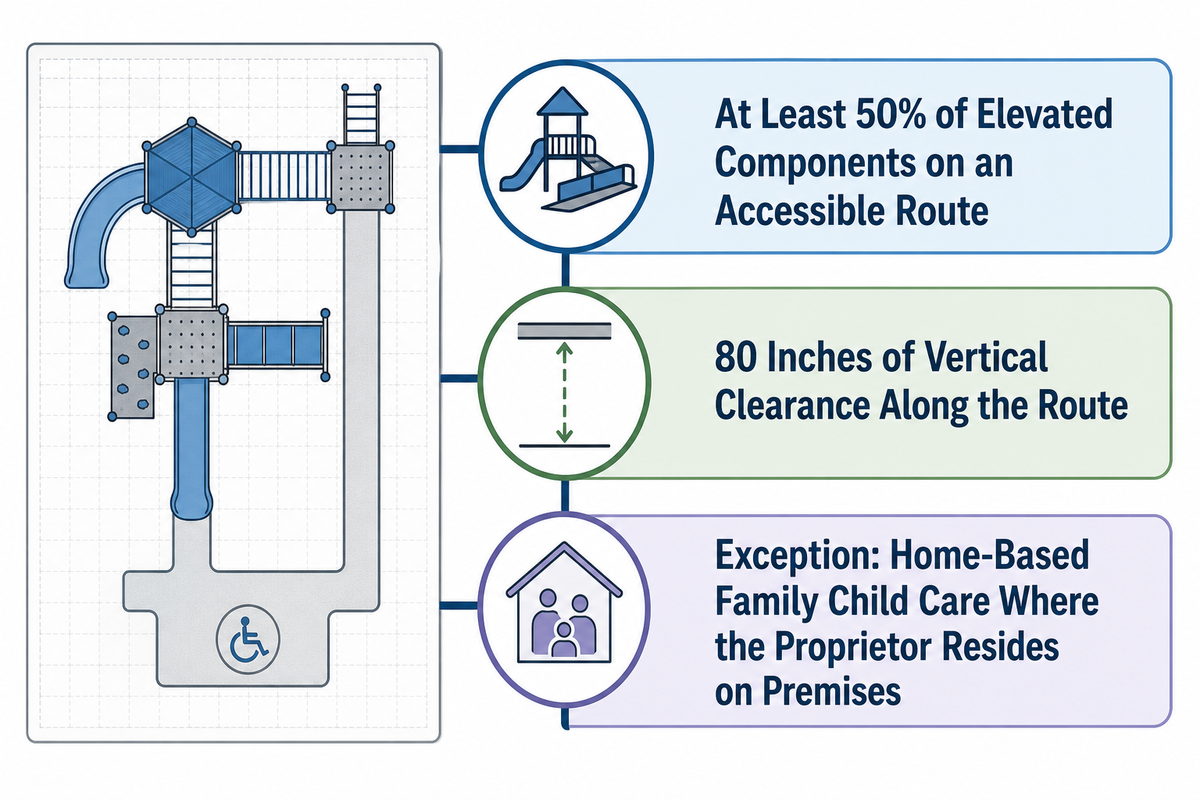
ADA Standards, not the voluntary ASTM documents, are the enforceable accessibility layer for a US play area, and the requirements are fixed at layout stage, before equipment is ordered. In short: at least 50 percent of elevated play components and one of each ground-level type must sit on an accessible route with 80 inches of vertical clearance, entry-point counts scale with how many entrances the structure has, and family child-care facilities where the proprietor resides on the premises are among the stated exceptions. Toplay’s venue-solutions guide lists the full entry-point thresholds; confirm any home-based or mixed-use exception with legal counsel before assuming coverage either way.
Hygiene & Cleaning — Building a Realistic Schedule for Ball Pits and Soft-Play Surfaces
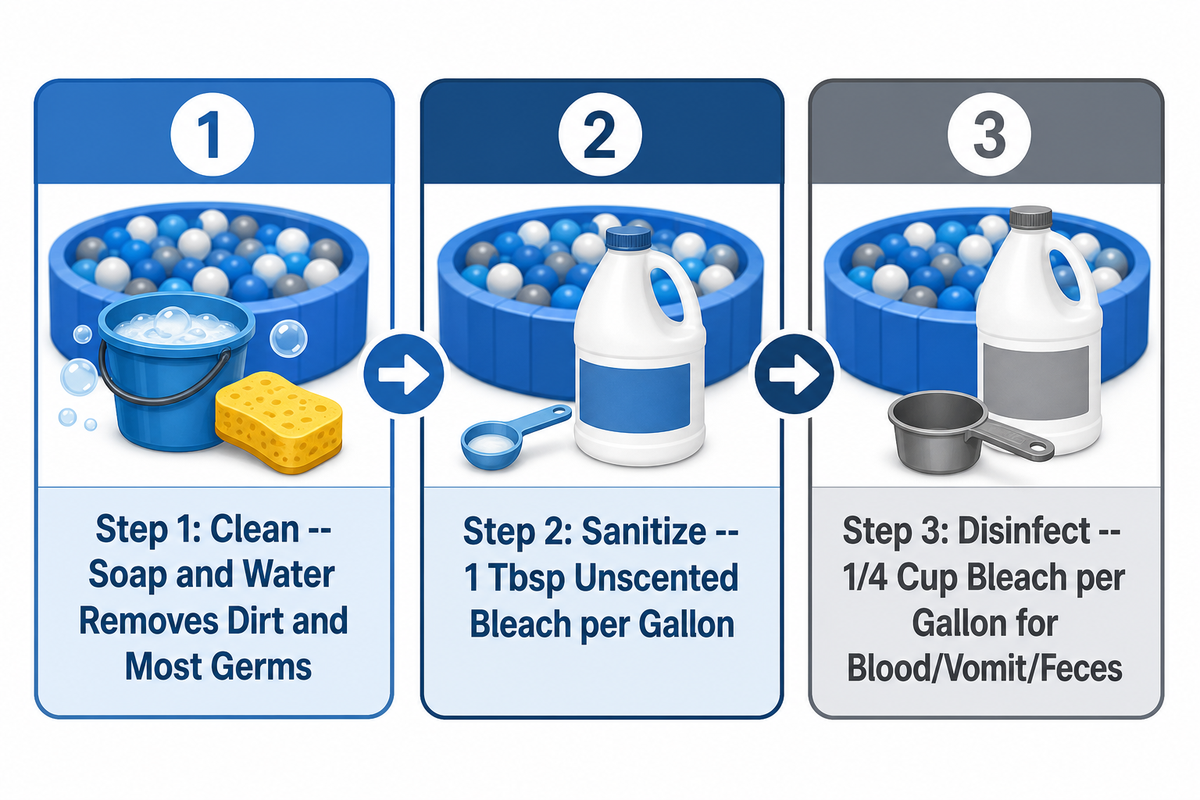
Commercial ball pits need a cleaning and ball-replacement regimen specified prior to handoff, and the ball pit isn’t the only play surface in a facility that needs one. Cleaning, sanitizing, and disinfecting are three different, equally important steps. Cleaning with soap and water removes dirt and most germs and always comes first. Sanitizing, using an EPA-registered product, reduces germs on surfaces to a public-health-safe level and is the appropriate action for mouth-contact surfaces like toys and ball-pit balls — commonly diluted around one tablespoon of unscented bleach per gallon of water for food-contact-grade sanitizing. Disinfecting uses a stronger concentration, around a quarter cup of bleach per gallon, and is reserved for blood, vomit, or feces. Specifying only “wipe down daily,” without distinguishing these three actions, misses the layer that actually controls illness transmission. A study of six ball pits in physical therapy clinics found 31 bacteria types, including 9 pathogenic to humans, despite regular clinical-standard cleaning; in other words, not all ball pits are unsanitary, but this is a reason to set a deliberate cleaning and replacement schedule, not a claim about the general safety of ball pits.
How Often Should a Ball Pit Be Cleaned?
There isn’t one correct answer across every playground or context — it depends on foot traffic and the local licensing structure. The best practice is to put a written cleaning cadence in the equipment-supplier agreement at handover, not improvise it later. High-touch plastic parts outside the ball pit belong on that same schedule: outdoor playground-surface research has found bacteria concentrated on plastic more than other materials, supporting the same schedule.
Indoor vs Outdoor — What “Childcare Playground Equipment” Searches Actually Cover
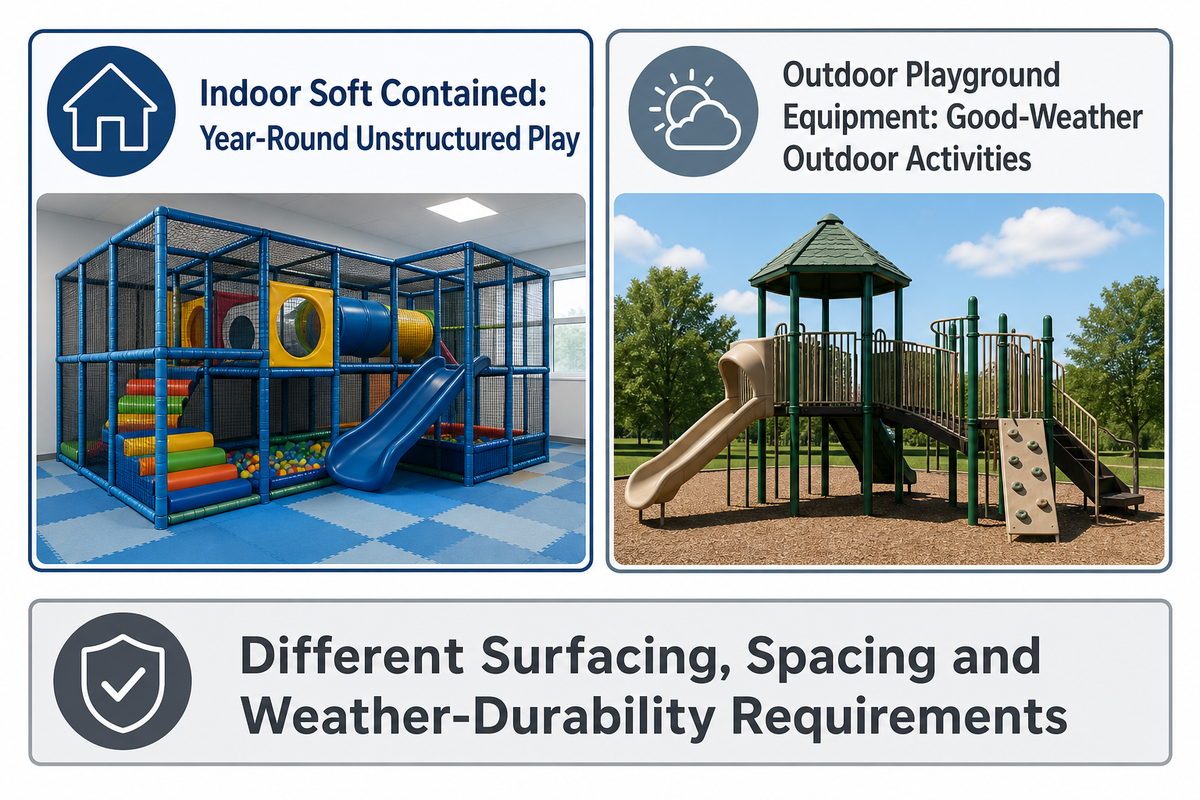
“Childcare playground equipment” spans two different product and standards classes, which means before engaging with a supplier you should know how they are classifying their product, and whether your conversation covers indoor soft contained equipment — foam, netting, and ball-pit-based systems, the focus of this guide — or a traditional outdoor playground (like a swing set or plastic tube slide on a steel frame), a different product entirely with different surfacing, spacing, and weather-durability requirements. The former falls under ASTM F1918 and/or EN 1176-10; the latter falls under ASTM F1487 or the EN 1176 family of standards.
Many daycare centers and preschool and daycare facilities that end up shopping for playground equipment for schools compare both categories side by side: an indoor soft contained system for year-round unstructured play, and a separate outdoor play equipment or outdoor playground equipment order for good-weather outdoor activities and outdoor play. A site with daycare play structures already installed outdoors may still want a smaller preschool playground equipment system indoors as a rain-day backup, or vice versa — the two budgets and installation timelines are usually planned and purchased separately, not as a single line item.
Indoor soft contained vs. outdoor rigid playsets
Indoor soft contained (ASTM F1918)
- Weather-independent year-round use
- Lower fall heights, foam/net construction
- Easier to zone by age within one room
- Hygiene schedule is a real ongoing cost
Outdoor rigid playsets (ASTM F1487)
- Requires engineered surfacing (mulch, rubber, poured-in-place)
- Weather and UV exposure affect materials and schedule
- Typically larger footprint and higher fall heights
- More established IPEMA certification pathway
How to Tell a Real Manufacturer From a Trading Company
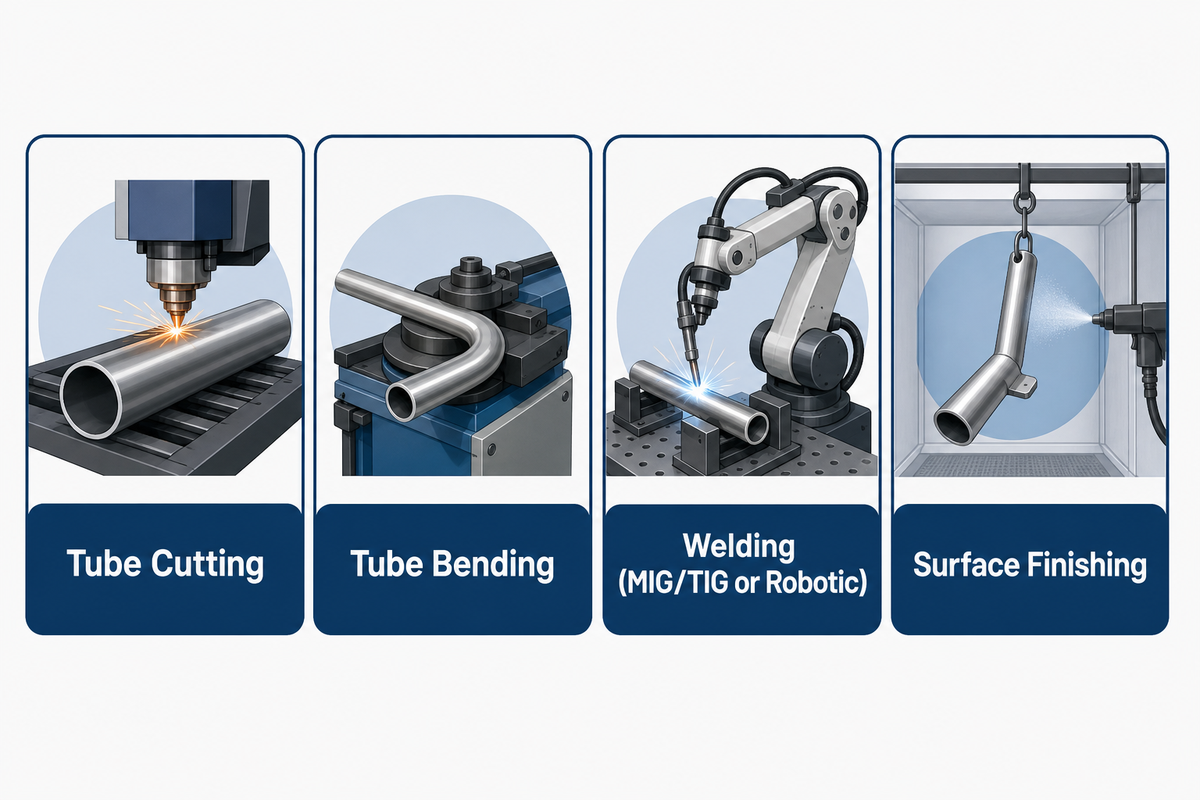
A true factory can show its own machinery; a reseller marking up another company’s products often can’t. Industry sourcing guidance points to a specific, checkable pattern sometimes called the “35 percent markup problem,” where several suppliers quote suspiciously similar prices because they’re reselling from the same factory with their own markup layered on. One reliable test is asking specific technical questions — what gauge is the steel tube, what is the foam density — that a genuine factory should be able to answer immediately.
In practice, that means asking to see evidence across four equipment categories: tube cutting, tube bending, welding (MIG/TIG or robotic), and surface finishing. Genuine factories can show their own machinery in each category; resellers usually can’t.
Association membership is a checkable third signal. Are your candidate suppliers active within industry trade associations, or listed on relevant directories? Genuine manufacturers tend to have a verifiable history at trade events. Missing this isn’t proof of being dishonest or disreputable, but confirming it is a fast, low-cost way to cross-reference a supplier’s claims.
| Mistake | Why it backfires | Fix |
|---|---|---|
| Assuming “IPEMA certified” covers F1918 | IPEMA’s program does not list F1918 | Ask for F1918-specific test documentation by name |
| Choosing on price alone | Cheapest quote often hides an intermediary markup or thinner materials | Compare gauge/density specs, not just total price |
| Oversizing the main structure | Wastes floor space needed for zoning and supervision sightlines | Size to the room’s usable height and age-zone plan first |
| Ignoring age-based zoning | Mixed-age free play increases both injury risk and supervision difficulty | Zone by the age bands in this guide before selecting components |
| Treating it as a simple purchase decision | Skips design, safety, traffic flow, and long-term operating cost | Use the 3-part procurement checklist in the next section |
| Neglecting operational/cleaning design | Cleaning becomes an afterthought instead of a design input | Specify cleanable materials and access before production, not after |
| Not checking state licensing rules | A compliant-looking ASTM product can still violate state licensing code | Check the state child-care licensing agency, not just the supplier |
| Leaving ADA access to “figure out later” | Entry-point and route requirements are fixed at layout stage | Size accessible routes before finalizing the floor plan |
| Accepting a lab surfacing certificate at face value | A lab certificate does not prove the as-installed floor is in spec | Request ASTM F3313 field verification after installation |
Budgeting — What Indoor Childcare Playground Equipment Actually Costs
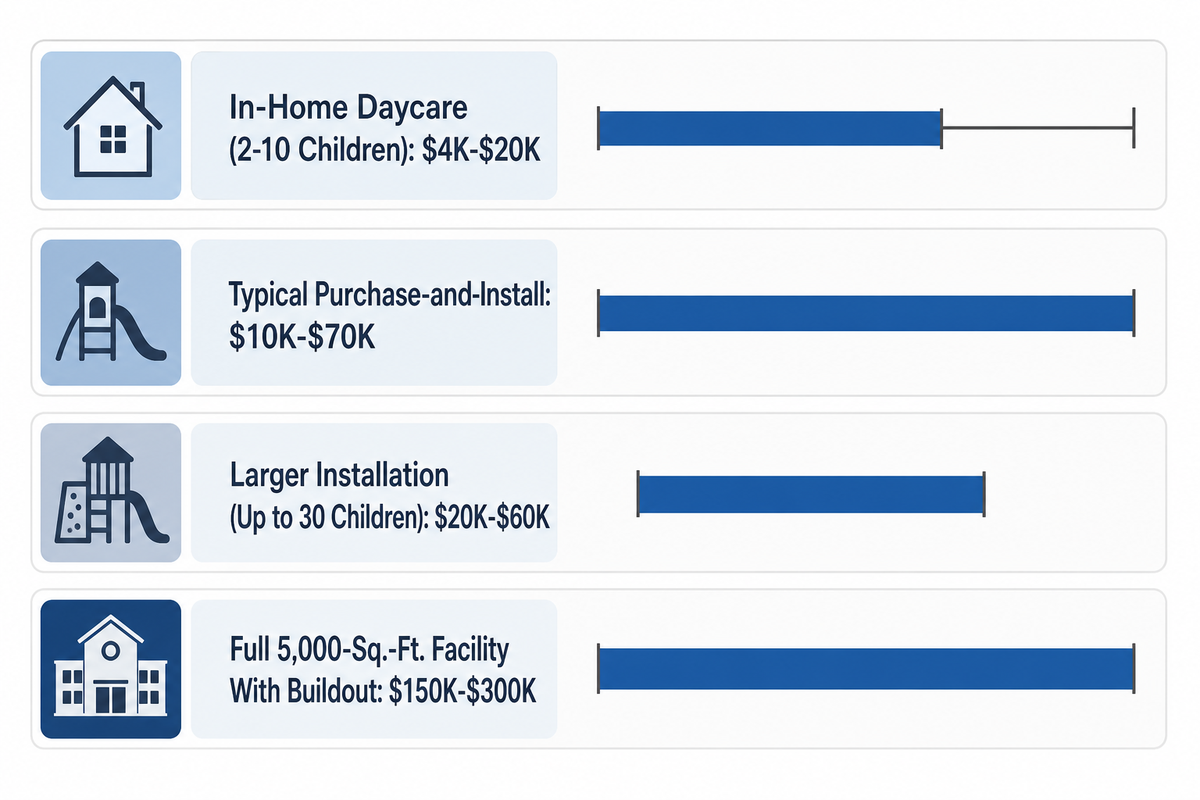
Costs range widely based on footprint and equipment class, so ranges are more honest budgeting than point solutions. As a very rough planning reference drawing from multiple independent vendor and industry cost breakdowns, rather than one canonical source, indoor commercial playground equipment purchase-and-install projects typically span $10K to $70K with a median of $35K; a small in-home daycare setup for 2-10 children runs lower, around $4K to $20K. A larger, full installation for up to 30 children runs in the $20K-60K range. Surfacing itself will often run $15 to $35 installed per sq. ft. A full, 5,000-sq.-ft. dedicated indoor playground facility inclusive of buildout often runs $150K-$300K. One retailer’s public catalog (a single source, not cross-referenced) lists individual playground pricing from about $134 to over $14,000 per product, averaging roughly $4,082 per product.
These are general, planning-stage figures pulled from across various sources, and you’ll need to enter conversations with suppliers to arrive at project quotes.
A 3-Part Procurement Checklist for Your Supplier RFQ
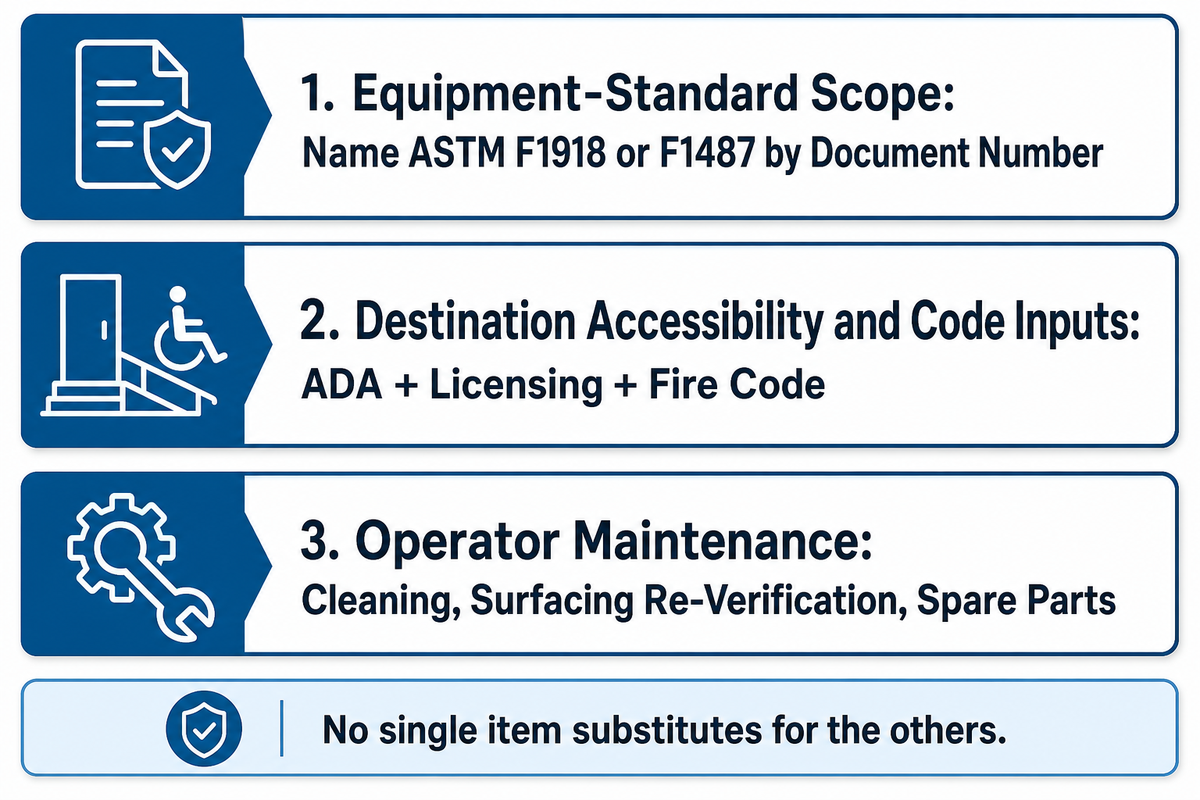
There’s a single, significant structural mistake when sourcing childcare playground equipment: conflating product safety testing certification with total project compliance. The RFQ can be far more effective on cross-border and single-site indoor playground projects by thoughtfully separating three primary scopes:
The 3-Part Procurement Checklist
- Equipment-standard scope: name ASTM F1918 (or F1487, or both, depending on what’s being purchased) and the applicable age band explicitly — do not accept “ASTM certified” without a document number.
- Destination accessibility and code inputs: confirm ADA entry-point and route requirements for the specific layout, plus state licensing rules and local building/fire-code thresholds for the actual room being used.
- Operator maintenance: agree the cleaning/sanitizing/disinfecting cadence, surfacing re-verification schedule, and spare-parts plan before the equipment ships, not after it arrives.
None of the three substitutes for the others, and citing only one — usually the equipment standard — is exactly the gap this guide has been walking through.
For centers whose venue is specifically a kindergarten, Toplay’s kindergarten playground solutions page goes deeper on that specific commercial procurement path; this guide is the broader standards-and-buying literacy reference for the whole childcare vertical, daycares, preschools, and kindergartens alike.
Frequently Asked Questions
Q: What are some examples of playground equipment?
Childcare playground equipment spans padded climbers, ball pits, foam blocks, tunnels, and slides for indoor soft contained systems, plus swing sets, rigid climbers, and slide towers for outdoor playsets.
Indoor soft contained types, sometimes searched for as commercial preschool playground equipment or toddler playground equipment, typically adhere to ASTM F1918 and consist of foam-and-net systems, ball pits, crawl tunnels, and low-level activity play areas. Outdoor types generally adhere to the ASTM F1487 standard and cover a wide set of slides, swing frame sets, and climbing equipment in metal, wood, or rigid plastic, as per manufacturer specifications. The type of equipment your facility requires is defined by whether you will be placing equipment indoors and enclosed, or outdoors and open to the elements, see the indoor-vs-outdoor comparison earlier in this guide.
Q: Do daycares need a playground?
Most state child-care licensing rules require regular access to gross-motor play space, whether that’s an indoor soft contained system, an outdoor yard, or both, though the exact requirement varies by state and license type.
Licensing requirements differ by state and by whether the facility is a licensed center or a family/group home. Indoor active-play space minimums per child are common, and many states require an active-play break every day whether a specific equipment format is used or not. Calling the specific state licensing agency directly is the reliable way to confirm the requirement for a specific facility type.
Q: What is children’s playground equipment?
Children’s playground equipment is any structure designed for supervised active play, split by US standards into rigid public playground equipment (ASTM F1487) and soft contained play equipment (ASTM F1918), each with its own testing, age range, and certification pathway.
It is all-encompassing enough to cover a backyard swing set or a commercial indoor soft-play area, which is exactly why naming the governing standard by its name – instead of generically calling it “playground equipment” – is the first step in checking the correct standard’s specifications. F1918 spans roughly 2 to 12 years for soft contained equipment, F1487 covers the same 2-to-12-year window for rigid equipment, and surfacing under either standard is tested for impact attenuation under ASTM F1292. The full nine-document breakdown is in the standards-at-a-glance table earlier in this guide.
Q: What are some good outdoor toys for daycare?
Outdoor toys and playsets fall under a different ASTM standard (F1487) than the indoor soft contained equipment this guide focuses on, so this guide does not make specific outdoor product recommendations by brand or model, the indoor-vs-outdoor comparison section above explains exactly where that scope line sits and why the two categories are specified separately.
Due to different standards, spacing, weather-durability, and surfacing requirements for outdoor rigid equipment versus indoor soft contained play, lumping the two together instead of evaluating them as separate procurement decisions is one of the scope mistakes this guide is written to help prevent. Each should be evaluated on its own merits, then checked against the standard that applies to it.
Q: Can you customize playground equipment for a daycare?
Customization is common and usually covers layout, theming, and age-zone configuration, but any customization should be checked against the applicable standard’s scope and the room’s usable height and code thresholds before finalizing a design.
A custom configuration must still work within the same parameters discussed in this guide — the room’s usable ceiling height, the building and fire-code area and height thresholds, the ADA entry-point and accessible-route restrictions, and the applicable ASTM standard’s own scope. Customizations may alter the appearance and theming of the solution (color, climbing features, themed branding, zoning by age band, etc.) but they don’t alter which rules apply to the layout. Assuming a supplier can offer endless options before they’ve verified the room’s usable ceiling height or the applicable code thresholds is an avoidable scope mistake that the 3-part procurement checklist above is designed to catch before the structure even exists.
Q: Do playground equipment suppliers offer warranties?
Terms vary by supplier, confirm in writing before purchase.
Confirm it in writing before the equipment ships.
Why We Write This
The standards discussion around childcare playground equipment is spread across nine separate documents that few buying guides cover together, which is why we wrote this guide. Toplay manufactures its own steel structures for indoor soft contained play systems used in daycares, preschools, and kindergartens, and the certification-literacy gap described above is one we see often in conversations with childcare operators.
References & Sources
- ASTM F1918 Standard Safety Performance Specification for Soft Contained Play Equipment — ASTM International
- ASTM F1487 Standard Consumer Safety Performance Specification for Playground Equipment for Public Use — ASTM International
- ASTM F1292 Standard Specification for Impact Attenuation of Surfacing Materials — ASTM International
- IPEMA Certification Program — International Play Equipment Manufacturers Association
- Public Playground Safety Handbook, Publication 325 (July 2025 edition) — U.S. Consumer Product Safety Commission
- Guide to the ADA Standards, Chapter 10: Play Areas — U.S. Access Board
- 29 CFR 1910.159 — Automatic sprinkler systems — Occupational Safety and Health Administration
- Examining Ball Pits as a Playground for Pathogenic Germs — Association for Professionals in Infection Control and Epidemiology
Related Articles
- Indoor Playground Solutions for Kindergartens — deeper commercial procurement path for kindergarten-specific projects



