Get in touch with Guangzhou Toplay amusement equipment co. Company

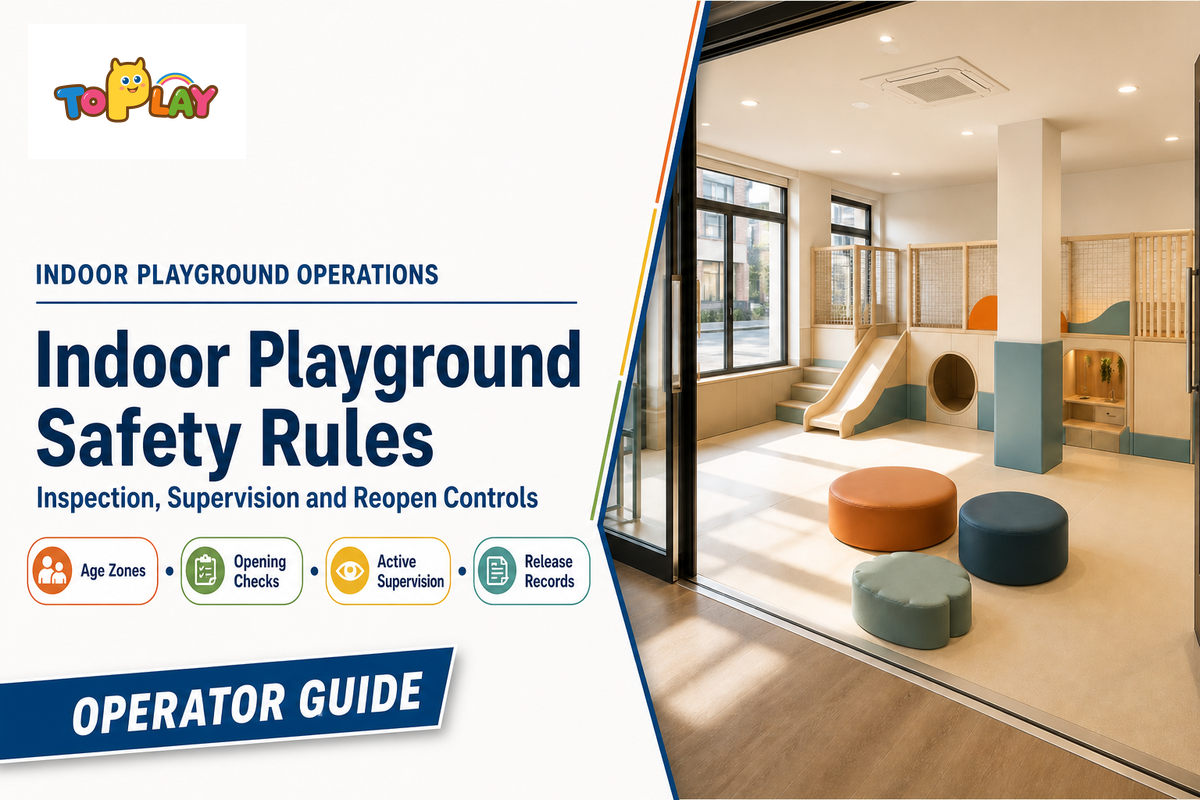
Indoor playground safety rules are operating controls that combine three things: the scope of the equipment and its safety standards, destination-specific venue requirements, and ongoing operator controls after handover. Posted signs can’t prevent injuries or stand in for active supervision, an opening inspection, closure authority, maintenance records, or an emergency plan. This scope overview supports safer decisions without claiming legal approval, medical advice, staffing approval, or product certification.
Three-Layer Safety Rule Stack
- Equipment and standard scope: identify the attraction, intended users, instructions, and applicable document.
- Destination requirements: confirm building, fire, egress, accessibility, health, childcare, insurance, and authority inputs.
- Operator controls: assign supervision, opening checks, cleaning, closure, incident response, repair, and reopen authority.
Updated September 2026. U.S. examples are identified as such. Operators in other markets should confirm current local requirements with the responsible authority and their insurer.
12 Indoor Playground Safety Rules to Post and Enforce
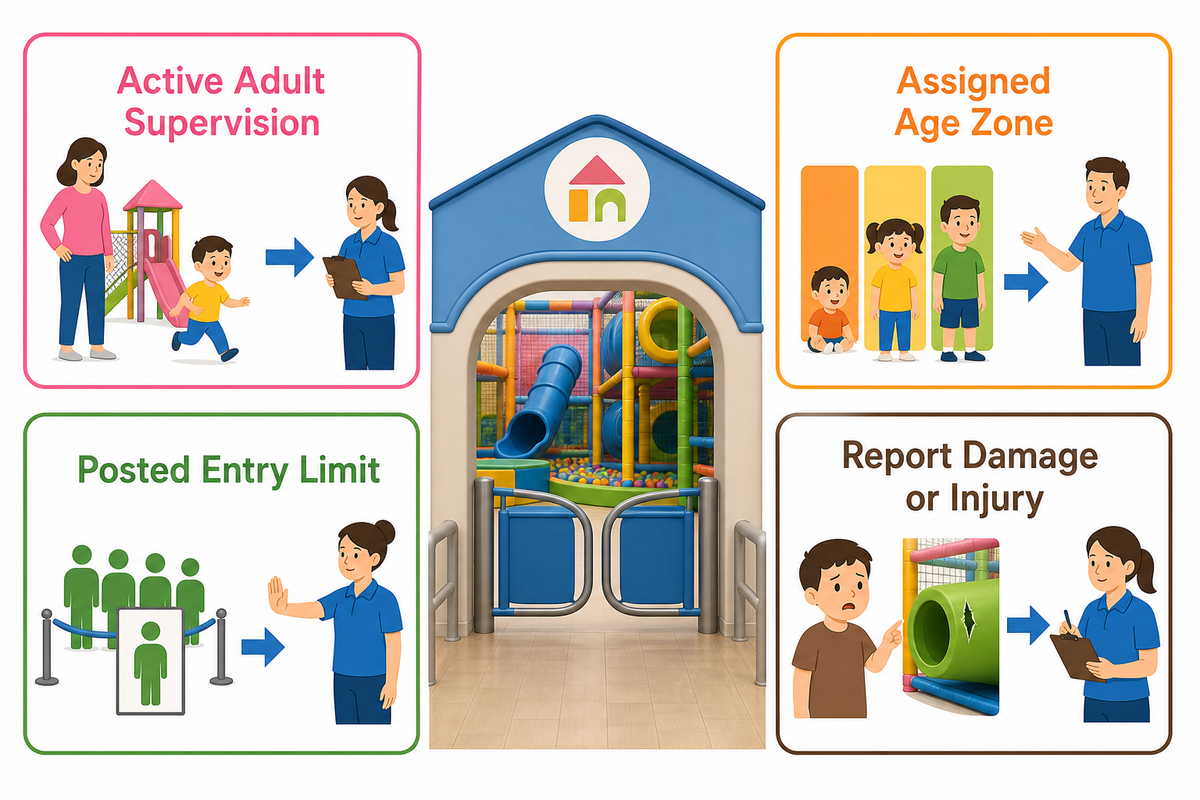
A useful visitor-facing rule board tells visitors, parents and caregivers what to do, then tells staff what action follows when someone doesn’t follow safety rules. These twelve examples are a starting point; age, capacity, footwear, food, play time, and evacuation wording still need to match the venue’s equipment instructions and destination requirements.
| # | Guest-facing rule | Staff enforcement action |
|---|---|---|
| 1 | Keep children under active adult supervision. | Confirm the assigned observer and intervene when coverage is lost. |
| 2 | Use only the assigned age zone. | Redirect users according to the posted zone and equipment instructions. |
| 3 | Respect the posted entry limit. | Pause entry when the venue’s approved capacity method reaches its limit. |
| 4 | Use equipment only as intended. | Stop improper use and check whether the affected component needs inspection. |
| 5 | Go down slides feet-first. | Stop head-first, group, or reverse use before the slide is entered. |
| 6 | Do not climb against traffic. | Separate opposing flows at ladders, ramps, slides, and transitions. |
| 7 | No pushing or rough play. | Intervene early and follow the venue’s escalation policy. |
| 8 | Remove loose jewelry and other snag hazards. | Screen visible items under the venue policy and equipment instructions. |
| 9 | Follow the footwear or sock policy. | Apply the same entry rule consistently and keep the boundary visible. |
| 10 | Keep food and drink outside active play. | Direct guests to the designated area and address contamination promptly. |
| 11 | Report damage or injury immediately. | Start the incident or defect process and isolate the affected area when needed. |
| 12 | Follow staff closure and evacuation instructions. | Use the venue’s emergency plan and account for affected users. |
The U.S. Consumer Product Safety Commission separately publishes a Soft Contained Play Equipment Safety Checklist covering netting, surfacing, cleanliness, size separation, loose items, posted-use guidance, and collision points. It helps shape questions for a guest rule board, but it’s neither venue certification nor a complete operating system.
Do
- Pair every rule with a staff action.
- Keep venue-specific wording editable.
- Name who can pause entry or close an attraction.
Don’t
- Treat a waiver as the control system.
- Copy an age or capacity limit without its basis.
- Leave enforcement authority implied.
Match the Rule Set to the Equipment and Standard Scope
Searches for indoor playground safety standards often group unlike attractions as though one guideline covers them all. Before copying an age limit, inspection line, or compliance statement, classify soft-contained play, under-two equipment, public equipment, swing or rope elements, trampolines, climbing walls, impact activities, and mixed attractions separately.
| Source or equipment class | Useful scope input | What it does not prove |
|---|---|---|
| CPSC Public Playground Safety Handbook, July 2025 | Current U.S. public-playground hazard and maintenance guidance. | Its own scope says it is not intended for soft-contained play equipment. |
| CPSC SCPE checklist | Consumer questions specific to soft-contained play conditions. | A venue operating plan, inspection acceptance, or product certificate. |
| ASTM F1918-21 | Soft-contained play scope and its stated user envelope. | A universal venue admission policy or proof that a configuration conforms. |
| BS EN 1176-10:2023 | High-level scope for fully enclosed play equipment in its issuing system. | The same document, certificate, or acceptance route as ASTM F1918. |
| Supplier declaration, report, inspection, or certificate | Evidence only within its named owner, date, scope, and configuration. | Blanket approval for the complete venue or every mixed attraction. |
The current CPSC Public Playground Safety Handbook says its guidelines aren’t intended for soft-contained play equipment. That boundary doesn’t erase CPSC’s separate SCPE checklist; it means playground safety tips and safety guidelines need to match the equipment class, including any entrapment or collision question.
“These guidelines are not intended for soft contained play equipment.”
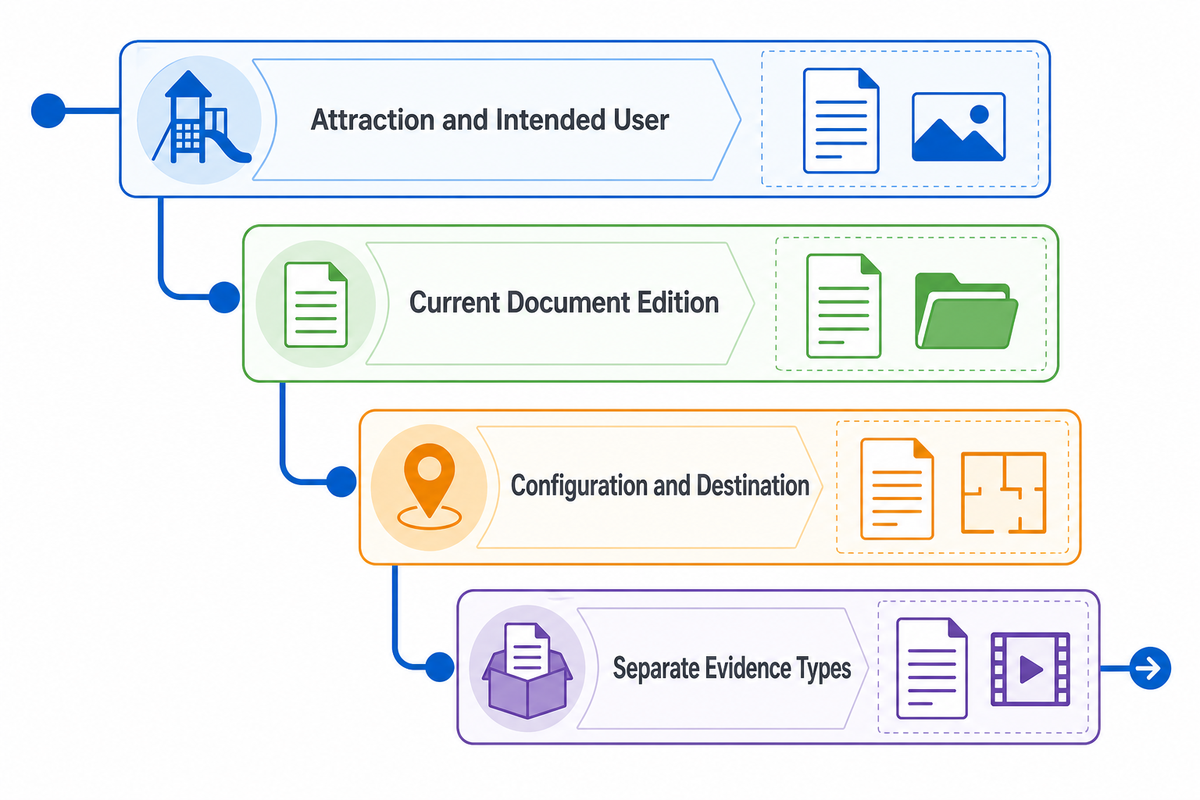
Scope check before publication
- Record the attraction and intended user group.
- Confirm the current document edition with its issuing body.
- Match the claim to the exact configuration and destination.
- Keep declarations, test reports, inspections, certificates, and authority acceptance separate.
The ASTM record for F1918-21 describes an equipment-scope user envelope from the 5th-percentile 2-year-old through the 95th-percentile 12-year-old. That range is not a venue admission policy; manufacturer instructions, attraction design, local requirements, and operating controls still decide who may use a particular zone.
Planning handoff: Use the indoor play standard scope router to organize questions. A tool result is a planning aid, not evidence that a safe indoor playground or compliant product has been established.
Do not import outdoor-only phrases
Public-playground guidance may discuss loose-fill depth, rubber surfacing, or metal slides that become hot to the touch. Those phrases don’t establish an indoor SCPE floor, surfacing depth, or material rule; confirm the actual setup, equipment, destination, and manufacturer instructions.
Separate Age Groups, Entry Capacity, and Collision Paths
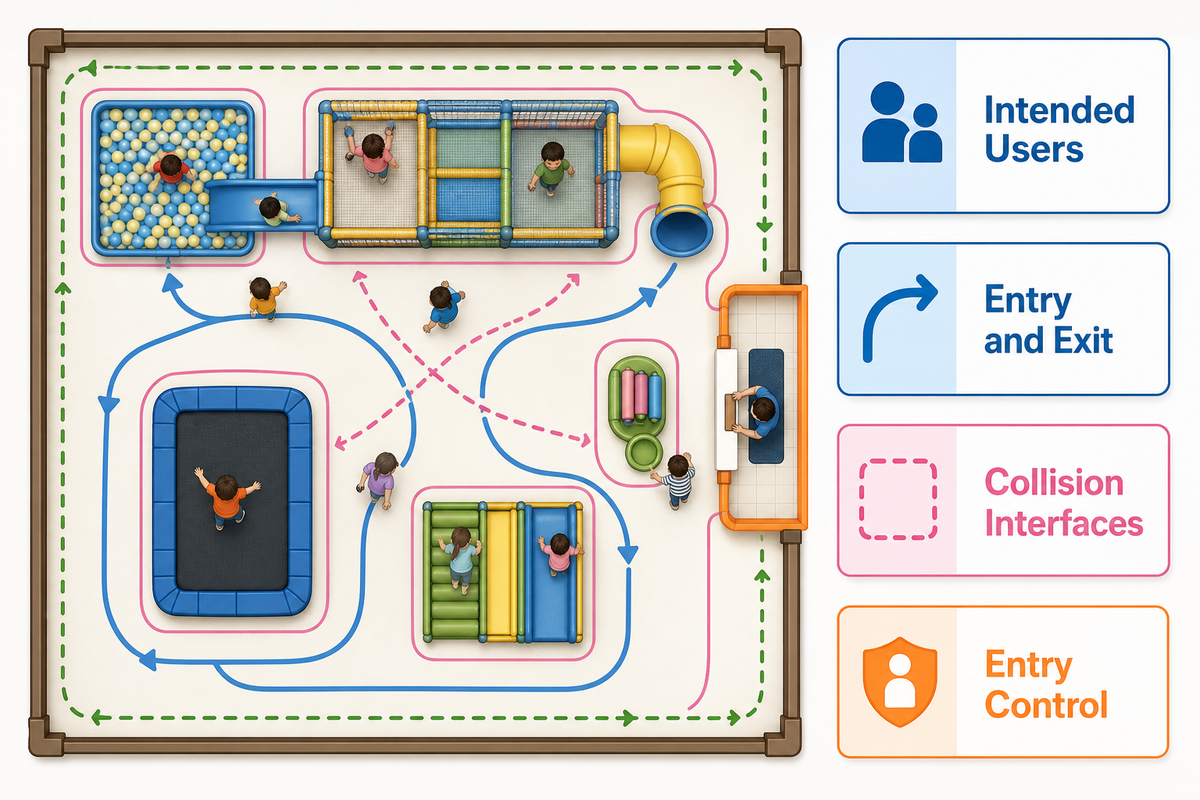
Turn age labels and entry limits into a zone plan that keeps unmanaged routes from crossing the play space. Record the accessible entry and assigned observer, then base capacity on equipment, circulation, supervision, local requirements, and the approved operation rather than a static web formula.
| Zone intake field | Record before opening | Stop condition |
|---|---|---|
| Intended users | Equipment age scope, venue admission wording, and exceptions. | The three sources conflict or are undocumented. |
| Entry and exit | Normal entry, emergency exit, accessible entry point, and responsible observer. | A route is blocked, shared unsafely, or not assigned. |
| Collision interfaces | Slides, climbs, ramps, ball areas, queues, and mixed-speed transitions. | Opposing flows cannot be seen or controlled. |
| Entry control | Approved limit, counting method, pause authority, and reset method. | Staff cannot explain or apply the method consistently. |
For U.S. planning, CPSC identifies a distinct voluntary-standard context for public-use playground equipment intended for children 6 through 23 months. An indoor or padded setting doesn’t make older-child equipment age-appropriate equipment for young children, and a guidance page doesn’t establish that a particular product is suitable.
Project links, not suitability evidence: Review kindergarten indoor playground planning inputs, indoor play structures, and soft play equipment options. These pages help define a project brief; they do not establish age approval, accessibility acceptance, or conformity for a final layout.
Build Active Supervision Around Sightlines and Staff Zones
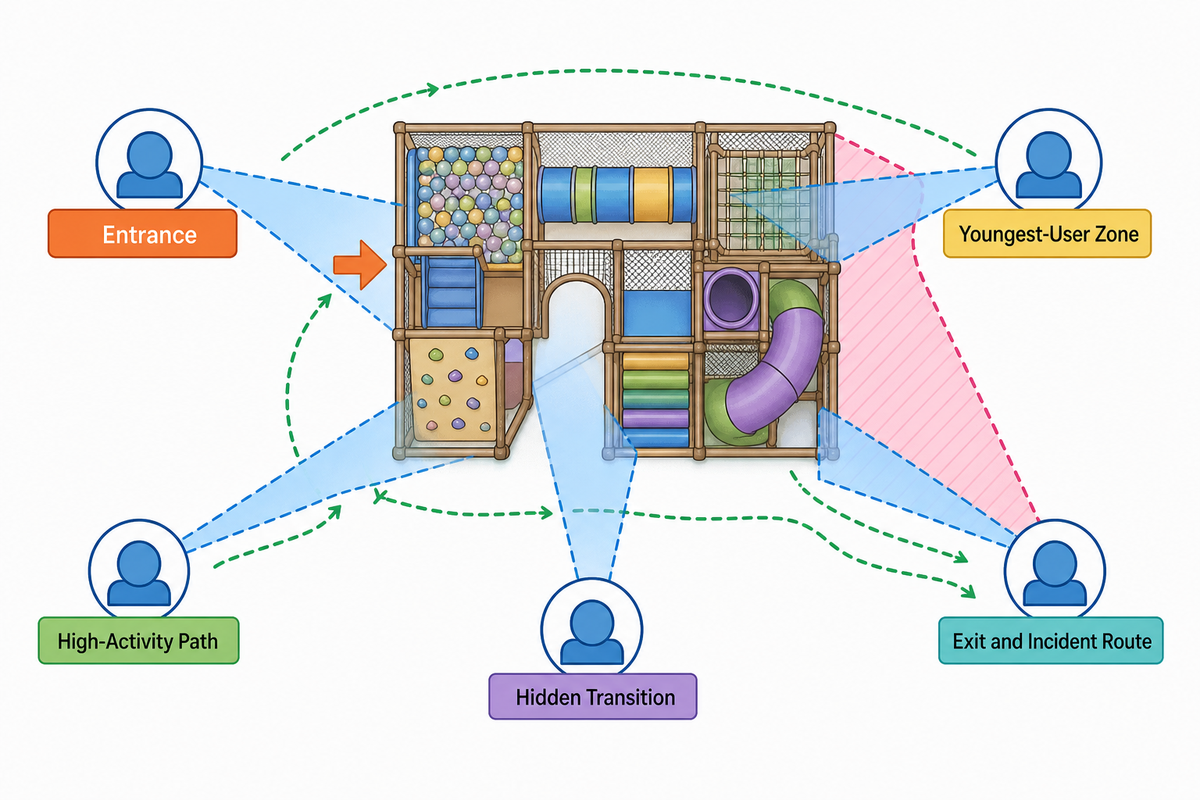
Active supervision is observable work, not simply an adult being present during playtime. Give staff positions from which they can scan and count users, listen for unusual activity, anticipate injury risks, and redirect behavior before blind spots or mixed-speed routes become unmanaged.
Five-Zone Blind-Spot Sweep
- At the entrance: can the assigned person see entry, exit, and any counting point?
- Youngest-user zone: Are access and nearby higher-speed routes separated and visible?
- High-activity path: Can staff observe slides, climbs, landings, and collision interfaces?
- Hidden transition: Is an enclosed turn, tunnel, platform, or queue outside the scan?
- Exit and incident route: Can staff reach, communicate, and account for users without abandoning another zone?
This method adapts the official Head Start active-supervision strategies while keeping their childcare-program context visible. It offers an observable supervision method, not a universal commercial ratio of one staff member per a fixed number of children.
Blind-spot escalation card
If an assigned position can’t cover a zone, record the location, affected route, temporary restriction, and owner of the layout or staffing review. Don’t compensate with an undocumented instruction to “watch more carefully.”
Use an Opening-Shift Stop/Go Inspection Card
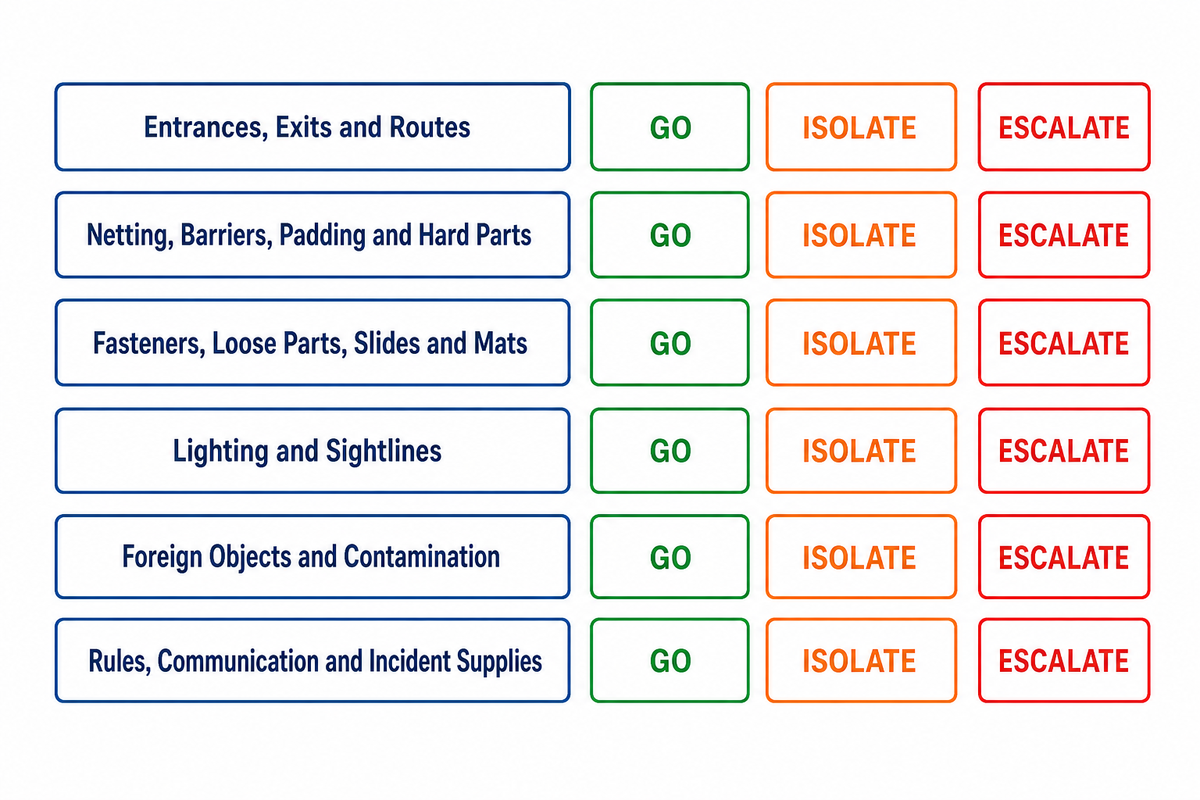
An opening check should produce a decision, not a vague “maintenance needed” note. Each line needs a pass, isolate, or escalate outcome, plus the affected area, interim control, evidence owner, inspector or competent checker where required, and condition for reopening.
| Opening check | Go | Isolate | Escalate |
|---|---|---|---|
| Entrances, exits, and routes | Clear and operating as planned. | One attraction or route can be secured. | Required egress or access is unresolved. |
| Netting, barriers, padding, hard parts | No observed defect under the approved check. | Affected component is identifiable and blocked. | Defect scope or repair authority is unclear. |
| Fasteners, loose parts, slides, mats | Condition matches instructions and acceptance record. | Local restriction prevents use. | Movement, crack, exposure, or interface needs competent review. |
| Lighting and sightlines | Assigned positions cover planned routes. | A zone can remain closed. | Safe supervision coverage cannot be restored. |
| Foreign objects and contamination | Removed and verified under the cleaning procedure. | Affected surface or zone is secured. | Material compatibility or exposure response is uncertain. |
| Rules, communication, incident supplies | Present, current, and understood. | A nonessential area can stay unavailable. | Required emergency communication is unavailable. |
Opening and routine checks don’t replace the full inspection and maintenance program. Manufacturer instructions, observable wear, previous repairs, occupancy, local authority guidance, insurer requirements, and competent-person review determine the schedule; this guide doesn’t set a universal frequency.
Handover input: Review project safety and quality handover inputs, then verify each document against the delivered configuration. A service page does not prove product quality, acceptance, or an inspection result.
Keep Hygiene, Clothing, and Play-Behavior Controls Separate
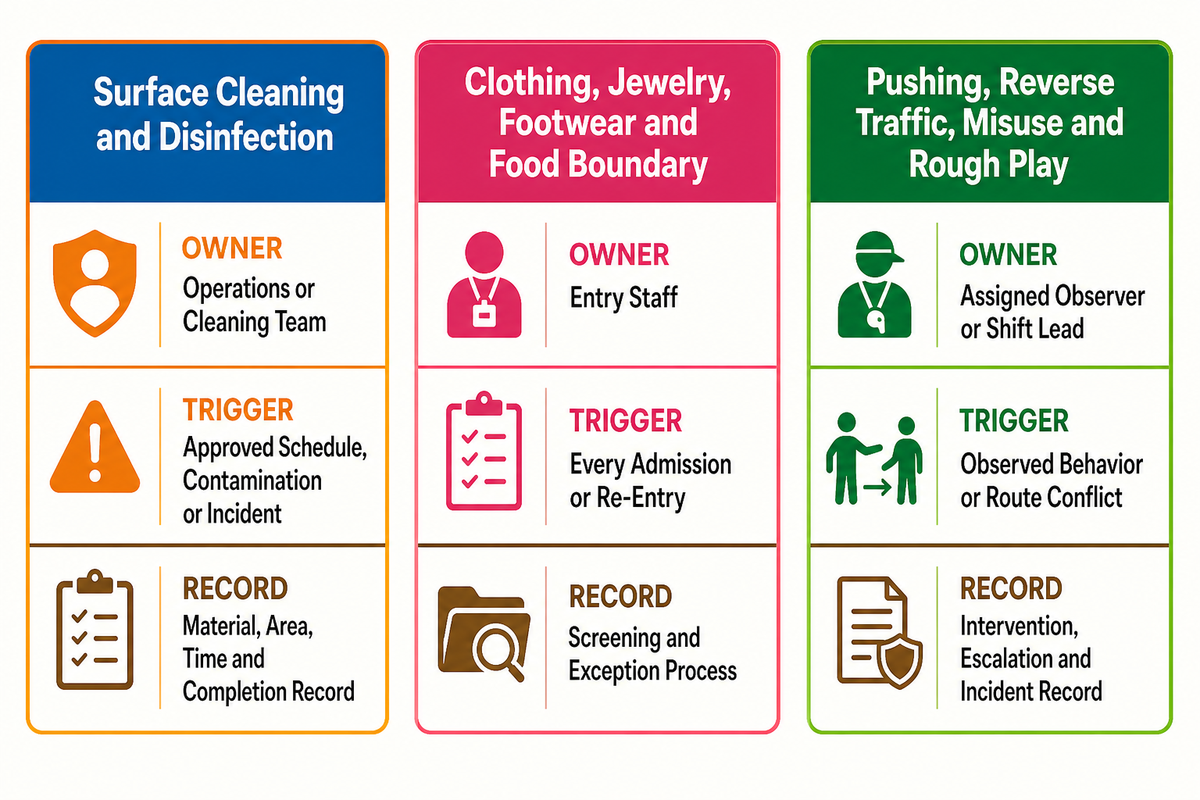
Cleaning, entry screening, and play conduct address different failure modes, so they need different owners, triggers, and records. A “socks and sanitizer” sign isn’t a hygiene program, and an antimicrobial claim can’t replace cleaning duties or material-compatibility checks.
| Control | Typical owner | Trigger | Verification |
|---|---|---|---|
| Surface cleaning and disinfection | Operations or cleaning team | Approved schedule, contamination, or incident | Product, material compatibility, area, time, and completion record |
| Clothing, jewelry, footwear, and food boundary | Entry staff | Every admission or re-entry | Consistent screening and visible exception process |
| Pushing, reverse traffic, misuse, and rough play | Assigned observer or shift lead | Observed behavior or route conflict | Intervention, escalation, and any incident or defect record |
Loose jewelry, a necklace, drawstring, or another item that could get caught on equipment should be handled through the applicable instructions and venue policy. Avoid unsupported universal lists, a single cleaning frequency for every surface, or a claim that one foam, rubber, or coating can protect users by itself.
Material check
Before changing a cleaning product or method, confirm the affected material, contact time, residue or slip risk, ventilation need, and the manufacturer-approved process. Keep the zone closed when compatibility or exposure response is unresolved.
Close, Record, Repair, and Reopen Equipment Safely
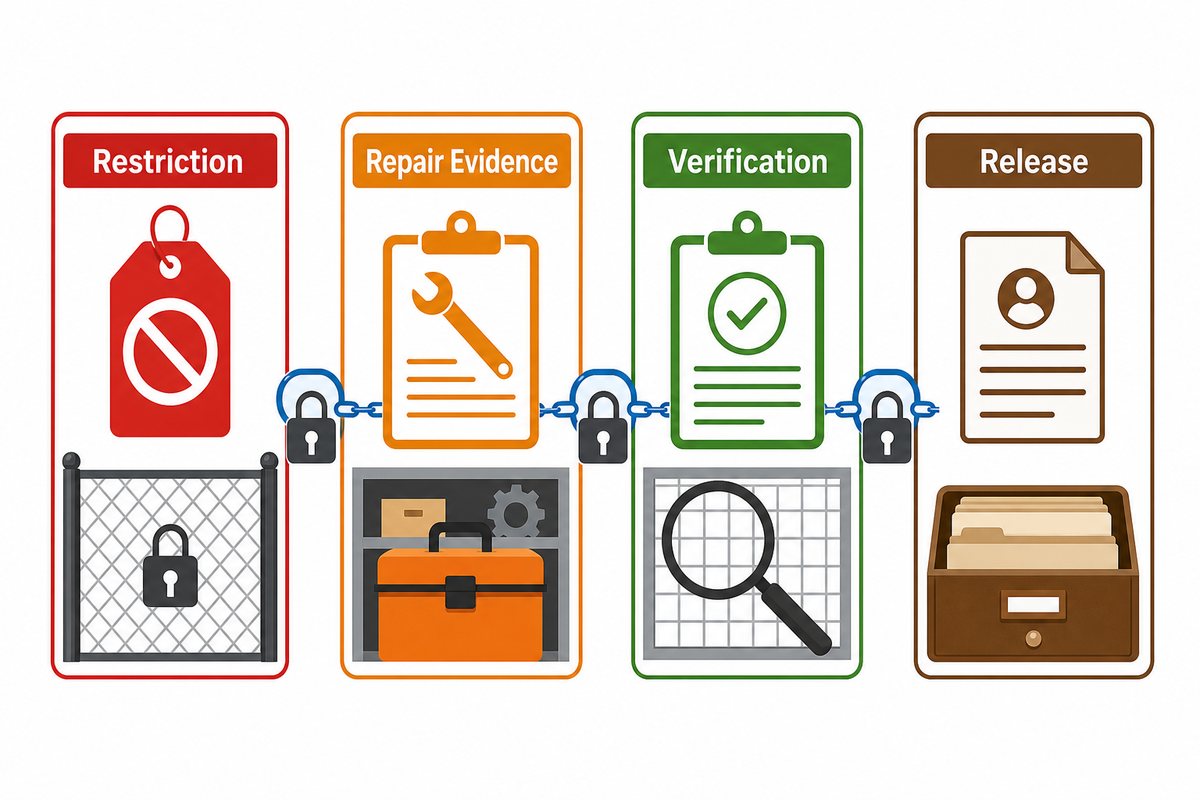
A verbal “fixed” message doesn’t identify the failed item, isolation, repair, durability or function check, or person who authorized reopening. Use a Red-Tag Release Record to protect the audit trail and keep the affected item unavailable until the required evidence is complete.
- Identify the defect — record the exact attraction, component, location, time, and observation.
- Isolate access — block the affected area and state the interim control.
- Assess the scope — determine which instructions, competent person, supplier input, or authority is required.
- Complete the repair — record parts, materials, method, and the responsible person.
- Verify the correction — check against the controlling instruction and retain the evidence.
- Authorize reopening — name the person with release authority and record the time.
Incident care and equipment evidence are related but separate tracks. Follow the venue’s emergency procedure and local reporting requirements for people, then use the CPSC SCPE checklist as one bounded condition check while preserving the technical record needed to restrict, repair, inspect, and release the affected attraction.
| Ledger field | Required entry |
|---|---|
| Restriction | Affected item, physical barrier, time, and owner |
| Repair evidence | Diagnosis, action, parts or materials, and instruction used |
| Verification | Checker, scope, result, and supporting record |
| Release | Named authority, unresolved limitations, and reopen time |
Use project documentation to separate installation and handover responsibilities. Delivery or an installer’s departure doesn’t establish repair competence, inspection acceptance, or the operator’s authority to reopen an attraction.
Reopen test
If the record can’t identify the defect, correction, verification basis, checker, and release authority, the item isn’t ready to reopen under this ledger method.
Assign Accessible Entry, Fire/Evacuation, and Operating Safety Ownership
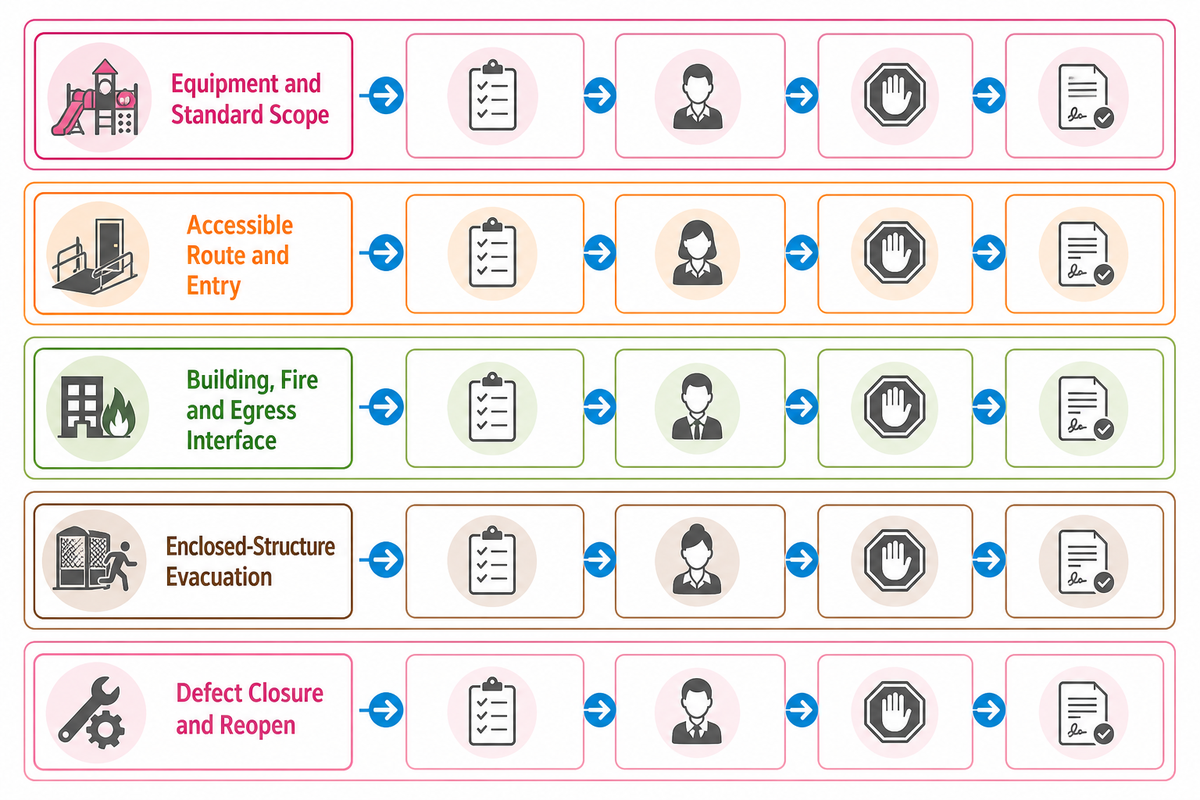
A supplier assurance or standard name can’t carry every project duty. Cooperation among the supplier, installer, project authority, operator, and insurer must shape accessible entry, fire and evacuation review, installation acceptance, maintenance, incident response, and release conditions.
| Control item | Controlling evidence | Primary owner | Stop condition | Release evidence |
|---|---|---|---|---|
| Equipment and standard scope | Current designation, scope, instructions | Project safety reviewer | Attraction class or edition is unclear | Approved scope register |
| Product-specific evidence | Declaration, report, certificate, configuration list | Supplier and purchaser | Evidence does not match the delivered item | Verified document set |
| Accessible route and entry | Destination rule, drawings, entry-point review | Project accessibility authority | Applicability or route is unresolved | Configuration-level acceptance |
| Building, fire, and egress interface | Local code review, approved plan, alarm interface | Local project authority | Required route or review is open | Authority-owned acceptance record |
| Enclosed-structure evacuation | Configuration plan, roles, communication, review or drill evidence | Venue and accepting authority | Users cannot be reached or accounted for | Accepted evacuation arrangement |
| Installation acceptance | Drawings, completion checks, punch list | Installer and project owner | Open defect affects use or access | Closed punch list and acceptance |
| Opening inspection | Approved stop/go card | Shift lead | Failed line lacks disposition | Signed opening record |
| Active supervision | Zone plan and assignment | Operations manager | Blind spot or unassigned zone remains | Approved coverage plan |
| Cleaning and maintenance | Instructions, schedule, compatibility, records | Operations and maintenance | Method or material is uncertain | Completed and verified record |
| Incident response | Venue emergency and reporting procedure | Incident lead | People or affected equipment are not accounted for | Closed response and technical follow-up |
| Defect closure and reopen | Red-tag ledger and verification | Named release authority | Required evidence is missing or conflicting | Signed release record |
In the United States, the U.S. Access Board guide on play areas describes accessible-route entry-point requirements for covered soft-contained structures. The Board doesn’t evaluate or certify products, so configuration-level accessibility review belongs to the applicable project authority rather than a marketing certificate.
Fire and evacuation are a separate release track
Record the controlling destination requirement, configuration-specific route, alarm and communication interface, staff roles, review or drill evidence where required, and the authority that accepts the arrangement. A standard section heading doesn’t provide those project answers.
ASTM publicly lists access and egress, fire safety, and evacuation as distinct F1918 review domains. Its WK94593 work item identifies an evacuation-section revision effort; a work item is under development, not a published design instruction or proof of acceptance.
Key takeaway
Do not release an indoor playground because every document has a title; release each control only when the controlling evidence, owner, stop condition, and acceptance record match the delivered configuration.
Need to organize the evidence before project review?
Use the project assurance brief scorecard, then ask Toplay to review the equipment and handover scope. The review doesn’t promise certification, injury prevention, authority approval, price, minimum order, or lead time.
Frequently Asked Questions
What are 10 safety rules on a playground?
View answer
Ten broadly useful rules are: supervise children actively; use the correct age zone; respect posted capacity; use equipment as intended; slide feet-first; do not climb against traffic; avoid pushing and rough play; remove loose jewelry or snag hazards; keep food and drink outside active play; and report damage or injury immediately. Indoor venues should add their footwear, hygiene, closure, and evacuation wording. These rules do not replace manufacturer instructions, equipment-specific limits, local requirements, documented inspections, or staff authority to isolate unsafe equipment.
Are indoor playgrounds safe for toddlers?
View answer
An indoor playground can be planned for toddlers only when the equipment’s intended age range, access, separation, supervision, maintenance, and local requirements align. Toddlers should not enter an older-child structure merely because the venue is indoors or padded. In the United States, CPSC identifies a separate voluntary-standard context for public-use playground equipment intended for children 6 through 23 months. That boundary is a planning input, not proof that a particular Toplay product or completed venue is certified or suitable.
What are the safety precautions for indoor playgrounds?
View answer
Before opening, inspect access and egress, barriers, padding, fasteners, play routes, mats, visibility, contamination, and posted rules. During operation, control age zones and entry, maintain active sightlines, and ensure staff can intervene. After damage or an accident, isolate the area, follow the emergency procedure, record the defect, complete the repair and verification, and obtain named authorization before reopening. No checklist can promise to keep kids safer without the controlling instructions and site conditions.
How often should an indoor playground be professionally inspected?
View answer
There is no single interval that is safe to copy across every indoor playground. Separate an opening or routine operator check from periodic maintenance, a competent-person inspection, a third-party inspection, and any review required by local authorities, insurers, or equipment documentation. The schedule should respond to equipment class, manufacturer instructions, occupancy, age mix, observed wear, incidents, repairs, and destination rules. A high-use transition or previously repaired component may need closer attention than an undisturbed area, but this guide cannot assign a universal daily, monthly, or annual interval. Trigger an extra review after a significant repair, impact event, layout change, prolonged closure, water intrusion, or another condition identified by the controlling instructions. Record the inspection type, scope, owner, defect disposition, trigger, and evidence needed to reopen; “annual” alone does not describe competence, coverage, or acceptance.
Are EN 1176 and ASTM F1918 the same?
View answer
No. ASTM F1918 and EN 1176-10 belong to different standards systems and have different stated scopes. Neither name is an interchangeable certificate or a substitute for destination-specific building, fire, accessibility, and operating review.
Does citing a standard prove an indoor playground is certified?
View answer
No. A standard reference identifies a document and scope; it does not show that a particular product was evaluated. Ask what evidence exists for the exact configuration: a supplier declaration, material or component report, accredited laboratory report, installation inspection, third-party certificate, or authority acceptance. Each document has an owner, scope, date, and limitation. Do not publish “compliant” unless the supporting evidence and applicable standard edition are identified and verified.
References & Sources
- Public Playground Safety Handbook, July 2025 U.S. Consumer Product Safety Commission.
- Soft Contained Play Equipment Safety Checklist U.S. Consumer Product Safety Commission.
- ASTM F1918-21 Standard Record ASTM International.
- WK94593 Revision of F1918-21 ASTM International.
- BS EN 1176-10:2023 Standards Development Record BSI.
- Active Supervision Head Start.
- Guide on Play Areas U.S. Access Board.
How This Guide Was Built
The guide separates indoor playground safety rules from equipment-standard scope and project acceptance because those duties have different owners. Toplay supplied no product-specific certificate, venue approval, incident dataset, inspection log, or post-installation safety outcome for this article, so none is claimed. The article-specific Five-Zone Blind-Spot Sweep, Opening-Shift Stop/Go Card, Red-Tag Release Record, and Safety Rule Custody Chain organize public evidence; they don’t replace professional or authority review.