Get in touch with Guangzhou Toplay amusement equipment co. Company

Build an Indoor Playground Business Plan That Holds Up on Paper

Project Build Support
Need an indoor playground layout before your next quote?
Send venue size, ceiling height, age range, theme direction and opening schedule. Toplay can match the play route, safety surface and delivery scope before you lock the quotation.
Layout fitFootprint, traffic and age zones
Build scopeEquipment, surface and installation
Quote pathFactory review before RFQ
RFQ Checklist
What to include for faster project matching
Venue and capacity
Floor size, ceiling height, entrance route, target age groups and daily visitor expectations.
Theme and operation
Brand direction, supervision plan, opening timeline and any food, retail or party-room requirements.
Delivery context
Send Project Details
City, floor access, installation window, local review needs and budget direction.
By XCX · Updated October 2026
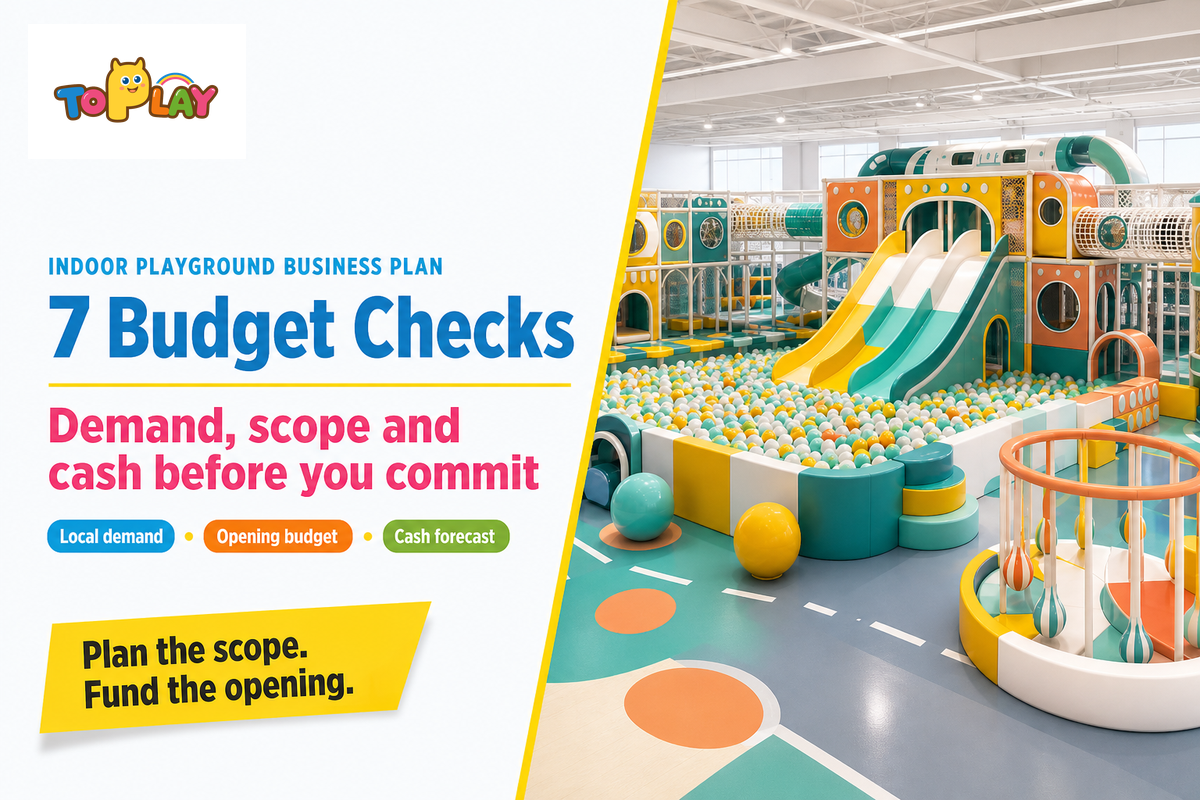
An indoor playground business plan should connect local demand to the cash needed before and after opening. Equipment is one purchase. Rent and deposits, construction, payroll and a slow first season all tap the same funding. A plan shows who pays for what and when and where the funding comes from.
Check seven things before committing: local paid demand, concept and capacity, opening costs, contribution by sales channel, required paid visits, the monthly cash low point, and approvals tied to supplier payment dates. The following hypothetical US planning examples show dollars but aren’t actual quotes or industry averages.
Indoor Playground Business Plan: What the Document Must Prove
A good plan shows who the buyers are, why they’re coming back and how the funding is sustained during the development of attendance. A lender also needs to see who manages the business and what happens when the person responsible for daily operations is absent. Assign those responsibilities before attaching optimistic sales projections.
Planning guidance by the U.S. Small Business Administration connects funding requests with projected income statements, balance sheets, cash flow and capex. It calls for more detail in the first year. Use monthly figures for opening an indoor playground, since an annual figure can mask the week a supplier balance falls due.
What do you need to start an indoor playground?
Starting an indoor playground requires a validated customer offer, a suitable site, locally confirmed approvals, an equipment and fit-out scope, trained staff and enough committed funding for opening and early trading. Business plans require evidence to support each requirement and state who will provide it and which spending decision depends on it.
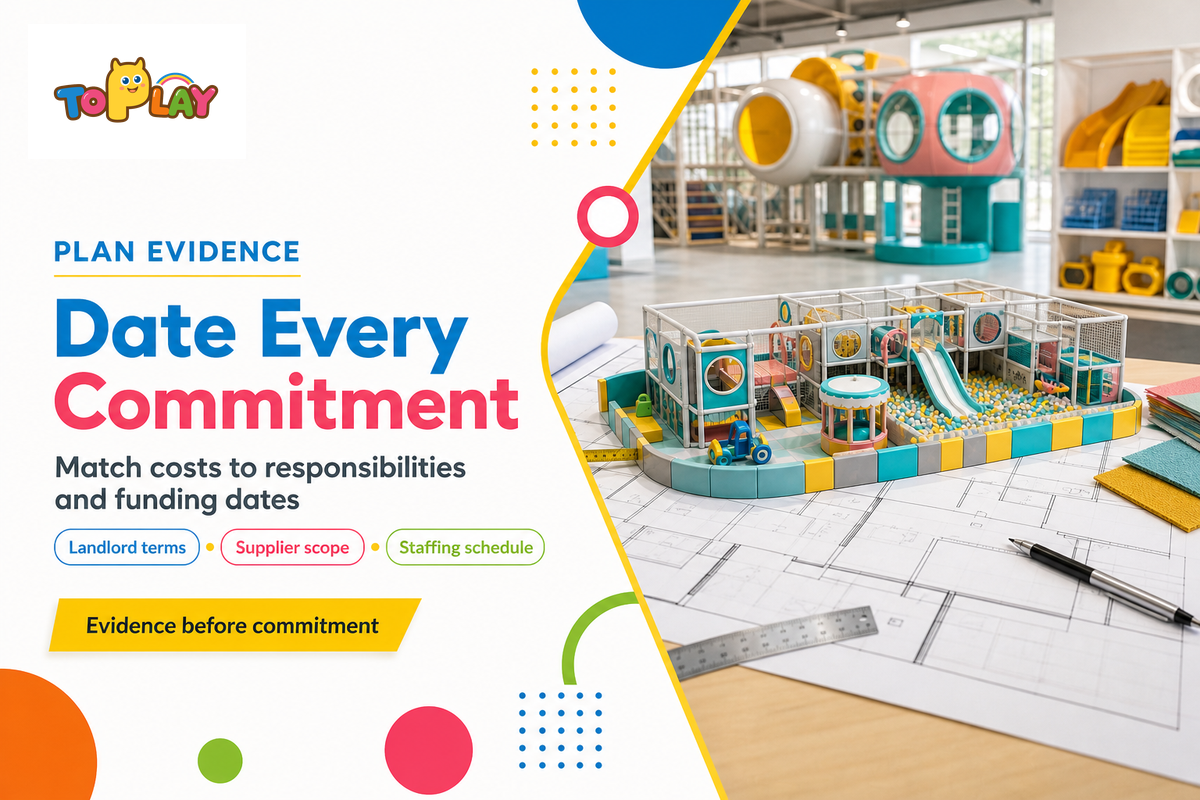
Alongside your plan, provide an evidence folder. Put dated landlord terms beside the occupancy budget, supplier exclusions beside equipment prices, and a weekly staffing schedule beside payroll. Keep unresolved conditions visible to the decision maker.
Choose the appropriate commercial model. Use the separate venue-specific equipment and compliance guide to evaluate the product offered vs. competitor venues.
Research Local Demand for Your Indoor Playground Business
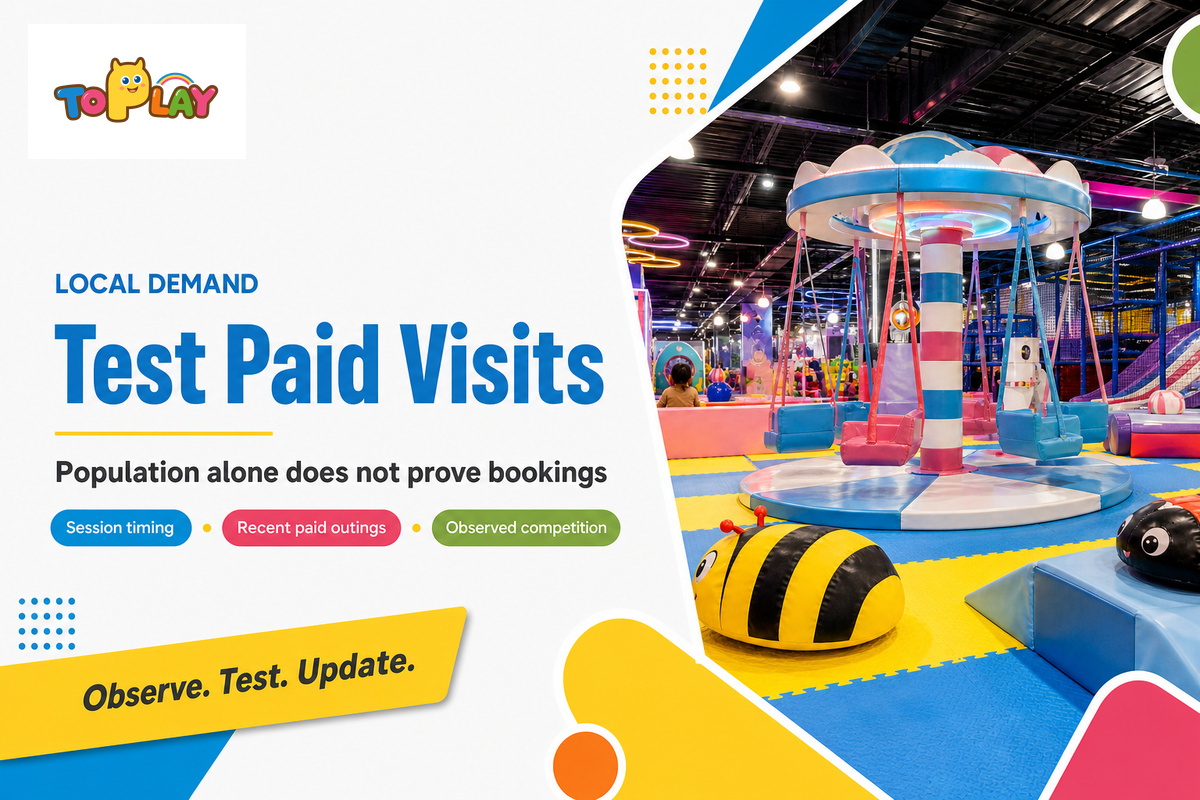
Demand research should show the location of paying households and the times they can attend. A large number of nearby children says little about weekday purchases if the offer mainly appeals to school-age families. Split toddler play, after-school use and weekend visits before forecasting sales.
The Census Bureau’s small-business data tools provide demographic and business information for market research. Capture the location and date used. Household income and children’s ages can help describe the catchment, but converting these households to paid visits requires a tested assumption.
During the session you wish to sell, visit competing indoor play venues. Record advertised admission, membership restrictions, party availability and observable queues without guessing their accounts. Ask parents about their most recent paid outing; record the total cost and the reason for the outing. Of the two, “would you visit?” produces a weaker response.
For shopping centers, investigate parking, stroller access and the route from the entrance to the play space. Ask nearby daycare centers about their own outing requirements before counting group bookings. A proposed partnership is in the pipeline until timing, transport and payment terms are agreed.
Use a catchment sheet with four fields: observed evidence, forecast assumption, who owns it, and next validation date. National indoor playground market growth cannot fill an empty local evidence field. A paid trial or documented advance booking is more valuable to the monthly model compared to a broad entertainment market headline.
Compare a Soft Play Cafe With a Party-Led Venue
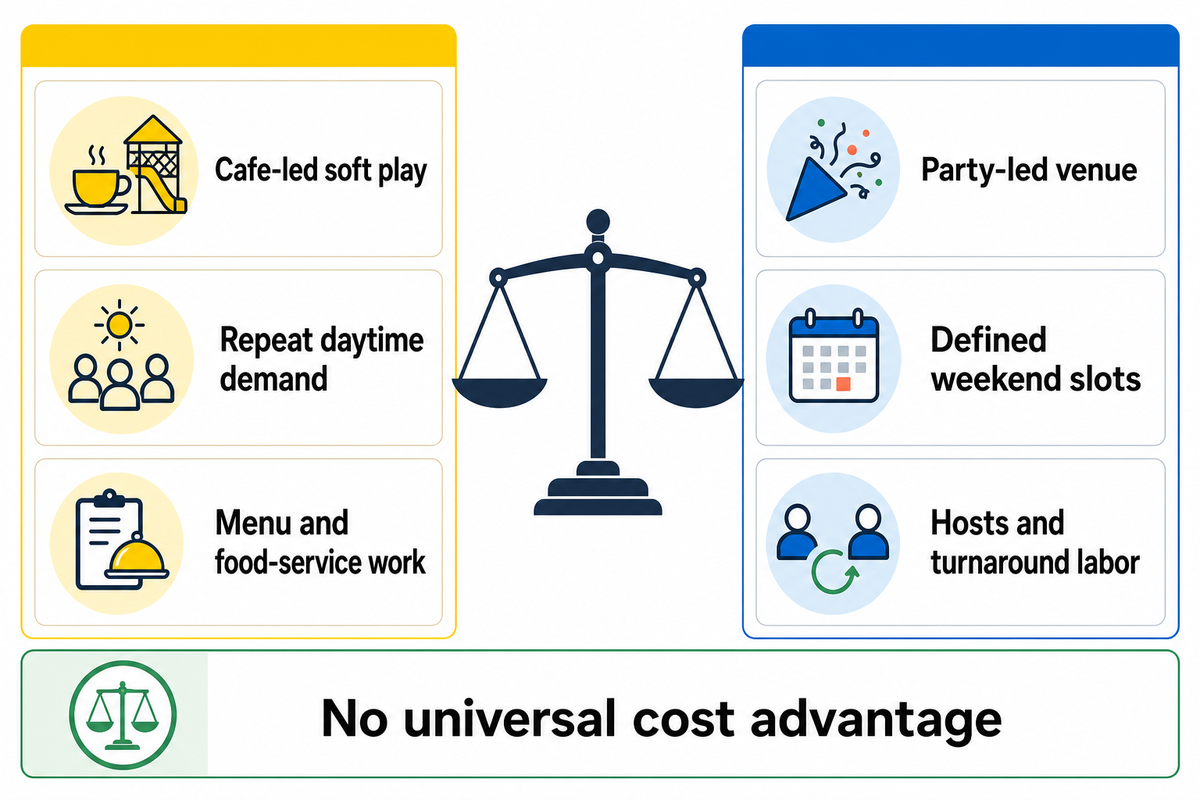
A soft play cafe and a party-led family entertainment center have different demands on facilities and staffing. Assess locally priced food scope and bookable slots to decide on the format. Neither format has a reliable universal cost advantage across different buildings and menus.
Cafe-led soft play
- Test repeat daytime demand from younger families.
- Price the proposed menu and food-service work.
- Allow for seating, cleaning and loose-toy resets.
- Postpone if the food scope or weekday demand remains unpriced.
Party-led venue
- Test advance bookings for defined weekend slots.
- Price hosts, package consumables and turnaround labor.
- Allow for guests, caregivers and overlapping arrivals.
- Postpone if party demand exceeds workable room and staff capacity.
Food scope requires early decisions. Clackamas County, Oregon, requires relevant food-service plan review before construction; menu and equipment affect that review. King County, Washington, lists an exemption for businesses offering only hot beverages that do not require time or temperature control for safety, served in single-service or disposable cups. These examples aren’t authorization to serve food elsewhere. A café with a full menu needs its own review, and a snack bar doesn’t exempt it from obligations.
Before you open a play cafe, review its proposed indoor play area with the indoor playground floor plan. Provide stroller storage and adult seating as well as the soft playground. An entertainment center can have an attractive play area yet insufficient space to receive a private party without crowding regular customers.
Peak-Session Bottleneck Map
The Peak-Session Bottleneck Map shows the smallest supported capacity for guest arrivals, play, food service, staffing and room turnover.
Conduct a trial session and track where families wait and which employee is already occupied. Forecast monthly attendance and plan for the busiest sessions, but be prepared for constraints when selling family entertainment packages.
Build an Indoor Playground Startup Cost Budget
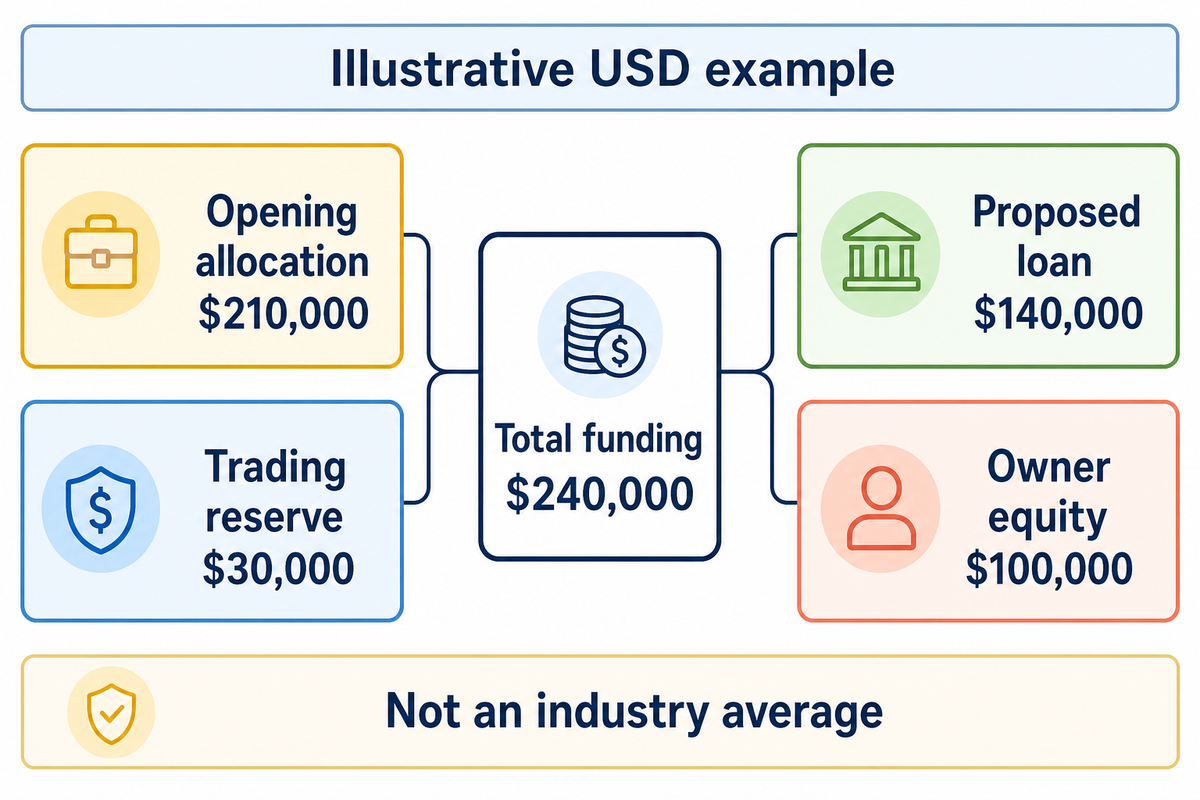
The cost to open includes money set aside before customers arrive and money reserved for trading after that. Get some local quotes for the building work first. In the case of insufficient funding, a low price for the equipment can’t balance the cost of unbudgeted ventilation or electrical work.
| Budget item | Example | Decision evidence and cash trigger |
|---|---|---|
| Playground equipment | $60,000 | Approved scope; supplier deposit and balance dates |
| Freight and destination provision | $12,000 | Delivery term; broker and local transport quotes |
| Installation | $8,000 | Crew, travel, lifting and assembly responsibilities |
| Building fit-out | $65,000 | Permitted scope; contractor progress payments |
| Design and professional fees | $5,000 | Named deliverables and approval responsibilities |
| Security deposit | $18,000 | Lease terms; restricted cash rather than a trading expense |
| Furniture and reception | $12,000 | Measured seating and check-in requirements |
| Software and initial setup | $3,500 | Hardware, setup charges and recurring fees separated |
| Pre-opening staffing and supplies | $7,000 | Training calendar and opening inventory |
| Launch marketing | $4,500 | Campaign dates and committed spend |
| Unspent contingency allocation | $15,000 | Reserved for scope changes; transfer only when approved |
| Total opening allocation | $210,000 | Reconcile against dated funding sources |
| Limitations | Illustration only | Taxes, scope and local costs require project-specific treatment |
Adding a separate $30,000 trading reserve gives a $240,000 funding requirement in this example. A proposed $140,000 loan plus $100,000 owner equity matches it. That arithmetic does not guarantee the funds will be available when required. Check the conditions on which funds will be made available and the date on which each payment clears.
The contingency allocation isn’t money already spent and the security deposit may remain an asset. Track them separately to avoid counting the same cash twice as available working capital. Send the supplier measured space planning requirements before treating a play equipment estimate as a firm commitment.
Forecast Revenue From Visits, Parties and Memberships
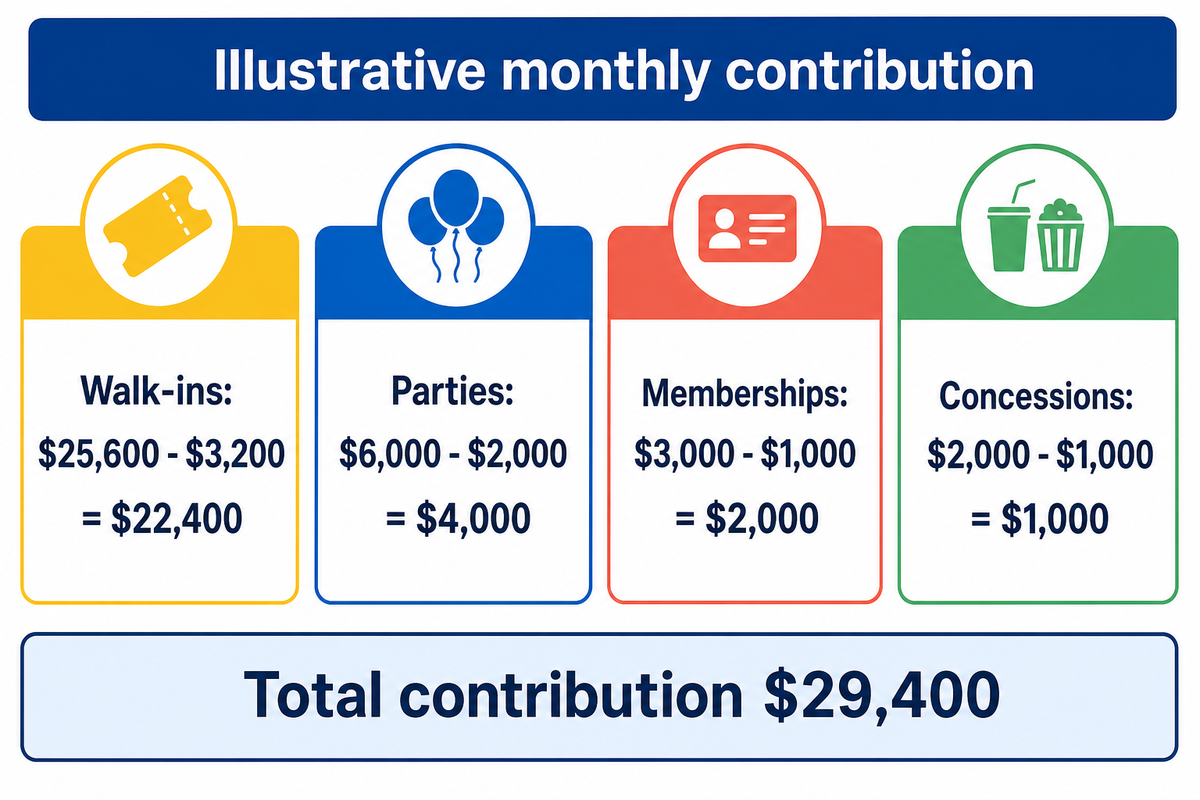
Revenue forecasts must have separate channels and be matched with variable costs. A member’s visit uses capacity even when it doesn’t generate an additional admission payment. Likewise, a child covered by birthday party packages must not also appear as a separately paid walk-in in the same forecast.
| Channel | Revenue | Variable cash cost | Contribution |
|---|---|---|---|
| 1,600 walk-ins at $16 | $25,600 | $3,200 | $22,400 |
| Birthday parties | $6,000 | $2,000 | $4,000 |
| Memberships | $3,000 | $1,000 | $2,000 |
| Concessions | $2,000 | $1,000 | $1,000 |
| Total | $36,600 | $7,200 | $29,400 |
Use actual gross admission after discounts, not the regular admission price. Define which transaction fees, consumables and labor are variable. Keep them out of fixed payroll costs if they’re already included here. Reconcile reservations and wristband counts with point-of-sale channel codes.
Adding 500 member visits and 300 party child visits to 1,600 walk-ins yields a total of 2,400 child visits in a month. Caregivers are additional visitors. This total doesn’t determine safe, simultaneous capacity, nor approved occupancy. Test open play area and party room together during simultaneous arrivals.
Chandler’s Tumbleweed Recreation Center demonstrates the difference: its posted party rules separate a maximum of 20 children from a room limit of 24 total persons (including adults). Their 90 minute package contains scheduled activities and room time. Those are their rules. Create party packages around approved capacity, playtime, check-in and a timed cleanup trial.
Test Indoor Playground Profitability With Break-Even Math
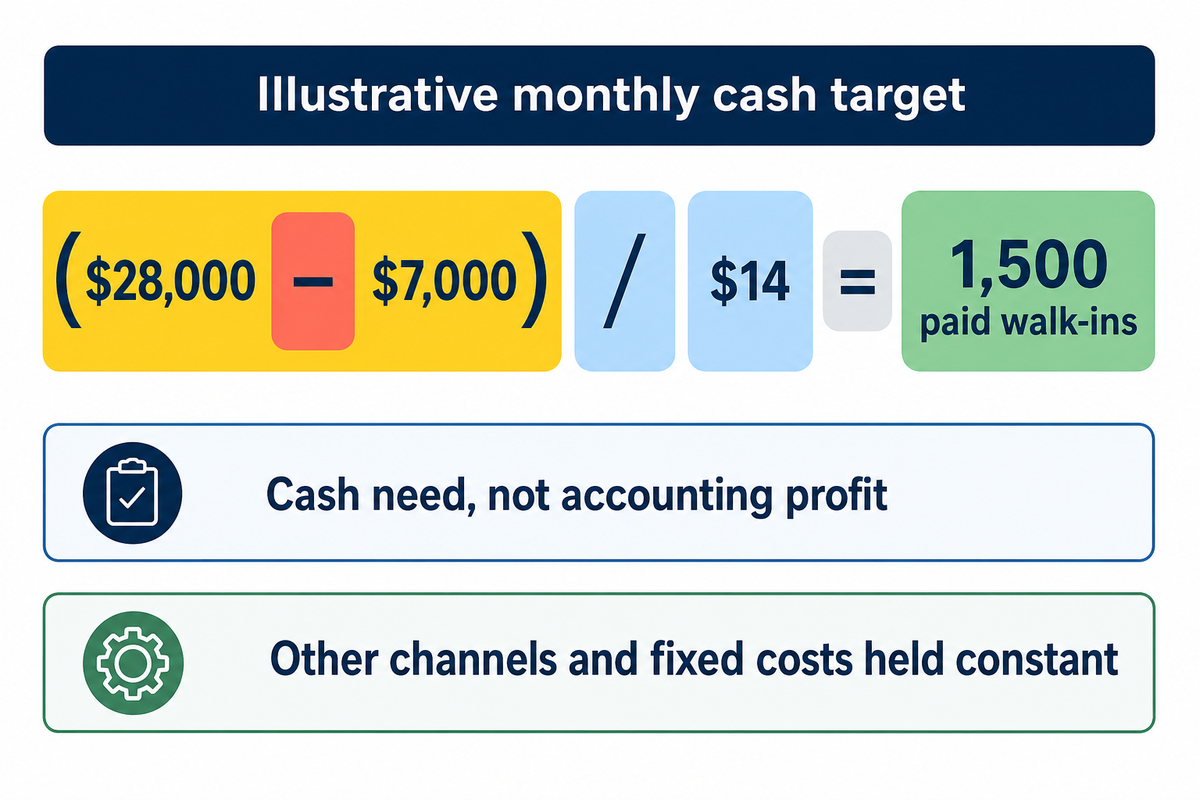
Indoor playground profitability is dependent on contribution after variable costs, fixed costs and financing. The calculation below estimates cash requirement. It can’t be interpreted as an accounting profit margin or owner’s take home pay.
“Fixed Costs ÷ (Price – Variable Costs) = Break-Even Point in Units”
The SBA formula is a single product starting point. For a venue with multiple channels, estimate party, membership and concession contribution separately. Subtract those contributions from the cash requirement to calculate the paid walk-ins needed to cover the remainder.
Assume $24,000 monthly fixed operating cash: $9,000 rent, $11,000 payroll, $1,500 utilities, $800 insurance, $1,000 maintenance and $700 software and administration. Payroll includes payment for the owner’s operating work. Add a $3,000 debt payment and a $1,000 transfer to a replacement reserve. Cash available for current operations must therefore cover $28,000.
Walk-in contribution is $16 admission minus $2 variable cost, or $14 per visit. Other channels contribute $7,000 under the preceding assumptions. The required paid walk-ins are ($28,000 − $7,000) ÷ $14 = 1,500 per month.
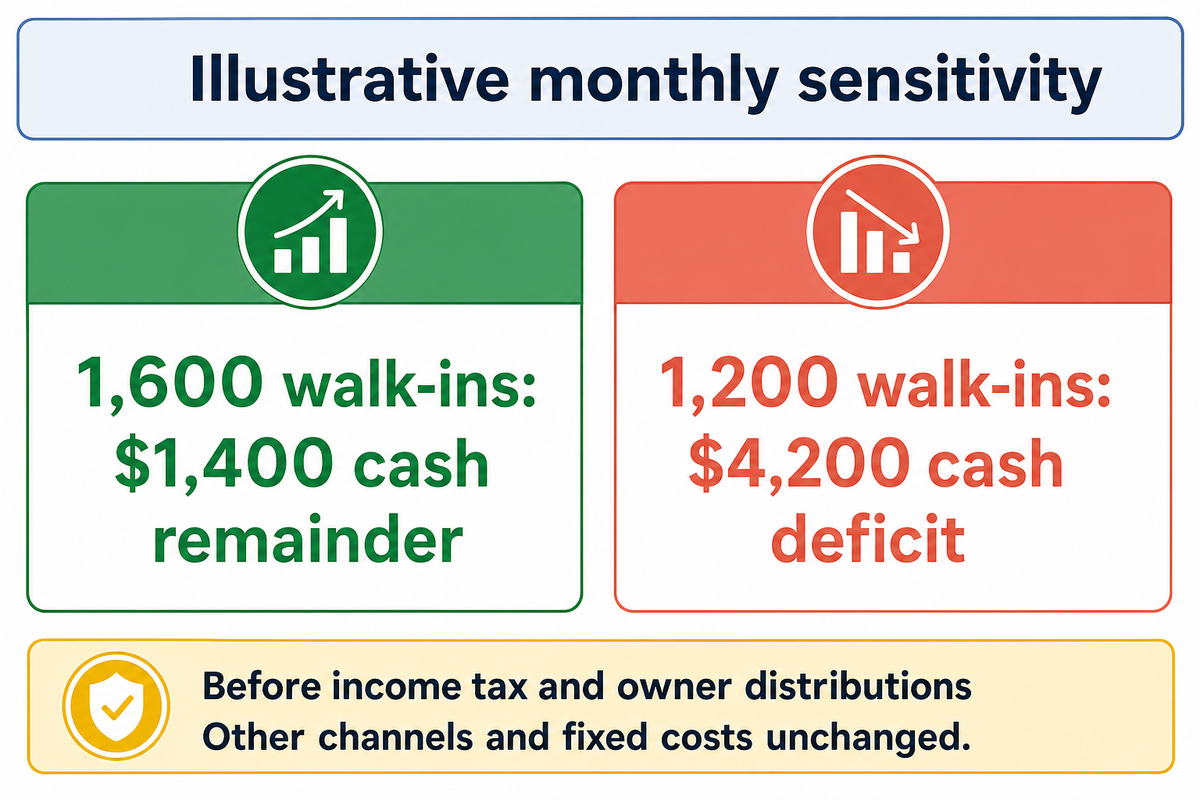
At 1,600 walk-ins, total contribution of $29,400 leaves $1,400 after those cash uses, before income tax and owner distributions. At 1,200 walk-ins, it leaves a $4,200 deficit. This sensitivity analysis assumes other channels and fixed costs remain the same; weaker parties and additional staffing would alter the results.
How much do indoor playground owners make?
Indoor playground owner income depends on wages earned for work performed, business profits, debt commitments and cash retained for business needs. Gross ticket sales don’t show owner earnings. In the illustrative model, the monthly cash remainder of $1,400 is before income taxes and distributions, with operating owner pay included in payroll.
Have an accountant reconcile income and cash flow statements before using the two. Principal debt payments aren’t operating expenses, and cash moved into a replacement reserve isn’t depreciation or equipment purchase. Planning to start an indoor playground business? Price a replacement manager, don’t assume a lifetime of unpaid owner labor.
Turn Financial Projections Into Monthly Cash Flow
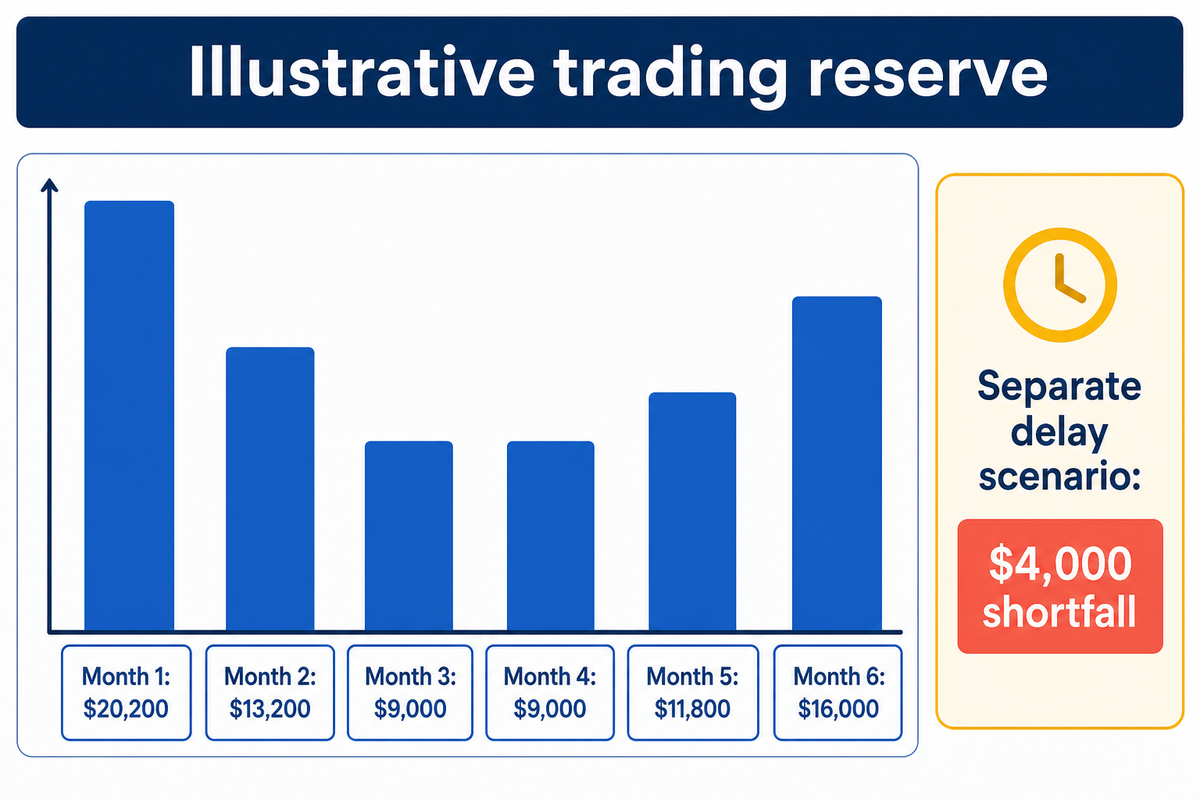
Financial projections require a continuous cash balance starting from the first deposit. A venue can reach its cash monthly target even if it has operating losses during its first few months. Record financing receipts when available, supplier payments when due and customer receipts when collected.
3-Ledger Opening-Cash Bridge
The 3-Ledger Opening-Cash Bridge shows the lowest funded balance by revealing reserves and monthly trading cash and opening commitments.
| Trading month | Paid walk-ins | Monthly cash change | Available reserve |
|---|---|---|---|
| 1 | 800 visits | −$9,800 | $20,200 |
| 2 | 1,000 visits | −$7,000 | $13,200 |
| 3 | 1,200 visits | −$4,200 | $9,000 |
| 4 | 1,500 visits | $0 | $9,000 |
| 5 | 1,700 visits | +$2,800 | $11,800 |
| 6 | 1,800 visits | +$4,200 | $16,000 |
The cumulative trading low point is a $21,000 draw on reserves. Now test an opening delay separately: $9,000 rent, $2,500 pre-opening payroll, $800 utilities and $700 insurance total $13,000 for an illustrative delayed month. Taking that from the same reserve before the ramp produces a $4,000 funding shortfall at the low point.
This isn’t a suggested reserve amount. Party and membership contributions were kept constant to support tracing; a new location needs its own ramp for those sources as well. Include tax, timing, deposits, refunds, and finance charges where applicable. Recalculate the minimum balance whenever opening day moves or there’s a significant change in the payment pattern.
Budget for Permits, Insurance and Daily Operations
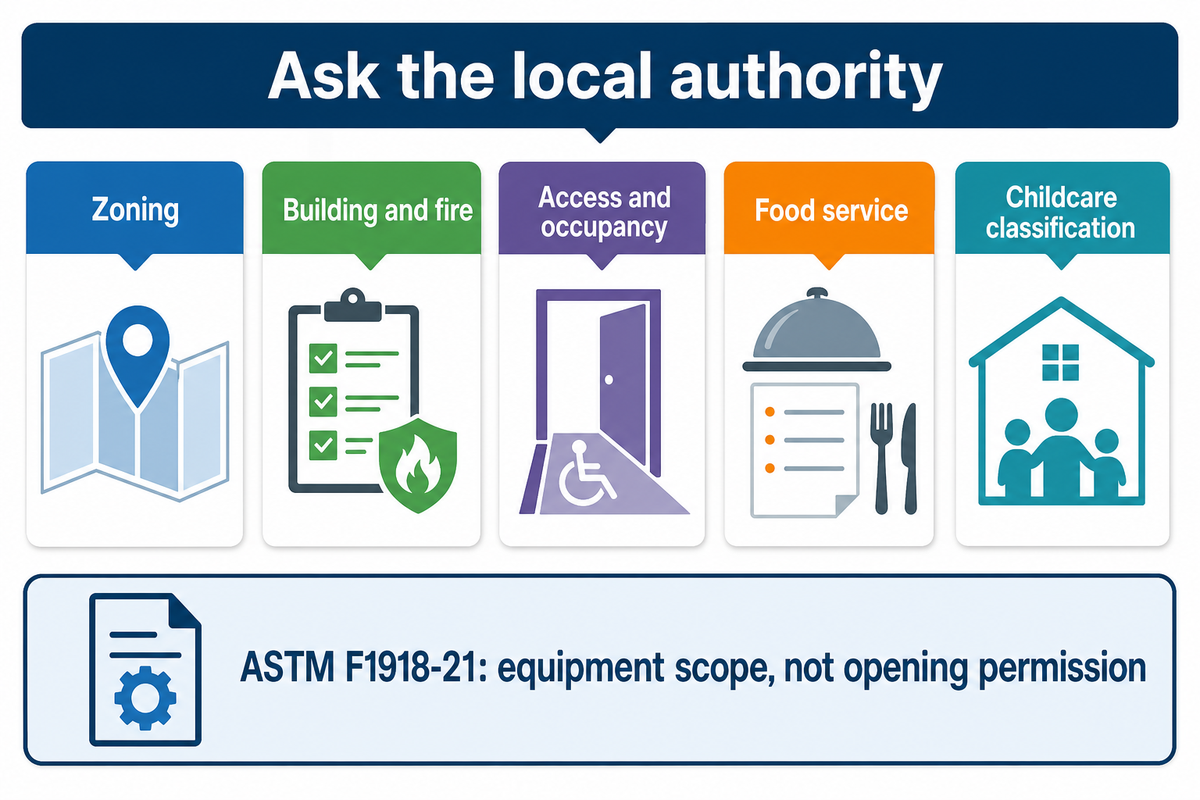
Approval questions should be placed before irrevocable commitments. Explain to the local authority your proposed activities and operating model, especially if care is provided by staff instead of parents. The presence of parents alone shouldn’t be assumed to settle childcare classification. Clarify the category before budgeting staff and advertising drop-off sessions.
What permits are needed for an indoor playground?
Permits for an indoor playground vary based on location, use of the premises, building alterations, food service and the care provided to children. Contact the relevant local offices for zoning, building and fire approvals, access, occupancy, food, and childcare permissions. Obtain site-specific answers before taking a lease or equipment order as a go-ahead.
ASTM F1918-21 addresses soft contained play equipment within its stated scope. It is not a broad standard to cover all attractions and does not provide authorization to open an amusement facility. Request relevant documentation from the supplier and have the site assessed against requirements for the activity.
Obtain quotes for the activities described, especially parties and care and food services. Ask about liability insurance and workers’ compensation, exclusions and incident reporting. Forming a limited liability business doesn’t replace adequate insurance and operating procedures.
Write shifts around tasks: supervise the play environment, manage the front desk, reset rooms, clean toilets and inspect equipment. Working with kids needs defined responsibilities and proper training. Verify the first aid and CPR arrangements with the appropriate adviser. A climate-controlled building still requires a maintenance budget and shutdown procedures; the ability for children to play, however, is dependent on more than the condition of the climbing structure.
Compare Indoor Playground Equipment Quotes by Scope
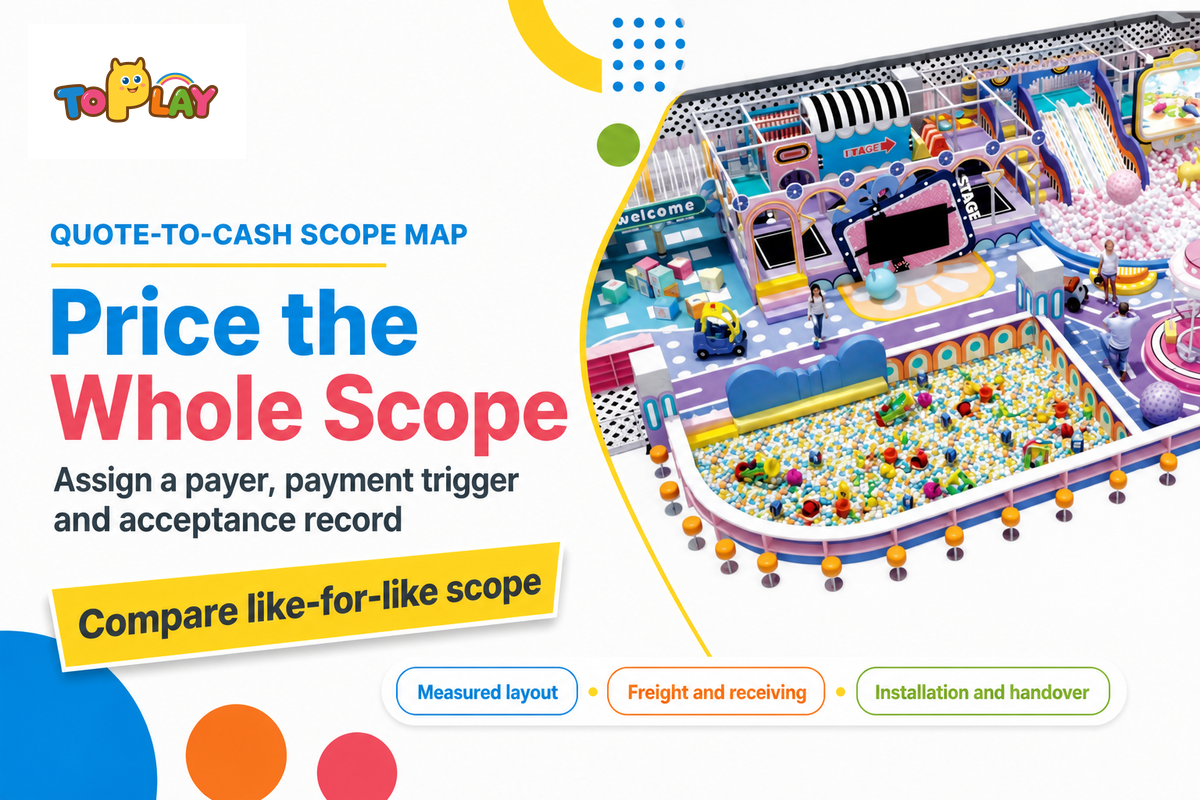
Comparable quotes require the same site, age groups and responsibilities. Define toddler zones independently from attractions for older kids. A toddler play area, obstacle courses and climbing walls create different operating questions; select the intended active play offer before pricing the play zones.
Quote-to-Cash Scope Map
The Quote-to-Cash Scope Map assigns each supplier and site-work item a payer, payment trigger and acceptance record, and finally compares totals.
| Scope category | Budget question | Evidence to obtain |
|---|---|---|
| Measured design | Who pays for surveys and revisions? | Approved layout, clear heights and exclusions |
| Play structure and components | Which products and quantities are included? | Itemized specification and applicable documentation |
| Accessible customer routes | Who designs and prices the required routes? | Site-specific accessibility review |
| Receiving route | Can packaged components reach the assembly area? | Door, lift, loading and handling survey |
| Freight | What delivery term and destination apply? | Freight quote and shipment responsibilities |
| Import and destination charges | Who is importer and who pays duties, taxes or storage? | Named parties and broker cost scope |
| Local building services | Who pays for electrical, ventilation and other work? | Contractor scope and approval schedule |
| Installation crew | Are travel, accommodation and local labor included? | Crew plan and separate exclusions |
| Inspection and handover | What releases the next payment? | Agreed inspection and acceptance records |
| After-sales and spares | Which response, parts and freight costs are covered? | Written service and warranty terms |
| Limitations | Unpriced rows remain exposure | A lower partial quote is not an installed-cost comparison |
Toplay’s public playground design and turnkey services page lists a 30% deposit and 70% balance before shipment, with 45–75 days of production after design approval and deposit. These published terms were checked in October 2026 and remain subject to the project quotation. Production time doesn’t include freight or on-site commissioning.
Ask for a free design consultation based on a measured brief, then verify the design exclusions and the delivery and installation scope. Compare commercial play equipment options against the offer families will buy. Attractive climbing structures can’t resolve an unpriced building alteration.
When to Delay an Equipment Order
Postpone the deposit if the site survey or intended use determination or funded payment schedule is unresolved. An approved rendering doesn’t clarify a receiving route.
In Recreation Management’s 2023 ARC Center case, tall replacement equipment had to be delivered in smaller pieces to enter the existing building. The case also illustrated the challenges related to maintenance demands which had outgrown the operator’s available staff.
Put the receiving survey beside the installer’s method and the future inspection schedule. Name the party who provides access equipment and who can reach enclosed areas for maintenance. Keep accessible customer entrances as a separate design question; a delivery doorway measurement cannot answer it.
If the installation plan adds expense, revise the funding schedule before signing. Ask the supplier to hold an explicit specification while the local contractor prices the remaining work. An order placed at a later date with funded exclusions is easier to assess than an order placed at an earlier date with an unjustified assumption that an implementation partner would cover the cost.
Plan for Uneven Demand Before the Grand Opening
The grand opening is a marketing event; the following weekday sessions test the operating plan. Build separate assumptions for school days, holidays and weekends. Indoor entertainment competes with other paid outings and free alternatives like an outdoor playground. A trampoline park may attract a different age group, but can also compete for the same family budget.
Use the downside calculation to make a spending decision in advance. Under the illustrative model, 1,200 walk-ins leave a $4,200 monthly cash deficit. Continuous cash deficits require adjustments to the forecast for all channels, staffing and reserves. Discounting admission without recalculating contribution can increase the number of visits required to cover cash needs.
Name who checks weekly bookings and who can pause discretionary spending, before opening. Record a review date and the minimum funded balance agreed with the financing decision makers. Rising searches for children’s indoor play do not establish that this venue can sell the required sessions.
Key takeaway
The example reaches monthly cash break-even at 1,500 paid walk-ins, yet its opening delay and ramp create a $4,000 reserve shortfall. An indoor playground business plan must fund the lowest cash balance as well as the opening purchases.
Frequently Asked Questions About Playground Business Plans
What are the 7 steps of a business plan?
A practical seven-part plan covers the offer, customers, competitors, operations, marketing, finances and funding.
Use those sections as a document structure rather than proof that the business will work. Attach local demand evidence to the customer section and dated quotations to costs. The operations section needs a responsible manager and staffing schedule. Match the funding request to spending dates, then test whether the cash forecast survives a slower opening period.
How much does it cost to build an indoor playground?
The project cost depends on the building, play equipment, local work, delivery scope and cash needed after opening.
Obtain separate quotations for the premises work and supplier scope before adding deposits, professional fees, staffing, launch spending and reserves. The $240,000 illustration combines a $210,000 opening allocation with $30,000 trading cash. It’s neither a minimum price nor an industry average. Replace every amount and payment date with evidence for the proposed site before making a commitment.
How do I conduct a SWOT analysis for my business plan?
A SWOT analysis separates internal strengths and weaknesses from external opportunities and threats.
Make each item testable. Experienced staff can be a strength; limited party turnaround capacity is a weakness. An underserved weekday segment may be an opportunity after local validation, while a nearby competing venue is a threat to investigate. Assign an action and owner to each significant item, then show its effect on costs, bookings or available cash.
How long should my business plan be?
The plan should be long enough to explain its decisions and support its funding request.
Ask the intended lender or investor what format they require. Keep the narrative readable and place quotations, research notes and detailed schedules in appendices. A short plan with traceable assumptions is more useful than repeated market commentary.
What financial documents are essential for an indoor playground business plan?
The financial package should connect startup sources and uses with projected income, cash flow, a balance sheet and capital spending.
Add a monthly first-year schedule, financing repayments and the assumptions behind each sales channel. Separate paid admissions from member and party visits. Include a downside case and the cumulative cash low point. Supporting records should include dated supplier and contractor quotations, lease terms and proposed funding conditions. Check that the opening funding total matches the uses and that the money is available before each payment falls due.
How can I get funding for an indoor playground?
Potential funding routes include owner equity, investors and business borrowing, subject to each provider’s requirements.
Prepare the evidence and cash forecast before approaching funders. Compare repayment timing and conditions with the opening schedule. Don’t count an application, verbal interest or conditional offer as cash already available to spend.
Can I start an indoor playground with no money?
A permanent venue needs committed funding even when the founder contributes little personal cash.
Someone must fund deposits, premises work, equipment and operating losses before receipts cover payments. Investors or borrowing can change the source of that money, but they don’t remove the requirement or guarantee approval. A smaller paid trial may help test demand before a permanent lease. Price that trial separately and confirm its own permissions, insurance and operating scope. Avoid committing to a full venue on the assumption that future ticket sales will pay bills due before opening.
Put a Measured Equipment Scope Behind Your Plan
Send Toplay your floor dimensions, clear height, destination, intended age groups and target opening date. Request an itemized equipment proposal with payment dates and installation responsibilities so your finance plan can use a defined scope.
References & Sources
- Plan your business, U.S. Small Business Administration: plan and projection structure.
- Break-even point, U.S. Small Business Administration: unit contribution formula.
- Powerful data for small businesses, U.S. Census Bureau: local research inputs.
- ASTM F1918-21 public scope: soft contained play equipment.
- Food-service plan review, Clackamas County: local menu and construction review example.
- Food-business permit exemptions, King County: limited local exemption example.
- Birthday party frequently asked questions, City of Chandler: child, total-person and session limits.
- Treetop Escape at the ARC Center, Recreation Management, Emily Tipping, 2023: historical installation and maintenance case; vendor involvement disclosed in the feature.