
Get in touch with Guangzhou Toplay amusement equipment co. Company

Updated September 2026
Family Entertainment Centers are multi-attraction indoor venues that pack several distinct attraction categories under one roof — soft play, a trampoline zone, an arcade, sometimes dining — and that mix is precisely where many buyers and operators run into confusion during the compliance stage. Here we walk through what actually governs an FEC floor, what starting one really costs, the numbers behind injury and sanitation concerns, and where the industry is headed in 2026.
Quick Specs
| Venue category | Multi-attraction indoor entertainment venue, distinct from a single-format arcade, bowling alley, or outdoor amusement park |
| Common attraction classes | Soft contained play, trampoline attractions, inflatables, arcade/redemption, occasionally bowling or laser tag |
| Governing equipment standards | Up to 4 separate ASTM documents apply simultaneously — no single certification covers them all |
| Planning framework | SBA break-even formula (Fixed Costs ÷ (Price − Variable Costs)); precise industry-wide cost benchmarks are largely unpublished or paywalled |
What Is a Family Entertainment Center?
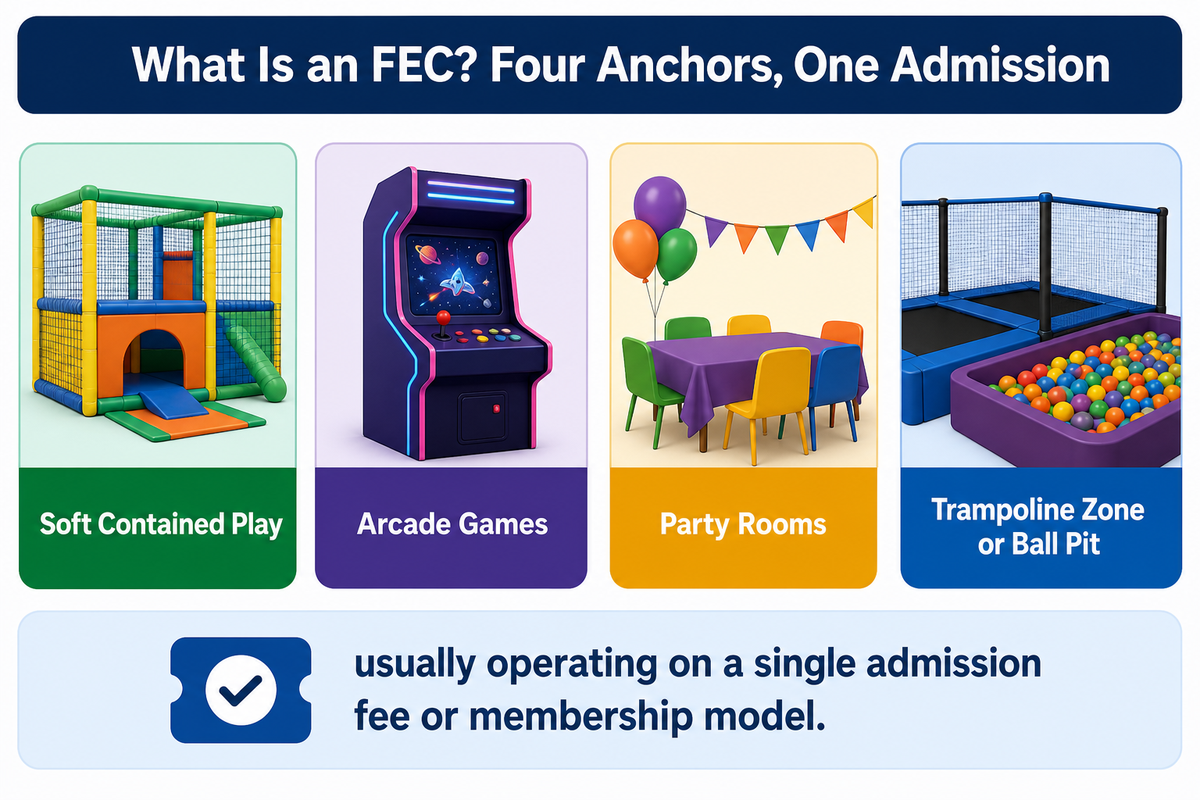
Short for Family Entertainment Center, an FEC is an indoor business featuring several, rather than just one, key attraction “anchors”: a soft contained play frame, arcade games, party rooms, and usually a trampoline zone or “ball pit” — usually operating on a single admission fee or membership model.
An FEC stands apart from an indoor arcade or a stand-alone bowling alley on one side, and from an outdoor amusement park on the other — outdoor amusement parks are built around rides across an open site, while an FEC crams several different attraction types into a tight, single building footprint, or a footprint within a larger retail space or mixed-use building. Buyers who skip this distinction end up sourcing equipment for the wrong venue type entirely: a single-format amusement supplier’s product line rarely covers the mixed-attraction floor plan an FEC actually needs, which is the mistake this guide is written to help you avoid. For examples of the soft-play portion of this mix, review indoor playground equipment from Didi Land; confirm the scope of any other attraction separately.
Another consequence of that compression shows up deeper in this guide: each attraction category on the floor must comply with its own separate standard, which is why “compliance in an FEC” is never a single checklist — see The Standards That Actually Apply Inside an FEC, below.
Older industry literature sometimes labels the category urban entertainment centers (UECs) or indoor family entertainment centers — same industry, an earlier era’s terminology. Family entertainment centers also sit inside the broader “out-of-home” entertainment sector alongside science museums, children’s museums, and other tourist destinations; what sets an FEC apart is its commercial nature and a business plan built on repeat visits rather than an educational or mission-driven purpose.
The venue is built for people of all ages, not just toddlers and preschool-aged children — families with small children, younger children out with older siblings, and even adults all need to stay engaged for repeat visits to happen. Indoor amusement parks and indoor water parks are a different category too, and so are outdoor attractions generally: those formats compete on ride diversity across a large footprint, while an FEC concentrates a dense, weather-free mix of games and adventure-play structures into a much smaller space.
FEC Formats, Standalone, Mall-Based, and the Family Fun Center Down the Street
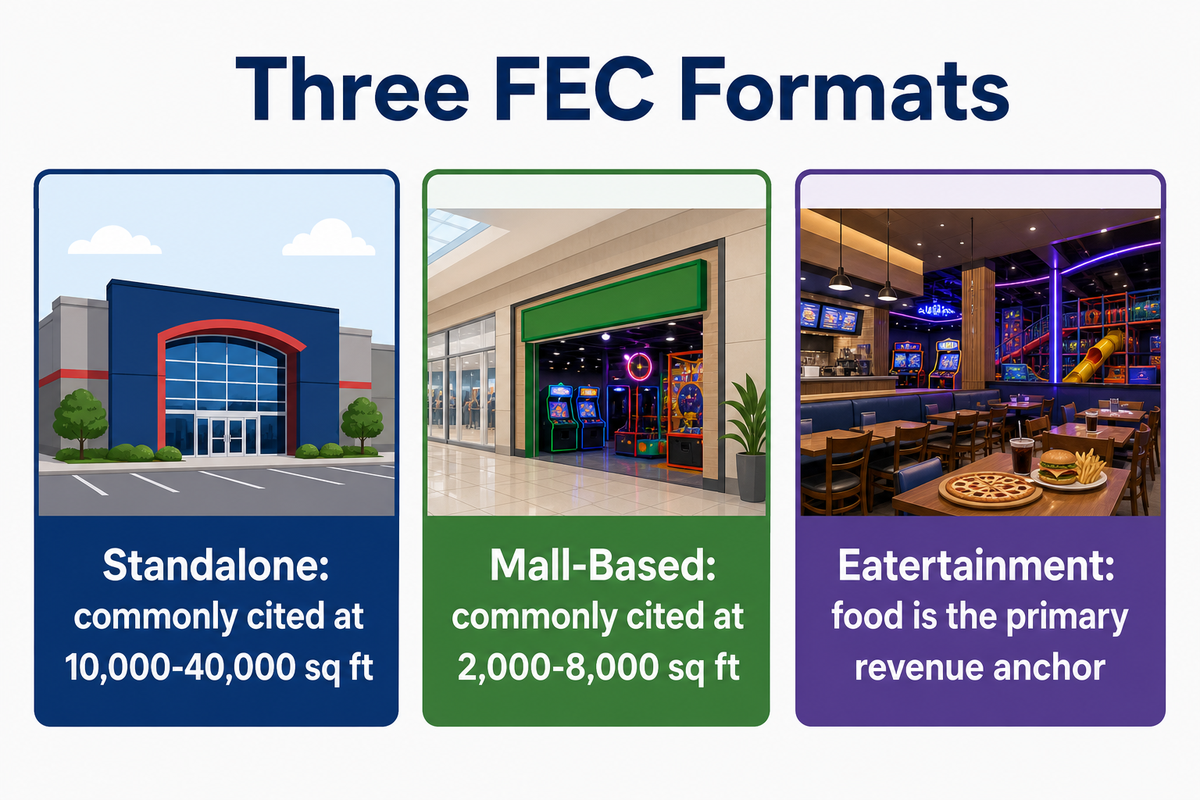
Most operations fall into one of three formats, and the format determines the lease and the attraction mix before anything else is purchased — a decision worth mapping out with a turnkey FEC design-and-delivery partner before signing a lease, not after.
Standalone indoor FEC
A dedicated building or large-format unit, commonly cited at 10,000-40,000 sq ft with 18-24 ft of clear ceiling height to accommodate a trampoline zone, housing the full attraction mix — soft play, trampoline zone, arcade, and party rooms — under one roof. Most people picture this format when they hear “family fun center”: the destination venue a family drives to for a birthday party or a weekend outing, built for repeat visits rather than a single trip.
Mall-based / mixed-use FEC
This format runs a smaller footprint (commonly cited at 2,000-8,000 sq ft) inside a shopping mall or co-mingled real estate development relying on existing foot traffic rather than destination marketing. Attraction mix is usually less broad — soft play with arcade, no full trampoline zone — since clear ceiling height in this format is constrained by the host building, typically well short of the 18-24 ft a trampoline zone needs.
Family entertainment restaurant (eatertainment)
Food and beverage service is the primary revenue anchor here, with play attractions layered in as a draw — a party room, a small soft-play area, or an arcade wall. Food-code compliance joins the play-equipment standards in this format as an extra layer (discussed below under Hygiene).
Industry advisors also categorize edutainment (leisure-and-learning centers) as a fourth, smaller category that combines science-museum-style displays with commercial play – always worth understanding if a supplier or landlord is using this word, although it’s a somewhat niche enough format that most operators creating family-friendly spaces naturally settle on one of the three types above. Whichever space type you settle on, the operating heart remains a dedicated private party or fundraiser booking model framed around scheduled play sessions, at spaces variously referred to as play places, play centers, or amusement centers, aimed at families with little children through older kids, and, in the better-planned designs, those of all ages rather than one narrow age band.
The Standards That Actually Apply Inside an FEC
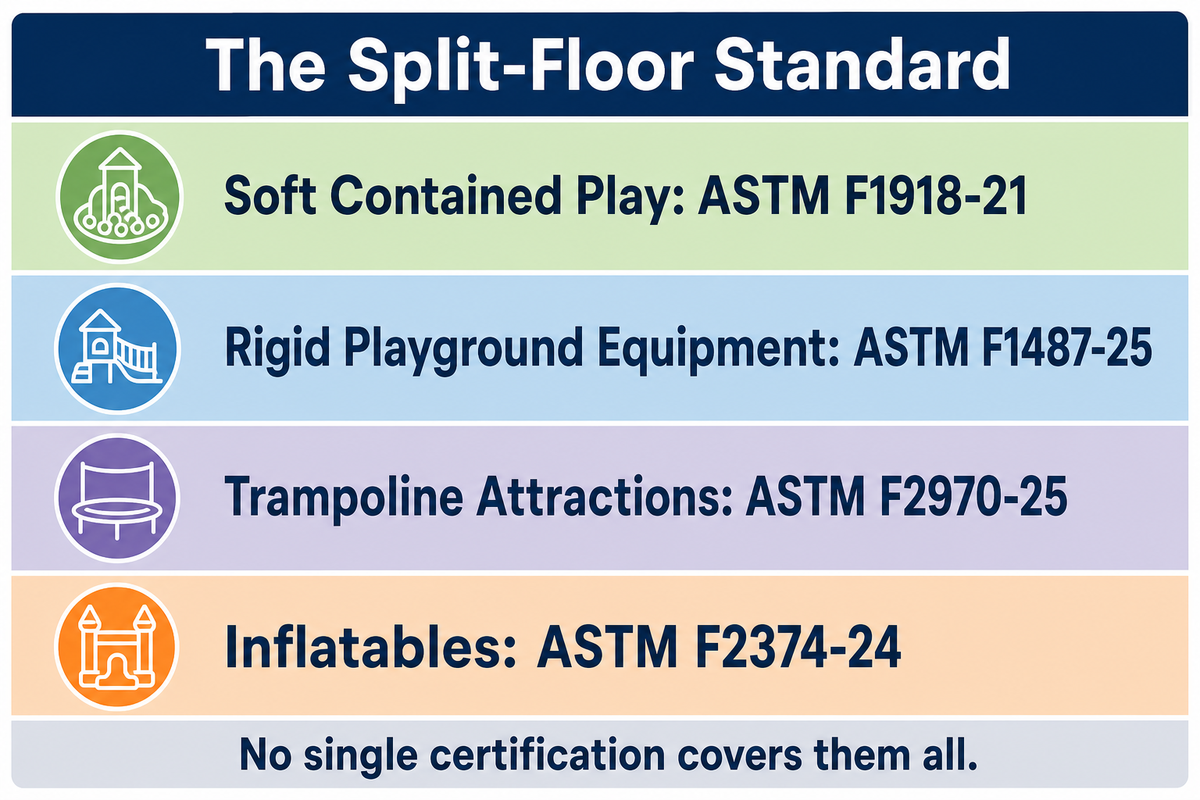
Ask a supplier “is this equipment certified?” and the truthful reply is: certified to which document? A family entertainment center floor routinely blends together four technically distinct categories of equipment, each scoped by its own ASTM document with its own exclusions written directly into the text — a technical, not automatically legal, distinction: whether any one of these documents is voluntary or mandatory in your location depends on whether your state or local code has adopted it by reference (see below). We call this the Split-Floor Standard — no single safety certification covers a full FEC floor (our FEC equipment specifications page breaks out the procurement-level detail behind each row below). If you’re comparing this against a mall kiosk, a standalone trampoline park, or another venue format entirely, our cross-venue standards comparison covers how this same split plays out across formats; the table below is the FEC-specific version.
| Attraction class | Governing standard | Scope note | Limitations / not suitable for |
|---|---|---|---|
| Soft contained play, US (netted/padded structures) | ASTM F1918-21 | Covers the 5th-percentile 2-year-old to the 95th-percentile 12-year-old | Does not cover children under 2 (row 6 below) |
| Soft contained play, EU | EN 1176-10:2023 | Covers fully enclosed play equipment up to age 14 | Different age envelope than F1918 — a two-market export design needs both |
| Rigid playground equipment | ASTM F1487-25 | Explicitly excludes soft contained play equipment from its own scope | Not applicable to netted/padded structures; a supplier citing F1487 for a soft-play unit is citing the wrong document |
| Trampoline attractions | ASTM F2970-25 | A separate document family under a different ASTM subcommittee (F24.61), reaching operation and inspection, not manufacture alone | Not evidenced by an F1918 or F1487 certificate |
| Inflatables | ASTM F2374-24 | Scope explicitly names family entertainment centers among covered venues | Governs design, manufacture, operation, and maintenance — not a substitute for the other documents on the same floor |
| Under-2 soft contained play, US | ASTM F2373-24 | Covers ages 6-23 months, but explicitly excludes soft contained play equipment from its own scope | Leaves a documented regulatory gap for under-2s inside a contained envelope in the US (no equivalent EU gap) |
| Impact-attenuating surfacing | ASTM F1292-22 | Lab-tested critical-height rating; must be greater than or equal to the attraction’s actual fall height | A passing lab rating does not guarantee field performance (see What the Injury Data Actually Shows) |
| Accessibility, covered play areas | 2010 ADA Standards, Section 240 | Legally enforceable for covered play areas, ages 2 and over, regardless of ASTM certification status | Not voluntary like the rows above for play areas specifically — but permanently installed amusement rides fall under separate ADA provisions, and some states also make specific ASTM documents mandatory by statute (see below) |
| Certification body scope (buyer-facing marks) | IPEMA program | Covers F1487 and surfacing (F1292); does not include F1918, F2970, or F2374 | An IPEMA mark alone does not evidence conformance for soft play, trampoline, or inflatable lines |
There is a US-only age gap worth understanding before buying: ASTM F1918-21 begins with the 5th-percentile 2-year-old, and ASTM F2373-24, the standard covering 6-to-23-month-olds, explicitly excludes soft contained play equipment from its own scope. In practice, a child under 2 inside a soft-contained play envelope falls outside both product documents in the United States — and outside the CPSC’s own Public Playground Safety Handbook (Publication 325) too, which states plainly that its guidelines are not intended for soft contained play equipment and are themselves guidance rather than mandatory regulation. The EN 1176 series publishes no separate under-2 part, so there is no equivalent carve-out on the EU side, meaning the operator attempting to build for both markets is designing to two different envelopes, rather than one.
The Split-Floor Standard, in one lineIf your floor plan has soft play, a trampoline zone, and an inflatable attraction, you need evidence against three separate documents — asking “is it certified” without naming which standard is the question that lets a gap slip through.
ADA Is the Enforceable Layer, Not the Product Standards
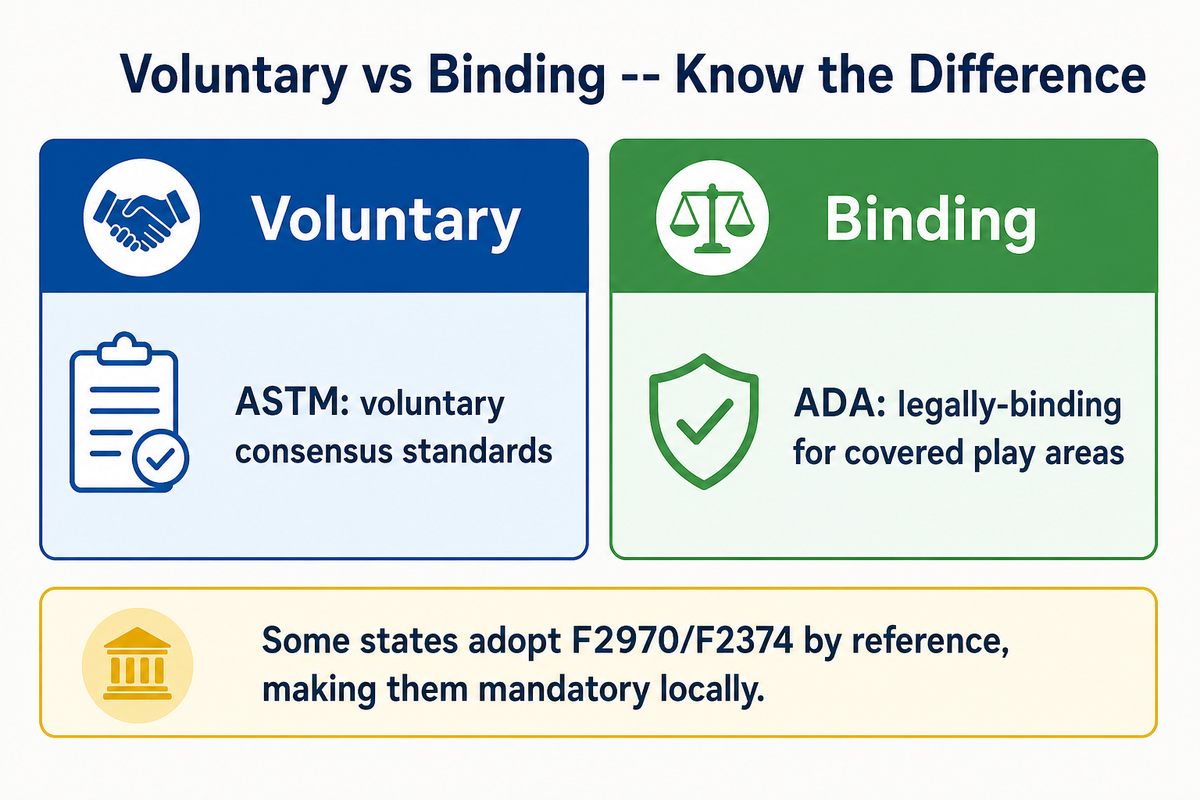
The ASTM product standards mentioned above are voluntary consensus standards at the federal level – a manufacturer can decide not to test to them, and federal law does not require the testing to a third-party standard. Several US states adopt ASTM F2970 and F2374 by reference in their amusement-device statutes, though, which makes those specific documents mandatory locally even without a federal certification requirement — check the rules in your state before assuming “voluntary” applies everywhere. The ADA Standards are different: they are legally-binding for covered play areas and name soft contained play structures directly, applying to play areas for children 2 and over with specified exceptions. This play-area coverage has its own boundary, though: the 2010 Standards’ play-area section excludes amusement attractions, and a permanently installed amusement ride is instead addressed under a separate ADA provision with its own scoping — so a trampoline zone or inflatable attraction classified as a ride, not a play area, can be evaluated under different accessibility requirements than the soft-play structure next to it, and it is worth confirming which provision applies to each attraction with your ADA consultant rather than assuming one set of rules covers the whole floor. Practically this means accessible-entry point counts, accessible route widths, and transfer-system requirements are real legal obligations whether or not the supplier can show you an ASTM certification – it’s worth discussing with the equipment supplier at the initial floor plan phase, not just after the equipment has been installed. (Full entry-point and route-dimension specifications are covered on our Family Entertainment Center Equipment page.)
Startup Costs, Break-Even, and Where the Real Numbers Come From
Search “family entertainment center startup cost” and dozens of uncredited, varied numbers come back — some under $500,000, some above $3 million, few with sources attached. The U.S. Small Business Administration‘s own guidance is to project monthly expenses for at least 12 months, ideally 5 years, before leaning on any single startup-cost figure. Knowing where real benchmarks might live matters more than repeating one of them: industry trade group IAAPA likely holds the most detailed financial benchmarks, and while its website publishes a 2025 Benchmark Series report specifically on entertainment centers, according to IAAPA’s own site, only a paywall access point — $499 for nonmembers, $250 for individual members, free to company members and students — is available; the publicly accessible landing page itself contains no figures. That gap is worth knowing before treating a percentage reported in an unlinked blog post as settled fact.
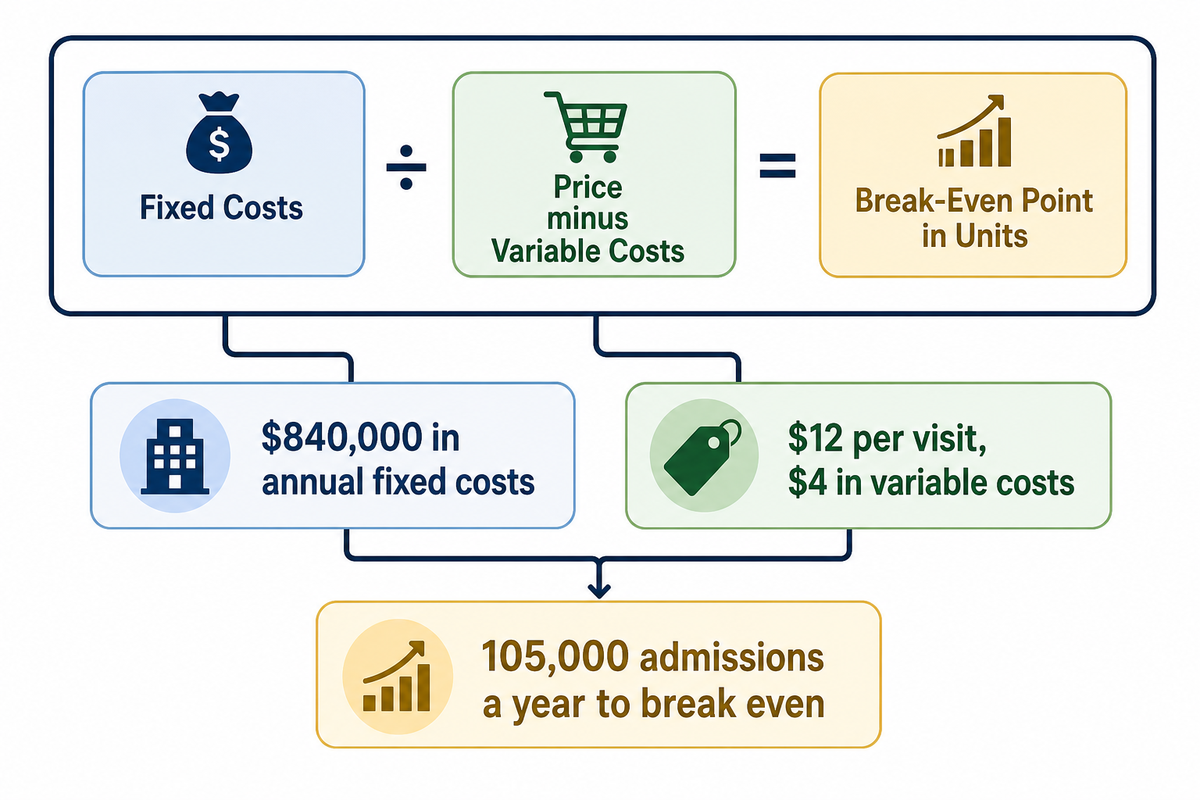
One number you can find and use right away comes straight from the U.S. Small Business Administration: the break-even formula is Fixed Costs ÷ (Price − Variable Costs) = Break-Even Point in Units. Assume a small, mall-based FEC operating 10 hours a day, 7 days a week, charging $12 per visit with $4 in variable costs (staffing time, consumables, and variable utilities per visit) and $840,000 of annual fixed costs (rent, base operations staff, insurance, financing) — illustrative, order-of-magnitude figures, not a benchmark: $840,000 ÷ ($12 − $4) = 105,000 admissions a year to break even, or roughly 2,020 admissions a week — about 29 paying guests an hour across a 7-day week. Run your own fixed-cost and variable-cost numbers through the same formula before committing to a lease — most operators can build a first-pass version in under 30 minutes once rent, staffing hours, and admission pricing are on paper, and the formula itself, not the illustrative dollar figures plugged into it, is the one calculation in this guide backed by a primary government source rather than an unattributed blog estimate.
4
Separate equipment standards on one floor
$499
Cost of IAAPA’s own paywalled benchmark report
1-5 yr
SBA’s recommended startup cost planning horizon
| Budget line item | SBA cost bucket | Typical timing |
|---|---|---|
| Soft-play, trampoline, and inflatable equipment | One-time | Paid before opening; confirm the full quote and production lead time directly with your supplier |
| Design, permits, and ADA compliance review | One-time | Paid before construction begins |
| Rent / lease deposit | Monthly (recurring) | Budget for at least 12 months upfront |
| Base staffing and supervision | Monthly (recurring) | Scales with hours open per week |
| Liability insurance | Monthly (recurring) | Required before opening day |
| Utilities (HVAC, lighting, power for attractions) | Monthly (recurring) | Rises with square footage and clear-height |
| Financing / loan service | Monthly (recurring) | Runs the full 5-year planning horizon |
| Ball pit and soft-play sanitation cadence | Monthly (recurring) | Weekly deep-clean minimum (see Hygiene, below) |
| Surfacing recertification and inspection | Monthly / periodic | Revisit annually as editions revise |
Franchise vs. Independent
FranchiseBuys a proven attraction-mix template, brand recognition, and vendor relationships, in exchange for royalties and less freedom over layout and equipment sourcing.
IndependentFull control over attraction mix, supplier selection, and branding, at the cost of designing the floor plan and compliance checklist from a blank sheet, with no franchisor playbook to fall back on.
Industry operators commonly report that construction, technology, and staffing costs run higher than initial budgets assumed, and that under-staffing supervision at individual attractions is a recurring source of both safety incidents and liability exposure — a pattern worth budgeting a contingency line for regardless of which route you take. The FEC business planning resources from Dreamland Plus offer another starting point for organizing the venue business case.
What the Injury Data Actually Shows
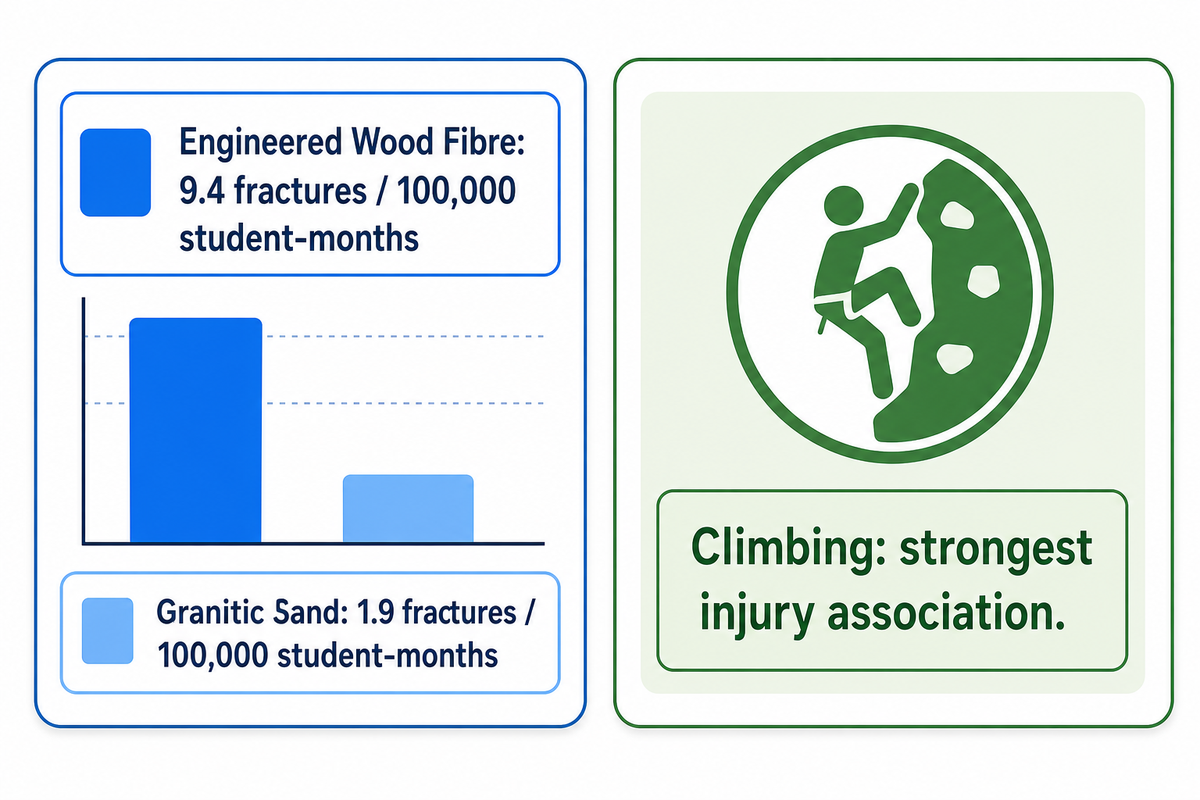
Climbing attractions carry a disproportionate share of injury risk in mixed indoor-play venues: a multicentre injury-registry study spanning 6 years found climbing had by far the strongest association with a significant injury among children in this venue type. We cover the full age-zoning evidence in our venue-by-venue planning guide; for equipment planning, supervision and zoning budget should weight toward climbing structures specifically, not spread evenly across the floor.
Another, less obvious, lesson relates to the surfacing you select: a product can meet its lab certification on impact attenuation standards and still perform worse in the field than a much simpler product. Among the compliant-surfacing schools in a 37-school cluster-randomised trial, falls onto engineered wood fibre, which scores better on the standard lab headform-drop test than plain granitic sand, produced 9.4 arm fractures per 100,000 student-months, against just 1.9 for falls onto granitic sand — a difference that reached significance at p=0.049, though the confidence intervals around the two rates overlapped. The trial was run on outdoor school playgrounds, not indoor commercial venues, so treat it as evidence that a lab rating can diverge from field performance rather than as a direct indoor-FEC benchmark. That is not a reason to reject lab-certified surfacing outright — it is a reason to tell apart what a certificate proves (lab test conditions) from what field performance data shows (actual on-floor outcomes). Ask your surfacing supplier for both.
Hygiene Is a Scheduled Cost, Not a One-Time Setup Task
Operators who treat a ball pool as a “wipe it down occasionally” fixture usually find out the hard way that it is not: a written cleaning cadence and ball-replacement interval, agreed with your supplier at handover, are the baseline, not an optional upgrade. Skip that step and the pain shows up later as a health-department complaint or a parent posting about a visibly dirty pit — the kind of reputational damage that costs far more than the cleaning labor would have. Even ball pits in physical therapy clinics, cleaned to healthcare standards and tested in a peer-reviewed pathogen study, still carried eight opportunistic pathogenic bacteria and one opportunistic yeast species. That is a clinical setting, though, so treat it as a reason to schedule cleaning rather than a direct measurement of a commercial FEC. Play surfaces outside the ball pool aren’t exempt either: an outdoor-playground survey of 355 samples across 16 Hungarian cities recovered Staphylococcus aureus, none of it methicillin-resistant, from about 2.81% of samples, concentrated on plastic surfaces generally. Budget a recurring cleaning-cadence line item into your operating costs from day one — many operators run a daily surface wipe-down plus a weekly full ball-pit sanitation cycle at minimum — and if your format includes food service, layer the local health department’s food-code sanitation requirements on top of the play-equipment cleaning schedule; the two obligations arrive through different regulatory channels and neither substitutes for the other. Our hygiene and maintenance breakdown by venue type covers how this cadence compares across other formats.
How to Vet a Supplier’s Compliance Claims
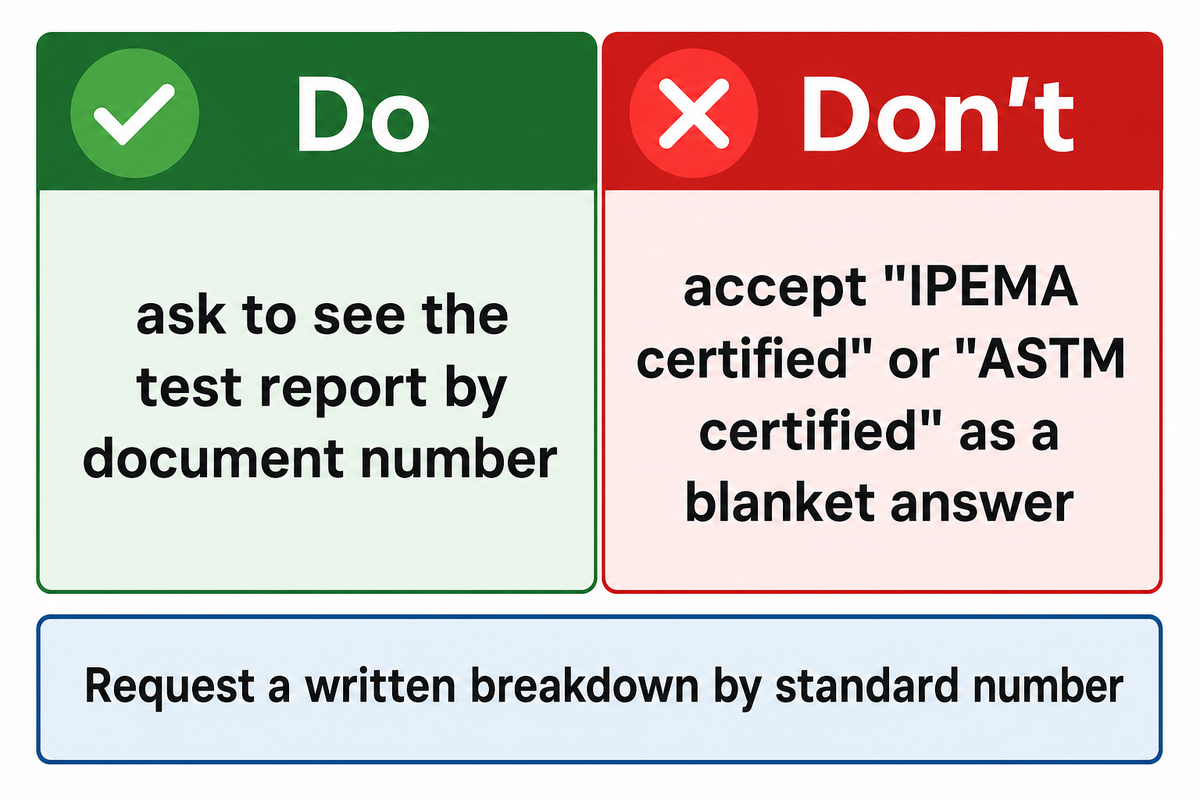
“IPEMA certified” is one of the more common claims on a supplier’s spec sheet, and one of the more commonly misunderstood. IPEMA’s own published certification program enumerates ASTM F1487-25, CSA Z614, ASTM F1292-22, ASTM F3351-19e1, ASTM F2075-26, and ASTM F3012-22 — F1918, the standard that actually governs soft contained play equipment, is not on that list. An IPEMA mark on a soft-play quote does not evidence F1918 conformance, and it says nothing about a trampoline (F2970) or inflatable (F2374) line either; those sit under their own separate document families.
DoAsk which specific standard (F1918, F1487, F2970, F2374) covers each individual attraction on your quote, and ask to see the test report by document number.
Don’tAccept “IPEMA certified” or “ASTM certified” as a blanket answer covering every attraction type on the floor — ask which document, for which line item.
Where the FEC Industry Is Headed in 2026
The attraction-mix decisions operators are making now are changing in a particular direction – towards hybrid experiences that meld physical activity with digital interaction; towards attractions engineered for competitive and social groups of any size, not just individual experience; and towards floor plans and party-room configurations that see birthday parties and private events as a primary driver of revenue instead of an aftermarket addendum.
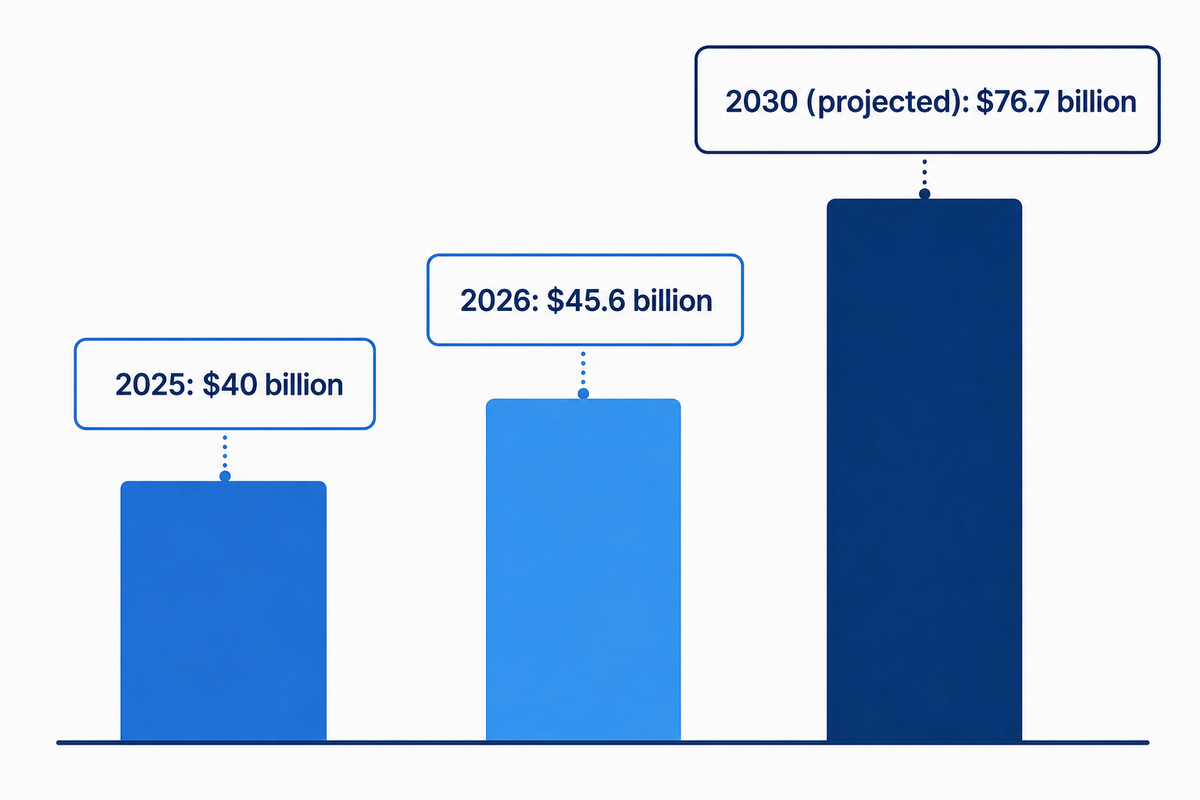
For equipment planning specifically, allocating floor space and clear-height for a hybrid-immersive attraction alongside the traditional soft-play and trampoline zones is no longer a purely aspirational line item; it’s where the most recent construction projects and franchise expansions are already heading. An operator who locks a floor plan into a static, single-format mix, without weighing it against how hybrid formats are already playing out across different venue formats, risks losing repeat-visit share to a newer venue down the road that opened with the hybrid format already built in — the switching cost of retrofitting an existing floor for a new attraction category is real, and it is cheaper to plan for it upfront than to rebuild around it later. Market sizing analysis suggests the industry sector, projected at approximately $40 billion in 2025, will bloom to $45.6 billion in 2026 with a compound annual growth rate of 14.1%. From there, a predicted 13.9% CAGR is expected to expand the sector to about $76.7 billion by 2030 – all directional context for the trend in operator decision-making, not the motivation for making each individual equipment purchase decision.
Building the Attraction Mix
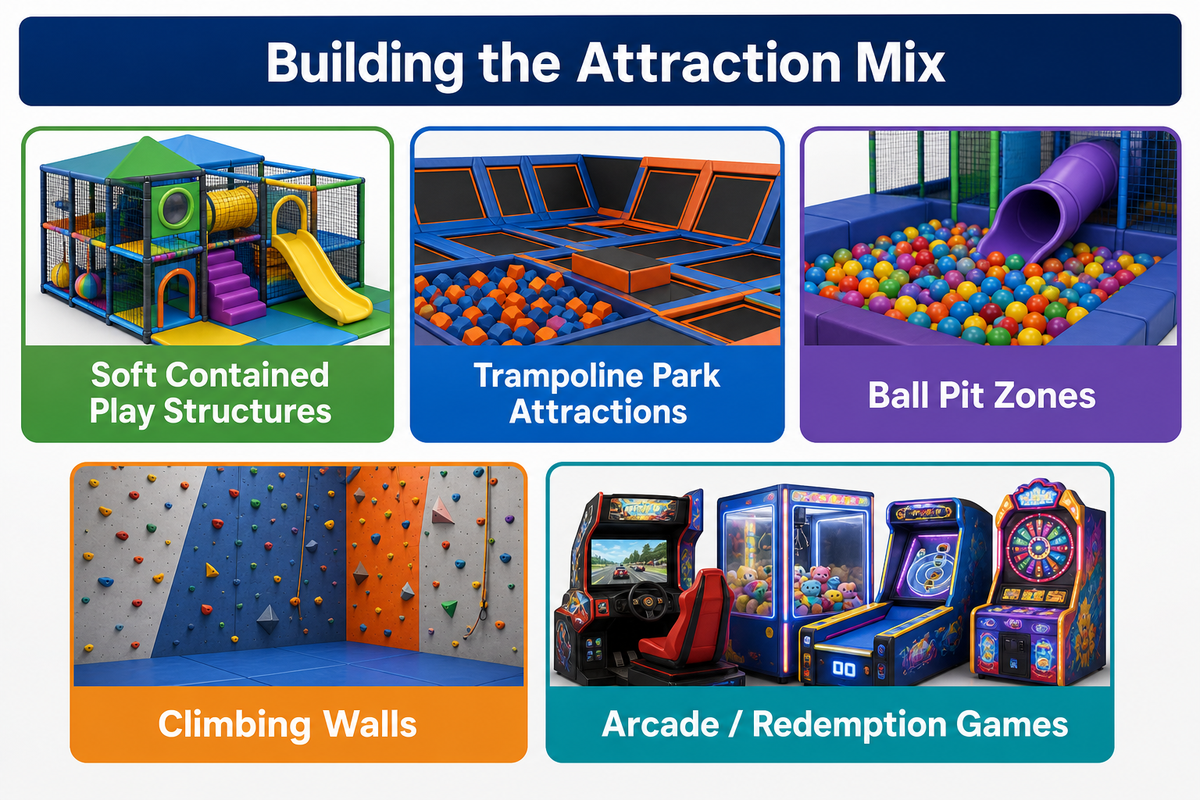
Five categories account for most of a typical FEC’s floor plan: soft contained play structures, trampoline park attractions, ball pit zones, climbing walls, and arcade or redemption games. Many venues round out the mix with a secondary attraction — laser tag, bowling lanes or a mini-bowling unit, or a billiards area — depending on available clear height and target age group. Each category, as covered above, answers to its own equipment standard, and each has its own footprint, ceiling-height, and utility requirements that belong on your floor plan before equipment gets ordered, not after.
A broader look at what shows up across the industry’s larger venues gives a sense of the full menu operators choose from: miniature golf and full-size golf course-style putting features, indoor go-karts and kart racing tracks, bumper cars and bumper boats, batting cages, ninja courses, and karaoke rooms; larger venues layer simulator and virtual reality (VR) attractions on top of that base variety of activities. Ping pong, darts, and a broad selection of arcade games round out the amusement attractions on the floor as common low-cost additions. Chains such as Urban Air have popularized the trampoline-heavy version of this mix, while older brands like Chuck E. Cheese (and its earlier Chuck E. Cheese’s Pizza Time Theatre format) built the eatertainment version around dining. None of that is a reason to copy any single competitor’s exact mix — it is a reminder that “best family entertainment” for your specific site depends on your ceiling height, your target age groups, and your lease size more than on what any one brand has done.
We have deliberately kept this guide at the planning and compliance-landscape level. For full specifications, materials, zone-planning-by-floor-area, and pricing mechanism on soft contained play structures specifically, see our Family Entertainment Center Equipment page — the procurement-depth resource this guide hands off to once you have the standards landscape and business case worked out.
💡 Pro Tip
Request a written breakdown of which standard number covers each attraction on your quote before signing, and revisit that breakdown every 12 months as editions revise — not a general certification claim, but the specific document (F1918 / F1487 / F2970 / F2374) per line item.
FAQ: Family Entertainment Centers
Q: What is a Family Entertainment Center?
A family entertainment center is an indoor venue built around several attraction types, soft play, arcade, party rooms, and often a trampoline or ball-pit zone, under one admission model.
That multi-attraction structure is what distinguishes it from a single-format venue like a bare arcade or a standalone bowling alley, and from an outdoor amusement park, which is built around rides across an open site rather than compressed into one indoor footprint. The mixed attraction set is also why compliance for this venue type is not a single checklist — see The Standards That Actually Apply Inside an FEC, above.
Q: How much does it cost to build a Family Entertainment Center?
There is no single reliable industry-wide figure, IAAPA’s own benchmark report is paywalled, and most circulating cost ranges online trace back to unattributed vendor estimates rather than a checkable primary source.
Rather than repeat a number you cannot verify, run the SBA’s own break-even formula, Fixed Costs ÷ (Price − Variable Costs), against your specific staffing, rent, and equipment quotes — work through the example in Startup Costs, Break-Even, and Where the Real Numbers Come From, above. That gives you a figure grounded in your actual costs, not a broad-based average for your market.
Q: Does one certification cover all the equipment in an FEC?
No. A typical FEC floor mixes up to four separate ASTM document families at once, F1918 for soft contained play, F1487 for rigid playground equipment, F2970 for trampoline attractions, and F2374 for inflatables, and critically, none of these four documents cover each other or substitute for one another.
An IPEMA certificate typically demonstrates F1487 and surfacing conformance only, yet F1918 does not appear anywhere in the IPEMA certification program at all. Don’t let a supplier get away with a general claim of “certified” on a soft-play, trampoline, or inflatable line item; instead, ask specifically which standard number protects the exact attraction listed on your quotation, and request the matching test report by document number before you sign.
Q: What’s the difference between a Family Entertainment Center and a trampoline park?
A standalone trampoline park is a single-format venue governed by its own document family (ASTM F2970-25, under a dedicated ASTM subcommittee, reaching operation and inspection as well as manufacture); a family entertainment center, by contrast, is a multi-attraction venue where a trampoline zone is typically just one of several distinct attraction types sharing the same floor, each answering to its own separate governing standard rather than one document covering the whole building.
Trampoline attractions carry their own risk profile and their own governing documents, distinct from soft contained play or rigid playground equipment — treating a trampoline zone as “covered” by a soft-play certificate is a scope error, not a technicality.
Q: Do soft play structures need to meet the same standard as outdoor playgrounds?
No, they are governed by two separate documents. ASTM F1487, the standard for outdoor and rigid public playground equipment, explicitly lists soft contained play equipment among its own scope exclusions.
For a fully contained, netted, and cushioned indoor play environment, ASTM F1918 applies instead — which is exactly what causes so much confusion, since both documents fall under the general heading of “playground equipment” while being explicitly written not to overlap one another in application or scope. A supplier who cites F1487 for a soft-play quote, or F1918 for a rigid climbing frame, is citing the wrong document for that specific attraction, even if the certificate itself is entirely genuine — the mismatch is between which document applies to which product, not whether the certificate is real. Ask which specific standard number covers the exact attraction on your quote, not just whether “a certificate” exists somewhere in the paperwork.
Why We Write This
At Toplay, indoor play structures for family entertainment centers, kindergartens, and mall locations are designed and manufactured on our own production floor — steel cut, formed, welded, and finished in-house. That is part of why we wrote this guide around compliance and planning, not just the equipment we sell: choosing a supplier comes down to which specific standard applies, not whether a certificate exists.
References & Sources
- ASTM F1487-25 — ASTM International
- ASTM F1918-21 — ASTM International
- ASTM F2373-24 — ASTM International
- ASTM F2374-24 — ASTM International
- 2010 ADA Standards for Accessible Design — U.S. Department of Justice (text hosted by the U.S. Access Board)
- Public Playground Safety Handbook (Publication 325) — U.S. Consumer Product Safety Commission
- IPEMA Certification Program — International Play Equipment Manufacturers Association
- Calculate Your Startup Costs — U.S. Small Business Administration
- 2025 IAAPA Benchmark Series, Entertainment Centers — IAAPA
- Injury registry study, kids-cafe-type venues — PMC / National Institutes of Health
- Playground surfacing field-performance trial — PMC / National Institutes of Health
- Ball pit pathogen study — PubMed / National Institutes of Health
- Playground surface bacterial contamination survey — PubMed / National Institutes of Health
- Family Entertainment Centers Set to Surge Through 2026 — Vending Times



