
Get in touch with Guangzhou Toplay amusement equipment co. Company

Updated September 2026
Indoor playground equipment for shopping malls refers to fully enclosed, netted and padded soft-contained play structures installed inside mall common areas or converted retail space — a different equipment class, governed by a different safety-standard family, than a typical outdoor playground. Buying it means it must perform for two audiences at once: the children who will be climbing, sliding and crawling through it for years, and a compliance file that has to survive a fire marshal’s visit, an ADA complaint, and a certificate-of-occupancy renewal. Most buying guides jump straight to indoor play area design themes and colors. This one starts with the standards, the code thresholds, and the space math that decide whether a supplier’s proposal is even buildable on your site — then works forward to layout, hygiene, certification verification, and what to do when a supplier’s paperwork doesn’t hold up.
Quick Specs
| Governing US standard | ASTM F1918-21 (soft contained play equipment) |
| Governing EU standard | BS EN 1176-10:2023 (fully enclosed play equipment, up to 14 years) |
| Age envelope (US) | 5th-percentile 2-year-old to 95th-percentile 12-year-old |
| Fire/building code triggers | >10 ft high or >150 sq ft (existing building); 600 sq ft structure cap; 20 ft from mall kiosks |
| ADA entry-point rule | ≤3 entry points: ≥1 accessible; ≥4 entry points: ≥2 accessible |
| Certification bodies that do NOT cover this equipment class | IPEMA (certifies to F1487, not F1918) |
A fully enclosed, netted and padded indoor play structure for a US mall is governed by ASTM F1918-21, not the outdoor-composite standard ASTM F1487. Buying it correctly means classifying the equipment first, checking code thresholds before finalizing a floor plan, confirming ADA entry-point and route dimensions, and verifying that any certification a supplier cites actually covers this equipment class — IPEMA certification does not.
📚 One Venue, In Depth
This guide stays inside one venue type — shopping malls and retail — and goes deep on the standards, code thresholds, ADA dimensions and certification questions specific to that setting. If you’re scoping equipment across several venue types at once (malls, FECs, kindergartens, play cafés), Toplay’s venue-by-venue business planning guide covers the cross-venue comparison this piece intentionally leaves out.
Why Shopping Malls Are Adding Play Attractions Now
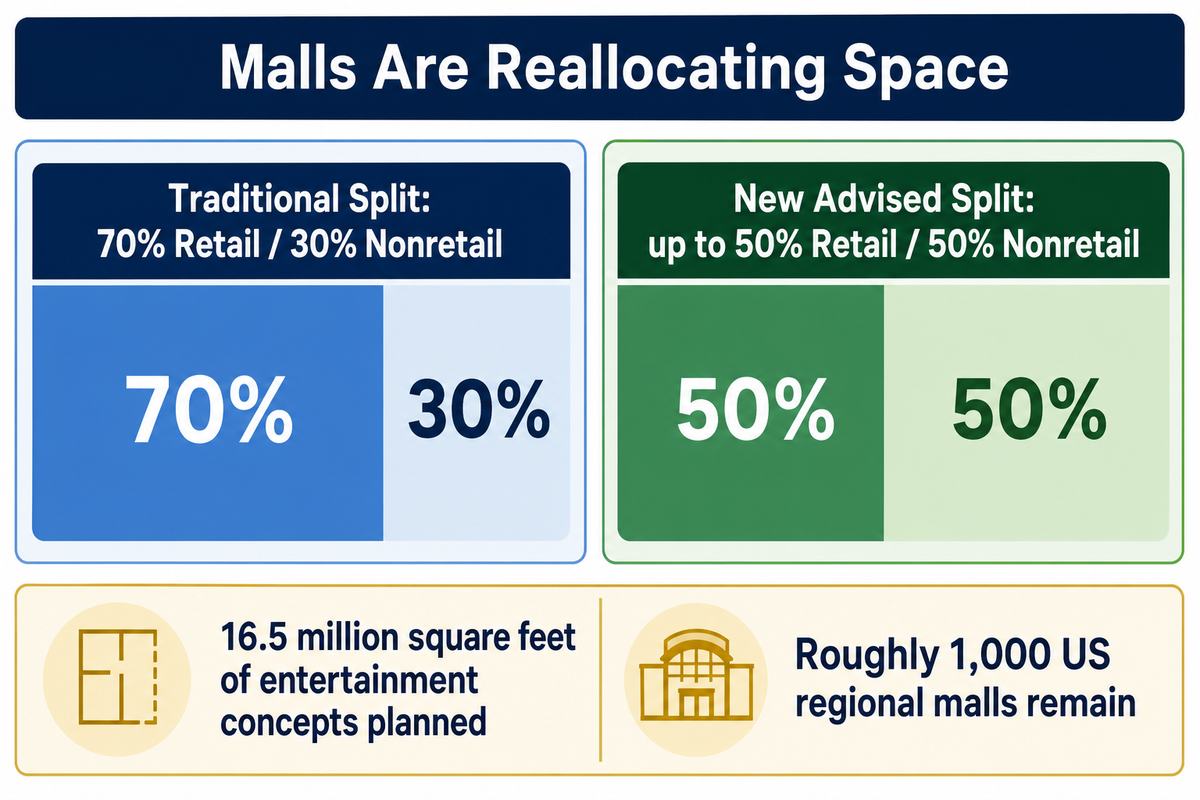
Mall landlords are converting vacant anchor-store and kiosk footprint into commercial indoor play attractions because dwell-time economics now beat marginal retail rent on that same square footage, not because malls are chasing a novelty. Entertainment and healthcare are now the two biggest users of retail space vacated in the last decade, per JLL’s 2026 Entertainment Report, and malls are shifting floor-area ratios accordingly.
That shift is already showing up in floor plans: malls that once reserved about 70% of floor area for retail and 30% for nonretail uses are now advised to reserve as much as half the space for nonretail tenants, according to WTOP News reporting on 2026 mall redevelopment, with roughly 16.5 million square feet of location-based entertainment concepts planned across the US and Canada per JLL. Roughly 1,000 US regional malls remain, and about a quarter are rated in “excellent” condition, meaning three-quarters carry some degree of vacancy or aging infrastructure that a play attraction can help re-tenant. 2026 openings named in that reporting include a candy-themed play land at Tysons Corner Center, a waterless-slide attraction park expected by summer 2026, and pickleball clubs opening in the back half of the year. None of that is a substitute for a market study of your own trade area, but it establishes the pattern: entertainment tenants are filling space that pure retail can no longer justify.
💡 Pro Tip
Before determining play space size, check with mall leasing about the current ratio of retail vs. common area square footage. If a mall is already pushing 50 percent non-retail space, there’s less opportunity to deploy a large footprint play facility than one operating under traditional conditions.
Buyers researching this category use several interchangeable names for the same product — indoor play equipment, an indoor playset, a soft play playground, or simply indoor commercial playground equipment — and evaluate playground solutions from a playground supplier the same way regardless of which term led them there: durability, modular construction, and whether the play systems are high-quality enough to fit your space and daily traffic. Any reputable supplier answers the compliance questions below the same way no matter what the RFQ calls the product.
A typical layout combines several play elements — climbing walls, tunnel crawls, a jungle-style climbing frame, swing attachments, and obstacle courses — around a central ball pool with a vinyl-surfaced bounce zone, each chosen to hold up under year-round foot traffic in a high-traffic mall environment. Suppliers that handle the full sequence in-house — from concept layout through on-site installation and commissioning — tend to catch clearance and ADA conflicts earlier than one that only manufactures to a drawing someone else produced.
Which Safety Standard Actually Applies to a Mall Play Structure
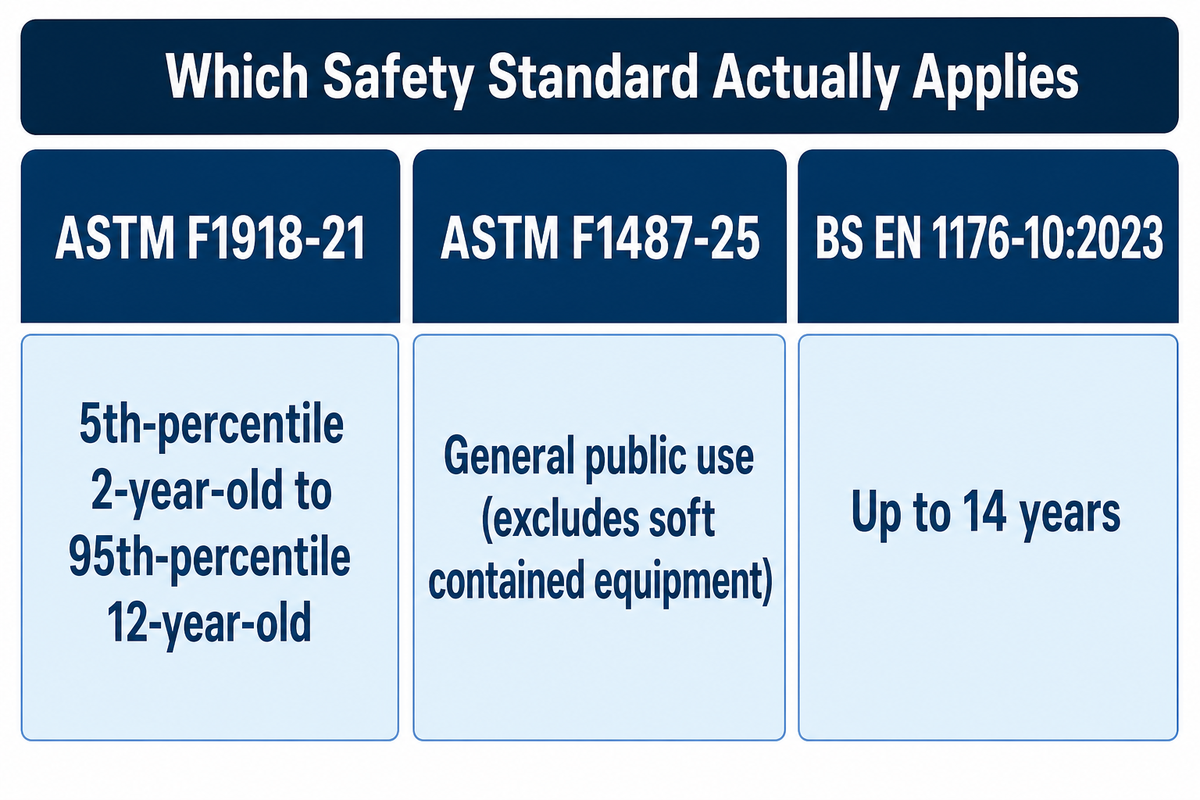
A fully enclosed, netted and padded indoor play structure is covered under ASTM F1918-21 in the United States, not ASTM F1487-25 – the two standards explicitly exclude each other’s equipment class. F1487-25 makes mention of soft contained play equipment in the scope exclusions, whereas F1918-21 is written specifically for the 5th-percentile 2-year-old through the 95th-percentile 12-year-old user range.
In Europe, BS EN 1176-10:2023 can be applied to fully enclosed play structures up to 14 years of age – a different age ceiling than F1918’s, which does matter if the same structure design is sent to both regions (see the export section below). The basic components of typical soft contained play structures — crawl tubes, tube slides, and ball pools — are addressed in F1918-21 in a manner F1487-25 is never written to encompass. Buyers most often go wrong here by comparing a certificate against the wrong document family. A quote referencing “IPEMA approved” or “ASTM compliant” without naming F1918 specifically has not addressed this product class – see the certification-verification section for how to press on that issue before you sign.
| Document | Jurisdiction | Equipment type | Age envelope | Enforceable? | Covers a mall SCPE structure? |
|---|---|---|---|---|---|
| ASTM F1918-21 | United States | Soft contained play equipment | 5th %ile 2yr – 95th %ile 12yr | Voluntary consensus | Yes |
| ASTM F1487-25 | United States | Public composite playground equipment | General public use | Voluntary consensus | No — explicitly excludes SCPE |
| CPSC Publication 325 | United States | Public outdoor playground equipment | General public use | Guidance, not regulation | No — names F1918 as the applicable document instead |
| ADA Standards (2010) | United States | Play areas, including soft contained structures | Ages 2 and over | Federally enforceable | Yes — route/entry-point rules |
| BS EN 1176-10:2023 | European Union / UK | Fully enclosed play equipment | Up to 14 years | Voluntary consensus | Yes — EU counterpart to F1918 |
| IPEMA certification program | US / Canada | 6 named standards (F1487, CSA Z614, F1292, F3351, F2075, F3012) | Varies by standard | Third-party certification | No — F1918 is not on the list |
| ASTM WK94592 (in progress) | United States | Proposed revision of F1918-21 | Unchanged in current draft | Not yet enacted | Not yet — ballot stage as of this writing |
| Adopted local building/fire code (IBC-derived) | United States, varies by jurisdiction | Any indoor play structure over threshold size | Not age-specific | Legally adopted, enforceable | Yes — height/area/kiosk-separation triggers (see next section) |
ASTM’s Subcommittee F15.36 opened a revision work item (WK94592) for F1918-21 on 2025-04-16, suggesting to change the standard title to “Contained Play Equipment” because the type of products it covered no longer always use the pliable, foam-covered materials the current title implies. The work item is still in an early ballot stage (Copyright/Permissions), so F1918-21 remains the standard in effect today – but the buyer should ask the manufacturer if the design is already planning to be renamed once the work item is passed.
Building & Fire Code Thresholds: The 20-Foot Kiosk Rule
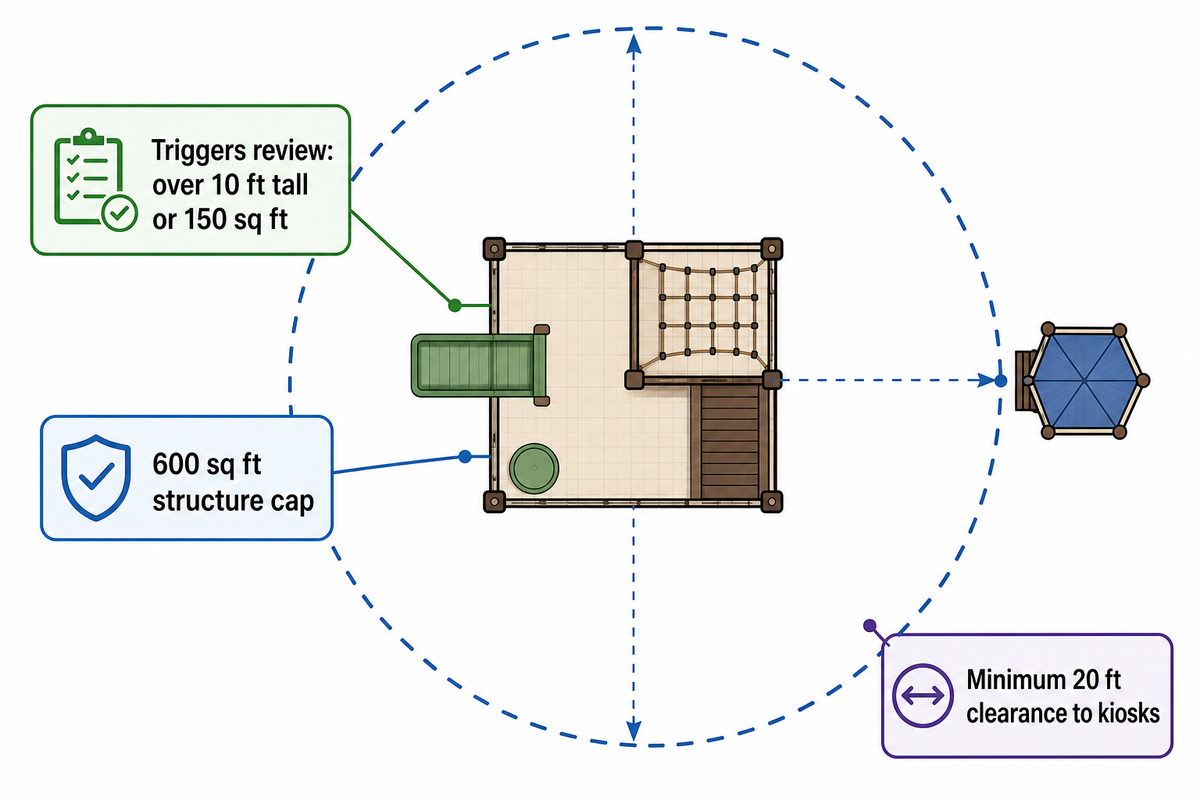
A structure taller than 10 feet or covering more than 150 square feet when installed inside an existing mall building sets off several building and fire code triggers above and beyond the purchase of one piece of equipment, and a single structure is limited to 600 square feet unless a special fire-safety review that is accepted by the building official is completed. Within a mall building structure, the adopted code also demands a minimum of 20 feet of horizontal clearance between structures and kiosks and the like–call it the 20-Foot Kiosk Rule, because that is the one dimension mall operators most often discover only after their architects already have a floor plan worked up.
Worked example, taken from a standard indoor playground layout: a 12-foot tall, 400-square-foot structure in a mall common space hits both the height and area triggers on its own, so it needs the additional fire-code review regardless of the 600-square-foot limit. Another 550-square-foot structure placed 15 feet from the nearest kiosk still violates the 20-Foot Kiosk Rule even though it is under the area limit–the kiosk-separation requirement is independent of the structure itself. You want to do both of these analyses in advance of committing to the layout, not afterward.
📐 Engineering Note
The numbers mentioned are established by code requirements that come from adopted state and local building and fire codes, typically based on the International Building Code, not one specific statute nationwide (e.g. Colorado’s 2024 Fire Code 808.4; Texas Windstorm Insurance Association Building Code 2024 section 424.5). Please confirm exact figures with your local building official as adoption dates and amendments to these codes vary by local jurisdiction.
Space Planning: Usable Height in an Existing Mall Footprint
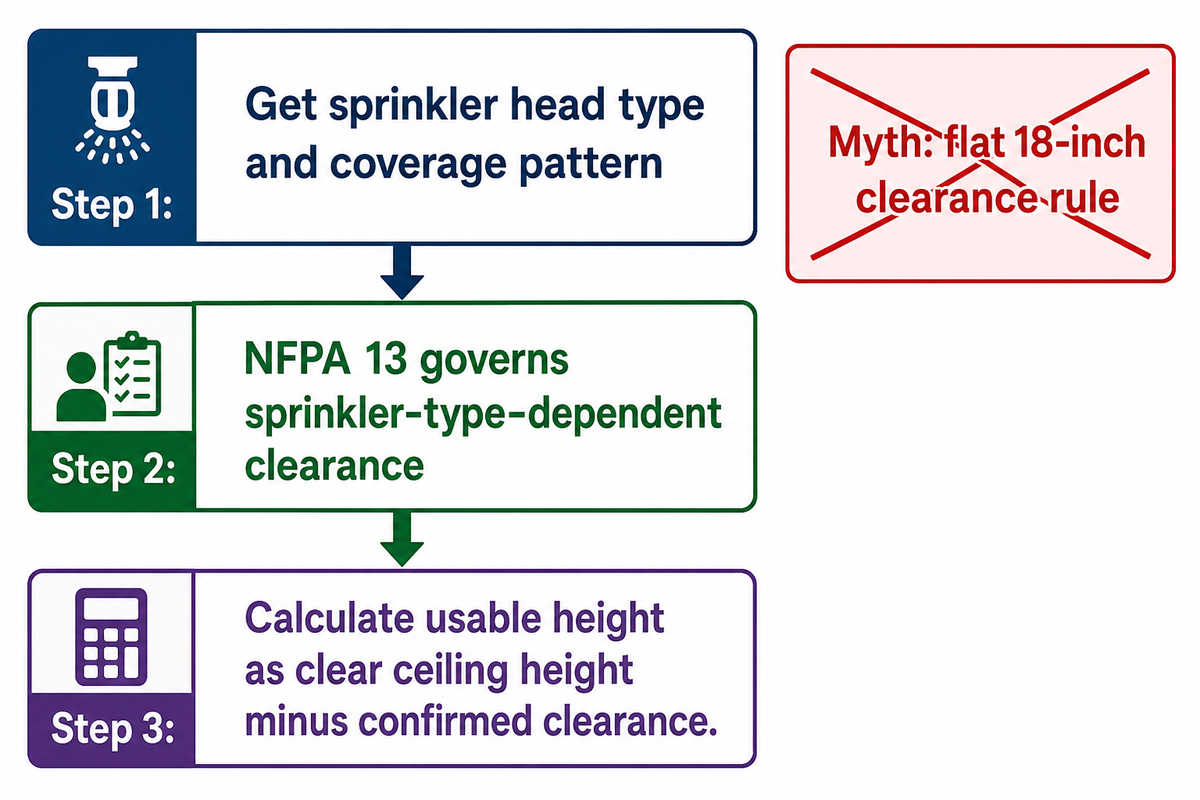
Do not apply a flat “ceiling height minus 18 inches” formula to size a play structure — that widely repeated shortcut overstates what OSHA’s sprinkler-clearance rule actually says. OSHA’s own 2008-09-29 Standard Interpretation of 29 CFR 1910.159(c)(10) states that the 18-inch clearance answer “applies to clearance from stored materials only.” A play structure is not stored material; it is a sprinkler-discharge obstruction, and obstructions are governed by NFPA 13’s sprinkler-type-dependent clearance rules, not a single fixed number.
The right sequence for an existing mall atrium or a vacant anchor-store retrofit is: (1) get the sprinkler head type and coverage pattern from the property’s fire-protection drawings; (2) ask a fire-protection engineer or the local AHJ what obstruction clearance NFPA 13 requires for that specific sprinkler type; (3) only then calculate usable structure height as clear ceiling height minus that confirmed clearance, not minus a borrowed 18-inch figure. This sequence matters more in mall retrofits than in new-build FECs, because an existing atrium’s sprinkler system was designed for the building’s original occupancy, not for a play structure, and retrofitting the wrong clearance assumption into a fabrication order is expensive to reverse once the structure is built.
- Consult the fire-protection plans relevant to the applicable portion or bay of the facility – do not use the building-wide plans in lieu of.
- Obtain the obstruction-clearance requirement by sprinkler type directly from the fire-protection specialist, in writing.
- Provide the certified obstacle-clearance number to your equipment supplier before final indoor playground design drawings are approved, not after equipment has already been fabricated or produced.
ADA Accessible-Route Requirements You Can Hand to Your Architect
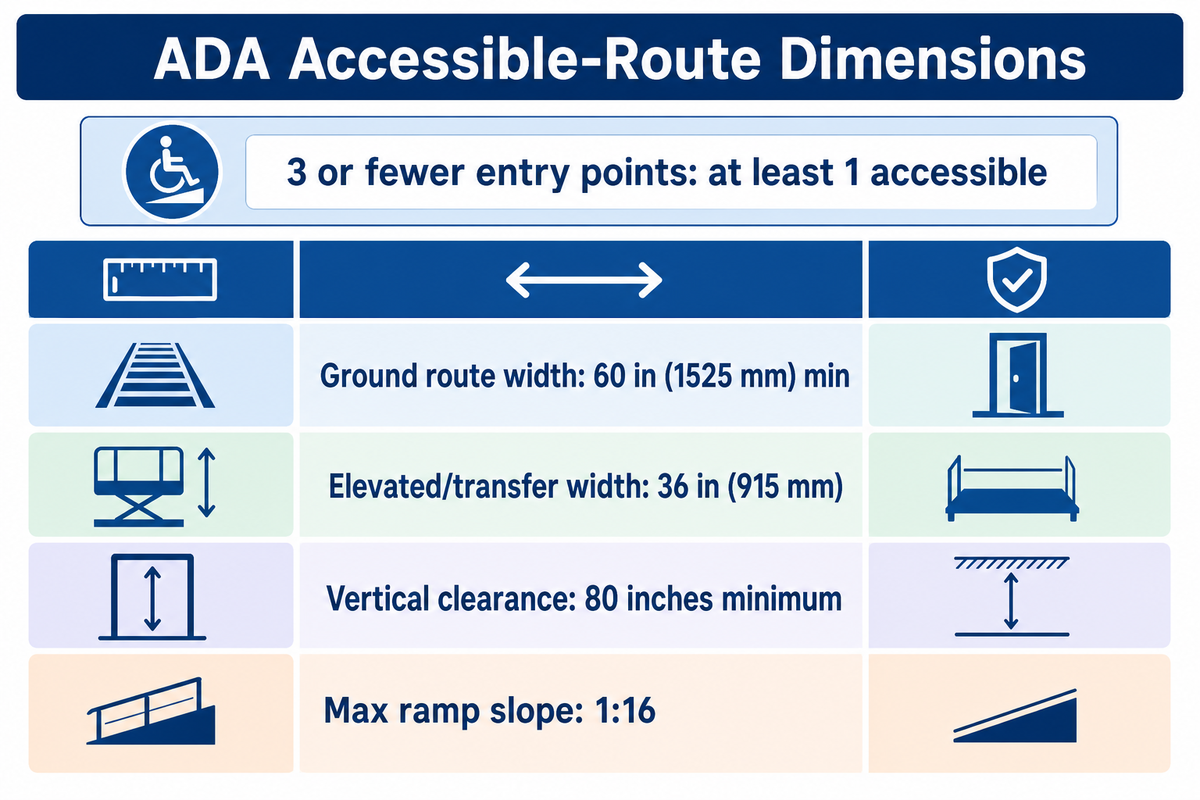
A soft contained play structure with three or fewer entry points needs at least one entry point on an accessible route; with four or more entry points, at least two must be accessible, a rule fixed at layout stage, not something to retrofit during assembly. Like the sprinkler-clearance number covered above, this dimension belongs on the floor plan before drawings are finalized, not adjusted after fabrication. Beyond entry-point counting, the 2010 ADA Standards set specific route dimensions: 50% of elevated play components and at least one of each type of ground-level component must sit on an accessible route, that route keeps 80 inches of vertical clearance, and a transfer system is a permitted substitute for part of the route.
RFQ checklist — copy these into your quote request:
| Parameter | Recommended range | Why it matters | How to verify |
|---|---|---|---|
| Ground-level accessible route width | 60 in (1525 mm) min; 44 in (1120 mm) if play area < 1,000 sq ft | Sets minimum corridor width around the structure | Measure clear width on final floor plan |
| Elevated-route / transfer-system width | 36 in (915 mm) route, or 24 in (610 mm) for a transfer system | Determines whether upper levels need a ramp or a compliant transfer system | Confirm in supplier’s structural drawings |
| Vertical clearance over ground route | 80 in (2030 mm) minimum | Prevents head-strike hazard on the accessible path | Field-measure after installation, before opening |
| Ramp running slope | Max 1:16, with 12 in (305 mm) max rise per run | Steeper ramps fail ADA compliance outright | Check ramp shop drawings against this ratio |
| Transfer-system share of elevated components | Max 25% where 20+ elevated components are provided | Caps over-reliance on transfer systems instead of ramps | Count components in the design package |
Age Zoning and the Injury-Risk Data Behind Where You Draw the Line
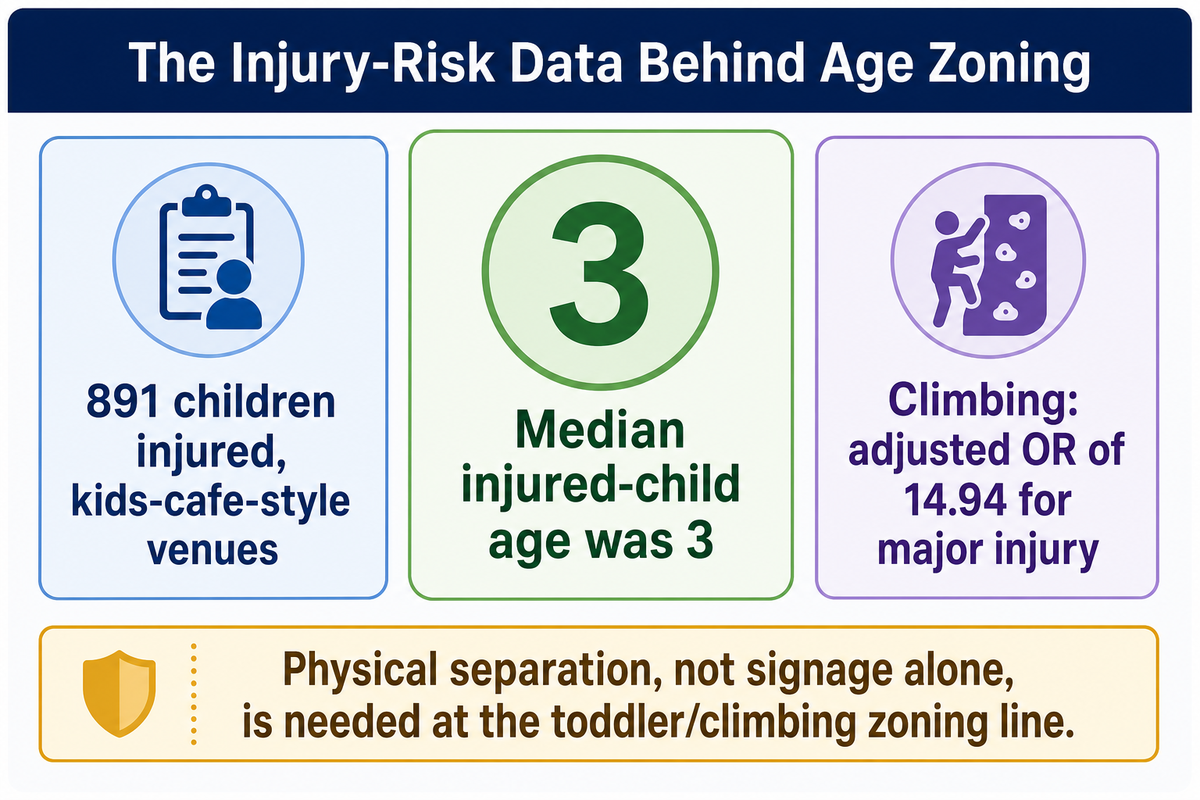
In a 6-yr, multicentre injury registry with 891 children injured in “kid’s café” type venues, the median child age was 3 (interquartile range 2-5) and climbing had by far the strongest statistical link to a major injury with an adjusted odds ratio (OR) of 14.94. Age zoning is a similar fixed-at-layout decision, much like the accessible-route dimensions above: once entry points and routes are locked, climbing-zone boundaries need to be drawn during that same layout pass, not added later. In high-traffic retail mall environment – with generally higher, more rapid child turnover and generally lower staffing per child ratios compared to a stand-alone FEC – that level of risk should also lead us to draw the line on toddler / climbing zoning at age three rather than allow “all age” use of climbing structures in this public spaces in the face of signage simply displaying maximum permitted height only.
⚠️ Important
A CPSC field review of soft contained venues (fieldwork from the mid-1990s) found that pay-for-play centers (the mall-type format) commonly staffed a separate section for children under 40 inches tall, while free-play centers co-located with restaurants often had no size threshold at all — a gap worth closing at the design stage regardless of how venue staffing practices have shifted since. Age-banded signage alone does not enforce zoning in a high-traffic mall setting. Physical separation (a step, a low barrier, or a distinct color zone) between climbing structures and toddler areas does more of the enforcement work than a sign that a running three-year-old will not read.
Hygiene & Maintenance: What a Mall Atrium Brief Requires
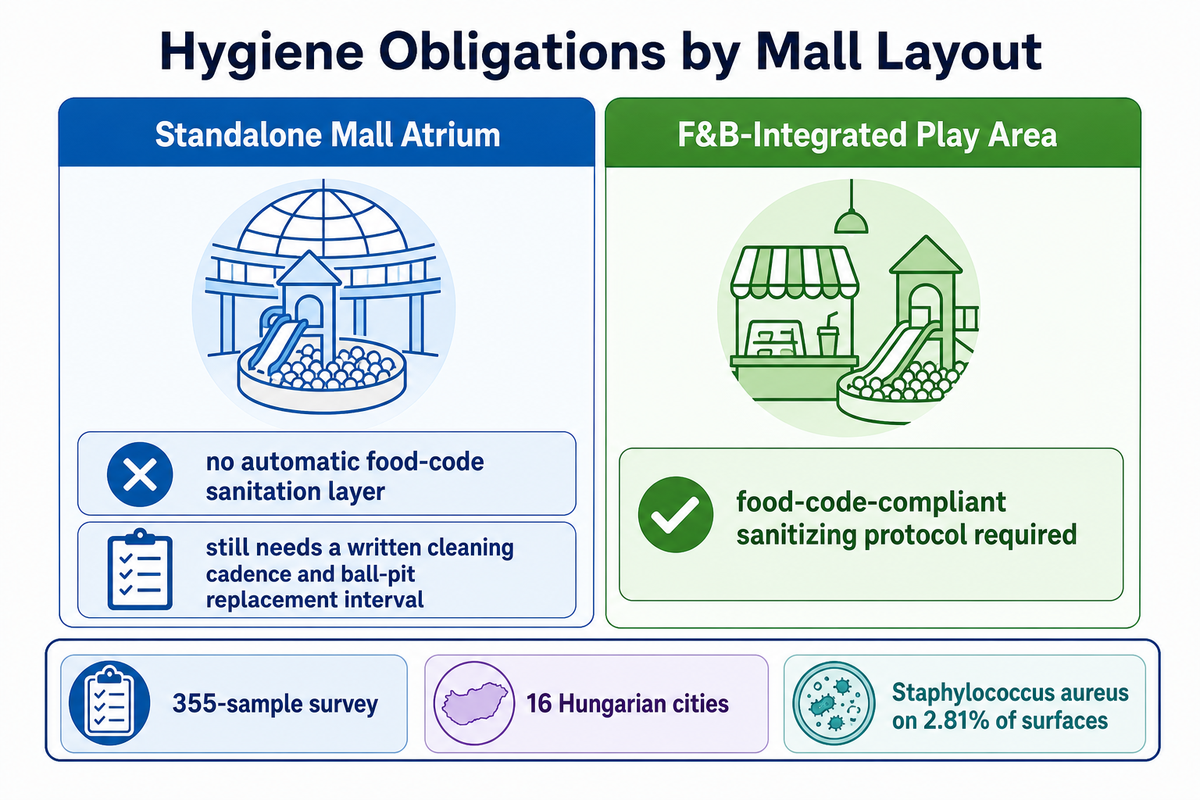
An open mall atrium play area doesn’t automatically carry a food-code sanitation layer the way a play café or restaurant-integrated play area does. Minnesota publishes specific Indoor Play Area Maintenance and Sanitation guidance under its state Food Code precisely because a play area co-located with food service picks up cleaning-cadence and sanitizing obligations that a stand-alone mall atrium installation doesn’t trigger. The practical difference: if your layout has no F&B integration, your maintenance contract needs a written cleaning cadence and ball-pit replacement interval, but not a food-code-compliant sanitizing protocol; if the layout does integrate a play café, budget for both.
A commercial ball pool needs a written cleaning cadence and ball-replacement interval agreed with the operator before handover regardless of venue type — clinical studies of ball pits in physical-therapy settings (a higher-hygiene-standard environment than a mall) still found multiple opportunistic bacterial and yeast species present, which is a reason to schedule cleaning proactively rather than a measurement of any specific commercial venue’s cleanliness. The ball pool isn’t the only surface that needs a schedule: a 355-sample survey of outdoor playgrounds across 16 Hungarian cities found Staphylococcus aureus on 2.81% of surfaces sampled, concentrated on plastic surfaces specifically — the study doesn’t rank indoor materials against each other, but it supports a cleaning schedule for every high-touch plastic surface, not just the ball pool.
Verifying Certification Claims Before You Sign
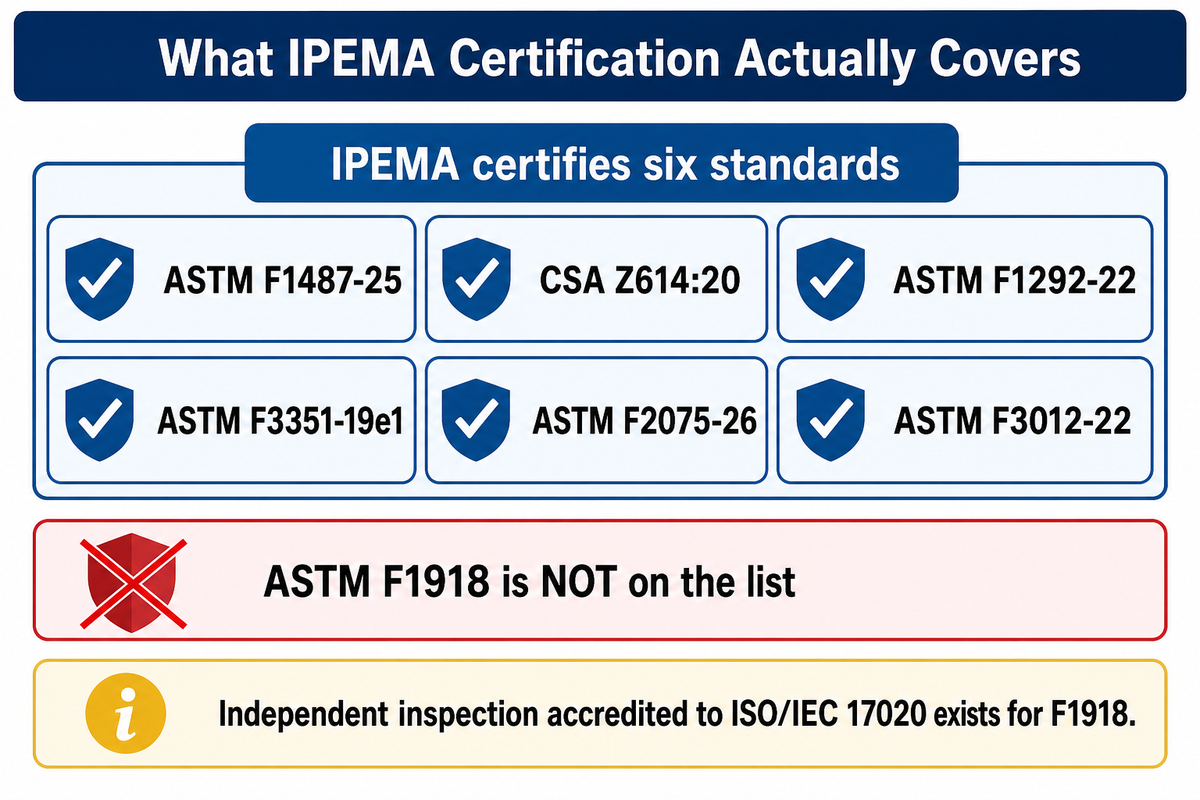
IPEMA’s published certification program enumerates six standards it certifies to — ASTM F1487-25, CSA Z614:20, ASTM F1292-22, ASTM F3351-19e1, ASTM F2075-26, and ASTM F3012-22 — and ASTM F1918 is not on that list. A clean cleaning-and-sanitizing record, of the kind covered above, does not settle this separate question. A supplier’s IPEMA mark, if they have one, therefore does not evidence F1918 conformance for a soft contained structure; it evidences conformance to a different equipment class entirely. Ask the specific question: “Which document does this certificate reference, by number?” rather than accepting “IPEMA certified” or “ASTM compliant” as a complete answer.
There is third-party inspection (accredited to ISO/IEC 17020) available for F1918 specifically — IAS Inspection Agency AA-858 publishes the detailed clauses covered as a stand-alone program separate from its F1487 program, which alone is proof that the field considers the two standards to be different scopes of inspection, not just a formality.
“We run structural fabrication — laser tube cutting, robotic welding, CO2/MIG-TIG welding, and grinding and polishing — in-house, which keeps every component traceable back to a single production floor. Ask any supplier whether their structural parts are made in-house or sourced from unnamed subcontractors, because that answer determines whether a certification claim can actually be traced back to the part it covers.”
Surfacing & Impact Ratings: What a Lab Certificate Does and Doesn’t Prove
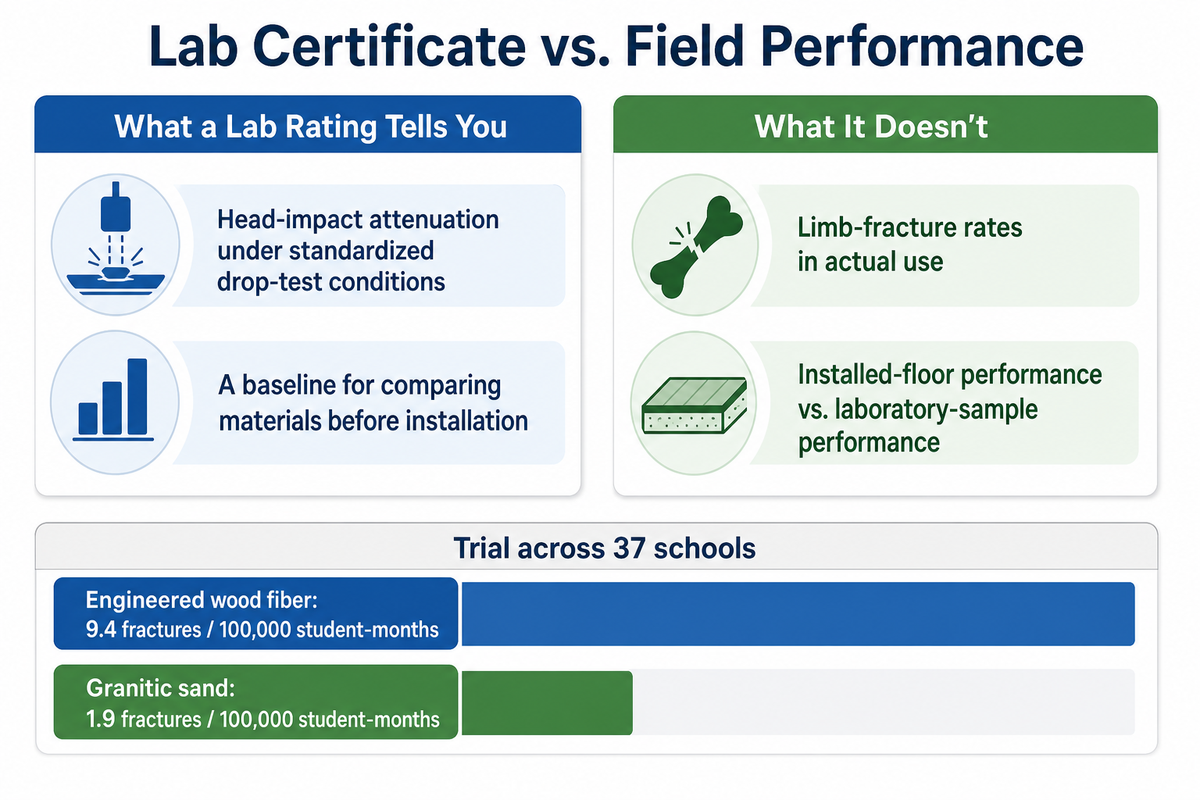
Fall height is the height of the highest designated playing surface to the surfacing underneath, and the ASTM F1292 critical-height classification of surfacing must be greater than or equal to that fall height – but a laboratory classification and field performance are not the same thing. A cluster-randomized trial over 37 schools showed that falls onto engineered wood fiber caused 9.4 arm fractures per 100,000 student-months versus 1.9 for falls into granitic sand, despite both types meeting compliance requirements – the confidence intervals overlapped and the difference was only marginally statistically significant (p=0.049), but it is a documented case of a compliant surface underperforming a plainer one in the field. Separately, rubber tile reduced peak hand-impact force in an upper limb fall arrest by just 2% compared to a rigid surfacing, while loose sand produced 17% less impact force – because impact surfacing has been designed and tested for head injury specifically, it does comparatively little for limb injury.
✔ What a lab rating tells you
- Head-impact attenuation under standardized drop-test conditions
- Whether critical height meets or exceeds your structure’s fall height
- A baseline for comparing materials before installation
⚠ What it does NOT tell you
- Limb-fracture rates in actual use (a separate injury mechanism)
- Installed-floor performance vs. laboratory-sample performance (request ASTM F3313 field verification)
- Long-term compaction or wear reducing effective depth over time
Request ASTM F3313 field proof of the installed surfacing, not merely the laboratory certification for the material batch — the lab certification shows what the material can do under test conditions, while F3313 field verification proves what the installed surfacing actually does on site.
Buying for an International Mall Portfolio: the US/EU Standards Gap
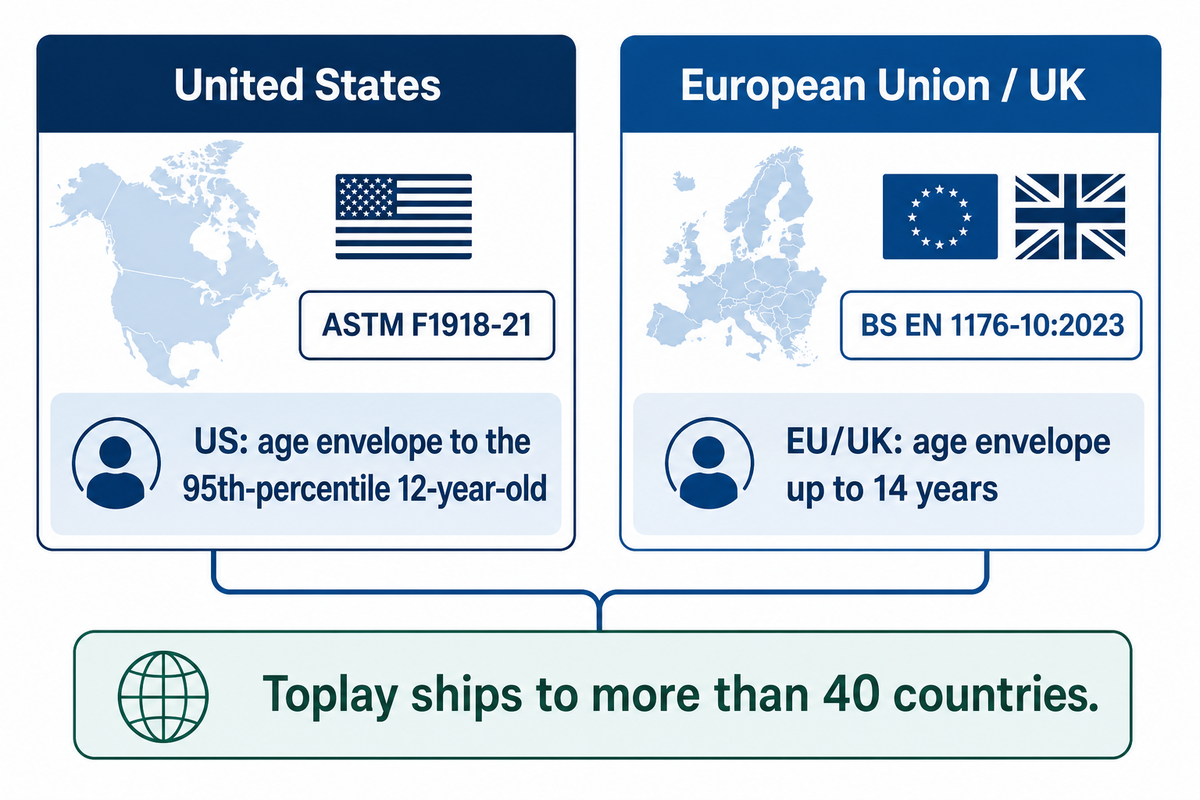
ASTM F1918-21 age envelope extends to the 95th-percentile 12-year-old, while BS EN 1176-10:2023 age envelope extends to children up to 14 years – a genuine envelope discrepancy for anyone designing the same structure for both markets. Field-verified surfacing, discussed above, is only half the compliance picture for a cross-border order — the age envelope is the other half, and it changes by destination. An exporter selling into US malls and EU/UK malls under one design is, in effect, designing to two separate envelopes at once, not one standard twice. Toplay ships to more than 40 countries, including markets across Europe, and the practical upshot is simple: check which envelope applies for the location, before you go final with structural dimensions, rather than assuming a US-approved design will automatically satisfy EU review, or the opposite.
When NOT to Buy a Fully Enclosed Soft-Contained Structure / Common Failure Modes
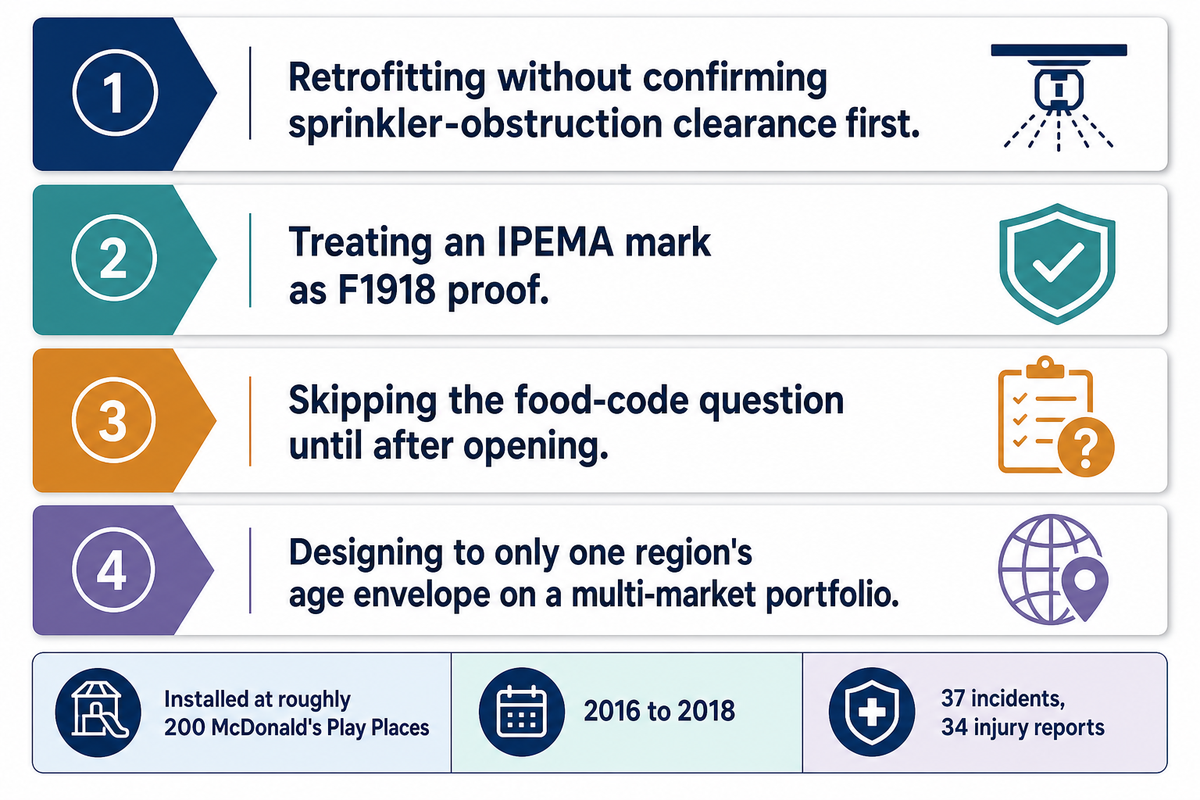
Four failure patterns account for most of the avoidable problems in this category: retrofitting without confirming sprinkler-obstruction clearance first, treating an IPEMA mark as F1918 proof, skipping the food-code question until after opening, and designing to only one region’s age envelope on a multi-market portfolio.
First, retrofitting a low-ceiling older mall without confirming sprinkler-obstruction clearance first — the same measure-before-you-fabricate discipline that a different geometry failure illustrates well: a 2019 CPSC recall of Soft Play’s Spider Climb climbers — installed at roughly 200 McDonald’s Play Places between 2016 and 2018 — resulted from platforms “designed too far apart, posing a fall hazard,” generating 37 incidents and 34 injury reports before the manufacturer retrofitted additional platforms free of charge. The specific defect was platform spacing, not sprinkler clearance, but the underlying lesson generalizes: geometry decisions made before the space constraints are fully confirmed are expensive to reverse after fabrication. Second, treating an IPEMA mark as F1918 proof, when IPEMA’s own published scope excludes it. Third, skipping the food-code question for a layout that later adds F&B, and discovering the sanitation-protocol gap after opening rather than before. Fourth, designing to only one standard’s age envelope when the buyer’s portfolio spans both US and EU markets, forcing a redesign mid-rollout instead of at the specification stage.
This does not mean a soft contained structure should not exist — it means the failures above are procurement-sequencing failures, not equipment-category failures, and every one of them traces back to a question that could have been asked and answered before fabrication instead of after. It just means the right questions need to get asked and answered before fabrication starts, not after.
RFQ Checklist & Decision Framework
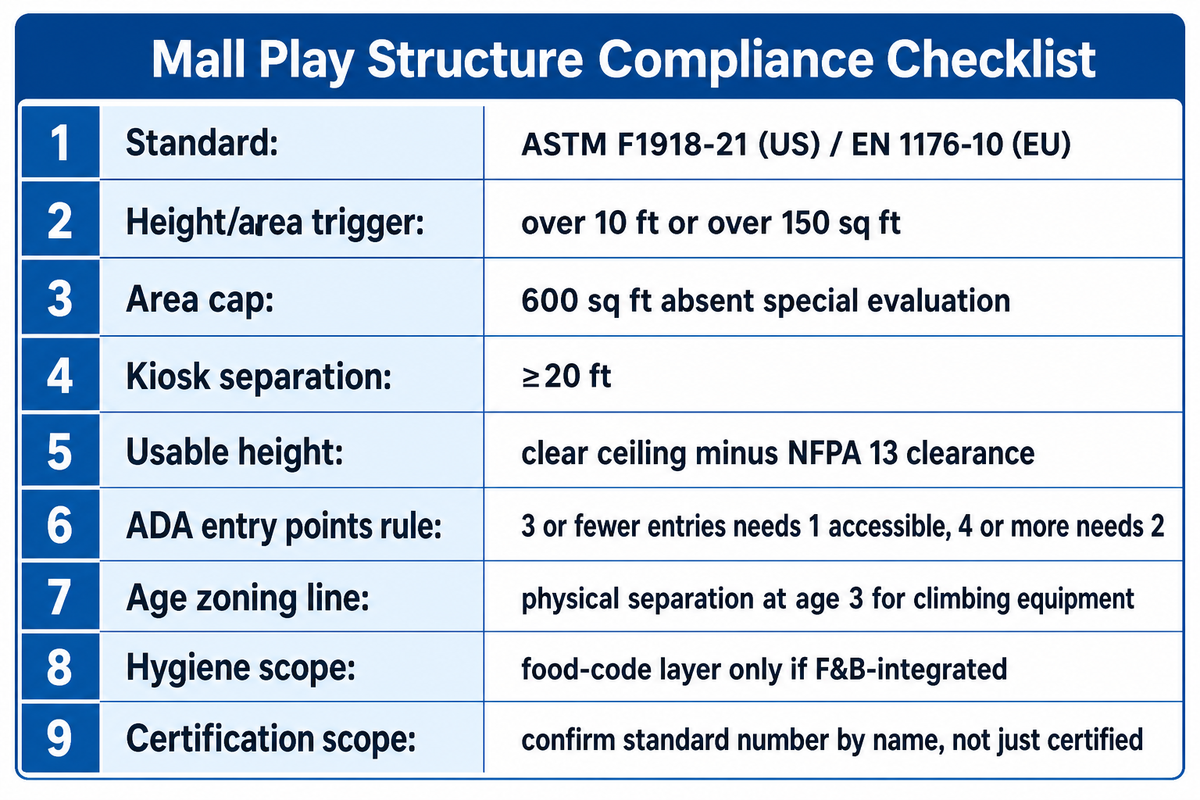
Malls that want to buy indoor play equipment for an active indoor entertainment zone are typically weighing the same short list before they issue the RFQ below: whether the equipment is designed for high-energy use by young children spanning toddlers through pre-teens, whether it supports motor skills development through imaginative, immersive experience play, and whether it is durable and carefully tested enough to withstand indoor use at daycare-level intensity, since a mall atrium often runs at similar occupancy to daycares. A custom playground build costs more upfront than a stock catalog unit but usually settles the underlying soft play question more cleanly, since the supplier designs to the buyer’s actual space and code requirements from the start rather than retrofitting a generic design. Indoor playhouses and other themed structures fall under the same evaluation criteria.
| # | Check | Standard / threshold | Confirm before | Limitations / not suitable for |
|---|---|---|---|---|
| 1 | Standard classification | ASTM F1918-21 (US) / EN 1176-10 (EU) | Signing the spec sheet | Not applicable to outdoor composite equipment |
| 2 | Height / area code trigger | >10 ft or >150 sq ft (existing bldg) | Floor plan finalization | Local code amendments vary — confirm with AHJ |
| 3 | Structure area cap | 600 sq ft absent special evaluation | Floor plan finalization | Exemption requires AHJ-accepted fire-safety evaluation |
| 4 | Kiosk separation (20-Foot Kiosk Rule) | ≥20 ft from mall kiosks | Floor plan finalization | Covered-mall-specific; may not apply to standalone FEC |
| 5 | Usable height | Clear ceiling minus confirmed NFPA 13 obstruction clearance | Structural drawings | Not a fixed 18 in formula — sprinkler-type dependent |
| 6 | ADA entry points | ≤3 entries: ≥1 accessible; ≥4: ≥2 accessible | Layout design | Counted per structure, not per venue |
| 7 | Age zoning line | Physical separation at age 3 for climbing equipment | Zone design | Signage alone is not sufficient enforcement |
| 8 | Hygiene protocol scope | Food-code layer only if F&B-integrated | Maintenance contract signing | Does not apply to standalone atrium installs |
| 9 | Certification scope | Confirm standard number by name, not just “certified” | Purchase order signing | IPEMA mark does not cover F1918 |
Key Factors to Consider Before You Request a Quote
- Make sure you know how your current structure is classified (F1918 vs. F1487 vs. EN 1176-10), before you start requesting prices.
Ensure every vendor is quoting on the same equipment class.
- Execute the code-threshold and kiosk-separation tests on your actual floor plan before permanently fixing its dimensions.
- Have a fire-protection engineer sign off in writing on the sprinkler-obstruction clearance before you calculate remaining usable height.
- Ask suppliers to identify their certification standard by number rather than by its issuer.
For a full walkthrough of how this fits into a shopping-mall or retail-center project from initial floor plan to signed quotation, see Toplay’s shopping malls and retail solution page, which covers project scoping and quotation for this venue type.
Request a Mall Play-Area Quotation →
FAQ
Q: How much does the equipment for a commercial indoor playground typically cost?
Industry sources commonly cite $15-40 per square foot for a turnkey indoor playground installation, with equipment itself running roughly $150-300 per square meter depending on design complexity.
These figures come from multiple industry cost guides and vary widely by design complexity, materials, structure height, and local labor rates — treat them as an order-of-magnitude planning range, not a quote. Surfacing alone commonly runs $12-25 per square foot installed, and a mid-sized commercial installation’s total project cost (equipment, surfacing, installation labor, and site prep) can range from roughly $50,000 for a small play café to well over $1,000,000 for a large-scale family entertainment center. Get a written, itemized quote against the RFQ checklist above rather than budgeting off a single per-square-foot number, since surfacing and installation labor are frequently the line items buyers underestimate.
Q: How much ceiling height do I need for an indoor play structure in a mall?
Usable height is your clear ceiling height minus the sprinkler-obstruction clearance your fire-protection engineer confirms for your specific sprinkler type — not a flat 18-inch subtraction.
OSHA’s 18-inch clearance rule applies to stored materials, not a play structure; sprinkler-discharge obstructions are subject to NFPA 13’s sprinkler-type-dependent rules instead. Obtain the sprinkler head type and coverage pattern from your property’s fire-protection drawings, then consult a fire-protection engineer or your local AHJ to determine what obstruction clearance applies before calculating a final usable-height figure for your equipment supplier.
Q: What certifications should I look for when buying commercial indoor playground equipment?
Ask which standard a certificate references by number — ASTM F1918-21 specifically for a soft contained structure — rather than accepting a general “IPEMA certified” or “ASTM compliant” claim.
IPEMA’s cataloged certification program currently applies to six of the above standards (F1487, CSA Z614, F1292, F3351, F2075, F3012); F1918 is not part of that list, so the presence of IPEMA certification neither implies conformance for a F1918 device nor warrants approval. Third-party inspection accredited to ISO/IEC 17020 does exist for F1918 specifically, run as a separate program from the F1487 inspection process — ask your supplier for that inspection body’s certificate number if you’re purchasing a fully enclosed soft contained module.
Q: Does a mall play area need the same hygiene rules as a play café?
No — a standalone mall atrium play area does not automatically carry the food-code sanitation layer that a play café does, though the equipment itself (ball pool, high-touch plastics) still needs a written cleaning schedule regardless of venue type.
Food-code sanitation is only relevant where food service is included. Check your layout category before you sign up.
Q: What’s the difference between an ASTM F1918 structure and an ASTM F1487 playground?
F1918-21 governs fully enclosed soft contained play equipment (netted, padded, crawl-tube structures); F1487-25 governs outdoor composite playground equipment and explicitly excludes soft contained equipment from its own scope.
The two standards address equipment of a different physical nature, not just different appearances. As noted, F1487-25’s own section specifying “Equipment this standard does not cover” specifically calls out “soft contained play equipment” — so a manufacturer whose equipment is only certified to F1487 has not addressed a netted, padded, fully enclosed structure at all. F1918-21 develops its own separate age ranges, independent inspection scope, material specification requirements, and construction and maintenance recommendations that were never part of the F1487 standard. The ISO/IEC 17020-accredited inspection program that covers F1918 (IAS Inspection Agency AA-858) runs it as a scope separate from its own F1487 program, so an inspector accredited under one is not automatically qualified to sign off on equipment under the other, and a purchase order that lists only one standard should be read as covering only that class of equipment.
The Team Behind This Report
This guide was compiled by Toplay’s technical team from primary-source standards documents (ASTM, CPSC, OSHA, the US Access Board), state and federal regulatory pages, and peer-reviewed injury-prevention research, organized around the equipment-classification and code-threshold questions that come up most often when specifying structures for shopping-mall and retail-center projects. Where a data point could not be independently verified against a primary source, we said so rather than presenting an estimate as a fact.
References & Sources
- ASTM F1918-21 Standard Safety Performance Specification for Soft Contained Play Equipment — ASTM International
- WK94592: Revision of F1918-21 — ASTM International, Subcommittee F15.36
- Soft Contained Play Equipment Safety Review — U.S. Consumer Product Safety Commission
- Soft Play Recalls Spider Climb Playground Climbers Due to Fall Hazard — U.S. Consumer Product Safety Commission (recall notice)
- ADA Guide, Chapter 10: Play Areas — U.S. Access Board
- Standard Interpretation, 29 CFR 1910.159(c)(10) — U.S. Occupational Safety and Health Administration
- Play Structures Added to Existing Buildings (IBC 402.6.3) — up.codes (adopted code reference)
- IPEMA Certification Program — International Play Equipment Manufacturers Association
- ASTM F1292-22 Standard Specification for Impact Attenuation of Surfacing Materials Within the Use Zone of Playground Equipment — ASTM International
- Injury Risk by Activity Type in Kids-Cafe Venues, PMC7025906 — PubMed Central
- Indoor Play Area Maintenance and Sanitation — Minnesota Department of Health
- Get Slimed at the Mall: Shopping Hubs Transform Into Entertainment Centers — WTOP News
- Experiential Retail Expands as Tight Supply and Investor Demand Shape the Market — ICSC (citing JLL’s 2026 Entertainment Report)
Related Articles
- Indoor Playground Business Plan: 5 Venues, One Guide — venue-by-venue equipment and compliance planning across malls, FECs, kindergartens, and play cafés
- Shopping Malls & Retail Solution Page — request a quotation for a mall or retail-center play area project



