Get in touch with Guangzhou Toplay amusement equipment co. Company

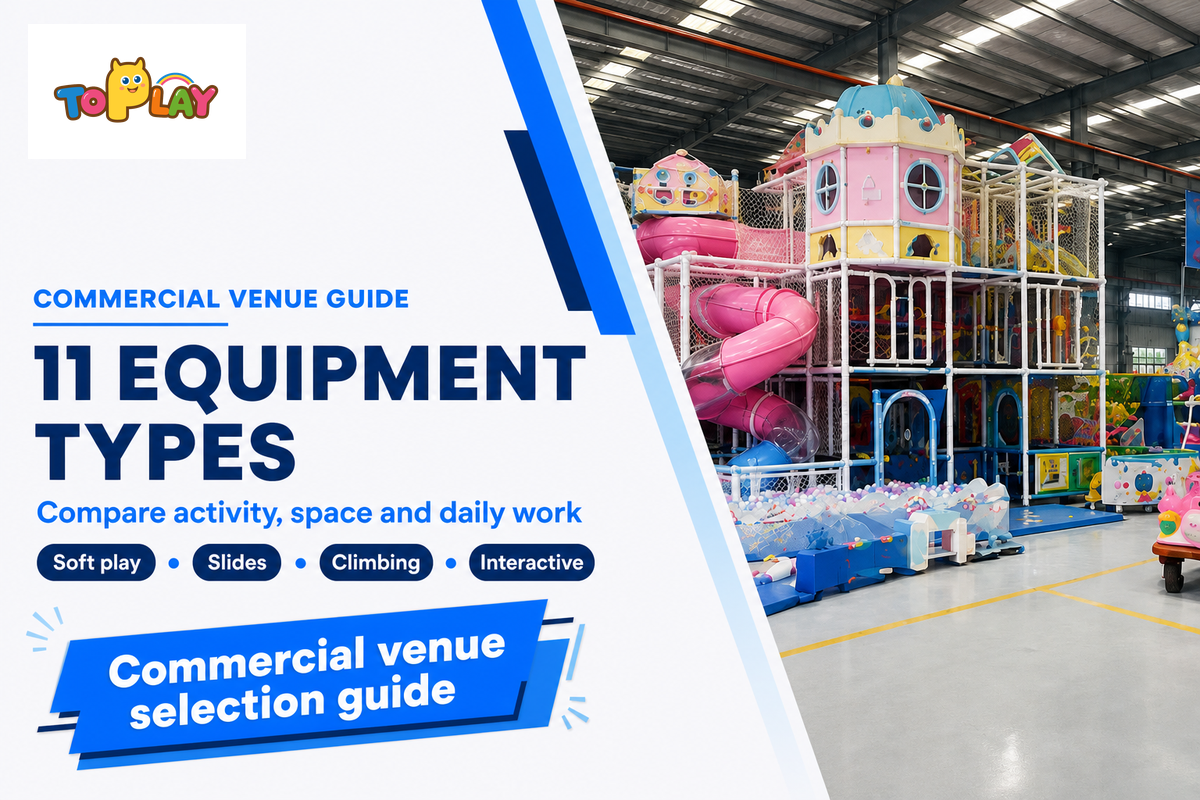
When evaluating indoor playground equipment types, it’s essential that each option have a clear job. A venue needs a balanced route, manageable daily work and room for adults to supervise, not the longest possible attraction list. This guide compares 11 commercial choices and points out the operating decisions behind each choice.
A multi-level indoor jungle gym, a toddler soft play zone and a trampoline park may all be in the same commercial playground catalog, but that doesn’t mean they’re interchangeable. Each has different demands on space, staff and the project team. Treating them as interchangeable may produce a crowded drawing, an incomplete quote or an attraction that is awkward to clean.
Indoor playground equipment types: compare 11 options
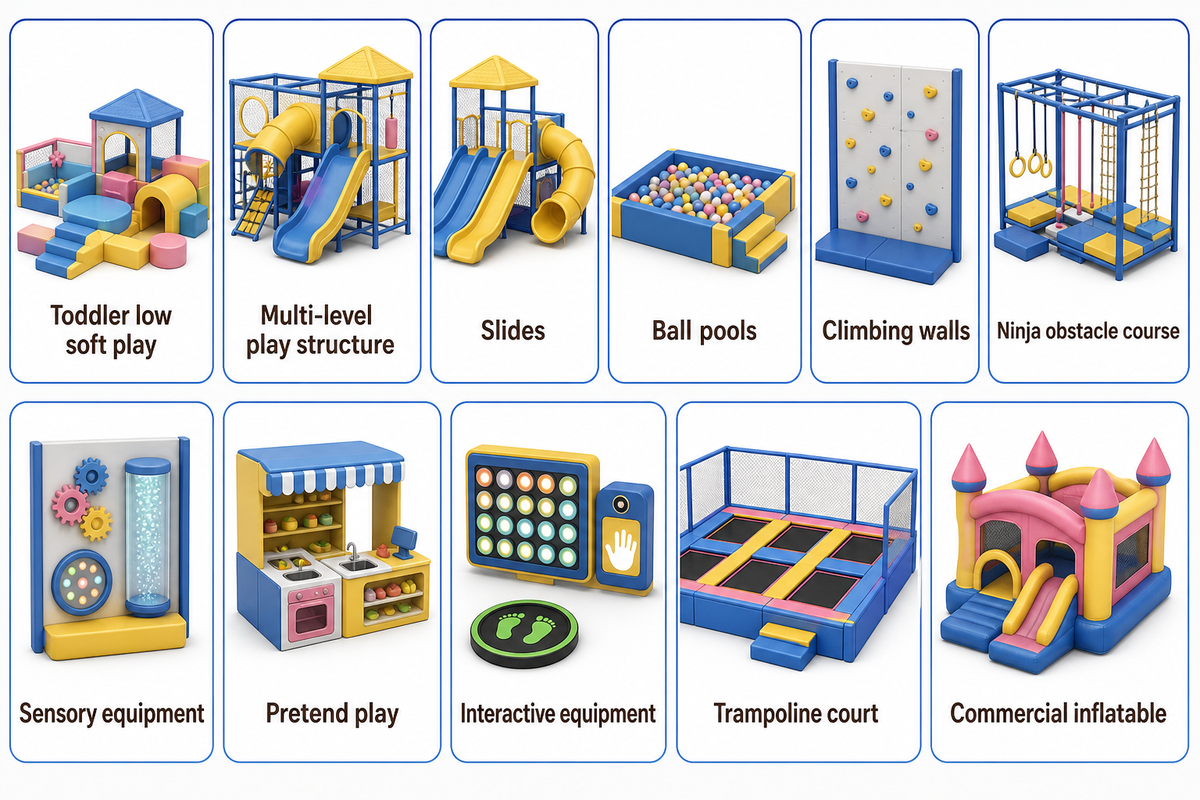
The best comparison would be to look at complete play systems and individual playground components. A complete system can organize and integrate an entire route; slides, ball pools and panels may be system elements as well. Trampolines and inflatables usually deserve their own operating review rather than being treated as decorative additions.
The purpose of the selector is to link each type to the activity it adds, and to the constraint that makes it a poor fit. It’s an editorial buying framework, and not an official classification of standards. The final decision is made by the operations, procurement, and management team, based on the product paperwork, and design of the venue.
| Type | Main role | Operating question | Limitations / Not suitable for |
|---|---|---|---|
| Toddler low soft play | Ground-level crawling, balance and small climbs | Can adults see and reach the whole zone? | Defer if older users must cross the toddler route. |
| Multi-level play structure | Connected climbing, crawling and sliding route | Where can staff enter for inspection or assistance? | Defer when clear height, egress or service access is unresolved. |
| Slides | Directed descent and repeat play | Where do users land, exit and rejoin? | Do not place an exit into a queue or another active zone. |
| Ball pools | Loose-part movement and lower-intensity play | How are balls removed and the liner inspected? | Defer if cleaning access or separation from slide exits is unclear. |
| Climbing walls | Vertical challenge and route choice | What wall type, landing provision and supervision apply? | A sport wall is not automatically playground climbing equipment. |
| Ninja obstacle course | Sequenced hanging, balance and traverse tasks | Can staff reach a stalled user without blocking the route? | Defer if rescue, fall control or landing needs are undefined. |
| Sensory equipment | Tactile, visual or sound-based choice | Can a user approach and operate it from the route? | A sensory label does not prove inclusive access or benefit. |
| Pretend play | Role play, storytelling and social interaction | Is there room for shared use without blocking circulation? | Defer oversized props that reduce flexible play space. |
| Interactive equipment | Game-led movement or responsive play | What action advances the game, and who supports it? | Defer when power, network or after-sales scope is absent. |
| Trampoline court | Rebound activity in a dedicated attraction | What court, staffing and operating plan is proposed? | Do not fold it into a soft-play review by appearance alone. |
| Commercial inflatable | Bouncing, climbing or sliding on an air-supported device | Which air system, anchoring and operating boundary apply? | Not suitable as an unreviewed filler in a constrained room. |
Use the table to reduce the first list, and then look closely at the detail. Toplay’s public commercial indoor playground equipment families provide a good starting point at the product level. Indoor playground systems still need comparable questions from the owner, operations team and procurement team.
Soft play equipment and multi-level play structures
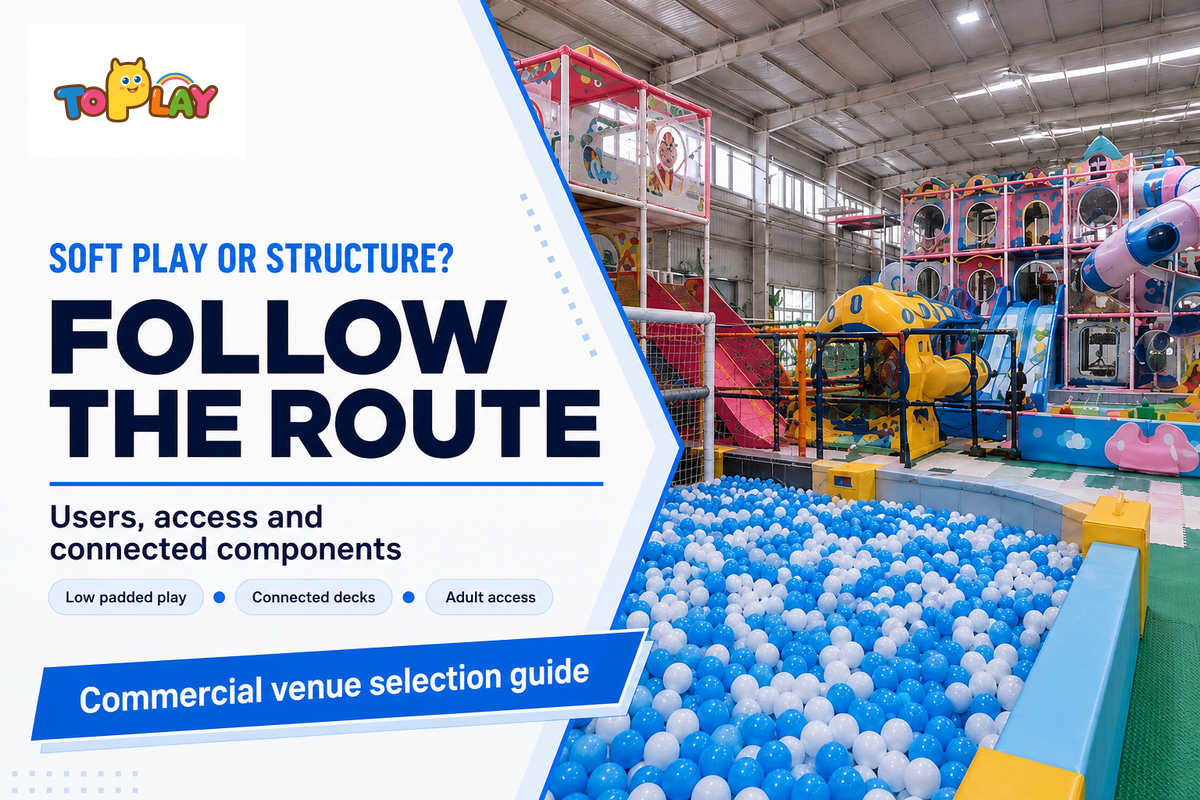
Soft play equipment can describe low padded pieces or a larger soft-contained system. Complexity of the route determines the buys: low pieces allow for more flexibility in rearranging and reusing components. Indoor play structures, on the other hand, connect decks, nets, tunnels and slides into a controlled path that requires planned adult access.
What’s the difference between soft play and traditional indoor playground equipment?
Soft play uses padded components to limit hard contact and to support balancing and crawling and small climbing. More traditional indoor playground equipment may include rigid climbers, slides, themed fixtures and electronic activities. Softness of the material determines neither age of the child nor the level of supervision, access, or the installation method.
The U.S. Consumer Product Safety Commission’s 1996 review described soft-contained playgrounds as systems that can include tubes, climbing nets, slides, ball pools and padded flooring. The report is useful in defining the category of soft-contained playgrounds and in warning about interactions of the components of a system. It is not proof that all current playground systems are safe. ASTM’s public F1918-21 scope and its user range definition for soft-contained play equipment are also included.
When comparing a low toddler corner with a custom soft play equipment system, a buyer should ask for a list of components, intended users, route diagrams and access points. Age-appropriate equipment starts with stated users. Some small play areas may be better off with clear zoning rather than another level.
Indoor playground slides and ball pits
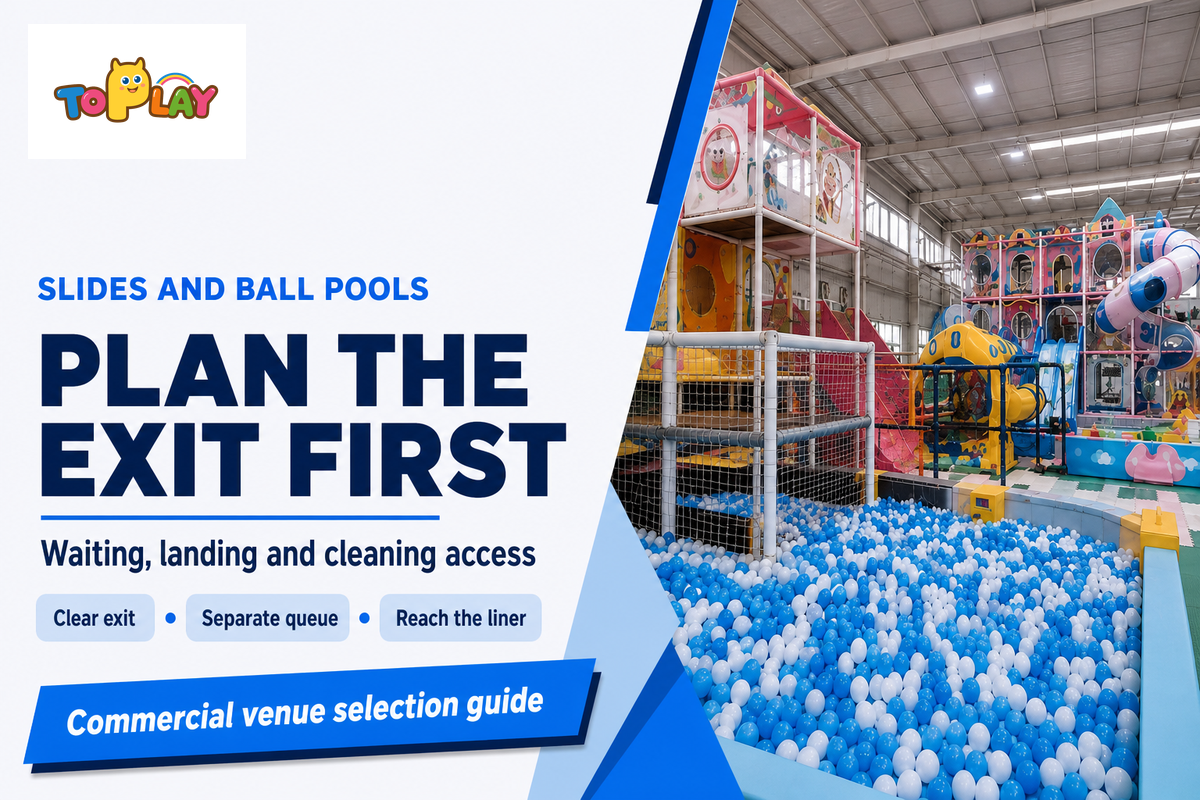
Slides and ball pools work best when the exit, waiting position and cleaning route are planned before the visual theme. A slide is a directed movement path. A ball pool is an occupied activity area. Conflicts from combining the two without an exit plan aren’t apparent from the equipment footprint.
Illustrative scenario: A family entertainment center proposes a tube slide ending beside a ball pool because both components fit a bright themed corner. The drawing shows children leaving the slide through the same opening used by toddlers entering the pool. Staff can see the slide mouth but can’t reach the far liner without emptying the area. The designer places the pool entrance further away from the slide exit, adds a waiting position and illustrates how staff remove balls to access the liner. Procurement then asks for those access details in the approved layout. This is a design example, not a completed Toplay project.
The CPSC review noted a concern with a slide-ball pool interaction. A supplier maintenance manual shows why the cleaning route is important, as balls may need to be removed in order to access the liner and other concealed surfaces. Commercial playground equipment needs model-specific instructions, and the manuals don’t establish a general cleaning interval.
Climbing walls and ninja obstacle courses
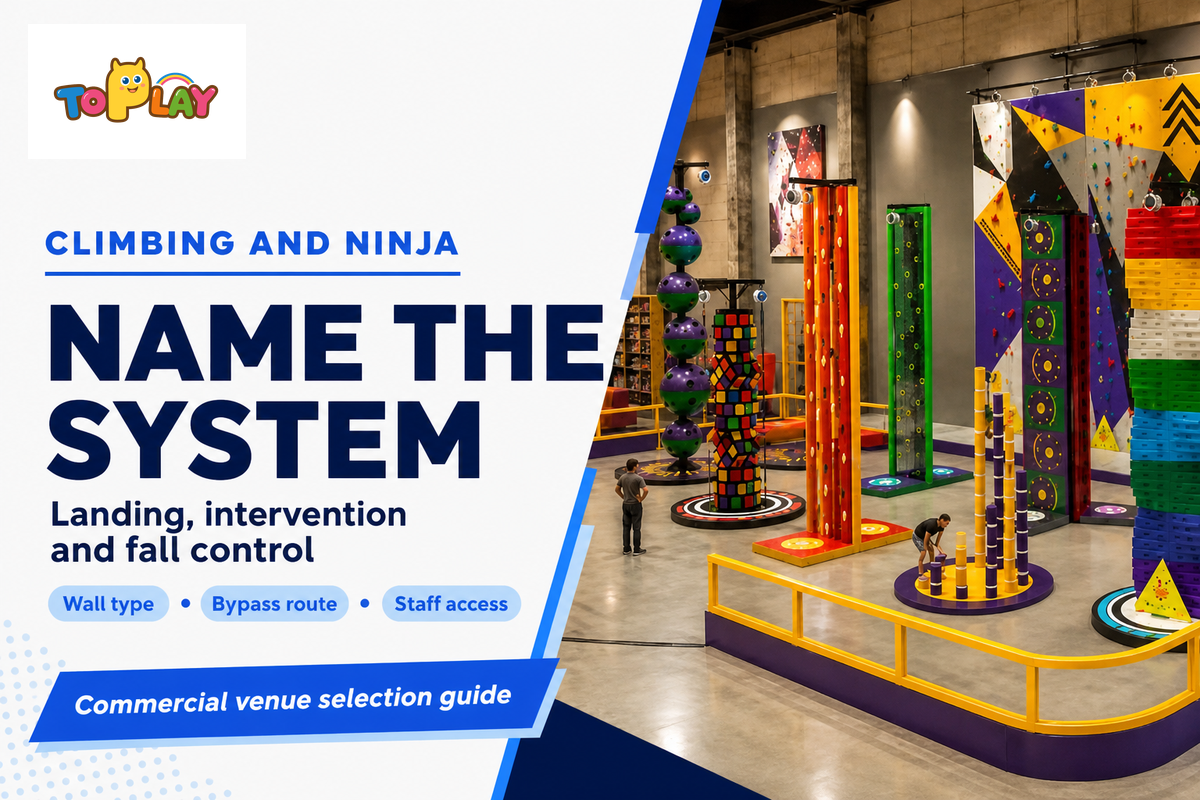
Equipment should be chosen based on the type of movement path and fall-control method, not by marketing name. A playground climber, a bouldering wall and an aerial course using personal fall protection are three separate categories. Ask what supports the user, where the intervention happens and which product scope applies.
The DIN publisher’s EN 12572-2 scope covers bouldering walls and their safety zones while excluding playground equipment. ASTM’s public F2959-26a scope addresses aerial adventure courses requiring personal equipment to prevent or control a fall from height. Neither page automatically includes children’s climbers in those categories.
For a ninja obstacle course, ask about the sequence, type of landing provision, whether a bypass route is provided and where staff intervention occurs. For a climbing adventure attraction, ask whether a fall-protection system is included in the design. A general statement or certificate isn’t acceptable evidence for an unspecified configuration.
Sensory play, pretend play and interactive equipment
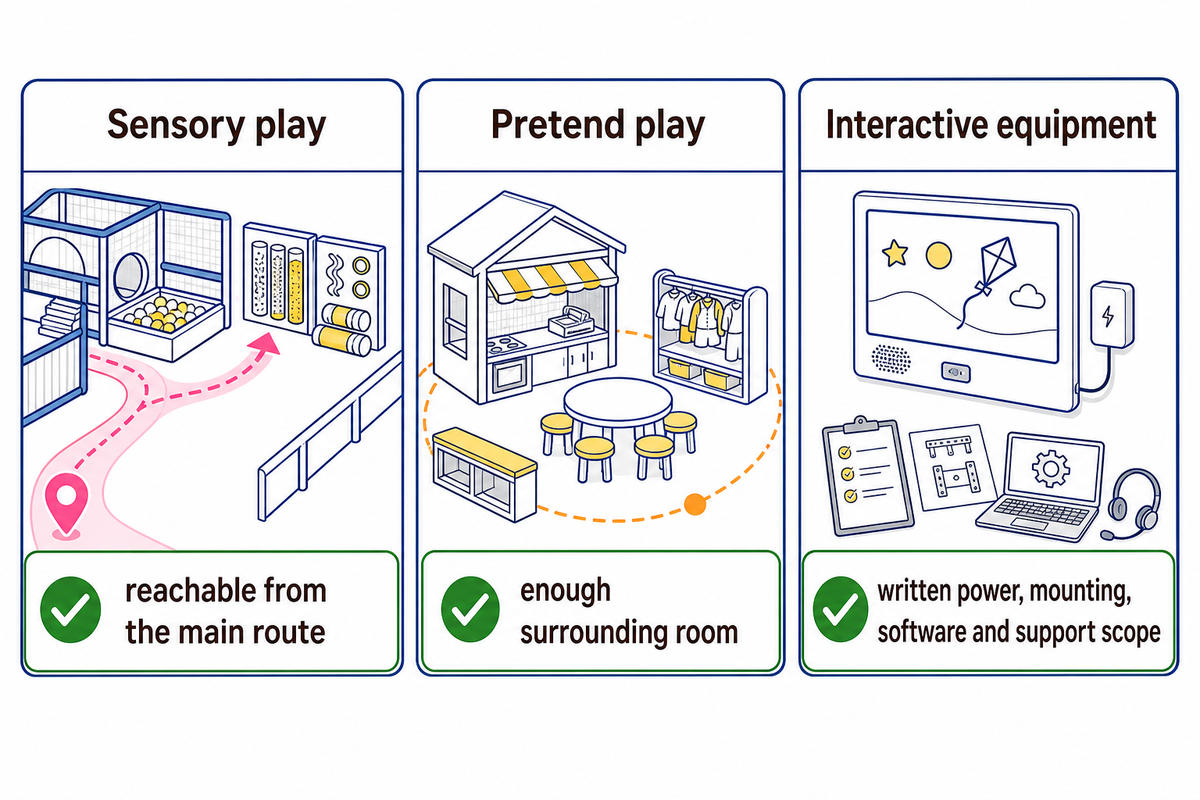
Things that promote interaction through the senses, play and movement may be space worthy, depending on how they invite participation in a unique way. Sensory play might provide opportunities for participation through the sense of touch or sight; pretend play may support a shared narrative; movement may be prompted by a digital game. None of these labels defines learning or inclusion, let alone guarantees sustained use.
A systematic review of interactive technologies for physical activity, published in 2021, found that movement depends on what the game requires and that shared access can influence collaboration. This leads to two practical questions: what physical action moves the game forward, and can more than one child control or understand the result? This review doesn’t support a guaranteed developmental outcome.
Lower-tech sensory equipment may be worth considering when it is reachable from the main route and does not force a user into a noisy challenge area. Pretend play needs enough surrounding room for play and social interaction. Electronic indoor play equipment needs a written power, mounting, software and support scope. The digital backdrop and animation may catch the eye, but without service responsibility, the screen may quickly turn to a dead playground.
When not to buy interactive playground equipment
Delay the purchase when a product names a digital backdrop and/or projector but doesn’t describe the expected game action, user control and capacity, electrical work, content updates, programming and content, and/or fault support. A passive animation that attracts a queue may add less play experience than a simple shared activity panel. The right digital label may support intended interaction, but the choice still follows intended behavior and service capacity.
Trampolines and inflatables as separate attractions
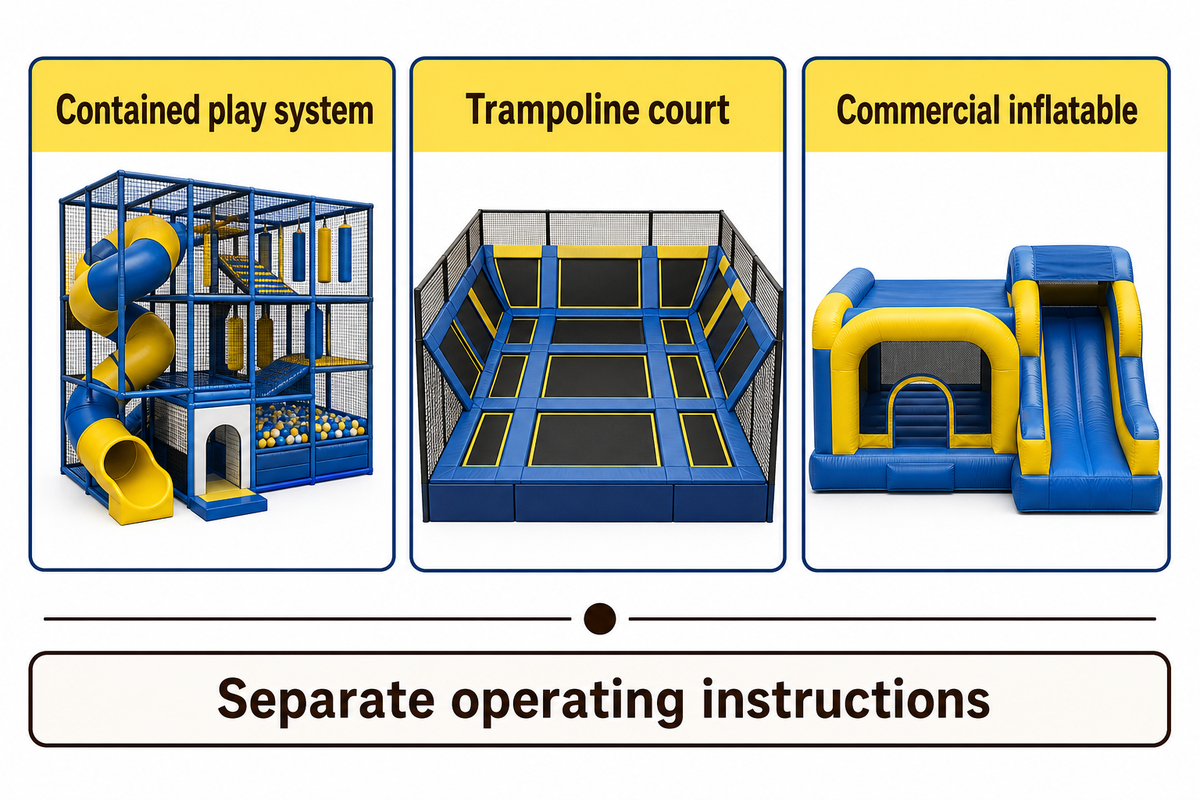
A contained play system uses an enclosed structure rather than a trampoline surface for its operation. Rebound courts depend on a trampoline bed; inflatables may use continuous-air or captured-air systems. The similarity of the venue doesn’t create similar standards of equipment.
ASTM’s public F2970-25 scope covers commercial or institutional trampoline courts and excludes devices without a trampoline-court bed in their design or use. The public F2374-24 scope includes commercial inflatable amusement devices using continuous-air or captured-air systems, subject to stated exclusions. The information on these pages sets a boundary to a review; it does not approve a particular venue.
A large indoor play park can operate several attraction families, but the owner should still separate operating instructions, staffing tasks, inspection records and acceptance evidence. Ask a trampoline park supplier or inflatable provider to identify the exact device category and configuration instead of reusing a soft-play checklist.
Choose small indoor playground equipment by space and age
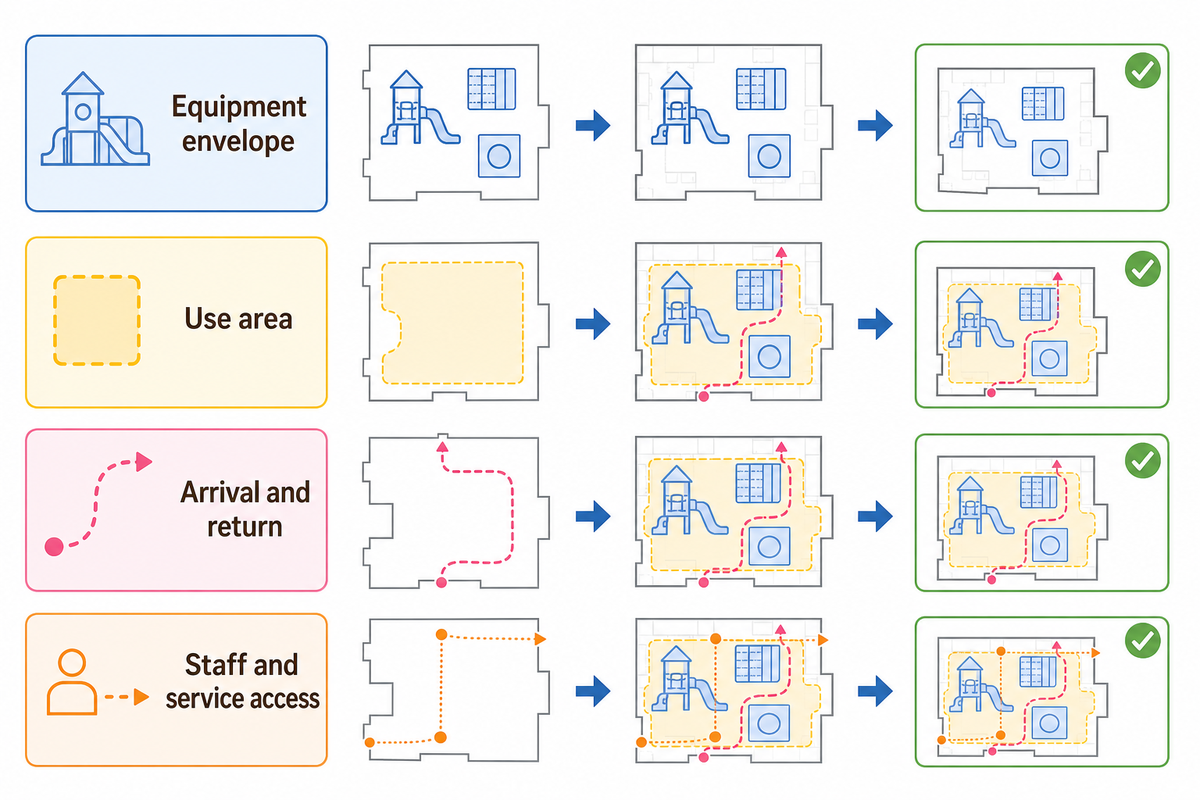
Small indoor playground equipment fits on a drawing only after four spaces are resolved: the equipment envelope, the space for the required use, the circulation for arrival and return, and the staff or service access. These spaces may be concurrent in the design, and combining four rectangles together doesn’t determine whether the design can accommodate the equipment.
How to Choose Indoor Playground Equipment?
Prioritize the intended users and the space constraints of the room. Then determine a purpose for each activity. The supplier must provide a drawing that shows the location of the equipment, the use area, the primary and return routes, and the access for maintenance. Reject any option where the clearance, local approval input or operating task remains a verbal assumption.
The local project team should identify specific building, fire, egress and structural review inputs before this test is performed.
| Drawing layer | What to mark | Acceptance question |
|---|---|---|
| 1. Equipment envelope | Exact model outline, height and fixed connections | Does it clear the lowest obstruction and building services? |
| 2. Use area | Landing, movement and manufacturer-required space | Is it free from another activity’s queue or exit? |
| 3. Arrival and return | Approach, waiting, exit and return to the main route | Can users enter and leave without crossing active movement? |
| 4. Staff and service access | Inspection, cleaning, intervention and replacement path | Can the difficult task be demonstrated before acceptance? |
Illustrative scenario: A compact children’s indoor venue has a low obstruction over one side of the room and wants both a toddler zone and a two-level structure. The equipment outline fits, but the proposed stair return narrows the route next to the party room door. The only adult access panel faces a fixed bench. The owner keeps low sensory and soft play under the constrained area, rotates the structure so its service panel opens into a controlled staff aisle, and reserves the shared central route. The design indicates that circulation and clear space can be integrated with the other uses. This example doesn’t imply or describe the clear space or capacity of the equipment.
The U.S. Access Board’s play area provisions state that, in certain circumstances, clear floor spaces, turning spaces and accessible routes may be combined. That permission is conditional; it does not erase the equipment’s own use area, landing, egress or maintenance needs. Good playground planning keeps all boundaries shown on the plans.
Indoor play areas: supervision, cleaning and replacement work
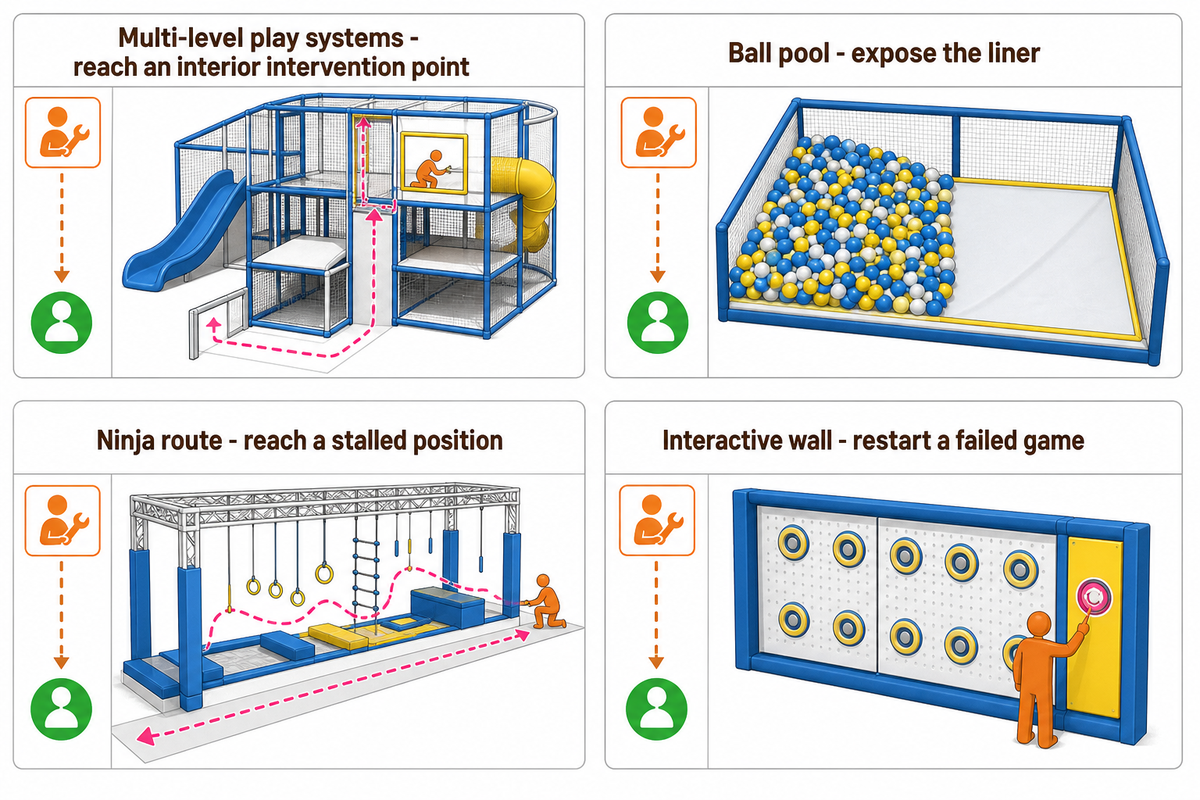
Workload depends on the equipment family. Contained play systems require routes and enclosures checks, ball pools require the removal of balls and access to liners, and interactive equipment requires fault and support tasks. Compare the hardest observable task before purchase, as a clean marketing image won’t show service access.
“A daily safety check should be undertaken by a competent member of staff.”
RoSPA’s page is UK guidance, so it shouldn’t be used as a required U.S. interval. Its useful operating range is wider: documented checks don’t disappear because equipment has been built to a standard. A January 2025 article in Recreation Management cites supplier advice for site-specific maintenance instructions and recommendations for an ongoing maintenance budget. That’s industry interview evidence, not an indoor commercial cost benchmark.
| System | Acceptance demonstration | Operations owner | Procurement evidence |
|---|---|---|---|
| Multi-level play systems | Reach the highest inspection point and one interior intervention point | Shift lead | Access diagram, checklist, replaceable-parts list |
| Ball pool | Remove balls, expose the liner and show the drying/reloading method | Cleaning lead | Cleaning instructions and liner access detail |
| Ninja route | Reach a stalled position without sending staff through another active lane | Floor supervisor | Intervention route and element inspection list |
| Interactive wall | Restart a failed game and identify the support contact | Venue manager or technical support | Power, warranty, updates and response boundary |
Inclusive playground routes that keep children moving
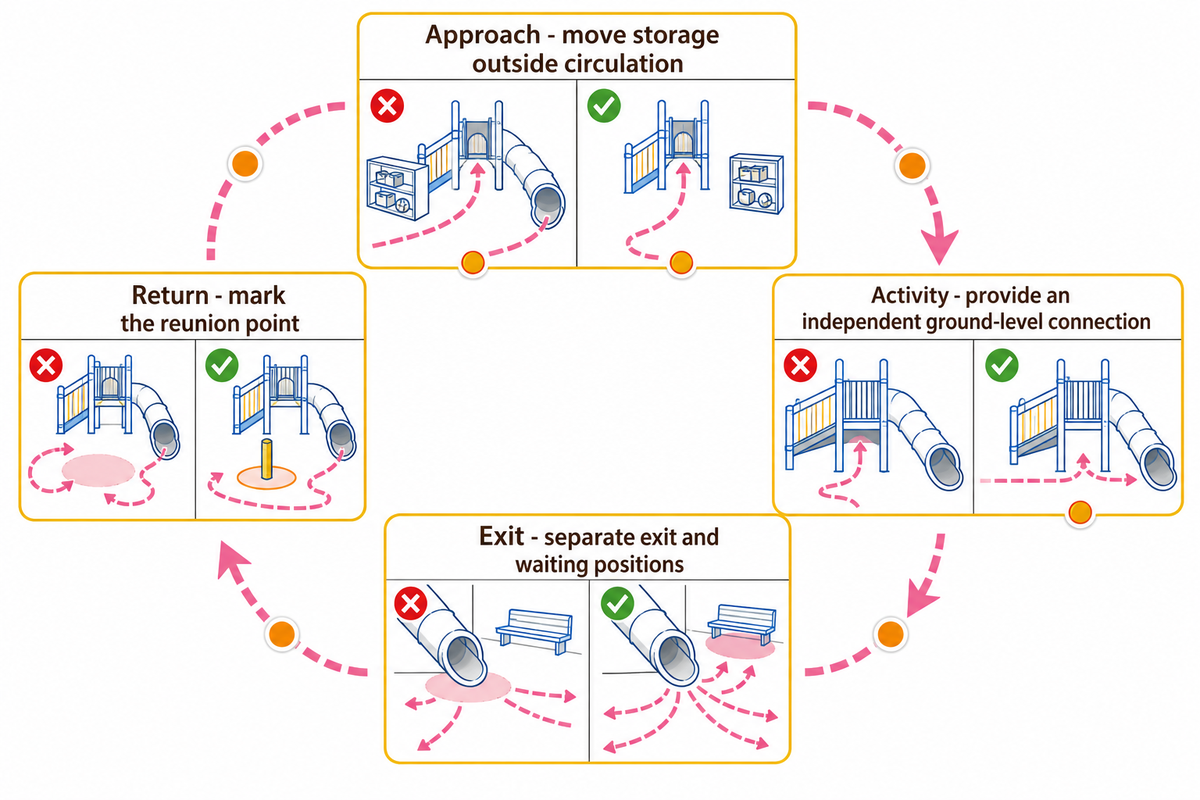
An inclusive playground route must connect approach, activity, exit and return rather than end at an accessible entrance. A good test is participation: can a user reach an activity, understand the next choice, see peers or communication cues, and return without an optional challenge becoming the only path?
How to Combine Different Types of Playground Equipment?
Combine equipment by connecting compatible movement speeds and clear transitions. Place waiting positions outside active use areas. Give every attraction a clear exit and return and an accessible route independent of optional climbing. Walk the plan as a child, accompanying adult, staff and maintenance worker before signing off the final design.
| Stage | Hidden conflict | Affected person | Drawing change | Evidence |
|---|---|---|---|---|
| Approach | Shoe storage narrows the entry route | Wheelchair user, stroller, accompanying adult | Move storage to a recess outside circulation | Dimensioned entrance plan |
| Activity | Only route to a panel crosses a climbing obstacle | User avoiding the challenge | Provide an independent ground-level connection | Connected-component diagram |
| Exit | Slide mouth opens into a ball-pool queue | Exiting user and waiting group | Separate exit and waiting positions | Supplier layout and walkthrough |
| Return | Adult sightline is blocked by a themed wall | Child and supervising adult | Lower or open the barrier and mark reunion point | Rendered sightline review |
Illustrative scenario: The design of a mixed-age layout places a sensory panel behind a rope bridge to create a discovery moment. In the proposed layout, a wall blocks the view from the seating area, and the bridge is the only way to reach it. The team moves the panel to a ground level loop, retains the bridge as an optional challenge and opens a view to the activity. The slide return is also shifted away from the panel’s waiting position. The revised plan gives users more than one way to participate and lets an adult locate the return point. It’s a route analysis case rather than proof of a completed installation or a guaranteed inclusion outcome.
U.S. Access Board’s play-area provisions established the framework of accessibility for covered projects in the US. However, it’s still the project team’s responsibility to determine the exact limits of the facility and the local review, rather than treating an inclusive playground label as approval.
Brief your indoor playground supplier for a comparable quote
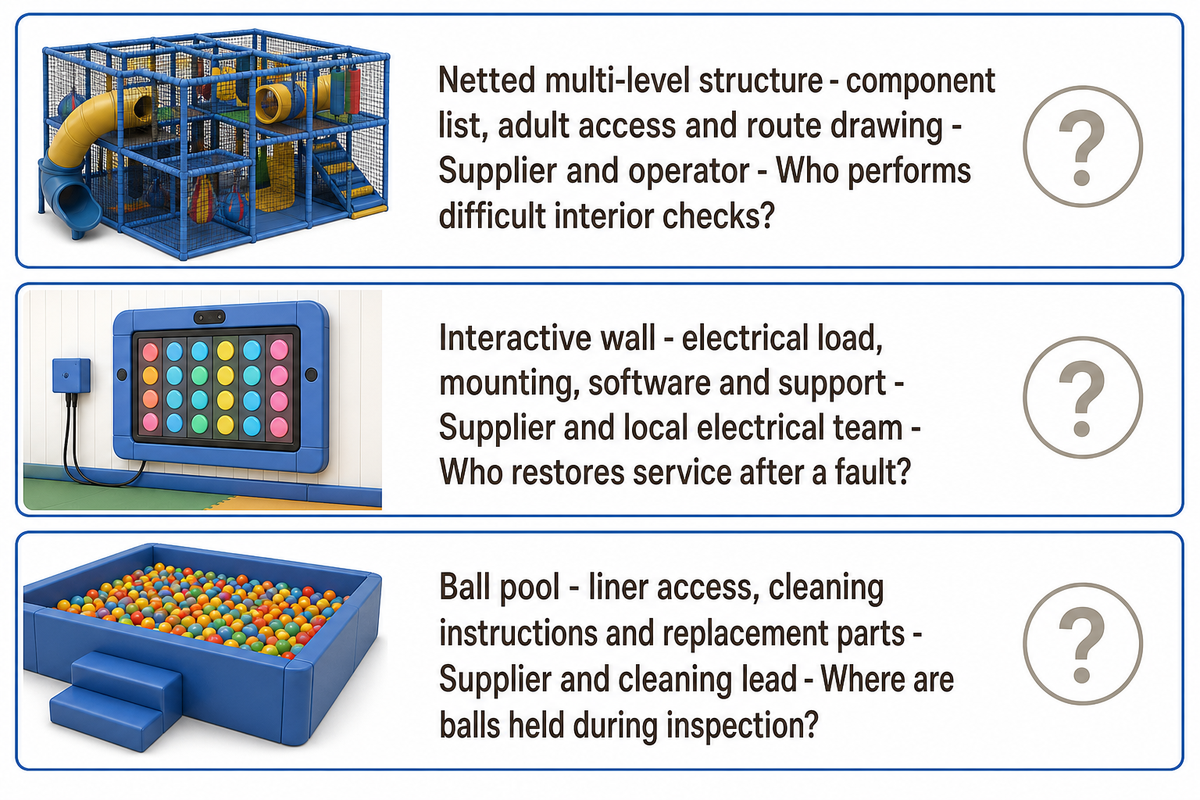
A comparable quote begins with the same measured room, user groups and delivery boundary for every supplier. To complete the scope, request an itemized list of equipment, responsibility for drawings, the installation model, evidence for the product, spare-parts and unresolved site work. A low total means little when local works or support is missing.
Toplay’s playground design and project scope service outlines space planning, theming and the shipping and installation responsibilities defined in a quote. A signed quote and approved drawings should be the project-specific records and be treated as such.
| Selected item | Request | Owner | Open decision |
|---|---|---|---|
| Netted multi-level structure | Component list, adult access and route drawing | Supplier + operator | Who performs difficult interior checks? |
| Interactive wall | Electrical load, mounting, software and support | Supplier + local electrical team | Who restores service after a fault? |
| Ball pool | Liner access, cleaning instructions and replacement parts | Supplier + cleaning lead | Where are balls held during inspection? |
Product questions can be answered by a playground equipment manufacturer, but the site responsibilities rest with the venue owner and the project team. The same scope holds true when a playground manufacturer provides design assistance. Require each unresolved item to have an owner and a date before comparing totals.
Plan future updates to indoor playground products
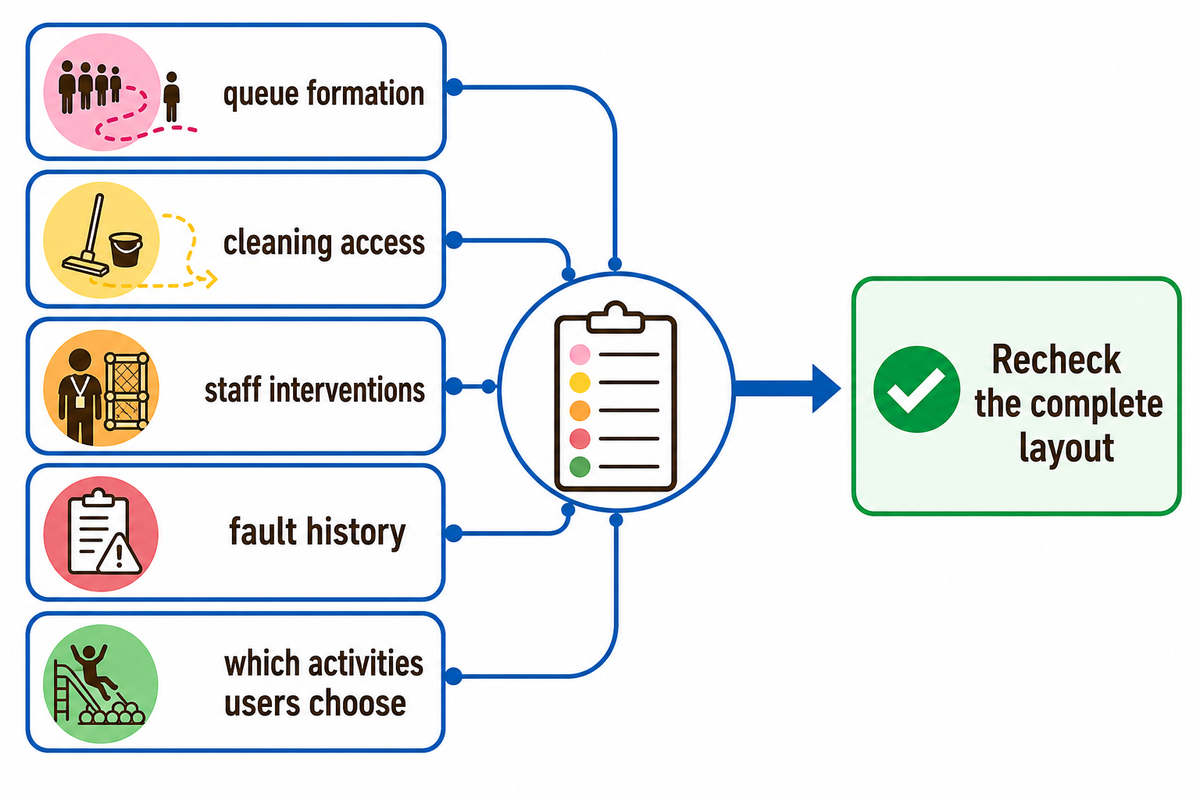
An operating need should be the basis for determining scope, rather than a predetermined schedule. Maintain capacity for future additions. Recheck complete layouts when a new product is selected. An empty corner doesn’t mean it’s available for a new piece of equipment.
When thinking about replacing or adding an attraction, review the applicable standard edition, manufacturer paperwork, support availability and route continuity. Even if equipment is designed as a modular addition, the complete play-area route must still be reviewed.
For a custom indoor project, record what the first phase teaches: queue formation, cleaning access, staff interventions, fault history and which activities users choose. Keep the original approval baseline and document what the addition changes.
Frequently asked questions
What is an indoor playground?
An indoor playground is a play space inside a building that combines activities such as climbing, crawling, sliding and imaginative play.
A commercial venue may use one contained structure or connect toddler, sensory, pretend and challenge zones. The equipment mix should follow the intended users, measured room, supervision plan and maintenance capacity. The term doesn’t identify one construction method, standards scope or age group, so buyers still need model-specific documents.
What is the difference between commercial and residential playground equipment?
Commercial equipment is intended for shared use in public or business venues; residential equipment is intended for household use.
A similar appearance doesn’t establish the same suitability. Ask for the intended-use statement, users, installation requirements, operating instructions and evidence for the exact product. A kids playground inside a business shouldn’t use a home swing, climber or soft block merely because its size and price appear attractive.
Can I use playground equipment outdoors and indoors?
Use equipment only in the environment and installation condition its manufacturer specifies.
Outdoor playground equipment may have different anchoring, surfacing, drainage and weather requirements, while indoor playground products may not tolerate outdoor exposure. Outdoor play also changes drainage and weather exposure. Moving that equipment inside creates building, fire, egress and circulation questions. Confirm intended location and installation evidence before treating the categories as interchangeable.
How frequently should playground equipment be inspected?
Follow the manufacturer’s instructions and the inspection plan applicable to the equipment, venue and jurisdiction. Record routine checks, faults and corrective actions. Usage, damage, alteration or an incident may trigger additional checks. A single calendar interval can’t represent every commercial play system.
How much ceiling height do I need for commercial indoor play area equipment?
No single ceiling height fits every system. Measure to the lowest obstruction, then ask the indoor playground supplier to show the exact equipment, required overhead space and nearby services on a dimensioned drawing. Include staff and maintenance access; a product height isn’t the same as confirmed room clearance.
Can a playground project be phased?
Yes, when the first layout reserves the routes, access, structure and utility connections that a later phase may need. Show future work on the drawing and recheck the complete play area when equipment is added. The U.S. Access Board also has specific requirements for covered play areas constructed in phases.
What certifications should I look for when buying commercial indoor playground equipment for sale?
Request evidence tied to the exact model, configuration, intended users and destination. A certificate or report should identify what was examined and the standard used. Separate product evidence from installation inspection and local site approval. Soft-contained play, trampolines, inflatables and aerial courses using personal fall protection don’t share one automatic standards scope.
References & Sources
- U.S. Consumer Product Safety Commission: 1996 soft-contained playground report release
- U.S. Access Board: Chapter 10 play-area provisions
- ASTM F1918-21 public scope
- ASTM F2970-25 public scope
- ASTM F2374-24 public scope
- ASTM F2959-26a public scope
- RoSPA Play Safety: Soft Play Area Standards
- Torres et al.: systematic review of interactive technologies for physical activity
Turn your shortlist into a dimensioned plan
Send the room plan, lowest clear height, columns, entrances, target ages and preferred activity mix. Toplay can use those inputs to prepare a project-specific equipment and delivery discussion.
Research note: standards links above refer to public publisher scopes, not paid full-text provisions or approval of a particular product. Local authorities, qualified designers and the project team determine site requirements.