Get in touch with Guangzhou Toplay amusement equipment co. Company

Owner and operator guide · Updated October 2026
A lifecycle guide for owners to turn an attraction plan into a system, a pre-opening check, a repair decision, and a controlled return to service.
Trampoline park equipment is easier to buy than it is to govern. Quotations can list courts, airbags, foam pits, basketball lanes, dodgeball zones, nets and pads. This still does not tell an owner where one system ends, which document supports each interface, what needs to be closed before opening, or who can release a repaired zone.
This article is an owner-side operating guide. It provides information on the boundary of an installed system, requirements, evidence, commissioning, checks, defects, and changes. Product packages, customization, material options, prices, lead times, shipping and quotations remain on Toplay’s commercial trampoline park equipment page. Keeping those roles separate helps the two pages answer different searches instead of competing with each other.
The 30-second method
Map the system boundary, write the owner brief, mark every critical interface, match evidence to the as-built installation, close the commissioning list, run a proactive pre-opening check, control defects through return to service, and reopen the evidence review whenever the system changes.
Start With the Equipment System Boundary
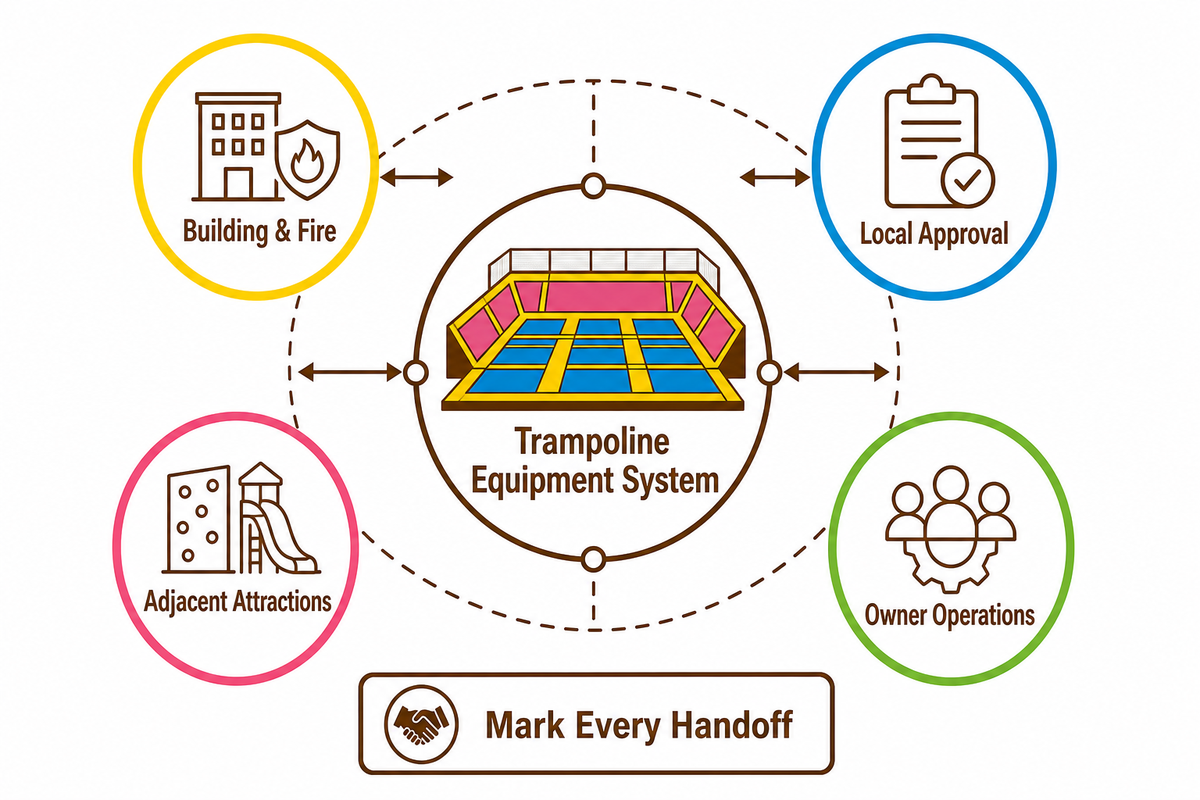
Direct answer: treat a commercial trampoline court as a connected installed system, not a collection of attractions. The active surfaces depend on frames or structural supports, elastic elements, padding, containment, access points, decks, landing systems and operating controls. Decisions made on one element can affect the interfaces surrounding it.
The public scope for ASTM F2970-25 is useful because it spans design, manufacture, installation, operation, maintenance, inspection and major modification of commercial or institutional trampoline courts. The scope is much broader than the selection of product. The same page also lists exclusions, including consumer trampolines and several other contexts, so the title of a document is never enough; its scope has to fit the installed use.
Mixed-activity venues introduce a second boundary. The official abstract for ISO 23659:2022 applies to trampoline parks and trampoline areas within multi-activity parks, including airbags and foam pits. It separately excludes general building, fire and planning rules and non-trampoline activities such as climbing, parkour and obstacle courses. Therefore, one standard cannot be a whole-facility compliance map.
Owner rule: if two activities share a physical connection but not the same technical scope, mark the handoff on the drawing and assign a reviewer to each side.
| Interface | Owner question | Record to locate | Scope warning |
|---|---|---|---|
| Bed ↔ elastic element ↔ frame | Do the supplied parts, tension and connections match the approved system? | Drawing, component register, installation record | A generic parts list is not an as-built match. |
| Bed ↔ pad ↔ hard structure | Can padding move, compress, open a gap or expose a hard member? | Pad identity, fixing method, inspection instruction | “Commercial grade” is not a condition limit. |
| Court ↔ containment | Where can a user reach, pass through, climb or collide? | Netting layout, attachments, entry control | Netting is part of a system, not a decorative layer. |
| Deck or access ↔ active traffic | Can waiting, entering and exiting users conflict with jumpers? | Circulation plan, operating rule, sightline review | Equipment acceptance does not replace crowd control. |
| Court ↔ landing or connected activity | What changes when the user leaves the bed or enters another activity? | Interface drawing, operating mode, local review | Climbing, parkour and obstacles may sit outside the trampoline scope. |
This map is a screening tool, not an approval. Along with the equipment file, add building, fire, accessibility, occupational safety, insurance and local authority. For a legacy or transferred system, note manufacture date, previous major modifications and the edition used for the original evaluation. Current standards can inform review without automatically rewriting the legal status of an older installation.
Write the Owner Requirements Brief Before Layout Selection
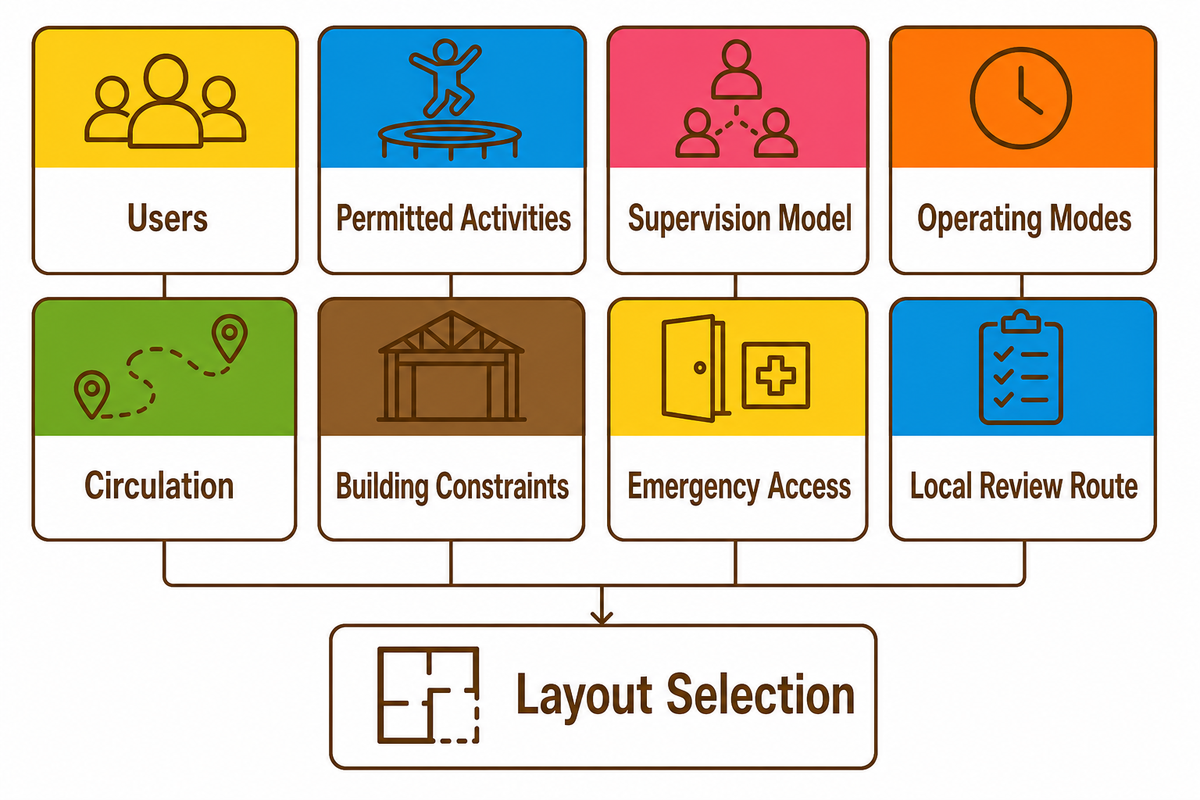
Direct answer: write how the venue intends to operate before asking a layout to solve the problem. The owner brief should define the users, permitted activities, supervision model, operating modes, simultaneous use, circulation, building constraints, emergency access and the route for local review.
Source note: The lifecycle scope on the official ASTM F2970-25 page is one reason this brief must cover operation and maintenance, not only installation.
Start with people and actions. Family sessions, toddler periods, coached activities, party groups and performance areas do not create the same traffic pattern. Write which activities can operate at the same time and which must be separated by time, staff control or physical boundary. State how users enter, wait, receive instructions, move between zones and leave an activity after a jump.
Then add the building. Clear height, columns, walls, roof services, sprinkler locations, lighting, exits, floor structure, utilities and service access are not equipment options; they are project conditions. Floor plans that omit them can look complete while leaving the difficult decisions for installation.
Finally, name the decision owners. Who reviews the equipment scope? Who owns building and fire coordination? Who confirms staff competence and emergency arrangements? Who can accept an installation deviation? Who can close or reopen a zone? These questions prevent a familiar failure at handover: every company delivered its own scope, but no one owned the interfaces.
Put in the owner brief
- User groups and permitted activity modes
- Supervision, occupancy and circulation assumptions
- Building, service and emergency constraints
- Required reviewers and acceptance owners
Keep on the commercial page
- Package comparison and attraction selection
- Custom color or theme options
- Price, freight, payment and lead time
- Quotation and supplier negotiation
Review Interfaces, Not Attraction Names
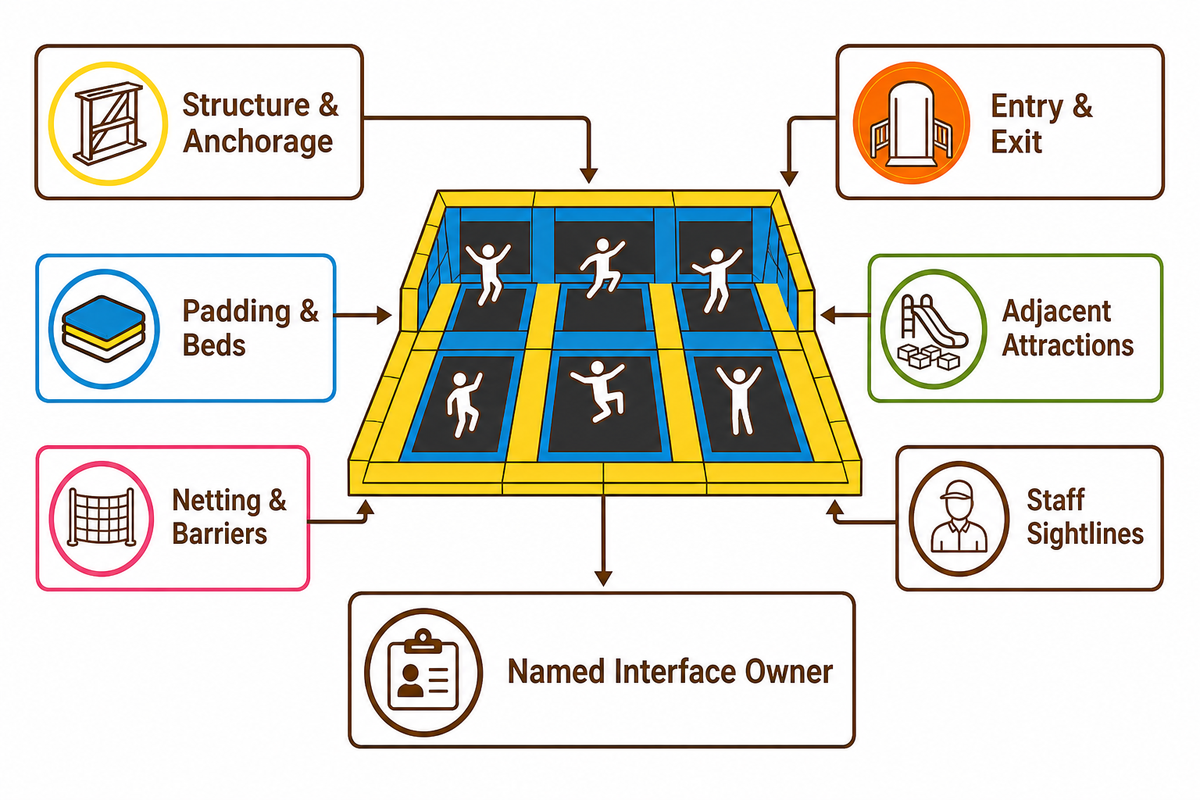
Direct answer: an attraction name describes what visitors see; an interface describes what the owner must control. “Dodgeball court” is a useful marketing label. It does not identify bed-to-frame conditions, pad movement, ball storage, entry conflicts, containment, staff sightlines or the effect of switching the court to a different operating mode.
Walk every interface in both directions. At the bed edge, ask what happens when a jumper lands short, steps off, waits or reaches through. At containment, ask whether the user can push into slack material, contact a support, enter a gap or reach an adjacent activity. At a deck, check the interaction between stationary people and moving users. At an airbag or foam landing, review the approach, landing zone, exit route and the condition that stops use.
Connected attractions deserve their own boundary. Ninja elements, walls, obstacles or climbing activities can be physically attached to the same installation while following a different technical and operating scope. Record the handoff point instead of assuming the trampoline file covers it.
Source note: The official ISO 23659:2022 abstract makes this distinction explicit by excluding several non-trampoline activities from its scope.
| Look at | Failure signal | Immediate decision | Evidence before release |
|---|---|---|---|
| Jump bed and edge | Tear, loose stitching, unusual sag, changed response | Protect or isolate the affected area | Approved repair or replacement plus verification |
| Elastic elements and connections | Missing, broken, deformed, corroded or uneven component | Stop the bay or zone defined by the system | Correct part identity, installation and surrounding-area check |
| Pads and covers | Gap, displacement, split cover, exposed core or hard member | Secure or isolate according to instructions | Position, fixing and condition verified |
| Netting and containment | Hole, cut, slack, loose attachment or uncontrolled entry | Close the exposure route | Repair method, attachment and functional check |
| Landing and exit | Obstruction, degraded media, blocked route or traffic conflict | Pause the affected operating mode | Condition restored and route rechecked |
Match Evidence to the Installed System
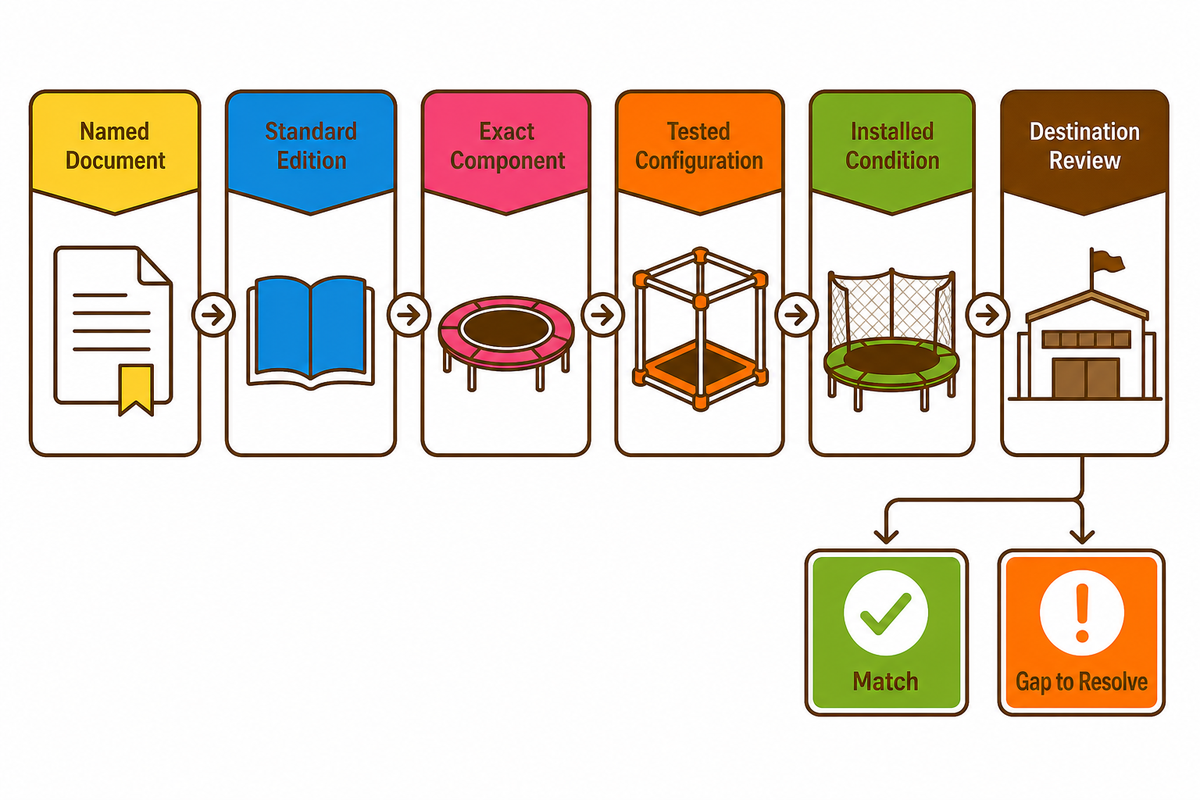
Direct answer: read every certificate, report, drawing and manual through six matching questions: What document is it? Which standard and edition does it use? Which component or model does it identify? What did the test or review cover? Which destination or authority is relevant? Does the as-built installation still match?
The distinction is practical. Labels can state that equipment complies with a standard, yet the owner may still need written supporting evidence. WorkSafe New Zealand’s trampoline-park bulletin explicitly notes that labels may not be sufficient on their own. The exact duty is jurisdiction-specific, but the owner lesson travels well: evidence must be usable and traceable.
- Document identity: issuer, date, number, status and complete pages.
- Edition and scope: the exact standard version and what it includes or excludes.
- Item match: component, material, model, drawing, sample or batch.
- Evidence role: design calculation, test report, certificate, installation record, inspection or operating instruction.
- Destination review: local adoption, authority, contractual and insurance requirements.
- As-built match: substitutions, site changes, repairs and modifications after the document was issued.
A cover page that cannot be traced to the installed item is weak evidence. So is a current standard applied without checking a legacy system’s manufacture date or modification history. Keep uncertainties visible in an evidence index. “Pending local review” is more useful than a confident but unsupported check mark.
Put a Commissioning Gate Before Opening
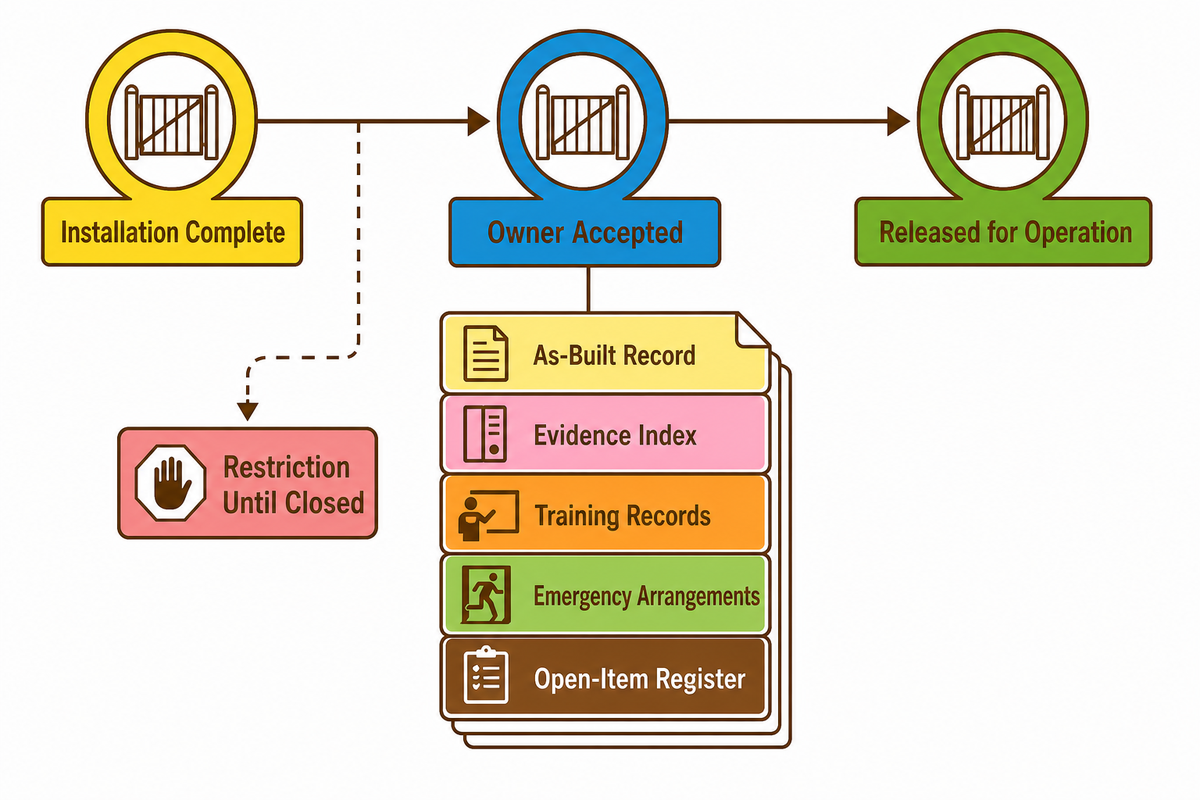
Direct answer: separate three events: installation complete, owner accepted, and released for operation. They may occur together on a simple project, but they are not the same decision. A tidy installation with an unresolved containment, impact, access or structural item should not become operational merely because the installation team has left.
The commissioning gate begins with the as-built record. It should show the installed layout, component identity and recorded deviations. Add the evidence index, manufacturer instructions, inspection responsibilities, training records, emergency arrangements and an open-item register. Each unresolved item needs an owner, a use restriction where applicable and a closure condition.
Source note: This record supports the installation, operation and inspection stages named in the official ASTM F2970-25 scope.
Human factors sit beside the equipment file. Supervision competence, occupancy control, patron education, incident reporting, first aid and emergency readiness are not material properties. They still affect whether the venue can operate. Keep them as named operating controls and link them to the roles that own them.
| Decision | Minimum owner evidence | Do not confuse it with |
|---|---|---|
| Installation complete | Installer’s scope and punch-list status | Independent or authority acceptance |
| Owner accepted | As-built match, documents, responsibilities and exceptions | Permission to operate every mode |
| Released for operation | Closed critical items, ready staff, emergency controls and authorized decision | A permanent promise that nothing will change |
Separate Pre-Opening Checks From the Defect Loop
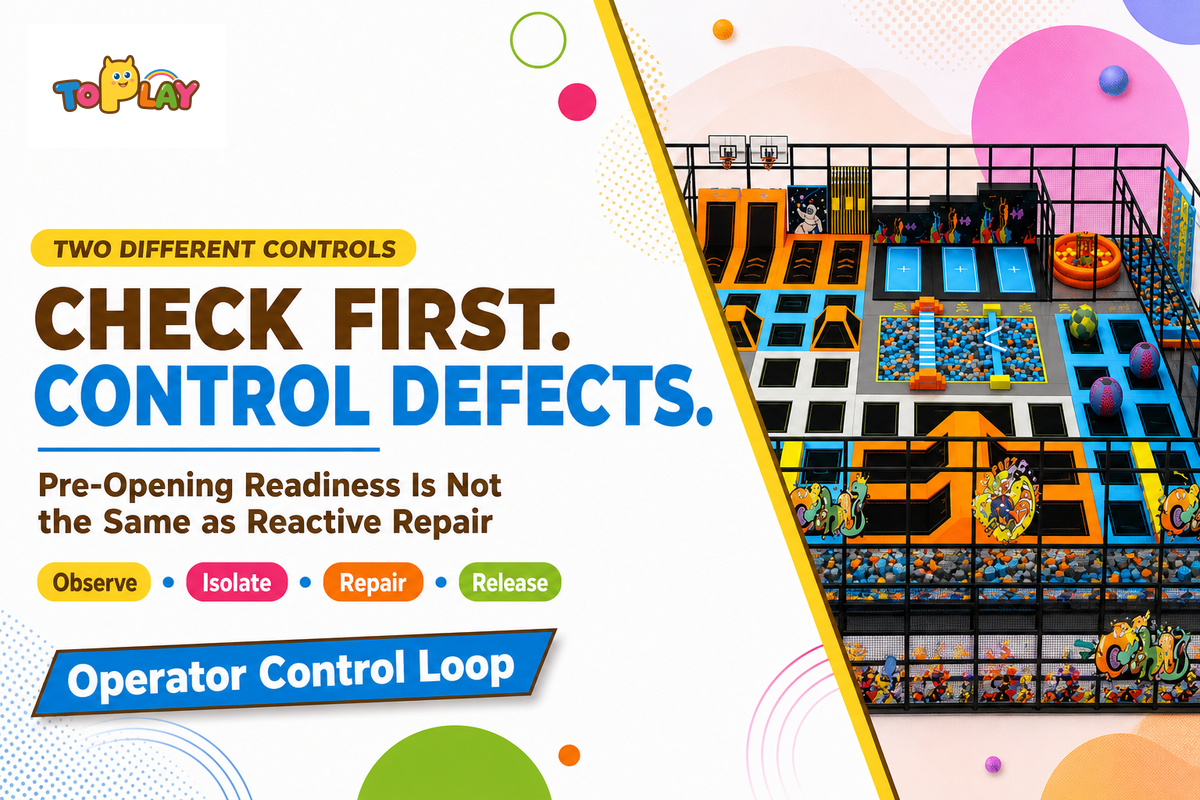
Direct answer: proactive inspection and reactive defect handling are two controls. A venue should not wait for a failure signal before checking the system. SafeWork South Australia says a competent staff member should conduct a routine inspection each day before patrons enter, while its page also lists equipment, padding, netting, matting and clearance conditions among the review points.
Local requirements differ, so this is not a universal legal schedule. It is a useful design lesson: build an opening check around the installed system and the responsible authority. The check should confirm the operating mode, closed zones, routes, containment, visible component condition, emergency access, staff readiness and any restrictions carried over from the previous session.
When a finding is made, a defect loop is initiated. ‘Repair complete’ should not go directly to ‘open.’ The owner of the defect should have a path from the finding to the reopening decision.
| Control type | Record | Control question |
|---|---|---|
| 1. Detect | Condition, time, exact component and location | What changed? |
| 2. Protect | Barrier, isolation, operating-mode restriction | Can a person still reach the exposure? |
| 3. Classify | Affected system and required authority | Who is competent to decide the next step? |
| 4. Correct | Approved method, part, technician and date | Did the work follow the correct instruction? |
| 5. Verify | Functional or competent-person check | Is the defect actually closed? |
| 6. Review interfaces | Adjacent components and records checked | Did the defect or repair affect anything nearby? |
| 7. Reopen | Named authority, date, limits and evidence link | Who authorized return to service? |
| 8. Learn | Trend, repeat finding and schedule response | Should another zone, interval or instruction be reviewed? |
Work on a repair ticket describes the repair. A return-to-service entry records a decision. Keeping them separate makes it possible to see whether the right evidence was checked, whether adjacent components were reviewed and whether the reopening authority was clear.
Plan Maintenance Around Instructions, Use and Failure Signals
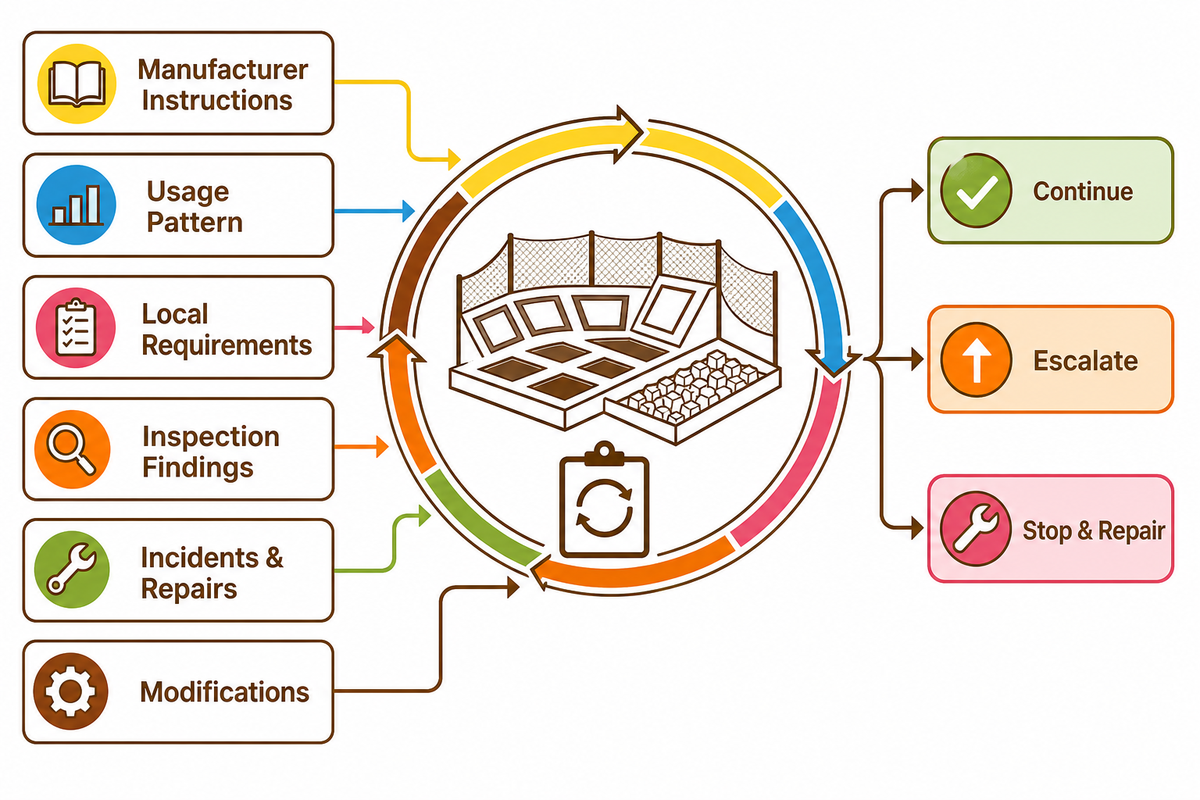
Direct answer: build the schedule from the installed system’s instructions, use intensity, findings, incident history, cleaning work and applicable local requirements. Failure signals tell staff when to escalate; they do not replace planned checks.
Useful observations include torn or frayed jumping surfaces, loose stitching, missing or deformed elastic elements, unusual movement, displaced or damaged pads, holes or slack in netting, loose connections, degraded landing media, blocked routes, missing labels and records that no longer match the component. The observation must connect to an action. “Monitor” without a limit, owner or next check is not a control.
Manufacturer documents are deliberately specific. A public manual may name daily, weekly or other checks for one system, but copying that interval to another installation is not evidence. If the correct guidance is unavailable, WorkSafe New Zealand advises obtaining appropriate professional input rather than improvising a schedule.
Toplay’s indoor playground maintenance checklist goes deeper into logs and routine structure. This guide keeps the narrower equipment-lifecycle question: which instruction, component, finding and authority controls the decision?
Control Replacements and Modifications
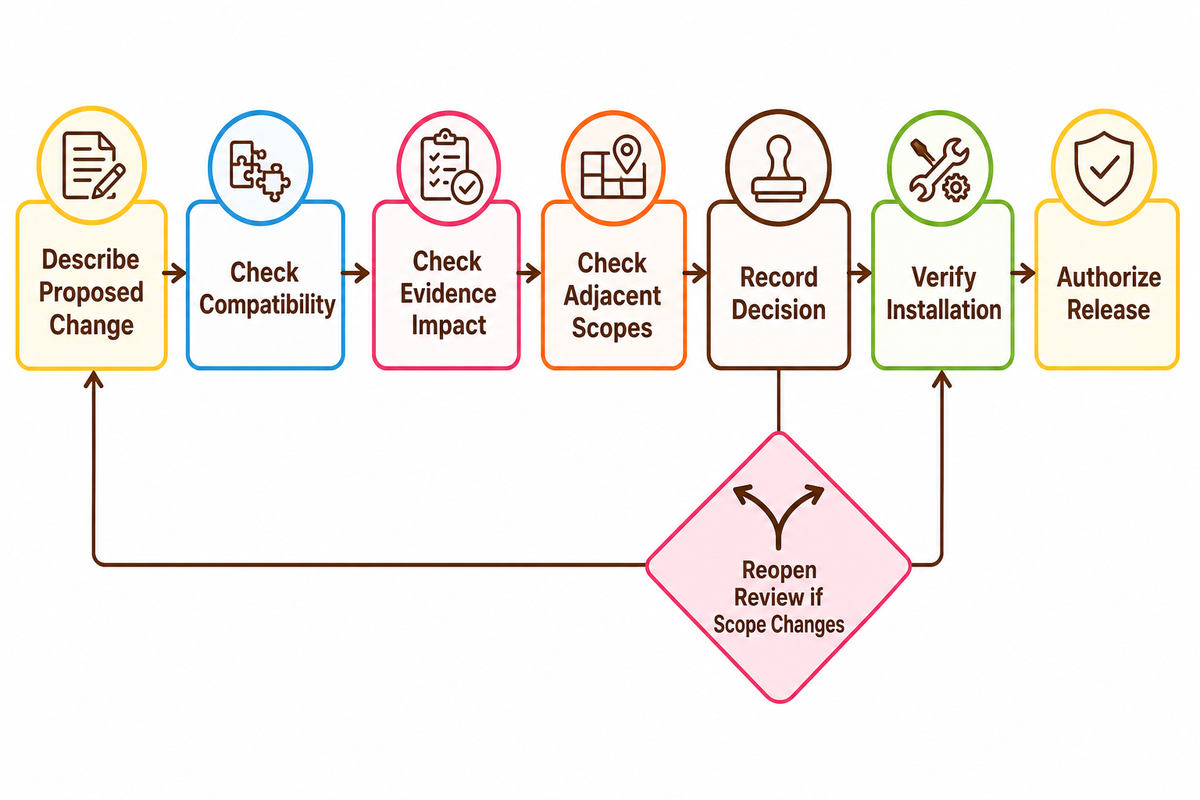
Direct answer: treat a replacement or alteration as a controlled change until compatibility is shown. A part can look similar while changing material, geometry, tension, attachment, padding coverage, flame performance, user trajectory, maintenance access or the evidence that originally supported the system.
Open a change record for substitute beds, springs or elastic elements, pads, netting, anchors, frame work, landing media, new connected attractions, altered court geometry, sensors, software or operating rules. Record the old and new identity, reason, instruction, responsible person, affected interfaces, evidence review, installation check and reopening decision.
The active ASTM work item WK98272 lists topics under review for a future revision of F2970-25, including netting, operations and supervision, impact attenuation, components, inspections and children’s zones. It is not a published requirement. It is a reminder to monitor change and to record which edition supported each decision.
For legacy equipment, the change record is especially valuable. It prevents a renovated zone from becoming a mixture of old drawings, current parts and undocumented field decisions. If the change crosses into a different attraction, building system or local approval route, reopen those scopes as well.
Use the 12-Question Owner Acceptance Check
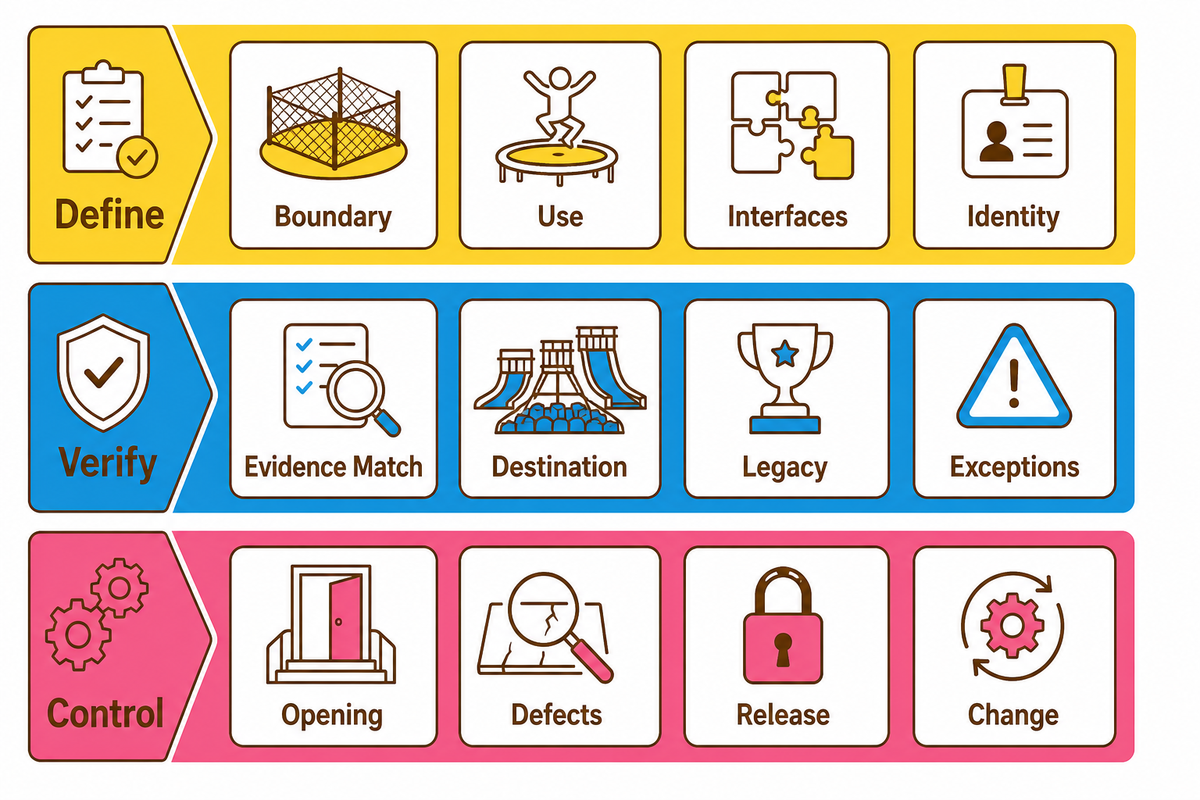
Direct answer: accept the operating system, not just the delivery. The following questions create a shared handover language for ownership, procurement, operations and maintenance teams.
Source note: These questions translate the lifecycle scope listed on the official ASTM F2970-25 page into owner-side handover prompts; they do not replace project-specific review.
| Gate | Question before acceptance | Evidence to retain |
|---|---|---|
| 1 · Boundary | Is the trampoline system boundary recorded separately from building and non-trampoline scopes? | Signed scope map |
| 2 · Use | Are intended users, activities, operating modes and supervision assumptions written? | Owner requirements brief |
| 3 · Interfaces | Are critical interfaces marked on the current as-built drawing? | Controlled drawing |
| 4 · Identity | Can each critical component be identified in the register? | Component register |
| 5 · Match | Does each report or certificate match its edition, scope, component and use? | Evidence matrix |
| 6 · Destination | Has destination-specific review been assigned rather than assumed? | Reviewer assignment |
| 7 · Legacy | Are previous modifications and legacy applicability questions visible? | Change history |
| 8 · Exceptions | Are installation exceptions and open defects recorded with restrictions? | Exception register |
| 9 · Opening | Are proactive pre-opening checks and responsible staff defined? | Check sheet and roster |
| 10 · Defects | Are closure triggers, repair authority and verification requirements written? | Defect-control procedure |
| 11 · Release | Is return-to-service approval separate from work-order completion? | Release record |
| 12 · Change | Will replacement or operating changes reopen the relevant evidence review? | Change-control trigger |
A “no” does not always mean rejection. It means the owner can see which decision is still open. That visibility is the purpose of the framework.
Send Commercial Decisions to the Solution Page
Once the owner brief and evidence boundary are clear, use the Toplay trampoline park equipment solution page for attraction options, custom layout, material and manufacturing information, replacement parts, project steps, commercial terms and quotation. Use the About Toplay page for company and factory context.
Those first-party pages explain what the supplier offers. They do not replace project-specific engineering, inspection, local authority or owner acceptance. Keeping that distinction visible is what makes the internal links useful rather than promotional duplication.
For the wider handoff between equipment categories, building conditions and destination review, use Toplay’s indoor playground safety standards guide.
Plan a Project-Specific Discussion
Bring the building plan, clear height, intended users, activity modes, destination and unresolved interface questions. Toplay can use that brief to discuss a project-specific equipment route.
Frequently Asked Questions
What equipment is included in a trampoline park?
A commercial trampoline system can include jumping beds, elastic elements, frames, pads, containment, access areas and connected landing systems, but its exact boundary follows the installed design and interfaces.
The exact boundary depends on the installed design. Dodgeball or basketball may operate on trampoline courts, while airbags and foam pits may form connected landing areas. Climbing, parkour, obstacles, building services and fire systems may follow separate scopes even when they share the same venue. Record the interfaces, responsible reviewer and evidence route instead of relying on a sales-category name.
Which safety standard applies to commercial trampoline courts?
ASTM F2970-25 and ISO 23659:2022 are relevant public scope references, but project applicability depends on destination and local review. No title alone approves every component in a mixed venue.
Check the standard edition, manufacture or modification date, exact equipment scope, contractual requirements and local adoption. Separate building, fire, planning, accessibility, workplace safety and non-trampoline activities. A standard title or label does not prove that every part of a mixed venue, or every legacy installation, has been reviewed. Record which qualified party or authority owns each remaining decision.
How often should trampoline equipment be inspected?
Use the installed system’s instructions and applicable local requirements, and keep proactive pre-opening checks separate from periodic competent review. A calendar alone cannot define the right schedule for every park.
There is no reliable universal web interval for every park. Usage intensity, findings, incidents, cleaning work and previous repairs can change the plan. Define what staff check before patrons enter, what requires a qualified reviewer, which findings close a bay or zone, how shifts communicate restrictions, and how every completed check is recorded.
When should a court or component be taken out of service?
Isolate an affected area whenever a finding can expose users and the approved operating condition cannot be confirmed. Keep it isolated until the relevant instructions and authorized reviewer support reopening.
Examples can include torn beds, failed elastic components, displaced padding, damaged containment, loose connections, degraded landing media or blocked routes. The actual threshold and isolation boundary come from the installed system, instructions, responsible reviewer and local requirements. Record the defect, photographs where useful, exact component identity, interim barrier or operating restriction, repair method, replacement part, technician, verification, adjacent-interface review and authorized return to service. A completed work order closes the maintenance task; it should not silently close the reopening decision.
How much does trampoline park equipment cost?
A credible quote needs a defined building, layout, activity mix, destination and responsibility split, so this guide does not publish a generic price range or compare unlike supplier scopes.
Compare suppliers against one written scope, with equipment separated from freight, installation, local works, engineering, inspection, spares and training. Request project-specific information only after the owner brief is ready.
How This Guide Was Built
The guide combines current public ASTM and ISO scope pages with government guidance from CPSC, WorkSafe New Zealand and SafeWork South Australia. It uses manufacturer materials only as product-specific examples and avoids universal price, lifespan, inspection-interval, injury-reduction, capacity or ROI claims. Project-specific design, engineering, inspection, legal and approval decisions remain with the responsible qualified parties and authorities.
References & Sources
- ASTM F2970-25 public scope ASTM International
- ISO 23659:2022 public abstract International Organization for Standardization
- ASTM WK98272 active work item ASTM International
- Trampoline park safety bulletin WorkSafe New Zealand
- Gymnasiums and trampoline centres SafeWork South Australia
- Trampoline Park Safety Discussion Meeting Log U.S. Consumer Product Safety Commission