Get in touch with Guangzhou Toplay amusement equipment co. Company

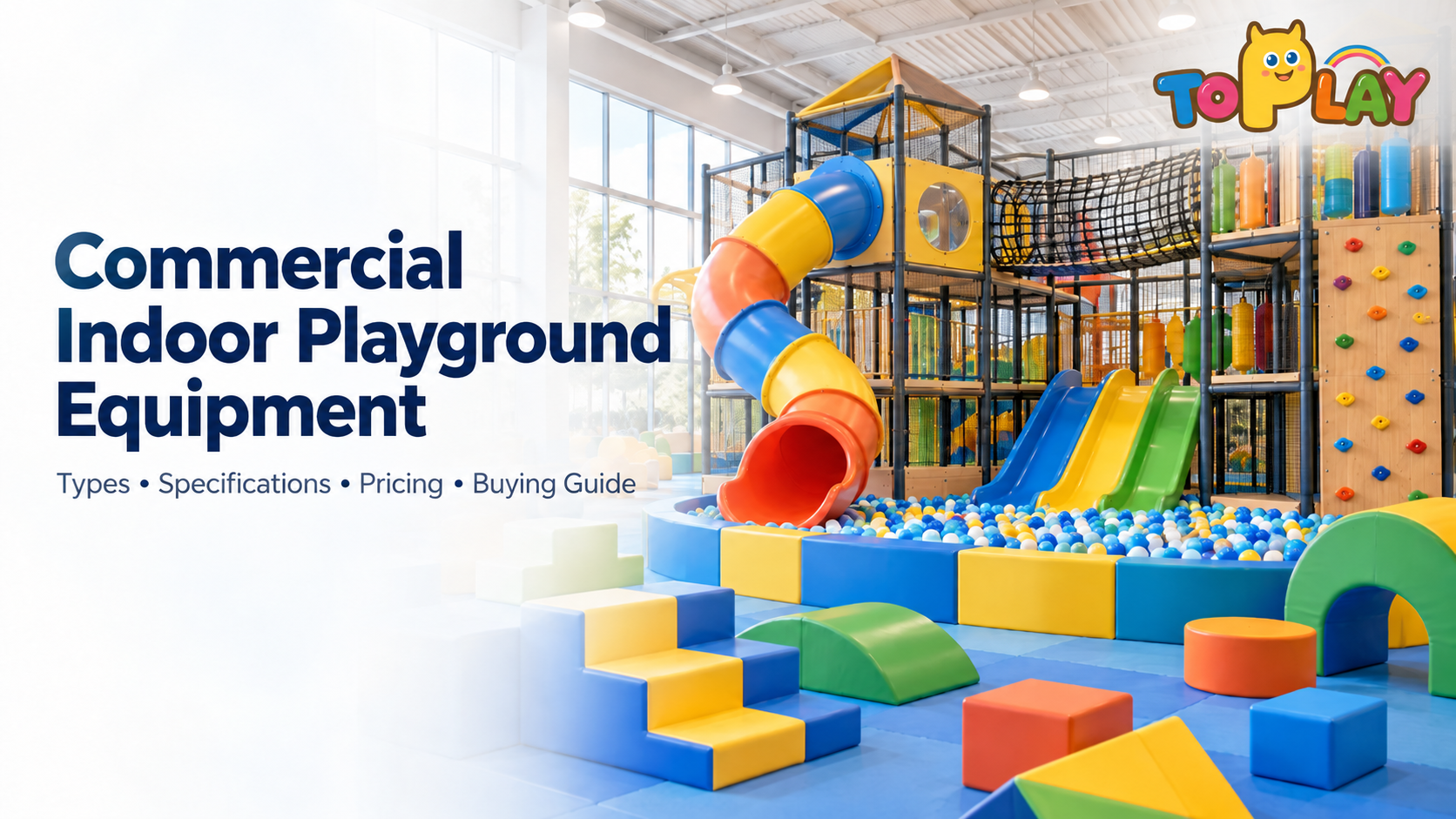
Commercial Indoor Playground Equipment: Types, Specifications, Pricing, and Buying Guide

Project Build Support
Need an indoor playground layout before your next quote?
Send venue size, ceiling height, age range, theme direction and opening schedule. Toplay can match the play route, safety surface and delivery scope before you lock the quotation.
Layout fitFootprint, traffic and age zones
Build scopeEquipment, surface and installation
Quote pathFactory review before RFQ
RFQ Checklist
What to include for faster project matching
Venue and capacity
Floor size, ceiling height, entrance route, target age groups and daily visitor expectations.
Theme and operation
Brand direction, supervision plan, opening timeline and any food, retail or party-room requirements.
Delivery context
Send Project Details
City, floor access, installation window, local review needs and budget direction.
Step into an indoor playground, and the first things you notice may be colorful slides, climbing towers, and ball pits. But if you are an operator preparing to invest in or purchase equipment, your first step should not be choosing an attractive rendering. Instead, start by understanding how your venue, target users, equipment structure, and ongoing operations fit together.
Indoor playground equipment typically includes multi-level play structures, soft play areas, slides, climbing facilities, commercial trampolines, ninja obstacle courses, and themed interactive environments. The right equipment mix depends on usable floor area, clear ceiling height, target age groups, and your business model—not a supposed list of the “world’s ten most popular attractions.”
Drawing on product information published on the official website of Guangzhou Toplay Amusement Equipment Co., Ltd. and information from relevant standards organizations, this guide explains how to select equipment, interpret specifications, calculate budgets, and compare manufacturers. Details that require project-specific confirmation are explicitly identified as “verify during the quotation stage,” rather than presented as fixed Toplay specifications.
What Is Commercial Indoor Playground Equipment?
Commercial indoor playground equipment consists of play systems designed for ongoing use in public spaces such as children’s play centers, family entertainment centers (FECs), shopping malls, kindergartens, childcare facilities, and family restaurants. It is not simply an enlarged version of home play equipment: structural design, circulation routes, supervision sightlines, cleaning and maintenance, installation documentation, and operating requirements must all suit commercial conditions.
It is particularly important to distinguish the technical classifications of different facilities. Fully enclosed soft play structures, freestanding open climbing facilities, and commercial trampoline courts may occupy the same indoor venue, but they do not necessarily fall under the same safety standards or inspection requirements. A theme is a matter of visual design; facility type and actual use determine technical documentation and safety management requirements.
What Are the Main Types of Indoor Playground Equipment?
What Are the Main Types of Indoor Playground Equipment?
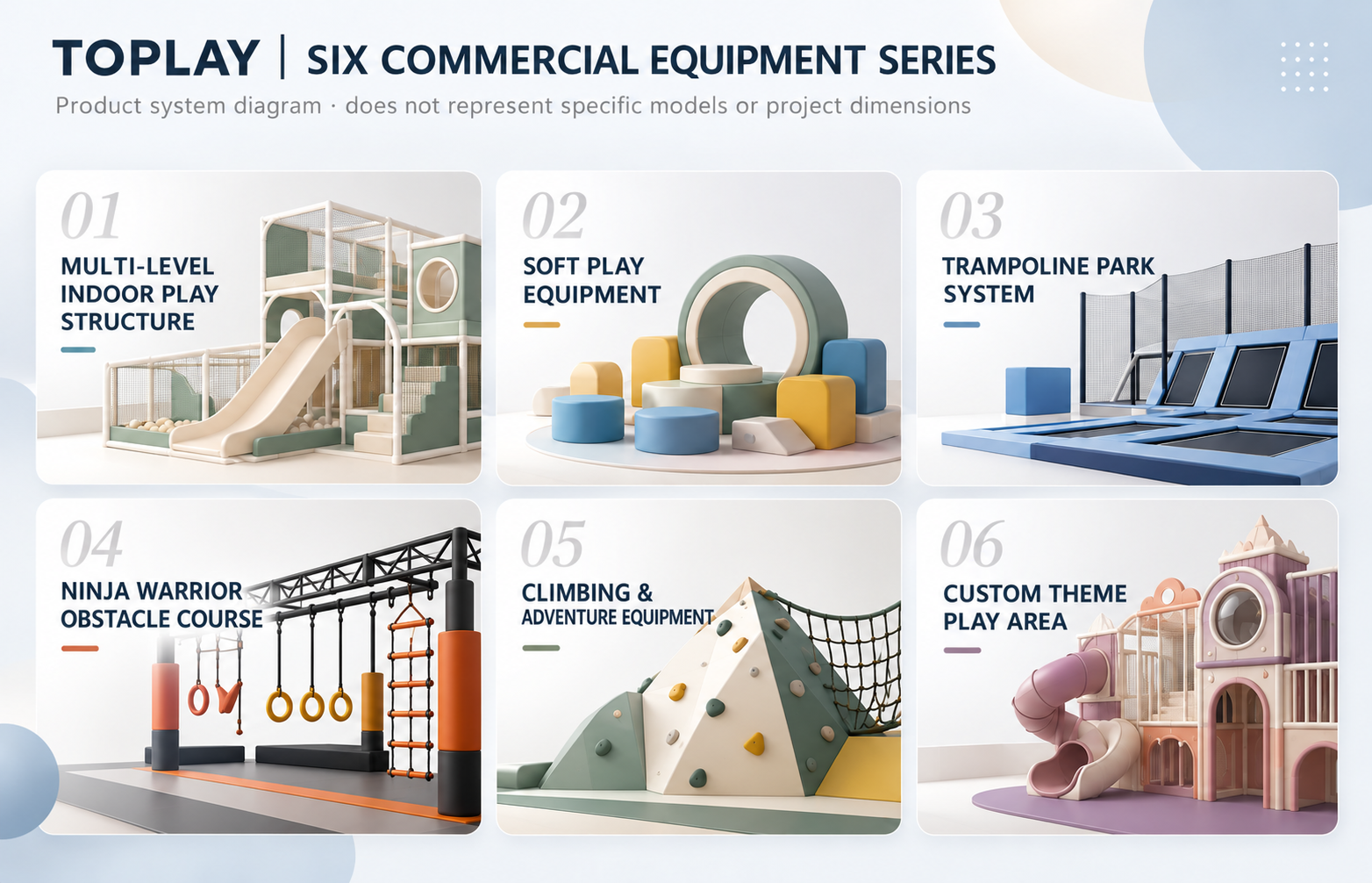
Commercial indoor playground equipment primarily includes multi-level indoor play structures, soft play equipment, commercial trampolines, ninja obstacle courses, indoor climbing equipment, and themed play environments built around these attractions. Each category differs in play style, intended age groups, space requirements, and operational management.
For playground investors, choosing equipment is not simply about buying more slides, trampolines, or climbing attractions. It is about creating an appropriate activity mix for the target audience and venue positioning.
For example, a small play café serving toddlers and families will generally benefit from low-level soft play as its core attraction. A large family entertainment center (FEC), by contrast, can combine multi-level play structures with trampolines, ninja challenges, and climbing zones to serve different age groups.
The following sections introduce six common categories of commercial indoor playground equipment, their features, and their suitable applications.
1. Multi-Level Indoor Play Structures
Multi-level indoor play structures are a core attraction in many large commercial indoor playgrounds, bringing climbing, sliding, exploration, and interactive play together in a continuous three-dimensional space. They are often worth prioritizing when a venue wants to make better use of its available height and offer a wider variety of activities.
A typical multi-level indoor play structure may include tube slides, wave slides, elevated platforms, net bridges, crawl tunnels, padded obstacles, ball pits, and interactive play components. Children can start on a lower platform, climb through nets and connecting passages into different zones, and return to ground level via slides, forming a complete play circuit.
The advantage of this design is continuity between activities. Rather than scattering multiple standalone attractions throughout the venue, a multi-level structure gives children varied movement experiences within one system and allows operators to arrange complementary activities around the main structure.
Toplay offers multi-level indoor play structures customized to site dimensions, combining different slides, climbing elements, net bridges, and soft play areas within one design. For venues with beams, columns, locally low ceilings, or irregular floor plans, layouts need to reflect actual building conditions rather than rely on fixed-size products.
More levels do not automatically make a structure better. The number and height of levels must account for the lowest usable clear height, platform arrangements, children’s entry and exit routes, fire protection installations, and staff supervision sightlines.
For projects destined for the United States, accessible entrances must also be considered when the equipment is classified as a soft contained play structure. According to the U.S. Access Board’s play area accessibility guidance, structures with three or fewer entrances must have at least one entrance on an accessible route; structures with four or more entrances must have at least two. This highlights the need to address accessibility during early layout planning rather than after installation.
Suitable applications: Large indoor playgrounds, family entertainment centers, shopping mall children’s entertainment areas, and commercial venues seeking to offer multiple activities through three-dimensional structures.
2. Soft Play Equipment for Younger Children
Soft play equipment uses padded structures, foam components, and low-height activities to provide toddlers and preschoolers with crawling, balancing, exploration, and interactive play experiences.
Compared with equipment focused on height, speed, or physical challenge, soft play is better suited to spaces centered on younger children and parent–child interaction.
Common soft play components include padded climbing blocks, foam steps, low slides, crawl tunnels, interactive walls, sensory play panels, padded platforms, and ball pits. Components can be combined into low-level activity routes or arranged as separate play zones.
For example, a play café serving children aged two to five could place foam steps, a low slide, and a crawl tunnel in one activity zone, with interactive panels and role-play components around it. This allows children to enjoy varied activities within a relatively concentrated space.
Toplay’s soft play products can be customized to floor area, target ages, theme colors, and activity types. Smaller commercial venues can prioritize compact layouts that are easy to supervise and clean, while larger early-years centers can separate physical activities, sensory exploration, and quiet play into distinct zones.
When purchasing commercial soft play equipment, buyers should also examine material construction, including the abrasion resistance of padded coverings, the suitability of foam components, the treatment of connection points, and whether high-contact areas are easy to clean and replace.
In terms of technical standards, ASTM F1918-21 is a safety performance specification for soft contained play equipment, with a user size range extending from the 5th-percentile two-year-old to the 95th-percentile twelve-year-old. This defines the standard’s scope; it does not mean every soft play installation is suitable for all children aged two to twelve. Actual age suitability must be confirmed against the product design and specific configuration.
Suitable applications: Early-years play centers, play cafés, kindergartens, hotel children’s areas, family restaurants, and small commercial indoor playgrounds.
3. Commercial Trampoline Park Equipment
Commercial trampoline equipment suits venues seeking high-energy physical entertainment and group interaction. It is a common attraction category in integrated family entertainment centers and indoor sports parks.
Modern commercial trampoline parks extend beyond basic free-jump areas. Combining different activity modules allows venues to create a more varied entertainment experience.
For example, a free-jump area provides the basic activity space; basketball slam dunk combines bouncing with shooting; and trampoline dodgeball adds group interaction and team play.
Some trampoline attractions also incorporate foam pits, airbag landing zones, and interactive game equipment to offer varied activities for participants with different abilities.
Toplay’s commercial trampoline range includes multiple activity modules that can be combined according to venue size, target audience, and business model. In large integrated entertainment venues, trampolines can also sit alongside ninja courses or other adventure activities while remaining independently managed zones.
However, trampolines differ significantly from traditional soft play in activity intensity, structural design, and operating requirements. The same equipment management approach cannot simply be applied to both.
ISO 23659:2022 explicitly covers the design, construction, inspection, maintenance, and basic operational safety requirements of trampoline parks and trampoline areas within multi-activity venues. For commercial buyers, this means assessing not only attraction appeal but also trampoline beds, connecting components, protective padding, landing facilities, and daily inspection procedures.
Suitable applications: Commercial trampoline parks, indoor sports parks, family entertainment centers, youth activity centers, and integrated entertainment venues seeking high-energy attractions.
4. Ninja Obstacle Course Equipment
Ninja obstacle course equipment offers children and teenagers a more challenging play experience through sequences of hanging, gripping, climbing, balancing, and traversing movements.
Unlike ordinary indoor slides or soft play areas, ninja facilities are generally designed around a route with a clear start, finish, and obstacle sequence. Participants complete successive challenges to reach the end.
Common ninja obstacles include monkey bars, hanging rings, balance beams, cargo nets, swinging steps, and warped walls.
Not every component needs to appear on the same course. A well-planned ninja course offers appropriate difficulty levels based on users’ ages, physical abilities, and site conditions.
For example, a challenge zone for younger children could use lower balance obstacles, shorter routes, and relatively simple climbing elements. Areas for older children and teenagers can incorporate continuous hanging, gripping, and traversing obstacles to increase the challenge.
Toplay offers customizable ninja obstacle courses, with obstacle types, activity sequences, and route lengths tailored to venue layouts and target users.
From an operational perspective, ninja facilities can help differentiate a venue from a conventional children’s playground. Multi-level play structures emphasize free exploration, whereas ninja courses focus more on goals, challenges, and repeated attempts, adding a different kind of activity experience.
However, because ninja facilities involve different heights, movement directions, and physical actions, buyers should pay particular attention to landing zones, impact protection, obstacle spacing, and supervision conditions.
Suitable applications: Family entertainment centers, indoor adventure parks, children’s challenge centers, youth activity spaces, and integrated sports and entertainment venues.
5. Indoor Climbing and Adventure Equipment
Indoor climbing and adventure equipment uses three-dimensional routes, climbing structures, and rope-net systems to create a stronger sense of exploration for children. It is particularly suitable for commercial venues with sufficient vertical space.
Common equipment includes indoor climbing walls, rope-net towers, cargo nets, rope bridges, multi-level adventure structures, and other three-dimensional climbing systems.
Different facilities offer different play experiences.
For example, climbing walls can offer varied challenges through hold placement and route design; rope-net structures allow children to move in multiple directions; and multi-level adventure towers connect different climbing activities into complete exploration routes.
In venues with higher ceilings, thoughtful use of vertical space can increase activity variety. This does not mean every high-ceilinged space is suitable for a large climbing installation.
Toplay offers a range of commercial climbing and adventure equipment, with climbing components configured to site height, spatial structure, and target audience, and integrated with other indoor play attractions.
During design, the support system, anchoring conditions, operating heights, landing protection, and maintenance access must all be clearly confirmed.
In particular, freestanding climbing walls, three-dimensional rope-net structures, and climbing components inside enclosed play systems may have different design and safety requirements. Similar appearances do not justify using the same technical solution.
Suitable applications: Adventure-themed parks, large family entertainment centers, indoor climbing activity zones, and children’s entertainment venues seeking more exploratory activities through vertical space.
6. Themed Play Environments
A themed play environment is not a separate category of physical activity equipment. Instead, it brings different indoor play attractions together into a complete entertainment experience through coordinated visual design, equipment forms, and scenic elements.
Common themes include jungle, ocean, space, candy, castles, and role-play towns.
For example, a jungle-themed playground could turn a multi-level play structure into a treehouse, using climbing nets, rope bridges, and green padded components to create an adventure atmosphere. An ocean-themed venue could combine blue ball pits, wave-shaped slides, and marine-life decorations into a consistent setting.
Theme design affects not only visual appearance but also how children understand play routes. Entrances, activity zones, and themed landmarks can act as cues that help children recognize and explore the venue.
For commercial operators, a themed environment can also reinforce brand identity, turning ordinary slides, climbing facilities, and interactive components into a distinctive play space.
Toplay’s themed customization service combines indoor playground equipment with theme colors, decorative forms, and venue design for commercial projects seeking a differentiated environment.
However, theme design should build on a sensible equipment layout and play experience rather than add decoration purely for visual impact. Highly elaborate custom forms can increase manufacturing, shipping, and long-term maintenance costs, so buyers should consider budget, material durability, and ease of component replacement together.
Suitable applications: Branded playground chains, themed shopping mall play areas, family entertainment centers, hotel children’s spaces, and large custom commercial play projects.
How Do You Choose Indoor Playground Equipment for Your Venue Type?
When selecting indoor playground equipment, the priority is not the number of equipment categories you offer. It is how well those attractions match your target users, venue size, and commercial positioning.
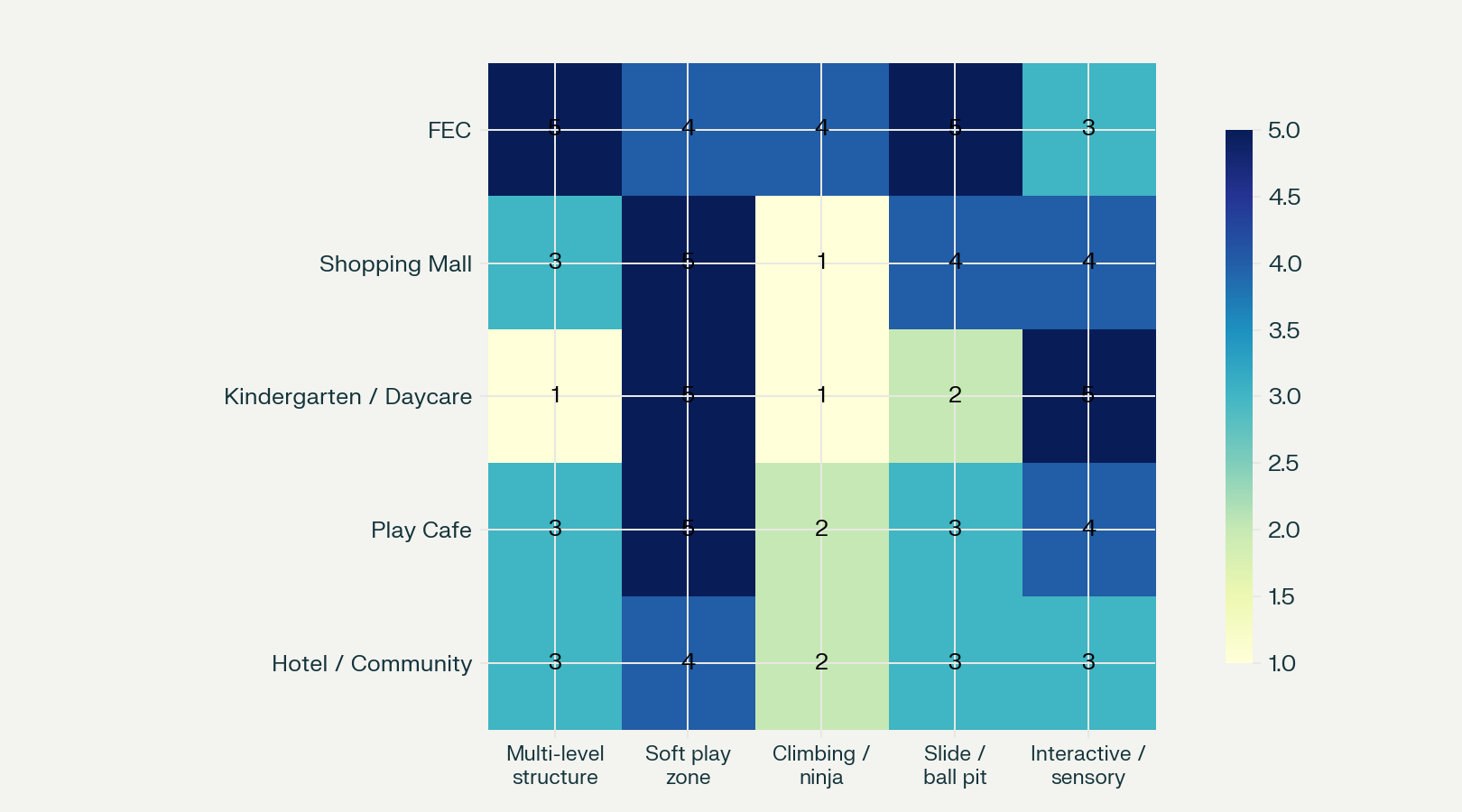
The following is a brief selection reference:
| Venue Type | Priority Equipment | Primary Objective |
| Small Play Café | Soft play, low slides, interactive components | Early-years activities and parent–child interaction |
| Early-Years Play Center | Soft play, sensory play, low-level climbing | Crawling, balance, and exploration |
| Shopping Mall Children’s Area | Multi-level structures, soft play, themed environments | Varied play and visual appeal |
| Large Family Entertainment Center | Multi-level structures, ninja courses, climbing, and separate trampoline zones | Activities for different age groups |
| Sports and Entertainment Center | Commercial trampolines, ninja courses, climbing equipment | Movement, interaction, and challenges |
| Themed Children’s Playground | Combined equipment categories and custom theming | A coherent play experience and distinctive brand identity |
These configurations are general planning directions, not fixed purchasing packages. Specific choices must also account for actual clear height, usable floor area, activity intensity, age zoning, fire safety conditions, and local regulations.
For investors planning a customized commercial playground, Toplay offers multi-level play structures, soft play, commercial trampolines, ninja courses, climbing facilities, and themed solutions, with equipment combinations designed around site conditions and target users.
Ultimately, a suitable indoor playground equipment plan should do more than assemble multiple attractions. Each play zone should have a clear purpose, and the equipment should work together to create a safe, coherent, and engaging play experience.
Which Indoor Playground Equipment Suits Different Commercial Venues?
A shopping mall play area and a separately ticketed family entertainment center may use similar products, yet their operating priorities can be very different. Rather than adding more attractions indiscriminately, define the primary customers, supervision model, queuing conditions, and reasons for repeat visits before deciding on the equipment mix.
| Commercial Venue | Potential Equipment Mix | Key Decisions |
| Play Café / Small Venue | Low-level soft play, crawl tunnels, sensory and role-play activities | Supervision sightlines, entrance control, cleaning |
| Shopping Mall Children’s Area | Compact themed structures and age zones | Entrance visibility, public circulation, building approvals |
| Separately Ticketed FEC | Multi-level structures, slides, separate toddler area | Activity routes, staff access, repeat-visit experience |
| Trampoline-Led Venue | Plan jump zones first, then consider ninja or soft play | Rule separation, clear height, regular inspections |
| Kindergarten / Childcare | Low climbing, padded equipment, sensory panels | Age suitability, supervision, daily operating procedures |
For example, a play café commonly needs parents to observe younger children from their seats without the play entrance conflicting with food-service routes. Low-level soft play may be more practical here than a three-story tower. A standalone FEC may place greater emphasis on continuous climbing-and-sliding routes, multiple age zones, and high-energy experiences. A trampoline-led venue should first plan its jump courts and independent operating procedures, then consider a soft play area for younger siblings who are not participating.
A useful screening question is: “If we removed this attraction, what important experience would customers lose?” If the answer is unclear, the venue may be buying a fuller-looking space rather than a better commercial product.
How Much Floor Area and Ceiling Height Are Needed, and How Do You Estimate Usable Space?
Manufacturers need the area genuinely available for equipment and the clear height beneath the lowest obstruction in that area. The gross area stated in a lease does not account for columns, emergency exits, reception, seating, building services, or maintenance access. A “price per square meter” with no stated conditions is only a preliminary budget indicator, not a final project quotation.
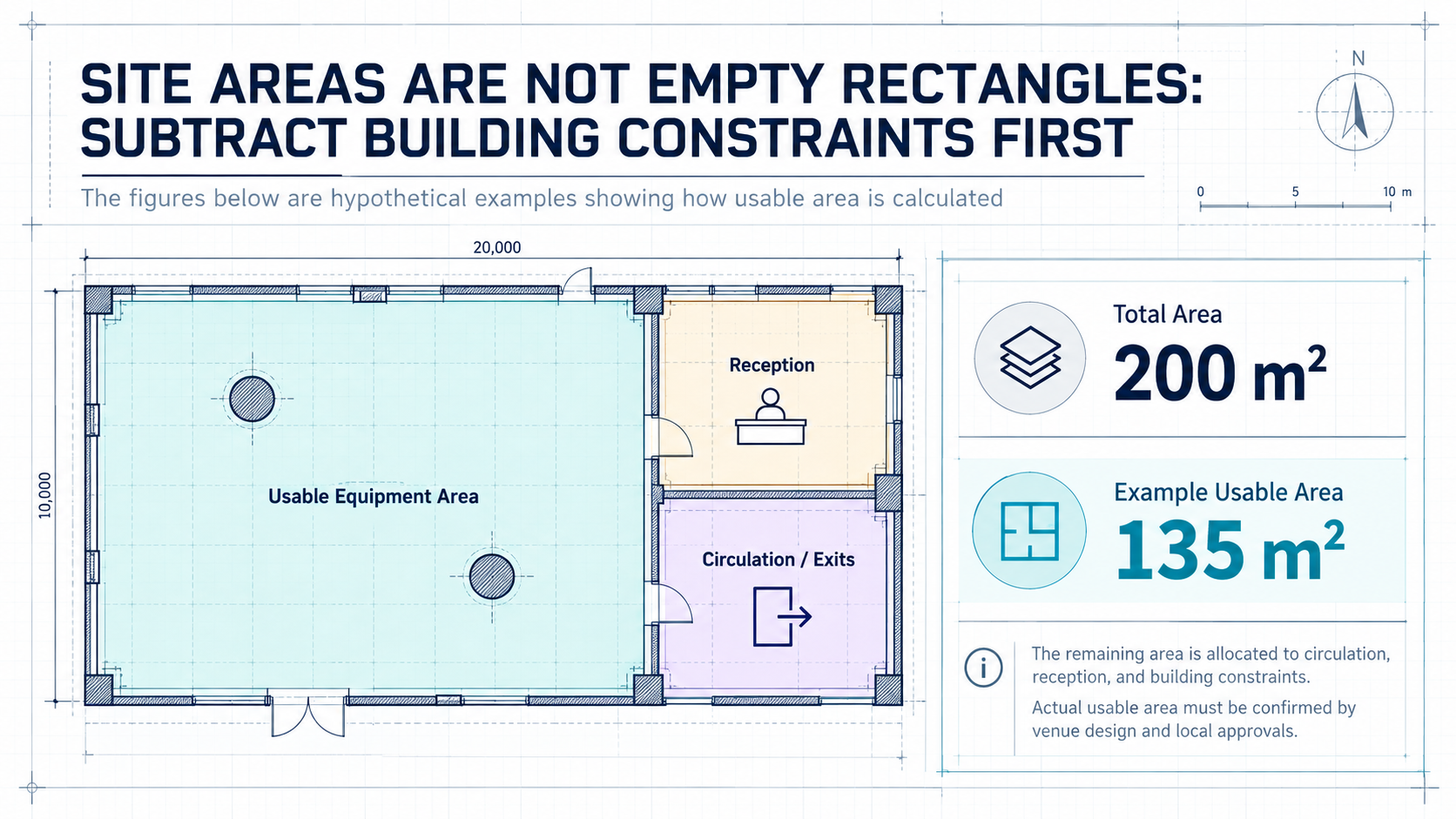
Suppose a 200-square-meter venue reserves 65 square meters for circulation, reception, waiting space, and fixed obstructions. The theoretical equipment area would be approximately 135 square meters. This only illustrates how to define the budget scope; it is not a design approved for fire safety, accessibility, or site permitting. Actual projects may need to reserve more or less space.
Before requesting a quotation, prepare the venue’s length and width, the lowest clear height beneath sprinklers and ducts, column positions and dimensions, door and exit locations, target ages, and destination country. Toplay’s website states that discussions can begin with a DWG file or a dimensioned hand-drawn floor plan. Site photographs can also help reveal obstacles that drawings do not fully explain.
What Materials Are Used in Commercial Indoor Playground Equipment, and How Can You Assess Quality?
Colorful padding does not reveal the quality of the materials inside. When comparing suppliers, examine steel frames, foam, PVC covering fabrics, nets and ropes, slide plastics, and connectors separately, because they differ in wear patterns, maintenance methods, and applicable testing conditions.
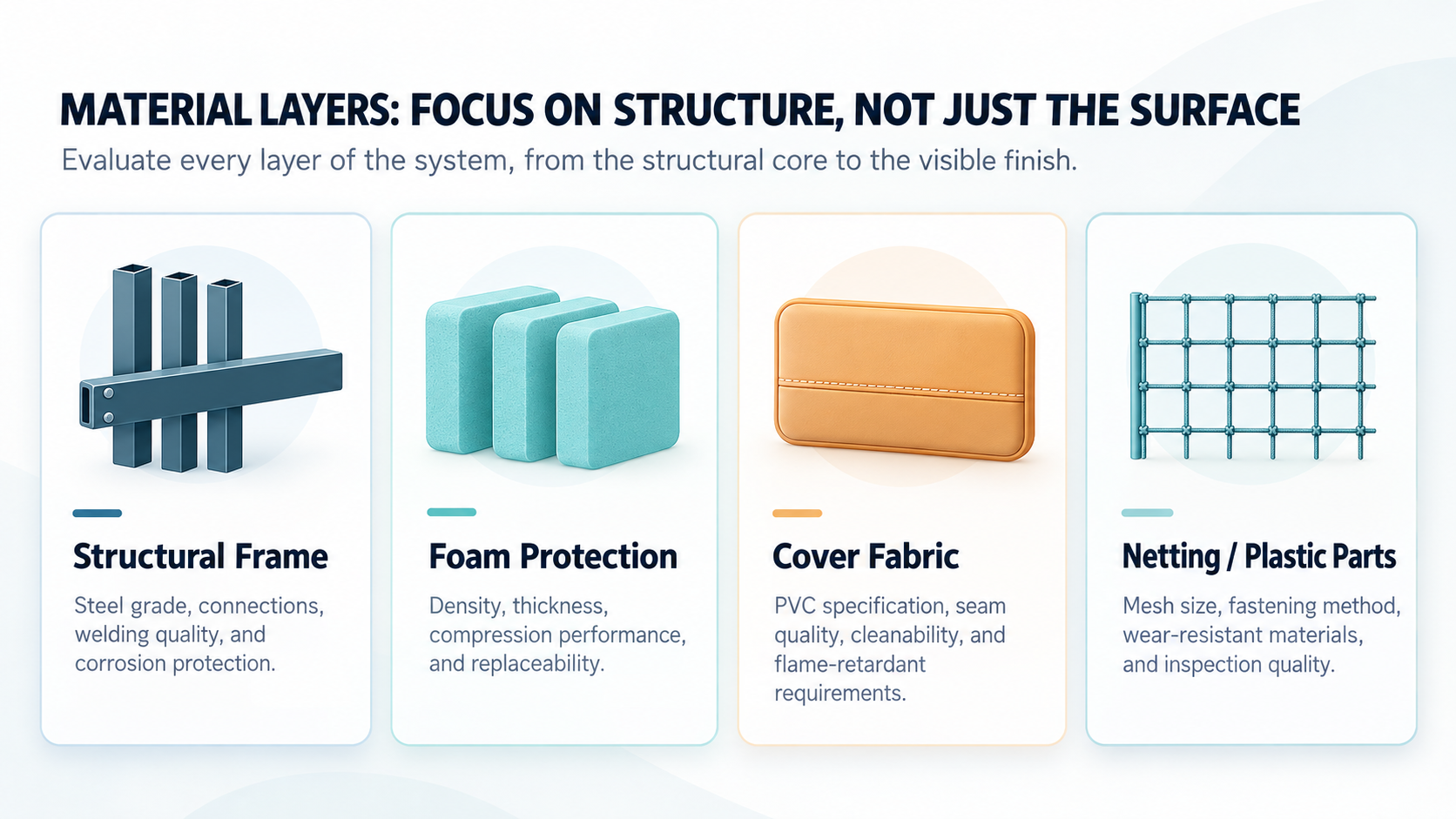
Toplay’s indoor structure website lists galvanized steel tube frames, rotationally molded LLDPE slides, HDPE/PP panels, PU/PE foam, PVC-coated fabrics, nylon enclosure nets, climbing ropes, and other accessories. These are publicly listed material categories, not a guarantee that every order uses all of them.
For load-bearing frames, request steel grades, tube dimensions, connection methods, and welding and corrosion-protection details. For foam, request material type, density, thickness, and compression properties. For coverings, check fabric specifications, seams, cleaning compatibility, and any flame-retardancy or other test evidence required at the destination. Slides, nets, ropes, and fasteners also need corresponding material descriptions and inspection methods.
Comparing foam density or PVC thickness alone is unreliable. Thicker materials can still fail if seams are poorly made, while a sufficiently strong structure may create a maintenance burden if it cannot be opened for inspection. The real question is whether the materials, assembly design, and actual operating conditions are consistent.
Toplay’s website lists in-house steel-frame processes including tube cutting, sawing, drilling, bending, several welding methods, grinding, and polishing. It also states that some rotationally molded slides, nets, ropes, and padded accessories come from specialist partner suppliers. This helps buyers verify manufacturing responsibilities more effectively than a blanket claim that every component is made in-house.
How Much Does Indoor Playground Equipment Cost, and How Can You Compare the True Purchase Cost?
There is no single fixed price for commercial indoor playground equipment that suits every project. Key variables include the equipment mix, usable area, ceiling height, materials and finishes, structural complexity, custom theming, international logistics, and installation responsibilities. Even similar-looking renderings can represent very different scopes of supply.
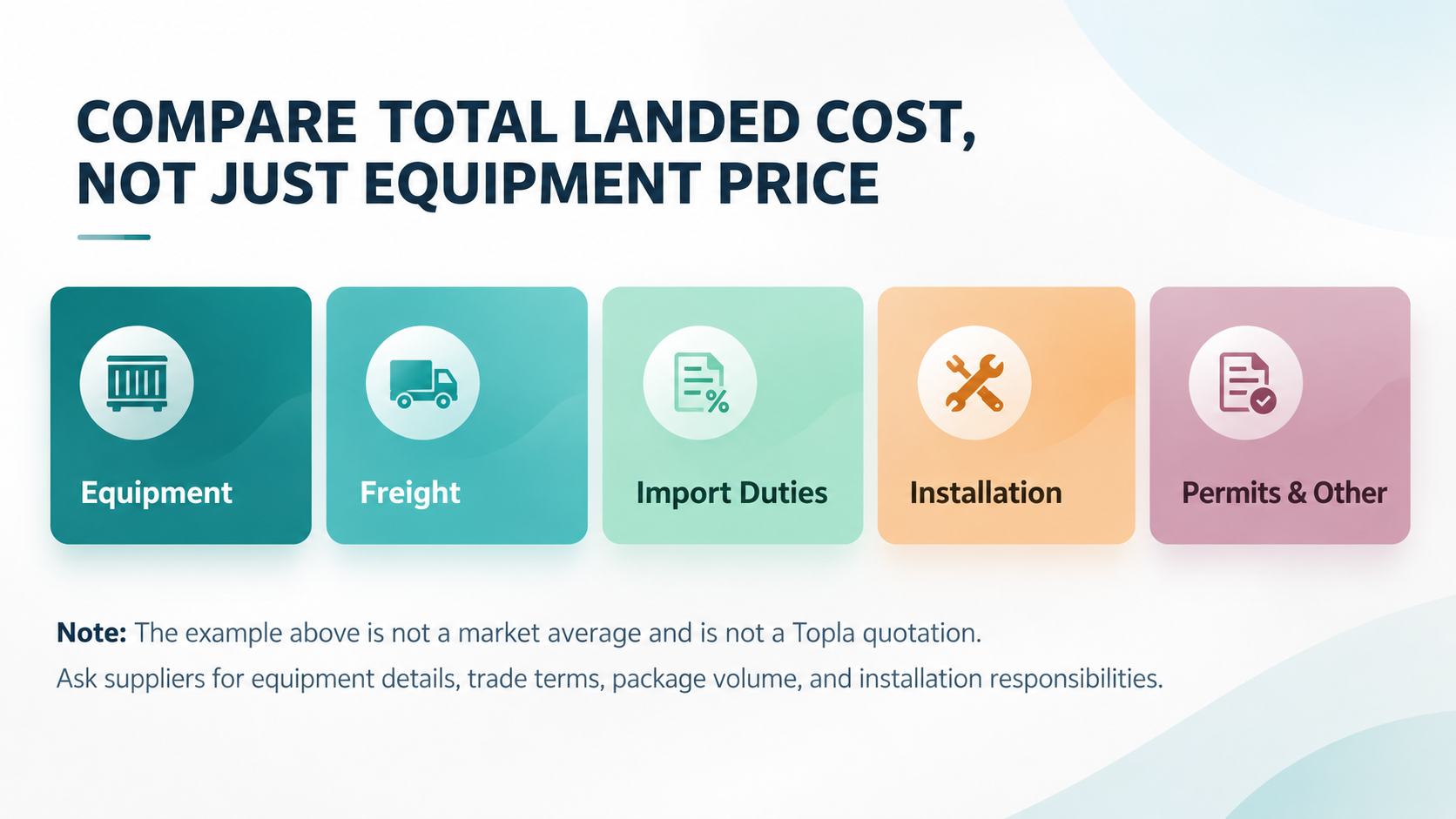
Do not compare only the equipment price per square meter. Compare the total cost of having the equipment delivered and installed. At a minimum, separate equipment value, packaging, freight and insurance, customs clearance and duties, unloading, site works, installation labor, inspection and training, and wear parts. If one supplier quotes FOB and another quotes CIF, the latter does not automatically include local installation or approval costs.
A well-prepared RFQ (request for quotation) asks all suppliers to quote against the same approved drawings and equipment list, specifying the trade term and named location, packing volume, installation support, exclusions, and payment milestones. This makes it easier to identify whether a low quotation omits necessary responsibilities.
Which Safety Standards Should Indoor Playground Equipment Meet?
There is no simple rule that one certificate covers every attraction in a commercial playground. ASTM F1918-21 addresses soft contained play equipment within its scope; ASTM F2970-25 addresses commercial trampoline courts; and EN 1176-10 addresses fully enclosed play equipment in relevant European contexts. Standalone climbing facilities, public playground equipment, and other mechanical activities may require different documentation. Buyers must check the destination requirements and current editions.
Rather than requesting only an image of a “certificate,” ask for test reports that clearly correspond to the models, configurations, and component scope being purchased. Ask what was tested, which edition of the standard was used, who issued the report, which components and site installation conditions fall outside its scope, and whether the documentation applies in the final operating location.
Factory testing cannot replace independent local reviews of building, fire safety, accessibility, electrical, and operating-license requirements. Confirm installation instructions, pre-operation inspection procedures, daily cleaning guidance, and component maintenance documents before paying the final balance—not after the equipment arrives.
How Do You Choose a Reliable Indoor Playground Equipment Manufacturer?
Choosing a reliable indoor playground equipment manufacturer means assessing custom design capabilities, material and manufacturing quality, safety compliance documentation, real project experience, and installation and after-sales support—not just equipment prices. For a commercial playground, equipment procurement is generally a long-term investment. The manufacturer’s capabilities affect not only the play experience but also project costs, installation schedules, and ongoing operations and maintenance.
Cross-border buyers, in particular, need to examine the connection between design, production, and delivery. A capable commercial indoor playground equipment manufacturer should do more than supply catalog products: it should help customers move from equipment selection to project implementation based on actual site conditions.
1. Assess Custom Design and Space Planning Capabilities
A reliable indoor playground equipment manufacturer should design equipment around the customer’s actual venue rather than simply sell fixed-size attractions.
Every commercial venue has different building conditions. Shopping malls may face constraints involving columns, fire escape routes, and ceiling height, while large FECs may need to accommodate multi-level structures, soft play, and other independently operated activity zones.
Buyers should therefore prioritize manufacturers that provide 2D layouts and 3D renderings, and examine whether those designs genuinely account for site dimensions, usable clear height, target ages, circulation, and everyday supervision.
For example, in an irregularly shaped venue, a professional manufacturer should adjust slide positions, platform connections, and age zones around columns and passageways rather than simply shrink an existing design.
More importantly, good design should do more than make equipment fit inside the venue. It should support smooth play, convenient staff supervision, and sufficient space for cleaning and routine maintenance.
2. Check Material Quality, Manufacturing Processes, and Safety Documentation
Commercial indoor playground equipment must withstand frequent use, making material specifications, structural quality, and safety documentation more important than appearance alone.
Two apparently similar installations may use substantially different steel structures, foam, PVC coverings, enclosure nets, and connectors. These materials affect service life as well as cleaning, replacement, and maintenance costs.
For steel structures, examine material specifications, weld quality, and corrosion protection. For soft play, confirm foam type, covering materials, seam construction, and cleaning requirements. For climbing and obstacle equipment, investigate connections, protective measures, and structural installation conditions.
Do not judge quality solely from descriptions such as “High Quality Materials” or “Commercial Grade.” A more reliable approach is to request specific material specifications, relevant test documents, production photographs, and quality inspection records that match the actual models being purchased.
Different indoor playground equipment categories may also fall under different safety standards. For example, soft contained play equipment involves ASTM F1918, while commercial trampoline parks may require consideration of ISO 23659. Buyers should confirm applicable standards according to equipment type and target market rather than assume one generic certificate means every product meets local requirements.
3. Review Completed Projects and Factory Production Capabilities
Real project experience is an important indicator of an indoor playground equipment manufacturer’s delivery capabilities, but the number of projects alone cannot replace quality verification.
When choosing a manufacturer, prioritize completed projects similar to your venue in scale and equipment type. Compared with 3D renderings alone, actual installation photographs and project videos help buyers understand the finished layout, appearance, and integration of components.
For example, a manufacturer that mainly showcases small toddler soft play projects does not necessarily have comprehensive design and manufacturing experience with large multi-level structures or commercial trampoline parks.
Beyond project references, examine actual factory capabilities, including steel-frame fabrication, welding, padded component production, quality inspection, trial assembly, and packaging.
For custom equipment, consistency between design drawings and actual production is particularly important. Production photographs of key structures, trial-assembly records, and pre-shipment inspection documents make it easier to confirm that an order is being fulfilled as agreed.
Factory size, production machinery, and the number of export destinations are only reference points; they cannot independently prove the manufacturing quality of a particular project. Order-specific specifications, inspection records, and final delivery results are more persuasive.
4. Compare Complete Project Quotations, Not Just Equipment Unit Prices
The lowest indoor playground equipment quotation does not necessarily mean the lowest actual project cost. In customized commercial projects, quotation scopes can vary significantly between manufacturers.
For example, one quotation may include equipment design, primary structures, padded components, and packaging, while another may also include shipping coordination, installation guidance, or selected supporting facilities. Comparing only the total amount can obscure differences in the actual scope of supply.
Buyers should confirm whether quotations specify equipment dimensions, main materials, activity components, design fees, packaging, shipping, installation support, and after-sales service, and clearly identify separately payable costs.
Overseas customers sourcing indoor playground equipment from China should also understand the responsibility boundaries of trade terms such as EXW, FOB, and CIF, including whether destination-port clearance, duties and taxes, unloading, and local installation labor are included.
A reliable manufacturer should provide a clear, comparable project quotation rather than a total price without configuration details.
When comparing suppliers, ask them to quote against the same site drawings, equipment requirements, and delivery conditions so that you can identify the reasons for price differences more accurately.
5. Confirm Installation Guidance, After-Sales Service, and Long-Term Maintenance Support
Purchasing commercial indoor playground equipment does not end when the goods leave the factory. Installation and long-term maintenance are equally important considerations when selecting a manufacturer.
For overseas projects, buyers typically need to coordinate international shipping, unloading, equipment assembly, and pre-opening inspections. A lack of clear installation drawings, component identification, and technical guidance can make on-site installation more complicated.
Confirm in advance whether the manufacturer provides installation instructions, remote technical support, and separately agreed on-site technician services. The costs, responsibilities, and local staffing requirements associated with different installation arrangements should also be specified in the contract.
During long-term operation, padding, enclosure nets, activity components, and certain connectors may also require inspection, repair, or replacement.
Buyers should establish whether wear parts can be purchased separately, components can be accurately identified, warranty coverage is clear, and technical support is available when problems arise.
A manufacturer worth partnering with over the long term should focus not only on initial delivery but also on helping customers establish clear maintenance documentation and after-sales communication channels.
How Can You Use These Criteria to Evaluate Toplay Further?
When shortlisting commercial indoor playground equipment manufacturers, prioritize suppliers that can connect site design, custom manufacturing, and delivery support.
Guangzhou Toplay, for example, presents multi-level indoor play structures, soft play, commercial trampolines, ninja obstacles, climbing equipment, and themed play environments on its website, alongside manufacturing processes such as steel-frame cutting, tube bending, welding, and padded component fabrication.
For design services, Toplay offers 2D layouts and 3D concepts based on customer site drawings and coordinates production, shipping, and installation support according to project needs.
Buyers planning a commercial indoor playground can explore Toplay’s indoor playground equipment range and review its custom design and project delivery services to assess whether the specific services match their venue and budget requirements.
Whether you choose Toplay or another manufacturer, the final decision should be based on actual design drawings, material specifications, contract terms, relevant safety documentation, and delivery responsibilities.
The key to choosing a reliable indoor playground equipment manufacturer is finding a long-term partner that can turn a design into equipment meeting project requirements while maintaining clear communication and responsibility allocation throughout procurement, production, installation, and ongoing maintenance.
Why Consider Toplay’s Custom Indoor Playground Equipment?
Start with a Site-Specific Design, Not a Product Picture
Toplay’s indoor play structure page states that customers can begin discussions with a DWG floor plan or a hand-drawn plan showing dimensions, entrances and exits, column positions, and minimum clear height. Its space planning service focuses on integrating activity zones, circulation, and site constraints. For commercial venues with beams, fire-service pipes, or irregular column grids, this can reveal conflicts between equipment levels, slide exits, parental sightlines, and maintenance access at an early stage.
The website states that a preliminary layout and quotation can be provided within approximately 72 hours of receiving a floor plan. This refers to an initial response time, not a guarantee of complete construction drawings, regulatory approvals, or final project delivery. The actual scope must still be confirmed in the quotation and drawings.
Combine Six Product Lines Around One Operating Concept
Toplay’s commercial equipment catalog covers multi-level indoor play structures, soft play areas, trampoline parks, ninja obstacle courses, climbing and adventure facilities, and themed play environments. For an FEC, this means identifying a main attraction first, then discussing how toddler zones, challenge areas, and themed visuals can work together on one floor plan instead of independently buying six separate equipment categories.
For example, a family venue focused on preschoolers may prioritize low-level padded activities and routes visible to parents. A larger FEC may combine multi-level structures with separate ninja or trampoline zones. The safety boundaries, staffing arrangements, and applicable standards for those activities need separate review; a shared manufacturer does not mean one certificate covers everything.
Replace “High Quality” Claims with Verifiable Production Processes
In its manufacturing process information, Toplay publicly describes steel tube cutting, bending, welding, and surface treatment, including some mechanized welding processes. Compared with adjectives such as “premium materials,” process information helps buyers ask more specific questions: What are the steel grade and wall thickness? How are load-bearing joints connected? How is the corrosion-protection coating specified? What are the specifications, supply sources, and replacement methods for foam padding, PVC coverings, nets, and ropes?
These details should not be invented as uniform fixed specifications across all products. A more convincing approach is to request a project-specific bill of materials, structural drawings, applicable testing documentation, and actual factory processing or pre-shipment inspection records alongside the custom quotation.
Use Published Minimum Orders and Lead Times for Initial Budget Comparisons
Toplay’s indoor structure product page describes the minimum order as “one complete structure” and mentions that some area-priced soft play zones start at 20 square meters. It also lists approximate production windows of 15–35 working days for standard or modular structures and 20–60 working days for fully customized structures. These figures provide a starting point for buyers comparing smaller projects with fully customized installations.
However, they are not universal guarantees for all products. Other Toplay pages state different lead times, and shipping, destination customs clearance, and on-site installation are separate stages. Quotations should therefore itemize design approval, production, packaging, shipping, and installation support, with starting milestones and responsible parties agreed in the contract.
Clarify Export Shipping, Installation Documents, and After-Sales Scope
For overseas projects, the challenge is often not whether equipment can be manufactured, but whether it can be assembled according to the drawings after arrival. Toplay’s logistics and installation service page describes shipping and installation support, while its main commercial equipment page mentions installation instructions, dimensioned assembly drawings, and installation videos supplied with orders. For buyers, whether these documents match their purchased configuration matters more than a general promise of “one-stop service.”
During the quotation stage, confirm trade terms such as EXW, FOB, or other separately quoted terms; packing lists; responsibility for installation personnel; responsibility for local building and fire approvals; procedures for damaged or missing parts; and ongoing spare-parts supply. Toplay can be included on a shortlist, but the final choice still depends on whether these project documents are specific and actionable.
If you are planning a playground, first send Toplay your floor plan, minimum clear height, age groups, preferred attractions, destination country, and target opening date. Ask for a layout that separates the entrance, toddler area, high-energy zones, and staff circulation routes, followed by a quotation that clearly lists inclusions and exclusions.
Frequently Asked Questions About Indoor Playground Equipment
Which Type of Indoor Playground Equipment Is the Most Popular?
Multi-level structures, slides, soft play, climbing attractions, and trampolines are all common commercial equipment categories. However, this article has not identified an independently verifiable global sales ranking, so it does not label any category the absolute number one. The best equipment mix matches customer ages, the business model, and site conditions.
How Does Commercial Playground Equipment Differ from Home Equipment?
Commercial equipment must account for repeated public use, staff supervision, installation documentation, maintenance records, and applicable public-use requirements. Even if home equipment is described as durable or has certain test certificates, it cannot automatically be considered suitable for a commercial venue.
Can Indoor Playground Equipment Be Customized for a Small Space?
Yes. Toplay’s website offers soft play and indoor structure designs based on floor plans and publishes single-set or single-project minimum orders for different categories. However, the activities that actually fit depend on usable area, minimum clear height, entrance access, and local approvals. There is no universal minimum-area guarantee for every project.
How Long Does Production Usually Take After an Order Is Placed?
It depends on the product category and degree of customization. Toplay’s product pages publish different ranges, including 15–35 working days for standard structures, 20–60 working days for fully customized structures, and 30–60 days after soft play requirements are released. Request a contractual schedule with a clearly defined starting milestone, and allow additional time for shipping, customs clearance, and on-site installation.
What Documents Should You Obtain Before Placing an Order?
At a minimum, request approved drawings, component and material lists, equipment-specific safety test documentation, an itemized quotation with trade terms and exclusions, a production schedule, packing documentation, installation instructions, warranty terms, and maintenance guidance. These enable supplier comparisons and help prepare for acceptance checks and post-opening operations.
Conclusion: Understand Your Site and Users Before Buying Indoor Playground Equipment
A successful indoor playground is not about purchasing as many attractions as possible. It starts with defining the core customers, site conditions, and operating model, then organizing climbing, sliding, imaginative play, and high-energy activities into an experience that is safe, manageable, and maintainable over time.
Start by reviewing Toplay’s commercial indoor playground equipment product page, then submit your dimensions and operating requirements to request a site-specific configuration and quotation. When comparing final proposals, focus on drawings, materials, documentation, and delivery responsibilities—not just attractive renderings or the lowest price.