
Get in touch with Guangzhou Toplay amusement equipment co. Company

Updated September 2026
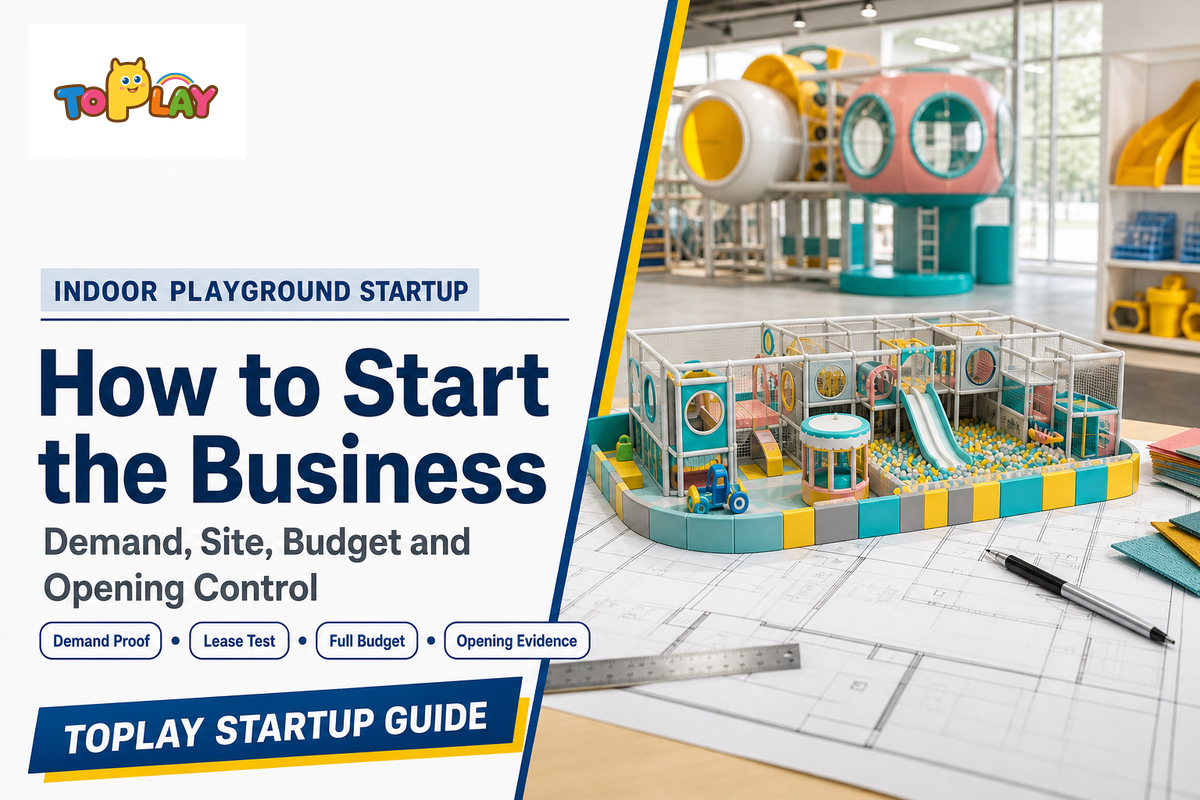
How to start an indoor playground business is a staged planning process: prove demand before signing a lease, build a complete opening budget and staffing plan, assign responsibilities, and name owners for approvals, deliveries, and installation. The best plan isn’t the one with the largest play equipment; it’s the plan with the most reasonable assumptions supported by evidence.
The commitment rule
Don’t let enthusiasm turn a reversible idea into an irreversible lease or deposit. Demand evidence comes first, then site evidence, then a comparable supplier scope, and finally opening acceptance.
1. Use a Ten-Step Roadmap Before You Spend
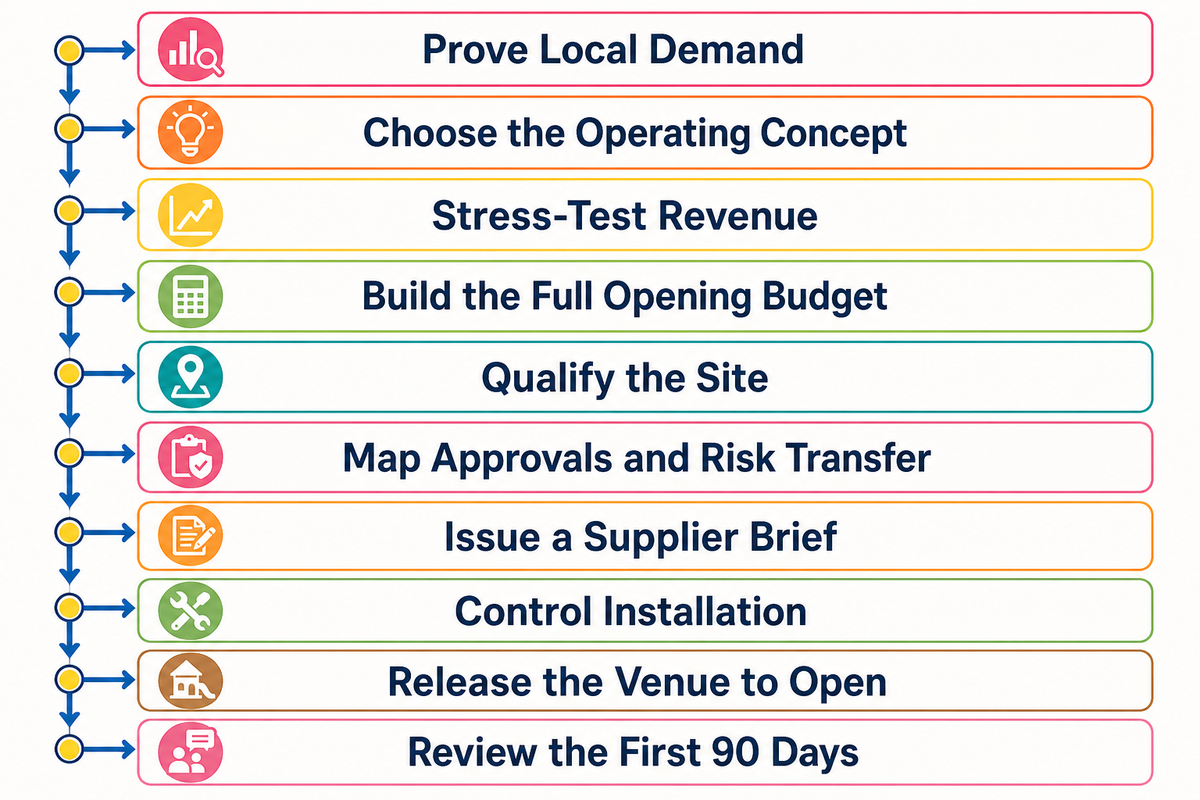
Use a ten-step indoor playground business plan that links market, concept, revenue model, full budget, site, approvals, supplier brief, installation, opening readiness, and post-launch review. The plan can’t be integrated if evidence isn’t available at the right stage, and missing evidence can add cost or delay.
- Prove local demand — define the trade area, customer groups, alternatives, and paid demand signals.
- Choose the operating concept — set the age mix, visit occasion, supervision model, and primary revenue engine.
- Stress-test revenue — model capacity, attendance, price, parties, memberships, food, and classes by time block.
- Build the full opening budget — separate equipment from property, professional, logistics, launch, and runway costs.
- Qualify the site — check use, egress, accessibility, utilities, structure, ceiling, parking, and landlord scope.
- Map approvals and risk transfer — identify authorities, licenses, permits, insurance, and any child-care classification.
- Issue a supplier brief — request comparable inclusions, exclusions, evidence, responsibilities, and acceptance terms.
- Control installation — connect dependencies, inspections, defect closure, training, and handover.
- Release the venue to open — require approvals, procedures, staff readiness, and an evidence file.
- Review the first 90 days — compare demand, revenue, labor, downtime, incidents, and cash with the plan.
Control is the primary objective of the integrated plan, but it doesn’t mean every project follows the same calendar. It’s expected that various activities will occur concurrently and depend on each other.
Decision tree
Demand unproven → research, do not lease. Demand proven but site unresolved → qualify the building, do not order. Site qualified but quote scope unclear → clarify responsibilities, do not compare totals. Installation complete but acceptance incomplete → close evidence gaps, do not open.
2. Prove Demand With the Demand Proof Triangle
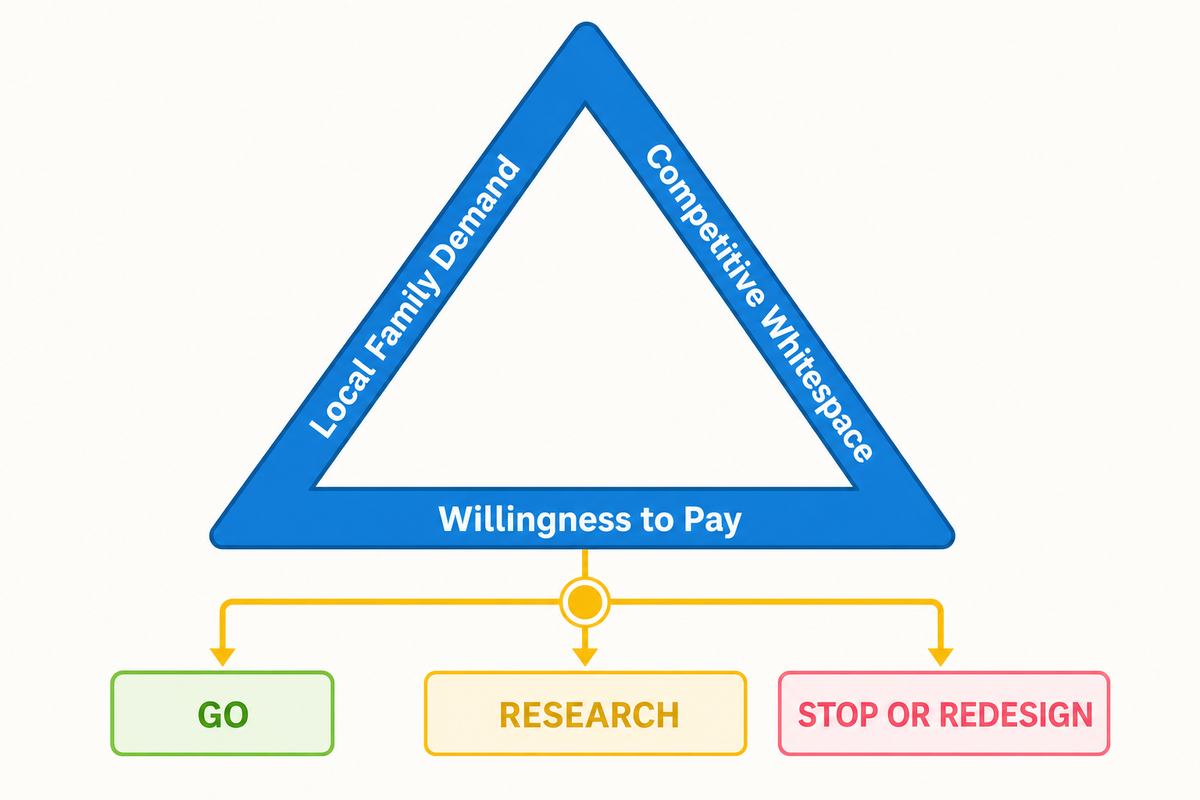
The Demand Proof Triangle shows that demand exists only when three market conditions align: enough local families, a clear gap among alternatives, and customer behavior demonstrating willingness to pay.
| Triangle side | Collect | Question it must answer |
|---|---|---|
| Local family demand | Age distribution, household concentration, travel patterns, school and childcare locations | Who can realistically visit, and when? |
| Competitive whitespace | Venue visits, price menus, age focus, party availability, reviews, peak queues, closures | What problem remains poorly served? |
| Willingness to pay | Deposits, presales where lawful, event inquiries, landing-page tests, structured interviews | Will interest survive a real price and visit condition? |
The U.S. Small Business Administration market-research guide asks founders to examine demand, market size, customer location, saturation, and the prices people pay for alternatives. Use those questions as a research frame, then replace national averages with evidence from the actual trade area.
Do not confuse a survey with a sale.
A parent saying “great idea” is weaker evidence than joining a waitlist tied to a location, age range, price, and proposed opening period. Treat online comments and forum stories as question generators, not forecasts.
Establish go, research or stop limits prior to collecting data. Setting limits in advance will help avoid falling in love and setting misleading goals for the business based on the attractiveness of a given site.
- Go: all three evidence sets support the same customer, use occasion, and price logic.
- Research: interest exists, but the trade area, offer gap, or paid signal is still uncertain.
- Stop or redesign: the model depends on assumptions that local evidence contradicts.
3. Build the Concept and Revenue Stress Test
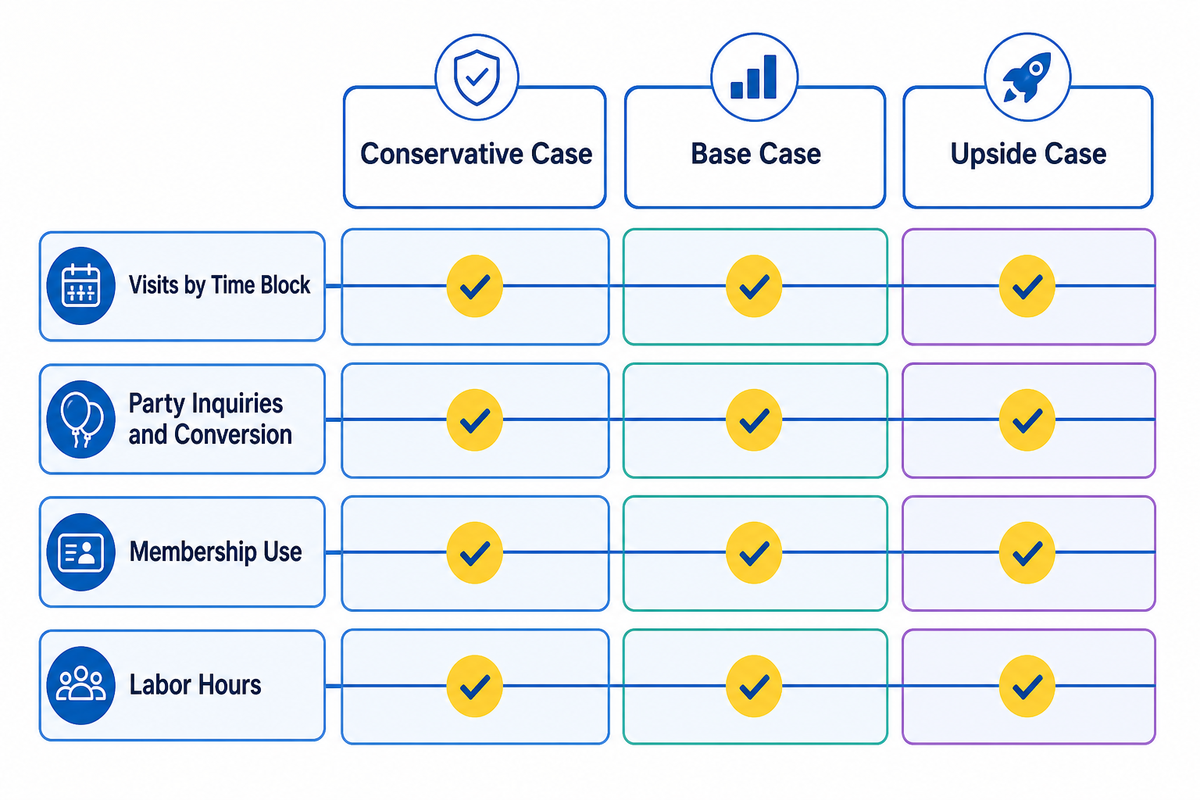
It’s necessary to evaluate a number of scenarios based on underlying assumptions to validate profitability. These scenarios may include the type of customer (age, length of stay, supervision, capacity, etc.), opening hours, peak periods, methods of trade, party terms, and other activities (classes, performances, etc.) offered by the business, as well as the business policy with respect to the sale of food and/or merchandise.
Starting a business in the indoor playground industry requires a clear target audience and a defined type of indoor playground. When choosing a location and venue model, a business owner should compare a family entertainment center, a smaller play cafe, and a community-center-style indoor play area, then test whether open play, birthday parties, party packages, or memberships fit the intended customer base and age groups.
Revenue Stress Test
Create conservative, base, and upside cases. For each case, calculate visit revenue, party revenue, membership revenue, secondary sales, labor hours, occupancy costs, variable cost, debt service, and cash runway using stated inputs.
Change one assumption at a time to see which variable breaks the plan. A model that only works at near-full weekend capacity or with immediate membership adoption is fragile.
The number of expected customers doesn’t always reflect actual attendance, and attendance doesn’t always reflect sales. Large customer volumes may be controlled through party terms, sight lines, and other methods.
| Input | Use in the model | Early evidence |
|---|---|---|
| Visits by time block | Admission and staffing load | Local tests, competitor observations, presales |
| Party inquiries and conversion | Room utilization and deposits | Inquiry log and booking funnel |
| Membership use | Cash timing and peak load | Offer test and retention assumption |
| Labor hours | Service coverage and payroll | Role map, schedule, local wage data |
Parent-absent or drop-off care may not be just another revenue stream. Differences may require additional analysis to determine if care activity is allowed under the business’s operating license.
4. Budget the Whole Opening, Not Just the Equipment
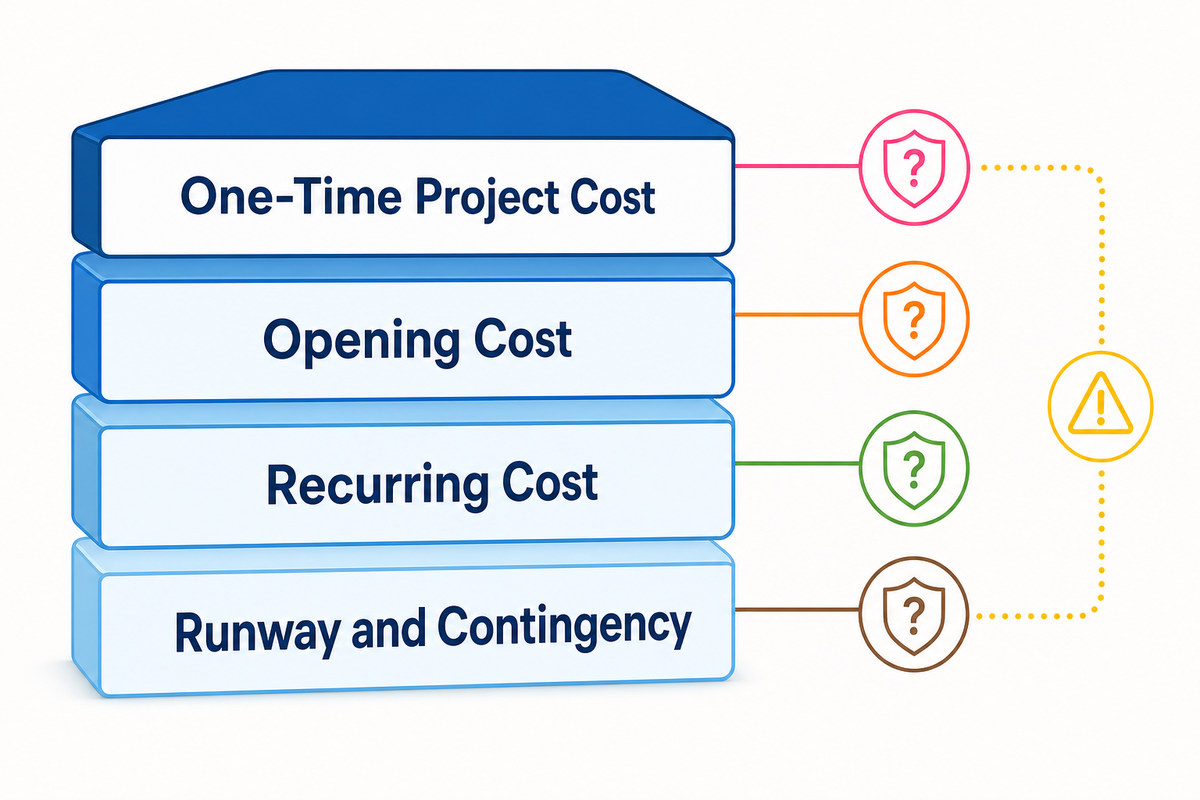
Factors beyond the cost of indoor playground equipment and soft play equipment affect the start-up cost of a business, including legal review, approvals, building fit-out, energy, transport, imports, technology, supplies, marketing, and working capital. Total costs vary and are difficult to estimate.
| Layer | Examples | Control question |
|---|---|---|
| One-time project cost | Design, deposits, build-out, equipment, freight, installation, professional fees | What is included, excluded, provisional, or owner-supplied? |
| Opening cost | Recruiting, training, initial stock, launch marketing, systems, pre-opening rent | Which costs start before the first paid visit? |
| Recurring cost | Rent, payroll, utilities, cleaning, software, maintenance, insurance, marketing | What continues even during a slow month? |
| Runway and contingency | Cash for delays, ramp-up, repairs, scope gaps, and working capital | How long can the business operate below the base case? |
Consider break-even and funding scenarios based on one-time and ongoing costs of start-up using the SBA framework. Adjust and complete the framework with local costs and contracts.
Create a business plan that connects every income stream to expenses, cash flow, and cash on hand. A detailed business plan can’t guarantee a profitable business or profitable indoor play venue, but it shows whether the proposed profitable play concept survives slower demand, opening delays, and cost changes.
Budget boundary
Don’t insert a contingency percentage copied from another venue unless its basis is documented. List unresolved scope items, obtain local advice, and set contingency from the project’s remaining uncertainty.
5. Qualify the Site With a Lease Exposure Test
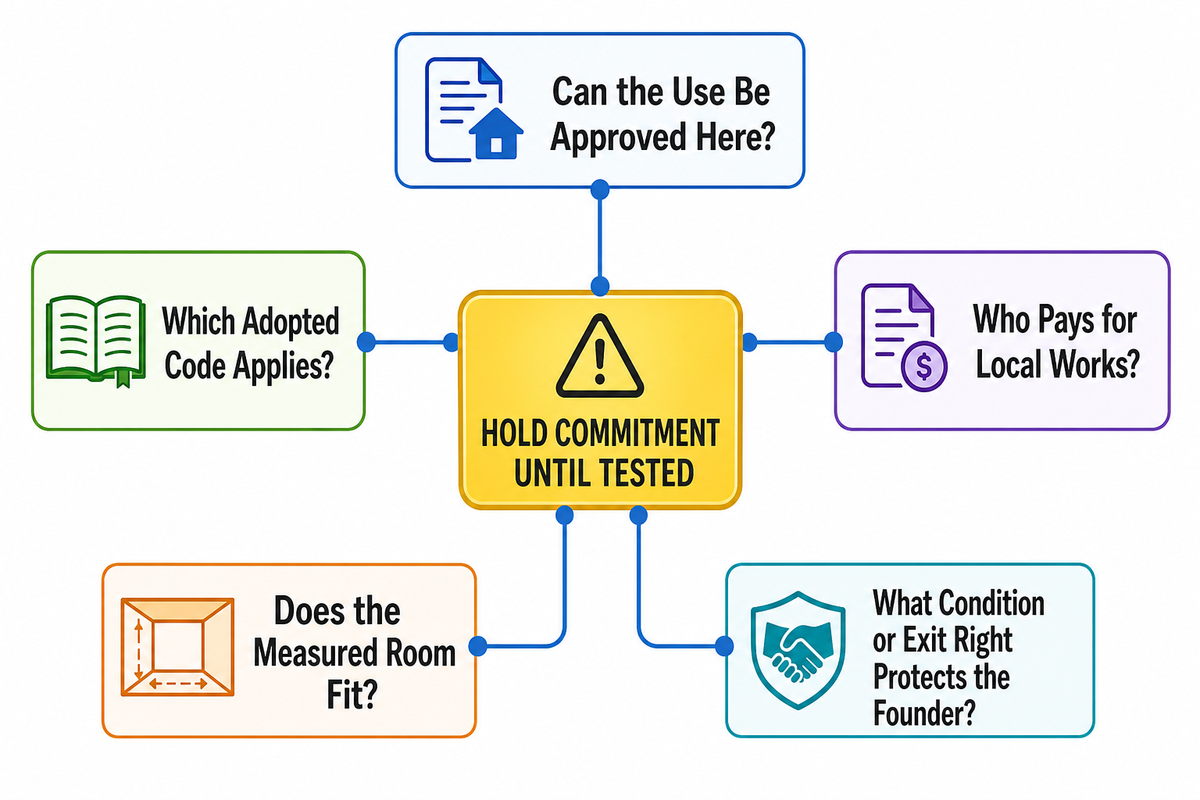
There are several factors to evaluate beyond determining that a space is appropriately sized to house a local business, and a space-planning review can test the site’s feasibility when choosing a location. The indoor play space is not qualified until the intended use, indoor entertainment concept, code path, egress, accessibility, structure, utilities, fire protection, clear height, toilets, parking, loading, and landlord-work boundaries have been reviewed.
Lease Exposure Test
- Can the proposed use be approved at this address?
- Which code edition and local amendments apply?
- Who pays for structural, fire, electrical, HVAC, toilet, accessibility, and utility work?
- Do the measured room dimensions match the concept, services, exits, and accessible routes?
- What lease condition, approval contingency, or exit right protects the founder if the site fails review?
For U.S. projects, the U.S. Access Board play-area guide explains accessible routes, clear spaces, ramps, transfer systems, and accessible entries to soft-contained play structures. It’s a design resource, not a permit or a substitute for project review.
Model-code blind spot
The 2024 International Building Code includes Section 424 provisions for indoor play structures over 10 ft in height or 150 sq ft in area, and states a 600 sq ft aggregate projection limit unless a special investigation shows adequate fire safety. Those model-code figures matter only through the code actually adopted and amended by the project jurisdiction.
There isn’t a universal clear height that works for all play structures and concepts. Clear height issues should be addressed on a case-by-case basis, including comparison of the surveyed clear height to the play equipment to determine if it meets local requirements.
- Obtain a measured plan and service locations.
- Write landlord and tenant work in the lease exhibits.
- Make required approvals and feasibility reviews visible before irreversible commitment.
- Keep the supplier layout, professional design, and authority approval as separate documents with separate owners.
6. Map Permits, Standards, Insurance, and Care Classification
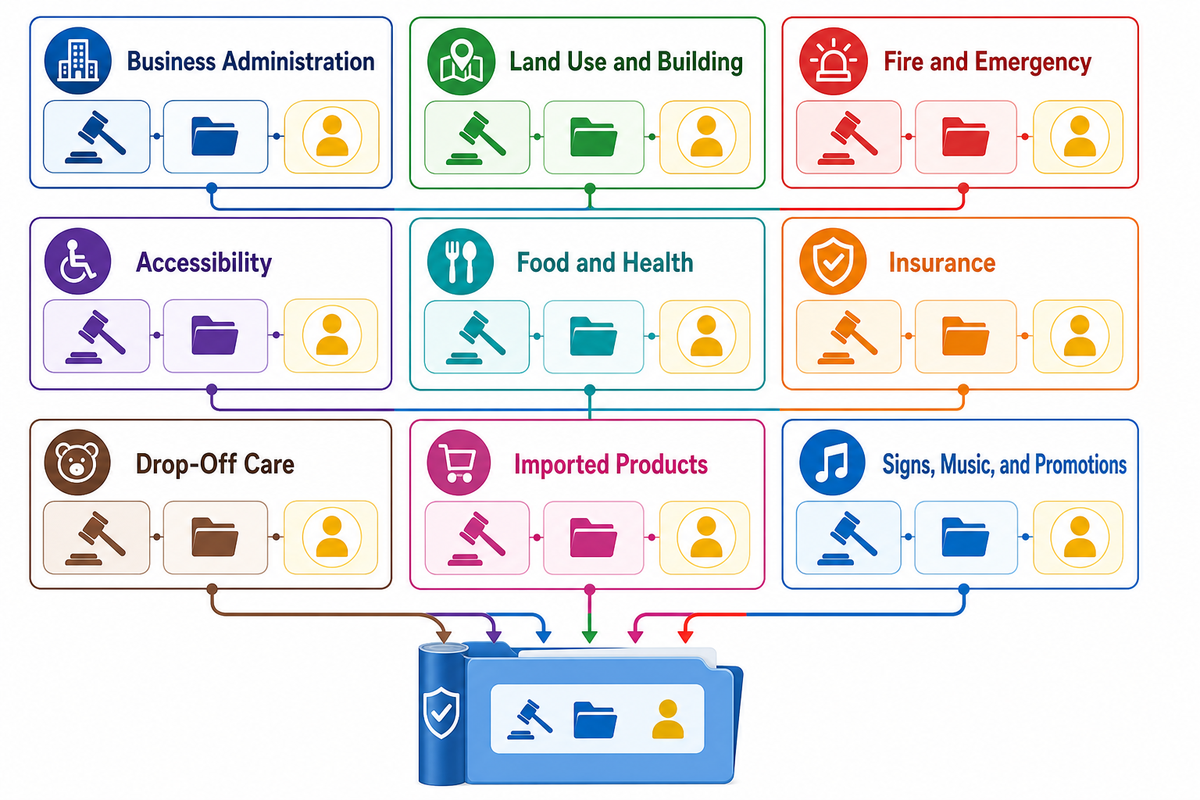
Opening a business may include a number of the following: obtaining a business license, zoning and land use approval, building and fire department approval, employee hiring and training, signage, music and other media licensing, health and safety inspections, and meeting the requirements of an insurance company.
“The requirements and fees vary based on your business activities, location, and government rules.”
Make an ‘authority matrix’ with columns for ‘authority/adviser,’ ‘question,’ ‘evidence,’ and ‘owner.’ Talk with local departments and the insurer about the specifics of indoor playground permits, including use, location, age mix, supervision, food, capacity, and conceptual plans.
| Category | Ask | Retain |
|---|---|---|
| Business administration | Which registrations, tax, labor, and general license duties apply? | Registrations, account records, licenses |
| Land use and building | Is the use allowed, and what plan review or occupancy path applies? | Written guidance, permits, approved drawings |
| Fire and emergency | Which protection, egress, load, and emergency reviews apply? | Approved plans, inspection and drill records |
| Accessibility | Which route, entry, toilet, service, and play-area duties apply? | Design review and approved details |
| Food and health | Does the menu or preparation method trigger review? | Permits, procedures, inspection records |
| Insurance | Which activities, exclusions, and controls affect coverage? | Policy, endorsements, requested controls |
| Drop-off care | Does parent-absent supervision trigger child-care licensing or an exemption? | Agency determination and operating conditions |
| Imported products | Who holds importer, testing, certificate, labeling, and filing duties? | Contracts, reports, certificates, labels |
| Signs, music, and promotions | Which sign, music-use, prize, or promotion rules apply? | Approvals, licenses, campaign terms |
Standard titles and certification programs are not blanket approval, and a general business license does not close every site-specific duty. The ANSI overview identifies F1918-21 for soft-contained play equipment serving ages 2–12 years, while ASTM’s current public record identifies F1292-26 for playground surfacing impact attenuation. The IPEMA certification page describes product validation against named standards; confirm the current edition, exact product scope, contract requirement, and local adoption at quote time.
Importer responsibility
For applicable U.S. children’s products, CPSC guidance says a domestic manufacturer or importer may need a Children’s Product Certificate based on third-party testing. Identify the importer of record and certificate duty before purchase; don’t assume an overseas supplier retains every legal responsibility.
7. Turn the Concept Into a Supplier Brief and Comparable Quote
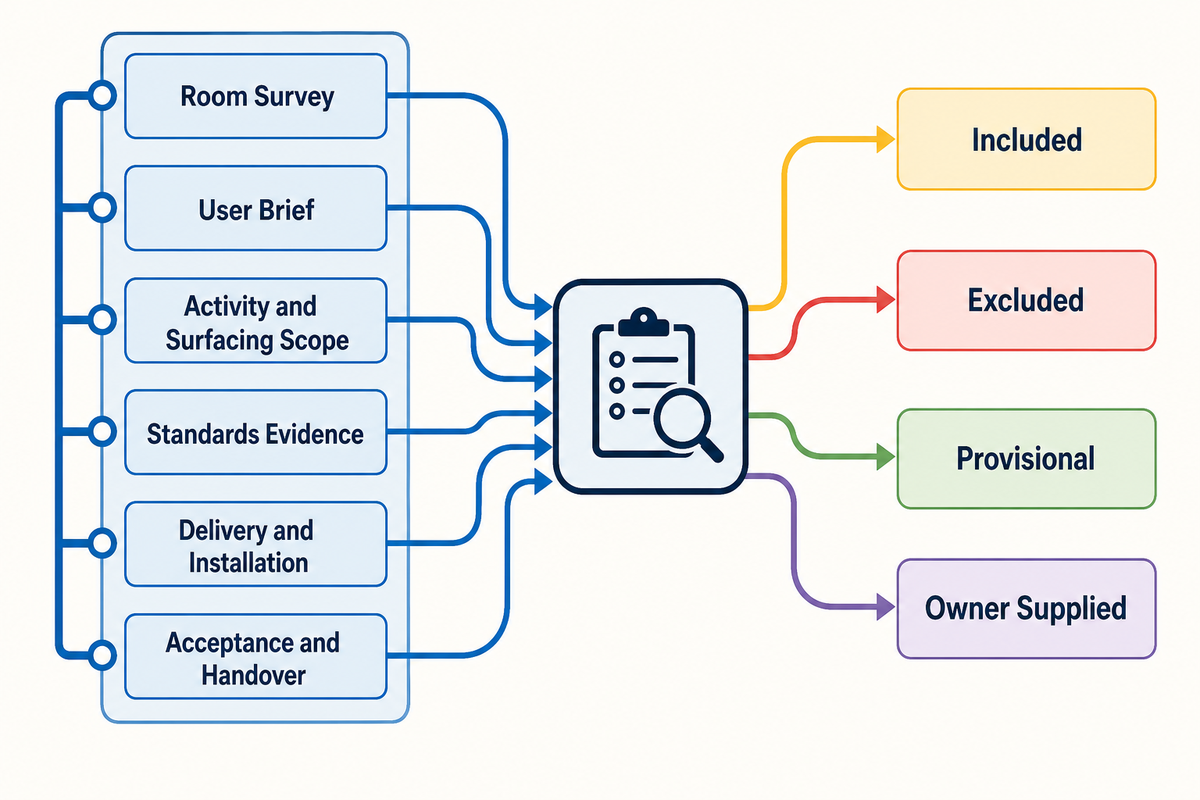
Comparable supplier quotes bind room and user inputs to deliverables, exclusions, responsibilities, standards evidence, acceptance, training, spare parts, and after-sales handover.
For the indoor playground project, the request specification must identify the equipment of the indoor playground, the soft component play equipment, any ball pit, and all interfaces associated with the playground equipment.
Ask each supplier to state its range of services and the full range of services priced for this project. Two totals can’t be compared when one includes surfacing, freight, installation, or supervision and the other quietly leaves those items to the buyer.
Equivalent written instructions must be provided to all bidders, and they must respond by indicating whether the requirement is included, excluded, provisional, or owner supplied. Toplay’s turnkey indoor playground design and delivery scope is the commercial handoff only after the buyer has defined those inputs and knows which evidence to request.
RFQ checklist — copy these into your quote request:
| Parameter | Recommended range | Why it matters | How to verify |
|---|---|---|---|
| Room survey | Enter measured length × width × clear height in m or ft | Controls fit and service conflicts | Signed measured plan and site photos |
| User brief | Enter age bands and max concurrent users in people | Controls zoning and activity mix | Operating concept and authority inputs |
| Activity and surfacing scope | List every included zone and interface | Prevents gaps between packages | Color-coded layout and bill of quantities |
| Standards evidence | State destination, required edition, and product scope | Stops vague certificate claims | Named reports, certificate owner, product match |
| Delivery and installation | State Incoterm, named place, local works, tools, labor, and supervision | Allocates cost and delay risk | Responsibility matrix and contract schedule |
| Acceptance and handover | List inspection, defect, training, spares, and record requirements | Defines completion beyond delivery | Signed acceptance plan and handover index |
The allocation of the risks, costs, and responsibilities for the transport and delivery of the goods to the buyer is determined by the Incoterms ruling. Other risks, costs and responsibilities for the installation and acceptance of the goods by the buyer are determined by the parties involved. The International Chamber of Commerce Incoterms overview is the starting point for the trade term, while the full project scope still belongs in the contract.
Quote-to-Opening Bridge
For every buyer input, identify the supplier return, evidence, owner, due date, acceptance point, and unresolved exception. Keep importer, certification, freight, installation, local works, professional review, authority approval, training, maintenance, and after-sales duties as separate rows.
8. Control Installation, Acceptance, and Opening Readiness
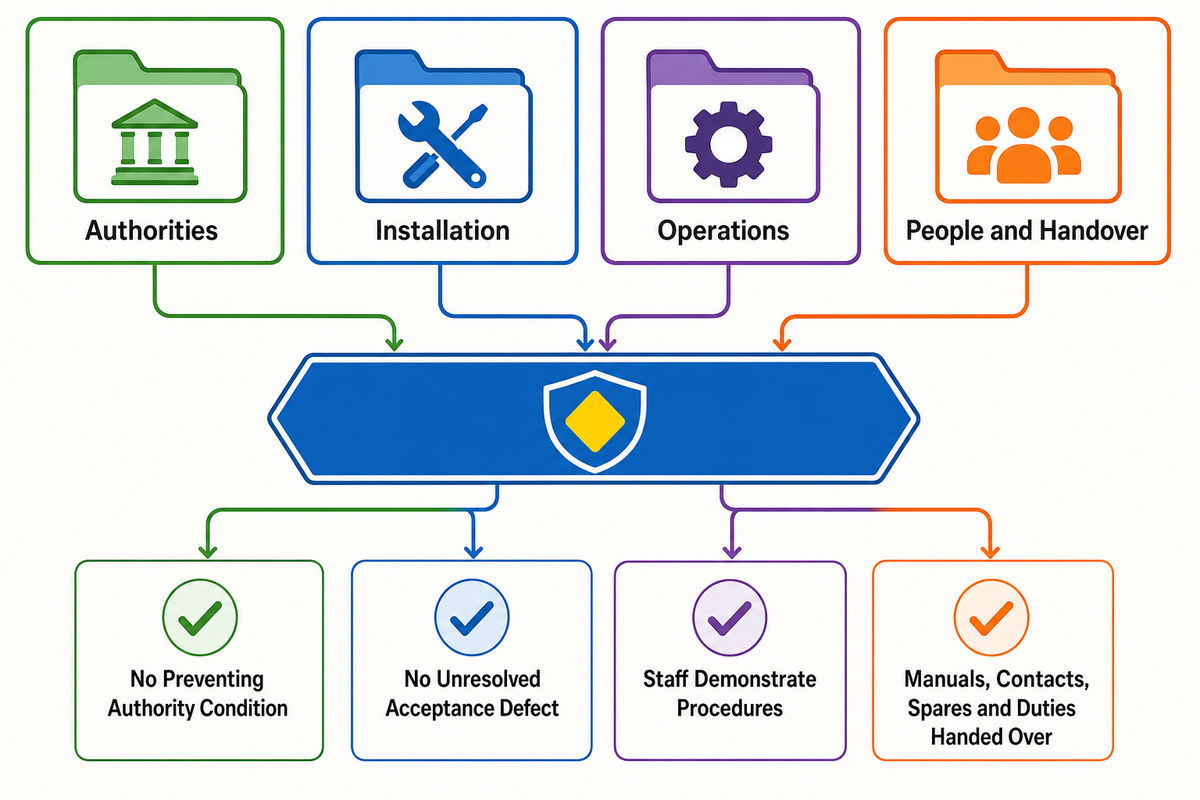
The decision on when to open a project is normally not the same as the decision on when the project work is complete. Acceptance and handover by the project owner, training of the project owner’s personnel, and closing of all defects, evidenced by operational documentation and records, are some of the requirements for completion.
| Evidence group | Minimum file contents | Release owner |
|---|---|---|
| Authorities | Required approvals, permits, inspections, occupancy records, open conditions | Operator and qualified advisers |
| Installation | Approved layout, installation records, punch list, defect closure, acceptance sign-off | Contract-defined parties |
| Operations | Use rules, cleaning, inspection, maintenance, stop-use, incident, and recall procedures | Venue manager |
| People and handover | Role training, emergency drills, manuals, spare-parts list, contacts, warranty terms | Operator and suppliers |
Relying only on the project delivery lead time shouldn’t determine the opening schedule or when to admit the first guest; work backward from dependencies instead. The presence of an open approval, training record, defect, or undefined stopping rule should remain visible as an opening blocker, not be concealed in project plans and emails. These should be represented as barriers to opening the project.
Soft-contained-play operating baseline
The CPSC checklist includes netting, ropes and webbing, floor surfacing, cleanliness, posted use guidance, size recommendations, and separation of younger and older children. It doesn’t prescribe a universal inspection interval, so the operator must set a suitable documented program with relevant authorities, suppliers, advisers, and insurer. Toplay’s indoor playground safety rules organize related operating questions for venue owners.
Prior to a location’s opening, staff must understand the entire stop-use escalation process. This includes who is authorized to isolate an area, how the situation is documented, who decides to repair and release the product, and how product recalls and notices are reviewed.
- No open authority condition that prevents use.
- No unresolved acceptance defect that affects the released area.
- Staff can demonstrate entry, supervision, cleaning, incident, emergency, and stop-use procedures.
- Manuals, contacts, spares, warranty terms, and maintenance duties are handed over.
9. Launch, Market, and Review the First 90 Days
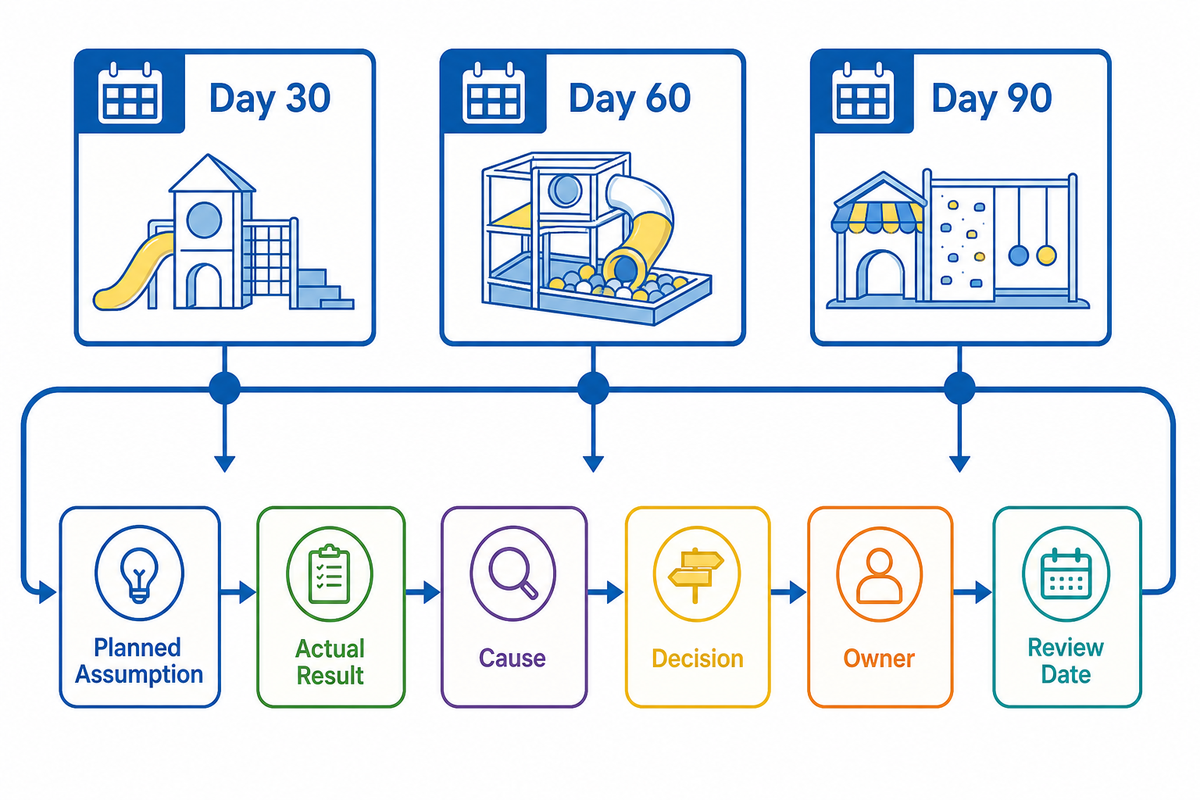
One successful weekend doesn’t validate a business model. The playground owners should take advantage of the first 90 days to test the business plan model through visits and functions, tracking repeat use, party conversion, membership retention, revenue mix, labor hours, cleaning load, downtime, incidents, defects, and cash runway. They should consider customer retention, revenue and labor mix, and average weekly cash on hand.
| Review | Focus | Decision |
|---|---|---|
| Day 30 | Demand by time block, check-in friction, staffing coverage, cleaning, defects, incidents | Fix service and readiness gaps before adding offers |
| Day 60 | Repeat visits, party funnel, membership use, secondary sales, labor per open hour | Adjust schedule, offer, and marketing by measured behavior |
| Day 90 | Revenue mix, cash runway, downtime, maintenance burden, unresolved assumptions | Continue, revise, pause, or fund the next change from evidence |
When developing a marketing plan, playground owners should think about how they’ll integrate capacity and visit occasion, rather than how they’ll achieve reach. They should implement a marketing plan to influence customer inquiries and deposit funnels, track customer retention, and develop partnerships to achieve a pre-determined visit goal.
The marketing plan should position your indoor playground for families with young children without pretending every potential customer wants the same visit. Start small, learn which offer can attract customers, and use measured repeat behavior before creating an indoor playground promotion around a new playground feature.
The first-ever successful implementation of the indoor playground business shouldn’t be conflated with an opening-day campaign; keep the launch your business checklist separate from marketing.
Keep the operating loop short
Record the planned assumption, actual result, cause, decision, owner, and review date. Avoid changing price, hours, staffing, promotion, and party format at the same time, because the business won’t know which change produced the result.
Frequently Asked Questions
Are indoor playgrounds profitable?
Indoor playgrounds can be profitable only when local demand, price, revenue mix, capacity, rent, labor, and cash runway work together and conservative assumptions remain true after opening.
No industry margin can establish whether one venue will make money. Build conservative, base, and upside cases, then replace assumptions with actual visits, party conversion, membership use, labor hours, downtime, and monthly cash data after opening. Models that need full weekends or immediate repeat use deserve careful redesign before commitment.
How much would it cost to set up an indoor playground?
The setup cost depends on the location, building condition, concept, equipment scope, approvals, delivery, installation, opening work, and cash runway, with project totals differing by site and scope.
Treat any universal total as incomplete unless it states geography, date, floor area, venue condition, inclusions, exclusions, taxes, freight, installation, and working capital. Request local property and professional quotes, compare supplier scope line by line, separate one-time and recurring expenses, and include unresolved items in a documented contingency rather than copying another project’s percentage. Link each allowance to a source, owner, due date, and update rule so the funding requirement changes when evidence changes.
What permits are needed for an indoor playground?
Permit and license requirements depend on the jurisdiction, address, building, intended use, food service, signage, capacity, and supervision model, with the final route confirmed locally.
Contact the local land-use, building, fire, business-licensing, accessibility, and any relevant health or child-care agencies with the real concept and site. Ask each authority what it decides, which evidence it needs, and which inspection closes the item. Generic online checklists can’t approve a particular address, building, use, or operating model.
What kind of insurance do you need for an indoor playground?
An indoor playground needs a broker-led coverage review based on its actual activities, property, workers, products, food, events, and supervision model, and the venue brief defines that review.
Possible policies or endorsements may address general liability, property, workers, business interruption, cyber or payment systems, employment practices, vehicles, food, events, and other exposures, but names and limits vary. Give the broker the site, activities, capacity assumptions, party and membership model, staff roles, waivers, inspection and maintenance program, incident process, and supplier relationships. Read exclusions, endorsements, reporting duties, and required controls rather than treating a certificate as proof that every activity, event, product, or interruption is covered.
What do I need to open an indoor playground?
Opening an indoor playground requires proven demand, a funded business plan, a qualified site, approvals, insured operations, accepted equipment, trained staff, and release evidence, with one owner assigned to each item.
Equipment is one workstream. Keep a dependency schedule and Opening Evidence File so the lease, build-out, reviews, delivery, installation, defect closure, cleaning, maintenance, training, systems, and runway reach readiness together.
How long does it take to open an indoor playground?
There is no universal timeline to launch an indoor playground business because site, design, approvals, imports, construction, installation, inspection, and training follow different local and supplier dependencies.
Build the schedule from evidence-based milestones and ask each responsible party for inputs, review time, dependencies, and acceptance conditions. Keep lease contingencies and supplier terms aligned with that schedule. Don’t market an opening date until critical approvals, construction work, equipment acceptance, staff training, and operating procedures have a credible release path, with float assigned to the dependencies most likely to move.
References & Sources
- Market research and competitive analysis U.S. Small Business Administration
- Calculate your startup costs U.S. Small Business Administration
- Apply for licenses and permits U.S. Small Business Administration
- Guide to the ADA Accessibility Standards: Play Areas U.S. Access Board
- Soft Contained Play Equipment Safety Checklist U.S. Consumer Product Safety Commission
- eFiling guidance for importers U.S. Consumer Product Safety Commission
- Playground standards overview American National Standards Institute
- ASTM F1292-26 public record ASTM International
- Product certification program International Play Equipment Manufacturers Association
- 2024 IBC Chapter 4, including Section 424 International Code Council
- Incoterms rules overview International Chamber of Commerce
How This Guide Was Built
The guide combines current public sources with a buyer-side view of indoor playground design, delivery, and handover. Toplay has manufactured customizable indoor children’s playground equipment since 2014 and reports exports to more than 40 countries, over 90% of products sold globally, and average annual growth above 20%; these company-supplied facts don’t guarantee an investor’s financial result.
Bring a Better Brief to the First Design Conversation
Use the Demand Proof Triangle, Lease Exposure Test, and RFQ checklist to define the project before asking for a layout or price. Toplay can review the room, audience, activity mix, and delivery scope against a written business brief while you retain local approval, insurance, and business decisions with the responsible parties.



