Get in touch with Guangzhou Toplay amusement equipment co. Company

How to Open Play Cafes and Small Venues: The Complete 2026 Guide to Costs, Permits, Equipment and Profitability

Project Build Support
Need an indoor playground layout before your next quote?
Send venue size, ceiling height, age range, theme direction and opening schedule. Toplay can match the play route, safety surface and delivery scope before you lock the quotation.
Layout fitFootprint, traffic and age zones
Build scopeEquipment, surface and installation
Quote pathFactory review before RFQ
RFQ Checklist
What to include for faster project matching
Venue and capacity
Floor size, ceiling height, entrance route, target age groups and daily visitor expectations.
Theme and operation
Brand direction, supervision plan, opening timeline and any food, retail or party-room requirements.
Delivery context
Send Project Details
City, floor access, installation window, local review needs and budget direction.
Play Cafes & Small Venues refers to the broader category of small-footprint indoor businesses that combine supervised children’s play with food and drink service, spanning everything from a single-room cafe to a multi-zone family space. Starting a play cafe means running a controlled children’s play area and food & beverage operation from one small business location, and on top of considering financing, licensing and equipment needs, it’s a consideration for daily operation even before the first family enters. Thanks to a 308.6% increase in web search activity in the last three years for “how to open a play cafe” there are countless first time operators all wondering the same thing: how much actually goes into it, what permits are needed first, and do the numbers really make sense with rent and insurance added in?
This post is designed for founders considering a play cafe or indoor small facility. It’s not for those who already know what equipment you need and want a quote. The order will remain the same whether you’re opening a new play café from scratch or your project involves transforming a local business that’s already operating as something other than a play facility into one.
For those who have your plans drawn up to set up play equipment, Toplay’s play cafes and small venues page explains configuration, project terms and production lead times, that page picks up where this decision process leaves off.
Key takeaways
- Total costs to open a small play cafe (1,000-2,000 sq ft) are typically $80,000-$250,000; larger multi-zone facilities run $400,000-$750,000+.
- The average time to break-even for a play cafe with a blended revenue mix (admission, memberships, birthday parties, food) is 12-24 months, with single-revenue operators requiring a longer time period.
- Most of the time, you can expect Certificate of Occupancy applications to be the slowest permit, taking about 4 to 8 weeks and costing about $250-$1,000, so that should be filed early in the process.
- As of 2026, ASTM F1918-21 is the active standard that covers soft contained play equipment. An ASTM committee currently has an active item open to revise it.
- Franchise fees buy speed and support; independent ownership buys long-term control over layout, vendors, and pricing.
What Is a Play Cafe? (And How It Differs From a Standard Indoor Playground or FEC)
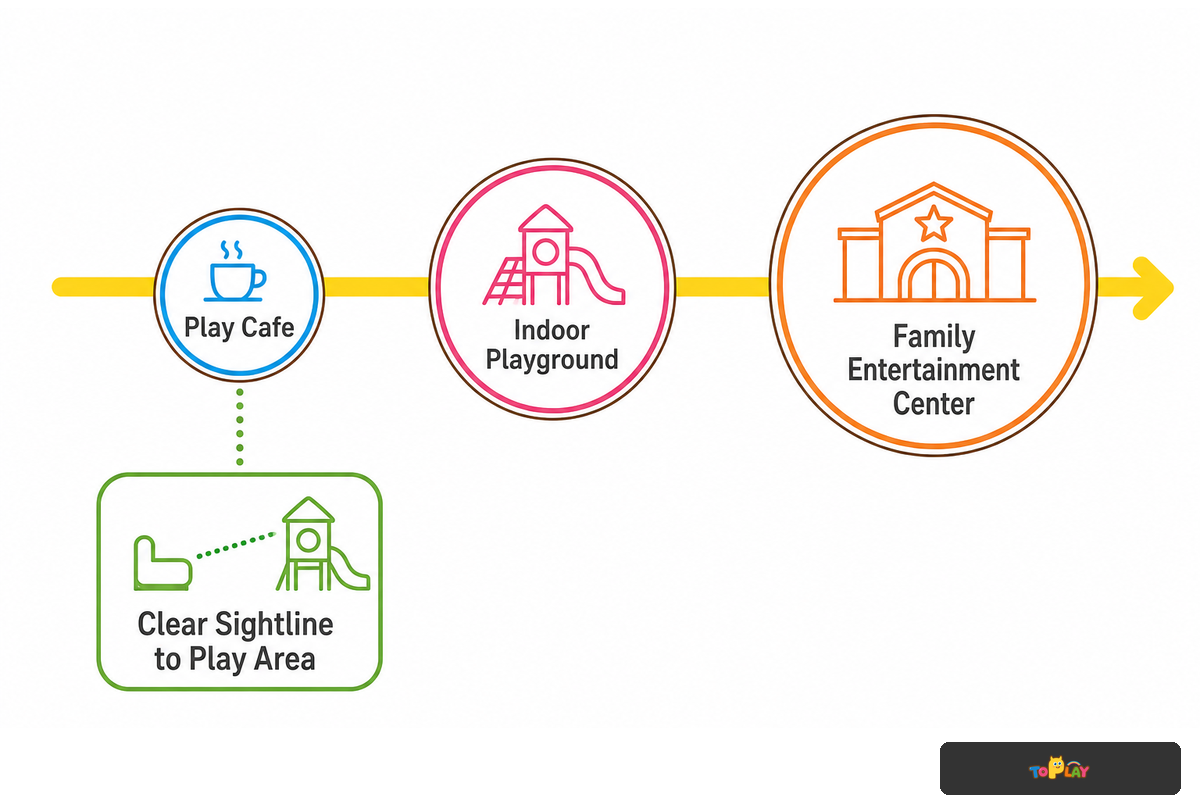
A play cafe is a supervised children’s play space combined with food and drink service, commonly sized between 1,000 and 4,000 square feet and designed around parent seating with a clear sightline to the play area. It sits at the small end of a wider spectrum that also includes indoor playgrounds and family entertainment centers.
The definition matters because “indoor playground,” “family entertainment center,” and “play cafe” get used interchangeably online — some owners even bill themselves broadly as a playground or play cafe business without drawing a hard line between formats — but the underlying formats sit at different scales: “amusement center” as a search category draws roughly 90,500 U.S. searches a month and “family entertainment center” roughly 40,500, while a play cafe is the small-footprint end of that spectrum, closer to a neighborhood coffee shop than an arcade destination. Whichever scale you land on, the underlying safety framework comes from the same place: the U.S. Consumer Product Safety Commission covers this format through its soft-contained-play equipment safety checklist, alongside the broader inspection-and-maintenance guidance in its Public Playground Safety Handbook. Toplay’s industries overview breaks down how the format changes across restaurants, malls, and other small-venue settings.
This matters to budgets. FEC benchmarks (for multiconcession facilities such as FECs with a laser tag, ropes course, arcades etc) are vastly greater than the capital cost of a play cafe, and dragging an FEC benchmark cost into a play cafe business plan will give you an excessive capital cost. If your concept is about seating for parents, with a coffee bar and one or two soft play areas with a size of less than 2,500 square feet, then you should compare the capital costs against play cafes, not against FECs. The mistake to avoid here is budgeting off a vendor’s flagship FEC case study and then being surprised when the actual buildout runs two or three times over plan — a risk that shows up almost every time a founder skips this category check.
Think of a play cafe as a mash-up for toddlers: enough play for a regular weekday stop, small enough for one or two staff members, and food service light enough for a modest espresso bar instead of a fully featured kitchen. Inside, that usually means a coffee shop counter next to a kid friendly indoor play area, a soft playhouse structure with slides and climbers for imaginative play, sized for younger kids and littles as much as for school-age visitors. The format works because it gives toddler-focused families a space that support real developmental opportunities, not a supervised holding pen.
Why the Play Cafe Model Is Growing (and What That Means for New Owners)
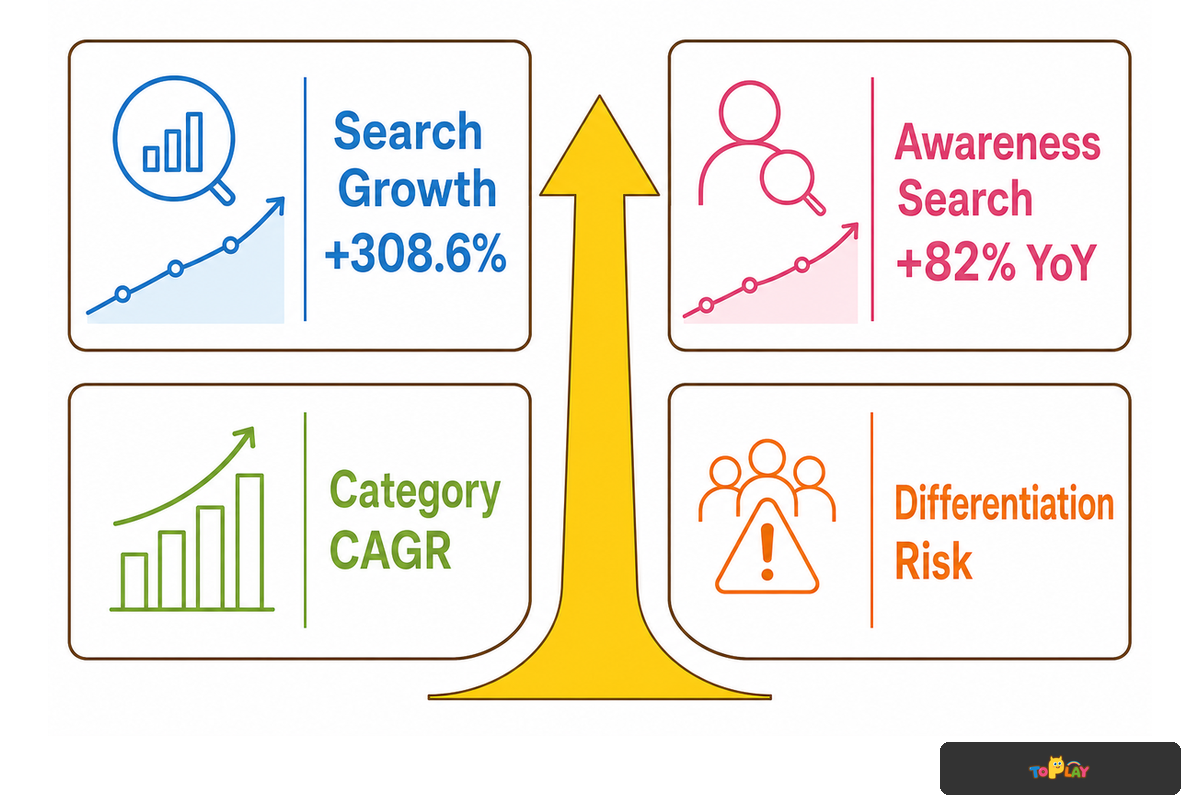
Demand for play cafes is growing: search interest in “how to open a play cafe” is up 308.6% over three years (a 12-month average of 109.1 monthly searches versus 26.7 three years prior), meaning more people are actively planning to open one, not just browsing the idea.
The good news for anyone drawn to the play cafe business is that the window to open is still open, but the field is evolving fast, plenty of guides on this topic have appeared recently, and this one reflects the most current data available. Even the underlying equipment standards are evolving alongside demand: ASTM’s committee has an active item open to revise F1918-21, the soft contained play equipment standard.
A second signal shows up in awareness-stage searching — the kind parents do while considering what kids play options they want. Searches for terms like “indoor play cafe” rose 82% year-over-year, and that jump in research activity points toward more openings over the next 1-2 years, along with growing importance of location selection and differentiation.
Overall market projections indicate that family entertainment and children’s entertainment are both projected to grow at a mid-single-digit CAGR through the next decade, a figure consistent with what young families and parents’ preferences show: demand for an accessible and readily available kid’s activity that can be booked on a weekly rotation in the form of kid-focused birthday parties and other upcoming events. Families want a business option that allows them continued visitation and a trusted child-focused provider, not a novelty experience that kids may only want a single time.
The real risk in a growing category is not lack of demand, it is a crowded field diluting each new location’s visibility. When a parent is comparing three nearby options, the deciding factor is rarely the closest one; it is usually whichever venue looks best-run in reviews and photos. A concept that opens without a clear differentiation plan, whether that is a specific age focus, a stronger food program, or simply better-maintained equipment, risks becoming interchangeable with the next new opening within a year or two.
How Much Does It Cost to Open a Play Cafe or Small Play Venue?
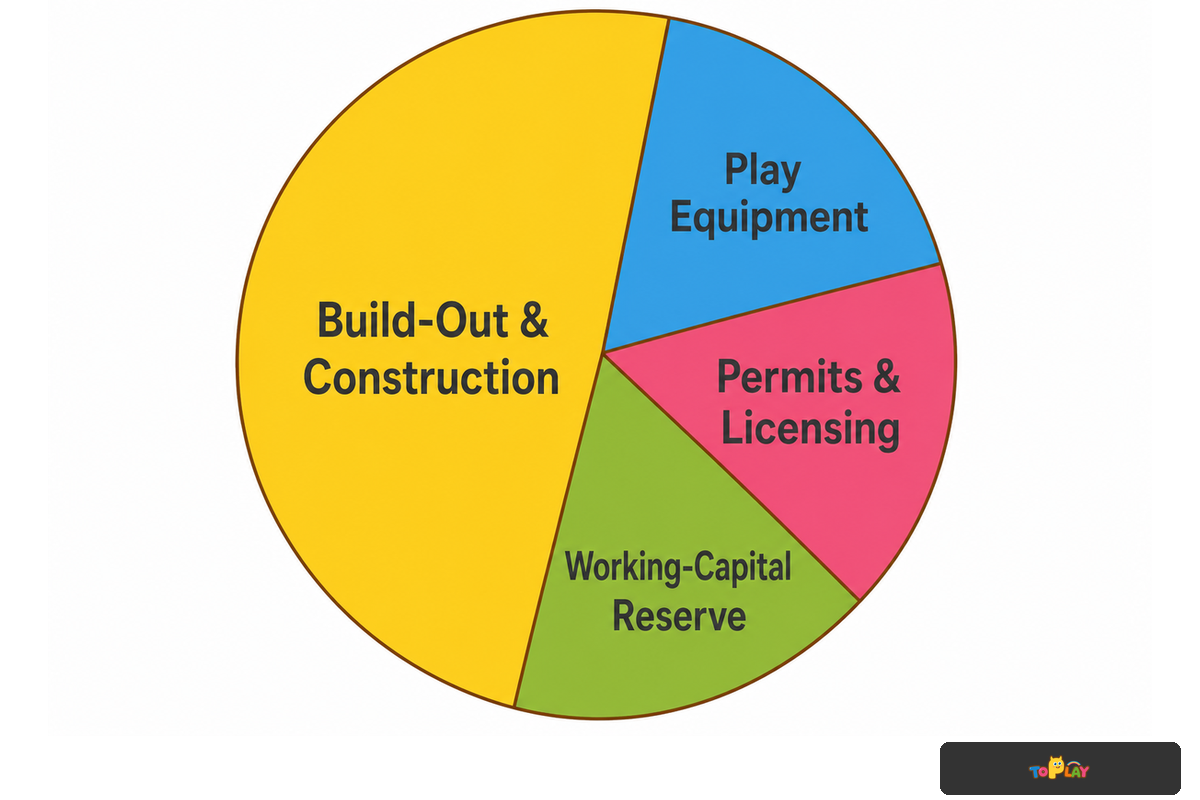
Total startup costs for a small play cafe (1,000-2,000 sq ft) typically run $80,000-$250,000, covering build-out, play equipment, initial permits and licensing, first-year insurance, and 2-3 months of working capital. That range covers a fully outfitted single-room location; larger or multi-zone concepts scale up from there.
Costs scale with footprint and finish level, and the biggest single swing factor is usually build-out condition: a space that already has adequate electrical service, plumbing, and HVAC costs far less to open than a raw shell. Equipment suppliers with years of production experience tend to give tighter, more accurate quotes at this stage than newer shops still learning their own costs. Building your budget line by line against a real licensing checklist, such as the U.S. Small Business Administration’s licensing and permit guide, catches fees that a rough estimate tends to miss.
| Cost category | Small (1,000-2,000 sq ft) | Medium (2,000-4,000 sq ft) | Notes / limitations |
|---|---|---|---|
| Build-out and construction | $20,000-$60,000 | $60,000-$120,000 | Electrical, plumbing, and HVAC upgrades are the most common overrun; not for spaces needing a full commercial kitchen build |
| Play equipment and soft-play structures | $15,000-$60,000 | $60,000-$150,000+ | Custom-configured structures for irregular footprints run higher than off-the-shelf modular units |
| Cafe / food service equipment | $10,000-$25,000 | $25,000-$45,000 | Assumes grab-and-go or light coffee-bar service, not a full commercial kitchen |
| Permits, licensing and initial insurance | $4,000-$8,000 | $8,000-$15,000 | See permit timeline table below; excludes ongoing annual premiums |
| Point-of-sale, booking and access software | $1,500-$4,000 | $3,000-$7,000 | One-time setup plus first-year subscription; not applicable for cash-only micro-operations |
| Signage, furniture and soft goods | $3,000-$8,000 | $8,000-$18,000 | Excludes custom millwork or branded interior design packages |
| Pre-opening marketing | $1,000-$4,000 | $3,000-$8,000 | Local digital outreach and a launch waitlist; not a paid national campaign |
| 2-3 months working capital reserve | $10,000-$25,000 | $20,000-$45,000 | Not optional — see Red Flags section for what happens without it |
| Total (indicative range) | $80,000-$180,000+ | $180,000-$400,000+ | Ranges compress toward the low end with a move-in-ready space and off-the-shelf equipment |
Larger multi-zone facilities with a fuller food program can reach $400,000-$750,000, but that figure belongs to the family-entertainment-center end of the category, not a single-room play cafe. Get at least two local build-out quotes before finalizing a budget; construction costs vary by region enough that a national average is only a starting point, not a number to lease against.
Play Cafe Business Plan: Revenue Streams and Business Model
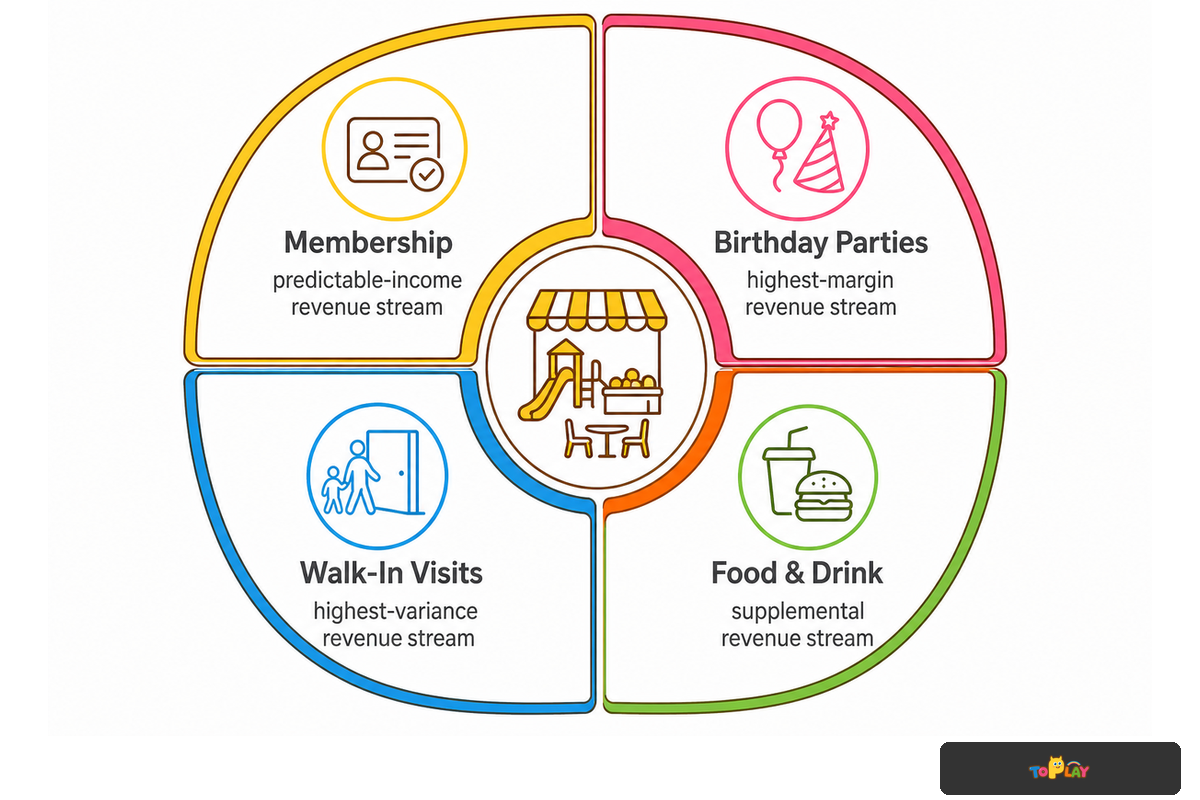
Your play cafe revenue comes from a blend of at least two sources out of membership, birthday parties, walk-in visits, and food and drink – nothing else is going to carry that cost of entry. Of the bunch, membership is usually the biggest driver since it translates those sporadic visits to a predictable income month after month. On the other hand, a membership model devoid of a substantial walk-in/party split will leave your play cafe at the mercy of slow months. Booking and membership software providers with years of experience serving family-entertainment venues can usually show you real occupancy and revenue-mix benchmarks from comparable locations before you finalize your own plan.
Birthday parties often deliver the biggest margin as a function of being the easiest thing to mark up since it involves selling a period of time for more than the rate you get to individuals, and because a single booking effectively brings a room of prospective new members with it. Walk-in visits are notoriously the biggest swing metric — weather, competition, and time of year affect volumes here the most, which is why running solely on walk-ins is the most common mistake early operators make.
A starting revenue mix that will typically work well at a single location for play cafes can be somewhat spread across membership, birthday parties, walk-ins, and food and beverage, with relative weights in each that reflect your location and demographics. Food and beverages will rarely be profitable standalone at this level but function as a supplement, boosting per-visit spending and dwell time of families that already come to you for your primary play offering. If your revenue plan depends on a food-service line, revisit the health department step in the U.S. Small Business Administration’s licensing guide before you finalize the menu.
Is a Play Cafe Profitable? Break-Even Math and Unit Economics
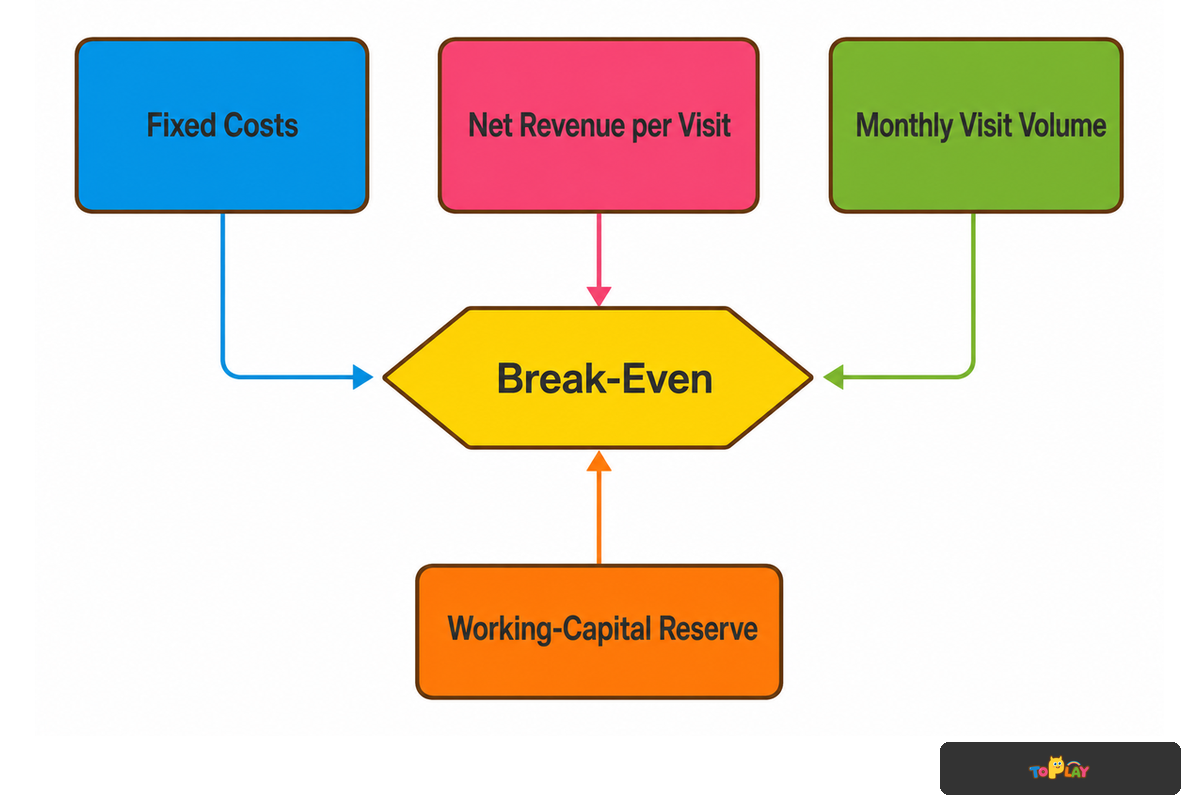
Play cafes can be incredibly successful, but whether one turns a profit depends on a blended revenue stream sufficient to meet fixed operating expenses within a certain window of time — not some specific line-item figure on your spreadsheet. Industry and market-size reports confirming growth in family entertainment can prove that category-level demand exists, but they can’t guarantee success for your own location. The gap between “the category is growing” and “this specific address will hit break-even” is exactly where undercapitalized openings run into trouble — a risk this guide keeps circling back to for a reason. The CPSC’s soft-contained-play checklist is a useful gut-check here too: equipment that fails routine inspection early adds unplanned repair cost right when a new location can least absorb it.
Consider this quick calculation for a simple, small play cafe facility. Let’s estimate operating costs — including fixed costs like rent, staffing, and utilities — to be $18,000 in an average month, and the average net revenue per visit (after the direct cost of goods sold) to be $14 per visit. Given this, a facility capable of 1,800 visits per month at a mature run rate (roughly 60 visits per operating day) would generate 1,800 x $14 = $25,200, enough to cover the $18,000 in fixed costs with $7,200 left over as monthly operating profit. If early months only reach half that volume, 900 visits, or $12,600 in contribution, the location runs at a $5,400 monthly shortfall until visit volume ramps, which is exactly why the working-capital reserve matters when calculating the overall startup budget.
Run this same calculation with your own local rent, staffing plan, and a realistic estimate of daily visits before signing a lease; the formula matters more than any single headline number, because your fixed costs and achievable visit volume are what actually move the outcome.
Choosing Your Location and Planning the Space (Including Age-Zone Design)
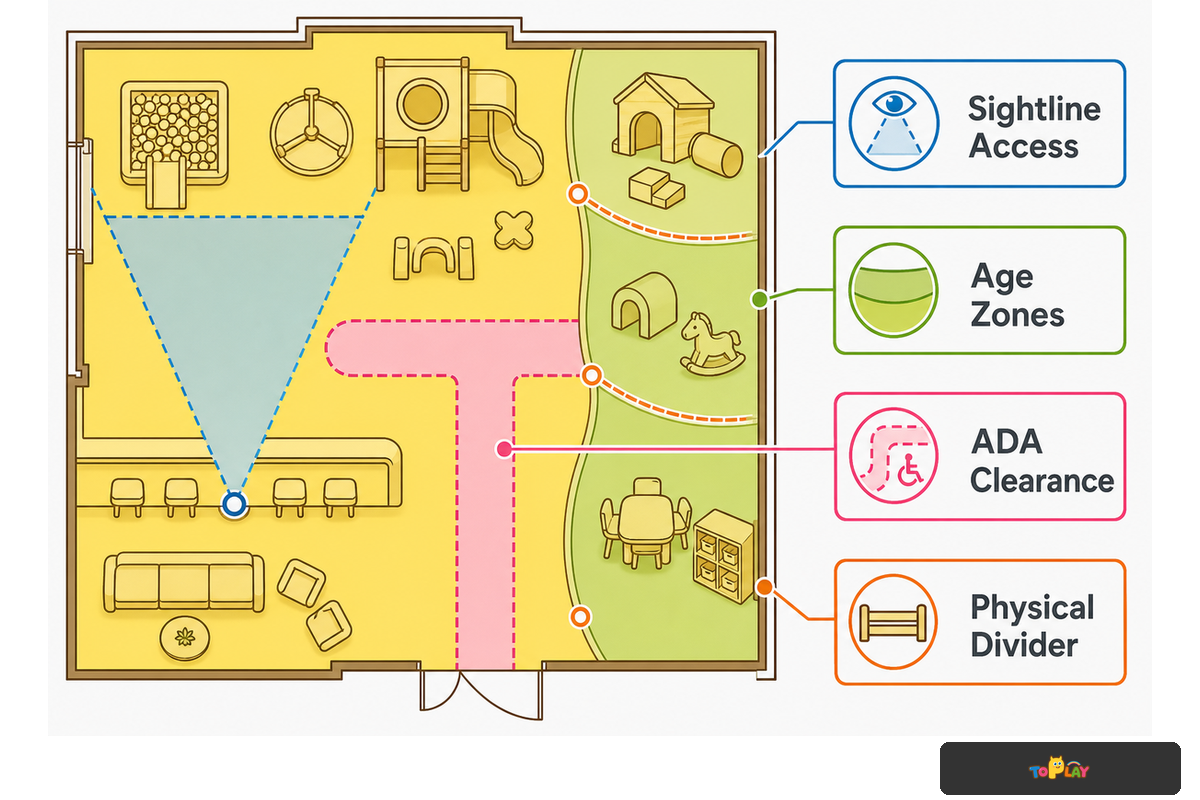
When evaluating location and layout decisions for your play cafe, make sure you assess them jointly; for example, a lower rent might seem enticing, but if the cost means lost trust and more safety complaints stemming from poor sightlines or awkwardly placed structural columns, it’s actually far more costly. You’ll need an uninterrupted view from parents’ seating to the actual play structure; a floor plan that’s logically organized on paper may, in reality, hide the play area behind a service counter or support column, creating a supervision void that signs alone can’t overcome.
Ensure ADA compliance. In spaces governed by the ADA in the United States, the U.S. Access Board’s guide on play areas presents clearances required for access paths: commonly a minimum of 60 inches clear width for a level access route, but with a conditional concession down to 44 inches in play areas of less than 1,000 square feet; 36 inches minimum for elevated paths; and a minimum clear floor space of 30 by 48 inches for play components. This clearance standard applies the same way no matter who builds the space — which is why equipment designed to a 3,000-sf spec doesn’t usually ‘fit’ inside a 1,200-sf cafe easily, even where the smaller-footprint exception applies.
Age zone separation should also be a layout decision rather than one made solely with signs. For most play cafes, kids from roughly 6 months to between ages 10 and 12 will come in and, if mixing an unsupervised toddler zone with a climbing structure that can safely accommodate an 8-year-old, your injury complaints are almost sure to start arriving in the mail. Use age separation zones to compartmentalize (usually infant-toddler, preschool and school aged), defining separations by way of a physical marker such as a low rail, different flooring, or a partial wall rather than using signage only, since even young kids are unreliable about putting themselves into a clearly designated zone.
Layout rule: If a floor plan requires an adult to stand up or move to see the play area, the layout is not finished, sightline access from seated positions should be treated as a fixed design requirement, not an aspiration.
If you’ve ever visited a space like this as a parent, you already know, intuitively, what a curated play environment feels like: real comfort for parents in the seating area, not only for the young patrons; sightlines are great; the space feels like it was professionally reviewed against local building codes and permitted rather than somewhat cobbled together on the go. Strive to make that feeling a priority right from day 1. A layout firm or equipment supplier with years of experience fitting structures into odd-shaped small footprints can usually flag these sightline and clearance conflicts before you sign a lease, not after.
Permits, Licensing and Zoning You Need Before You Open
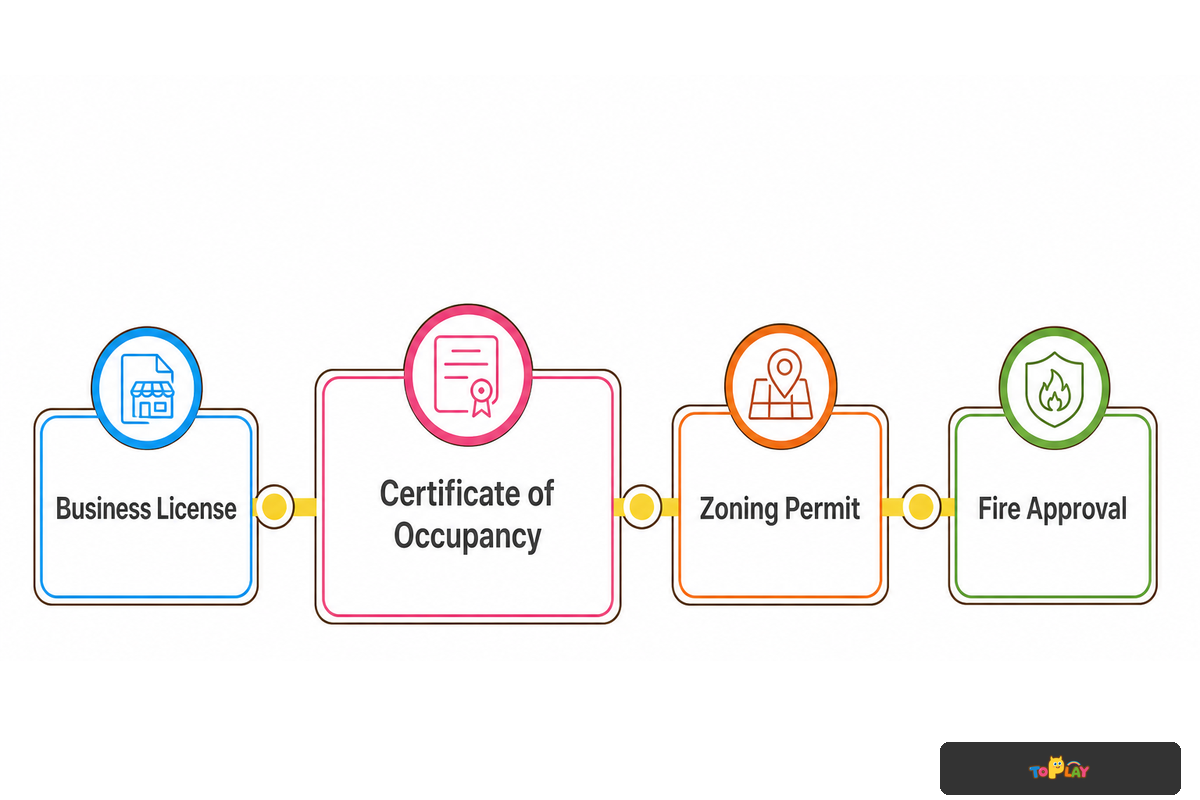
Skipping a permit or filing it late is one of the most expensive mistakes a new owner can make, since it can delay opening day by weeks. Depending on where in the US you’re located, you’re almost guaranteed to require some permits and licenses in addition to the basic ones such as a general business license or a Certificate of Occupancy (to assure the space is appropriate for public access) including possibly a zone permit, a permit for child activity facilities, a fire department clearance and a health department permit (if food/beverages are served). These will vary by city, county, and state.
The list below should be a checklist to verify (and not a substitute for making contact with your city planning or building departments); the U.S. Small Business Administration’s guide to licenses and permits is an appropriate starting point.
| Permit | Typical lead time | Typical cost | Issued by |
|---|---|---|---|
| General business license | 1-3 weeks | $50-$400 | City or county clerk |
| Certificate of Occupancy | 4-8 weeks | $250-$1,000 | Local building department |
| Zoning / child-activity-facility permit | 2-6 weeks | $100-$600 | Local zoning or planning office |
| Fire department approval | 1-4 weeks | $50-$300 | Local fire marshal |
| Health department permit (if serving food/drink) | 2-4 weeks | $100-$500 | Local health department |
By far the longest wait in build-out is for the Certificate of Occupancy, and it’s often treated as the very last build-out task — which is a mistake, because it can’t be issued until your electricians, fire, and plumbing are inspected, so it’s critical to apply as early as is allowed in your local procedures. Many operators lose two to four weeks of opening time by leaving the Certificate of Occupancy application as the last thing to be done rather than something that can run in parallel with other phases of build-out.
Safety Standards, Liability Insurance and Compliance
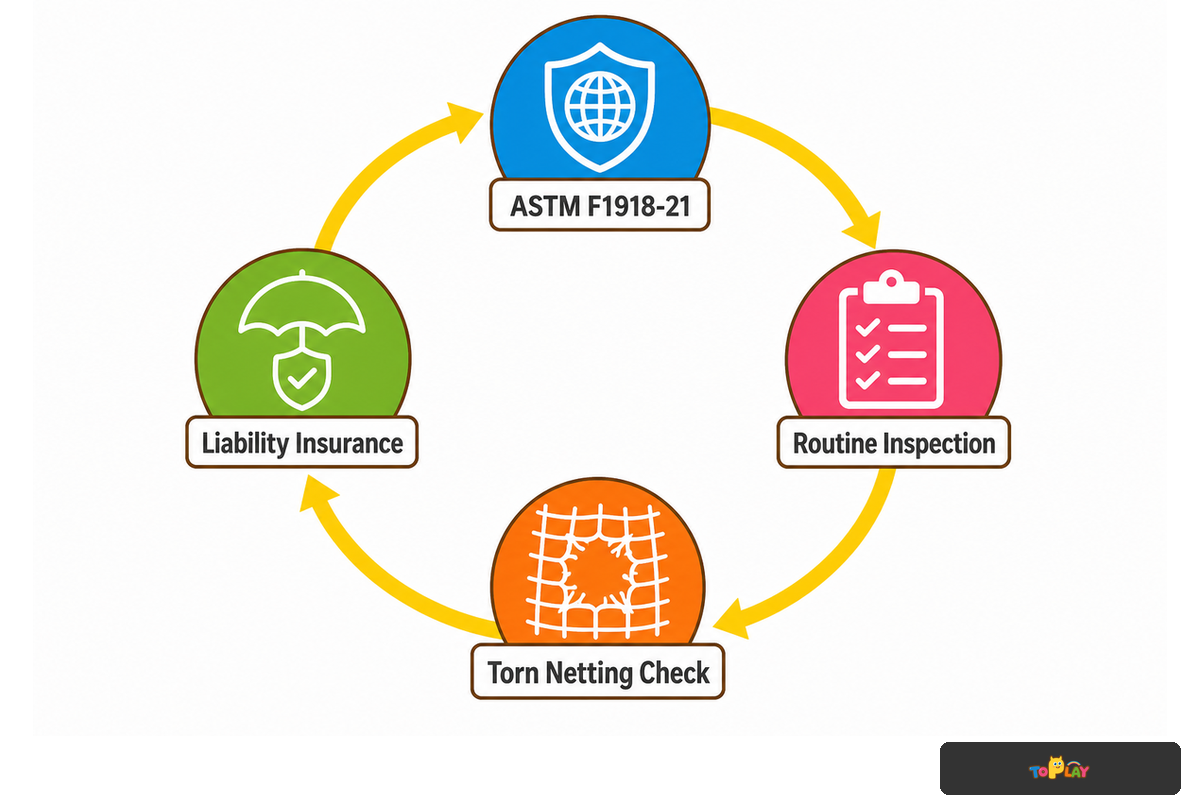
ASTM F1918-21 (soft-contained play equipment standard) remains the active safety-performance standard for this form of enclosed play, covering ages spanning the 5th-percentile 2-year-old to the 95th-percentile 12-year-old. As of 2026, the ASTM technical committee has an active work project to revise this standard, as typical soft contained play is no longer a soft, foam-wrapped fabric model, but an enclosure of some kind. Consult your supplier to know against what edition your equipment has been certified; an update does not retrofit existing equipment.
The U.S. Consumer Product Safety Commission’s soft-contained-play checklist offers a simple list of the type of routine inspection items you should be performing: Torn or unravelled netting; broken or stretched ropes, webbing or suspension; gaps or open seams on mats; obstruction in walkways; hygiene; and adherence to the age and size limits posted at each equipment area. Design this checklist for daily play equipment before opening the area each day – it’s not a one time installation check.
Budgeting for liability insurance for a cafe like this really has to start with an honest number: it probably works out to the low thousands of dollars per year. Generally, a facility under 2,000 square feet offering play falls into this bracket for general liability coverage; expect premiums to increase for larger play areas, riskier activities, and states with more frequent claims. Get it bundled with property as much as your provider allows, and check the policy carefully to confirm it explicitly covers a supervised children’s play component.
A generic retail or cafe policy doesn’t automatically include that coverage — confirm it in writing rather than assuming it.
How to Choose the Right Play Equipment for a Small Footprint
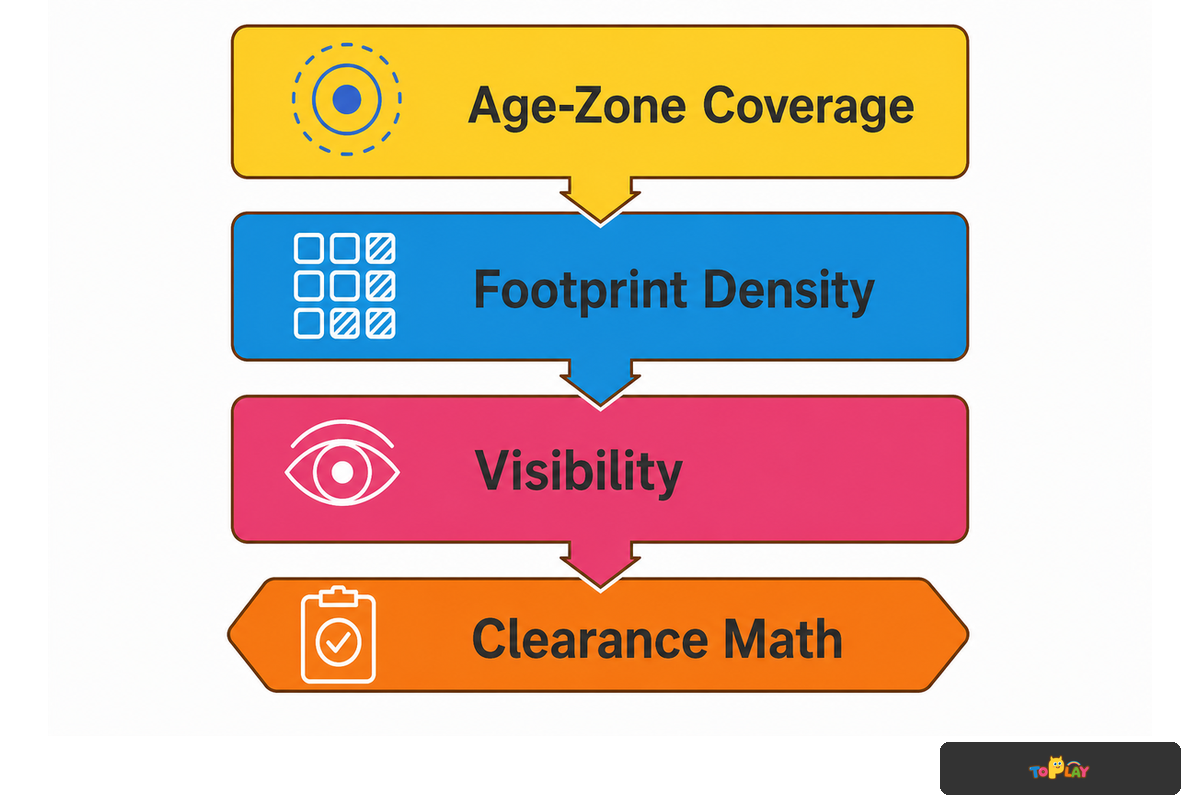
The play equipment selection for a small play cafe should come from three constraints, in order of importance: range of coverage by age zone, footprint density (the amount of playability achieved per unit area), and visibility — not from a good-looking photo in a showroom catalog. In other words, a tall, fully enclosed play structure built to maximize playability per square foot could still completely obstruct these view corridors, so equipment selection should be made in parallel with architectural decisions.
Finding the right equipment for a small footprint relies less on browsing a catalog “favorite” and more on sourcing a custom play structure or indoor playground equipment made to fit your space — equipment to fit the age-zone plan (younger kids in one play zone, older kids in another) rather than the other way around. Once your age groups, footprints, and sightline restrictions are established, equipment selection becomes more about configuration than a shopping trip, and you align the product with your space, versus trying to build your play cafe around one that shouldn’t have been in that space. Toplay produces custom-configured play structures within 15-30 working days of design confirmation, based on a 30% deposit / 70% pre-shipment payment basis, with a minimum order of one set. For current lead times, configuration options, and a quote, see Toplay’s configuration and project-terms page for small-venue installs, which covers project terms, space screening, and production requirements in detail; the design and turnkey delivery process walks through how drawings move from confirmation to production.
The most common equipment-selection mistake is sizing the structure to the room’s footprint alone and skipping the clearance math. A structure that leaves less than the 36-inch elevated-route or 60-inch ground-level clearance covered earlier is not a minor gap to fix later; it is a redesign. Equipment built to ASTM F1918-21 for the correct age band (roughly 2 to 12 years) also needs to be checked against your actual visitor mix before ordering, not after: a buyer who assumes “soft play” is a single category risks ordering a structure that serves toddlers well but leaves 8- to 10-year-olds bored and testing it in ways it was not designed for.
Staffing, Supervision, Cleaning and Daily Operating Records
Staffing requirements aren’t something you sort out in one weekend right before opening: be ready the week before opening day with staff assigned to both supervision ratios and cleaning routines that can be launched immediately, not tweaked after the fact. Skimping on supervision staff to shave costs invites trouble, and any short-term savings are wiped out by the additional paperwork of filing an incident report and the attendant risk if the equipment in a particular area comes under review.
On cleaning, let’s follow the CDC’s sequence for day care and ECE spaces: “Visible soiling (e.g., dust, dirt, food particles) can reduce the effectiveness of disinfectants.” Therefore, “Clean visibly soiled surfaces and objects with soap and water or detergent-based cleaner before applying a sanitizer or disinfectant to the target surface.” And remember, while some disinfectants are formulated to work on both soft surfaces and a range of nonporous and porous hard surfaces, others are designed to serve only one category. Always use appropriate chemicals.
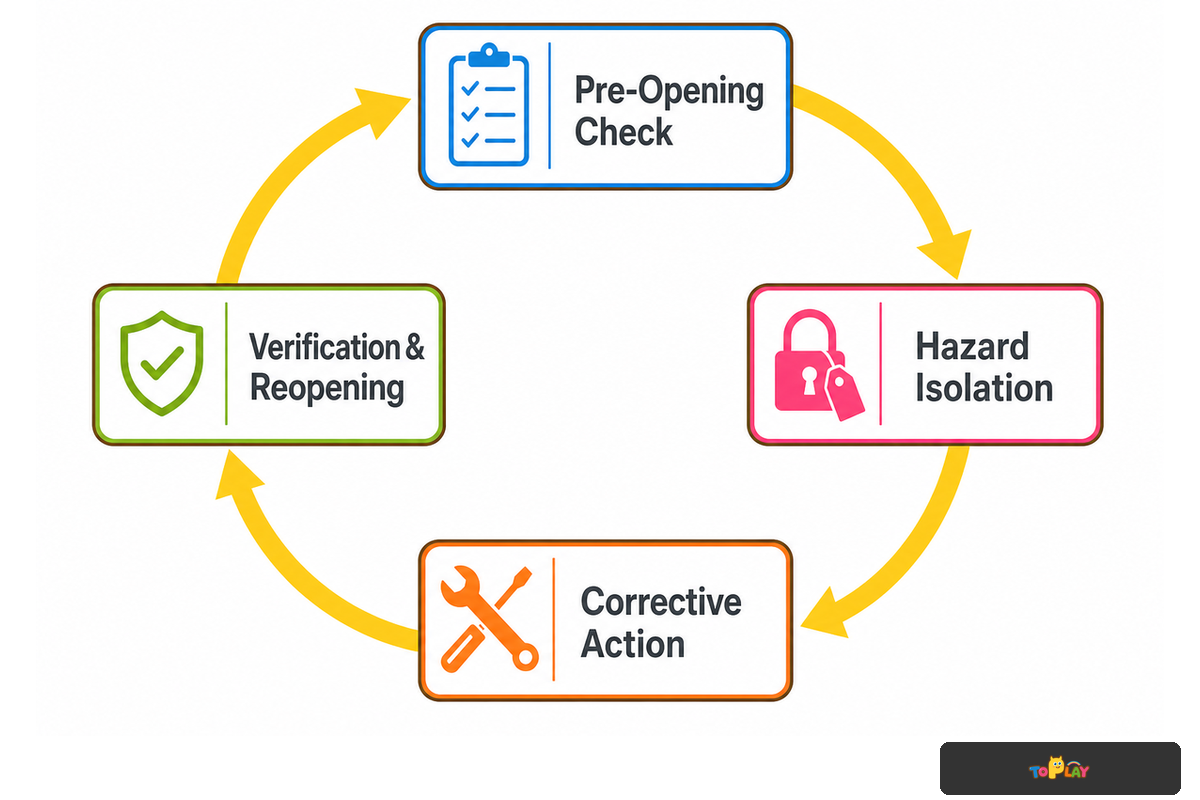
On inspection, CPSC’s Public Playground Safety Handbook outlines a maintenance process that goes beyond checking boxes; it provides for documenting findings, assigning corrections, verifying completed corrections, and documenting that a zone reopens after repairs or safety updates. Our recommended daily procedure includes a pre-opening check, finding identification, isolation of any hazards, corrective actions to address any problem (either internally or escalating the problem), verification of corrections, then officially re-opening the impacted area or component. One of the most common, and potentially damaging, shortcuts is foregoing these verification and reopening steps.
A clean, well-run floor is what keeps families coming back — it does more to attract customers over time than any single marketing campaign or social media presence push, and it outpaces competitors who aren’t actively engaged in keeping their establishments well maintained. Word-of-mouth and the community’s response compound around venues that are visibly well maintained, and slow to a decline around facilities where that’s lacking.
Independent Play Cafe or Franchise?
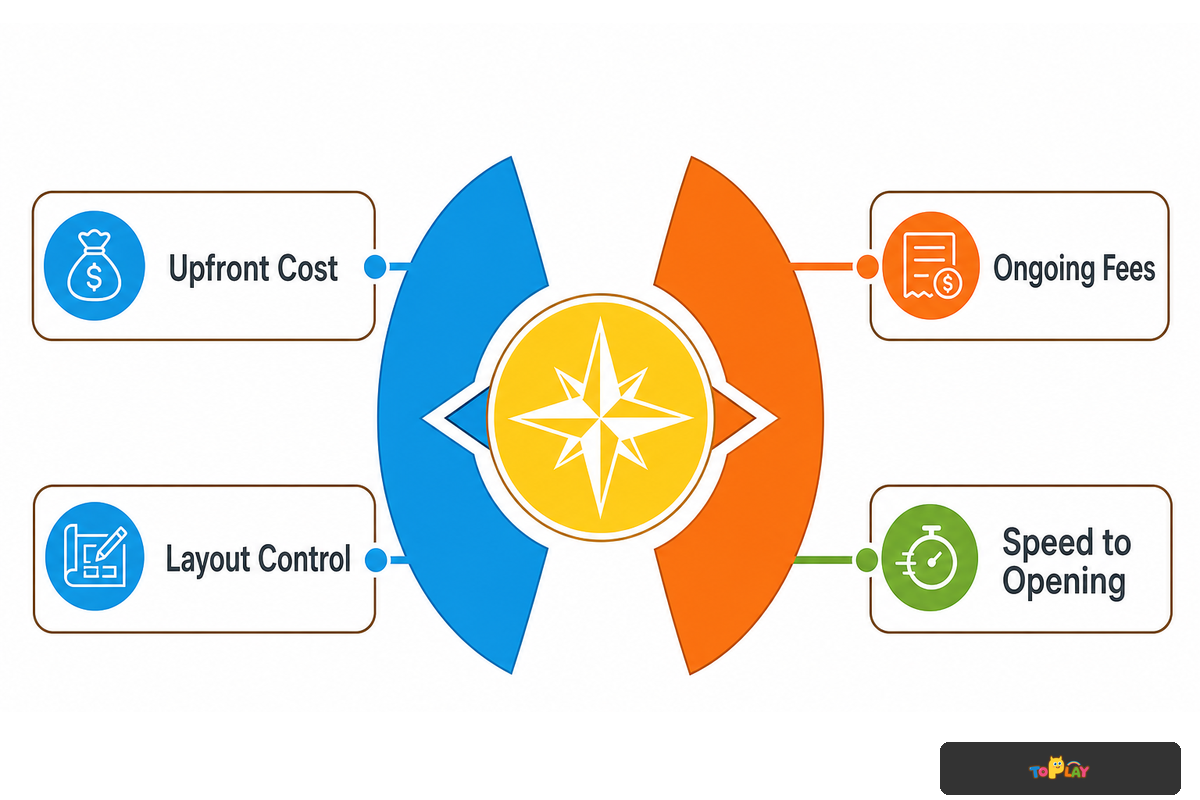
The independent-versus-franchise decision comes down to a trade-off between speed-and-support and long-term control over cost. Once your business plan and numbers hold up, that is the next fork in the road: search for a play cafe franchise, or build an independent brand from scratch.
Buying into a franchise means buying an already tested layout, training system, and marketing engine — often including a formal “play cafe academy” staff-training program that a brand-new play cafe owner would otherwise have to build from scratch; this shortens time-to-opening by a wide margin but means paying the franchise ongoing royalty fees, potentially getting restricted into a territory, and having fewer options to pivot on equipment choices or pricing. Starting an independent play cafe requires fewer ongoing fees and maintains control over layout and product choices but saddles the owner with all of the market research and systems building effort. Either path still runs through the same licensing and permit process; a franchise agreement does not exempt you from local Certificate of Occupancy or health-permit requirements.
| Factor | Independent | Franchise |
|---|---|---|
| Upfront cost | Lower (no franchise fee) | Higher (franchise fee layered on top of build-out) |
| Layout and equipment control | Full control, custom-configured to the space | Often standardized to brand specifications |
| Brand recognition at launch | None; built from zero locally | Existing brand awareness, if present in the region |
| Training and operating support | Self-sourced | Structured onboarding and playbooks |
| Territory protection | Not applicable | Usually included, but restricts expansion flexibility |
| Equipment and supplier freedom | Full freedom to choose and switch suppliers | Often restricted to approved vendor lists |
| Ongoing fees | None beyond normal operating costs | Royalty and marketing fees, typically a percentage of revenue |
| Exit flexibility | Sell or close on your own terms | Franchise agreement terms govern resale and closure |
| Speed to opening | Depends entirely on owner’s own research pace | Faster, given a pre-built playbook and support structure |
Retail, hospitality, or child care industry professionals with existing operational expertise often find value in the independent route because they already bring much of what a franchise’s training program would otherwise provide. Novice small business owners more often select a franchise because they seek to purchase a support system and get access to the faster learning curve that buying pre-tested systems provides.
Talking to existing indoor playground owners — whether they run a small play cafe, an indoor playground business, or one of the larger regional play centers — should outrank nearly any other resource at this stage. Most will make time for a brief consultation and start the conversation if you respect their time and come with prepared questions: a realistic, personal estimate of the steps to opening (from first walk-through to being ready to open), and what a new business like theirs was unprepared for or omitted the first time around.
Red Flags That Should Delay Your Play Cafe Launch
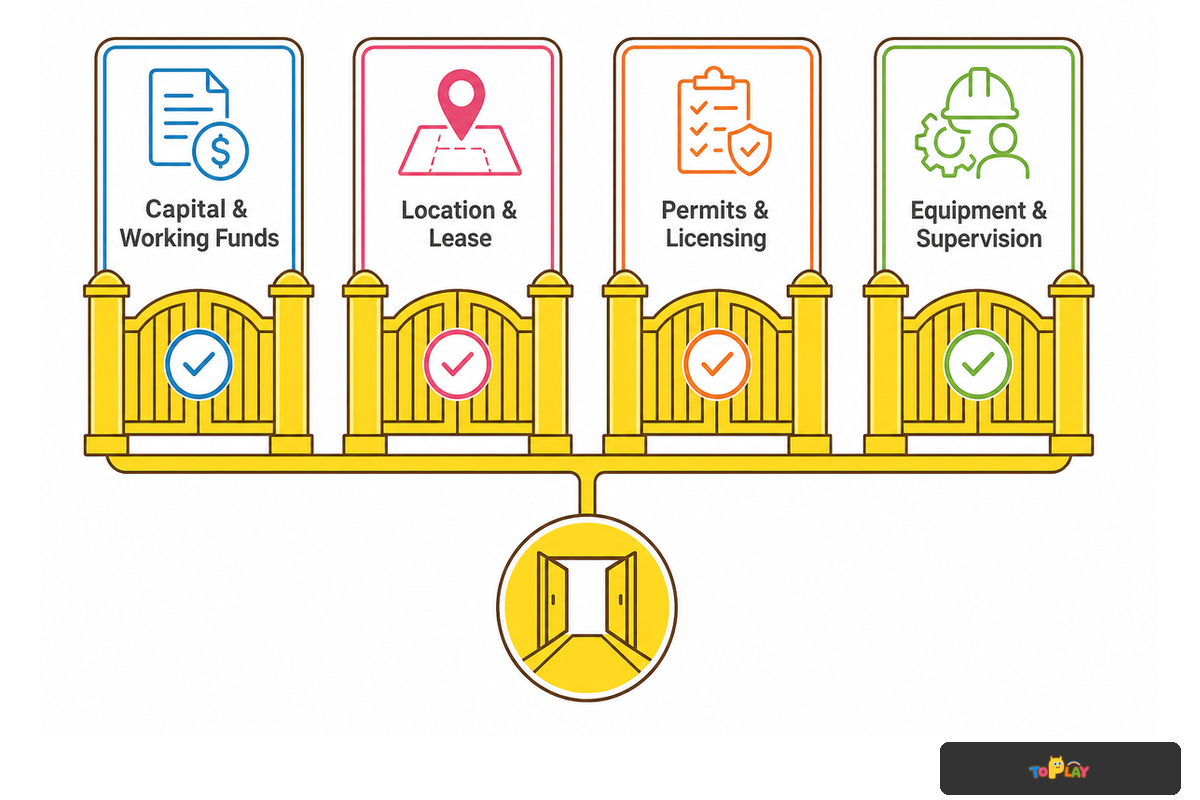
A few conditions consistently separate opening on time with no headaches from delaying to prevent problems — conditions that, in almost every case, are resolvable with time, not money. Founders who lean on advisors and suppliers with years of hands-on experience in this category tend to catch these red flags earlier than founders working entirely alone. The same logic behind the CPSC’s inspection-and-correction framework covered earlier applies here too: an unresolved finding, whether it’s a safety item or a readiness-matrix gap, is itself a signal to slow down.
The Play Cafe Launch Readiness Matrix
| Readiness area | Minimum bar | Red flag | How to verify |
|---|---|---|---|
| Capital and working funds | Full build-out budget plus 3 months of fixed costs in reserve | Working capital reserve under 3 months of fixed costs | Bank statement or funding commitment against your fixed-cost line item |
| Location and lease | Signed lease with confirmed zoning use and adequate ceiling height for the tallest planned structure | Zoning use not yet confirmed for a child-activity facility | Written zoning confirmation from the local planning office |
| Permits and licensing | Certificate of Occupancy application filed at least 8 weeks before target opening | Permit lead time exceeds 14 weeks with no filing yet | Filed application receipt with a stated review timeline |
| Equipment and supervision plan | Equipment order confirmed with a lead time that fits inside the permit timeline; supervision staffing plan written | Equipment lead time unconfirmed while a fixed opening date is already being marketed | Supplier order confirmation with a committed ship date |
Look for any and all of the following: any “red flags” mean you need more time prior to opening, not more money — every one of them is fixable with time. If you can’t check off every “minimum bar” item in the matrix above by opening day, delay the ribbon-cutting rather than rushing the fit-out. If you open without a plan and secured funds for the 3 months of operating cash the readiness matrix calls for, your revenue won’t have time to catch up with fixed costs, and a business model that might have been a huge success can become a costly failure in the first year. The biggest reason most businesses fail within the first year isn’t that customers don’t know they’re available or that “the market doesn’t support it”; rather, it’s usually a lack of capital, a lack of planning, and, frankly, a lack of leadership to make prudent, timely (and often time-consuming) decisions.
Industry practitioners who have gone through this process also point to a narrower set of avoidable mistakes: trying to run every function personally instead of hiring out legal, accounting, or marketing tasks that fall outside the owner’s expertise; finalizing a floor plan without walking it as a parent would, which is how single-bathroom or blocked-sightline layouts get built; and buying an existing space assuming it is turnkey, when hidden structural or permit issues can cost more to unwind than starting from a raw shell would have.
Frequently Asked Questions
How much does it cost to open a play cafe?
Total startup costs for a small play cafe (1,000-2,000 sq ft) typically run $80,000-$250,000, covering build-out, play equipment, initial permits and licensing, first-year insurance, and 2-3 months of working capital. Larger multi-zone facilities with food service can reach $400,000-$750,000. Costs vary significantly by city, lease condition, and how much soft-play equipment you customize versus buy off the shelf.
Are play cafes profitable?
Play cafes can be profitable; margins depend on blending at least two revenue streams, for instance daily admission and memberships or birthday parties or food and drink, not just entry fees. Break-even typically occurs in 12-24 months once fixed costs (rent, staffing, insurance) are recovered with combined revenue streams; single revenue streams tend to have a longer payback.
What permits are needed for an indoor playground?
Most states and localities require a general business license, a Certificate of Occupancy that certifies the indoor space is suitable for public access, a zoning or child-activity-facility permit, fire department approval, and a health department permit if any food or drink is served to consumers. The Certificate of Occupancy is often 4-8 weeks in the making and costs $250-$1,000, so should be obtained as early as possible.
What age is a play cafe good for?
Most play cafes serve children from about six months to ten or twelve years old, with equipment and furnishings zoned by age band to allow both toddlers and older children to play safely in the same room.
Should I open an independent play cafe or buy a franchise?
It depends on how much support and speed you value; a franchise is likely to provide faster delivery and proven protocols and layout, but it also imposes territorial limits, ongoing royalty fees, and less variety in equipment vendors once established. An independent play cafe avoids those ongoing royalty fees and gives full control over layout, pricing, and vendor selection, at the expense of the time and effort of researching and building your own systems without a proven playbook to fall back on. Owners with prior retail or childcare experience more often seek the independent route; first-time small business owners more often seek a franchise.
From Business Plan to Opening Day
The sequence that work is straightforward in all situations, whether you’re building an indoor playground or play cafe: size your budget to your actual footprint, file for the Certificate of Occupancy and begin zoning immediately, select equipment against sightline and age-zone needs rather than a catalog photo, and build a cleaning and supervision routine before you need it. Careful planning, not a bigger budget, is what most reliably separates a realistic business launch from a hurried, stress-filled opening.
Families search for this concept under several spellings — “play cafe near me,” “play cafés,” “indoor playground with coffee” — but whichever listing they compare against the next one in the local business directory, they all ultimately want the same thing: a safe, clean, kid friendly place to relax while their children burn off some energy. Start building toward that ideal from day one, and the rest of the operating checklist in this guide follows naturally. If you are still collecting play cafe ideas before committing to a floor plan, revisit the readiness matrix above before you sign a lease.
When your space, age zones, and layout are ready, Toplay can help you set play equipment size to your dimensions and timeline.
Discuss Your Play Cafe Equipment Project
References & Sources
- U.S. Consumer Product Safety Commission: Public Playground Safety Handbook
- U.S. Consumer Product Safety Commission: Soft Contained Play Equipment Safety Checklist
- U.S. Access Board: Guide on Play Areas
- ASTM International: F1918-21 Scope and Active Status
- Centers for Disease Control and Prevention: Cleaning and Disinfecting Early Care and Education Settings
- U.S. Small Business Administration: Apply for Licenses and Permits



