Get in touch with Guangzhou Toplay amusement equipment co. Company

While designs can include beautiful renderings and detailed quotes, and while an owner may be enthusiastic about a project, people working from different decisions can cause problems. That’s the case when a comment about the theme becomes an instruction to change a component, or when the layout reaches the installer after the equipment order has been placed.
Design & Project Delivery connects the venue brief, design decisions and agreed equipment scope to the information used for production, installation and support. The owner coordinates decision rights, current revisions and the consequences of changes.
- An approval can close one decision while another package still needs review.
- A design change needs an impact decision before revised work is released.
- Equipment, venue and operating responsibilities need their own named owners.
- A useful project record explains what the next person may do with each file.
What Does Design & Project Delivery Mean for the Owner?
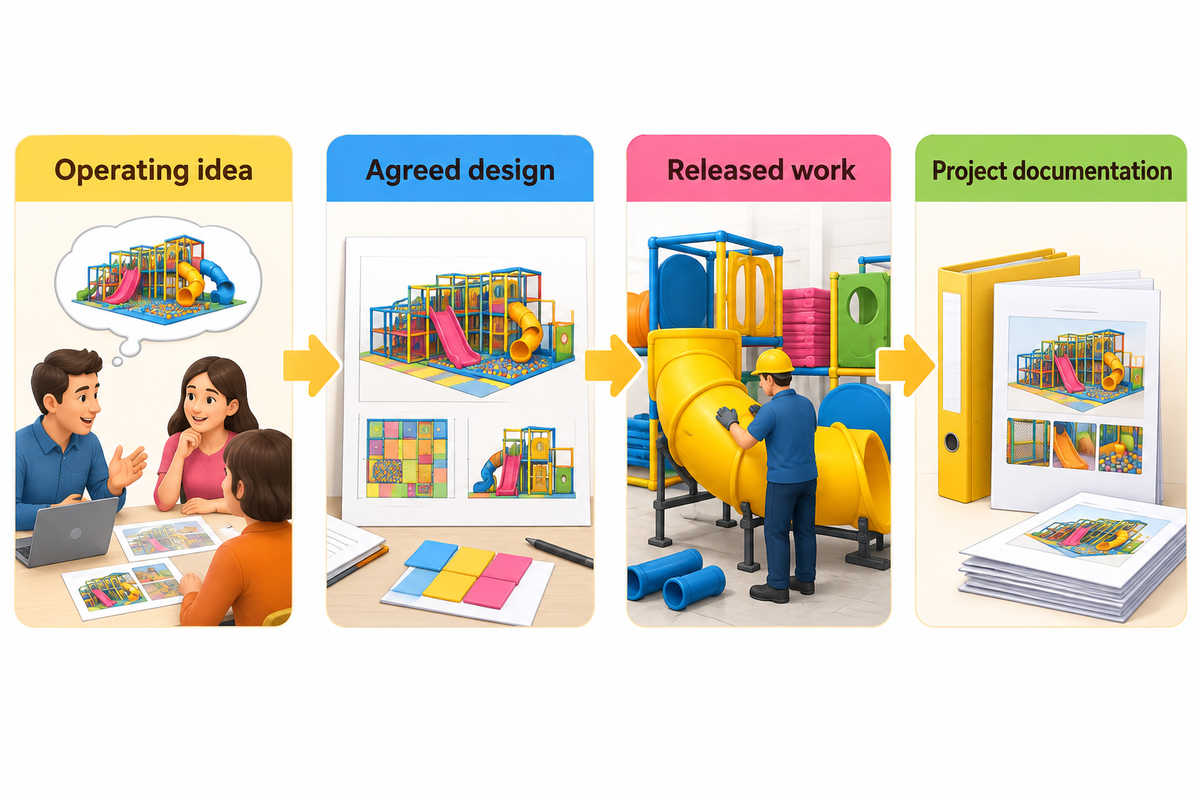
Design and Project Delivery means setting out how an indoor playground evolves from an operating idea into a defined and agreed design, released work and usable project documentation. Owners need a defined route for making decisions across the venue team, designer, equipment supplier and installation team. Each party provides information to fulfill a different role.
The first important distinction to make is between the business you intend to operate and the equipment package you’re purchasing. A play cafe, mall play area and a family entertainment center may seem similar when looked at from a play structures perspective, but may require very different operating arrangements. Opening hours, party bookings and the overall parent experience belong in the operating brief. A commercial indoor venue also requires equipment to match the supplier’s agreed scope.
Toplay’s playground design and turnkey delivery service explains the process from the supplier point of view. Use that scope to identify the information your project team needs to exchange. Other concurrent activities like building work and venue permissions, and the owner’s preparation to operate the venue, also need their own responsible people.
A project-specific quality plan offers a useful management reference. ISO 10005:2018 describes guidance for establishing and revising quality plans for a product, service, project or contract. Applied to an indoor playground project, the practical question is which information must be ready before someone makes the next decision.
Appointing a single coordinator for starting an indoor playground prevents every supplier question from becoming a separate conversation, as the coordinator collects and consolidates decisions. Technical reviewers retain their own authority and the coordinator connects those answers to the work they influence.
Connect Four Workstreams Before Decisions Diverge
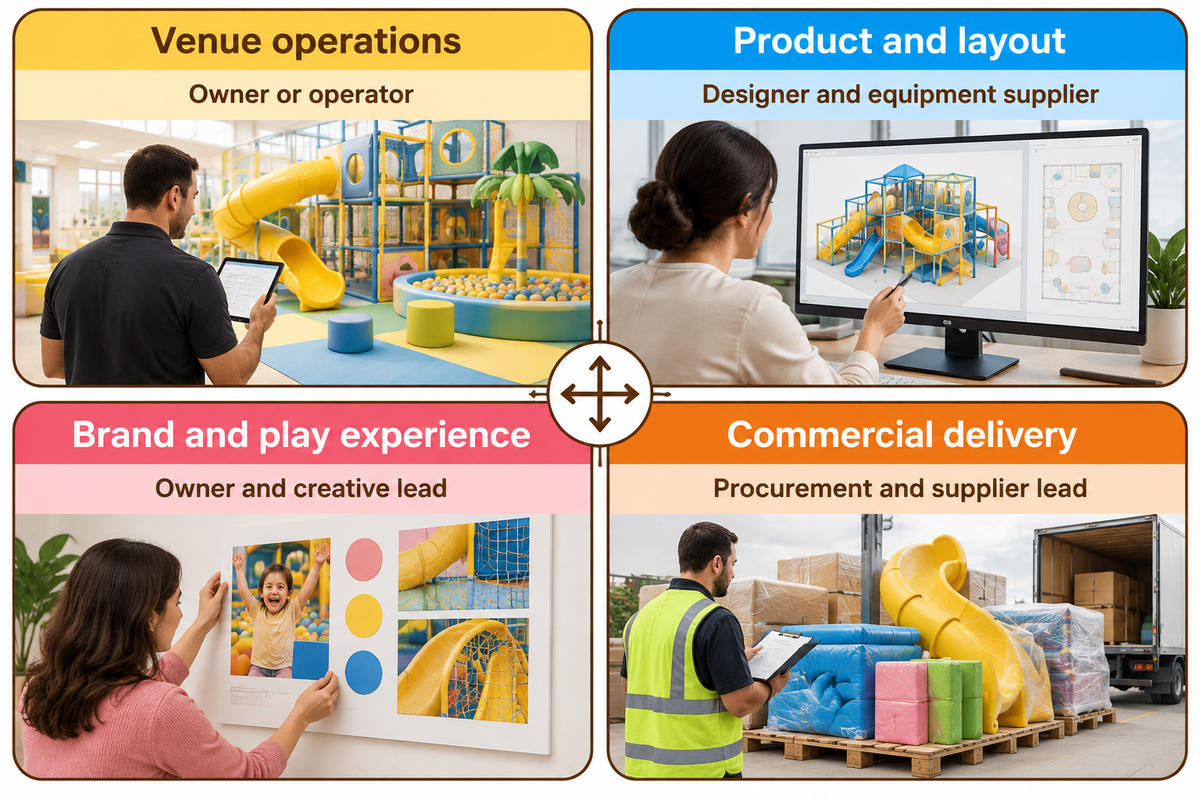
For an indoor playground project, there needs to be alignment between operational planning, product design, the visitor experience and commercial delivery. Connect those workstreams through named decision owners. A choice is ready to move forward when the people responsible for its interfaces can see what has been decided and what remains open.
| Workstream | Decision owner | Information to connect |
|---|---|---|
| Venue operations | Owner or operator | Audience, staffing tasks, party use and daily routines |
| Product and layout | Designer and equipment supplier | Site information, equipment schedule and reviewed layout |
| Brand and play experience | Owner and creative lead | Theme, play value and agreed visual applications |
| Commercial delivery | Procurement and supplier lead | Quoted scope, release conditions and delivery responsibilities |
Example: An investor looking at two play cafe concepts sees the same slides, climbing structures, and party capacity assumptions in both. One concept places the party room next to the reception; the other places it behind the active play area. During a group arrival, the operator needs to have someone to welcome families, explain the booking and guide the party host. The designer shows how to do the sequence for both options. Procurement then confirms if the reception furniture is in the equipment order. The creative lead identifies the signs that represent the theme of the venue. Now a preferred concept has a list of rational business choices and reasons as to why a particular option is preferred. No attendance or revenue forecast is needed to explain that choice.
Objectives guide the assessment of options and their tradeoffs in the UK Treasury’s Green Book. For a private indoor playground business, use the idea of ‘making assumptions visible.’ A simple weighted score shouldn’t disguise a disputed judgement as an objective result.
Keep the output short. Summarize the preferred option, the operating reason for the choice, the questions that are still open, and who will answer those questions. More paperwork adds little when it leaves the actual decision unclear.
Build a Project Brief with Questions Assigned to Owners
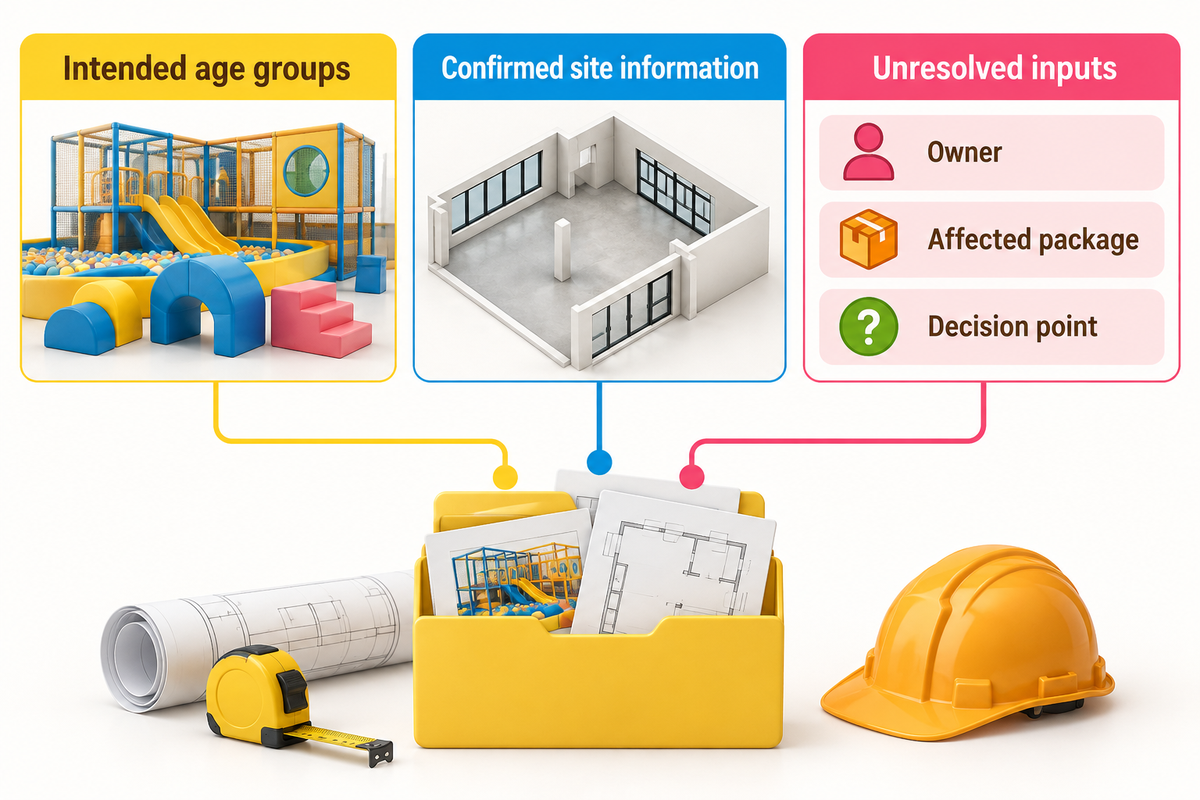
Build the brief according to confirmed inputs and assigned questions. For the indoor playground, state who it’s for, how the venue will operate and what site information the designer may use. For all unresolved inputs, state an owner, an affected package and a decision point. This means that the supplier will get one consolidated brief.
Available space extends beyond the area shown on a leasing plan. Indoor playground layout is shaped by structural columns, fixed services, the agreed constraints of the building and the challenging activities. Route and adjacency work is in the indoor playground space-planning guide; the task is to identify who provides and verifies the information.
The intended age groups for the operating side and the type of equipment should be named. A compact play venue serving younger children will have different staff questions from an adventure zone with challenging activities. Sensory activities, interactive play and play space can be part of the concept, but should be justified in the brief.
An example of an open question is, “Party groups arrive together; the operator needs a check-in arrangement that keeps the reception task manageable.” The operator describes the process they want. The venue rep states the reception constraint they’ve verified. The designer shows the arrangement on the next layout. Until they agree, this part of the brief is provisional. The question is detailed enough that it can be answered without requiring each stakeholder to redesign the entire playground.
Other commercial inputs belong here. Separate the equipment budget from local work and operating prep. A business plan may include a business license, liability insurance and launch staffing, while the equipment quotation has a different boundary. Those responsibilities should be evident early, even if different advisers or contractors handle them.
Treat completeness as a working condition: one coordinated input set gives the supplier a defined basis for its proposal, and a changed input needs an identifiable revision.
Review Concept Options Against the Operating Brief
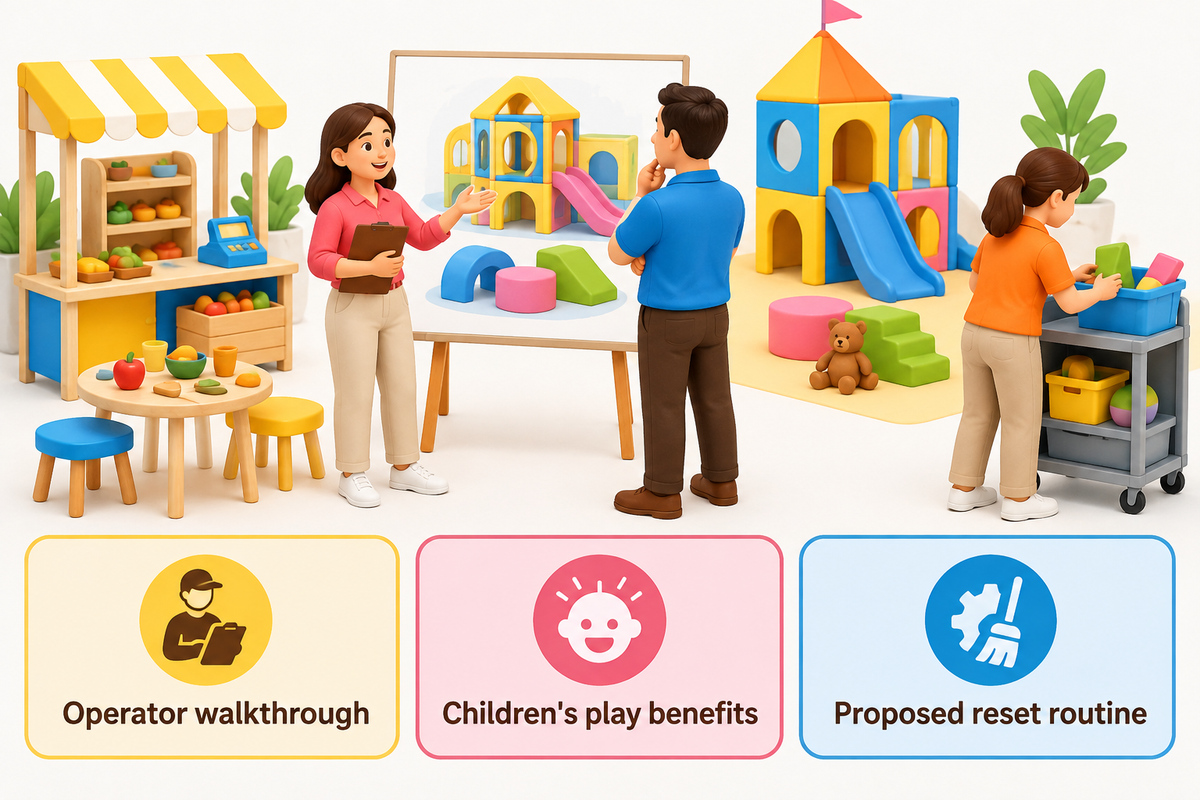
Review design concepts and indoor playground design ideas by repeating visitor and operator tasks in each. Compare how children use the play elements, how adults participate and how staff reset the venue. Keep site assumptions the same. A good concept illustrates its operating choices and play value as clearly as its interior design.
Example: Two concepts for an indoor playground for children both include pretend shops and a soft play structure. One of the examples provides a number of loose parts and leads to an open-ended immersive experience; the other example uses a more fixed structure and a greater number of interactive elements. During a party changeover, staff must clean the equipment, find missing elements, and reset the play scenario. The operator walks through the task while the designer outlines the benefits gained by children from each arrangement. The removal of all loose parts, such as LEGO bricks, also alters the intended play experience. It’s important to identify the desired imaginative play, the reset method, and who will test the proposed routine. These aspects are reflected by the equipment list and theme drawing. The same choice is captured in two different ways, so the equipment list and theme drawing describe that choice.
Play-cafe consultant and former owner Michele Caruana discusses this reset workload in her account of opening mistakes. Her advice comes from an owner and training-business perspective. It’s a useful prompt to examine staff tasks, rather than a measured labor allowance for your venue.
Equipment variety, including sensory play equipment such as textured walls or sand tables, can also lead to a change in the result. If the elements provide a choice between ball pits and tactile panels, different reset questions will arise. If the elements involve loose parts, the loose parts need to be tidied, which creates a different reset task. Discuss the different play benefits derived from the sensory elements, such as sensory paths.
What can the child explore, practice and choose in this activity? The UK Health and Safety Executive’s statement on balanced play takes into account the benefits of play as well as the real dangers and what’s proportionate. Physical development and age-appropriate challenge stay in the discussion without turning an activity worksheet into a safety judgment.
Find the section on creative direction elsewhere. For brand to theme decisions, use the custom playground concept and theme guide. Keep this review focused on the alignment of the proposed experience, operating brief, and equipment information.
Make Each Approval Specific to a Package and a Purpose
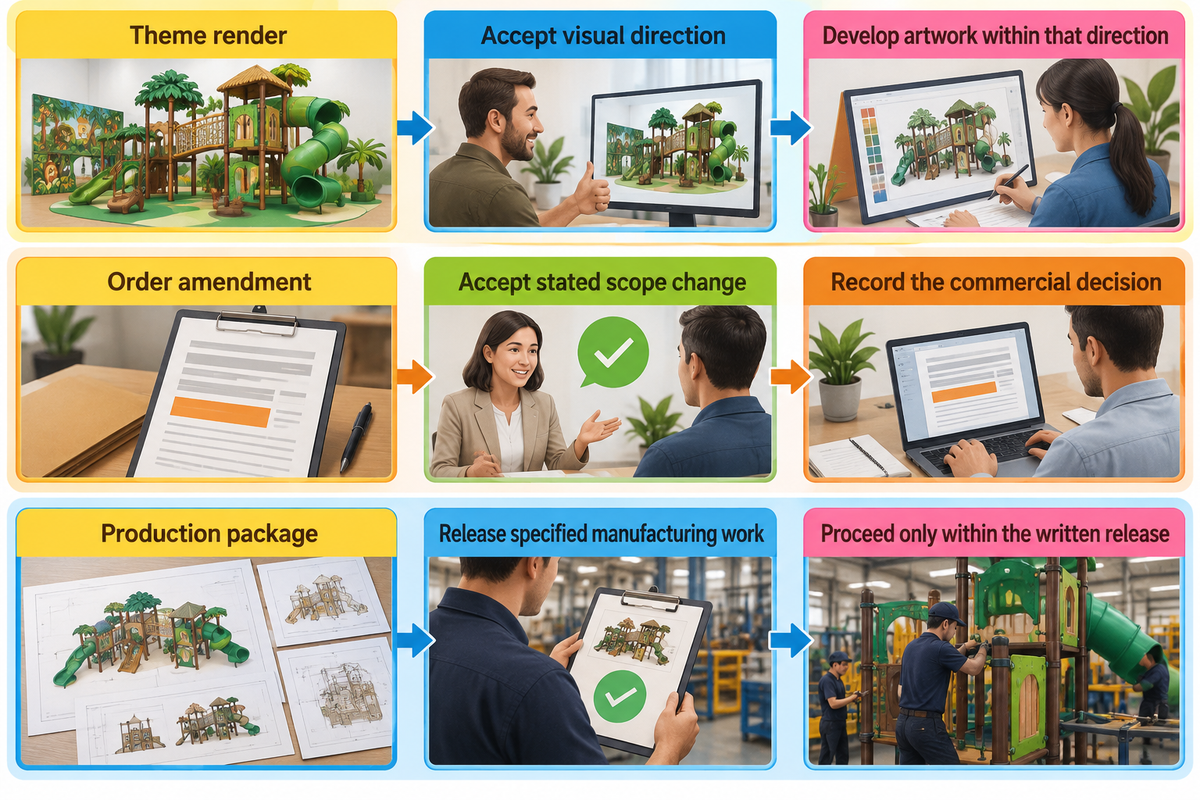
An approval should identify the package, revision, and intended use and next permitted activity. Different reviewers can close different decisions on the same package. Record the remaining dependency next to the approval. An accepted concept, color, or order may not give permission to manufacture or alter the venue.
The Approval-Scope Record below is a specific example of that distinction. Examples of file names and revisions are provided. Agree identifiers your team can actually use.
| Package and revision | Intended decision | Decision owner | Open dependency | Permitted next activity |
|---|---|---|---|---|
| Site input, revision 2 | Use confirmed room information | Venue representative | Reception interface answer | Develop unaffected concept areas |
| Operating brief, revision 3 | Accept party arrival procedure | Operator | Final staff allocation | Review the arrival layout |
| Concept layout, revision 3 | Accept the preferred arrangement | Owner with designer | Relevant venue reviews | Develop the selected concept |
| Theme render, revision 2 | Accept visual direction | Creative lead | Entrance graphic wording | Develop artwork within that direction |
| Equipment schedule, revision 4 | Agree selected play equipment | Procurement with supplier | Changed entrance component | Resolve the quoted component list |
| Artwork file, revision 3 | Accept named graphic application | Brand owner | Supplier application review | Prepare the reviewed application file |
| Order amendment, revision 1 | Accept stated scope change | Named commercial signatories | Supplier release confirmation | Record the commercial decision |
| Production package, revision 5 | Release specified manufacturing work | Responsible supplier lead | Explicitly listed excluded item | Proceed only within the written release |
| Installation instructions, revision 2 | Issue the current instruction set | Responsible supplier lead | Installer acknowledgement | Plan the stated installation work |
| Installed record, revision 1 | Identify the handed-over configuration | Project and operations leads | Named outstanding item | Use the record for service enquiries |
The UK government’s GovS 002 guidance on traceability and information management connects status, version and related deliverables. The record applies that management logic to buyer communication. ISO 10007:2017 gives the broader configuration-management context across a product or service life cycle.
A short decision like “visual direction accepted; entrance wording remains open; continue artwork development” is more helpful than an approval stamp. The supplier can see what the next step is, and the operator can see what question needs an answer. Get rid of any fields that don’t help your team make or implement a decision.
Follow a Design Change Across the Project
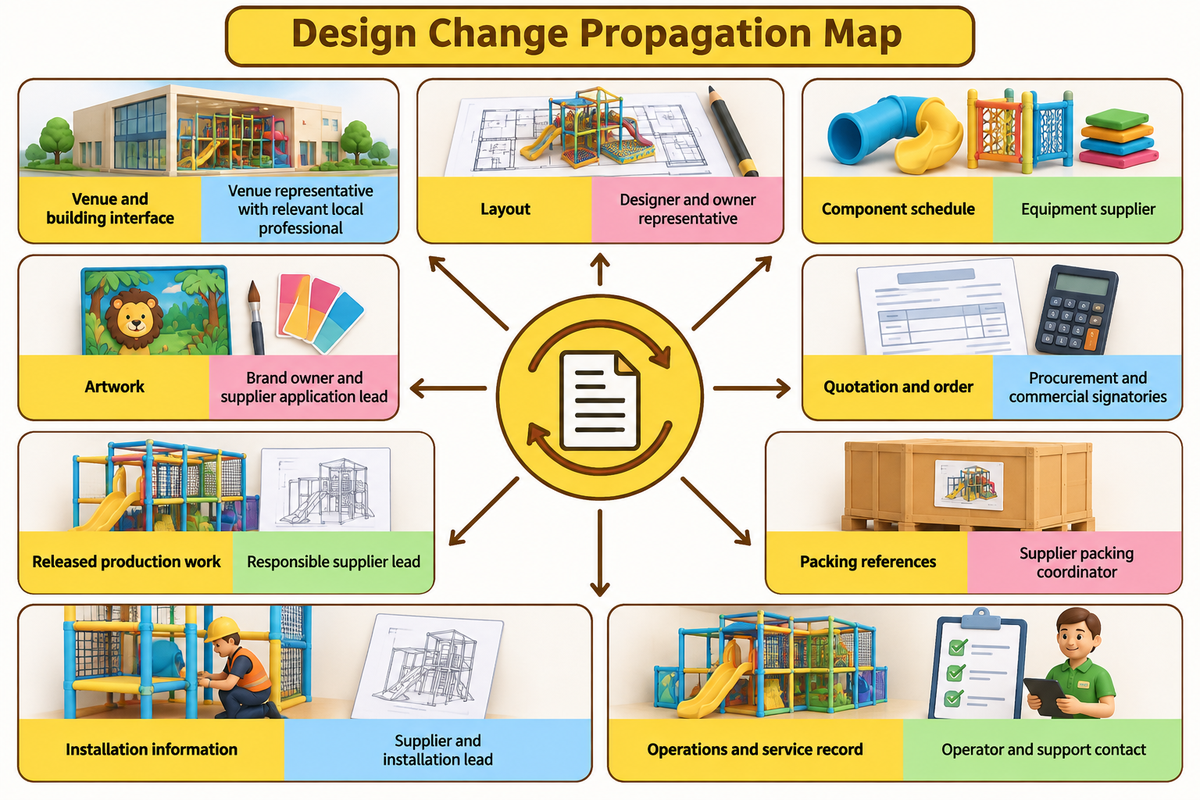
In case of a design change, follow the change through all affected packages before releasing the modified work. Start from the reason for the request, connect the venue review, design, supplier order and implementation instruction. The responsible parties decide what changes and what stays the same. Approving and implementing a change are done separately.
Example: After receiving concept approval, the owner of a mall playground requests a different position for the entrance and a new graphic to reflect the identity of the tenant. The first request goes to the venue representative because a physical move may be in conflict with the arrangement of the building. The designer identifies the affected layout. A supplier checks whether the entrance component and its references change. Procurement requests the commercial effect; the brand owner reviews the graphic. If a file has been previously released, its owner identifies the work reached by that release. The coordinator collates the answers before giving the next decision. A revised graphic alone, leaves too many people to guess what they should do next.
The Design Change Propagation Map captures that example, and each row of the map denotes one interface with a concrete output. A graphic-only change request may leave some rows unchanged, but that determination is the responsibility of the people responsible for those packages.
| Affected package | Responsible review | Question to resolve | Recorded output |
|---|---|---|---|
| Venue and building interface | Venue representative with relevant local professional | Does the physical move affect venue or shared-building arrangements? | Review outcome and dependencies |
| Layout | Designer and owner representative | Which position and linked layout information change? | Identified layout revision |
| Component schedule | Equipment supplier | Is the entrance component or its reference different? | Matched component reference |
| Artwork | Brand owner and supplier application lead | Which graphic file applies to the revised component? | Accepted artwork revision |
| Quotation and order | Procurement and commercial signatories | Does the agreed scope or commercial commitment change? | Written amendment or unchanged-scope record |
| Released production work | Responsible supplier lead | What work has already used the previous package? | Affected-work decision and revised commitment |
| Packing references | Supplier packing coordinator | Do item labels and the packing list still match? | Updated or confirmed references |
| Installation information | Supplier and installation lead | Which instructions must replace the previous set? | Issued revision and acknowledgement |
| Operations and service record | Operator and support contact | Which installed item will later service enquiries identify? | Retained final reference |
The Teal Book’s change-control chapter distinguishes authorising implementation from approving a change while deferring implementation. Its government-project method is a useful analogy here: the decision should travel with its consequences and the information needed to act on it.
A move involving a physical entrance also requires venue-specific professional input. The coordinator routes the question to the relevant person and records the answer. The same person should not infer technical acceptance from the fact that a graphic, component or commercial amendment has been approved.
Link Production and Delivery to the Approved Information
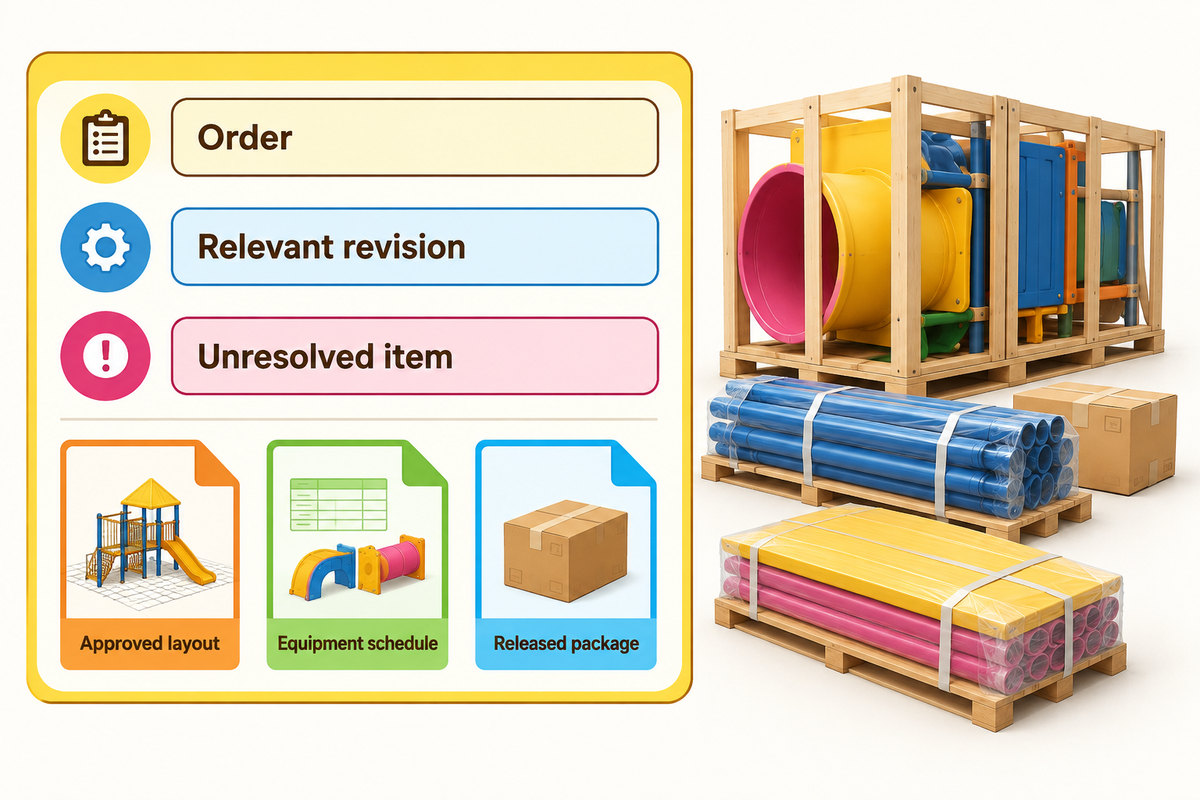
Associate supplier progress updates to the approved layout, equipment schedule and released package. Owners should be able to decipher which version an update refers to and whether a subsequent change has been incorporated. Delivery coordination then follows an identifiable scope, with outstanding decisions visible to the planners of the next activity.
While building an indoor playground, an owner may receive a message saying the equipment is progressing. A useful update identifies the order, relevant revision and unresolved item. If the equipment changed, the update should say whether the changed component belongs to the work being reported.
Equipment category is important in passing information. A trampoline park attraction, climbing walls or ninja courses can involve a different supplier package from a soft-contained structure. Adventure sports areas and an interactive technology zone also may involve different operating and technical interfaces. Relevant professional reviewers should identify the applicable safety standards for the equipment, venue and installation. For a mixed-attraction venue, the responsible professional indoor playground manufacturer or specialist should be identified to define the scope rather than treating all attractions as the same indoor playground equipment.
For practical sequencing, Playground Professionals recommends a preconstruction meeting involving the equipment consultant, installers and owner or representative. Its questions about responsibilities and who approves a layout change are directly useful to coordination. Outdoor groundworks details in that article have a different project context.
A family entertainment center combining several playground solutions can use that meeting to match current equipment information to the agreed site sequence. They also provide a named contact for each unresolved interface and a current package for the installer, not a rendition package.
Transport and commercial obligations must be described in the guides they pertain to, i.e., the scope and delivery responsibilities (turnkey) and playground and installation logistics (installation). Retain the connection of your production commitment to the conditions of your quote, approvals and payment. Site work and freight retain their dependencies.
Keep the Project Record Useful After Opening
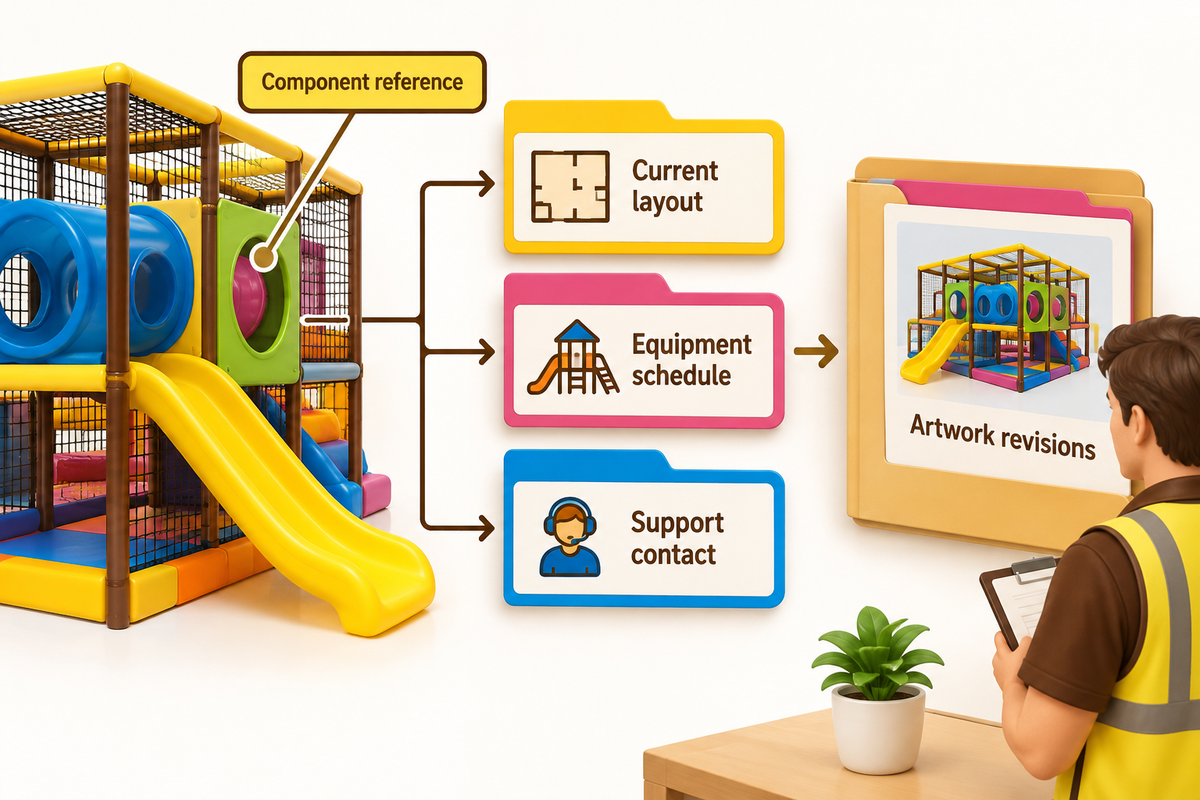
Keep a project record that helps the operator identify the installed equipment, retrieve the right instructions and describe a later service request. Retain revisions and accepted changes together, as well as outstanding items that are named. The completion record should relate the work done to the information that the operating team needs.
A photo can show where a damaged play element is, but the accompanying component reference helps the supplier identify it. The entrance graphic in the example should be linked to the final component and artwork revisions. This will help prevent a replacement request being made from a superseded image.
Imagine an operator taking over an indoor playground for kids after the original project manager leaves. A folder full of exports is of little use when each file looks final. A short index naming the current layout, equipment schedule and support contact provides a reference point for the operator. The supplier’s maintenance instructions are the reference for the equipment, and the project record helps staff identify the correct set.
The UK Government’s Gate 4 Review: Readiness for Service contains handover, support, and recorded incomplete work with a remediation plan. For an owner, the valuable management principle is continuity between the delivery team and the operational team. Venue opening and technical acceptance still hold to the responsibilities agreed for the actual site.
Keep service communication practical. The operator needs a clear picture of the item reference, relevant photograph and issue described in the request. A later design idea can then be assessed against the indoor playground solution rather than an old design that was never built.
What Is Changing in Design and Project Coordination
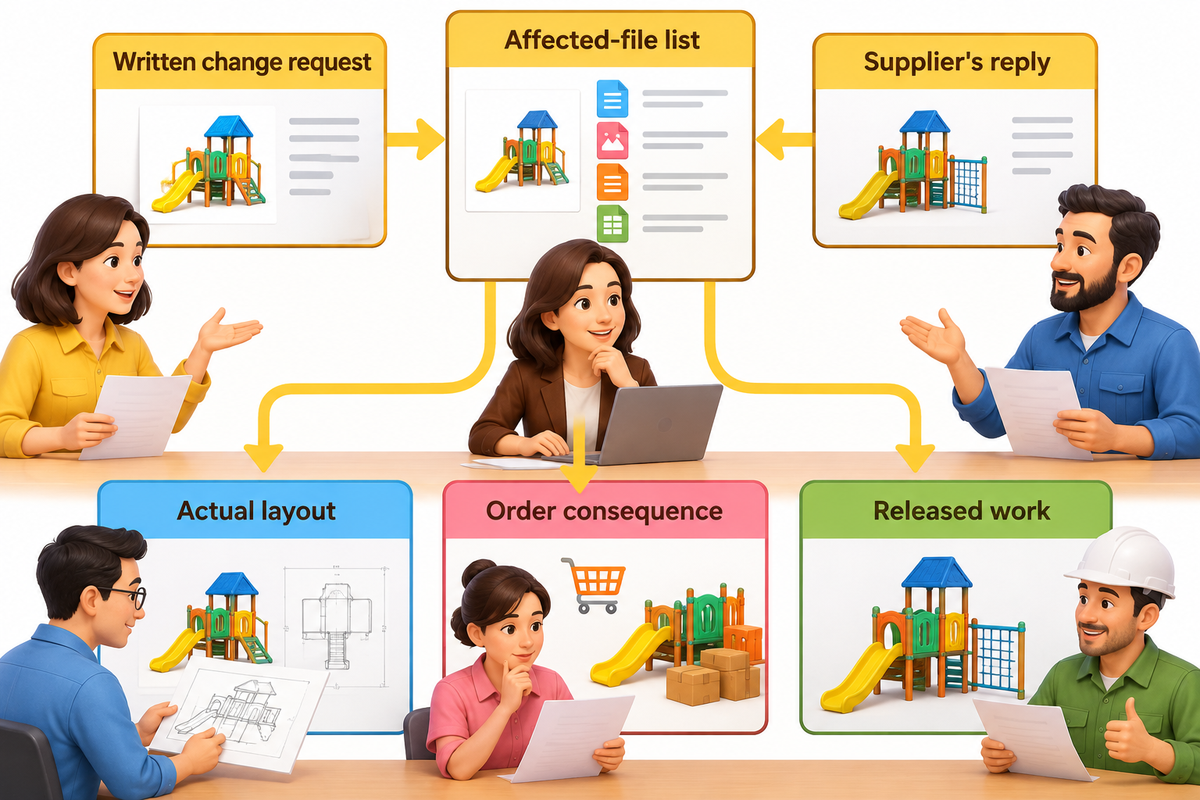
There are more ways to digitally render and use AI to create summaries for indoor playground designs, but the project still needs to identify a main current record and an accountable decision-maker. Suggested material for questions and descriptions can be generated, compiled, and organized. Human reviewers should connect a summary with the files and decisions that govern their work.
In her planning-for-2026 article, Michele Caruana proposes organizing real business inputs and turning notes into role-based checklists. A collection of indoor playground ideas is valuable when it helps make a decision on the location you wish to run.
“AI only works when you give it real inputs and clear constraints.”
For example, a coordinator can compare the written change request with a supplier’s reply and draft an affected-file list. A designer checks the list against the actual layout. A purchaser checks the order consequence of the change. The supplier confirms the released work. A persuasive summary never becomes an instruction merely because it reads smoothly.
When you create an indoor playground concept, keep inspiration sketches distinct from the issued project information. Indoor play renders can represent color and theme, while a dimensioned plan and equipment schedule represent other decisions. That distinction is useful no matter who or what creates the image.
When designing your indoor playground, compile your current brief, package list and one unresolved change prior to the next review. Confirm the intended use of each approval, the person responsible for venue interfaces and the route for supplier release. These questions will transform “general design tips” into a manageable discussion on the next piece of work.
Frequently Asked Questions
Where should you start when designing an indoor playground?
Start with a coordinated operating brief
Start by writing an operating brief and identifying who can resolve the open questions. State the intended visitors, venue model, measured site information, available budget and opening objective. Give the supplier one coordinated input set. Keep unresolved landlord, local-professional and operator decisions visible, so a concept can be reviewed against confirmed requirements rather than assumptions hidden in a render.
Can an indoor playground be customized for my space?
Yes, around the venue and agreed product scope
Yes, a supplier can develop a concept around your venue, but customization still depends on verified dimensions, operating needs and the agreed product scope. Ask which elements are standard modules and which require new design work. Review the proposed layout before detailed theming, then identify the package and revision covered by your approval. Local site and professional reviews remain separate responsibilities.
How much does it cost to build an indoor playground?
Use the budget for an itemized project scope
The useful figure is the budget for your agreed project scope. Request an itemized quotation that distinguishes equipment and design work from the local building work, freight, installation and operating preparations assigned to other parties. Record exclusions and assumptions before comparing totals. If a design change alters those assumptions, ask for its commercial and scheduling consequences before approving the revised package.
What does approving a 3D render authorize?
The use stated in that approval
It authorizes only the use stated in the approval record. Agreement on a visual theme shouldn’t silently become approval of dimensions, manufacturing information or local requirements. Name the package, revision and purpose before the supplier or local team acts on it.
How should a design change be recorded before manufacture?
Connect the request to affected packages and release decisions
State the requested change and its reason, identify the affected packages, obtain the relevant reviews and record which revision may be used next. One person should consolidate the decision. If work has already been released, ask the supplier how the change affects that work before anyone substitutes an instruction.
To plan the next project discussion, bring your venue information and operating brief to Toplay’s design and project delivery team. Cover the equipment scope, review responsibilities and the information for the next decision.
This guide has been published by Toplay for indoor-playground investors and operators. The worked examples are illustrations of project communications. Where necessary, project-specific professional and local reviews belong to the responsible professionals.
References & Sources
- ISO 10005:2018, Quality management: Guidelines for quality plans. Public abstract.
- ISO 10007:2017, Quality management: Guidelines for configuration management. Public abstract.
- Government Functional Standard GovS 002: Project delivery. Traceability and information management sections.
- The Teal Book, Chapter 22: Change control.
- The Green Book (2026). HM Treasury; option appraisal.
- Children’s play and leisure: promoting a balanced approach. Health and Safety Executive.
- Be the Playground Hero. Playground Professionals; preconstruction meeting.
- Gate 4 Review: Readiness for Service.
- 12 Indoor Playground or Play Cafe Mistakes I Can Spot Before You Even Open. Michele Caruana. September 24, 2026.
- How Indoor Playground Owners Can Use AI Now to Make 2026 Their Best Year Yet. Michele Caruana. December 15, 2025.