Get in touch with Guangzhou Toplay amusement equipment co. Company

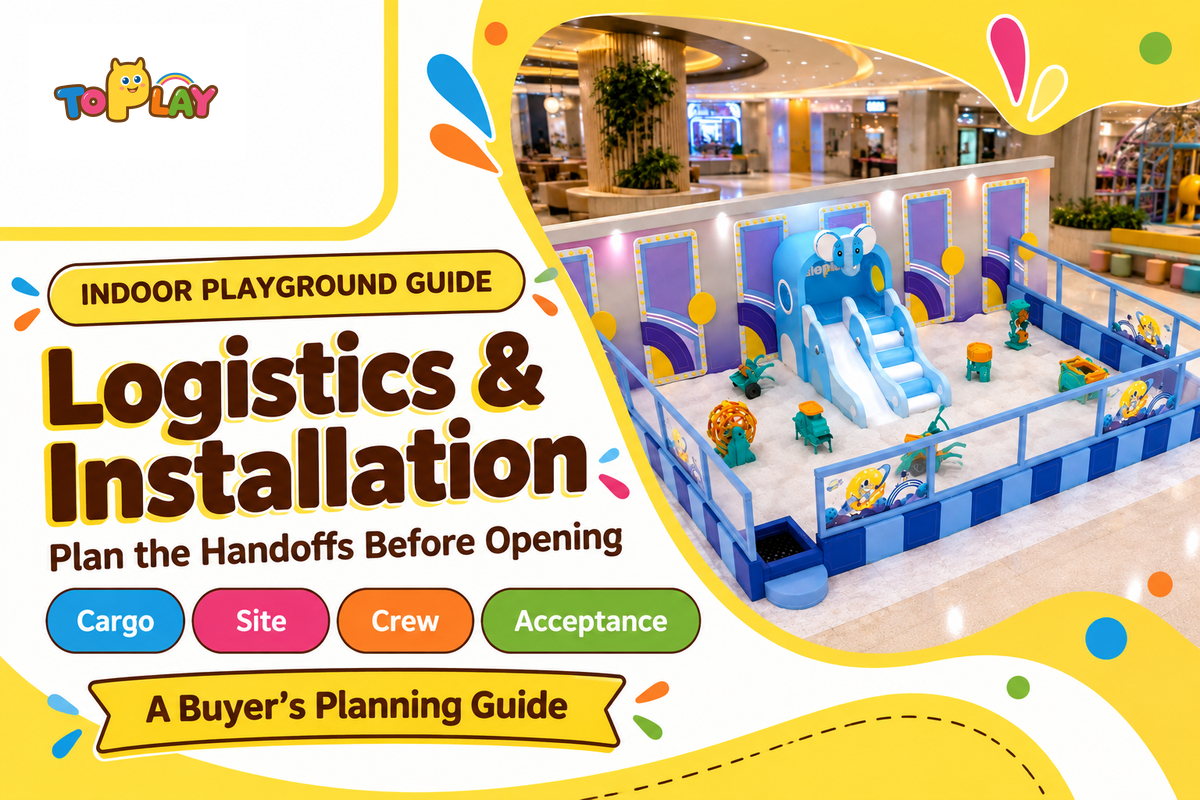
Logistics & Installation connects an indoor playground order to a working venue: shipping, import clearance, receiving, site preparation, assembly and handover. As an investor, making the tough decisions happens between those activities. A ship can arrive while a room is unfinished. A complete shipment can still contain a part the crew can’t identify.
This guide explains how to plan those handoffs, compare what quotations cover and respond when a prerequisite is missing. It concerns commercial indoor play equipment, particularly soft-contained structures. Home playsets, outdoor installations, trampolines and amusement rides can require different instructions and approvals.
Logistics & Installation should be planned through separate cargo, site, crew and acceptance decisions. Assign an owner and evidence to each handoff before committing installers or announcing an opening date.
Before you book the installation
- Separate the contractual delivery point from the destination written on a freight quotation.
- Check the entire receiving route against package dimensions and handling needs.
- Confirm that the crew, documents, work permissions and site will be ready together.
- Keep cargo receipt, installation acceptance and local opening approval in separate records.
What Logistics & Installation Covers for an Indoor Playground

Indoor playground logistics takes care of the movement and custody of the equipment. Installation takes care of assembling the system at the site. An opening plan also requires local building work and inspections, along with preparation for operations. The buyer should assign these interfaces explicitly because a transport booking or equipment purchase doesn’t close all parties’ work.
Start with the approved equipment schedule and drawing revision. The same description should follow the product from the commercial invoice to the packing list and into the installer’s component inventory. A decorative panel and a structural part may arrive in similar packaging, yet a missing structural part can stop a whole assembly sequence. Installation logistics requires the freight company and assembly team to use that same identity record.
A useful distinction is between three records. The receiving record describes the cargo and its condition. The installation record describes the work completed against the approved documents. The local approval record addresses whatever permits the venue needs to admit customers. Different people may sign them and their dates need not be the same.
Keep design changes out of informal delivery discussions. If a customer entrance or obstruction in the ceiling or a column has been changed, refer the change to the design team. The indoor playground design and space planning guide explains the layout decisions that should be settled before the shipment becomes an installation problem.
Build the Opening Schedule Around Release Conditions
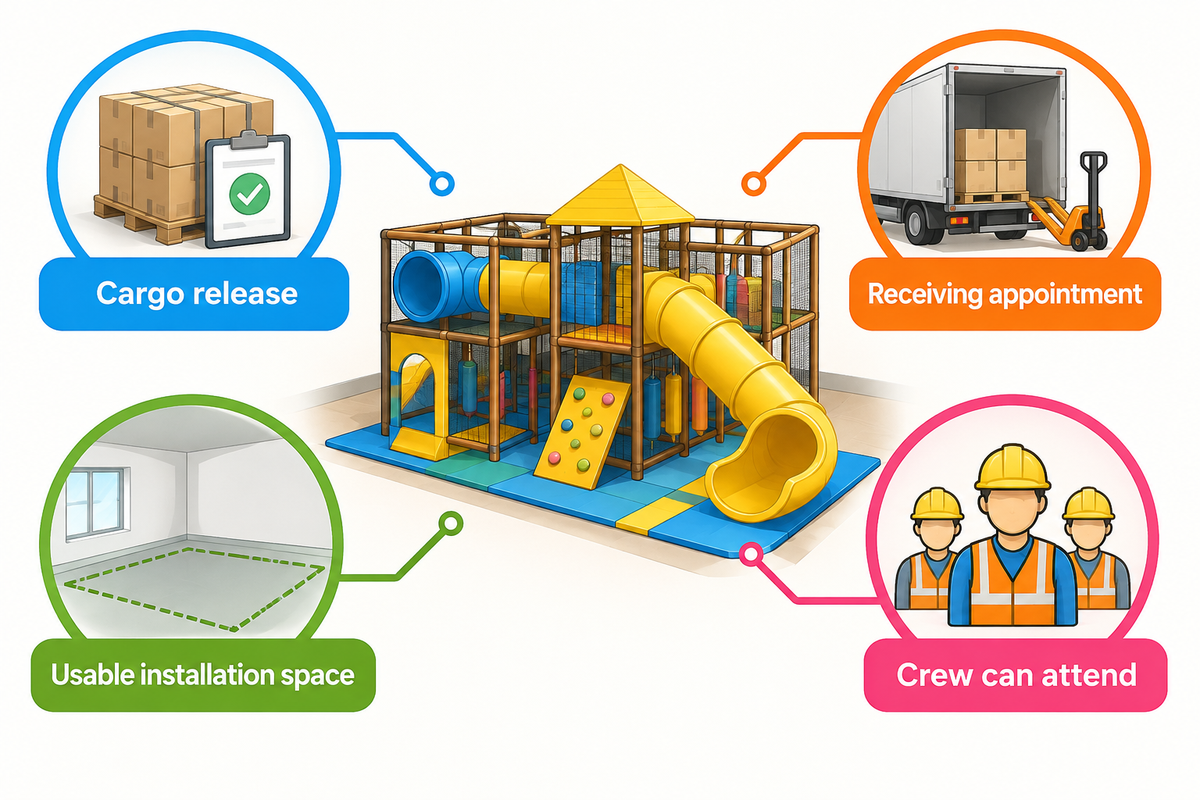
Schedule installation from confirmed prerequisites. Set distinct milestones for production, transport and site readiness and acceptance. Some tasks can be performed in parallel, while others can’t until a named party provides evidence. A schedule is most useful when the owner can tell what unresolved conditions prevent the next activity, and who can resolve it.
Playground Professionals recommends a preconstruction meeting of the owner, equipment representative and installers to address logistics and sequencing. Its examples include outdoor projects, therefore its construction dimensions aren’t instructions for an indoor venue. The practice that’s transferable is agreeing the order of work and decision contact prior to crew arrival.
Opening Dependency and Evidence Table
Use the table below as a template for the meeting agenda. Substitute role descriptions with names and indicate what evidence is expected for each milestone.
| Decision | Evidence to collect | Accountable contact | Work that depends on it |
|---|---|---|---|
| Release the equipment scope | Approved equipment list and current drawings | Buyer and supplier project leads | Manufacture, package planning and installer preparation |
| Confirm the delivery boundary | Trade rule, named place and written exclusions | Procurement and freight contacts | Comparable transport bookings and destination arrangements |
| Clear the import-document questions | Broker review of the shipment document set and packaging requirements | Importer and customs broker | Dispatch and clearance planning |
| Approve the receiving route | Package sizes, weights, route survey and handling plan | Site and handling leads | Vehicle appointment, lifting arrangements and staging |
| Confirm usable installation space | Completed local works, protected work area and approved site interfaces | Owner and relevant local contractors | Assembly start |
| Confirm the crew can attend | Agreed team, scope, tools, travel and destination work permissions | Installation lead and owner | Mobilization commitments |
| Release cargo for site delivery | Actual cargo-release status and a receiving appointment | Freight contact and receiver | Truck, unloading team and storage booking |
| Authorize assembly | Receiving exceptions resolved or bounded; correct parts and instructions available | Supplier technical contact and installer | Work in the affected equipment zone |
| Close installation corrections | Issue register, correction records and specified rechecks | Installer, supplier and designated checker | Contractual installation acceptance |
| Authorize public operation | Required local approvals, appropriate inspections and operating preparation | Owner and relevant local professionals or authorities | Customer access |
Illustrative mall scenario: Landlord grants unloading from 10 p.m. to midnight, a 2-hour window. Booked crew has an 8-hour shift and truck arrives after the bay closes. Roughly four times as much crew availability doesn’t secure another delivery appointment. Check the bay booking and cargo release. Any waiting charge follows the agreed contract.
Published supplier guidance also suggests aligning installer travel with shipping, customs and site readiness. Ask what can be postponed, by who, and at what cost? Align the next booking with the revised release condition. A production-complete notification is one input to that decision. Supply chain updates should reach the person who books the loading bay; leaving that contact outside the conversation breaks the flow.
Match the Shipping Term to the Real Delivery Boundary
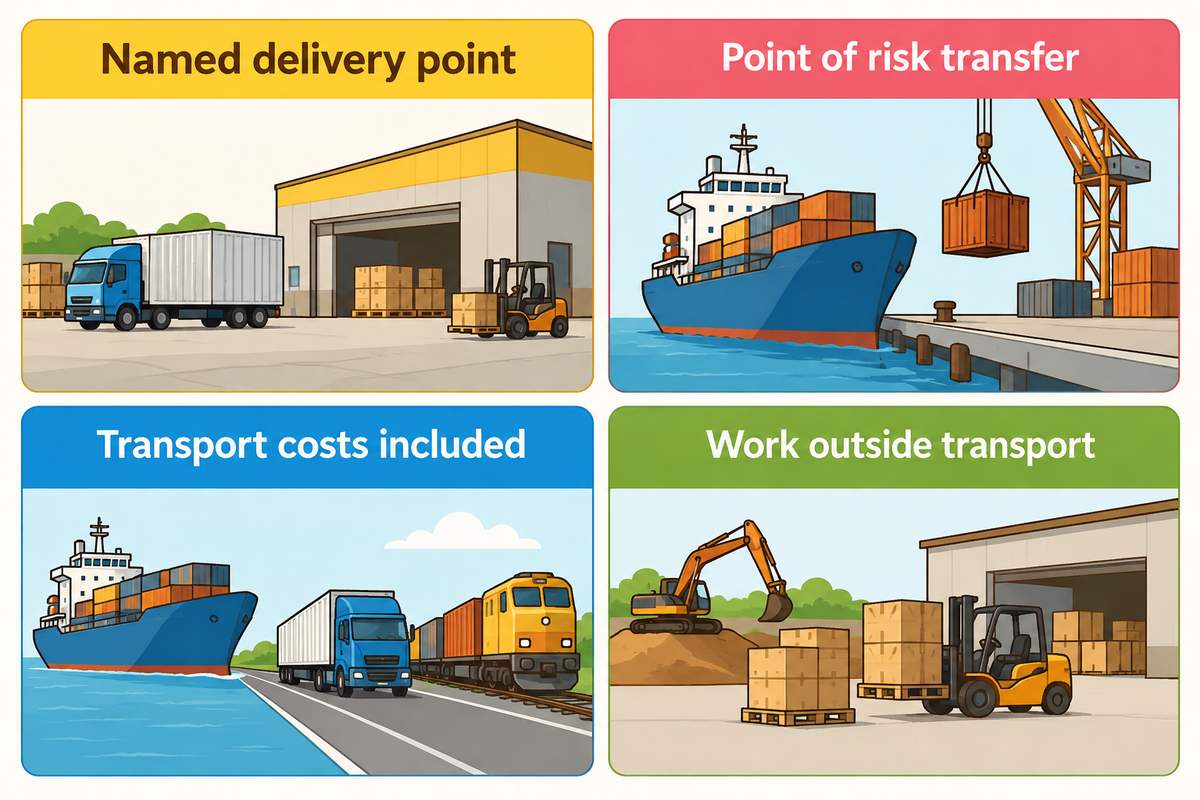
A shipping quotation has four parts. The first is the named delivery point. The second part is the point of risk transfer. The third is the transport costs included. The last is the work left outside the transport agreement. Incoterms help allocate goods and delivery responsibilities. Installation, local works and acceptance require an express scope in the sales or services contract.
The International Trade Administration’s Incoterms overview distinguishes rules for any transport mode from maritime rules and explains their limits. The rules don’t determine the time of payment or transfer of title, or define the limits of the responsibility for delayed or defective goods.
CIF contract illustrates the fact that the naming of a destination may confuse a buyer. In a CIF contract, risk passes to the buyer when the goods are loaded on the ship at the port of shipment. However, in the CIF contract, the seller bears responsibility for transporting the goods and insuring them to the port of destination. In his ICC Academy explanation of CIF and CIP, trainer Miguel Angel Bustamante Morales writes:
“The seller must arrange and pay for the maritime carriage (or inland waterway transportation) up to the port of destination.”
Transport payment and installation responsibility are distinct. The author’s view is expressed in the article; however, the applied Incoterm and the contract govern the transaction.
For cargo shipped in multiple modes or in containers, consider the handover point of the carrier before accepting FOB as the default. In such cases, FCA may work better. DDP too requires checking the seller’s ability to fulfill their import obligations, route-specifically. Under the standard DDP allocation, the seller is not required to unload; a separately agreed unloading service can change the practical work scope without automatically changing the standard risk allocation. Neither label indicates the playground will be assembled.
Quote the agreed delivery location and the point of risk transfer. The freight company should state what it will deliver at that point. Name the party that unloads and moves the packages and the party that assembles and checks the system. Confirm destination-port charges and onward transport against the particular carriage agreement instead of assuming a universal split.
Make the Receiving Route Work Before Cargo Leaves
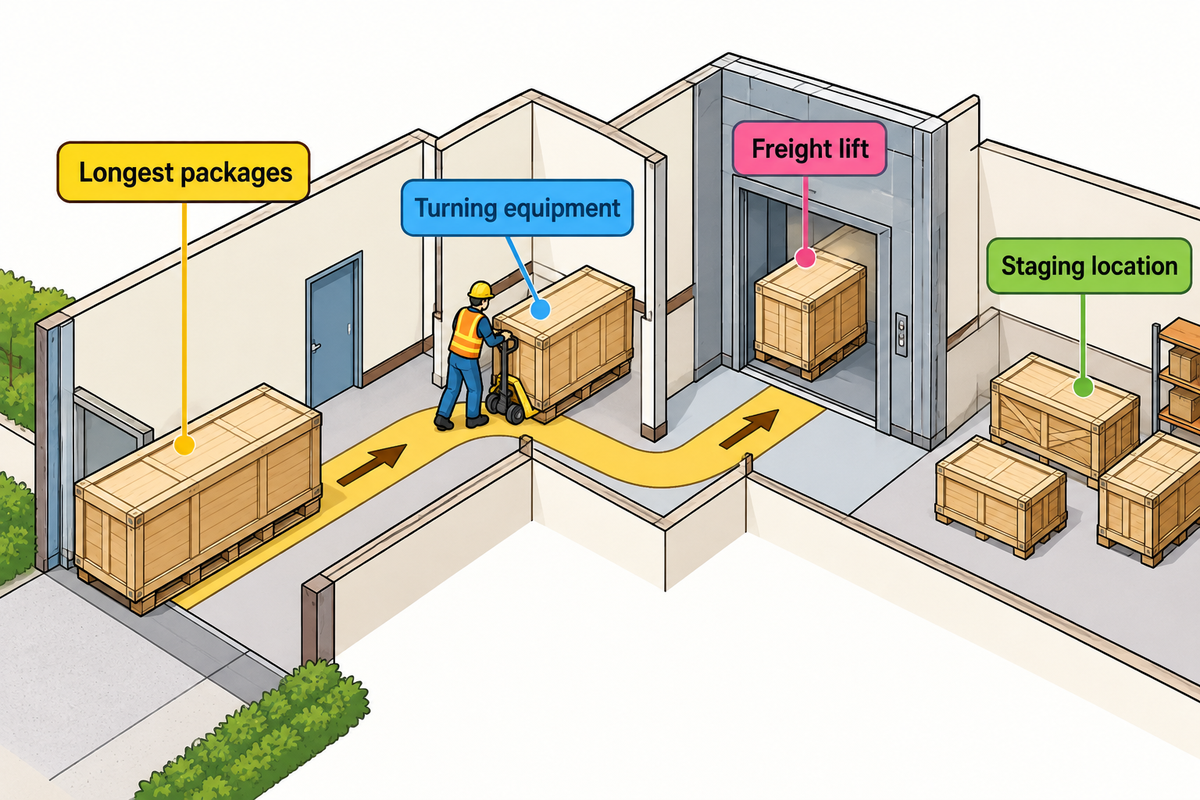
For the truck-installation stretch, it’s important to check the actual packages and the equipment that’s going to be used. A finished equipment footprint is inadequate for this check. Doors, turning, loading appointments, lifts, temporary storage and confirmed building constraints can change the delivery even if the playground fits the approved floor plan.
Request a schedule of the heaviest and the longest packages. Ask the handling contractor which clearances are needed for safe movement of the load, attachments and turning equipment. Building load capacity, lift suitability and lifting methods require the appropriate qualified people; they should not be guessed from a photograph. Include changes of floor level in the survey and confirm the property manager’s access conditions.
Illustrative upper-floor scenario: a crate is 1.1 m wide and a doorway is 1.2 m wide. The nominal 0.1 m difference doesn’t answer whether the crate can turn through the corridor, whether its handling equipment fits or whether it can travel in the freight lift. Request the full length, height and weight, then check the route with the receiving contractor. Don’t unpack or alter the crate solely to make a dimension work without supplier and handling approval.
The indoor playground floor plan guide covers the layout of a room; add a separate cargo route plan to it. Indicate the unloading point, restricted areas, proposed staging location and the route for packaging removal. Protect the floor of the facility and leave other building users an agreed path of access. Commercial equipment handling should be planned for named packages rather than a small parcel delivery.
For a US-bound shipment using regulated wood packaging, USDA APHIS directs importers to the applicable import requirements and outlines treatment and marking. Noncompliant wood packaging can prevent entry. Verify the actual packing materials with the broker before shipping; a general assurance about wooden crates doesn’t resolve destination requirements.
Public accessibility is a different route question. The US Access Board expressly addresses accessible entry points to soft-contained play structures. A freight route that works for a pallet does not answer how customers will use the completed facility. Keep local accessibility reviews during design and opening of the facility.
Receive, Count and Quarantine Before Assembly
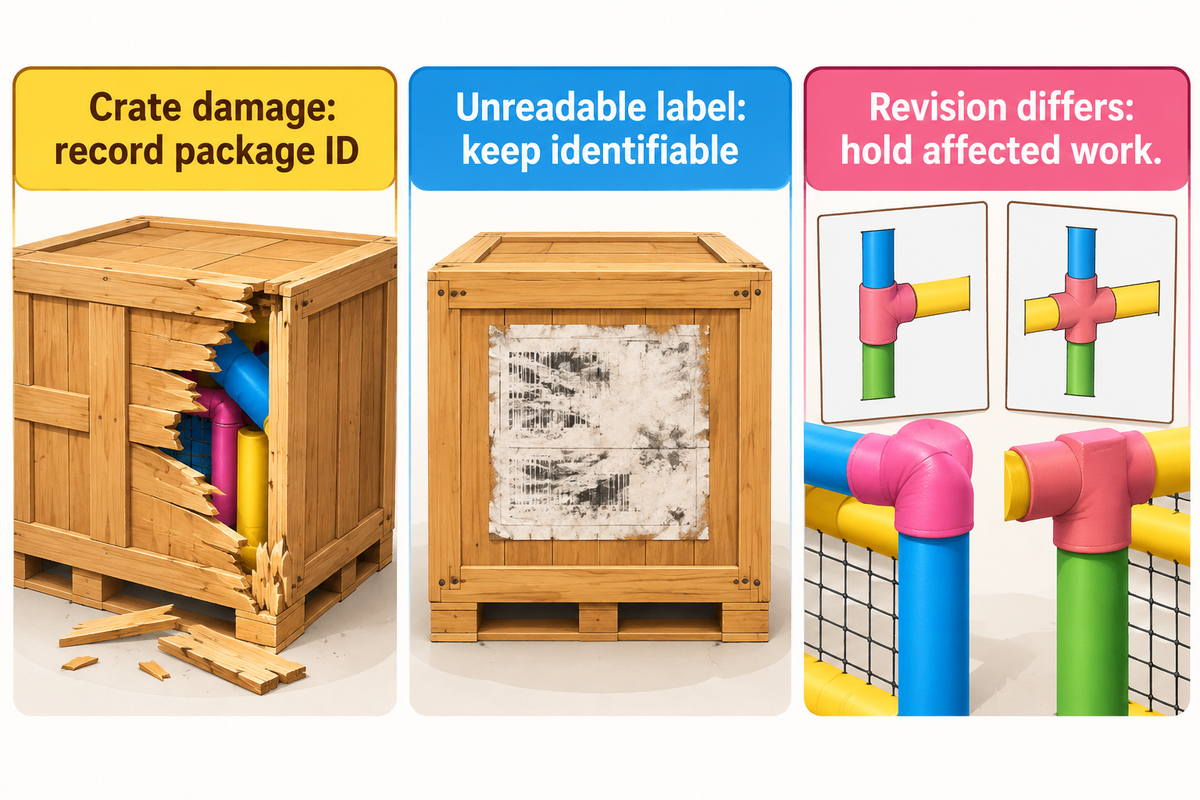
Record the delivery condition, reconcile package identities and isolate suspect items before releasing for assembly. Maintain labels and packaging until discrepancies are explained. This is to detect affected work and notify the correct party promptly, while observing the carrier’s and supplier’s mutually agreed inspection and claim process.
Appoint a receiver who has the packing list and records exceptions. Photographs connect an exception to the package and delivery record. If seals are used, describe the condition of the seal. Agree on the carrier’s procedures and deadlines for inspection and claims. Confirm inspection rights before arrival rather than applying another supplier’s deadline to your cargo.
Delivery Exception Decision Table
| Exception type | Record now | Control the item | Next decision contact |
|---|---|---|---|
| Visible crate damage | Package ID, damage photographs and delivery exception | Keep affected contents identifiable pending inspection | Carrier and supplier contacts under the claim procedure |
| Package count is short | Expected and received package IDs | Check split-shipment records before declaring a component missing | Supplier dispatch and freight contacts |
| Wet packaging or contents | Condition, affected surfaces and arrival record | Use supplier instructions for isolation and storage | Supplier technical contact and relevant carrier |
| Package label is unreadable | Photographs, location and any surviving markings | Avoid inventing a replacement component identity | Supplier dispatch or technical contact |
| Item differs from the packing list | Package, part description and count | Separate it from verified inventory | Supplier project lead |
| Drawing revision differs | Both revision references and affected zone | Hold work that depends on the disputed instruction | Supplier design or installation lead |
| Essential hardware is absent | Part reference and affected connection | Do not substitute hardware without written technical approval | Supplier technical contact |
| Finished surface is damaged | Part ID, condition and photographs | Keep the item out of use until disposition is agreed | Supplier and designated acceptance contact |
| Assembly identity is uncertain | Component markings and intended drawing location | Keep it identifiable rather than assembling by resemblance | Installation lead and supplier |
Illustrative shortage scenario: The packing list states 12 crates, the receiver states 11. A second delivery may explain the missing crate, but the installer still must determine if the missing crate contains a critical connection set. Keep the package difference and installation dependency separate. A discount does not authorize a substitute part or make an incomplete zone ready for play.
Do
- Keep original package identification.
- Connect photographs to the delivery record.
- Name the affected equipment zone.
Don’t
- Mix disputed parts into verified stock.
- Guess which similar component belongs.
- Promise a claim outcome before review.
Similar first-party delivery guidance for playgrounds differentiates receiving, inventory and storage. Apply the process principles to your shipment, while retaining your own supplier’s and carrier’s terms.
Choose Installation Support by the Questions Your Crew Can Answer
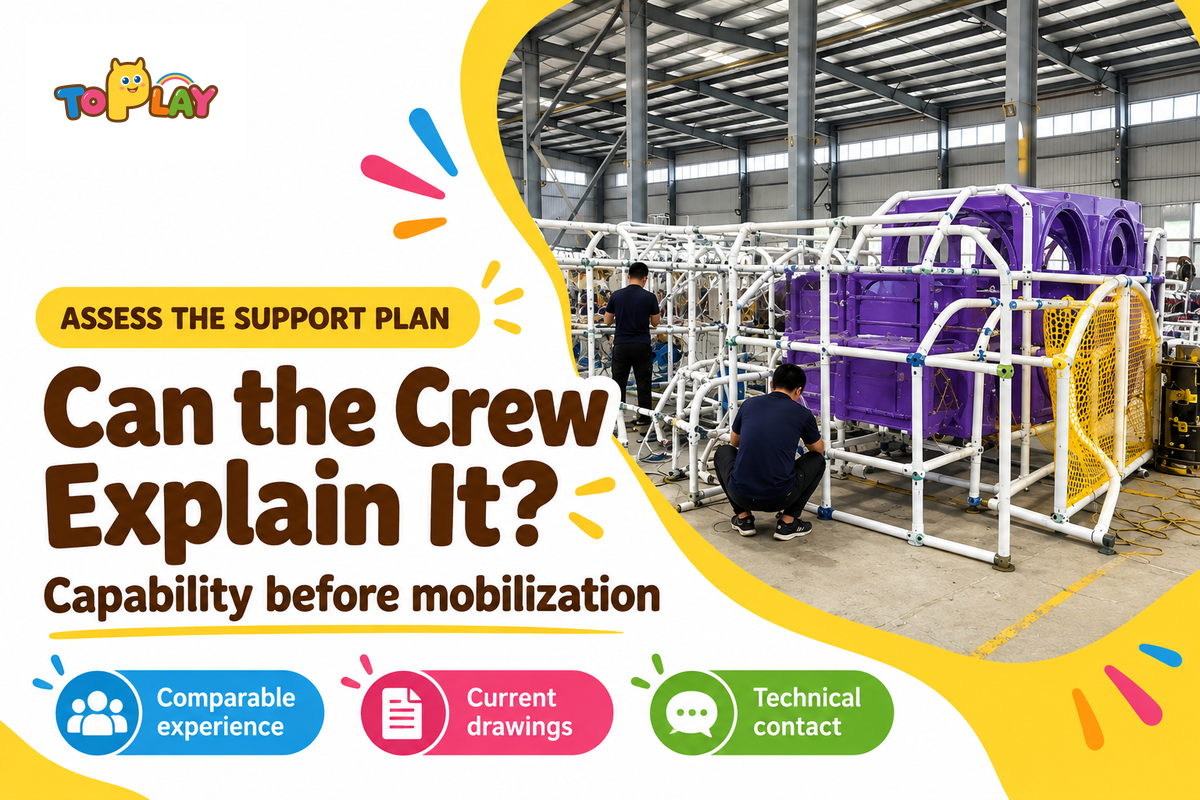
Select installation support based on documented crew capability, supplied system and reliable checks. Local crew with remote guidance requires sufficient experience, useable guidance and a technical support person. On-site supervision may be necessary when those conditions aren’t met, or when the agreed project requirements demand it; floor area alone cannot make the decision.
Ask the proposed lead to describe a comparable installation, identify the current drawing set and explain how uncertain parts will be escalated. The answer must include work which is to be left pending approval. General construction experience is desirable but doesn’t necessarily mean they’re familiar with the given system.
Remote support also requires an inspection sequence. Agree which connections, interfaces or assemblies must be photographed or checked prior to work concealing them. Identify who can authorize a change, who will be available across time zones and what happens if a response isn’t received within a reasonable time. Integrate these checks with the other contractors’ work. For a tight opening window, resolve any gap in technical attendance before accepting the crew plan. A chat group without members with the appropriate responsibility can leave crew members waiting.
For a traveling technician, settle flights, accommodation, local transport and the intended service duties in writing. Confirm destination entry and work authorization with competent advisers. For example, the US State Department describes conditional business-visitor equipment services and distinguishes them from actual building or construction work. A travel booking or equipment contract alone doesn’t decide an individual’s eligibility.
Anchoring, fastener torque, protective padding, nets and mechanical interfaces must comply with approved equipment-specific requirements. Don’t substitute an unavailable instruction with a generic online estimate. Likewise, electrical, fire-system or building alterations should be carried out by qualified local trades. Review those interfaces within the broader turnkey project delivery scope before mobilization.
Compare the Full Cost of a Ready-to-Open Playground
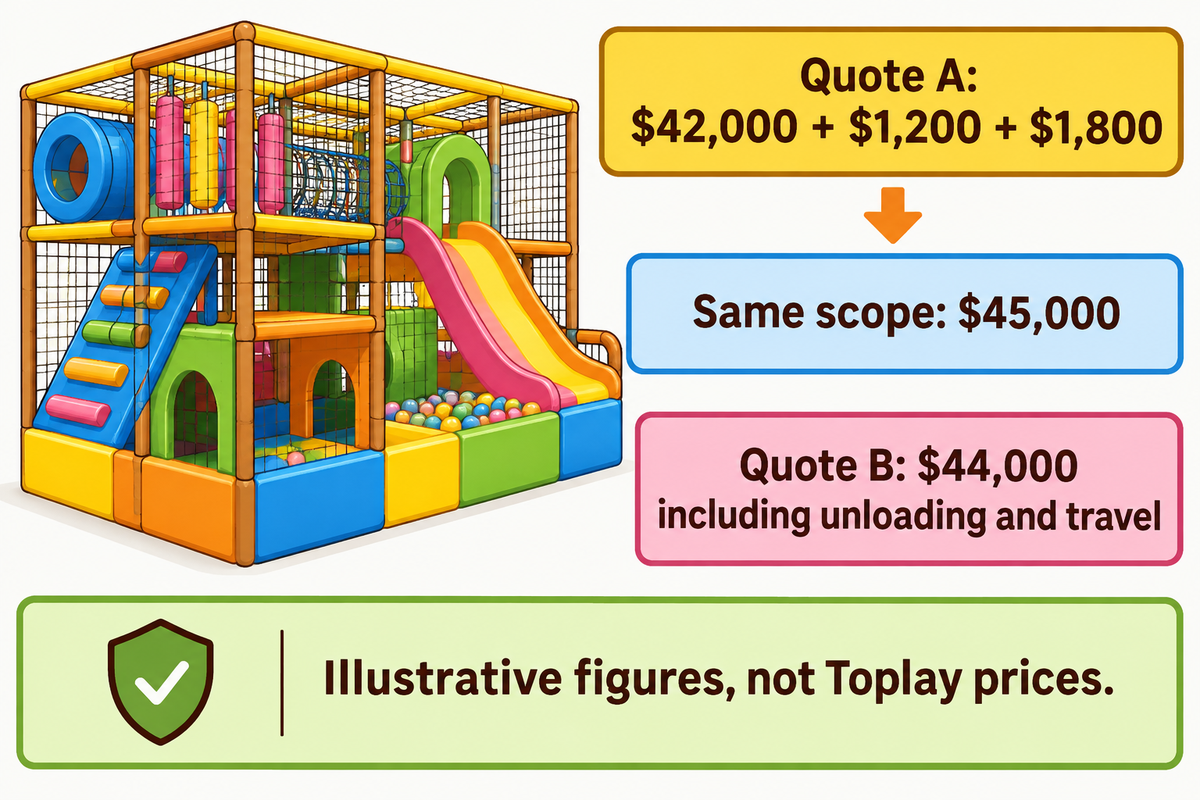
Compare quotations on the same equipment, destination, handling and installation terms before comparing their totals. Ask each provider to mark included work, exclusions and items for which a local estimate is needed. The useful budget is the cost of completing the agreed project; a low equipment-and-freight subtotal may leave substantial work with the owner.
Soft Play’s identification of hidden opening costs mentions shipping, installation and labor as costs impacted by equipment and project. These provide categories to check, rather than a universal installation percentage.
Ready-to-Open Cost Worksheet
| Budget line | What must be comparable | Evidence or estimate source | Common unanswered question |
|---|---|---|---|
| Equipment supply | Approved models, quantities and revisions | Equipment schedule and quotation | Are specified accessories and spares included? |
| Export packing | Actual package protection and applicable marking | Packing proposal and broker requirements | Who resolves a packaging compliance issue? |
| Main freight | Route, mode, trade rule and named points | Valid freight quotation | What happens if booking or routing changes? |
| Insurance | Covered journey, risks, value and deductible | Policy or written coverage terms | Does coverage fit the cargo and inland movement? |
| Import and destination charges | Relevant duties, taxes, brokerage and terminal services | Qualified broker and freight estimates | Which charges are outside the transport price? |
| Final delivery and unloading | Appointment, vehicle, labor and equipment | Handling contractor and landlord confirmation | Who pays for a failed receiving appointment? |
| Storage and waiting | Custody, conditions, charge triggers and permitted time | Carrier, terminal or warehouse terms | When do charges begin and who can stop them? |
| Local site works | Floor preparation and relevant building interfaces | Local professional and contractor quotations | Which work must finish before assembly? |
| Installation support | Crew duties, supervision, tools and specialist work | Installation statement of work | Is the quote for a technician or a full team? |
| Travel and attendance | Travel, accommodation, local transport and extension terms | Agreed attendance scope | What is payable if site access is delayed? |
| Inspection and corrections | Required checks, corrective work and reattendance | Contract and project inspection plan | Who owns the unresolved items? |
Hypothetical quotation comparison: Quote A totals $42,000 but excludes unloading and installer travel, locally estimated at $1,200 and $1,800. Adding those specified exclusions produces $45,000. Quote B totals $44,000 and includes the same unloading and travel scope. On those inputs, B is $1,000 lower for the compared work. These invented figures demonstrate normalization; they aren’t Toplay prices, a market benchmark or a complete investment budget.
Unknowns should remain visible. Ask for applicable waiting, storage and container-use terms and conditions, as well as the event that initiates each charge. Don’t combine all delay costs under “shipping.” Currency conversion dates and the treatment of recoverable taxes should also reflect a consistent basis among the persons preparing the project accounts. If a distribution warehouse will hold the equipment, confirm its custody and onward-delivery duties separately; storing the asset does not make that provider the installer.
Close the Handover Without Losing Unfinished Work
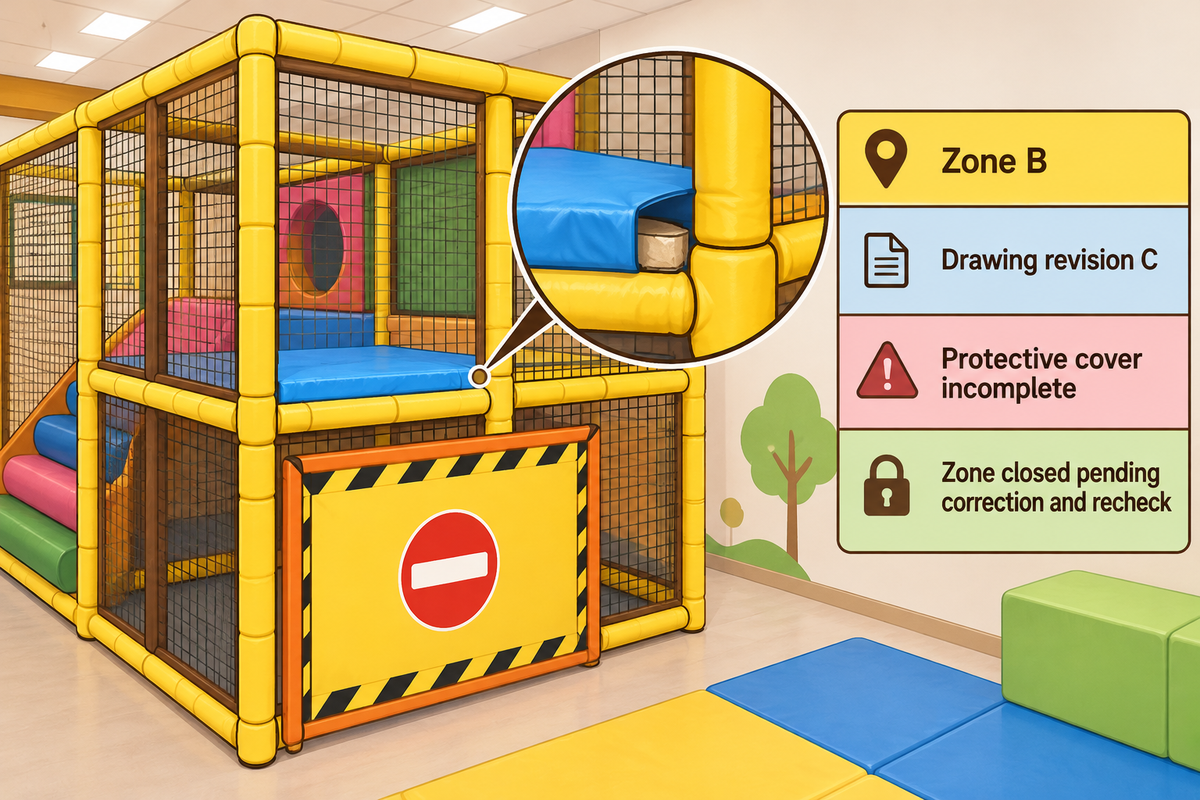
Accept installation against the agreed equipment and document scope, and manage unresolved items through a written register. Keep the commercial decision separate from local permission to open. A useful handoff explains what the installer completed, what’s still restricted, how corrections will be checked, and what the operator needs to maintain the equipment.
Use one central register for open items, identified by equipment zone and drawing reference. For each record, capture the restriction, action owner, agreed target date, completion evidence and checker. “Finish padding” isn’t clear and may not bring the correct area of concern to attention. “Zone B, drawing revision C, specified protective cover incomplete; zone closed pending the stated correction and recheck” gives the next team an actionable record.
Check the equipment classification before accepting a standards statement. ASTM F1918-21 concerns soft-contained play equipment; its published scope excludes other named equipment classes and limits its treatment of accessibility. A mixed-attraction venue needs its relevant requirements identified by the appropriate professionals. One document carrying a familiar standards number should not become a blanket approval for the building or every attraction.
The operator’s handover file should include the supplied configuration: current drawings, equipment identification, agreed inspection records, maintenance and cleaning instructions, relevant operating limits, terms and conditions of the warranty, if any, and contact details for replacement parts. Confirm the staff orientation and the procedure for reporting damage and defects. A supplier’s safety, quality and after-sales support scope may assist in linking those records to a named service contact.
Anticipate the need for local inspections and approvals and take corrective action in time. Accessibility, building, fire, landlord and insurer requirements may have different owners. The indoor playground safety standards guide provides background for that equipment-classification conversation; local project requirements still need to be confirmed for the given location.
What Is Changing in Playground Delivery Planning
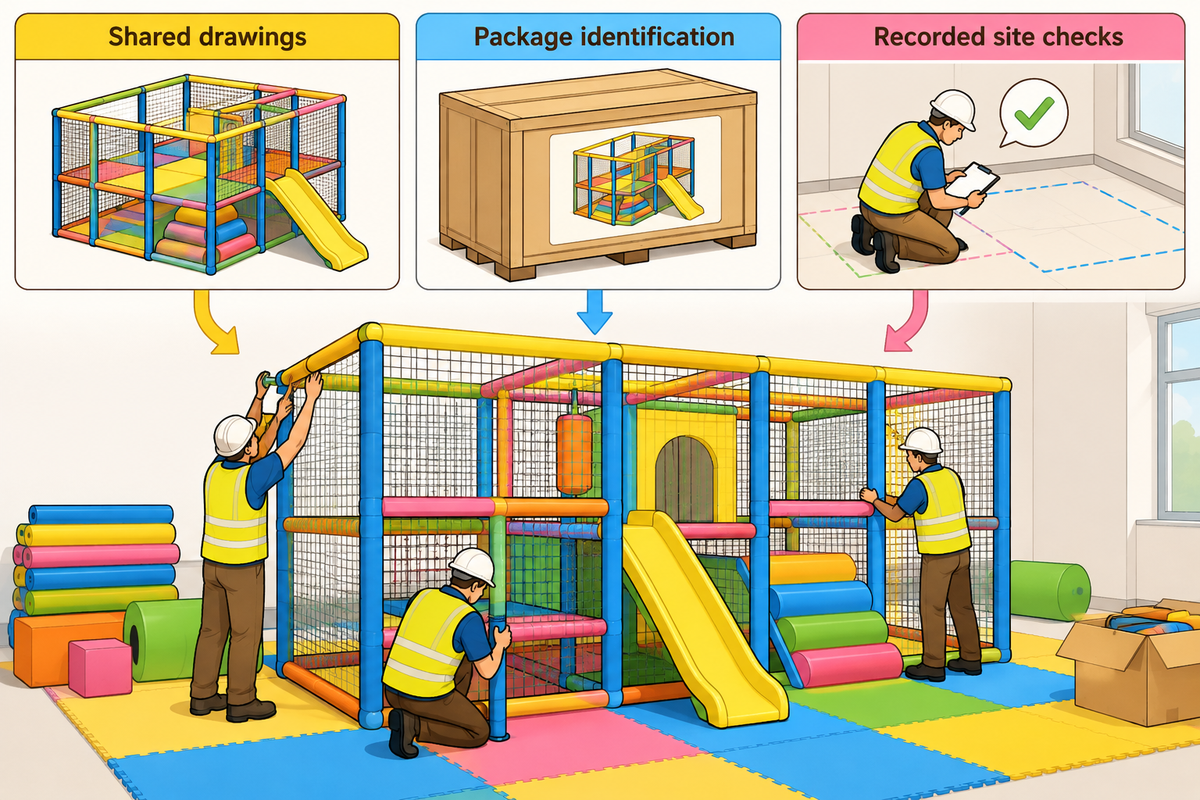
Shared drawings, package identification and recorded site checks can help refine the delivery conversation. Prospective buyers must find out how the records are amended and made available to the crew. A digital dashboard is of use only if the people responsible for installation, access and cargo keep it current.
Public overseas preparation guidance already emphasizes matching the installation date to site and shipment readiness. Treat this as a practical purchasing expectation rather than a forecast of faster industry-wide delivery. The available search data doesn’t demonstrate a reliable trend for this narrow topic, and broad playground-market forecasts can’t dictate your freight route or installation duration.
In procurement, you can request a sample package list, a drawing-revision procedure and an example of receiving exception closure. Sensitive customer details can be removed. Evaluate if the documents allow your receiver and installer to identify next action without interpreting a sales promise. Seasonal promotions should follow confirmed acceptance dates rather than set the installation deadline before these dependencies are understood.
Key takeaway
Book each next activity when its cargo, site, crew and approval prerequisites are evidenced. Keep delivery condition, installation acceptance and permission to open in separate records with named owners.
Frequently Asked Questions
How much does playground installation cost?
Compare the installation scope before using a price.
There is no single installation rate that fits every commercial indoor playground. The cost changes with the equipment, crew duties, supervision, access, tools, travel and required local specialist work. Request an itemized quotation with those boundaries stated, then add local estimates for excluded work. A technician-attendance price and a complete installation-team price answer different questions. Use the cost worksheet above to compare the same destination and tasks.
What permits are needed for an indoor playground?
Confirm the route with the relevant local professionals.
The required permits and approvals depend on the country, city, building use and attractions. Ask the owner’s local advisers to identify the building, fire, accessibility, operating and other applicable requirements before ordering. Landlord and insurer conditions may add separate reviews. Equipment documents support those discussions, but do not determine the whole venue’s approval. Name the person responsible for each submission and allow time for inspections and corrections before announcing an opening date.
How does logistics and installation work for an indoor playground?
Coordinate cargo, site and crew milestones.
The supplier prepares the agreed equipment and shipment records, the responsible freight and import parties move and clear the cargo, and the receiving team checks it against the packing list. Installation follows when the correct parts, drawings, site and crew are available. The completed work then undergoes the agreed checks and handover. Local opening requirements remain a separate part of the owner’s project plan. The contract assigns the specific duties.
Is DDP the same as installation included?
No. Delivery and assembly need separate scope.
No. DDP allocates goods-delivery and import obligations at the named destination; it does not automatically buy an assembly team. Confirm unloading, movement into the room, installation supervision and acceptance duties separately in writing.
What should I do if equipment arrives before the room is ready?
Agree custody, storage and a revised installation plan.
Arrange an approved storage and custody plan, then revise the receiving and installation milestones with the supplier and site lead. First check whether the cargo can be received and inspected without exposing it to water, dirt, damage or unauthorized access. Keep the packing identity intact so later inventory can be traced to the drawings. Confirm who is responsible for the stored goods and which handling or storage charges apply.
Next identify the actual missing prerequisite: unfinished local works, unavailable access, unresolved cargo release or another dependency. Give it an owner and an expected resolution date. Reconfirm the crew’s travel and attendance terms before changing bookings. Do not place packages in an unapproved area or begin assembly around unfinished building work merely to keep a team occupied. The revised plan should protect the equipment and state what event will make the site usable.
Can my local crew install the equipment?
Use a crew and support arrangement accepted for the project.
Yes, when the supplier and project requirements permit that arrangement and the crew has the relevant capability. Confirm comparable experience, approved instructions, suitable tools, supervision and a working communication channel. Agree which stages need checks before they are concealed. Local electrical, building or other specialist tasks still belong with appropriately qualified people. If the proposed team cannot explain those boundaries, resolve the support arrangement before mobilization.
Does signing the delivery receipt mean the playground can open?
No. Cargo receipt is a separate record.
No. The delivery record concerns the shipment and its recorded condition. Installation checks, unresolved defects, operating preparation and applicable local approvals still need their own decisions. Keep the affected equipment out of public use until its required release conditions are satisfied.
Turn the Planning Record into a Project Scope
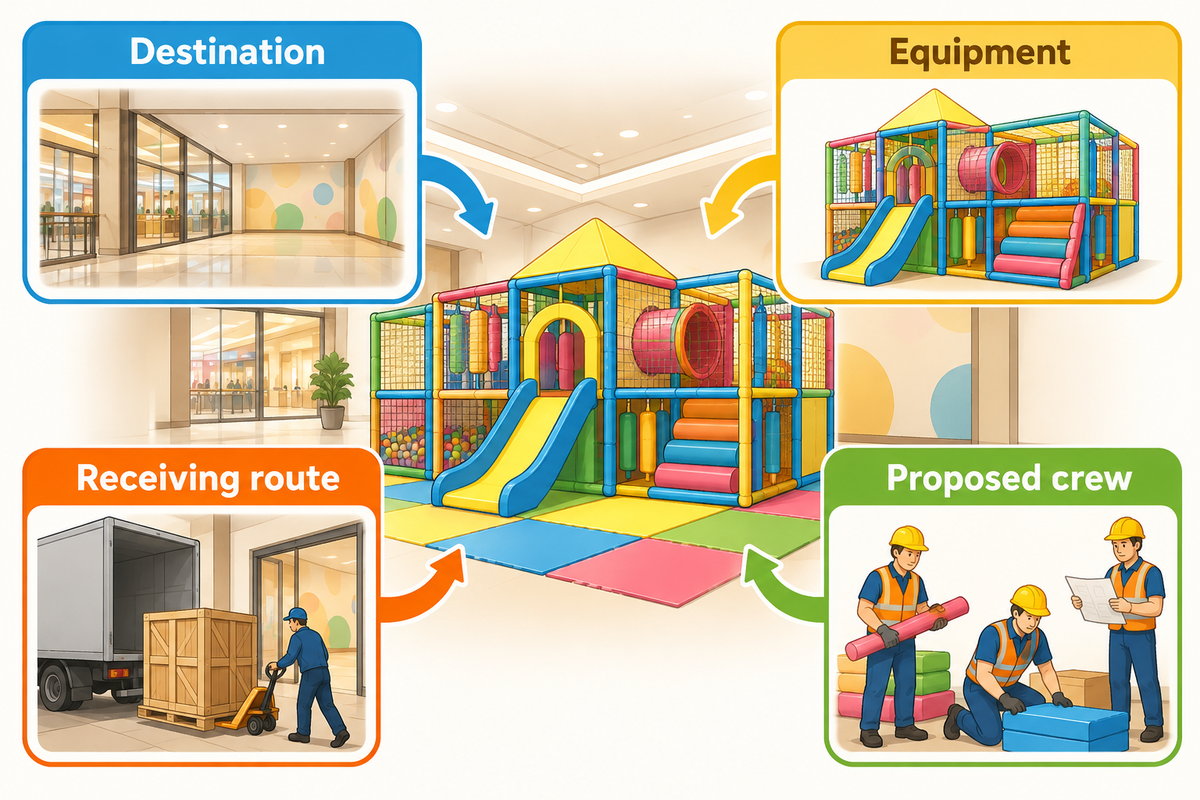
Toplay provides customizable indoor playground equipment for commercial venues. Once the destination, equipment, receiving route and proposed crew are defined, use Toplay’s logistics and installation service scope to discuss the project-specific responsibilities and support arrangement. Bring the unresolved rows from planning tables to help name actions and clear exclusions.
Discuss Your Delivery and Installation Plan
This guide combines public trade, standards and supplier guides with buyer planning methods. Named scenarios and quotation figures are illustrative, not customer results or market prices. Equipment assembly, import decisions and venue approvals require the project’s applicable instructions and competent local advice.
Updated October 2026.
References & Sources
- International Trade Administration — Know Your Incoterms.
- ICC Academy — Miguel Angel Bustamante Morales on CIF and CIP. Contributor explanation; author views disclaimer applies.
- ICC Academy — Peng Xianwei on delivery and risk transfer. Contributor explanation.
- USDA APHIS — Importing compliant wood packaging into the United States.
- ASTM International — F1918-21 public scope and active listing.
- US State Department — B-1 business activity fact sheet.
- US Access Board — Soft-contained play structure entry points.
- Playground Professionals — Be the Playground Hero. General project-sequencing guidance; outdoor construction specifications are outside this guide’s scope.