Get in touch with Guangzhou Toplay amusement equipment co. Company

Turnkey Project Delivery consolidates agreed completed results under one coordinated delivery. For an investor in an indoor playground, what the result comprises is the primary concern: an equipment package, a fitted-out premises, or a complete venue. Each case requires different work, different evidence and different decisions by the buyer.
Turnkey project delivery assigns coordinated responsibility for a defined completed result. The written scope sets the boundary. Compare the promised result, retained owner duties and acceptance records before comparing price.
Key points for investors
- Installed equipment and a venue ready to open are different outcomes.
- A fixed price is a pricing mechanism; turnkey describes delivery responsibility.
- One contact reduces interfaces inside the contracted package, while local building and operating decisions still need owners.
- Comparable quotations need matching inclusions, exclusions and completion evidence.
This guide explains buying decisions related to the terminology. It focuses on delivery models, quotation comparison and final acceptance. Detailed specification and configuration of equipment as well as installation services should appear in the project brief and proposal of the supplier.
What does turnkey project delivery mean?
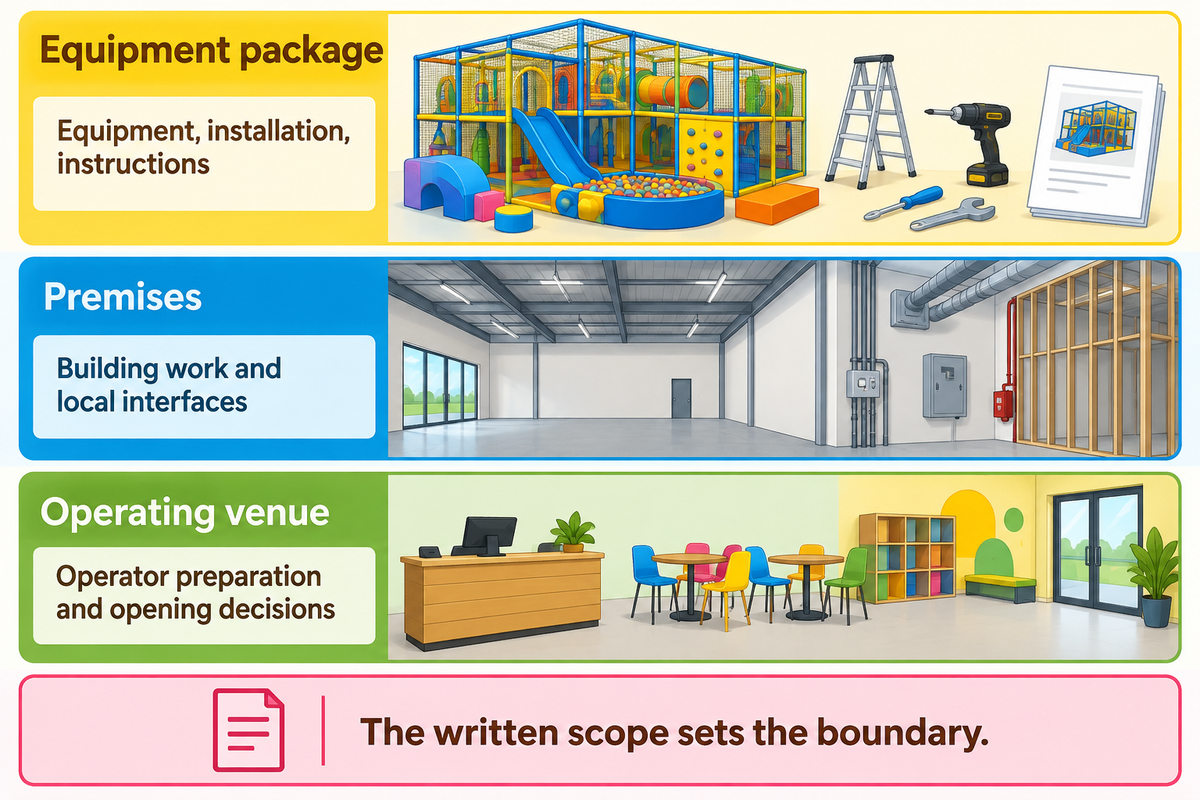
Turnkey project delivery means buying a defined completed result through a coordinated provider rather than organizing each component independently. The provider is responsible for all aspects of its agreed package and its interfaces. A ready-to-use solution for equipment has a narrower scope than an operating venue; the completion description should state that boundary.
What does turnkey delivery mean?
An agreed completed result (upon completion) can be taken over by the buyer. For an indoor play center, this can mean approved equipment, installation and operating instructions. A complete venue includes the equipment, the premises and the operator. Specifying these separately can give a basis for delivery to both parties.
Turnkey solutions can simplify procurement when an investor wants one contractor to integrate interconnected work efforts. This is mainly due to responsibility for interfaces. A layout revision reaches the equipment team, a constraint in an installation effort reaches the project manager, and an accepted revision reaches the buyer. Simply naming one contact doesn’t indicate who will perform the work.
In the FIDIC contract-selection guide, the term ‘turnkey’ is used to describe an EPC contract family. The terminology appears in construction and engineering contracts. A turnkey approach from an equipment supplier may cover a different entire scope, and neither label is explanatory of building work and operating responsibility.
Write the result as a sentence: “The client receives a fully installed equipment package in accordance with the accepted drawings and listed handover documents.” If the desired outcome is broader, the added work requires named responsibility and a price basis. Define the scope around that result so the deliverable can be checked rather than interpreted as a slogan.
Turnkey, design-build and separate contracts: what changes?
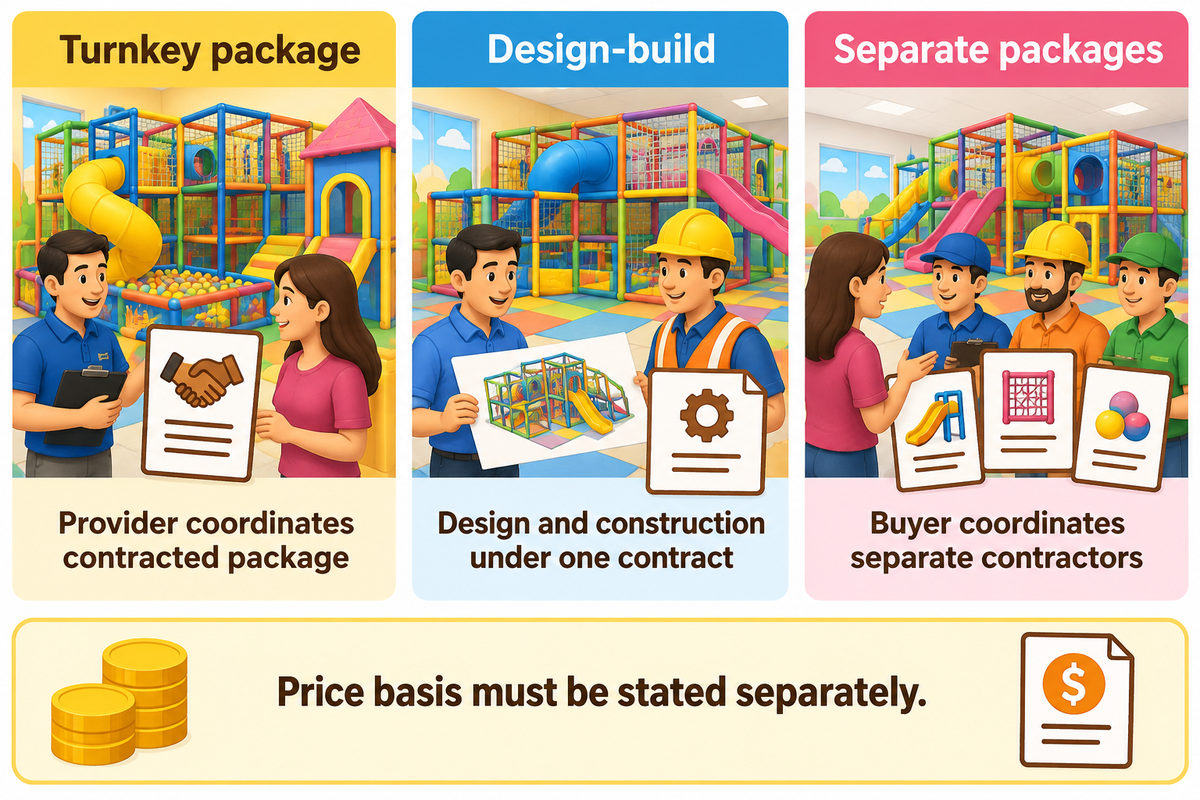
The main difference between project delivery methods is the contracting and coordination of design and construction. Design-build combines design and construction under one contract. Using a number of contracts leaves more interfaces with the owner. Turnkey contractually defines a completed outcome, which is to be provided within a specified scope; the mechanism for setting price and owner’s retained discretion, however, still require an agreement.
In the construction industry, the Design-Build Institute of America states that the defining feature of design-build is having one contract for design and construction. Its description of progressive design-build also allows the owner and the team to develop design and cost towards an agreed price. Therefore the terminology in construction projects separates delivery structure from the stage at which the price is agreed.
| Decision | Coordinated turnkey package | Design-build | Separate packages / DBB |
|---|---|---|---|
| Contracting focus | Defined completed package | Design and construction under one contract | Owner appoints separate designers and builders |
| Internal interfaces | Provider coordinates contracted package | Design-builder coordinates its contracted work | Buyer coordinates between appointments |
| Price basis | Must be stated separately | Must be stated separately | Stated in each appointment |
| Owner control | Agreed requirements and approval points | Agreed requirements and approval points | More direct control over individual appointments |
| Completion test | Accepted package outcome | Contracted design/construction outcome | Individual package completion plus integration |
| Best starting condition | Clear result and interfaces | Clear project objectives and suitable design responsibility | Buyer has integration capacity |
Example: A mall investor is opening a 600 m² play center with a separate cafe. The landlord controls building design and utility contractors. A complete package may work for the play area, while the cafe and landlord work remain separate. Another investor with an in-house construction manager may prefer to take equipment and local contracts. The first buyer wants fewer package interfaces, and the second wants more control. Neither choice eliminates the need to coordinate the cafe entrance and the play area access. The right comparison is the buyer’s available management capacity, and the number of interfaces the buyer retains, rather than assuming a traditional project is always slower.
Choose a package when the buyer accepts the provider’s agreed execution responsibility, and the result is stable. Retain separate appointments when specialist control is essential and someone on the buyer’s side can manage integration throughout the project lifecycle. Selecting the right delivery method starts with that capacity decision.
Which responsibilities stay with the investor?
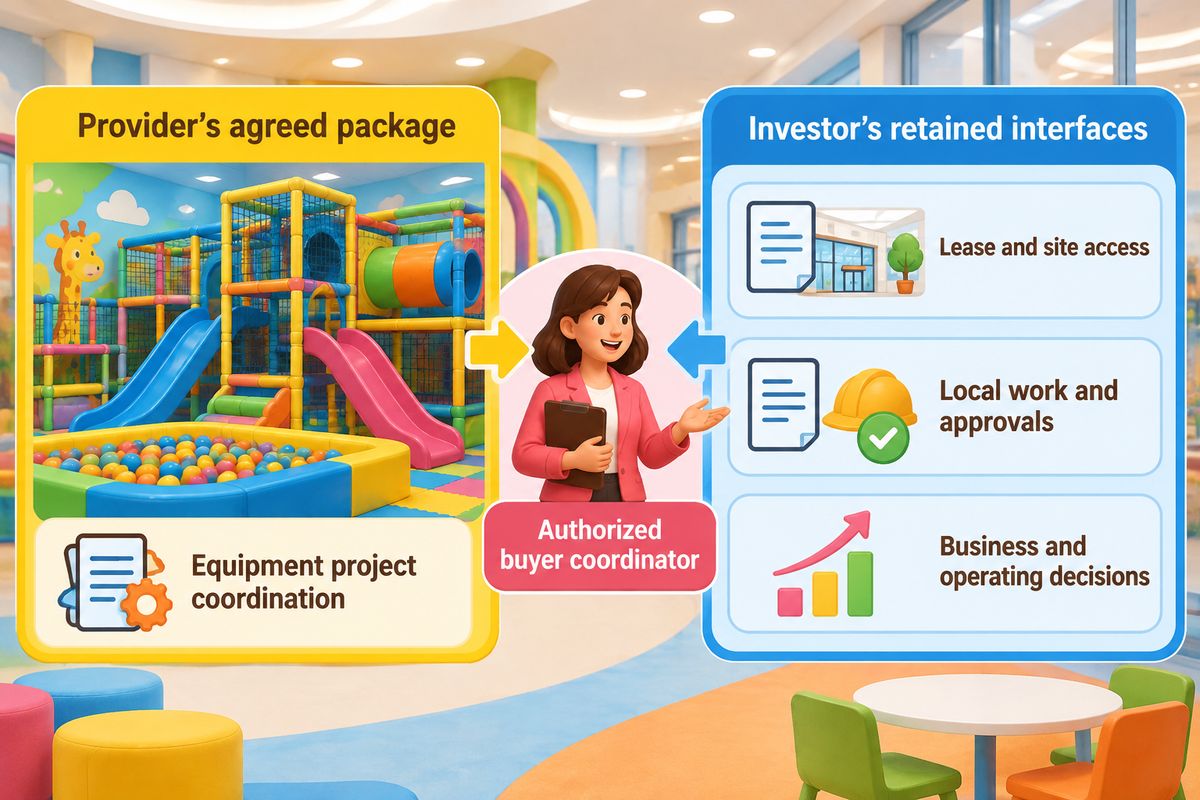
The investor retains the decisions and work outside the supplier’s agreed package, together with the owner’s applicable legal and operating duties. Standard interfaces are the lease, site access, local professional appointments and business preparation. Typically, a buyer’s coordinator should control these interfaces, even when the equipment is being delivered by a single entity.
Toplay coordinates an agreed indoor-playground equipment project. For the specific package boundary and installation arrangements, use Toplay’s defined turnkey equipment-project scope. Local building work, approvals and venue operations need their own agreed route. The client’s role includes approving requirements and making decisions that affect those interfaces. The buyer can commission local professionals for work and advice outside the equipment package.
“communication is streamlined through a single point of contact” and “the client is ultimately responsible for project success.”
A single point of contact can reduce the messages the investor handles. The service provider handles everything within its specifically agreed package; the buyer coordinates the other interfaces. A single point of accountability is more specific; one entity is responsible for a specific result, and the route to escalate is via someone who has the decision-making authority. The buyer still needs authority over changes to the premises, the operating budget and the intended use.
Contractual allocation and public obligations can also differ. In the United States, the Department of Justice’s Title III manual states that covered landlords and operating tenants have obligations to the public, despite what’s specified in their contract. This is an example of public accommodation in the U.S. The duties relevant to the actual location should be defined by the local advisers.
For a buyer with minimal internal project management resources, appointing a coordinator is a practical first step. The coordinator links supplier choices to landlord and operator choices. The supplier can’t make the investor’s business choices, merely because its offer contains end-to-end execution.
How do you compare price and project risk?
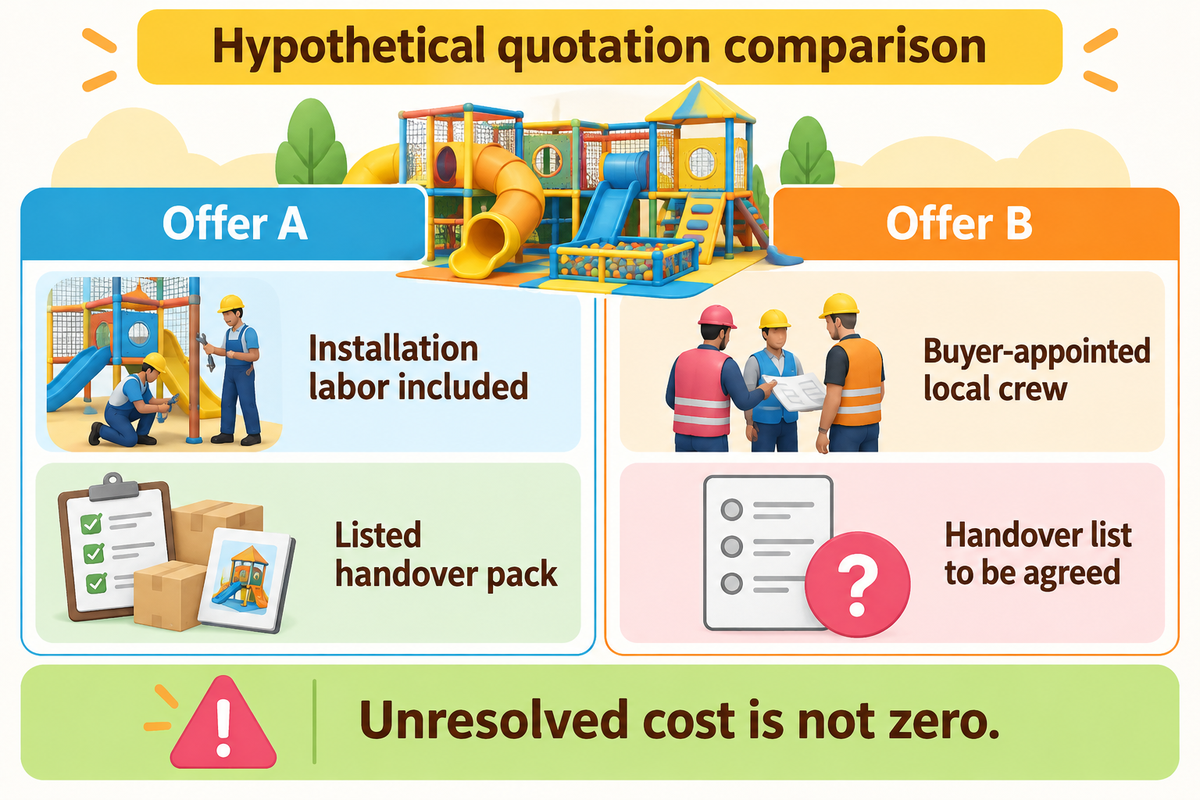
Compare prices and assess risk exposure and whether the party is capable of performing the work. Look at what’s included and what’s left to be decided. Compare quotations that show scope, exclusions and evidence, side by side. Separate confirmed inclusions from allowances and unresolved items. Consider who will undertake the risks, and whether that party is capable of performing the work. A low headline amount can leave substantial work and cost outside the quoted package.
Scope, Price, Evidence Comparison
Example: Let’s say we have two offers covering the same play center concept. Offer A includes installation labor; Offer B includes remote guidance and leaves local labor to the buyer. Both offers describe a turnkey project. In the following comparison, we’ll make the missing decisions clear before either offer is considered the cheaper complete solution.
| Comparison item | Offer A | Offer B | Decision or evidence needed |
|---|---|---|---|
| Equipment configuration | Accepted list included | Concept list included | Match the final equipment list |
| Drawings | Accepted revision priced | Revision still open | One common scope baseline |
| Freight | Named shipping basis | Separate allowance | Same destination and logistics boundary |
| Import handling | Responsibility listed | Unresolved | Named local party and cost owner |
| Installation labor | Included for stated work | Buyer-appointed local crew | Local labor proposal and supervisor route |
| Travel and accommodation | Separate exclusions listed | No traveling crew | Budget only applicable expenses |
| Site preparation | Buyer work | Buyer work | Local contractor scope and readiness record |
| Completion evidence | Listed handover pack | List to be agreed | Same acceptance criteria |
| Changes | Approval route stated | Approval route missing | Cost/time effect and authorized approver |
| Support and continuity | Support route stated | Contact only | Response arrangements and available resources |
Price comparisons only become useful once the rows match. An unresolved cost remains unresolved; entering zero would hide it. The benefits of turnkey can include fewer internal connections, like simplified management, but cost savings require a like-for-like comparison. A contingency allowance and an excluded task are also different: the first carries a stated budget assumption, while the second still needs procurement.
Shipping deserves its own line. The International Trade Administration’s Incoterms guidance separates shipment tasks, costs and risk from payment timing, ownership and contract-performance remedies. An Incoterm can clarify transport responsibility without defining the entire project.
In the UK government’s Risk Allocation and Pricing Approaches, it’s noted that if risk is transferred to an inappropriate party, premiums can increase or the contract can even fail. While evaluating relevant delivery capacity, one must check the contractual insurance and support arrangements, as well as the guarantees provided. This guidance concerns public contracts and risk allocation. However, the individual contract needs its own professional review.
Build a schedule around decisions, not a promised date
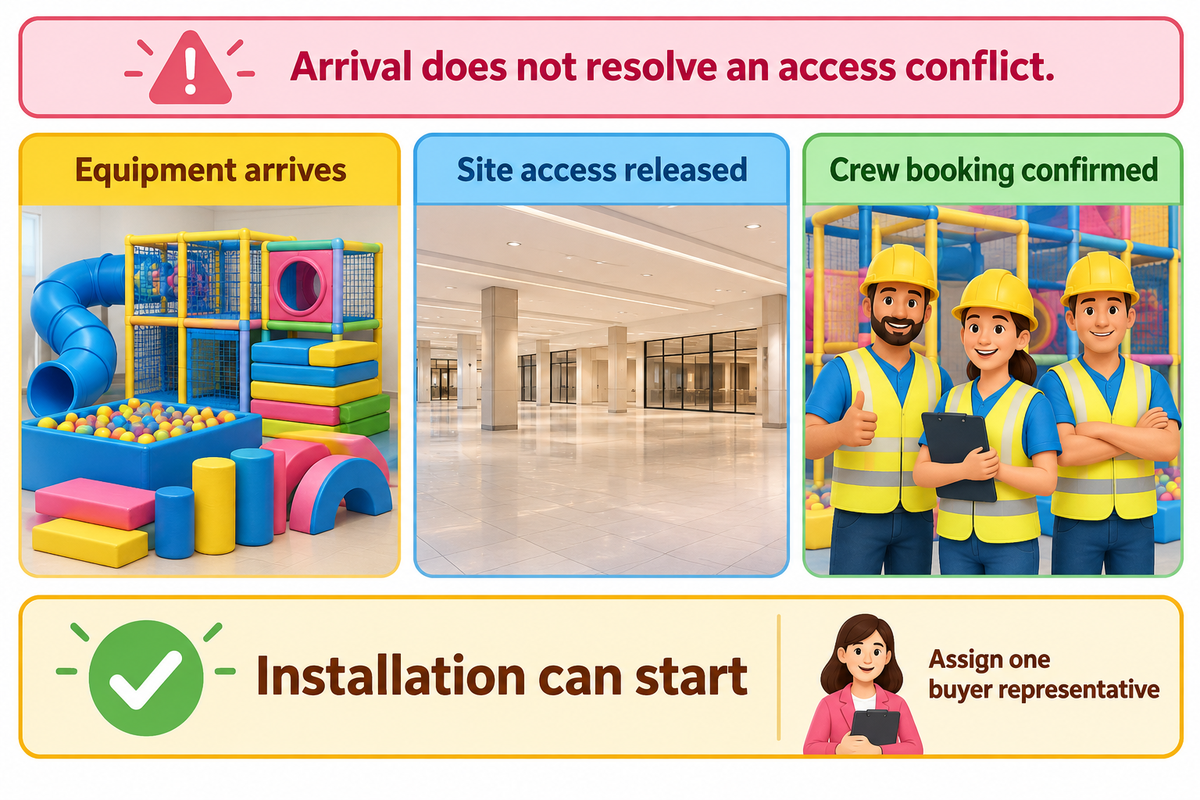
An activity schedule defines the release conditions for each activity and the person in control of those conditions. Different paths may be taken for activities such as design approval, manufacturing, shipping and installation. Efficient project delivery requires those paths to meet at agreed release events. The opening date also needs to account for the operator’s readiness.
Speed of delivery often turns on a decision outside the factory. Access route changes may require packing or unloading changes. A landlord’s work may determine when installers can enter. Delays in approval of an initial design can move the production release. A project manager needs these dependencies visualized throughout the process.
Example: An investor blocks 5 working days for a local installation crew. The equipment arrives when expected, but the landlord releases access 2 working days later. The crew’s next booking then prevents an immediate start. The equipment arrived, so there’s nothing in the ship date that resolved that access conflict. A better schedule would have tied the crew booking to a documented site-release event and assigned one buyer representative to monitor it. The resulting action is clear. Before confirming the opening campaign, revise the crew arrangements and dependent handover date. The example durations explain the dependency. They aren’t estimates for a real venue.
Playground Professionals’ pre-construction guidance calls for coordination between owner, contractor and equipment parties. For an indoor venue, that meeting can settle access, storage and unloading, without importing outdoor playground construction dimensions into the brief.
Use the supplier’s installation support after site release for the operational detail. Setting manufacturing, transit and when the venue will be ready for immediate use are separate schedule questions. An unanticipated local construction phase and short factory clock aren’t a good match.
How does turnkey project management control changes?
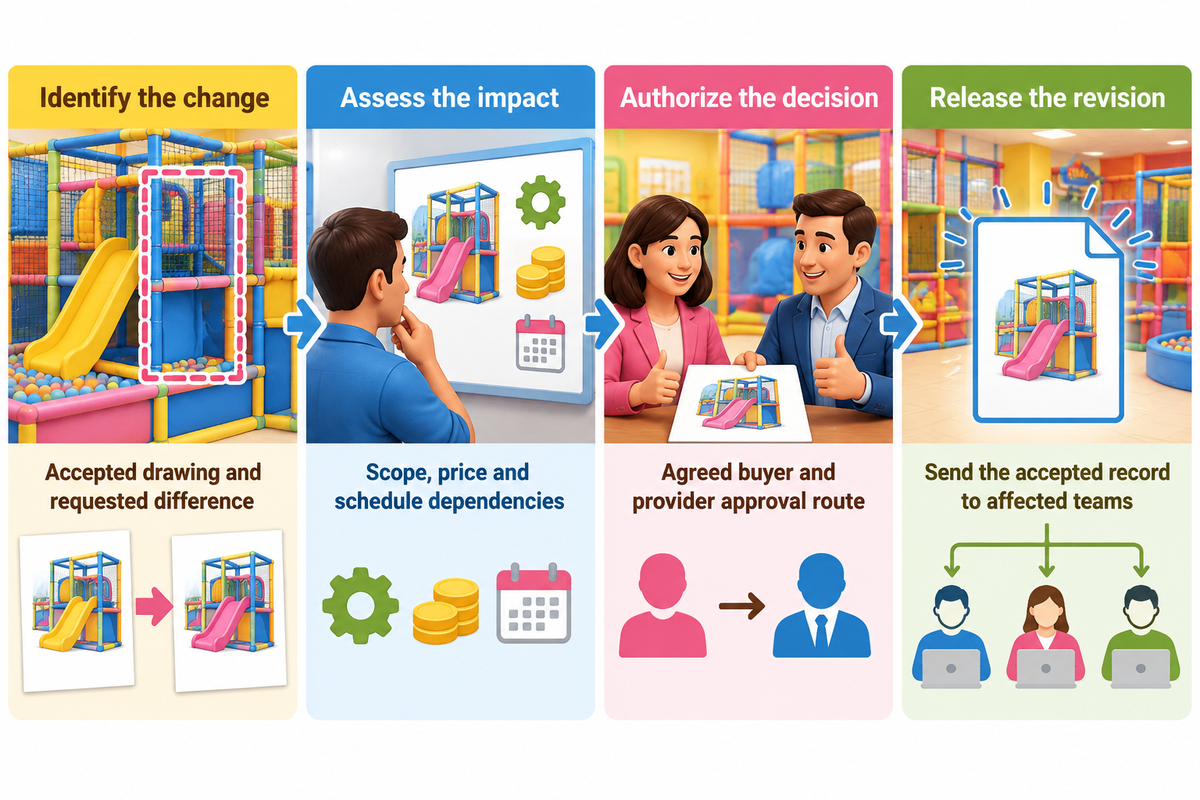
Record an adjustment by comparing it to the baseline, identifying its effects on time and money, and obtaining the authorized decision before allowing affected work to proceed. Provide the direction to the workforce. One contractor coordinates the package, but an informal instruction still needs a defined approval route.
Relocating a reception entrance may be required after acceptance of equipment drawings. Circulation and surrounding equipment may also need to be revised. The designer locates the required revisions, the delivery team assesses the work; the buyer decides along with the landlord or the local professional as required. This becomes the new baseline for the affected aspects of the project.
- Identify the change. Record the accepted drawing and the requested difference.
- Assess the impact. Record affected scope, price and schedule dependencies.
- Authorize the decision. Use the agreed buyer and provider approval route.
- Release the revision. Send the accepted record to each affected team.
A fixed price can coexist with a change mechanism. As a specific federal-contract example, FAR 52.243-4(d) provides cost or time adjustments for changes covered by that clause. Private playground projects follow their actual contracts and applicable law. The practical buying lesson is to read fixed price contracts together with their scope and change provisions.
Reduced risk comes from a controlled decision route and not from an expectation that no change will occur. Specific performance criteria enable the team to assess whether a change request modifies the agreed result. Avoiding cost overruns starts from recording who’s authorized to approve additional work and how its effects are accepted.
When is the project ready for final handover?
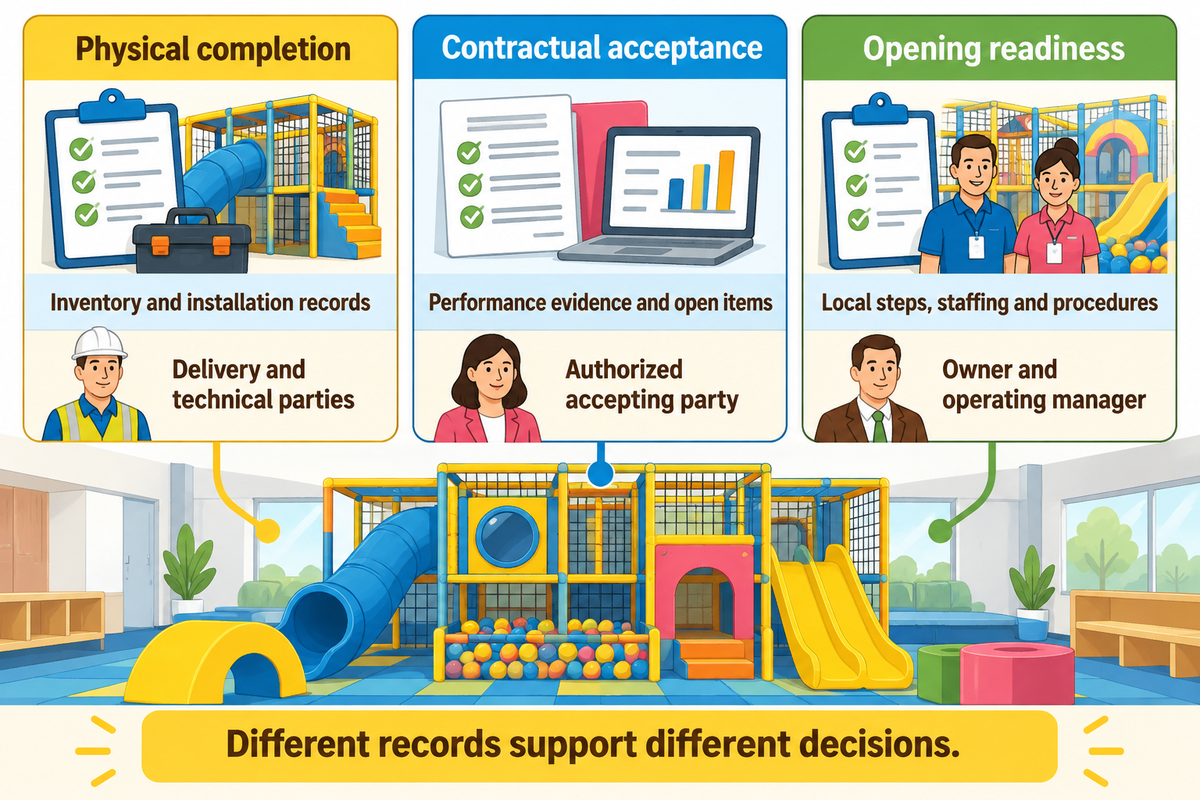
A project is in a state of readiness for final handover when the agreed work and acceptance conditions have been fulfilled, with any permitted open conditions specifically captured. Acceptance, opening readiness and completion need to be decided separately. Three completion records support the decision and evidence for each of these.
Three Completion Records
The records below are the buyer’s worksheet to organize a handover meeting. The first records what’s physically constructed. The second records the decision to accept the work including the agreed quality standards and performance criteria. The third connects the completed work with the playground owner’s opening preparations. The actual acceptance and opening of the playground are governed by the law and the provisions of the contract.
| Record category | Evidence to organize | Decision owner to name | Open-item action |
|---|---|---|---|
| Physical: equipment inventory | Equipment inventory against accepted list | Delivery and receiving representatives | Record shortages or substitutions |
| Physical: installation record | Installation and relevant inspection records | Agreed technical parties | Assign unfinished work |
| Physical: configuration record | Accepted drawing and equipment identification | Project representatives | Update the delivered configuration record |
| Acceptance: performance evidence | Performance criteria and agreed evidence | Authorized accepting party | Resolve failed or missing conditions |
| Acceptance: open-item record | Defect list with owners and dates | Buyer and provider | Record any contract-permitted open items |
| Acceptance: commercial documents | Acceptance, warranty and support documents | Authorized contract representatives | Clarify triggers and outstanding documents |
| Opening: premises route | Premises and destination-specific approval route | Owner with local professionals | Complete the relevant local steps |
| Opening: operator preparation | Operator training and maintenance arrangements | Operating manager | Assign remaining preparation |
| Opening: staffing and procedures | Staffing, access and operating procedures | Owner or operating manager | Make a documented opening decision |
The US Department of Energy’s federal energy-project process distinguishes installation sign-off from formal acceptance and also allows for specified conditional and partial acceptance. The UK government’s Readiness for Service workbook independently looks at preparations for operation and unfinished works. These are project management distinctions; the process for the different industries doesn’t take over the rule for opening a playground.
Example: A play center’s equipment is installed, with 2 minor document items still assigned to the supplier. The buyer and provider discuss whether the contract permits acceptance with those items open. Meanwhile, the operating manager hasn’t finalized his staff preparation, and the owner hasn’t completed the local procedure for opening. Recording the equipment as installed answers only one aspect of the consideration. The buyer records the contractual decision under the agreed conditions, keeps the document items assigned, and leaves the opening decision with the responsible operator and local parties. Declaring the equipment fully functional wouldn’t resolve the remaining staff preparation, finalize the opening, and transfer the responsibility to the installer.
Specific technical records depend on the equipment class and destination. Next, Toplay’s quality and after-sales information is relevant for project support. For final delivery, the operator must be left with clear, usable instructions and a contact route. A collection of installation photographs isn’t sufficient.
Before procurement: agree the delivery brief
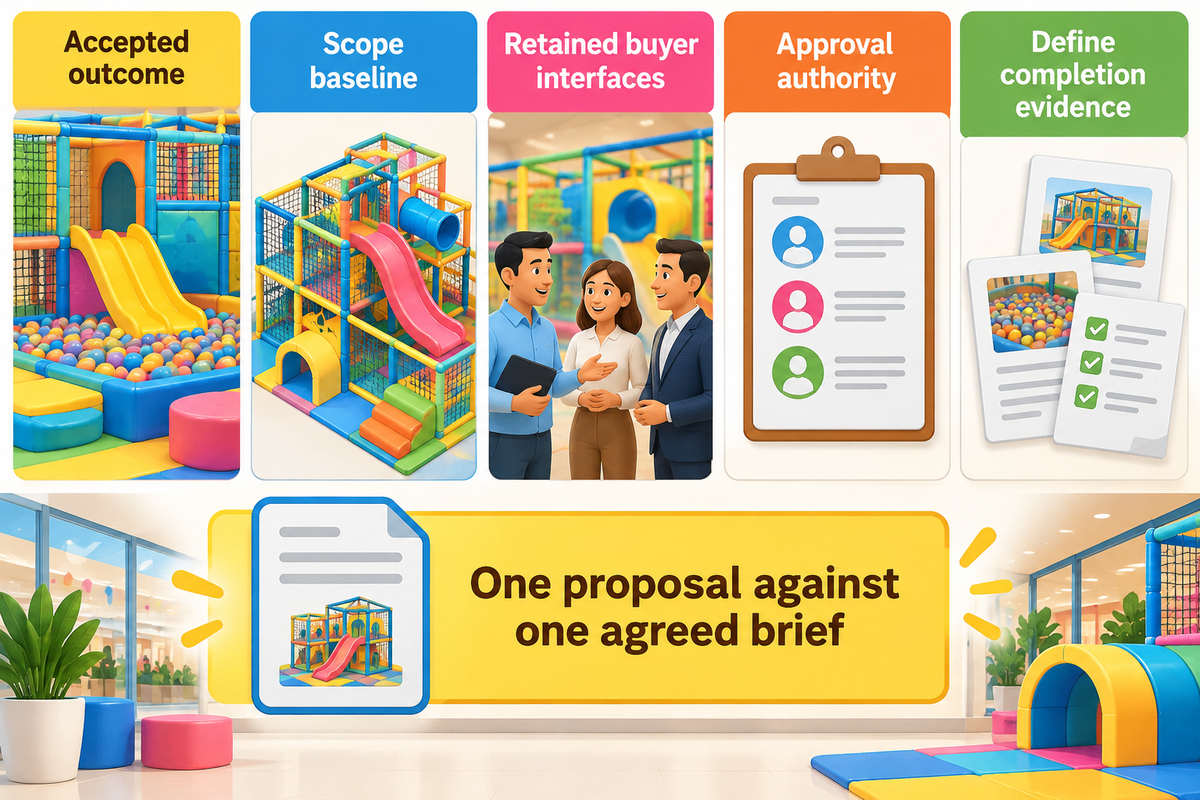
A delivery brief must show the accepted outcomes, the scope baseline and the buyer’s retained interfaces before it’s priced. It should also include the approval authority and completion evidence. This gives turnkey providers a consistent basis for proposals and allows the investor to compare the advantages of turnkey with other options.
Ask for one proposal against one agreed brief. The included equipment, the accepted installation routes and drawings should be confirmed. The name of the party responsible for local building work, access and approvals should be given. Ask how changes affect price and dates, who can approve them, and which records establish acceptance. What records show acceptance? Are the provider’s proposed delivery resources and support adequate? What’s their price?
The idea behind reducing coordination is to help make these interfaces manageable. A contractor that takes full responsibility for its contracted package can provide the investor with a clearer route through execution. Investors can focus on their core business when their own decisions have named owners and timely approvals, rather than leaving everything to the final week.
Key takeaway
A workable turnkey purchase connects one defined outcome with an agreed price basis, assigned interfaces and usable acceptance evidence. Choose the arrangement your team can manage, then document what completion means.
For the next project discussion, discuss your delivery brief with Toplay and bring the accepted project scope into that conversation. Readers still defining the premises can use the separate indoor playground space-planning guide before requesting an equipment proposal.
Frequently Asked Questions
What does a turnkey contract include?
A turnkey contract includes the work and completed result defined in its agreed scope.
The package should identify equipment or works, design responsibility, installation arrangements and completion evidence. Exclusions and retained buyer tasks belong beside the inclusions so they remain visible during comparison. The price basis, approval route and treatment of changes also need to match that scope. An equipment contract can cover a complete equipment package while leaving the premises and business operation under separate arrangements.
What are the downsides of turnkey projects?
The main tradeoffs are dependence on the integrator and less direct control over individual packages.
Changes can become expensive or disruptive after requirements are accepted, particularly when they affect connected work. A broad promise can also hide exclusions if the buyer compares only headline prices. Supplier capacity matters because one coordinated appointment concentrates reliance on that provider. Mitigate these issues by agreeing scope and performance criteria early, retaining authorized buyer oversight, and reviewing how the provider will manage changes, support and continuity. Greater coordination inside the package still leaves the owner responsible for its own interfaces.
What is the difference between fixed price and turnkey?
Fixed price describes pricing; turnkey describes responsibility for a defined completed result.
A turnkey package can use an agreed fixed price, but its exclusions and change provisions still matter. Separate-contract projects can also use fixed prices for individual packages. The useful comparison therefore has two parts: what result each party must deliver and how payment changes, if at all, when the agreed scope or other contract conditions change. Neither term replaces the actual commercial agreement.
Is equipment handover enough to open an indoor playground?
No. Equipment handover is one part of the venue’s opening preparation.
The owner also needs the relevant premises, local approval and operating arrangements ready. Organize the discussion through physical completion, contractual acceptance and opening readiness. An equipment inventory or installation record belongs to the first; the authorized acceptance decision belongs to the second. Local professional input, staffing and operator procedures belong to the third. Some contracts permit particular open items at acceptance, but that permission doesn’t itself decide when the business can open. A useful handover discussion identifies each outstanding item, its responsible party and the decision it affects. The owner can then follow the actual contract and destination requirements without treating an installed equipment package as an automatic authorization to trade.
Who should manage a turnkey project on the buyer’s side?
Appoint one authorized buyer coordinator with access to the owner and local professionals.
The coordinator should connect commercial approvals with site access, landlord work and operating decisions. Technical specialists can advise without becoming a second competing approval route. A clear buyer role helps the provider receive timely instructions and keeps decisions outside the contracted package moving alongside its delivery work.
Planning an indoor playground equipment project?
Share your venue brief and the result you need to accept. Toplay can discuss the equipment package and its delivery interfaces with your project team. Discuss your project brief.
Editorial note: Toplay sells indoor playground equipment, so this guide includes a commercial element. For comparison purposes only, the samples are illustrative, not client case examples. Government and construction sources are used within their stated contexts; local professionals and the agreed contract govern project-specific legal and technical decisions.
References & Sources
- Which FIDIC Contract Should I Use? International Federation of Consulting Engineers.
- What Is Design-Build? Design-Build Institute of America.
- Title III Technical Assistance Manual, III-1.2000 US Department of Justice.
- Know Your Incoterms International Trade Administration.
- Risk Allocation and Pricing Approaches UK government.
- Pre-Construction Playground Professionals.
- 48 CFR 52.243-4, Changes Federal Acquisition Regulation, eCFR.
- Federal ESPC Process Phase 4: Project Implementation and Construction US Department of Energy.
- Gate 4 Review: Readiness for Service UK government.