Get in touch with Guangzhou Toplay amusement equipment co. Company

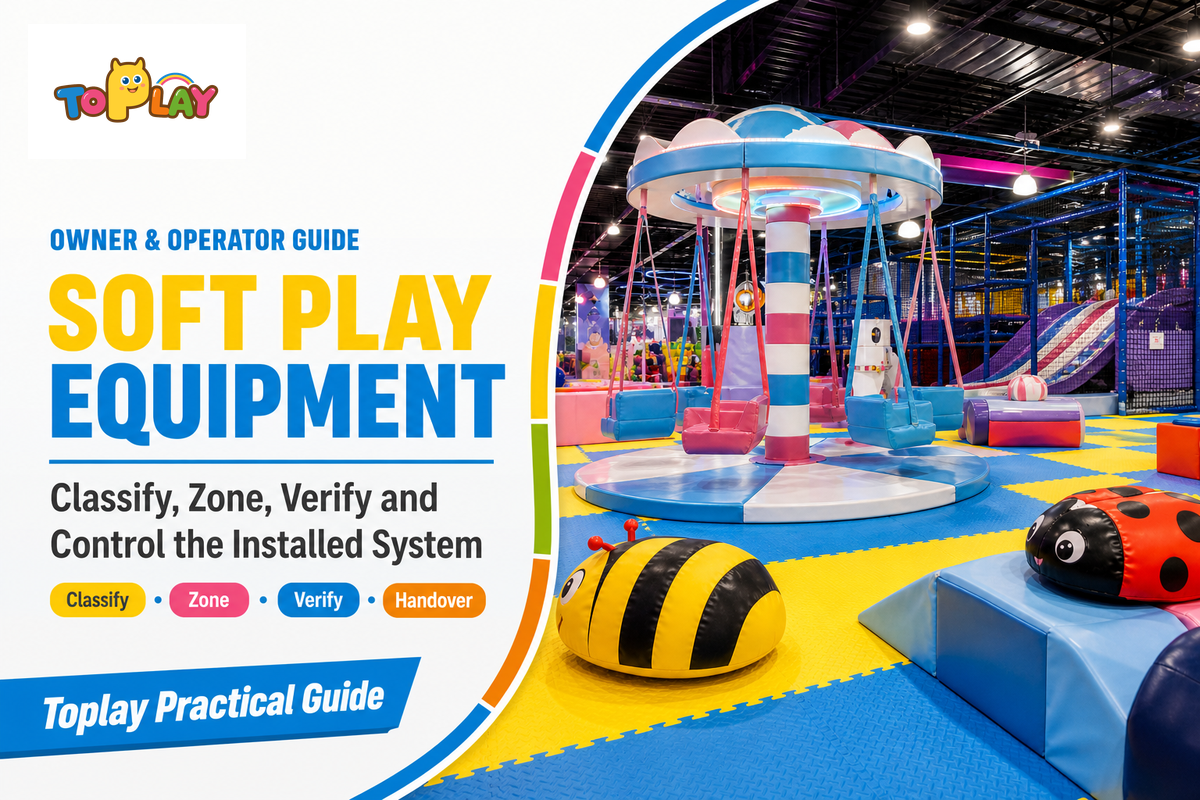
Owner and operator guide · Updated October 2026
A padded room may contain four different play families. This guide shows how to split them, match users and actions, evaluate evidence, complete handover records, and set responses for repair before the first public session.
Soft play equipment is a helpful shopping phrase, but it isn’t a full technical category. In one indoor playground, a foam climber, a toddler ball pit, a netted multi-level play structure, and a playground trampoline can raise different questions about users, movement, containment, access, evidence, and supervision.
This is an owner-side decision guide. Product options, custom configuration, indoor playground equipment for sale, quotation, lead time, shipping, and discussions with the supplier belong on Toplay’s commercial soft play solution page. The job here is to determine what we’re looking at and what we need to verify next.
Key takeaway
Classify the component before comparing documents. A broad “soft play” label cannot make a toy, foam block set, contained system, trampoline, inflatable, or climbing attraction share one evidence route.
Soft Play Equipment Is a System Boundary, Not a Foam Label
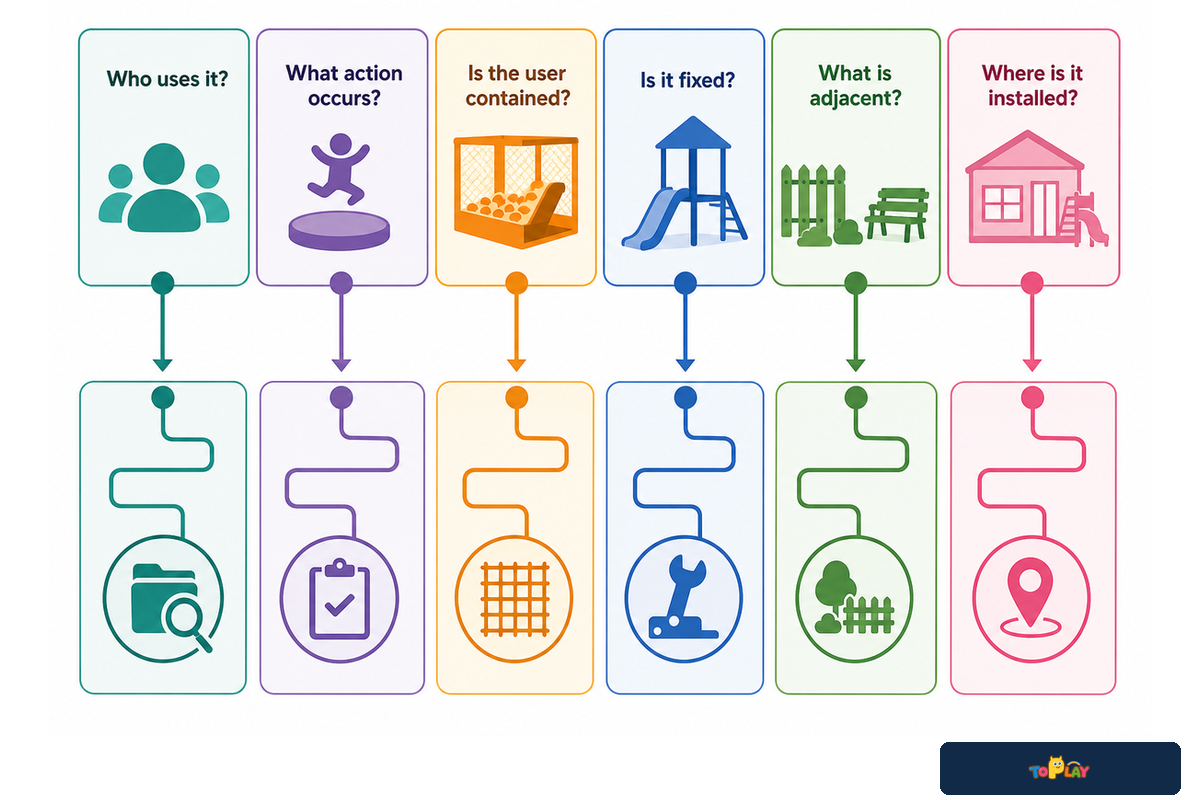
Direct answer: classify a play area by intended users, play action, height, containment, construction, mobility, and installed context. Padding is one of the service features. Whether something is classified as a soft contained system, public playground component, toy, inflatable, trampoline, amusement attraction, or some other product class is determined by other factors.
This phrase maps to different search intents. A home buyer may use the phrase for a soft foam 3-piece climber, a play couch for toddlers, a toy set, a building blocks set, or Montessori furniture. Party companies may mean rental modules. Family entertainment centers may mean fixed indoor amusement systems with tunnels, slides, nets and upper levels. These aren’t interchangeable just because their pictures are colorful.
The most detailed warnings are found in the 2025 CPSC Public Playground Safety Handbook, which uses detailed equipment guidance and excludes soft-contained play. In other words, a general outdoor playground checklist isn’t category-specific proof for every indoor soft play area.
A second classification layer appears in the CPSC playground-equipment FAQ. According to this layer, home indoor products may be regarded as children’s toys and fixed or anchored products are to be treated differently from portable or foldable products. Therefore, product specific rules and regulations may stand outside the norms used for commercial contained systems.
| Question | What it separates | Do not assume |
|---|---|---|
| Who uses it? | Age, size, ability, supervised use | A single “kids play” label is enough |
| What action occurs? | Crawl, climb, slide, balance, bounce, high-speed movement | Softness removes action-specific risk |
| Is the user contained? | Open module versus enclosed play path | Netting is only decoration |
| Is it fixed? | Anchored commercial system versus portable item | Home and public-use classifications match |
| What is adjacent? | Trampoline, climbing wall, ride, water, or giant inflatable | One report covers the whole room |
| Where is it installed? | Destination, venue, facility, and authority context | A foreign certificate guarantees acceptance |
The classification map is a screening tool and not a certification tool. When a classification isn’t clear, describe precisely the component, movement, user, anchoring, location, and interface and seek clarification from the concerned supplier, laboratory, qualified reviewer and local authority.
Map Four Soft-Play System Families Before You Compare Products
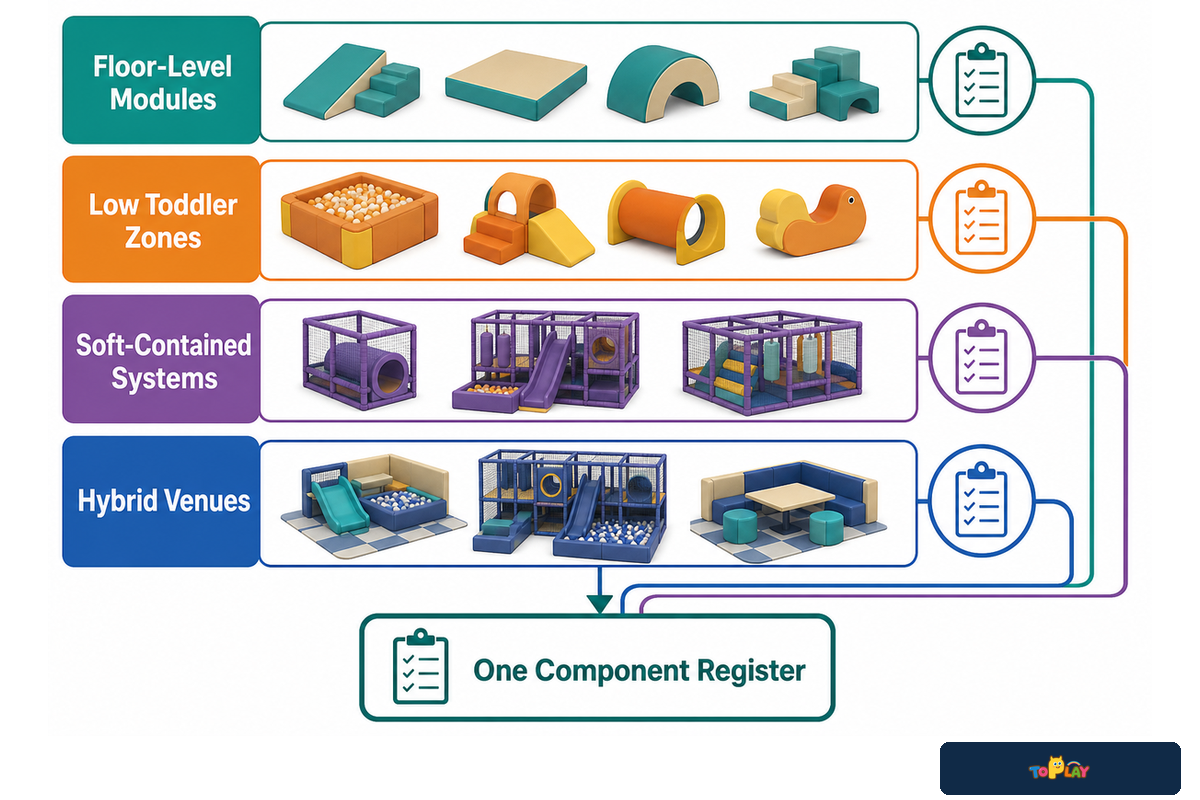
Sort the proposed area into the following four working families: freestanding floor-level modules, low toddler zones, soft-contained multi-level systems, and hybrids. The map doesn’t replace a formal classification. It allows a buyer to not compare dissimilar products, reports or operating responsibilities as if they were similar.
Family 1 consists of modular floor pieces such as a mini step, barrel, wedge, tunnel, or low foam climbing element. Listings may refer to these as a soft play set indoor, indoor gym equipment, sofa play or a play foam combo. These may be household items or designed for commercial child care. The label alone doesn’t always describe that difference.
Family 2 consists of a toddler play area planned around floor-level movement, short transitions, visible exits and separation from faster users. Preschool soft play areas aren’t necessarily defined by a rainbow palette. It’s defined by the intended users, movement, supervision, staff routes, and interfaces.
Family 3 consists of a soft-contained system. The CPSC soft-contained-play review describes tubes, ball pools, climbing nets, slides, padded floors and larger multi-level systems. ASTM F1918-21 is specific to that category and should not be applied to every similar attraction in the vicinity.
Family 4 is the hybrid. One kids indoor play venue can place a contained structure next to interactive panels, themed sculptures, climbing challenges, a trampoline court, or fitness-style obstacle courses. Indoor play structures, climbing and adventure equipment, and trampoline park equipment content on Toplay’s web pages show where the content boundary is.
One supplier can customize all four families, but a single supplier relationship doesn’t create one evidence scope. Maintain a component register to show the family and evidence route for each zone.
Use the Age × Action Zoning Matrix
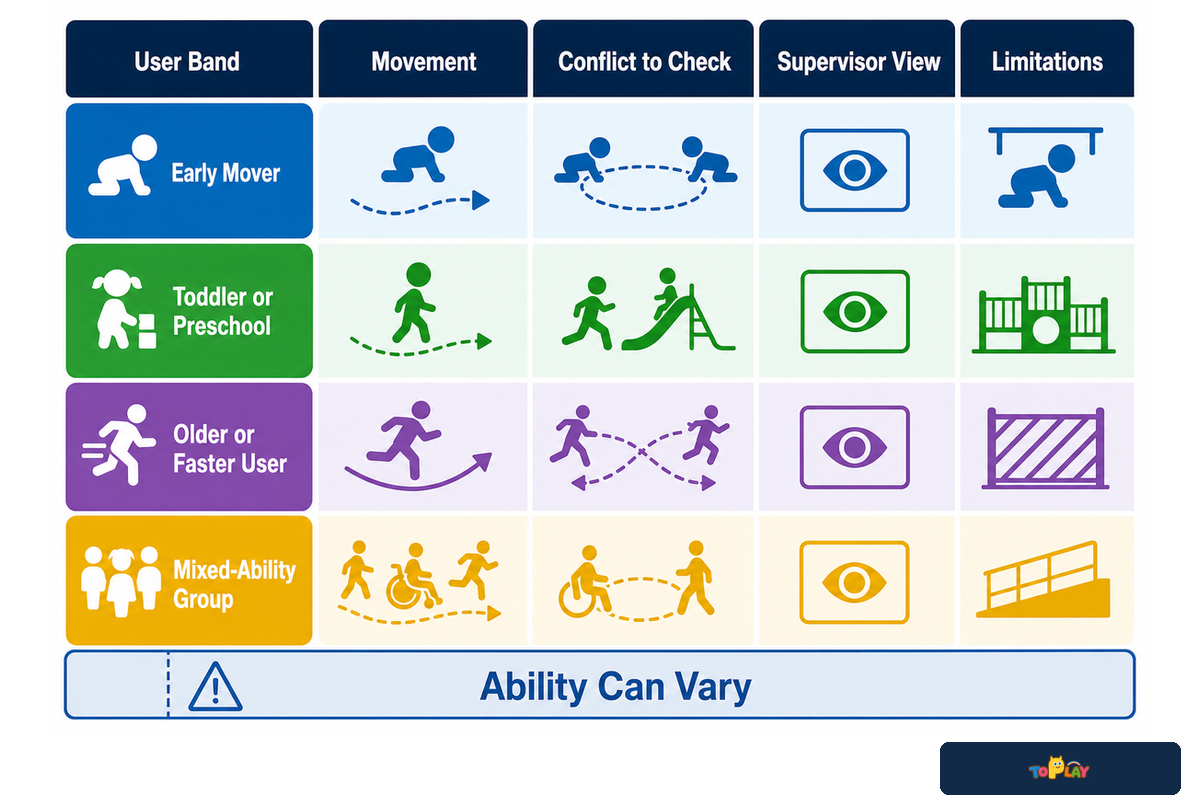
Direct answer: Zoning based on age or size is just the first of many layers. Ability, direction of movement, speed, collision exposure, fall or bounce action, waiting points, exit conflicts, and the supervisor’s position are all important layers of a workable plan. Boundaries should be defined by behavior as best as possible.
“Adult supervision is critical.”
CPSC Soft Contained Play Equipment Safety Review
The CPSC review describes the problem. Smaller children can be disadvantaged when grouped with larger children. Children waiting at a slide exit can be hit. Children at the bottom of a climb in a ball pool can be hit by someone coming down. The right question isn’t “What age is this for?” The right question is “What happens here? Who can see it and who can control it?”
| User band | Movement | Conflict to check | Supervisor view | Limitations |
|---|---|---|---|---|
| Early mover | Crawl, pull, low transition | Larger users entering the zone | Direct view of entries and exits | Not a label-based age approval |
| Toddler or preschool | Low climb, short slide, balance | Queues, reverse travel, exit overlap | View of transition and landing points | Ability can vary within one age band |
| Older or faster user | Run, climb, longer slide, obstacle | Speed meeting a slow or hidden user | Sightline into approach and exit | Keep out of lower-speed zones |
| Mixed-ability group | Choice of quiet and active actions | Blocked route or forced transfer | View that supports assistance without isolation | Requires project-specific access review |
Different facilities, such as a daycare, elementary school, play center, or indoor gym, may use different operating policies for the same-looking module. Also, children develop at different rates, so record the intended user policy for each component, rather than assume that one sign tells all. For daycare-specific questions, read Toplay’s daycare soft play guide.
Read Materials as Service Conditions, Not Marketing Labels
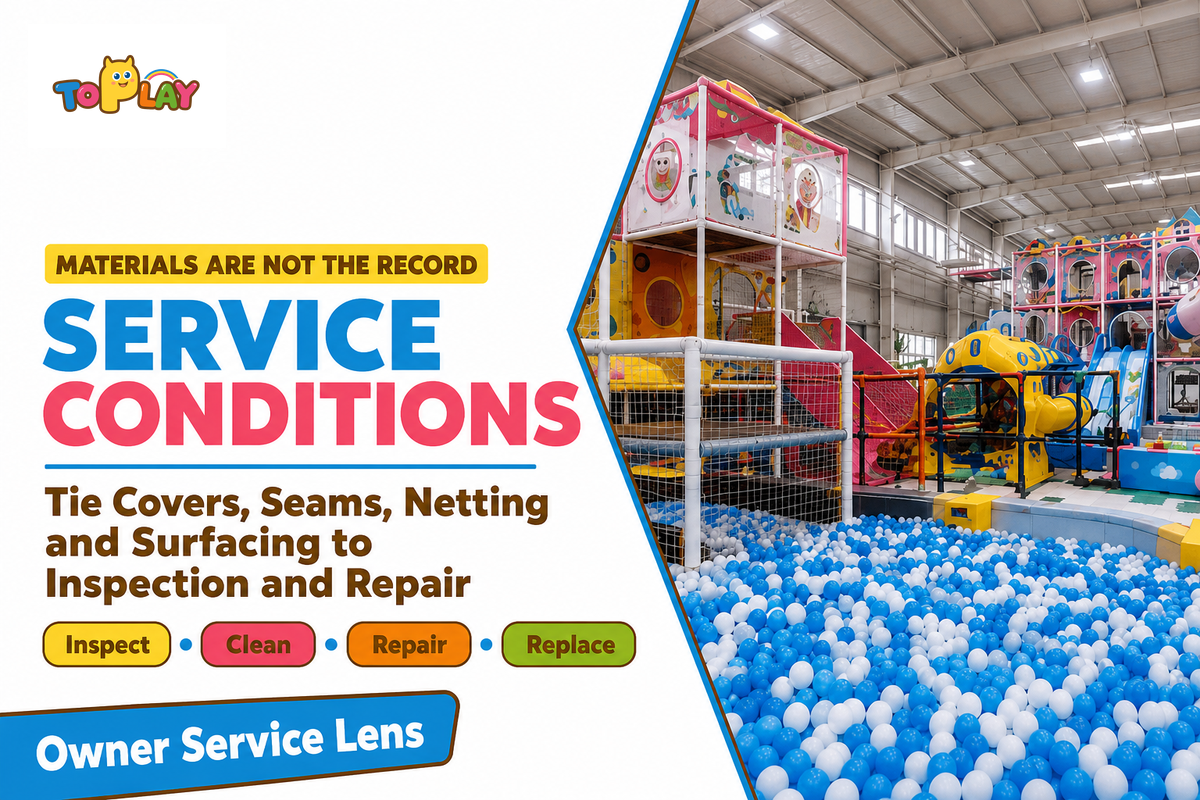
A material name becomes useful when it is connected to exposure, cleanability, seams, wear points, inspection, repair, and replacement. “Soft,” “commercial grade,” or “antimicrobial” on a sales page isn’t a service record and doesn’t certify an installed system.
First, look at a component and identify its function. For foam blocks and low modules, look at what supports the shape, which cover is exposed, whether the cover can be removed, and how its replacement is identified. For netting and webbing, identify attachment points and high-contact zones, then record how a torn section can be isolated. For rigid panels and windows, look at edges, fasteners, scratches and looseness. For floor surfaces, look at joints, transitions, external mats, debris and separated pieces that can create a trip.
Do
- Tie every material to a component and location.
- Record seams, covers, closures, and replaceable parts.
- Keep the approved cleaning method with the item record.
- Define who can release a repaired item.
Don’t
- Infer lifespan from a polymer name.
- Copy a cleaning frequency from an unrelated product.
- Treat soft foam as proof of installed performance.
- Let cheaper suppliers replace evidence with adjectives.
Service questions are only one layer: depending on product classification, the CPSC FAQ may identify lead and phthalate limits, third-party testing, a Children’s Product Certificate, and tracking-label duties. A vendor’s material information sheet and a Product-Law file serve different purposes. Keep both questions open until the exact product and destination are known.
For the routine schedule and log format, follow Toplay’s indoor playground maintenance checklist. This article ends at the information that must exist prior to that maintenance system being implemented.
Use the 5-Rung Evidence-to-Use Decision Ladder
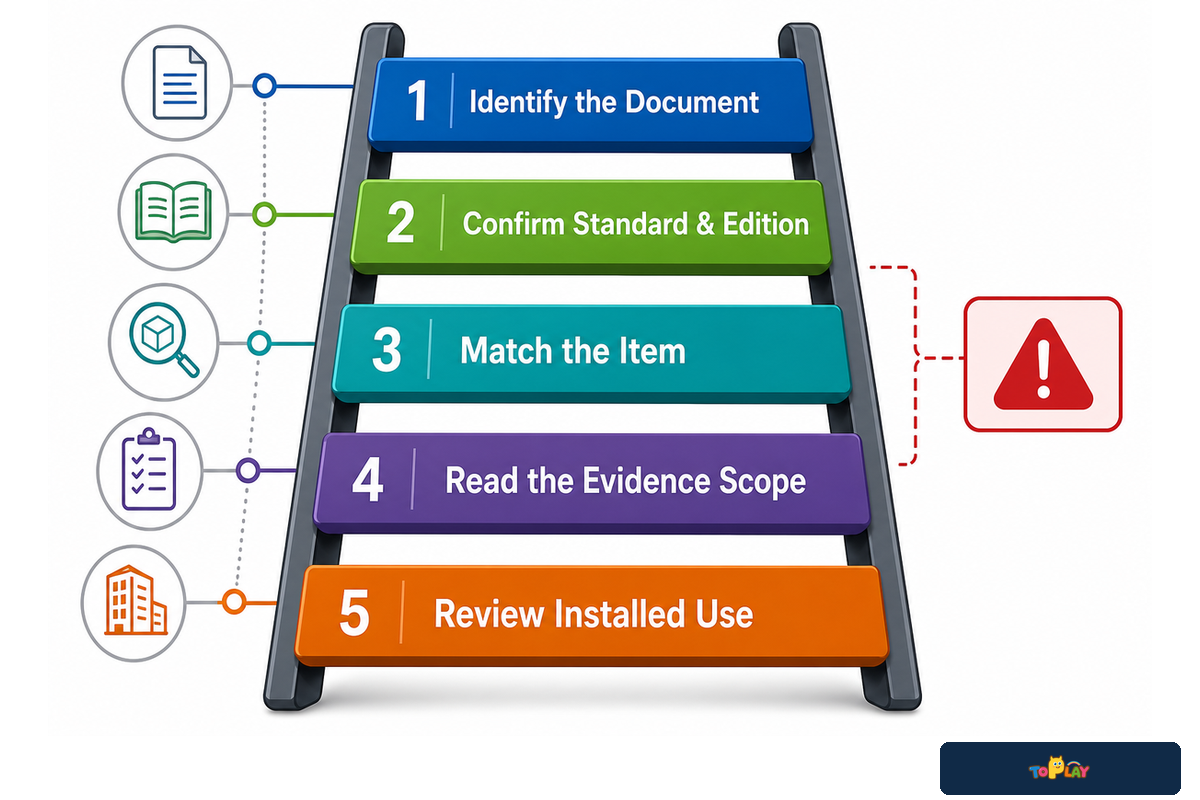
Direct answer: Read every report or certificate using a five-rung ladder: document identity, standard and edition, product or material match, test or certification scope, and destination and installed-use review. If a rung is missing, the document may still be useful, but it isn’t evidence for the claim you want to make.
- Identify the document — record issuer, report number, date, status, and complete pages.
- Confirm the standard and edition — check that the cited scope fits the category and that the edition is acceptable for the project.
- Match the item — connect model, drawing, material, sample, or component to what will be supplied.
- Read the evidence scope — separate manufacturer statements, laboratory reports, third-party certification, accessibility review, and installation records.
- Review installed use — confirm destination, interfaces, deviations, local acceptance, and the owner of any unresolved decision.
ASTM F1918-21 applies to soft-contained play within its stated scope. It does not automatically certify a loose module, a home toy, a playground trampoline, a climbing wall, a giant inflatable water feature, or the entire family entertainment center. The 2025 CPSC handbook makes the same category point from the opposite direction: its general public-playground guidance sends soft-contained systems elsewhere.
A cover page isn’t an as-built match. A report may apply to a test sample, a particular model, one cover material, or a specific configuration. The owner should be able to trace the report to the supplied item and the supplied item to the installed location. If a field substitution breaks that trace, reopen the review before acceptance.
For a more complete discussion across markets, read Toplay’s indoor playground safety standards guide. It owns the standards comparison and this ladder explains how an owner tests evidence relevance.
Review Access and Participation Before Layout Freeze
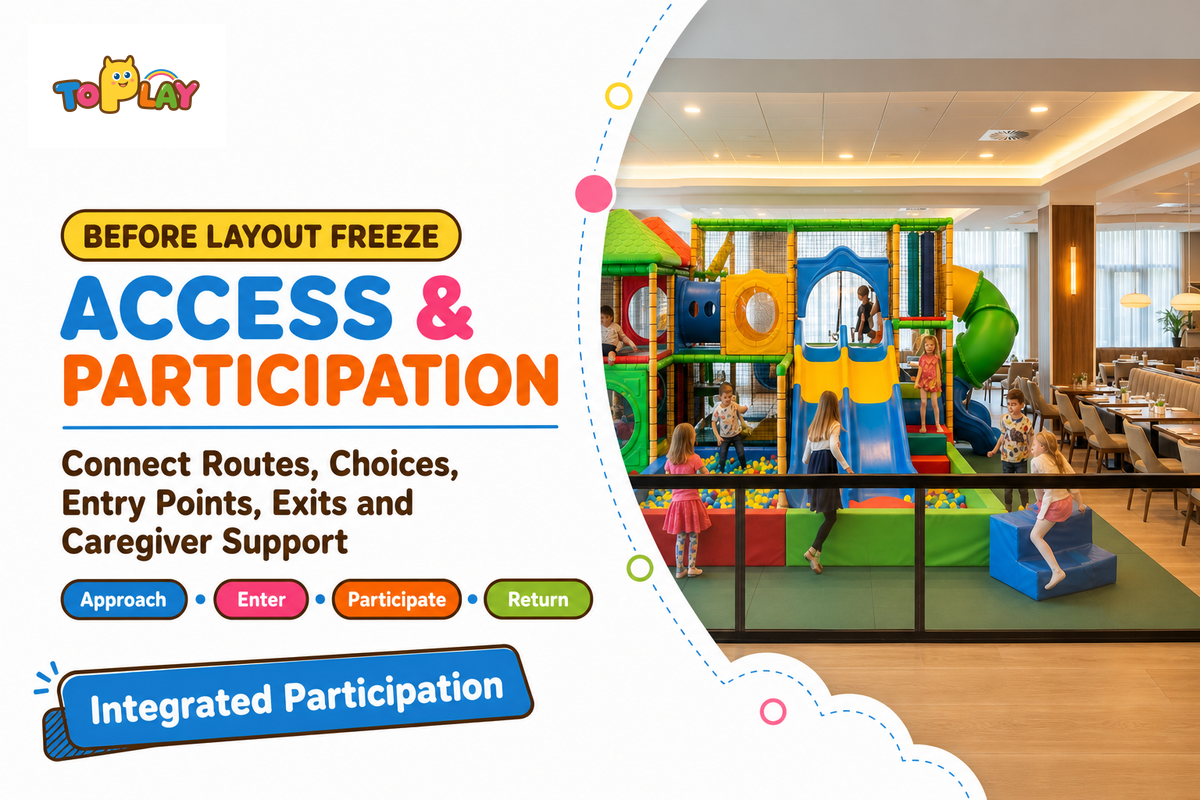
Direct answer: This question asks how children access the play area. Before layout freeze, consider how a person reaches the play area, finds integrated ground-level choices, approaches usable entry or transfer points, leaves the activity, and stays connected to companions and caregivers.
The U.S. Access Board play-area guide includes play areas for children age 2 and older where its scoping applies and discusses soft-contained play structures. It also sets boundaries. The types of facilities, new construction versus alteration, existing-area conditions, exclusions for amusement attractions, phasing, and the project history can affect the analysis. This guide doesn’t make a legal determination for a specific site.
Participation options should be integrated rather than parked at one edge. Would a child be able to access a ground-level play experience? Would an approach remain usable when a space is busy? Does an entry lead to a meaningful experience? Would the return route work without crossing a faster stream? Would caregivers/staff be able to assist as needed?
More information about inclusion can be found in Toplay’s inclusive indoor playground design guide. Concepts like route widths, adjacency, circulation and the development of floor plans are covered in the space-planning guide. The purpose of this submission is to put these inputs on the table for consideration prior to the position of equipment being frozen.
Create an Opening Readiness Record at Handover
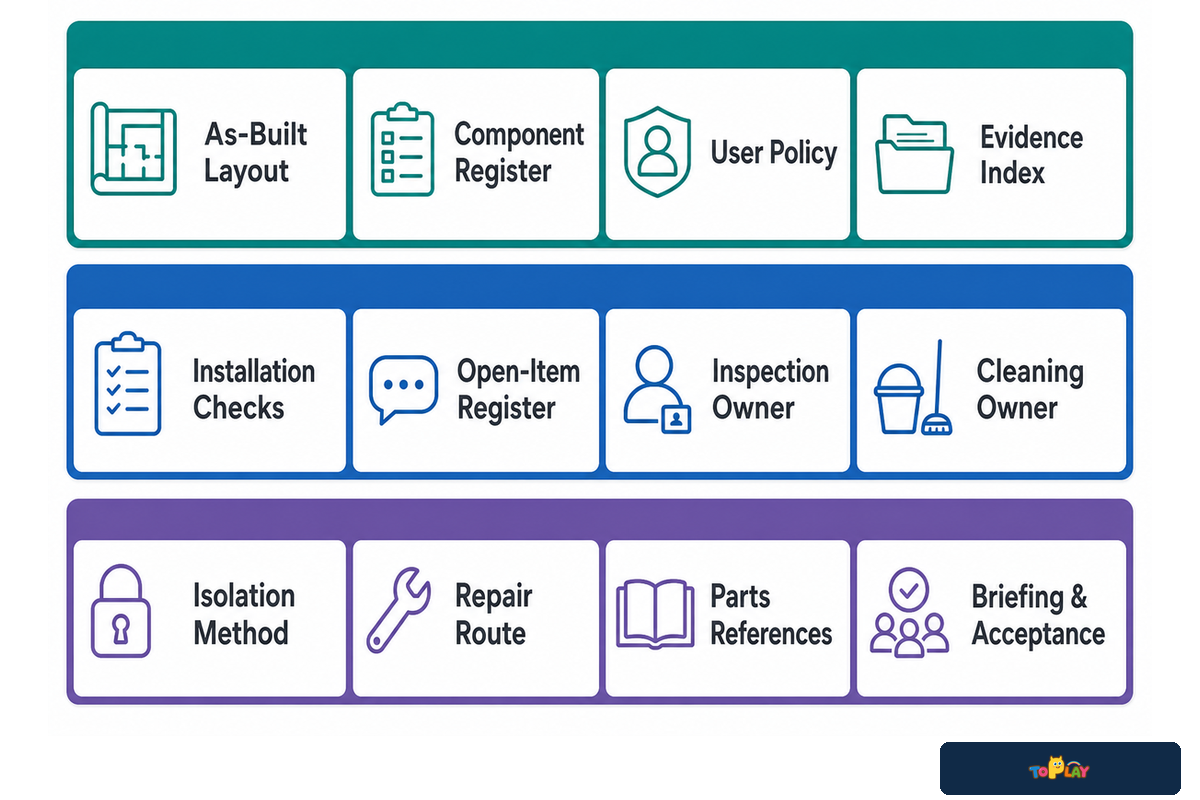
Direct answer: The owner needs one traceable baseline before opening. Delivery photos, invoices, and other similar documents don’t depict what was installed, what evidence was submitted to support each component, who has daily control, what issues are still open, or how an element that’s damaged in service would be isolated and put back in service.
The Opening Readiness Record is an index created by the owner. It doesn’t supersede supplier documents, inspections or authority acceptance. Its purpose is to connect the record items so the operating team can find the right answer after installation.
| Record category | What to record | Owner check | Limitation |
|---|---|---|---|
| As-built layout | Installed zones, routes, exits, interfaces | Matches the physical room | Not a site approval by itself |
| Component register | Model, family, location, identifier | Every item can be found | Must be updated after change |
| User policy | Age or size bands, abilities, supervision | Signs and staff brief agree | Cannot replace judgment |
| Evidence index | Report, certificate, model, scope, edition | Traceable to the item | Cover page alone is weak |
| Installation checks | Recorded observations and closures | No open item is hidden | Scope depends on project |
| Open-item register | Issue, owner, due date, use restriction | Restrictions are visible | No silent acceptance |
| Inspection owner | Role, competence, escalation route | Coverage exists for opening | No universal interval |
| Cleaning owner | Method, products, inaccessible zones | Matches manufacturer instructions | Hygiene claim not implied |
| Isolation method | Barrier, sign, lockout, zone closure | Staff can act immediately | Must suit the actual layout |
| Repair route | Contact, approved method, evidence | Release authority is named | Temporary fixes need control |
| Parts references | Part number, compatible revision, storage | Correct item can be ordered | Substitution reopens review |
| Briefing and acceptance | Staff date, local record, unresolved limits | The baseline has an owner | Not a substitute for authority sign-off |
Toplay’s company page describes its factory and projects. First-hand statements can say who supplies drawings or pre-shipment records, but they can’t confirm acceptance for a particular installation. The project record must contain the project evidence.
Set Inspection and Repair Triggers Before the First Session
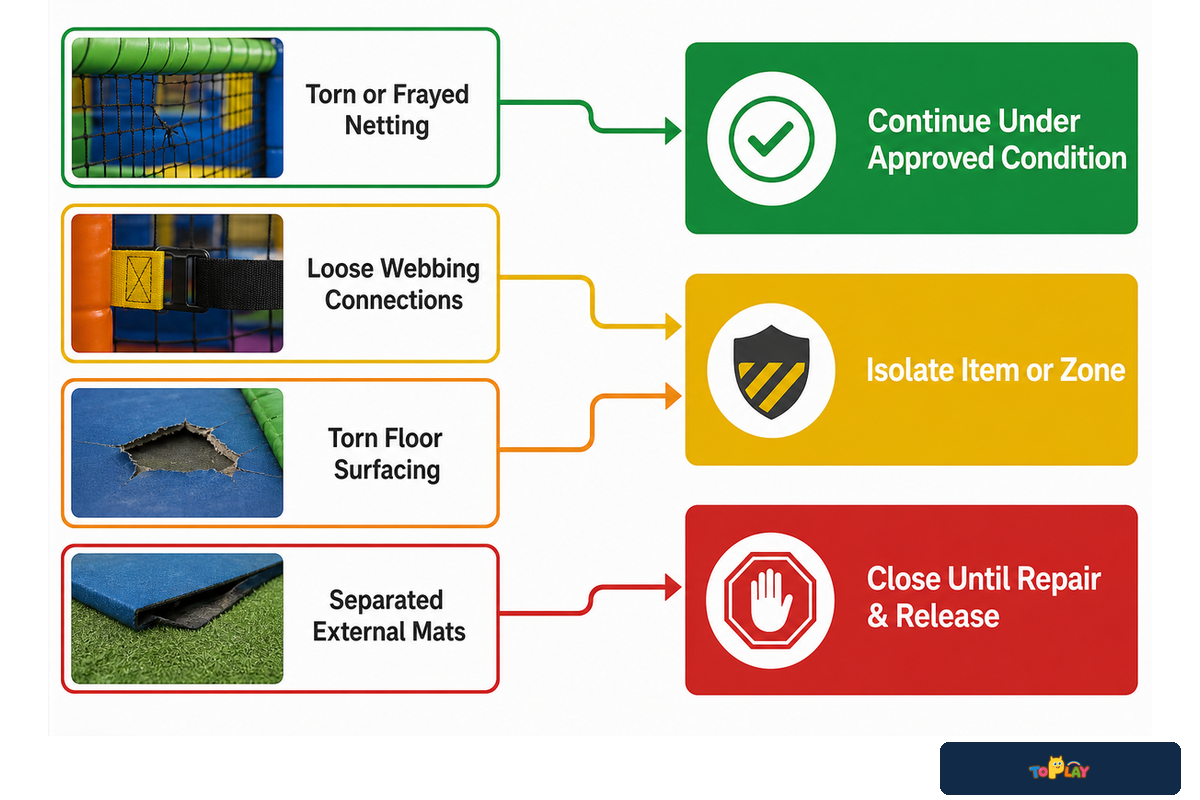
Direct answer: “inspect regularly” is incomplete unless staff knows what finding changes the operating state. State three responses before opening: continue under the approved condition, isolate the affected item or zone for review, and close the zone until repair and release evidence are complete.
The historical CPSC checklist names visible conditions that still make useful prompts, including torn or frayed safety netting, torn rope, loose sewing connections in webbing, torn floor surfacing, separated external mats, dirty equipment, cluttered walkways, and people lingering at slide exits or climbing bases near a ball pit. The source doesn’t supply one universal inspection frequency for every venue.
Action record
- Name the condition and exact location.
- Choose continue, isolate, or close.
- Record temporary controls and owner.
- Attach repair and release evidence.
Weak record
- Write “monitor” without a trigger.
- Leave a damaged route open without review.
- Accept an untracked substitute part.
- Close the note before the item is released.
The schedule should be adjusted to manufacturer instructions, installed construction, user volume, event history, cleaning work, local requirements and findings. A highly utilized children’s indoor play area and a less utilized private room may require different controls. What’s important is the condition of the equipment, not the calendar, that decides if a defect can wait.
Route the Next Decision to the Right Owner
Direct answer: Keep page and project roles focused. This guide owns classification and owner questions. Product pages own configuration and quotation. Specialist articles own standards, maintenance, inclusion, daycare and space planning. Qualified project reviewers own site-specific approval.
| Question | Primary destination | Why |
|---|---|---|
| Models, theme, customize, price, quotation, lead time | Soft play solution page | Commercial and supplier intent |
| Standards across equipment families | Safety standards guide | Scope comparison and evidence detail |
| Inspection schedule and log | Maintenance checklist | Operating record structure |
| Inclusive and sensory planning | Inclusive design guide | Participation choices and project brief |
| Daycare or child-care selection | Daycare equipment guide | Venue-specific user and operating context |
| Floor plan, adjacency, and circulation | Space-planning guide | Detailed layout process |
| Facility acceptance or legal applicability | Qualified local team and authority | Site and jurisdiction facts control |
A top 10 list, an online sale, a soft playground rental page, or a search for the cheapest soft play set may help a buyer discover vocabulary. None can replace a written scope. State the required room and users, then the family, responsibilities, duties, evidence, and acceptance owner, and compare suppliers.
Have a real venue to classify?
Bring the floor plan, clear height, intended user bands, venue type, destination, and unresolved questions. Toplay can use that brief to discuss a project-specific equipment route without turning this guide into a quotation page, and confirm which decisions still need a local reviewer.
Frequently Asked Questions
What is soft play equipment?
Soft play is a broad term for padded play components and contained systems, not one automatic standards category. The right evidence path depends on the exact users, play action, construction, setting, and installed context.
Soft play can include floor-level modules, a toddler zone, a ball pit, crawl elements, a slide, and a contained multi-level system. Nearby trampolines, inflatables, rides, climbing attractions, or toys may follow other routes. Classify the component by users, action, construction, containment, mobility, destination, and installed context before choosing evidence. Record the boundary in the project brief so drawings, reports, installation checks, and operating controls describe the same system.
What soft play equipment is best for toddlers?
Toddler equipment should match movement, ability, exit paths, collision exposure, and available supervision. No universal toddler package fits every venue; the zone must separate slower movement from faster users and preserve clear staff sightlines.
Floor-level crawling, a low climber, short sliding, manipulatives, and clear separation from faster users can be useful directions. No product type is best in every venue. Review the actual component, surface, route, sightline, manufacturer instructions, and local requirements rather than choosing from color, theme, or a “toddler” label alone. Watch where children queue, reverse direction, leave a slide, or meet older users. Keep the supervisor’s view and response path in the same review, and document any ability-based exception instead of assuming all children in one age band move alike.
Which standard applies to soft play equipment?
The applicable route depends on the exact product, users, setting, destination, and installed use. ASTM F1918-21 covers soft-contained play within its scope, while adjacent equipment may follow different standards or rules.
ASTM F1918-21 addresses soft-contained play within its scope. Public playground equipment, toys, trampolines, inflatables, rides, water attractions, accessibility, fire, building, and local requirements can have separate scopes. Match each report to the exact product, edition, test scope, installation, and jurisdiction, then confirm acceptance with qualified reviewers. One room may therefore need more than one evidence route.
How much does commercial soft play cost?
Commercial cost cannot be reduced to one credible range without a defined project scope. Area, height, configuration, theme, freight, installation duties, destination, and evidence requirements must be defined before a like-for-like quotation is possible.
A floor-level module package and a contained multi-level system are different purchases. Area, height, component mix, theme work, materials, destination, freight, installation responsibilities, local work, and evidence needs can all change a quote. Compare supplier replies against the same written brief rather than a generic online range. The comparison should state what is included, excluded, supplied by the venue, and still subject to local review. It should also distinguish equipment price from building work, shipping, installation, inspection, spare parts, and operating preparation. A cheap number without those boundaries cannot support a like-for-like decision.
How often should soft play be inspected?
Inspection frequency should follow the installed system, instructions, use, findings, incidents, and local requirements. The schedule should also change when damage, cleaning work, or user volume alters the operating condition.
Avoid copying one interval from an unrelated product. Opening observations, routine checks, and competent review have different purposes. Define immediate triggers, such as torn containment, loose webbing, damaged surfacing, or a blocked route, that isolate an item until review and release.
How This Guide Was Built
The guide combines current public CPSC, ASTM, and U.S. Access Board sources with Toplay’s live equipment-family pages. It deliberately avoids generic price, lifespan, injury-reduction, capacity, and ROI claims. Project-specific classification, approval, and legal duties remain with the responsible supplier, laboratory, qualified local team, and authority.
References & Sources
- Soft Contained Play Equipment Safety Review U.S. Consumer Product Safety Commission
- Public Playground Safety Handbook 2025 U.S. Consumer Product Safety Commission
- Playground Equipment Classification FAQ U.S. Consumer Product Safety Commission
- Guide to Play Areas U.S. Access Board
- ASTM F1918-21 Public Scope Page ASTM International