Get in touch with Guangzhou Toplay amusement equipment co. Company

By Cherry · Updated October 2026
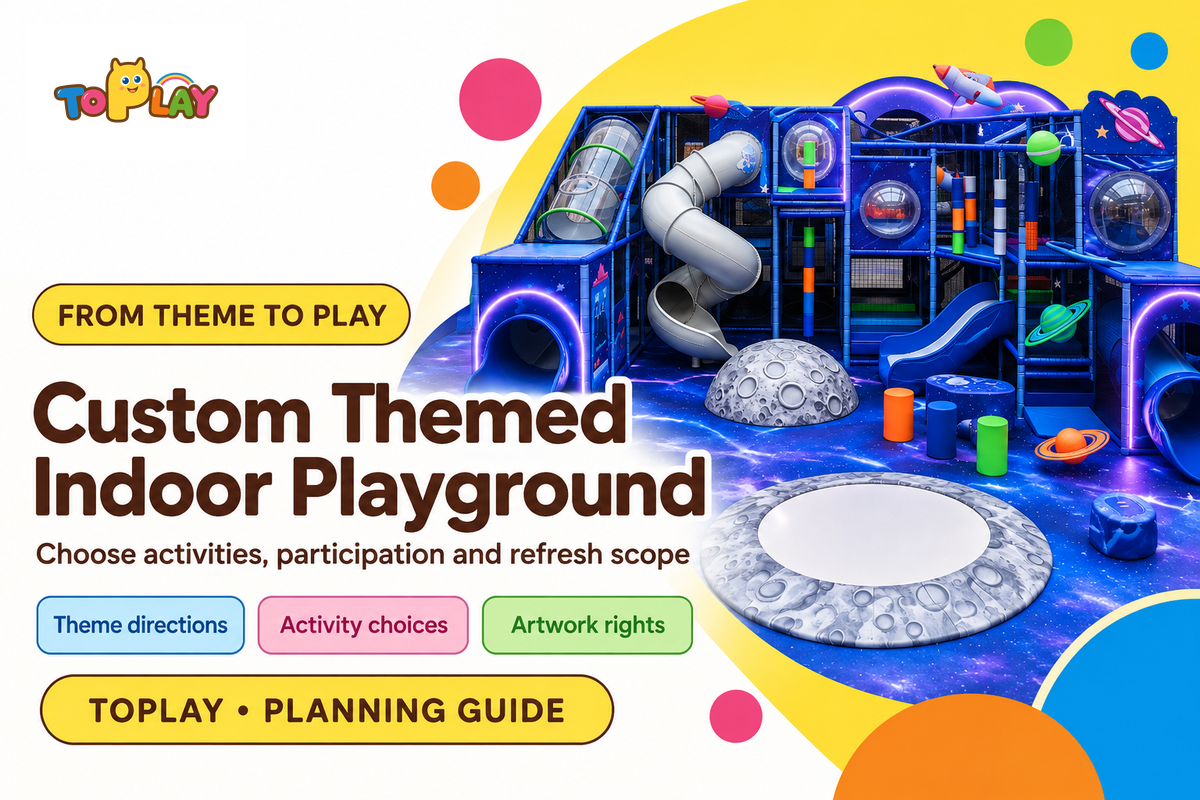
The custom themed indoor playground combines a chosen story with equipment, graphics and activities children can use. Choose play actions first, then shape the setting around them. A theme can use catalogue components; bespoke scenery is one option.
A rocket makes an impressive entrance, but what happens afterwards matters too. Can children send a message, move a pretend cargo load or invent a mission together? This guide helps owners transform their visual ideas into places children can choose to explore; it includes participation options and a plan to keep the theme fresh.
Planning at a glance
- Start with activities: moving, making, pretending and discovering.
- Compare six theme directions by what children can do inside them.
- Separate the story artwork from equipment suitability and physical access.
- Plan the first installation and later refresh as different scopes of work.
What Makes a Custom Theme Part of Play?
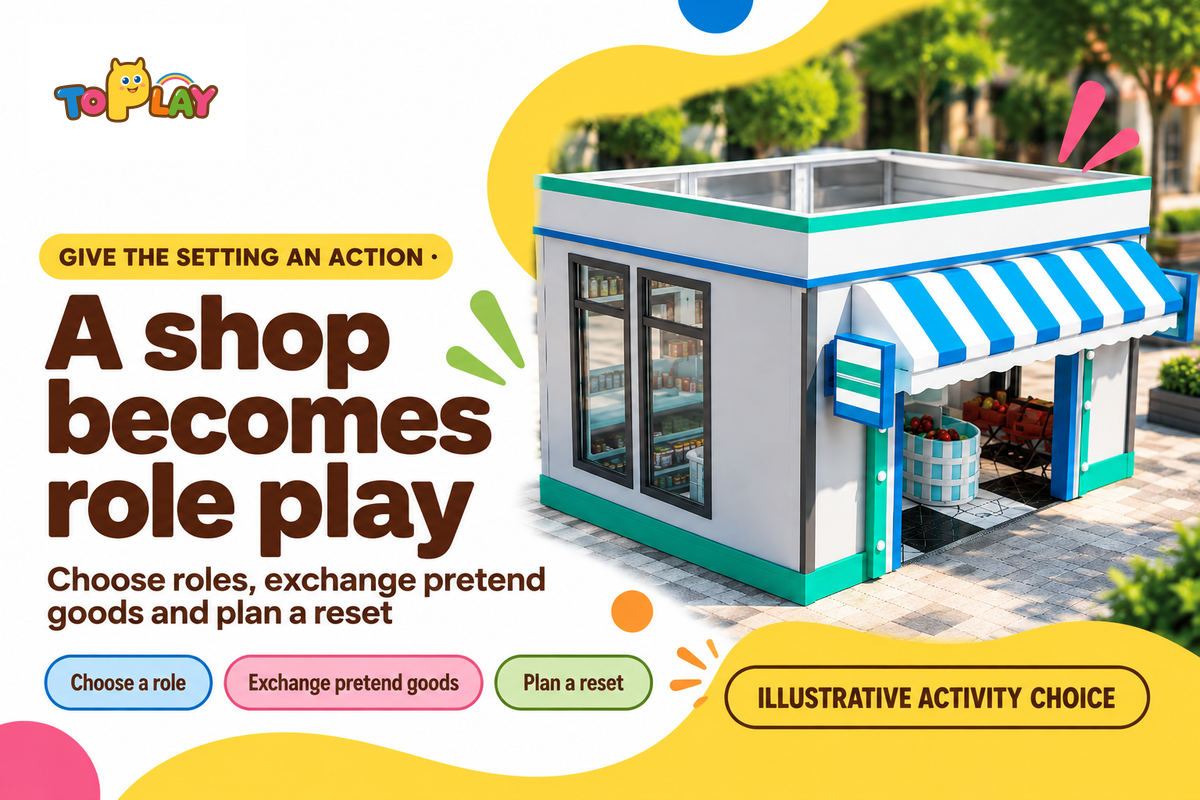
When children can act out a story presented in a custom theme, and change things or make discoveries themselves, it forms part of play. Printed backdrops can help form the setting. Good play components can provide the action. The design has to explain how children understand the story and who helps them act things out.
Pretend the setting is the ocean. For atmosphere, use a blue backdrop; for interaction, provide a makeshift harbor where children sort cargo and help decide its final destination. A climb, tunnel or slide can be part of that story, without everything needing to be newly made. Head Start describes a range of roles for children to choose from. Follow children’s interests and let them choose roles for make-believe play.
“They develop their own play experiences, and it can be different every time.”
Planning adult interaction is central to the concept. In the bakery classroom example from Eastern Connecticut State University, teacher Maureen Ostroff describes presenting the baking activity, helping children take turns to use the tools and providing adult support throughout the week. Children wanted to use the setting; however, the pictures and props didn’t alleviate the need for adult support. A commercial indoor venue has a different operating model. It can offer a simple self-initiating task during open play and save a more elaborate role during a hosted session. Decide which experience the project is promising before purchasing the setting. A play cafe team may demonstrate an order-taking game; a busy admission desk can’t run a continuous performance.
Developmental promises need restraint. A 2025 systematic review of indoor loose-parts play included 25 studies and reported mixed findings, including studies without the expected associations. That review concerns play materials and young children, rather than commercial themed venues. Describe opportunities for imagination and creativity; judge the proposed activities on how children can actually join them.
Six Indoor Playground Themes, Compared by Activity
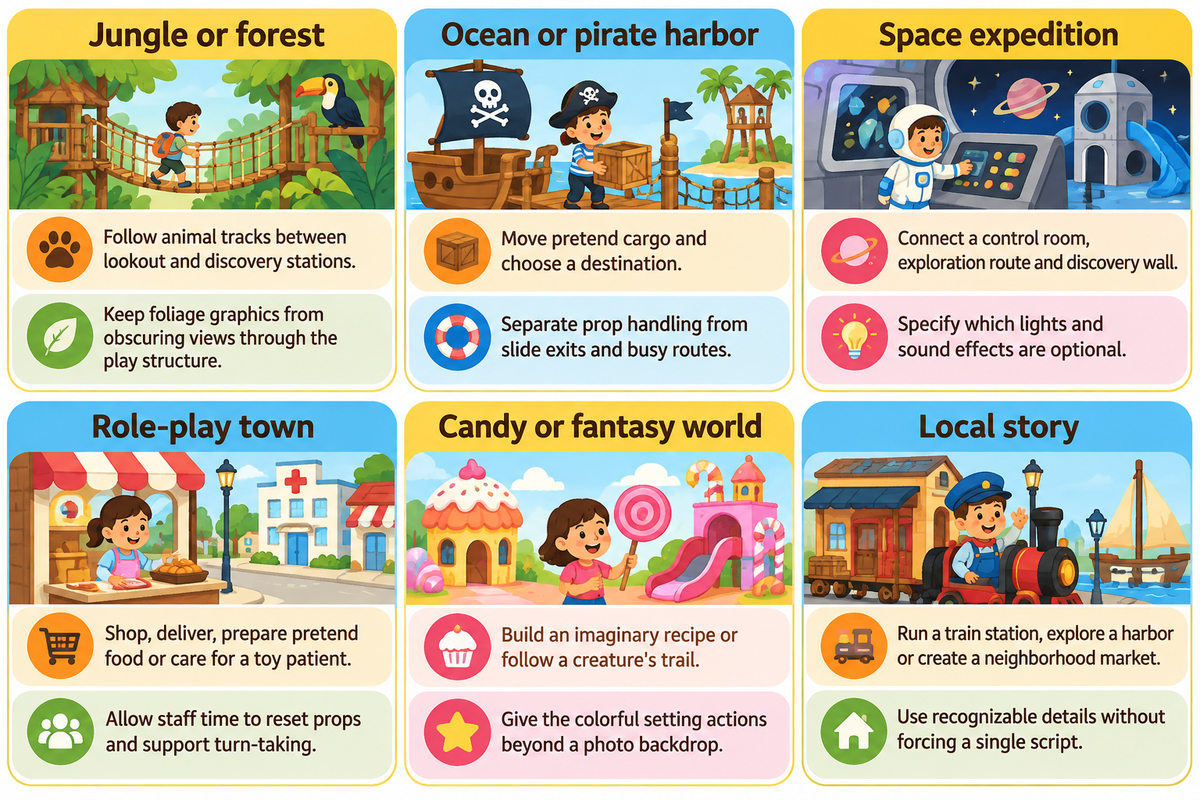
Match your theme to your audience and available space. Jungle, ocean and space settings can each support active or quiet play. A role-play town can work through ordinary routines, while fantasy and local stories offer different visual identities. The comparison that works best is what the setting allows a child to do.
Consider the following starting concepts when comparing activities and staff work before deciding on visual treatment. The practitioner interviews in Recreation Management mention both catalogue themed pieces and locally inspired custom solutions. Neither route needs a story to prescribe every move.
| Theme direction | Playable idea | Quieter participation | Commitment to plan |
|---|---|---|---|
| Jungle or forest | Follow animal tracks between lookout and discovery stations. | Find matching leaves on a low activity panel. | Keep foliage graphics from obscuring views through the play structure. |
| Ocean or pirate harbor | Move pretend cargo and choose a destination. | Sort supplies at a harbor counter. | Separate prop handling from slide exits and busy routes. |
| Space expedition | Connect a control room, exploration route and discovery wall. | Choose a mission using a non-electronic panel. | Specify which lights and sound effects are optional. |
| Role-play town | Shop, deliver, prepare pretend food or care for a toy patient. | Arrange goods alongside another child. | Allow staff time to reset props and support turn-taking. |
| Candy or fantasy world | Build an imaginary recipe or follow a creature’s trail. | Design a pretend shop display. | Give the colorful setting actions beyond a photo backdrop. |
| Local story | Run a train station, explore a harbor or create a neighborhood market. | Match local landmarks or plan a journey. | Use recognizable details without forcing a single script. |
For low-level role play and manageable prop storage, a familiar shop or market can suit an operator of a small cafe. A family entertainment center might take an adventure route and have a discovery station. A jungle theme doesn’t need sand, nor live plants or an outdoor playground surface. An indoor playground might use equipment suited to indoor use within the story of an outdoor place.
A recognizable setting can be used for children if they need to begin with little explanation. Fantasy settings can be used if the activities show the possibilities themselves. A visitor should be able to explore after the Instagram photo, and local families should be able to change the story on another visit.
Turn a Theme into Places Children Can Explore
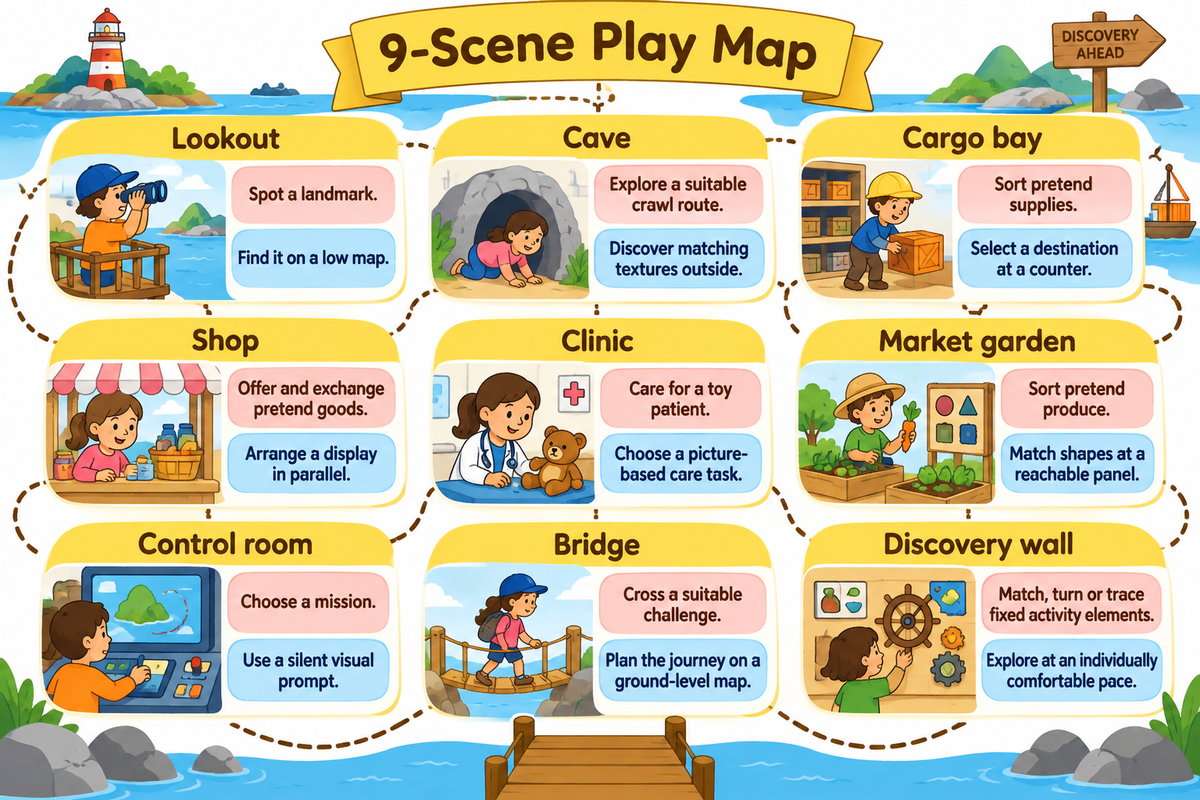
Name the action, alternate ways to participate and the work needed to keep an activity functioning to turn a theme into an activity. Different play spaces can share a story with different actions. Use the map below to discuss a concept with designers and operations staff, and then adapt it to suit the equipment and children it’s intended for.
9-Scene Play Map
The 9-Scene Play Map connects a story location to a child’s action, another way to participate and an operating detail.
This is an editorial planning aid inspired by Head Start’s use of roles, props and adaptations. This has no pass score. Only choose scenes that advance the project. A compact venue need not fit all nine scenes. Other scenes can be adapted for the intended audience. Keep space for children’s curiosity to suggest other destinations.
| Scene | Child action | Another way to join | Next story prompt | Operating detail |
|---|---|---|---|---|
| Lookout | Spot a landmark. | Find it on a low map. | Search for a new destination. | Preserve supervision views. |
| Cave | Explore a suitable crawl route. | Discover matching textures outside. | Find an animal’s trail. | Keep cleaning and staff access available. |
| Cargo bay | Sort pretend supplies. | Select a destination at a counter. | Prepare a different delivery. | Store props away from travel routes. |
| Shop | Offer and exchange pretend goods. | Arrange a display in parallel. | Change the shop’s order. | Plan a simple reset routine. |
| Clinic | Care for a toy patient. | Choose a picture-based care task. | Welcome a new patient. | Select cleanable, age-appropriate props. |
| Market garden | Sort pretend produce. | Match shapes at a reachable panel. | Pack a picnic order. | Track missing or damaged pieces. |
| Control room | Choose a mission. | Use a silent visual prompt. | Plan a rescue or exploration. | Separate optional effects from essential instructions. |
| Bridge | Cross a suitable challenge. | Plan the journey on a ground-level map. | Choose a new route. | Keep story stops out of circulation. |
| Discovery wall | Match, turn or trace fixed activity elements. | Explore at an individually comfortable pace. | Find a new pattern. | Keep approved service points reachable. |
Imagine a space-themed center that’s very busy with a popular slide and a crowded entrance to the next obstacle. Adding a “collect the moon rock” stop to the slide landing puts an activity where children need to move through. Instead, place the collection activity at a separate suitable station, and allow the mission to continue from there. A child who doesn’t want to climb can choose the destination at mission control. Staff can discuss the activity and determine whether the child understands its instructions. The activity connects the steps, while the actual route remains clear. The U.S. Consumer Product Safety Commission’s soft-contained play checklist specifically mentions “slide exits” and advises against lingering.
Offer Choices in Noise, Light and Social Play
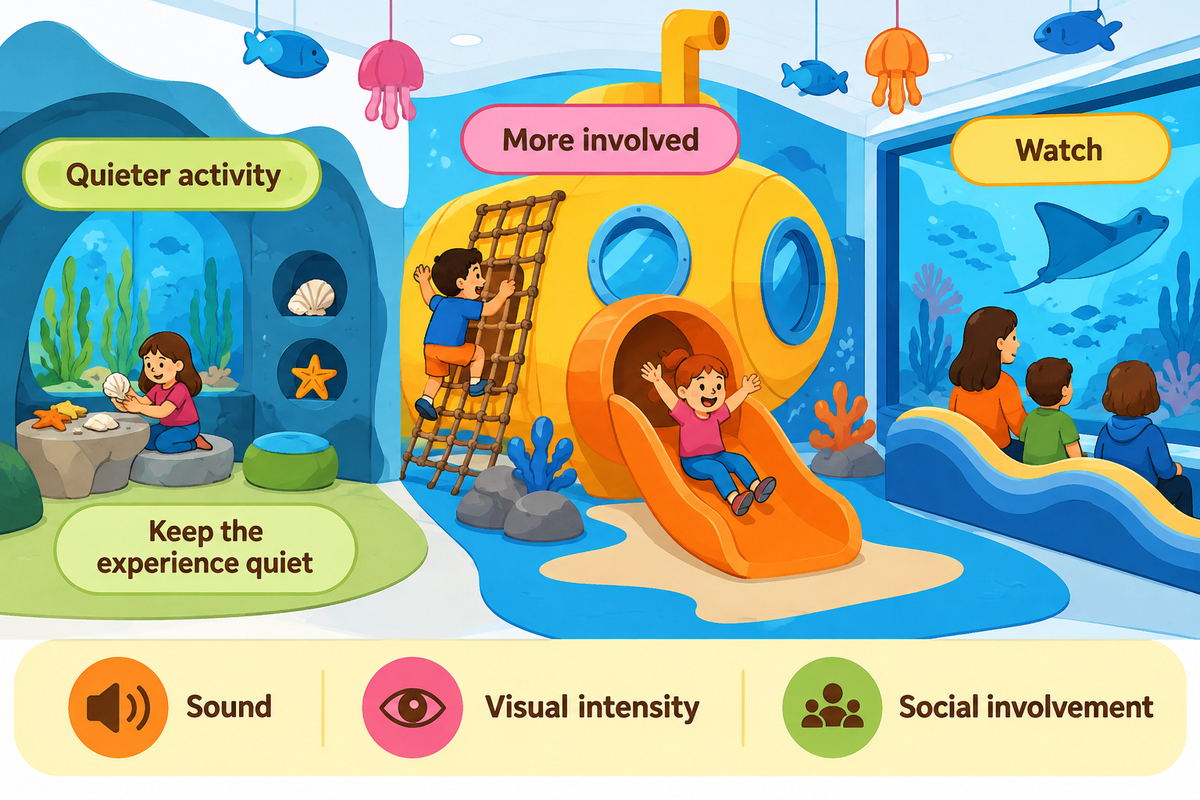
Offer ways to participate at differing levels of sound, visual intensity and social involvement within the same theme. Children should be able to watch, choose to join a quieter activity or be more involved. Children need ways to enter and join the activities at the setting.
A space environment can have a bright control panel without continuous flashing effects. An ocean environment can use visual waves without constant wave audio. In her historical critique of a themed outdoor playground, inclusive-play practitioner Mara Kaplan explains why music beside a quiet retreat defeats its purpose. The practical design question is where sound travels and what choice remains when a child wants less of it.
How would that approach work with a ball pit, musical wall and cafe seating? Use a quiet activity where the experience can remain quiet. Staff must still be able to supervise and reach the children. The detailed work on adjacency and routing belongs in the indoor playground space planning guide.
Equipment and access note
For covered U.S. soft-contained play structures, section 206.2.17.2 of the 2010 ADA Standards calls for at least one entry on an accessible route when three or fewer entries are provided, and at least two when four or more are provided. Those are access-entry requirements, not emergency-exit counts or proof that every activity can be used. Resolve the specific project’s routes and components with its design team.
How to set up a play area for toddlers?
Set up a toddler area around the children’s abilities, the equipment’s stated use and an operating plan to keep larger children from taking it over. Make sure there are low-level activities and a clear view for accompanying adults. The theme can be consistent with the rest of the venue and not require toddlers to use the same play structure.
The Consumer Product Safety Commission checklist states to follow use and size recommendations and keep older, larger children out of the toddler area. A safe environment depends on suitable equipment and staff to maintain the boundary during play. A shared jungle story might offer a track-matching panel with a suitable play area, and a separate adventure climbing wall for other users.
Original Characters, Licensed Worlds or Changeable Graphics?
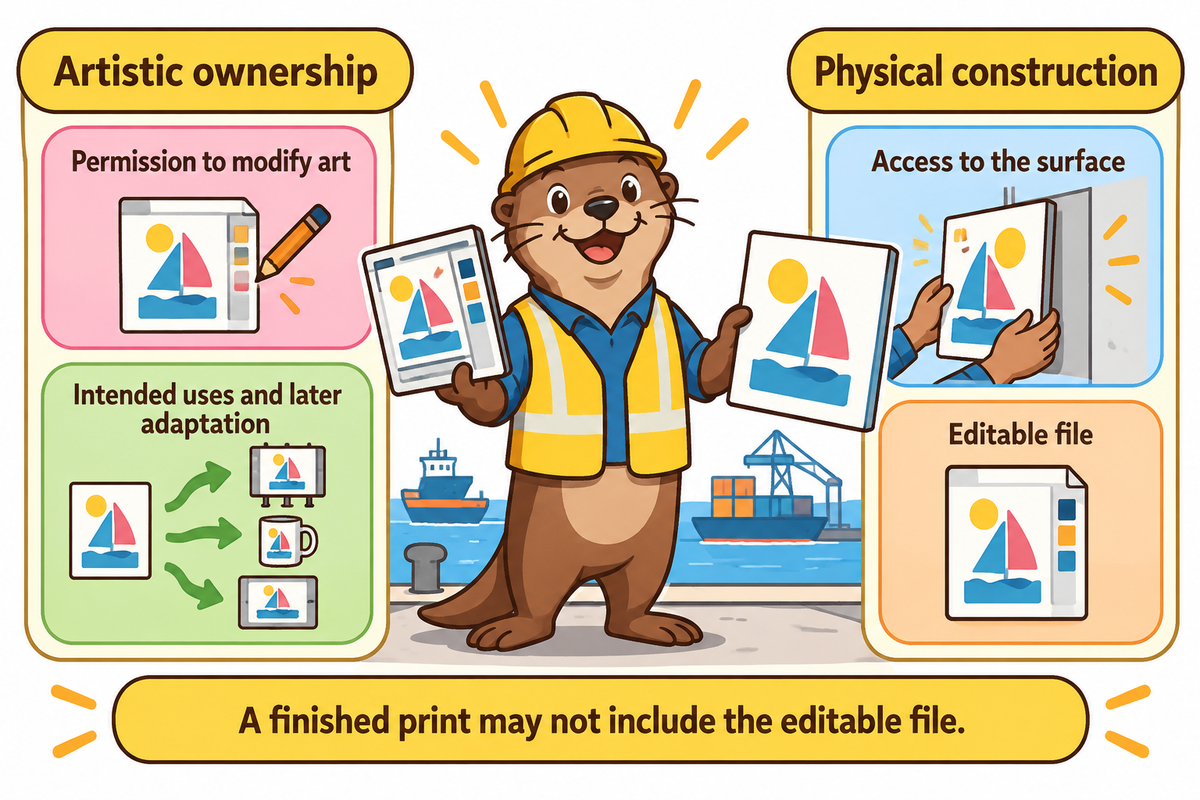
Choose the type of artwork based on the identity you want to portray and the rights you’re able to acquire. Then make a decision on how that artwork will be applied and replaced. Characters can be displayed on removable surfaces, and licensed images can be built into surfaces. Artistic ownership and physical construction are separate decisions.
For U.S. works, hiring an illustrator doesn’t necessarily mean ownership of the illustration. The U.S. Copyright Office’s guidance for visual artists states that, generally, the person who created the work is the owner of the copyright in the work. A limited exception to this general rule exists for works made for hire. Document the assignment or permission for the intended uses of the work, including later adaptation. Using copyrighted cartoon characters requires the acquisition of the necessary rights along with the production agreement.
Original story world
- Develop characters and places around the venue.
- Agree who owns the artwork and what each party may use.
- Include rights for replacement graphics and future changes.
Licensed story world
- Build around an existing character or property.
- Agree the permitted locations, uses and approval process.
- Resolve refreshes and replacement artwork within that permission.
Let’s suppose the owner selects an original harbor mascot. The launch artwork shows the mascot delivering fruit. A later Halloween event changes the cargo and prompts the story. The owner needs permission to modify the art and practical access to the surface carrying it. Paying for a finished print may not give the owner the editable file. Address these during the development of the brand-to-theme design brief.
Should indoor playground equipment play cartoons for kids?
Cartoons aren’t essential. Physical activities and child-led stories can be integrated into the program through a themed indoor play area. Make a deliberate decision regarding purpose, sound controls, content permissions and placement in program design. A display should support the chosen activity while leaving children a meaningful way to play without watching it.
What Changes the Cost of a Custom Theme?
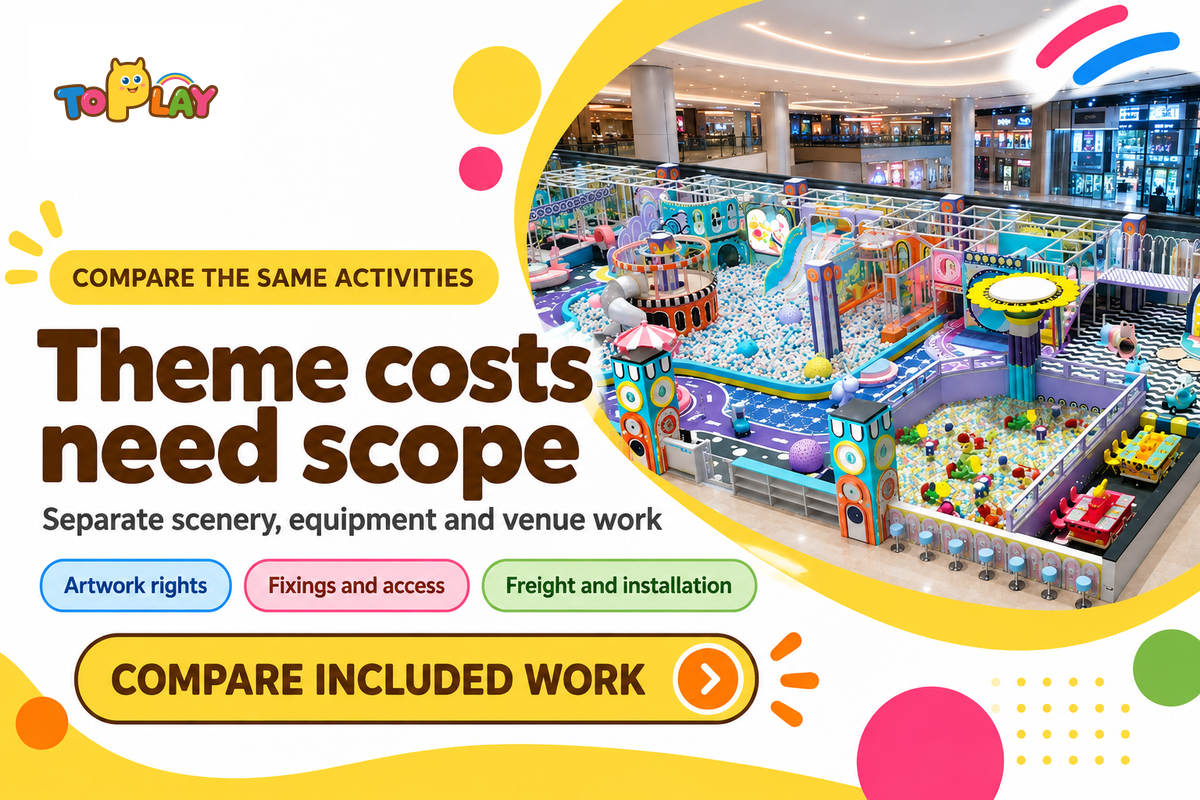
The price for a custom theme depends on what’s fabricated, how it’s attached, the rights to the artwork, and the labor required onsite. Separate those items from the play equipment and the whole-venue opening budget. Comparing the same activities with varying scenic treatments is more informative than evaluating each advertised package as if it were of equivalent worth.
A real scope example shows the distinction. The Texas registration for HyperKidz Fort Worth, filed November 2025, lists an estimated $1,500,000 for 17,093 square feet. Its description includes an existing commercial shell’s interior buildout with themed play zones, a cafe, party rooms, restrooms and amenities. That figure describes a particular project’s declared scope. It’s neither a theme-only price nor a final audited cost. An equipment quote could leave a large portion of the other work outside of its scope. Before comparing proposals, make their boundaries visible: the same picture can hide very different responsibilities for the room around the equipment.
For an even comparison, keep equipment layout and intended activities the same. Compare graphically depicted settings with more sculpted settings. Compare freight, fabrication, fixings and installation as separate line items. Owners can assess whether additional graphic detail is warranted, without assuming the introduction of additional playable activities.
| Work item | Filled example | Hidden constraint | Decision owner |
|---|---|---|---|
| Story artwork | Original harbor characters and signs. | Future adaptation and promotional-use rights. | Owner and procurement. |
| Theme fabrication | Printed panels versus shaped boat scenery. | Access to covered equipment and fasteners. | Designer and maintenance lead. |
| Play equipment | The selected structure and activity units. | Actual user suitability and required room space. | Procurement and design team. |
| Venue work | Floor, building services and cafe fitout. | Responsibility outside equipment supply. | Owner and finance. |
| Ongoing operation | Props, cleaning and replacement surfaces. | Staff work and access during a refresh. | Operations and finance. |
An effective comparison of pricing needs the scope and exclusions beside each factory quotation. A durable finish requires a maintainable design; the label “high-quality” can’t communicate how a damaged graphic or padded pipe covering will be serviced.
Who Turns the Concept into Equipment?
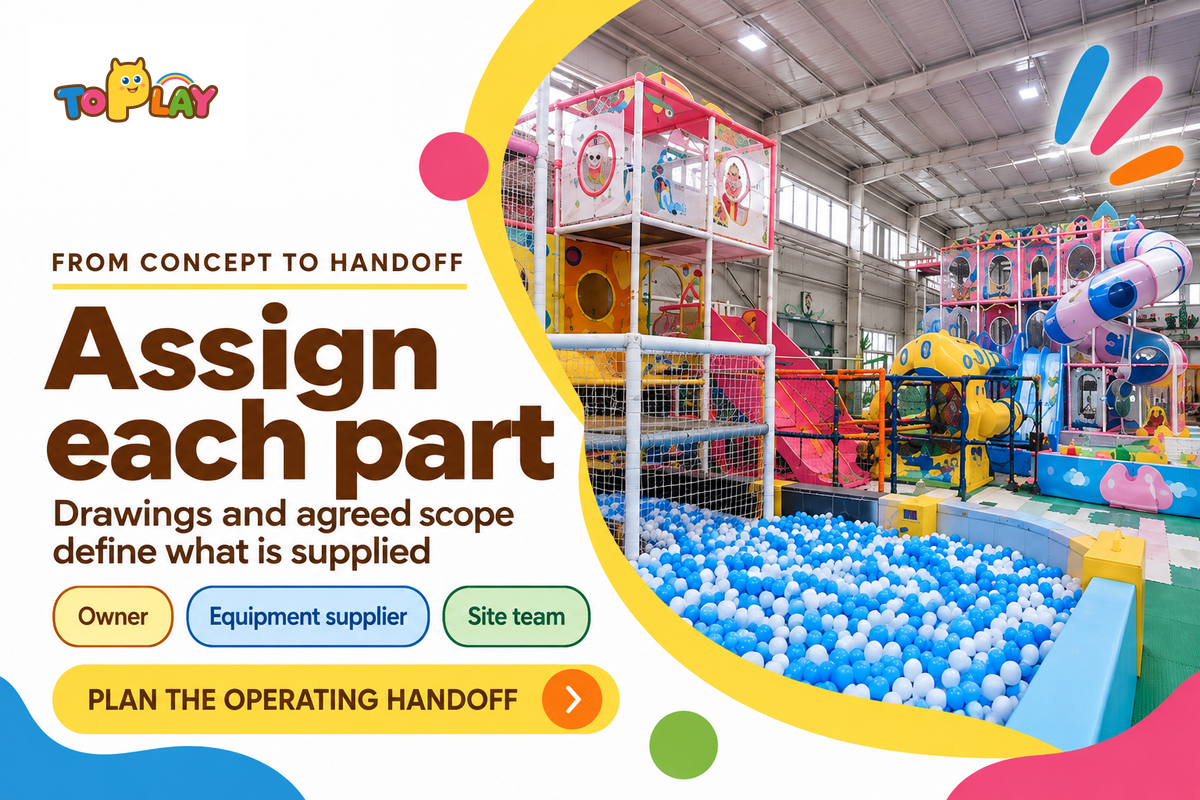
Equipment suppliers, site personnel and owners each turn different aspects of the concept into a working facility. Assign responsibility for the story, physical equipment, building interfaces and operations before manufacture. A theme rendering depicts appearance. Approved drawings and the agreed scope of supply define what will be manufactured and installed.
The custom themed indoor playground equipment page by Toplay provides info on custom themes, graphics, façades and role-play settings. Use that page for the equipment discussion when the intended play activities are clear. For a larger supplier search, the current manufacturer comparison covers that separate decision.
To check the ongoing condition of equipment, the Consumer Product Safety Commission’s equipment checks cover netting, surfacing, clear walkways and webbing.
Keep the Theme Useful When the First Look Wears Off
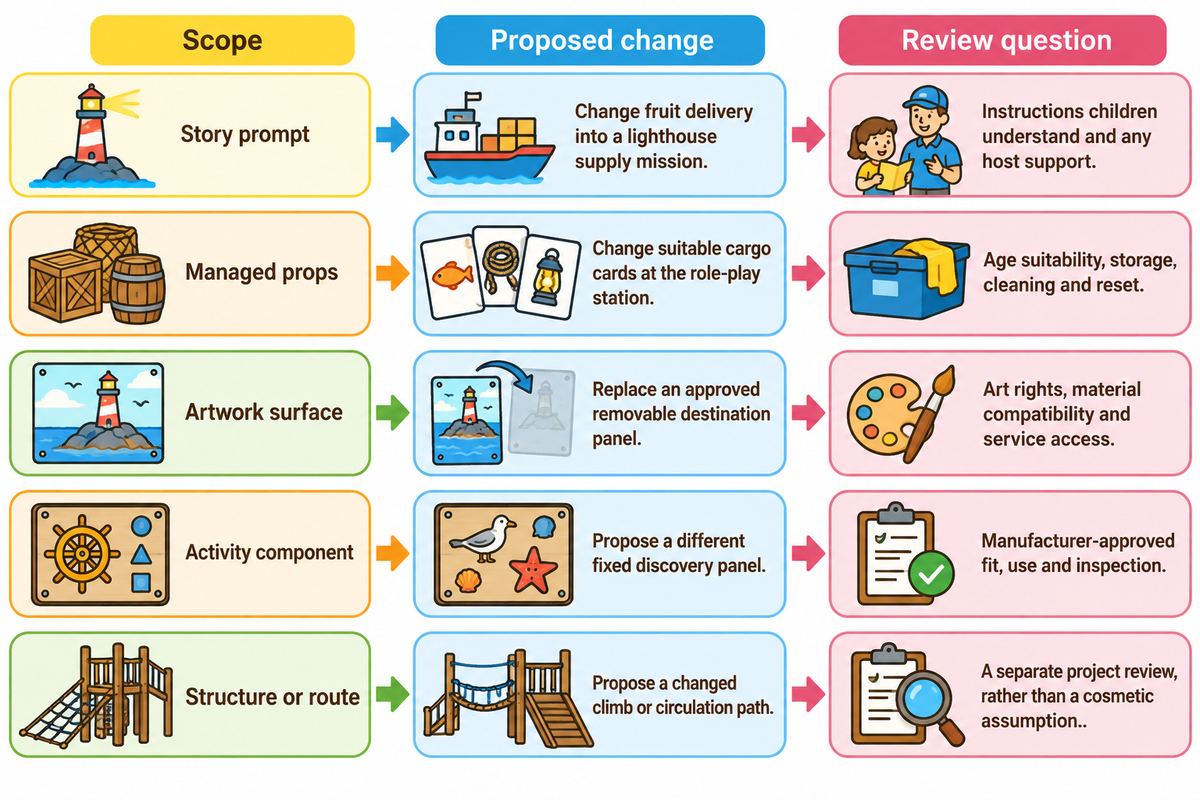
Keep the theme useful at the current venue by changing prompts and activities at a level the venue can support. New prompts, props or approved graphic replacements can create a different experience without assuming the structure must change. Physical changes need their own design and maintenance review. Refreshing the looks of equipment doesn’t repair broken equipment.
Separate the different layers of theme before choosing a treatment. A feature that’s shaped permanently may represent the identity of the program, and changing that feature may not be essential. The Consumer Product Safety Commission checklist identifies equipment that shows tears, fraying and other signs of wear; keep those inspection points available when adding scenery. The detailed routine is in the indoor playground maintenance checklist.
| Layer | Filled refresh example | Work to resolve |
|---|---|---|
| Story prompt | Change fruit delivery into a lighthouse supply mission. | Instructions children understand and any host support. |
| Managed props | Change suitable cargo cards at the role-play station. | Age suitability, storage, cleaning and reset. |
| Artwork surface | Replace an approved removable destination panel. | Art rights, material compatibility and service access. |
| Activity component | Propose a different fixed discovery panel. | Manufacturer-approved fit, use and inspection. |
| Structure or route | Propose a changed climb or circulation path. | A separate project review, rather than a cosmetic assumption. |
Picture the equipment of the harbor game as suitable. The operations manager wants a new challenge, the finance manager wants to see the numbers, and the maintenance manager wants access to the existing connections. A lighthouse mission might begin with revised prompts and approved graphics. Other elements like an electronic panel would raise questions about installation, service and cleaning. Those scopes could be compared to determine a treatment before changing the structure of the harbor. A similar situation arises with all of the possible alternative treatments. If the artwork cannot be adapted or the panel cannot be removed as intended, the apparently simple option changes. Refresh should always be considered as part of the original treatment.
Materials are important to this discussion. The early-care cleaning guidance from the CDC mentions surface-appropriate cleaning products and manufacturer’s instructions. The CDC’s guidance concerns early-care settings, whose operation differs from a commercial amusement venue, but the comparison is useful to ask: can staff clean the new surface according to the method described? Make sure to follow the instructions of equipment and products used; don’t assume that a new fabric or print will allow you to use your old cleaning methods.
Key takeaway
Build the story around activities children can choose, then keep the artwork, equipment and operating work clear enough to adapt the experience later.
Frequently Asked Questions
What is indoor playground equipment?
Indoor playground equipment is the physical equipment provided for play inside a building, selected for its intended users and setting.
The category can include contained structures, slides, fixed activity panels and suitable soft play pieces. A trampoline is a different equipment choice from a pretend shop, even when both share the same theme. Compare the activities and use conditions first. The equipment types guide helps separate those families before choosing their appearance.
How do you choose indoor playground equipment?
Choose indoor playground equipment around the intended children, activities, room and operating responsibilities before selecting its theme treatment.
Describe who will use each play area and what a child can do there. Then establish the building constraints, supervision arrangement, maintenance access and project requirements with the design team. Compare proposals using the same activity brief. A rendering can excite the owner, but the purchasing decision also needs the actual supply scope, drawings and instructions.
Are indoor playgrounds worth it?
An indoor playground is worth pursuing when its local demand, operating plan and costs support the owner’s objectives.
A theme alone cannot establish profitability. Test the proposed admission, parties or membership offer against the audience you can serve, then consider staffing, premises and ongoing upkeep. Food and drinks may be part of a cafe model, with their own operating work. Use the business plan and budget guide for that wider decision.
What age range can use a themed indoor playground?
The usable age range depends on the actual equipment and operating rules, rather than the theme name.
An ocean story can include different activities for different children. Follow the selected components’ use and size recommendations, and plan how the venue maintains those boundaries. A shared visual theme does not make every component suitable for everyone.
Can a custom theme use catalogue play components?
A custom indoor playground can combine catalogue play components with project-specific graphics, scenery and activities.
A familiar route can become a forest expedition through its setting and prompts. The supplier still needs to resolve how the chosen components and added theme elements work together in the complete installation. Scenery must preserve the required routes and access. Decide which elements need an original form and which can use an existing design. This lets the owner compare the actual custom work instead of assuming that every slide or tunnel needs to be newly invented.
Can a playground be rethemed without replacing every structure?
A refresh can target selected story elements when the existing equipment and proposed changes permit it.
Start with prompts, managed props or approved replaceable artwork. Confirm the physical fit, cleaning method and rights for the proposed change. Structural changes and damaged equipment need their own response; a new graphic does not solve them.
What should be settled before themed equipment is installed?
Settle the approved design, site responsibilities, artwork permissions and operating handoff before installation.
Identify who supplies the play equipment, theme fabrication, flooring and building work, and who accepts each stage. Confirm the relevant project requirements through the design team and local approval process. Provide the artwork needed for the agreed uses, then plan training and documentation for the people who will operate the space. Keep loose props in their designated activities rather than carrying them into obstacle courses or slide routes. The handoff should leave the operator with usable instructions and a clear route for service questions.
Bring your preferred setting, audience and a few activities from the map to the next design conversation. Toplay can talk about the themed equipment mentioned on the solution page. Discuss your themed play concept
Written by Cherry for Toplay. The activity maps and harbor examples are illustrative planning aids. Equipment selection and project needs depend on the venue, users and agreed design.
Related Articles
References & Sources
- It’s Make-believable Head Start.
- Catch the Imagination Emily Tipping, Recreation Management, March 2023.
- The Bakery: Supporting Children to Succeed in the Dramatic Play Center Eastern Connecticut State University.
- The Relationship Between Children’s Indoor Loose Parts Play and Cognitive Development: A Systematic Review Cankaya, Martin and Haugen, 2025.
- Soft Contained Play Equipment Safety Checklist U.S. Consumer Product Safety Commission.
- Inclusive Design of the Past Falls Short Today Mara Kaplan, Playground Professionals.
- 2010 ADA Standards, section 206.2.17.2 U.S. Access Board.
- What Visual and Graphic Artists Should Know about Copyright U.S. Copyright Office.
- HyperKidz Fort Worth project TABS2026005913 Texas Department of Licensing and Regulation, registration November 2025.
- How To Clean and Disinfect Early Care and Education Settings Centers for Disease Control and Prevention, April 2024.